
Specs are compiled from manufacturer listings and verified buyer reviews and can change over time — please confirm the key details on the product page before buying.
If you brew coffee every morning, you know the pile of damp grounds adds up fast. Tossing them in the trash invites smells and fruit flies, but a dedicated bin on your counter changes that routine entirely. The right one traps odors, fits beside your brewer, and makes moving those nutrient-rich grounds to your garden or compost pile clean and simple.
I’m Rikta — the founder and writer behind Lawn Gear Lab. This guide is built by comparing the manufacturers’ published specifications and the patterns across verified customer reviews, so you get each pick’s real strengths and trade-offs instead of marketing spin.
Whether you produce a few scoops a day or a full pot’s worth, finding a reliable container is key. This breakdown of the coffee compost bin options focuses on capacity, odor control, and how each bin handles the daily grind of grounds, filters, and cleanup.
Quick Picks
- EPICA Countertop Compost Bin — Best Overall
- Blue Ginkgo Kitchen Compost Bin — Filter-Free
- Full Circle Fresh Air Kitchen Compost Bin — Largest Capacity
- KAZAI. Compost Bin Kitchen ‘Elin’ — Compact Premium
- Perfnique Kitchen Compost Bin — Stylish Mid-Range
- KIBAGA Beautiful Kitchen Compost Bin — Solid Value
- Minky Homecare Kitchen Compost Bin — Budget-Friendly
How To Choose The Best Coffee Compost Bin
Picking the right bin for your coffee grounds starts with a few simple questions. You want something that keeps smells locked in, sits comfortably on your counter, and isn’t a hassle to dump every few days. The main things to think about are the material, the odor-blocking method, and the size.
Capacity: Matching your coffee habit
A 0.9-gallon bin can hold roughly a few days’ worth of grounds and kitchen scraps for a couple of people. If you brew multiple pots daily or cook for a larger family, a 1.3 or 1.5-gallon bin gives you enough room so you aren’t running outside every other day. A bin that’s too small for your volume fills up fast and forces you to empty it constantly, while one that is too large might sit too long and start to decompose inside.
Material: Stainless steel vs. plastic vs. powder-coated steel
Stainless steel bins are tough, resist rust, and look sleek on a counter, but they can dent and cost more. Plastic bins are lightweight and quiet to use, though some cheaper plastic may absorb odors over time. Powder-coated carbon steel offers a durable finish that resists rust, but it is heavier and can chip if dropped. Each material also affects how easy the bin is to clean, with smooth non-porous surfaces being the simplest to wipe down.
Odor control: Filters vs. airtight seals
Most bins use a charcoal filter in the lid to absorb smells while letting a little air circulate. These filters work well for about four to six months before needing a replacement. Other bins rely on a tight silicone or rubber gasket to create an airtight seal, which keeps smells inside without needing any filters at all. The filter approach is great for a bit of airflow, while a gasket seal is simpler and costs nothing to maintain.
Quick Comparison
| Model | Best For | Capacity | Dimensions (L x W x H) | Material | Amazon |
|---|---|---|---|---|---|
| EPICA | Best Overall | 1.3 gallons | 7.16″ x 7.16″ x 11″ | Stainless Steel | Amazon |
| Blue Ginkgo | Filter-Free Pick | 1.32 gallons | 7.87″ x 9.31″ x 8.62″ | Polypropylene Plastic | Amazon |
| Full Circle | Largest Capacity | 1.5 gallons | 9.45″ x 8.86″ x 8.3″ | Recycled Plastic | Amazon |
| KAZAI. | Compact & Premium | 1.2 gallons | 9.9″ x 7.2″ x 6.5″ | ABS, Bamboo | Amazon |
| Perfnique | Stylish Mid-Range | 1.3 gallons | 7.5″ x 9.9″ x 7.9″ | Metal, Plastic | Amazon |
| KIBAGA | Solid Value Pick | 1.1 gallons | 7″ x 7″ x 10.2″ | Powder-coated Carbon Steel | Amazon |
| Minky Homecare | Budget-Friendly Entry | 0.9 gallons | 7″ x 7″ x 7″ | ABS Plastic | Amazon |
In‑Depth Reviews
1. EPICA Countertop Compost Bin

The stainless steel standard that set the bar for odor-free countertop composting.
This is the bin you will see recommended most often for a reason. The EPICA holds 1.3 gallons, which gives you enough room for about a week’s worth of coffee grounds and food scraps without hogging counter space at 7.16 inches wide and 11 inches tall. The high-grade stainless steel build resists rust and scratches, so it handles daily use without looking worn. A replaceable activated-charcoal filter sits in the lid to naturally block smells, and buyers report that with proper handling, the filter lasts over six months before needing a swap.
The one-piece molded design means there are no welds or seams to trap moisture or leak — a clear advantage over bins made from multiple joined parts that can fail over time. Compared to the Minky’s 0.9-gallon capacity, the EPICA holds 1.3 gallons, which means fewer trips to the outdoor pile for anyone who cooks regularly. Reviewers consistently note it looks good on the counter, contains any odors, and is easy to clean, though a few mention the air holes in the lid can let a faint smell escape if the bin is very full.
What makes it shine
- 1.3-gallon stainless steel body resists rust and leaks for long-term durability.
- Replaceable charcoal filter keeps odors naturally contained for over six months per the data.
- Featured in Bon Appétit & Forbes for design and function.
One thing to know
- The lid has air holes for circulation, which a small number of users found could emit a faint odor when the bin was half full.
The no-regret choice: Reach for the EPICA if you want a proven, long-lasting bin that looks clean on your counter and handles a week’s worth of coffee grounds without smell complaints.
skip it if: You prefer a filter-free seal or need a wider, shorter shape to fit under a cabinet — this bin is tall and cylindrical.
2. Blue Ginkgo Kitchen Compost Bin

A smartly designed plastic bin that locks smells out without needing any filters.
If you are tired of buying replacement charcoal filters, the Blue Ginkgo solves that with a tight-sealing lid that keeps odors and bugs in without any extra parts. It holds 1.32 gallons, nearly identical to the EPICA’s 1.3-gallon capacity, but it is a shorter, squarer shape measuring 7.87 x 9.31 x 8.62 inches, which sits better on a cramped counter. Made from polypropylene plastic (marked as PP), it is safe for the dishwasher and resists absorbing smells. A really clever feature is the removable inner colander that sits about an inch above the bin bottom, so liquids drain away from your coffee grounds and scraps, preventing that slimy, rotting mess.
Reviewers love that the lid is tight enough to stop flies, something many found was a problem with vented metal bins. The square shape and compact handles save wasted space compared to a round bin, and the whole thing weighs just 1.3 pounds, making it easy to carry. Made in South Korea, this is a thoughtful build for a household of about four people. The catch is that the inner colander can get gunk stuck in the holes and takes a bit more scrubbing than a flat bucket, though being dishwasher safe helps a lot.
The filter-free payoff: A tight-fitting lid and an inner colander that separates liquids make this a low-maintenance choice, especially for grounds that drain wet.
Its main trade-off: The holey inner basket requires extra cleaning attention to avoid buildup — nothing a rinse and a dishwasher cycle cannot handle.
Best for: Anyone who wants to stop buying replacement filters and prefers a lightweight, easy-to-clean bin that fits a busy kitchen counter well.
Look elsewhere if: You want metal or need a bin that holds a full week’s worth of scraps for a very large household — this one’s capacity works best for 2-4 people.
3. Full Circle Fresh Air Kitchen Compost Bin

The biggest of the bunch, using patented airflow to slow decomposition and cut smells.
The Full Circle takes a different approach to odor control. Instead of a charcoal filter or a dead-seal lid, it relies on a patented airflow design — holes on top and a grate on the bottom — to let air circulate around the scraps. This slows down the decomposition process, which in turn means less odor and fewer fruit flies. It is the largest bin here at 1.5 gallons, with dimensions of 9.45 x 8.86 x 8.3 inches, giving you room for several days of grounds, filter papers, and kitchen prep waste. The attached lid pops open with a push of a button and stays there, which is handy when you have a handful of eggshells and a scoop of grounds to drop in.
This model comes with five compostable bags included, making it easy to lift the entire batch out and carry it to your outdoor pile without cleaning the bin itself every time. It weighs 2.5 pounds and is made from recycled plastic, so it feels solid but not heavy. Owners mention it fits easily in the freezer, which helps lock in odors completely, and the soft material lets you push the frozen block of scraps out without waiting for it to thaw. The main thing customers note is it does not come with a separate lid cap over the push-button, so if you need a completely airtight seal for your counter, this bin’s airflow vents might let a faint smell through over time.
Why it stands out
- Airflow design slows decomposition naturally without filters or gaskets.
- Push-button lid stays open for one-handed use during meal prep.
- Includes 5 compostable bags for mess-free transport.
A small catch
- The ventilation system means it is not fully airtight — a sealed lid design might suit you better if you are sensitive to any faint smells.
Pick this if: You generate a lot of scraps, want a hands-free lid, and plan to keep the bin in the freezer or take it out frequently — the airflow and included bags make that routine smooth.
Avoid it if: You need a fully sealed bin to sit on a warm counter for a week; the Fresh Air design is meant to breathe.
4. KAZAI. Compost Bin Kitchen ‘Elin’

A beautiful bamboo-topped bin that keeps a low profile while trapping smells tight.
The Kazai ‘Elin’ is the most thoughtfully designed compact pick for the coffee corner. It holds 1.2 gallons (4.5 liters) in a rectangular shape that measures 9.9 inches long by 7.2 inches wide and just 6.5 inches tall, making it the lowest-profile bin here — it slides under upper cabinets without trouble. The lid features a real bamboo top paired with a tight silicone seal and an activated charcoal filter, so it keeps odors trapped without clashing with your decor. The body and inner bucket are both dishwasher safe, which is a rare combination for a bin this polished.
Reviewers point out the flip-up lid stays open when you need both hands and that the bin gives off zero odor in daily use. The inner bucket is designed to fit standard 2.6 and 3-gallon liner bags, keeping them hidden for a clean look. The anti-slip pads on the base keep it steady when you scrape plates, and the sturdy handle makes the trip to the outdoor pile simple. The trade-off is that the capacity is smaller than the 1.3-gallon options, so if you drink a lot of coffee and cook a lot, you will empty this every two to three days instead of once a week.
Style meets function: The bamboo lid and off-white color make this the best-looking bin on the list, and the dishwasher-safe build makes daily cleaning easy.
The size reality: At 1.2 gallons, it’s not the biggest — ideal for 1-2 people who empty it frequently, but a tall order for a large family.
Reach for this if: You value kitchen aesthetics, want a low bin that fits under cabinets, and prefer the convenience of dishwasher-safe parts.
pass on it if: You need a larger capacity to go a full week without emptying — look at the 1.5-gallon Full Circle instead.
5. Perfnique Kitchen Compost Bin

A farmhouse-chic metal bucket with a removable plastic insert that makes emptying easy.
The Perfnique gives you the look of a classic metal bin without the downside of wet grounds sitting against raw steel. It holds 1.3 gallons — the same capacity as the EPICA — but it is wider and shorter at 7.5 x 9.9 x 7.9 inches, which some find easier to scoop grounds into. The cream beige color and “Compost” script give it a farmhouse personality that blends into rustic, boho, or minimal kitchens. Inside, a plastic inner pail with a small handle lifts out completely, so you can carry the scraps to your pile without touching the metal outer bucket at all.
The lid includes two active carbon filters to stop odor leaks, and the company notes the period of use of the carbon filter is about 4 months to 6 months, so budget for replacements twice a year. Shoppers say the bin is compact and looks good on the counter, that the removable insert makes it easy to clean in the sink daily, and that being metal, it will not crack, rust, or corrode. One reviewer noted the wire handle on the inner bucket is a bit small and can hang down into the bin, which is a minor annoyance when carrying a full load.
What works well
- Plastic inner pail isolates wet grounds from the metal shell for rust-free durability.
- Classic cream color and script print fit farmhouse and country kitchen aesthetics nicely.
- Two charcoal filters included to start, with each lasting 4-6 months.
A design note
- The inner bucket’s wire handle is a bit small and can drop into the scraps when you lift it out.
This one is for: People who want a pretty farmhouse-look bin and prefer a removable inner bucket to make daily dumping and washing a breeze.
Not for you if: You dislike small handles or want a filter-free design — this bin relies on disposable carbon filters to control odor.
6. KIBAGA Beautiful Kitchen Compost Bin
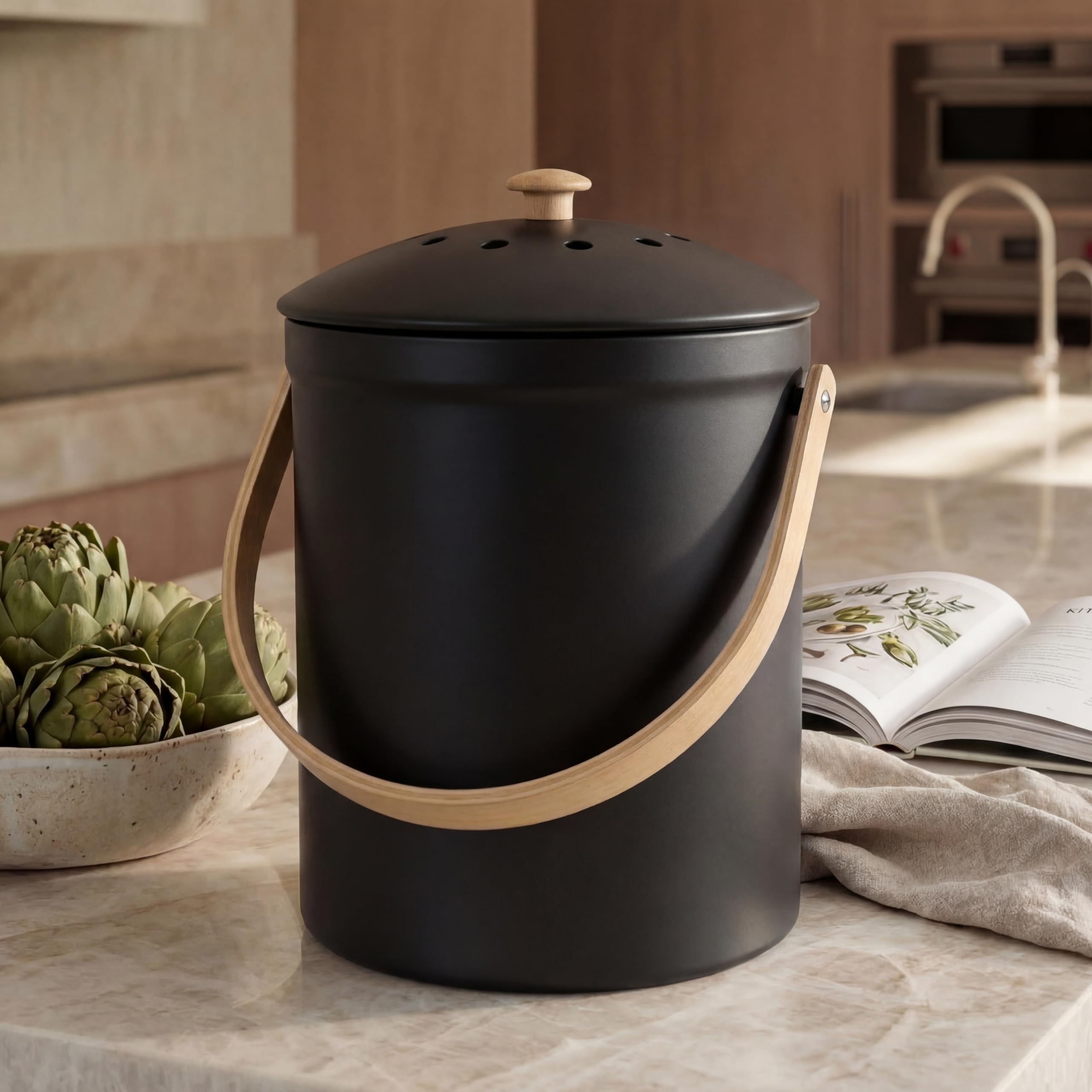
A powder-coated steel bin that blends a premium look with a very practical price.
The KIBAGA is a compact 1.1-gallon bin that feels heavier and more durable than its price suggests, thanks to a rust-proof powder-coated carbon steel body. It measures 7 inches wide by 10.2 inches tall, giving it a tall, narrow footprint that fits into a small gap on the counter. The black exterior is accented with a natural wooden handle and knob, which adds a touch of modern style. It comes with two charcoal filters to control odors, and the lid has small air holes to circulate air while the filter does its job.
The size is described as just right for 1-2 empties per week, which works well for coffee grounds and vegetable peels. It does not require compostable bags, making it a lower-waste option. The main criticism is that the lid is surprisingly heavy and the small wooden knob can be hard to grip, leading some users to drop it. One buyer mentioned that the instructions for installing the filters are sparse — you just push them in — but once in place, they work.
Durable and understated: The powder-coated steel body resists rust and looks great after a year of daily use, according to long-term buyers.
The one awkward point: The knobs small size and the lid’s heft can make opening it a fiddle — something to note if you have hand mobility concerns.
Best for: Shoppers who want a durable, stylish bin that won’t break the bank and prefer powder-coated steel over plastic or raw stainless.
it’s not for you if: You need a light-lid bin that opens with one finger — this lid is heavy and the knob is small.
7. Minky Homecare Kitchen Compost Bin

A simple, odor-trapping cube from the UK that is just the right size for coffee grounds.
The Minky is the most compact and affordable bin on the list, holding 0.9 gallons in a neat 7-inch cube. That is 0.9 gallons versus the EPICA’s 1.3 gallons, but for a single person or a couple who brews once a day, it is plenty. The ABS plastic body is lightweight (about 1.2 pounds) and features rounded corners with no crevices for gunk to hide, so wiping it clean after dumping grounds takes seconds. The stay-open lid is great for when you are scraping a portafilter or emptying a Chemex, and the non-slip feet keep it planted on the counter.
Buyers specifically call this out as their dedicated mini bin for used coffee grounds headed for the compost pile, noting the lid opening is wide enough to transfer grounds from the plunger pot cleanly. It seals well enough that reviewers report no escaping odors, and a removable bag retention ring lets you use a liner or go without. Designed and made in the UK, it is a solid, unpretentious bin. The lid does not have a latch, so if you knock it over, it will spill — something to keep in mind if you have pets or a tight counter.
The simple highlights
- Compact 7-inch cube footprint fits on even the smallest counter or coffee caddy.
- Stay-open lid and non-slip feet make one-handed operation smooth and steady.
- Easy wipe-clean interior with no attachment points for trapped residue.
The trade-off
- No latch on the lid means a bump or knock could open it and scatter grounds on your counter.
Reach for this if: Your coffee routine produces a manageable amount of grounds, you want a fuss-free bin that is easy to clean, and you need the smallest possible footprint.
Look elsewhere if: You cook for a large family or need a lid that latches shut for extra security against spills.
Understanding the Specs
Capacity: Gallons vs. Liters
Capacity tells you how much waste the bin can hold before you need to empty it. A 0.9-gallon bin (about 3.5 liters) is fine for a light coffee routine — a few days of grounds and filters. A 1.3-gallon bin (about 5 liters) gives you closer to a week of room for a typical household. Bins measured in liters are common from European and Asian brands (the KAZAI is 4.5 liters, the Blue Ginkgo is 5 liters), so the number is nearly the same. The right size depends on how often you want to walk to your outdoor pile.
Materials: Plastic vs. Metal vs. Carbon Steel
The material changes how the bin feels, lasts, and cleans. Stainless steel (like the EPICA) is rust-proof and strong but can dent. Powder-coated carbon steel (like the KIBAGA) resists rust with a painted finish but can chip if dropped. Plastic bins (like the Minky or Blue Ginkgo) are light, quiet, and cheap, but some plastics can stain or absorb odors over time. Each material handles daily grounds contact differently — stainless and carbon steel are the easiest to keep smelling neutral without much effort.
Odor Control: Carbon Filters vs. Airtight Seals
There are two ways bins fight smells. Carbon filter bins (EPICA, Perfnique, KIBAGA, KAZAI) have a small compartment in the lid holding a puck of activated charcoal that absorbs odors. These filters need replacing every 4-6 months. Airtight seal bins (Blue Ginkgo, Minky) use a silicone or plastic gasket to close the lid completely, trapping smells without any replacement part. The Full Circle uses a third method — airflow — to slow rotting so less smell forms in the first place. None of these approaches is better for every situation; it depends on whether you prefer replacing filters occasionally or wiping down a gasket.
Internal Bucket vs. Single Body
A removable inner bucket (found on the Perfnique, Blue Ginkgo, and KAZAI) lifts out so you can carry the waste without touching the outer bin. This is very helpful if you compost outdoors and want to dump the whole inner load without dirtying the decorative shell. Single-body bins (EPICA, Minky, KIBAGA) have no separate inner piece, which means fewer parts to clean but you must dump the entire bin. Some single-body bins are dishwasher safe (KAZAI), which compensates for the lack of a removable bucket.
FAQ
Can I put wet coffee grounds directly into the bin?
How often should I replace the charcoal filter?
Is it better to use compostable bags or no bags?
Will a coffee compost bin attract fruit flies?
Can I put paper coffee filters in the bin?
What is the difference between a stainless steel and a plastic bin?
Will the bin rust if I put wet grounds inside?
How do I clean a coffee compost bin properly?
Should I keep the bin in the fridge or freezer?
How do I know when the filter needs replacing?
Final Thoughts: The Verdict
For most buyers, the coffee compost bin winner is the EPICA Countertop Compost Bin because its 1.3-gallon capacity, rust-proof stainless steel build, and replaceable charcoal filter provide the most reliable odor-free experience for a typical household. If you want to never buy replacement filters, grab the Blue Ginkgo with its tight-sealing lid and draining inner colander. And for the largest capacity and a push-button lid that stays open, the Full Circle Fresh Air is your best bet for a busy kitchen that generates a lot of scraps.
How We Picked
We do not accept paid placement. Every pick is matched to a real buyer and a real use-case; we do not hands-on test units.
Sources & Methodology
Specifications: manufacturer listings and product documentation. Review insights: verified customer reviews, as of July 2026. Pricing: not shown on this page (it changes often); check the current price via the retailer link.
As an Amazon Associate, Lawn Gear Lab earns from qualifying purchases. This does not affect which products we feature.