
Specs are compiled from manufacturer listings and verified buyer reviews and can change over time — please confirm the key details on the product page before buying.
If your lawn is measured in acres, not feet, using a manual dethatching rake on a hot Saturday is a recipe for a bad back and a failed weekend. You need a machine that can pull up all that dead, matted grass (thatch) without you breaking a sweat, which is exactly what a wide, tow-behind dethatcher is built for. The best choice for you depends on how wide your mower is, how much thatch you have, and how much assembly you are willing to do.
I’m Rikta — the founder and writer behind Lawn Gear Lab. This guide is built by comparing the manufacturers’ published specifications and the patterns across verified customer reviews, so you get each pick’s real strengths and trade-offs instead of marketing spin.
Whether you have a half-acre or several acres, these tow-behind attachments take the hard work out of lawn care. Here is how to choose the best outdoor yard tool for the job with this guide to the dethatcher for large lawns.
Quick Picks
- Brinly 48″ Tow Behind Grass Dethatcher — Best Overall
- Brinly DT2-40BH2-P Premium Tow Behind Dethatcher — Premium Pick
- Suchtale 48inch Tow Behind Dethatcher — Best Value Width
- CRAFTSMAN 40-Inch Tow Behind Lawn Dethatcher — Solid Value
How To Choose The Best Dethatcher For Large Lawns
Picking the right dethatcher isn’t just about grabbing the biggest one you see. You need to match its width, tine design, and build quality to your mower and your lawn’s condition. Here are the three specs that decide how well a tow-behind dethatcher will work for you.
Working Width
This is the single biggest decision. The working width is the total span of the tines. A wider unit means you cover more ground with every pass, which saves you time. For a large lawn, anything under 40 inches will feel slow. A 48-inch model covers more ground per pass than a 40-inch one, because you are covering more territory per lap around the yard.
Number and Quality of Tines
More tines generally mean more aggressive thatch removal. Look for spring steel tines, which are durable and flexible enough to follow the contours of your lawn without snapping. Some models offer pre-assembled tines, which saves you a lot of headache during setup. The tines are the only part that touches the grass, so their quality dictates the outcome.
Weight Tray and Transport System
A weight tray lets you add ballast (like cinder blocks or landscape bricks) to push the tines deeper into the soil for heavy thatch. A good transport system with never-flat wheels lets you lift the tines off the ground when crossing a sidewalk or driveway without having to disconnect the whole unit. Skip this, and you will be stopping constantly or dragging the tines across hard surfaces.
Quick Comparison
| Model | Best For | Working Width | Number of Tines | Item Weight | Amazon |
|---|---|---|---|---|---|
| Brinly 48″ Tow Behind | Mega lawns / fastest coverage | 48 in | 24 | 36.7 lbs | Amazon |
| Brinly DT2-40BH2-P | Premium build / easy assembly | 40 in | 20 | 33.5 lbs | Amazon |
| Suchtale 48-inch | Value / large width on a budget | 48 in | 24 | 35.6 lbs | Amazon |
| CRAFTSMAN 40-Inch | Budget-friendly / solid quality | 40 in | 20 | — | Amazon |
In‑Depth Reviews
1. Brinly 48″ Tow Behind Grass Dethatcher

The widest pick here, built to chew through acres without wasting a single lap.
If covering ground fast is your only goal, this is the one. The Brinly 48″ Tow Behind Grass Dethatcher gives you a 48-inch working width — at 48 inches versus the 40-inch Craftsman model, meaning you finish your lawn faster. It uses 24 long-lasting, triple-coil strength 3/16″ diameter spring steel tines arranged in two rows of 12 to comb through and lift thatch out of your lawn effectively.
Buyers report it works flawlessly after assembly and is heavy duty, removing thatch and moss effectively. At 36.7 pounds, it is only 3.2 pounds heavier than the 40-inch Brinly DT2-40BH2-P below, despite being significantly wider. The 8″ never-flat transport wheels sit behind the tray, keeping the footprint narrow, though a couple of reviewers mention the lack of a raised towing position means you have to unhitch it to cross a street. One owner noted that if a part is missing, contacting Brinly directly gets a quick replacement.
Why it wins for big lawns
- Widest working width (48 in) of any pick for the fastest dethatching
- 24 durable spring steel tines (compared to the Craftsman’s 20)
- Built in the USA with solid, heavy-duty construction
The honest drawbacks
- No on-the-fly raise feature for crossing roads; you must disconnect
- Some owners mention missing hardware or tines in the box
- Assembly can be tricky with unlabeled bolts
Reach for this if: your lawn is huge and you want the absolute widest pass to finish the job in the fewest laps.
Look elsewhere if: you frequently tow across paved surfaces and don’t want to unhitch each time — the lack of a raised transport mode is a pain on streets.
2. Brinly DT2-40BH2-P Premium Tow Behind Dethatcher
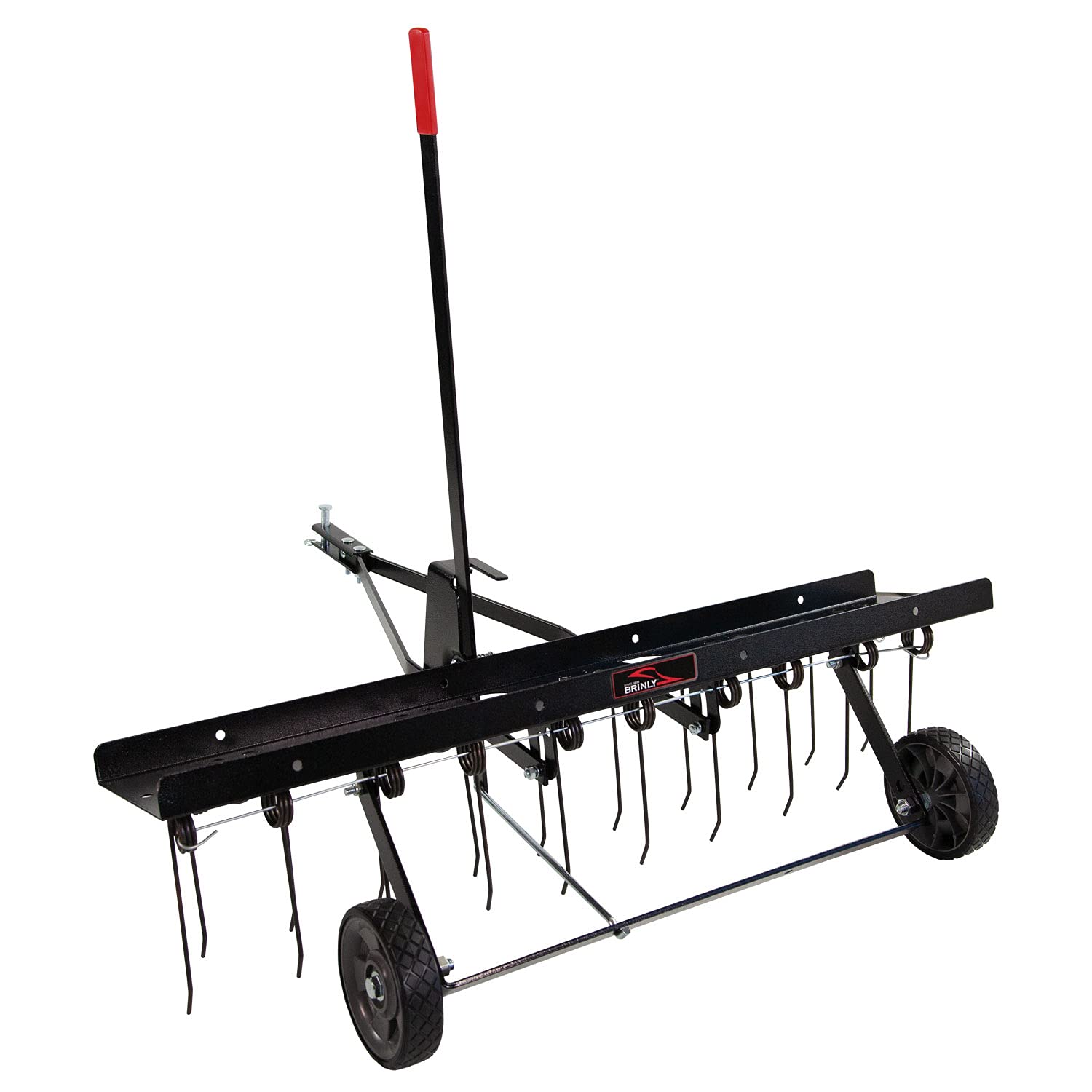
A premium 40-inch unit that arrives with the tines already bolted on, saving your knuckles.
The biggest headache with tow-behind dethatchers is assembly, especially dealing with dozens of spring tines. The Brinly DT2-40BH2-P solves this by delivering the 20 long-lasting, triple-coil strength 3/16″ diameter spring steel tines pre-assembled to the tray. This 40-inch unit has a working width that still covers ground quickly, though it is narrower than the 48-inch Brinly above (40 inches vs 48 inches), so you will make more passes.
It offers multiple settings for different tasks — you can run it as a straight dethatcher or in a more aggressive mode where the tines scrape and scarify the soil, which is useful for reseeding. Customers note one user covered 0.5+ acres in just 45 minutes and picked up about 50 baskets of thatch. At 33.5 pounds, it is 3.2 pounds lighter than the 48-inch Brinly, making it slightly easier to maneuver. The transport wheels are conveniently engaged from the driver’s seat, so you can lift the tines when crossing a driveway without stopping.
What makes it worth the extra
- Tines come pre-assembled, saving you significant setup time
- Adjustable tine settings for dethatching or aggressive scarifying
- Easy-to-engage transport wheels accessible from the driver’s seat
What to watch for
- Clogs easily with sticks, leaves, and pine needles
- Assembly of the control arm can be tricky; a review suggests watching a video
- Takes up a fair bit of storage space (40 x 40 x 33 inches)
Smart splurge for: anyone who values their time and wants a lawn tool that’s ready to work fast with minimal assembly.
Skip it for: yards with lots of pine needles or debris — the tray clogs easily, forcing you to stop and clear it.
3. Suchtale 48inch Tow Behind Dethatcher

A 48-inch wide dethatcher at a budget price, though you pay in assembly time.
If you want the wide coverage of a 48-inch unit but your budget is tighter, the Suchtale 48-inch dethatcher delivers the same working width as our top pick for a lower cost. It uses 24 rust-proof, heat-treated spring steel tines to uproot dead grass and thatch, and the wheels track behind to avoid damaging flower beds or other obstacles. It sits at 35.6 pounds, nearly identical in weight to the 48-inch Brinly despite a lower price point.
The catch is the assembly. Reviewers point out it took over 2 hours to put together, describing the instructions as “confusing diagrams lacking text/warnings” and noting that parts must be in exact orientation. One reviewer who owns it says it is effective on heavy thatch without added weight, but another mentions the transport bar has a design flaw that may require welding to fix. Despite these issues, those who get it together praise its performance for the price, with one calling it “really impressive quality compared to big box store equivalent.”
Where it saves you money
- Full 48-inch width at a budget-friendly price point
- 24 heat-treated, rust-proof spring steel tines
- Solid rubber tires and powder-coated frame feel premium for the cost
Where it makes you work
- Assembly is notoriously difficult (2+ hours) with confusing diagrams
- Transport wheel lock lever has a reported design defect
- Must squeeze tines by hand to insert them into the brackets
Grab it if: 48-inch width is non-negotiable for your yard size and you are handy enough to muscle through a tough assembly.
Avoid it if: you don’t have the patience for complex setup or want something that works right from the start — the assembly horror stories are real.
4. CRAFTSMAN 40-Inch Tow Behind Lawn Dethatcher

A dependable, American-made 40-inch dethatcher that won’t break the bank.
If you need a solid tool that just works without the premium price tag, the CRAFTSMAN 40-Inch dethatcher is a proven workhorse. It uses 20 durable spring steel tines across a 40-inch working width — that is 20% narrower than the 48-inch picks above. It comes with a weight tray that holds up to 70 pounds, so you can add ballast (like cinder blocks or landscape bricks) to really dig into heavy thatch. The universal hitch attaches to any lawn tractor regardless of brand, and the cantilever transport handle makes raising and lowering straightforward.
You can assemble it in about an hour with a ratchet and socket set, shoppers say. One reviewer says he “used it to dethatch 1 acre and it removed alot of thatch.” Owners also note that a few small landscape bricks held on with a bungee cord add weight well, but warn that too much weight makes it bounce off balance. The 3-year limited warranty and USA manufacturing add confidence at this price.
The reasons it sells so well
- Weight tray holds up to 70 lbs for deeper soil penetration
- Universal hitch fits any lawn tractor brand easily
- Made in the USA with a 3-year limited warranty
A couple of known issues
- Some units ship with missing nuts, bolts, or spring tines
- 40-inch width is less efficient on very large lawns than a 48-inch model
Ideal for the budget-conscious buyer: who wants a reliable, American-made dethatcher with a solid warranty and doesn’t need the absolute widest pass.
Not ideal if: you have more than a couple of acres and want the fastest lap times — the 40-inch width means you will make more passes than with a 48-inch unit.
Understanding the Specs
Working Width (Inches)
This is the total span of the tines from side to side. A wider working width means you cover more ground with each pass around the yard. For example, a 48-inch unit covers 48 inches per pass versus 40 inches for a 40-inch unit, which translates directly into less time on the tractor. Match the working width to your mower deck size — you generally want the dethatcher to be the same width or slightly narrower than your mower to avoid missing strips.
Spring Steel Tines (Count & Diameter)
The tines are the metal fingers that comb through grass and pull out thatch. More tines and a thicker diameter — like the 3/16″ triple-coil strength on premium models — mean more aggressive removal and better durability. Spring steel stays flexible so it follows your lawn’s contours without snapping. Some models pre-assemble their tines, saving you the tedious work of wrestling individual tines into brackets.
Weight Tray Capacity
Many tow-behind dethatchers have a tray on top where you can add weight (like cinder blocks, landscape bricks, or even water jugs). Adding weight pushes the tines deeper into the soil, which is essential for breaking up heavy, compacted thatch. A typical tray holds up to 70 pounds. Start with no weight and add gradually until you see the desired depth of penetration — too much weight can make the unit bounce or dig too deep.
Transport Wheels & Hitch Type
Transport wheels allow you to lift the tines off the ground when you cross a sidewalk, driveway, or path so you don’t scrape or damage the surface. The best designs let you engage these wheels from the driver’s seat. The hitch type is also important — a universal pin-style hitch fits most lawn tractors and ATVs without any special adapters. Never-flat diamond rubber-tread wheels are a bonus because they don’t go flat after sitting in the garage all winter.
FAQ
How wide should my dethatcher be for a large lawn?
Can I use a tow-behind dethatcher with any lawn tractor?
Do I need to add weight to a dethatcher?
How long does it take to assemble a tow-behind dethatcher?
What is the difference between a dethatcher and a power rake?
Will a dethatcher damage my lawn?
Can I use a dethatcher on a Bermuda grass or St. Augustine lawn?
How often should I dethatch my lawn?
Why do some dethatchers have transport wheels and others don’t?
What is the best time of year to dethatch my lawn?
Final Thoughts: The Verdict
For most homeowners with large lawns, the best dethatcher for large lawns is the Brinly 48″ Tow Behind Grass Dethatcher because its 48-inch width and 24 spring steel tines let you cover ground faster than any other pick here. If you want a premium experience with pre-assembled tines and easy transport, grab the Brinly DT2-40BH2-P. And for a budget-friendly 48-inch option that saves you money but costs you time in assembly, the Suchtale 48inch Tow Behind Dethatcher is a solid choice.
How We Picked
We do not accept paid placement. Every pick is matched to a real buyer and a real use-case; we do not hands-on test units.
Sources & Methodology
Specifications: manufacturer listings and product documentation. Review insights: verified customer reviews, as of July 2026. Pricing: not shown on this page (it changes often); check the current price via the retailer link.
As an Amazon Associate, Lawn Gear Lab earns from qualifying purchases. This does not affect which products we feature.