
Specs are compiled from manufacturer listings and verified buyer reviews and can change over time — please confirm the key details on the product page before buying.
You rake a pile, and the next gust scatters it again. You fill a bag, and the pile barely shrinks. The real answer is a mulching leaf vacuum that shreds every leaf into fine dust so you bag far fewer loads and spend far less time at the curb. This guide will show you the models that actually do that without jamming or leaving you exhausted after ten minutes.
I’m Rikta — the founder and writer behind Lawn Gear Lab. This guide is built by comparing the manufacturers’ published specifications and the patterns across verified customer reviews, so you get each pick’s real strengths and trade-offs instead of marketing spin.
We sized up five of the most popular models — corded and cordless — by their real-world mulch ratios (the number that tells you how many bags of leaves get crushed into one), their air speeds and CFM (cubic feet per minute, a measure of air volume), their bag capacities, and buyer reports of clogs or breakage, so you can find the best mulching leaf vacuum that fits your yard size and your tolerance for dragging a cord around.
Quick Picks
- BLACK+DECKER Leaf Blower Vacuum Mulcher 3-in-1 (BV6000) — Best Overall
- WORX Trivac 3 in 1 Electric Leaf Blower (WG509) — Best Mulch Efficiency
- MZK 3 in 1 Electric Leaf Blower Corded (LB67M) — Best Budget Value
- SOYUS 3-in-1 Cordless Leaf Blower & Vacuum (SY8A512) — Cordless Freedom
- ZEGJAW 40V Cordless Leaf Blower & Vacuum (ZJ8A512-S) — Long Runtime Cordless
How To Choose The Best Mulching Leaf Vacuum
Picking the right leaf vacuum depends on three things: how finely it shreds leaves (the mulch ratio), whether that shredding happens fast enough to keep up with your yard (air speed and CFM, or cubic feet per minute), and whether you can tolerate a cord or want the freedom of batteries. Here is what each spec really means for your back and your time.
Mulch Ratio: The Number That Cuts Your Bag Trips
This is the single most useful spec on the box. An 18:1 ratio means it crams 18 bags of whole leaves into one bag of fine mulch. A 10:1 ratio means you still carry nearly twice as many bags to the curb. Buyers report that higher ratios are the difference between emptying the bag four times a session and fourteen times.
CFM vs MPH: Which One Moves a Wet Pile
MPH is how fast the air leaves the nozzle — great for blasting debris out of a flower bed. CFM (cubic feet per minute) is the volume of air moving — that is what actually lifts a heavy, wet, matted mass of leaves. For multipurpose use, a model with at least 400 CFM will save you frustration on damp fall mornings.
Metal vs Plastic Impeller: The Durability Dividing Line
The impeller is the spinning fan that does the actual mulching. A metal impeller chews through twigs, acorns, and the stray pebble you inevitably vacuum up. A plastic impeller is quieter but can crack if it hits something hard. If your yard has any debris beyond dry leaves, lean toward a metal impeller.
Quick Comparison
| Model | Best For | Mulch Ratio | Air Speed | Air Flow (CFM) | Amazon |
|---|---|---|---|---|---|
| WORX WG509 | Highest mulching efficiency | 18:1 | 210 MPH | 350 CFM | Amazon |
| BLACK+DECKER BV6000 | Best all-around power | 16:1 | 250 MPH | 400 CFM | Amazon |
| MZK LB67M | Best budget value | 15:1 | 167 MPH | 460 CFM | Amazon |
| SOYUS SY8A512 | Cordless convenience | — | 170 MPH | 360 CFM | Amazon |
| ZEGJAW ZJ8A512-S | Long runtime cordless | 12:1 | 170 MPH | 360 CFM | Amazon |
In‑Depth Reviews
1. BLACK+DECKER Leaf Blower Vacuum Mulcher 3-in-1 (BV6000)

You want a machine that handles twigs and pebbles without jamming — this corded workhorse does it with a metal impeller that shrugs off hard debris.
You get a 16:1 mulch ratio here — it crushes 16 bags of whole leaves down to just one — so you are emptying that 8.1-pound unit far less often than most competitors. The 12-amp motor delivers 400 CFM (cubic feet per minute) of air flow and a 250 MPH top speed, which beats the WORX WG509 on air volume (400 vs 350 CFM) and on speed (250 vs 210 MPH). Owners mention that mulched leaves fill a 40-gallon bag after just five to six empties, covering a whole yard in a single trip.
The high-impact metal fan (the impeller, or spinning blade) is the key differentiator here: it stays unclogged even when you accidentally suck up a stray stone or small branch. One reviewer confirmed the motor shut off and restarted after snagging a rag rather than breaking.
The trade-off is the disposable bag system — you get two bags included, but the bag gets very dusty, and reviewers strongly recommend wearing a mask and goggles. The cord is also short (about 1-2 feet), so you will need a heavy-duty extension cord for anything beyond a small yard.
The Impeller Advantage
- Metal impeller shrugs off rocks and twigs without jamming
- No. 1 in air speed (250 MPH) and a strong 400 CFM air volume
- 16:1 mulch ratio means few bag trips
- Shoulder strap takes the weight off your arm
The Dust Reality
- Disposable bags get extremely dusty — mask and goggles are necessary
- Short power cord demands a long extension cord for larger yards
- Switching between blower and vacuum modes takes some practice at first
Reach for it if: you have a medium to large yard with mixed debris (leaves, twigs, pebbles) and you want the strongest shredding power, lowest noise, and longest corded runtime without battery anxiety.
Look elsewhere if: you absolutely cannot stand wearing a dust mask or you need total cord-free freedom — this vacuum must stay plugged in.
2. WORX Trivac 3 in 1 Electric Leaf Blower (WG509)

You want the fewest possible bag changes — this WORX shrinks 18 full bags into one single sack, the best ratio in this lineup.
No other mulching leaf vacuum in this lineup shrinks volume as aggressively. The WORX delivers an 18:1 mulch ratio — compared to the MZK’s 15:1 — meaning fewer trips to the compost pile or the curb. It achieves that with a metal impeller (a spinning fan that grinds leaves) and a 12-amp motor that produces 350 CFM (cubic feet per minute) at 210 MPH, so you get enough air volume to lift drier leaves while the high speed shreds them thoroughly.
Customers note the mulcher works well with dry leaves but caution against wet piles, which clog the bag faster. The bag has a convenient zipper at the bottom for dumping, but reviewers point out it gets surprisingly heavy when it is even half full of dense shredded material. The blower function is considered the weaker part of the package — buyers rate it as merely adequate for clearing patio furniture rather than a heavy leaf layer.
Compared to the BLACK+DECKER BV6000, the WORX is heavier at 9.3 pounds versus the B&D’s 8.1 pounds and shorter in the body (14.1 inches vs 20.6 inches), which makes it easier to store but gives you a little less reach. The variable speed trigger is useful for switching between gentle sweeping and full-blast clearing, but reviewers warn the power switch is stiff and the impeller stays accessible while spinning — an important safety note.
Mulching King: The top shred density in the lineup at 18:1 lets you empty the bag way less often than any other model here, so long as you stick to dry leaves. The catch: it is heavier (9.3 lb) and the blower mode is noticeably weaker than the B&D’s 250 MPH blast, making this a pure mulching specialist rather than a true all-rounder.
Grab this for: a yard full of dry deciduous leaves where you want the absolute minimum number of bag changes.
Pass if: your leaf piles are often wet, you need a strong blower separately, or you prefer a lighter tool — the B&D or MZK will feel almost a pound lighter in the hand.
3. MZK 3 in 1 Electric Leaf Blower Corded (LB67M)
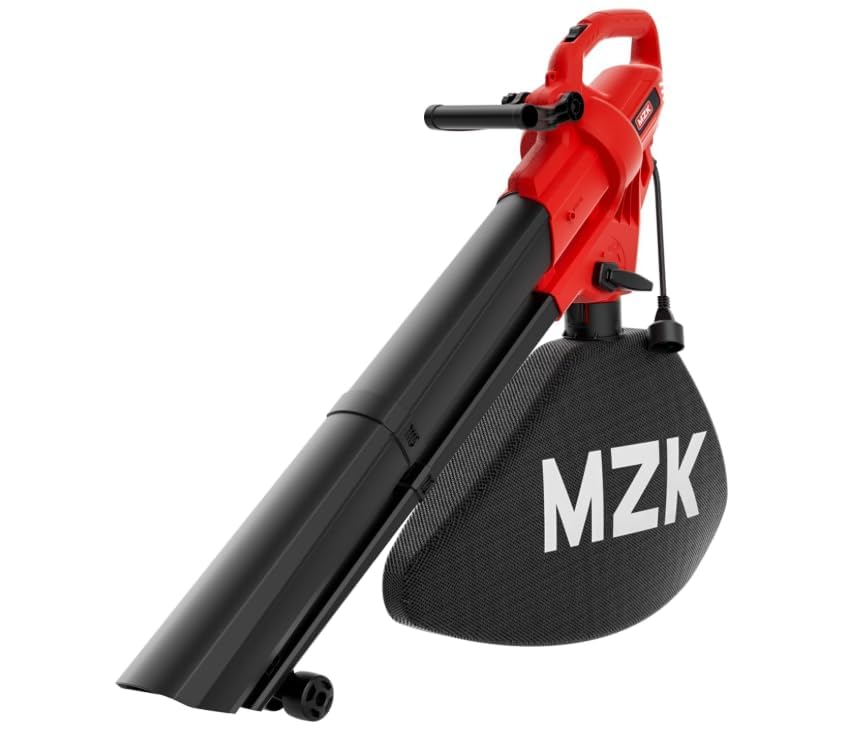
You want the most lifting power for your dollar — this MZK moves 460 CFM, the highest air volume in the test, at a budget price.
That big air volume (460 CFM, or cubic feet per minute) moves heavy damp leaf piles far more effectively than the spec sheet suggests. The trade-off is a lower top speed of 167 MPH (where the B&D is 250 MPH), but in practice the extra CFM means the pile actually lifts rather than just getting dust blown off the top.
Shoppers say the vacuum and mulcher work without clogs, producing fine mulch that packs into the 50L bag without issues. They also call it lightweight and say switching between blower, vacuum, and mulcher modes requires no tools — just a simple motion. The 15:1 mulch ratio is slightly behind the WORX’s 18:1 but still means you are filling the bag only a fraction as often as you would with a basic leaf blower.
One detail worth noting: the MZK is the only model here with a 50L bag that is actually described as spacious by multiple reviewers, so even though the ratio is lower than the WORX, the larger bag partly compensates by holding more between empties. A few reviewers mention it may lack power for extremely heavy or soaking wet debris, so it is best matched to regular fall cleanups rather than a post-storm mess.
CFM King, Budget Price: The highest air flow (460 CFM) in the entire lineup at the lowest price makes this the smart pick for anyone who wants the most lifting power per dollar. The lower MPH (167) means it is slower to blow a dry path but excellent at vacuuming a heavy pile into fine mulch.
Ideal for: budget-minded homeowners who need a reliable corded vac that sucks up wet leaves without choking and turns them into fine mulch at a 15:1 ratio.
Not for: large properties where every second counts on blasting mode — the slower top speed (167 MPH) means the B&D or WORX will clear a dry lawn faster.
4. SOYUS 3-in-1 Cordless Leaf Blower & Vacuum (SY8A512)
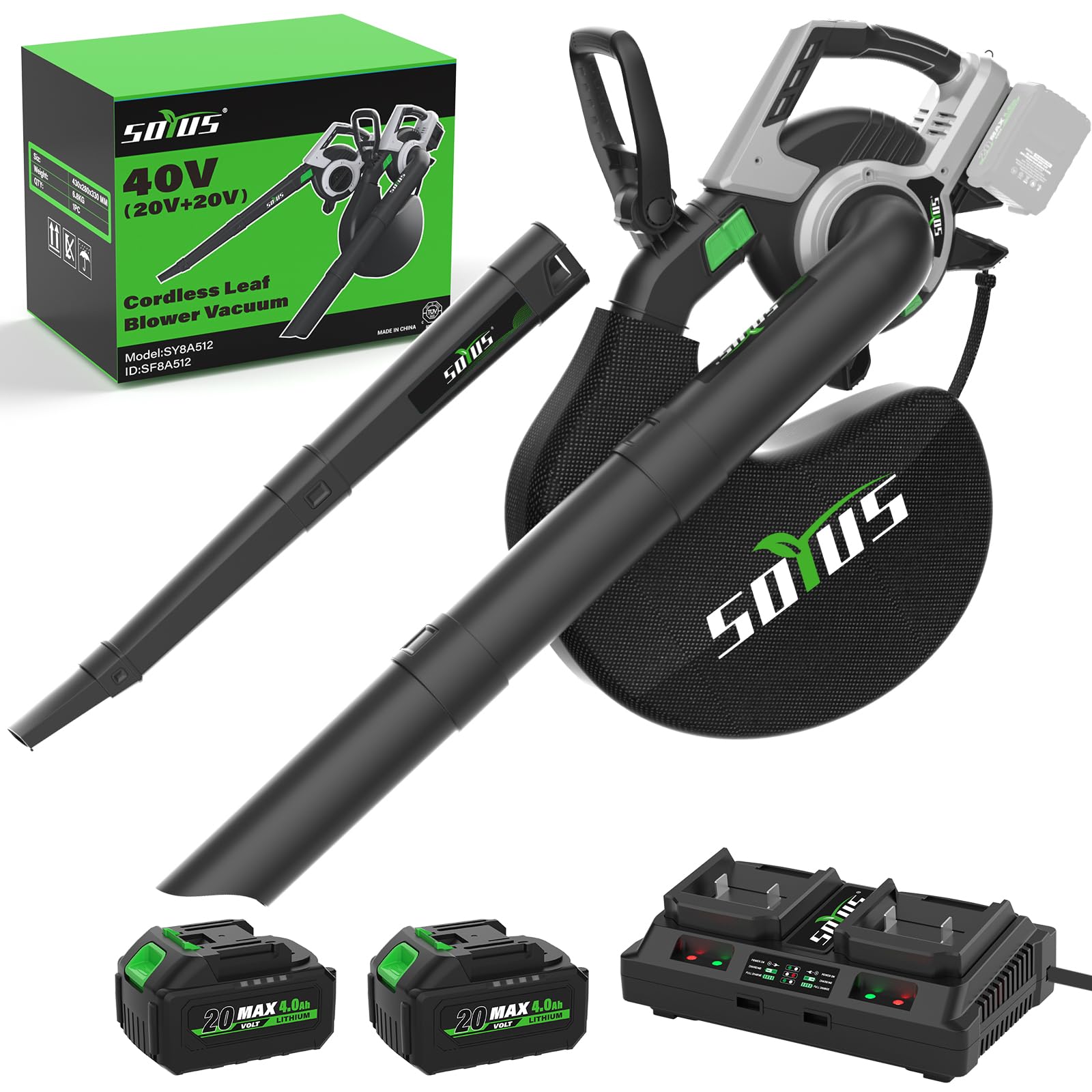
You want to roam anywhere in your yard without an extension cord — this battery-powered vac uses two 20V 4.0Ah batteries for true cord-free operation.
The SOYUS is the true cordless alternative to the three corded models above, using a brushless motor (an efficient motor with no brushes to wear out) and two 20V 4.0Ah (amp-hour) batteries. It pushes 385 CFM (cubic feet per minute) at 170 MPH on paper, but buyers report that on turbo mode it will “easily clear a pile of wet leaves,” outperforming the expectation you might have for a battery tool. The runtime is decent: over 30 minutes at maximum speed and up to 90 minutes on low, with a full charge taking just 1.5 hours.
The 45L (45-liter) bag is almost as generous as the MZK’s 50L bag and includes a bottom zipper for quick dumping. Five speed settings plus a dedicated turbo button give you fine control, from gentle patio sweeping at speed 1 to full-blast mulching on turbo. The batteries are compatible with the standard Makita 20V platform, so if you already own Makita tools you essentially have spare batteries ready.
The real-world weakness: battery life drops fast on turbo, and one reviewer noted a battery dying after 11 months of light use. If your yard is large or you always run it on turbo, you may get only about 30 minutes before swapping packs. That is enough for a typical suburban front and back yard, but not for a multi-acre property.
Why Go Cordless
- Truly portable with two 4.0Ah batteries — no extension cord to drag around
- Batteries share Makita 20V platform for compatibility
- Five speeds + turbo mode for precise airflow control
- Bottom zipper on 45L bag makes dumping quick and clean
The Runtime Catch
- Turbo mode drains batteries in about 30 minutes — plan your session
- Wet leaves on turbo accelerate battery drain even further
- Reliability questions: one buyer’s battery died after 11 months of moderate use
- 385 CFM is less than the corded MZK’s 460 CFM — less lifting power for heavy piles
Best for: cord-free convenience around a small to medium yard where you value maneuverability over unlimited runtime. The turbo mode handles wet leaves surprisingly well for a battery machine.
skip it if: you have a large property, need all-day mulch power without stopping to recharge, or want the absolute highest air lift — the corded B&D or MZK will outperform on both runtime and raw CFM.
5. ZEGJAW 40V Cordless Leaf Blower & Vacuum (ZJ8A512-S)
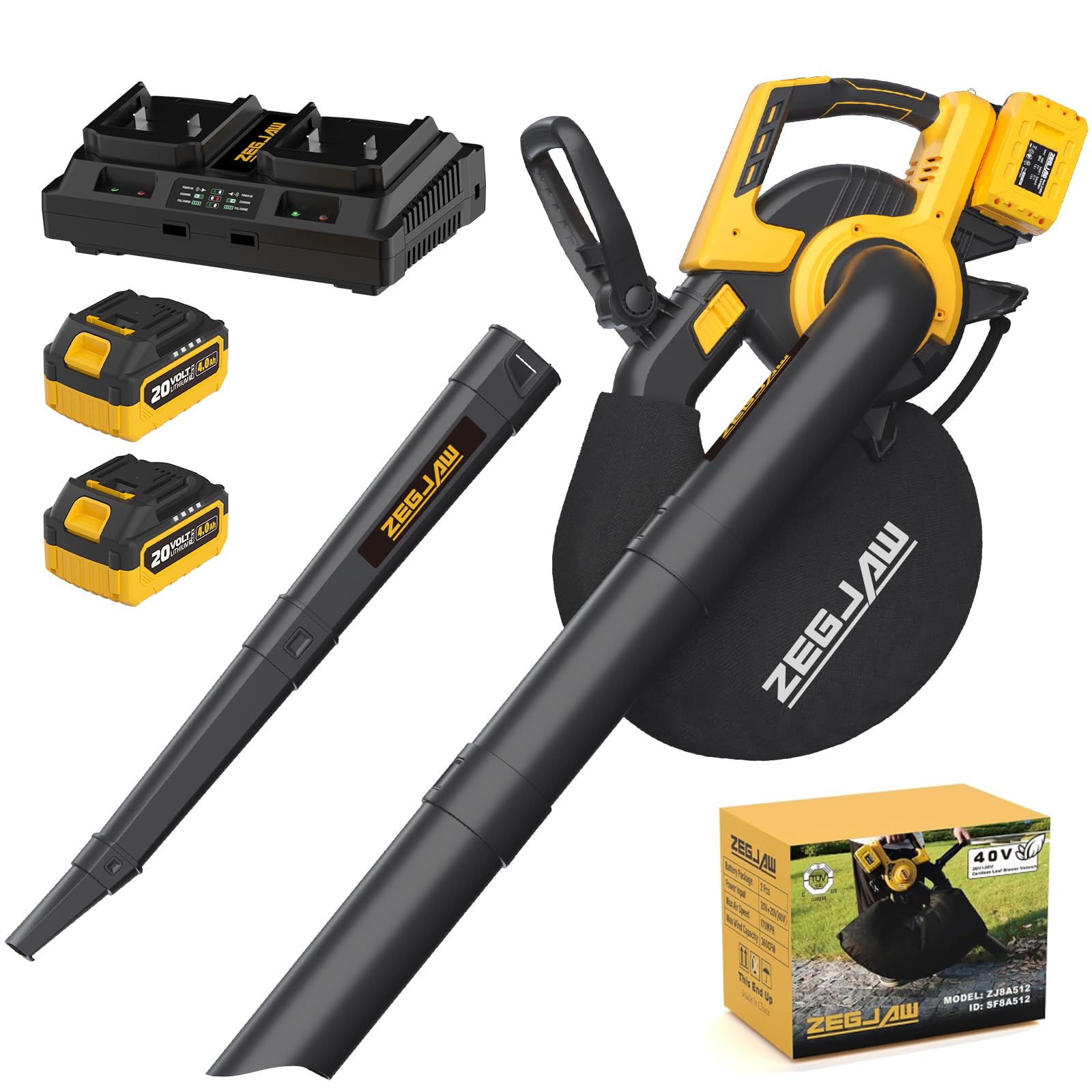
You need the longest shift in the battery pack — this 40-volt cordless vac runs up to 4 hours on low speed, enough for a full afternoon without recharging.
The payoff is remarkable runtime: up to 90-240 minutes on low speed for light use, or 30-40 minutes at maximum speed in turbo mode. That is a full afternoon of mulching without the cord.
Performance is 360 CFM (cubic feet per minute) and 170 MPH, which matches the SOYUS on air volume and speed but falls short of the top corded units. The 12:1 mulch ratio is the lowest in the test (it shrinks 12 bags into 1 versus 18:1 on the WORX), so you will empty the 45L (45-liter) bag more often. However, the bag has a bottom zipper for fast dumping, and the 5-speed settings plus a turbo button give you real control over airflow for delicate jobs like sweeping a patio at speed 1-2 or clearing a leaf pile at speed 5.
Buyers praise it as surprisingly powerful and lightweight given the battery capacity — one called it a “genuine little monster” for moving gravel, pine needles, and cones with ease. But another noted it only has one speed usable for their purpose, suggesting the variable-speed control may feel limited. The main trade-off: you carry 14 pounds for the whole session, and the mulch ratio is lower than the corded competitors.
Battery Marathon Runner: The longest runtime of any cordless here (up to 4 hours on low) makes it a strong pick for a full day of yard work without recharging mid-job. Just know the 12:1 shredding is less aggressive than the WORX or B&D, so plan on more bag changes.
Choose it for: a large cordless-only property where you want to finish the entire yard on a single charge, and you prioritize runtime over the finest possible shred.
Avoid if: you want the highest mulch density (the WORX at 18:1 or B&D at 16:1 will give you much less bag filling), or if 14 pounds feels too heavy for long sessions — the SOYUS or MZK are noticeably lighter.
Understanding the Specs
Mulch Ratio
The number that tells you how many bags of whole leaves get crushed into one bag of fine mulch. A 16:1 ratio means 16 bags of loose leaves become just one bag of shredded material — fewer trips to the bin, less bag-wrangling. The higher this number, the more impressive the internal shredding impeller (the spinning blade that grinds the leaves).
CFM vs MPH
MPH measures how fast the air jet shoots out the nozzle — good for blasting a dry path clean. CFM (cubic feet per minute) measures the total volume of air moving — this is what actually lifts a heavy, damp, matted pile of leaves. For vacuuming and mulching, CFM matters more than MPH.
Metal Impeller
The spinning blade inside the vacuum that shreds leaves. A metal impeller handles twigs, acorns, and stray pebbles without cracking or dulling. Plastic impellers are quieter but can chip or break on hard debris, so if your yard has anything beyond dry leaves, metal is the durable choice.
Corded vs Cordless Runtime
Corded units run as long as you keep the extension cord plugged in — no battery anxiety, but you are tethered. Cordless units trade unlimited runtime for freedom of movement. Look at the actual minutes at max speed (30-40 min is typical) and check whether the batteries are standard platform (like Makita 20V) so you can swap with other tools.
FAQ
What is the best mulch ratio for a leaf vacuum?
Can a mulching leaf vacuum handle wet leaves?
Will a leaf vacuum mulcher clog on twigs or rocks?
How often do I need to empty the collection bag?
Is a cordless leaf vacuum powerful enough for a big yard?
What does the 3-in-1 function include?
How heavy is a typical mulching leaf vacuum?
What power cord length do I need for a corded leaf vacuum?
Can I use a leaf vacuum mulcher as a regular leaf blower?
Which is better: a metal or plastic impeller?
Final Thoughts: The Verdict
Across the board, the best mulching leaf vacuum winner is the BLACK+DECKER BV6000 because it combines the highest air speed (250 MPH), a sturdy 400 CFM air flow, a 16:1 mulch ratio, and a metal impeller that survives twigs and pebbles — all at a moderate weight of 8.1 pounds and with a quieter motor (according to the brand). If you want the absolute finest mulching with the fewest bag changes, grab the WORX WG509 with its best-in-test 18:1 ratio. And for cordless freedom on a medium yard, the SOYUS SY8A512 is the top pick with its two 20V batteries, turbo wet-leaf capability, and Makita platform compatibility.
How We Picked
We do not accept paid placement. Every pick is matched to a real buyer and a real use-case; we do not hands-on test units.
Sources & Methodology
Specifications: manufacturer listings and product documentation. Review insights: verified customer reviews, as of July 2026. Pricing: not shown on this page (it changes often); check the current price via the retailer link.
As an Amazon Associate, Lawn Gear Lab earns from qualifying purchases. This does not affect which products we feature.