
Specs are compiled from manufacturer listings and verified buyer reviews and can change over time — please confirm the key details on the product page before buying.
If whiteflies have turned your garden into a sticky mess, you need a treatment that hits both the adults fluttering around and the hidden nymphs on the undersides of leaves. The right insecticide for whiteflies knocks them out fast without harming your plants or the beneficial bugs you want around.
I’m Rikta — the founder and writer behind Lawn Gear Lab. This guide is built by comparing the manufacturers’ published specifications and the patterns across verified customer reviews, so you get each pick’s real strengths and trade-offs instead of marketing spin.
Whether your gardenias or tomato plants are under attack, this guide breaks down the top options into a clear choice — from contact sprays to systemic killers — so you can pick the best insecticide for whiteflies for your specific garden setup.
Quick Picks
- Bonide Systemic Insect Control, 16 oz Concentrate — Best Overall
- Organic Insecticide Liquid Concentrate – Arber — Organic Choice
- Safer 5118-6 Insect Killing Soap Concentrate — Best Contact Spray
- Organic Insecticide & Fungicide for Plants — Dual Action
- Bonide Captain Jack’s Neem Oil, 128 oz Ready-to-Use — Ready-to-Use
- Ortho Insect Killer Flower and Vegetable Garden Dust — Budget Dust
How To Choose The Best Insecticide For Whiteflies
Whiteflies are tough because they breed fast and hide on the undersides of leaves. Your choice depends on how you want to attack them: on contact, or through the plant itself.
Contact killers for immediate results
These sprays kill whiteflies the moment they get wet. Options like insecticidal soap or neem oil work fast and are safe for organic gardens, but you have to spray every few days because they don’t protect new growth.
Systemic insecticides for long-term control
These are absorbed by the plant and kill whiteflies when they feed. They last longer and need fewer applications, but you cannot use them on edible crops like vegetables or fruit plants if the label says so.
Organic vs conventional options
Organic treatments like potassium salts of fatty acids or neem oil are gentler on pollinators and safe to use up to harvest day. Conventional systemic options are more powerful but may have restrictions on where and when you apply them.
Quick Comparison
| Model | Best For | Type | Active Ingredient | Coverage | Amazon |
|---|---|---|---|---|---|
| Bonide Systemic Insect Control | Long-term ornamental protection | Systemic Concentrate | — | 16 gallons | Amazon |
| Organic Insecticide (Arber) | Indoor & outdoor organic gardens | Biological Concentrate | — | — | Amazon |
| Safer Insect Killing Soap | Safe contact spray for edibles | Contact Concentrate | Potassium Salts of Fatty Acids | 16 oz concentrate | Amazon |
| Organic Insecticide & Fungicide | Two-in-one pest & disease control | Bio-based Concentrate | — | 16 oz concentrate | Amazon |
| Bonide Captain Jack’s Neem Oil | Ready-to-use organic multi-purpose | Contact RTU | Clarified Hydrophobic Extract of Neem Oil | 128 oz RTU | Amazon |
| Ortho Garden Dust | Long-lasting dust for ornamentals | Contact Dust | — | 1,300–3,500 sq. ft. | Amazon |
In‑Depth Reviews
1. Bonide Systemic Insect Control, 16 oz Concentrate

A systemic (plant-absorbed) insecticide that keeps working from the inside out for weeks, so you spray less often.
This is the pick when you want to stop whiteflies without spraying every few days. The plant absorbs the concentrate through its roots, so any whitefly that feeds on the sap gets killed — including the hidden nymphs you might miss with a contact spray. It makes up to 16 gallons of finished spray, which is a strong value for larger ornamental gardens.
One major catch: the label says this is not intended for vegetable or fruit plants. It is labeled for use on flower beds, roses, shrubs, and other listed ornamental plants only. Buyers report it “smells like actual poop, noticeable indoors,” so consider that if you are treating indoor ornamentals.
Unlike contact sprays that wash off in rain, this systemic keeps protecting between waterings. It is a different approach than dusts like the Ortho option below, because it works from within the plant rather than sitting on the leaf surface.
Why it leads the list
- Treats thrips, mealybugs, scale, spider mites, and whiteflies
- Works on over 100 plant varieties
- Can be mixed with certain fungicides or fertilizers
The honest trade-off
- Not for vegetable or fruit plants
- Strong noticeable odor according to buyers
- Outdoor residential use only per the label
Best for ornamental gardens: If your flower beds, roses, or shrubs are the main concern and you want a low-maintenance systemic.
skip it if you grow food: Vegetables and fruit plants are not an option here — look at a contact killer instead.
2. Organic Insecticide Liquid Concentrate – Arber
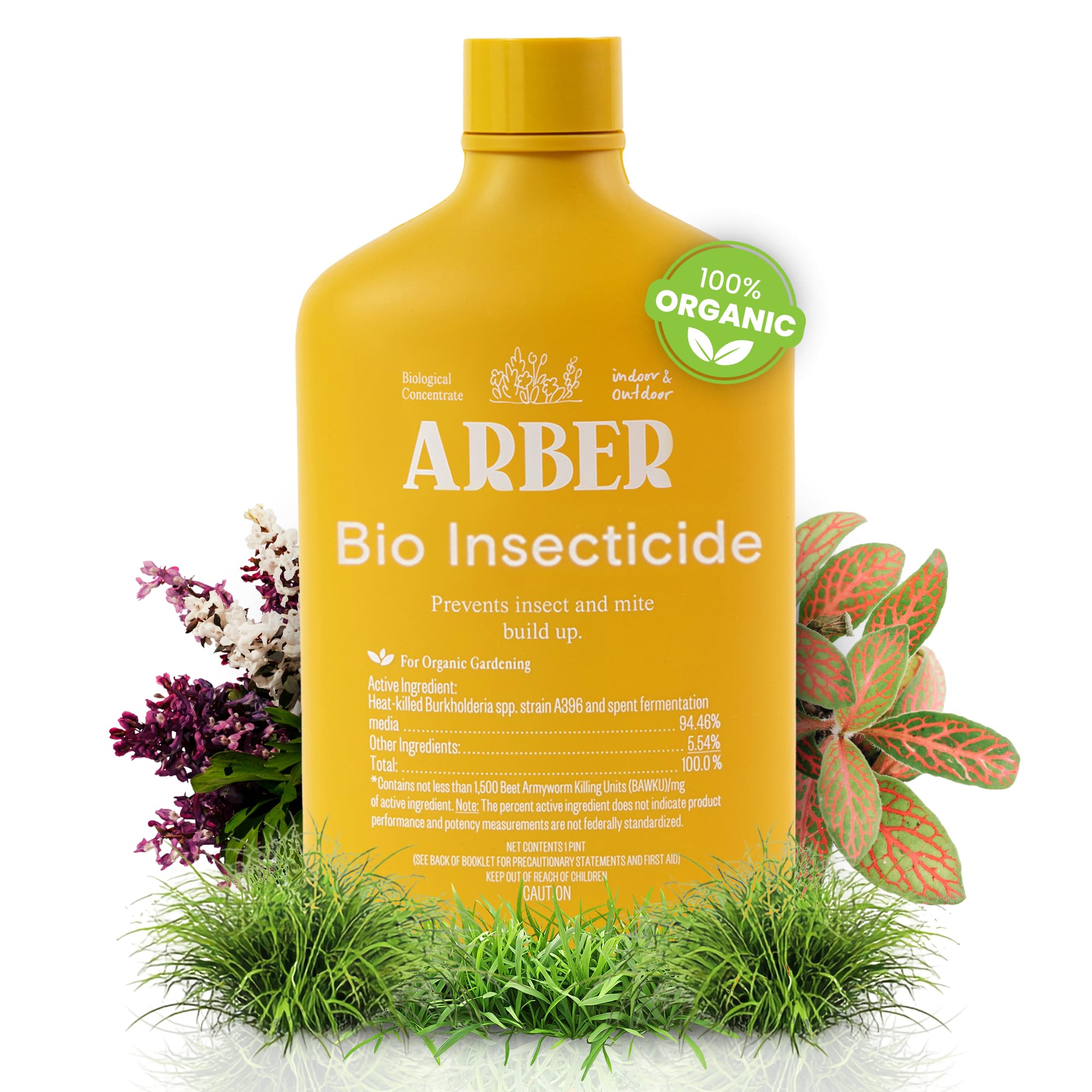
A biological approach using living microorganisms to disrupt the pest life cycle without harsh chemicals.
This liquid concentrate uses organic biologicals (living or naturally derived microorganisms) to penetrate both foliage and soil, breaking the whitefly life cycle while supporting the root zone’s microbiome. It is customizable — you can use a lighter mix for weekly maintenance or a stronger ratio when flare-ups happen. It works indoors on houseplants or outdoors in garden beds.
The downside? Results are not instant. One buyer found that using Arber’s combo of insecticide plus fungicide and spraying every 5 days killed both larvae and adults after 3 applications, calling it more cost-effective long-term. Another reviewer with 70+ houseplants had the opposite experience, reporting the product increased gnats rather than reducing them — so expectations depend on your specific infestation.
Compared to the Safer soap below, this is gentler on the soil ecosystem but requires more patience and consistency. You will need to stick to a schedule of spraying every 5 days during active outbreaks.
What makes it unique
- Low-odor and dye-free formulation
- Suitable for indoor and outdoor use
- Customizable dilution for different plant types
What buyers caution
- Mixed results on fungus gnats according to reviews
- Some users reported spray mix growing mold in the bottle after a week
- Needs consistent repeat applications for full effect
Reach for this if: You want an organic biological option that works indoors and out, and you are willing to follow a strict 5-day spray schedule.
Look elsewhere if: You need an immediate knockdown or are dealing with a severe infestation that needs faster action.
3. Safer 5118-6 Insect Killing Soap Concentrate

Simple chemistry — potassium salts of fatty acids (a special soap) — that dehydrates whiteflies on contact, safe enough for harvest day.
This uses potassium salts of fatty acids — basically a specially formulated soap — to weaken the whitefly’s outer shell, causing it to dehydrate and die. It kills on contact, meaning you need to spray directly onto the insects, especially the undersides of leaves where whiteflies cluster. It is OMRI Listed (approved for organic gardening) and compliant for organic gardening.
Owners mention it works fast: one reviewer noted “this product works, got rid of the white fly on my gardenias.” Another saw 90% of aphids dead by day one and all gone by day three. The key is getting the dilution right — 2.5 oz per gallon for general use, and avoid spraying in hot sun to prevent leaf burn.
Unlike the Bonide systemic above, this is a contact killer only, so you need to reapply every 5-7 days while whiteflies are present. But you can use it on vegetables and herbs right up to the day of harvest, which the systemic cannot do.
Why gardeners trust it
- Use on flowers, herbs, vegetables, houseplants, trees, and shrubs
- Does not kill beneficial insects when used correctly
- Can be used up to harvest day
What to watch for
- Strong smell reported by some buyers
- May solidify in cold storage (easily remelted)
- Only kills on contact — no residual protection
Perfect for edible gardens: If you grow vegetables, herbs, or fruit and want an organic contact killer you can use right up to harvest.
Consider the trade-off: You will need to reapply every 5-7 days since it does not protect new growth.
4. Organic Insecticide & Fungicide for Plants – Evergreen Way

One concentrate that tackles both insect pests and fungal diseases at the same time, saving you a separate spray step.
This is a bio-based formula that works as both an insecticide and a fungicide — so if whiteflies have brought powdery mildew or other leaf diseases along with them, you handle both problems in a single spray. It covers mites, aphids, whiteflies, thrips, and fungus gnats while also suppressing powdery growths on the leaves.
Buyers praise how fast it works: one buyer mentioned 10 drops in 32 oz of water killed bugs on contact in 5-10 seconds, causing them to shrivel. Another noted that nightly application eliminated aphids and reduced caterpillars and gnats, and the fungicide side promoted lush green growth with no leaf burn. The concentrate is economical — it yields multiple refills for weekly care.
Compared to the Safer soap which is purely an insecticide, this dual-action formula gives you more value if you routinely deal with both pests and fungus. Just be aware that the fungicide component is thicker and has a stronger smell than the insecticide part alone.
Best feature
- Two-in-one spray saves time and money
- Safe for vegetables, herbs, ornamentals, and lawns
- Protects pollinators when used as directed
Small drawbacks
- Fungicide component has a noticeable smell
- Needs consistent application schedule for best results
Smart choice for dual problems: Go this route if whiteflies and fungal issues like powdery mildew are both messing with your plants.
Not essential if: You only have whiteflies and no sign of fungal disease — a simpler insecticide may be enough.
5. Bonide Captain Jack’s Neem Oil, 128 oz Ready-to-Use
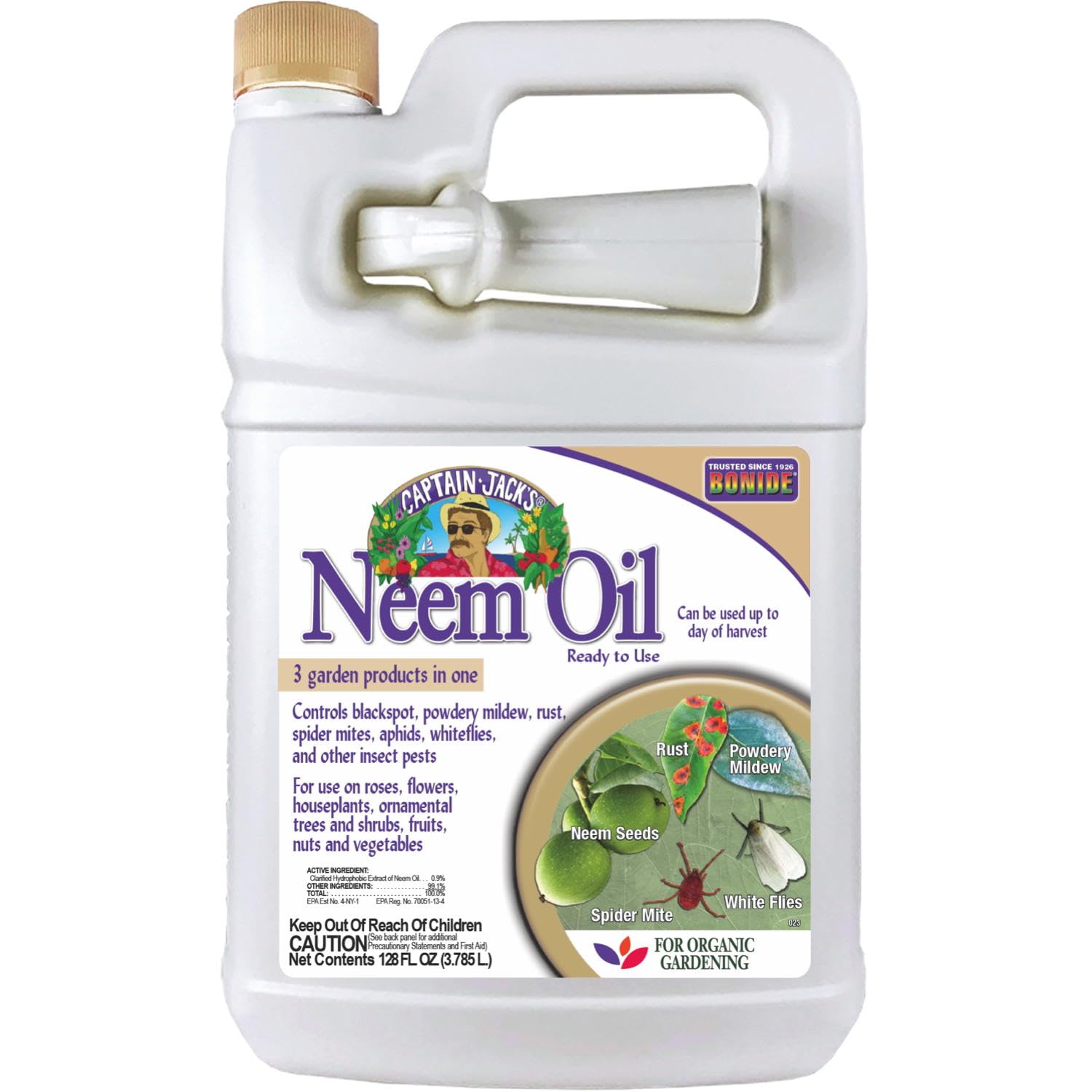
A massive ready-to-use jug (128 oz) that handles everything — insects, mites, and fungus in one pass without mixing.
This is the grab-and-go option for gardeners who do not want to mix concentrates. The 128 oz bottle comes with a spray nozzle, and you simply shake it, spray, and reapply every 7-14 days. The active ingredient is Clarified Hydrophobic Extract of Neem Oil, which kills eggs, larvae, and adults of spider mites, aphids, whiteflies, and more. It also controls common fungal diseases like rust and powdery mildew.
Buyers have mixed feelings on the smell — one described it as “eggy like smell,” while another said “no smells.” It works against insects slowly over time rather than instantly; one owner reported it took about a month to notice fewer flies, spiders, and worms. When used consistently, it kept fungus gnats away from seedlings effectively. It can be used up until the day of harvest on fruits, nuts, and vegetables.
Unlike the Ortho dust which is a dry powder, this is a wet spray that coats leaves evenly. The 128 oz size is good for larger gardens, but if you only have a few houseplants, a smaller bottle would be more practical.
Why it stands out
- Ready-to-use with spray nozzle included
- Triple action as fungicide, insecticide, and miticide
- Approved for organic gardening
What to know
- Some customers note a noticeable egg-like smell
- Works slowly — results may take a month
- Heavy jug at 8.98 pounds
Pick this if: You want a no-mix, ready-to-spray organic solution that covers both insects and fungus across a large garden.
pass on it if: You need fast knockdown — the neem oil works gradually over time.
6. Ortho Insect Killer Flower and Vegetable Garden Dust

A dust that kills on contact and then keeps protecting for up to 8 months through weather, covering the most ground per dollar.
This is a powder that you apply with a duster to cover both upper and lower leaf surfaces with a thin, even film. It kills on contact and then continues protecting for up to 8 months. One 1.75 lb container covers up to 1,300 sq. ft. in vegetable gardens and up to 3,500 sq. ft. on ornamentals and shrubs — making it the best value for covering large areas.
Buyers rave about its speed: one customer observed that “12 hours after using this powder with a duster, there isn’t a single flea beetle to be seen.” Another said it saved their tomatillos from flea beetles after Malathion failed. The trick is applying on a calm day — wind will blow the dust back onto you. You will need to reapply after heavy rain, but the residual protection is impressive.
The main trade-off versus the liquid sprays above is that you need a separate duster tool for even application, and you must be careful about timing to avoid harming bees — applying at night gives the dust time to settle before bees return in the morning.
What buyers love
- Kills listed insects on contact and protects up to 8 months
- Excellent large-area coverage — up to 3,500 sq. ft.
- Saved gardens from cucumber beetles and flea beetles per reviews
Application tips from users
- Wind can blow dust onto you — apply on calm days
- Reapply after heavy rain for continued protection
- Bees stay away for a couple days after application, so apply at night
Best for big gardens: If you have a large area to protect and want long-lasting residual control with one application.
Not ideal for: Small indoor spaces or precise spot treatments where a spray is easier to control.
Understanding the Specs
Contact vs Systemic
A contact insecticide kills whiteflies only when it directly hits them. You need thorough coverage on the undersides of leaves, and you will reapply every 5-7 days. A systemic insecticide is absorbed by the plant’s roots or leaves and spreads through the sap — whiteflies die when they feed, even if your spray missed them. Systemics last longer but cannot be used on edibles if the label says so.
Active Ingredient
This is the chemical or biological compound that actually kills the pest. Potassium salts of fatty acids (soap) dehydrate soft-bodied insects on contact. Neem oil (Clarified Hydrophobic Extract of Neem Oil) suffocates insects and disrupts their life cycle. Biological concentrates use living organisms to disrupt pest populations gradually. Always check the active ingredient to know exactly how the product works.
Coverage and Dilution
A concentrate gives you more for your money because you mix it with water — for example, Bonide’s systemic makes 16 gallons of finished spray. Ready-to-use options cost more per gallon but need zero prep. Dust products cover a specific square footage (like up to 3,500 sq. ft. for ornamentals) and last through weather without needing to be mixed.
OMRI Listing and Organic Compliance
OMRI (Organic Materials Review Institute) Listed means the product is approved for use in organic gardening. That matters if you grow food, because you know the active ingredients come from natural sources and do not leave synthetic residues. Products without OMRI listing may still be safe but have not gone through that certification.
FAQ
What kills whiteflies instantly on contact?
Can I use systemic insecticide on vegetable plants for whiteflies?
How often should I spray for whiteflies?
Do organic whitefly insecticides work as well as chemical ones?
Will whitefly insecticide hurt my plants?
Why do whiteflies keep coming back after I spray?
Can I use the same whitefly spray on indoor houseplants?
What is the difference between neem oil and insecticidal soap for whiteflies?
Will whitefly treatment harm bees and other pollinators?
How do I apply garden dust for whiteflies properly?
Final Thoughts: The Verdict
For most gardeners, the best insecticide for whiteflies is the Bonide Systemic Insect Control because its systemic action keeps killing whiteflies from the inside out for weeks with fewer applications. If you grow vegetables and need an organic contact spray, grab the Safer Insect Killing Soap. And for large ornamental gardens where you want months of protection from a single dusting, the Ortho Garden Dust covers the most ground per dollar.
How We Picked
We do not accept paid placement. Every pick is matched to a real buyer and a real use-case; we do not hands-on test units.
Sources & Methodology
Specifications: manufacturer listings and product documentation. Review insights: verified customer reviews, as of July 2026. Pricing: not shown on this page (it changes often); check the current price via the retailer link.
As an Amazon Associate, Lawn Gear Lab earns from qualifying purchases. This does not affect which products we feature.