
Specs are compiled from manufacturer listings and verified buyer reviews and can change over time — please confirm the key details on the product page before buying.
Getting a thick, vibrant green hedge starts at the roots, but picking the wrong feed is like giving your shrubs fast food when they need a balanced meal. You need something that delivers steady nutrition without burning the roots or washing away after one rain. This guide breaks down the top performers in liquid, granular, and spike forms so you can match the fertilizer to your soil type and your schedule.
I’m Rikta — the founder and writer behind Lawn Gear Lab. This guide is built by comparing the manufacturers’ published specifications and the patterns across verified customer reviews, so you get each pick’s real strengths and trade-offs instead of marketing spin.
Whether you have a row of arborvitae or a mixed shrub border, you want a product that actually boosts growth and color without complicated mixing. Let’s find the right fertilizer for hedges that turns your yard into a lush, private sanctuary.
Quick Picks
- Nelson NutriStar 21-6-8 Granular Fertilizer (4 lb) — Best Overall
- Espoma Evergreen-Tone 4-3-4 Organic Fertilizer (18 lb) — Best Organic
- Jobe’s 16-4-4 Tree Fertilizer Spikes (30 Count) — No-Mix Champion
- TPS Nutrients Arborvitae Tree Fertilizer (32 oz Liquid) — Quick Drench
- Old Farmer’s Almanac Tree & Shrub Fertilizer Spikes — Clay-Buster
- SimplyGro Evergreen Fertilizer Spikes 12-3-3 — Time-Release Specialist
How To Choose The Best Fertilizer For Hedges
Not all hedge feeds work the same way. The wrong choice can leave you with yellow leaves, weak roots, or even burned plants. Here are the three things to check before you buy.
N-P-K Ratio — The Three Numbers That Matter
The three numbers on the bag (like 16-4-4) stand for Nitrogen (N), Phosphorus (P), and Potassium (K). Nitrogen (the first number) drives leafy green growth, which is exactly what you want for thick hedges. Phosphorus helps roots and blooms, while Potassium builds overall plant health. For most hedges and evergreens, a higher first number (nitrogen) is ideal to push dense foliage.
Liquid, Granular, or Spikes — Which Delivery Suits You?
Liquid feeds act fast because the nutrients go straight into the soil and roots, but you need to reapply every couple of weeks. Granular options release slowly over weeks, though some need to be worked into the soil. Spikes offer a “low-maintenance” approach — you hammer them into the ground during spring and fall and they feed for months without mixing or mess.
Soil Type and Drainage
Sandy soil drains quickly and loses nutrients fast, so you need a slow-release or time-release formula that can last. Clay soil holds nutrients longer but can compact, making it hard for roots to absorb the feed. A granular option with multiple release rates or a liquid you can water in well will work in both conditions.
Quick Comparison
| Model | Best For | N-P-K Ratio (Nitrogen-Phosphorus-Potassium) | Form | Unit Count | Amazon |
|---|---|---|---|---|---|
| Nelson NutriStar 21-6-8 | Fast green-up on struggling shrubs | 21-6-8 | Granules | 64 Ounce | Amazon |
| Espoma Evergreen-Tone 4-3-4 | Organic feeding over months | 4-3-4 | Granules | 18 lb | Amazon |
| Jobe’s 16-4-4 Spikes | Zero-mess season-long feeding | 16-4-4 | Spikes | 30 Count | Amazon |
| Arborvitae Tree Fertilizer 32 oz | Sandy soils needing quick absorption | — | Liquid | 32.0 Ounce | Amazon |
| Old Farmer’s Almanac 13-3-3 | Hard clay soil where spikes hold firm | 13-3-3 | Spikes | 24 Count | Amazon |
| SimplyGro Evergreen 12-3-3 | Time-release nitrogen for poor soil | 12-3-3 | Spikes | 24.0 Count | Amazon |
In‑Depth Reviews
1. Nelson NutriStar 21-6-8 Granular Fertilizer (4 lb)
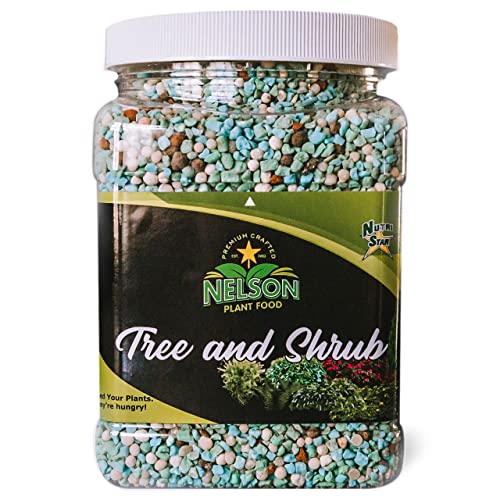
The granular powerhouse that turned yellow boxwoods green in two days.
If you need fast, dramatic results on struggling shrubs, this is the granular feed to grab. The 21-6-8 ratio (21% Nitrogen, 6% Phosphorus, 8% Potassium) is high in nitrogen to push out dense green leaves, and it uses five different nitrogen sources that release at different speeds so the feed lasts for weeks. Buyers report that “within two weeks, anemic, yellow, dying plants turned into thriving, bright green, shiny shrubbery.” It comes in a 64-ounce bag (4 pounds) and covers both in-ground and container plants.
Unlike the milder Espoma organic option below, the Nelson formula hits hard with 21% nitrogen — so you see results fast, though the bag is smaller at 4 lb versus Espoma’s 18 lb. You will need to reapply every 30 days during the growing season for continuous feeding.
Speed champion: Best pick if you have visibly yellow or stressed shrubs and want green-up in days, not weeks.
One trade-off: The bag size is smaller than the Espoma, so if you have a long hedge row you will buy more bags over the season.
Grab this if: Your hedges look anemic and need a quick, visible revival with a high-nitrogen granular feed.
Pass on it if: You prefer a single seasonal application and do not mind waiting a little longer for results — a slower-release formula might suit you better.
2. Espoma Evergreen-Tone 4-3-4 Organic Fertilizer (18 lb)

An 18-pound organic feed that makes evergreens bright green in just weeks.
This is the set-and-trust organic option for anyone who wants natural ingredients without mixing. The 4-3-4 ratio (4% Nitrogen, 3% Phosphorus, 4% Potassium) is gentle but effective — one reviewer noted “it made my evergreens bright green just after a couple of weeks!” The 18-pound bag covers a lot of ground, and it is approved for organic gardening. It contains a proprietary Bio-tone formula (a blend of beneficial microbes that supports root development), plus 5% sulfur for acid-loving evergreens like pines and azaleas.
The Espoma is a milder feed compared to the Nelson granular above — 4-3-4 versus 21-6-8 — so results are slower, but the huge 18 lb bag and organic certification make it a better fit for larger hedges and users who avoid synthetic chemicals. One buyer mentioned the smell is a bit “barnyard” due to chicken manure, but the plants love it.
Why it stands out
- Approved for organic gardening
- Large 18 lb bag covers long hedge rows
- Safe for needle and broadleaf evergreens
The honest limits
- Mild ratio means slower results than synthetic high-nitrogen feeds
- Noticeable barnyard smell during/after application
Reach for this if: You want an organic, large-bag feed that safely greens up evergreens without a harsh chemical burn.
Look elsewhere if: You need lightning-fast results on near-dead shrubs — a higher-nitrogen granular like the Nelson is a better bet.
3. Jobe’s 16-4-4 Tree Fertilizer Spikes (30 Count)

Hammer them in once in spring and the shrubs are fed all season long.
These spikes are the ultimate low-effort solution for busy homeowners. The 16-4-4 ratio (16% Nitrogen, 4% Phosphorus, 4% Potassium) is high in nitrogen to push leafy growth, and the spikes release slowly underground so there is no runoff, no mixing, and no measuring. Owners mention that you can literally “low-maintenance…..actually pound them into the ground and they will work for the year.” The 30-count box provides enough spikes for several shrubs or a few young trees.
Compared to the liquid Arbowitae fertilizer below, the Jobe’s spikes deliver a much higher nitrogen ratio (16-4-4 vs an unlisted ratio) and last longer — a single application feeds for the whole growing season rather than needing biweekly mixing. They do require damp soil and a mallet to install in hard ground, but the convenience is class-leading.
easy feeding: Ideal if you want to apply once in spring and forget about it, with no risk of over-fertilizing.
The catch: If your soil is extremely hard or rocky, you may need to pre-drill a hole before hammering the spike in.
Best for: Anyone who dislikes mixing liquids or spreading granules — just pound and go.
skip it if: Your shrubs are already in a serious decline and need a fast-acting liquid drench to bounce back quickly.
4. TPS Nutrients Arborvitae Tree Fertilizer (32 oz Liquid)
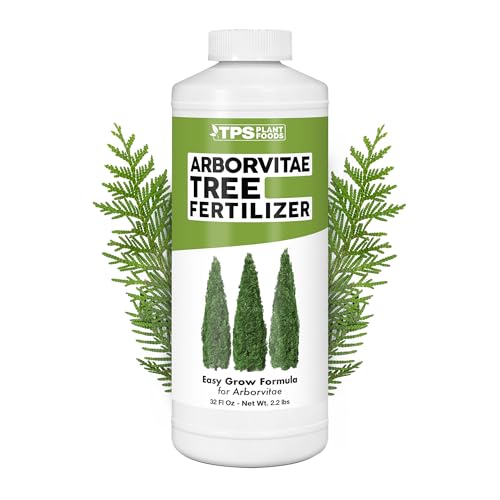
A 32 oz liquid that soaks into sandy soil where spikes cannot keep up.
For sandy or fast-draining soil, liquid fertilizer is often the only way to get nutrients down to the roots quickly. This 32-ounce concentrate from TPS Nutrients mixes at a rate of 2 tablespoons per gallon and is formulated specifically for arborvitae and other evergreens. One buyer in sandy soil noted it “outperformed fertilizer spikes” and that “biweekly feeding revived dying branches, boosted growth.” It also survived a Chicago winter where nearby unfertilized trees died, per the same reviewer.
At 32 ounces, the TPS liquid is a smaller unit count than the Nelson granules (64 ounces), meaning you get less volume for the money and need to reapply more often. But for trees that are actively dying or in very poor soil, the liquid form delivers immediate relief that a spike cannot match — fast absorption with no waiting for breakdown.
Why it works
- Fast-acting liquid penetrates sandy or poor soil quickly
- Biweekly feeding schedule revives stressed trees
- Easy to mix and apply with a watering can or hose
The honest limits
- Requires repeated applications every two weeks
- May be ineffective on trees that are already dead or nearly dead
When to pick it: Your hedges are in sandy or nutrient-leaching soil and need immediate rescue with a liquid that soaks in fast.
Otherwise: If you prefer a one-time seasonal feed and have decent soil, a granular or spike option saves you the mixing time.
5. Old Farmer’s Almanac Tree & Shrub Fertilizer Spikes (24 Count, 6 lb)
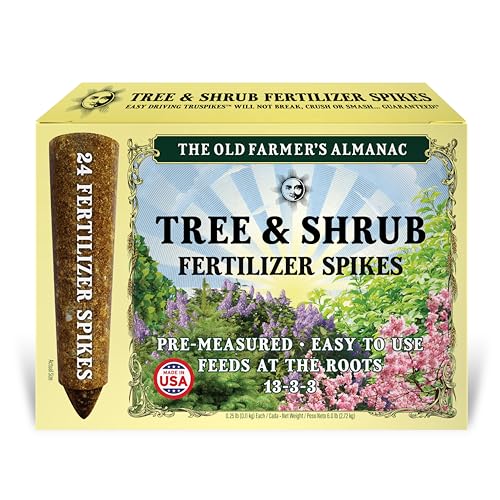
Tough 5-inch spikes that stay intact even when hammered into hard clay.
Clay soil is dense and can crush weaker fertilizer spikes before they even go in. The Old Farmer’s Almanac spikes are built to handle it — customers note they “stay intact even when I use a mallet to bang them into clay soil.” The 13-3-3 ratio (13% Nitrogen, 3% Phosphorus, 3% Potassium) provides a solid 13% nitrogen for leaf growth, with natural ingredients like molasses that feed the root zone directly. The pack contains 24 spikes weighing 6 pounds total, and each spike is 5 inches long for deep placement.
These spikes have a slightly lower nitrogen percentage (13-3-3) than the Jobe’s option above (16-4-4), but they include natural ingredients and a tougher build that survives rocky or compacted ground. One owner reported they cracked during hammering, so pre-drilling a pilot hole is recommended for very hard soil.
Tough build: A great fit for clay soil or rocky ground where softer spikes crumble on impact.
Heads up: The spikes can crack during hammering — dig a small pilot hole first for the smoothest installation.
Reach for this if: You have clay or hard soil that destroys ordinary spikes and you want a natural-ingredient formula that stays tough.
Otherwise: For soft, loose soil the Jobe’s spikes are easier to install and have a higher nitrogen ratio.
6. SimplyGro Evergreen Fertilizer Spikes 12-3-3 (24 Count, 6.0 lb)
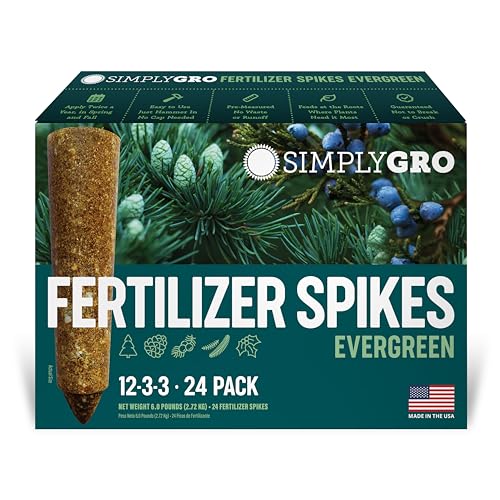
Spikes engineered for sandy soil that loses nitrogen every time it rains.
If your yard is mostly sand, nitrogen leaches out fast. This SimplyGro spike uses a 12-3-3 formula (12% Nitrogen, 3% Phosphorus, 3% Potassium) that time-releases for up to 3 months per application, so the feed stays in the root zone even after heavy watering. One buyer in sandy soil confirms “these time-release nitrogen spikes keep soil fertile for months” and turned sparse, dying fruit trees into lush, thriving plants. The pack holds 24 spikes at 6.0 pounds, and each 5-inch spike is a patented TruSpike design that should not break or crumble.
Compared to the TPS liquid (which also works in sandy soil), the SimplyGro spikes require far less effort — apply twice a year (spring and fall) instead of biweekly mixing. The nitrogen is lower at 12% versus the Nelson granular’s 21%, but the long release period makes up for the slower delivery.
Why it shines
- Continuous 3-month feeding with one application
- Pre-measured spikes prevent over-fertilizing
- Ideal for nitrogen-deficient sandy soil
The honest limits
- Lower nitrogen ratio than Jobe’s or Nelson — slower initial green-up
- Not recommended for very dense clay without a pilot hole
Pick this if: You have sandy soil that drains everything away, and you want a low-maintenance spike that keeps feeding for months.
pass on it if: Your shrubs need an immediate nitrogen jolt — a liquid or high-ratio granular will deliver faster visible results.
Understanding the Specs
N-P-K Ratio (Nitrogen-Phosphorus-Potassium)
This is the fertilizer’s nutritional label — three numbers representing the percentage of Nitrogen (first), Phosphorus (second), and Potassium (third) in the mix. For hedges and evergreens, Nitrogen (the first number) is the most important because it drives leafy green growth. A ratio like 16-4-4 means 16% nitrogen, 4% phosphorus, and 4% potassium. High-nitrogen blends (above 15%) give fast greening, while lower ratios (4-6%) are gentler and work well for organic feeding.
Time Release vs Immediate
Some formulas release all their nutrients at once when you water them in (immediate), while others use coated granules or spikes that dissolve slowly over weeks or months (time release). Time-release feeds reduce the risk of burning the roots and mean fewer applications — a good choice if you want to feed just twice a year. Immediate-release liquids are better for rescue feeding because the plant gets nutrients right away.
FAQ
How often should I fertilize my hedges?
Can I use lawn fertilizer on my hedges?
What does the N-P-K ratio (Nitrogen-Phosphorus-Potassium) mean for hedge feeding?
Are fertilizer spikes better than granular for hedges?
What is the best fertilizer for arborvitae hedges?
Can I over-fertilize my hedges?
Do I need a special fertilizer for evergreens?
How long do fertilizer spikes last in the soil?
What if my hedge is planted in sandy soil?
Can I use these fertilizers on potted hedges?
Final Thoughts: The Verdict
If you want one dependable pick, the fertilizer for hedges winner is the Nelson NutriStar 21-6-8 because its five-source nitrogen formula delivers fast, dramatic green-up on struggling shrubs without complicated mixing. If you prefer organic gardening and a huge 18 lb bag, grab the Espoma Evergreen-Tone 4-3-4. And for a true no-fuss experience, the Jobe’s 16-4-4 Spikes will keep your hedges fed all season with zero measuring or mess.
How We Picked
We do not accept paid placement. Every pick is matched to a real buyer and a real use-case; we do not hands-on test units.
Sources & Methodology
Specifications: manufacturer listings and product documentation. Review insights: verified customer reviews, as of July 2026. Pricing: not shown on this page (it changes often); check the current price via the retailer link.
As an Amazon Associate, Lawn Gear Lab earns from qualifying purchases. This does not affect which products we feature.