
Specs are compiled from manufacturer listings and verified buyer reviews and can change over time — please confirm the key details on the product page before buying.
You water your vegetables every day, but if the leaves are yellowing or the tomatoes stay small, the missing link is probably the nutrients your soil can’t supply on its own. The right liquid feed delivers that boost straight to the roots without the guesswork of granular mixes.
I’m Rikta — the founder and writer behind Lawn Gear Lab. This guide is built by comparing the manufacturers’ published specifications and the patterns across verified customer reviews, so you get each pick’s real strengths and trade-offs instead of marketing spin.
Whether you are feeding a backyard patch or a raised-bed garden, finding the best organic liquid fertilizer for vegetables means balancing nutrient content, ease of mixing, and how well the formula supports steady growth without burning delicate roots.
Quick Picks
- True Organic Liquid All Purpose Plant Food — Best Overall
- Neptune’s Harvest Fish & Seaweed Liquid Fertilizer — Top Performer
- FOOP Organic All-Purpose Liquid Plant Food — Soil Champion
- Great Big Tomatoes and Vegetables Liquid Fertilizer Booster — Yield Booster
- Alaska Fish Fertilizer OMRI Listed 5-1-1 — Heavy Feeder
- The Grow Co Organic Fish Emulsion Fertilizer 1 Gallon — Gallon Value
How To Choose The Best Organic Liquid Fertilizer For Vegetables
Every vegetable garden needs a different nutrient balance depending on what you are growing. Leafy greens like lettuce and spinach want more nitrogen (the first number). Tomatoes, peppers, and squash need higher phosphorus (the second number) to set fruit. A liquid fertilizer lets you adjust without waiting for granules to dissolve.
NPK Ratio — The Three Numbers That Matter
The NPK ratio tells you the percentage of nitrogen, phosphorus, and potassium by weight in the bottle. A formula like 5-1-1 is heavy on nitrogen and good for early-season green growth. A 2-3-1 is more balanced and works for flowering and fruiting stages. A 1-1-1 or similar low-number ratio means more concentrated nutrients that require less product per feeding.
What The Bottle Is Made From
Most liquid organic fertilizers are derived from fish emulsion, seaweed (kelp), soy protein hydrolysate, or a blend. Fish-based formulas supply nitrogen quickly but have a strong smell that lasts a day or so after application. Kelp and plant-based blends tend to smell milder and also add trace minerals. Blended products like fish plus seaweed give you the benefits of both without the full pungent odor of straight fish emulsion.
Certification and Label Claims
If you follow organic gardening practices, look for the OMRI (Organic Materials Review Institute) seal on the bottle. This third-party verification means the ingredients meet organic production standards. Some brands also list “OMRI Listed” in their spec sheet. Without that seal, the product may still contain plant-derived ingredients but hasn’t gone through the formal certification process.
Quick Comparison
| Model | Best For | NPK Ratio | Bottle Size | Mixing Ratio | Amazon |
|---|---|---|---|---|---|
| True Organic All Purpose Plant Food | Daily balanced feeding | 3-2-2 | 32 fl. oz. | 2 oz per gallon | Amazon |
| Neptune’s Harvest Fish & Seaweed | All-around growth boost | 2-3-1 | 36 fl. oz. | 1 oz per gallon | Amazon |
| FOOP Organic All-Purpose | Soil enrichment with microbes | — | 32 fl. oz. | 1 oz per 32 fl oz water | Amazon |
| Great Big Tomatoes and Vegetables | Massive tomato yields | — | 32 fl. oz. | 1 tbsp per pint water | Amazon |
| Alaska Fish Fertilizer | Long-lasting large garden feed | 5-1-1 | 115 fl. oz. | Every 3 weeks | Amazon |
| The Grow Co Fish Emulsion | High-volume garden feeding | 2-3-1 | 128 fl. oz. | 1:100 (water to fertilizer) | Amazon |
In‑Depth Reviews
1. True Organic Liquid All Purpose Plant Food
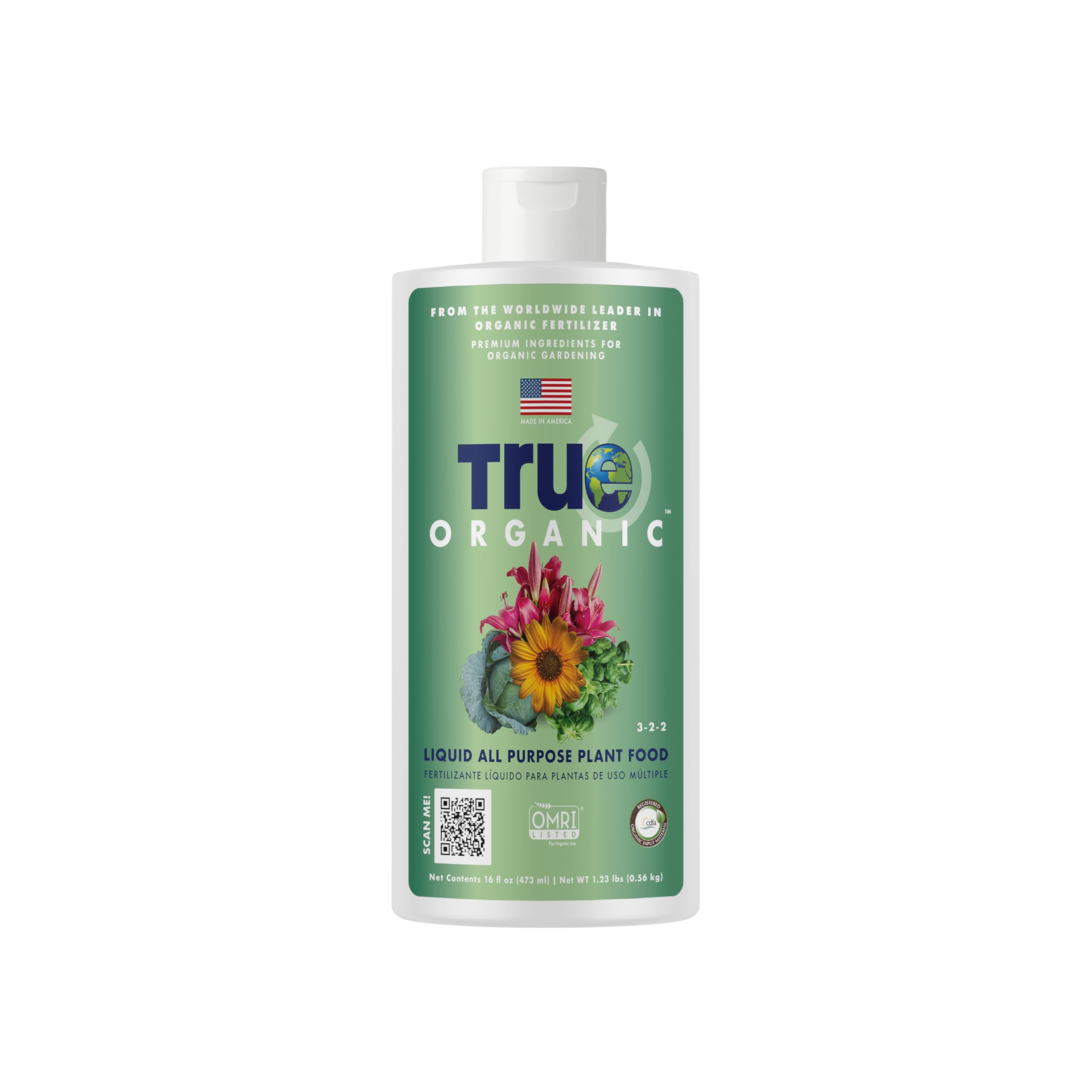
A balanced, odor-friendly feed that makes houseplants and veggie beds thrive without the fishy downside.
Your vegetables get a steady 3-2-2 NPK mix from fish solubles, soy protein hydrolysate, and kelp extract — all feeding the roots without harsh chemicals. The 32-ounce bottle covers roughly 60 square feet when you mix 2 ounces per gallon of water every two weeks during the growing season. Buyers report that after switching from cow manure, their plants became “HUGE, beautiful, bountiful” with the same simple routine.
You get a nearly odorless fertilizer once it is mixed into the soil, so it works well indoors or near patios where a fishy smell would be a problem. Owners mention a “strong smell” from the fresh concentrate, but that fades quickly after you water it in. This bottle holds 32 ounces, which is 4 ounces less than the 36-ounce Neptune’s Harvest (a 12% smaller quantity), so you trade a little volume for a formula that suits both indoor and outdoor vegetable gardens.
You get a gentler feed with 3% nitrogen, compared to the Alaska Fish Fertilizer 5-1-1 which has 5% nitrogen. That means this fertilizer works for both leafy greens and fruiting plants without pushing too much foliage at the expense of flowers.
Why This One Works
- Balanced 3-2-2 NPK works for all plant growth stages
- Nearly odorless after watering — good for indoor use
- Organic inputs (fish solubles, soy protein hydrolysate, kelp) feed soil structure
A Couple of Things to Know
- One reviewer noted a strong smell from the undiluted concentrate itself
- Lower nitrogen than high-N formulas, so less ideal for pure leafy green gardens
Reach for this if: You want a versatile, low-odor organic feed that works on everything from houseplants to a vegetable patch without separating bottles by crop type.
Look elsewhere if: You need a high-nitrogen boost specifically for leafy greens — the 3% nitrogen will support growth but won’t push foliage as fast as a 5-1-1.
2. Neptune’s Harvest Fish & Seaweed Liquid Fertilizer (2-3-1)
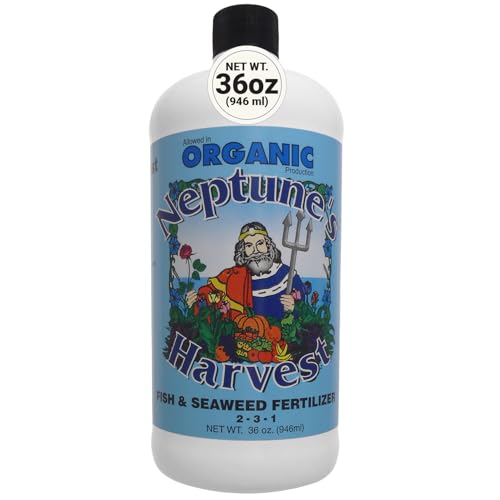
The classic fish-plus-seaweed blend that gardeners trust for higher yields and deeper soil health.
Your goal here is consistent, balanced feeding through the entire season, and Neptune’s Harvest delivers with a 2-3-1 NPK derived from 75% hydrolyzed fish and 25% seaweed. The 1-ounce-per-gallon mixing ratio actually requires less concentrate per feeding than the 2-ounce rate of the True Organic, so the 36-ounce bottle goes further. Customers note that “a little goes a long way” and that pepper plants respond especially well.
What sets this apart from the True Organic is the inclusion of seaweed extract, which provides additional trace minerals and growth hormones (auxins and cytokinins) that improve root development and stress tolerance. The fish and seaweed together also build organic matter in the soil, feeding beneficial bacteria and making the soil looser and better-draining over time. The catch is that because the product is primarily fish, the smell is noticeably stronger than the plant-based blends — one reviewer called it “stinky.” It works best on outdoor gardens where the odor dissipates within a day.
Compared to the Great Big Tomatoes fertilizer, which targets fruit production with humic acid and minerals, this one is more of a general-purpose soil builder. It supports both foliage and fruits across vegetables, flowers, trees, and lawns — a flexible option if you grow a mix of crops.
Who it fits: Gardeners who want an OMRI-listed, time-tested fish blend that improves soil structure while feeding plants — ideal if you grow a variety of vegetables and don’t mind a bit of fish odor.
One honest trade-off: The strong smell means this is really an outdoor-only product; using it on indoor plants could be unpleasant for a day or two.
3. FOOP Organic All-Purpose Liquid Plant Food

A microbiome booster that gives your soil beneficial fungi and bacteria along with basic nutrients.
Most liquid fertilizers deliver only the three primary macro-nutrients (N, P, K). This one from FOOP also packs in mycorrhizae (beneficial fungi that extend the root system) and a broad spectrum of microbes, plus calcium, magnesium, and silica — all from ingredients like fish emulsion, kelp, and fish manure. Reviewers point out that their garden “thrives despite poor weather” and that the formula effectively revives plants suffering from heat damage.
The value here lies in the 1:32 mixing ratio, which makes one 32-ounce bottle produce 32 gallons of diluted feed. That’s more coverage than the True Organic’s 60-square-foot claim per bottle. Reviewers also note the smell is “tolerable” and milder than pure fish emulsions, so it won’t drive you away from the garden after application. One buyer mentioned that while the small bottle size is compact, it is still effective and affordable for budget-conscious users.
Compared to the pure fish formulas above, this is a smarter pick if you are trying to rebuild weak or compacted soil. The mycorrhizae and microbes colonize the root zone and help plants access nutrients already in the ground, rather than just dumping synthetic-soluble nitrogen.
Standout Strengths
- Mycorrhizae and microbes actively improve soil structure and root access
- Mild smell — much more tolerable than straight fish-based fertilizers
- High dilution ratio means a single bottle makes 32 gallons of feed
Consider This
- No NPK ratio listed on the product data, so you can’t dial in specific nutrient levels for different growth stages
- The bottle is small for the price — one buyer wished it were larger for the cost
Choose this if: Your soil is tired or compacted and you want a live-microbe formula that rebuilds the underground ecosystem along with feeding the plants.
skip it if: You need precise NPK numbers to manage a targeted feeding schedule — without those values on the label, you are guessing on nutrient ratios.
4. Great Big Tomatoes and Vegetables Liquid Fertilizer Booster
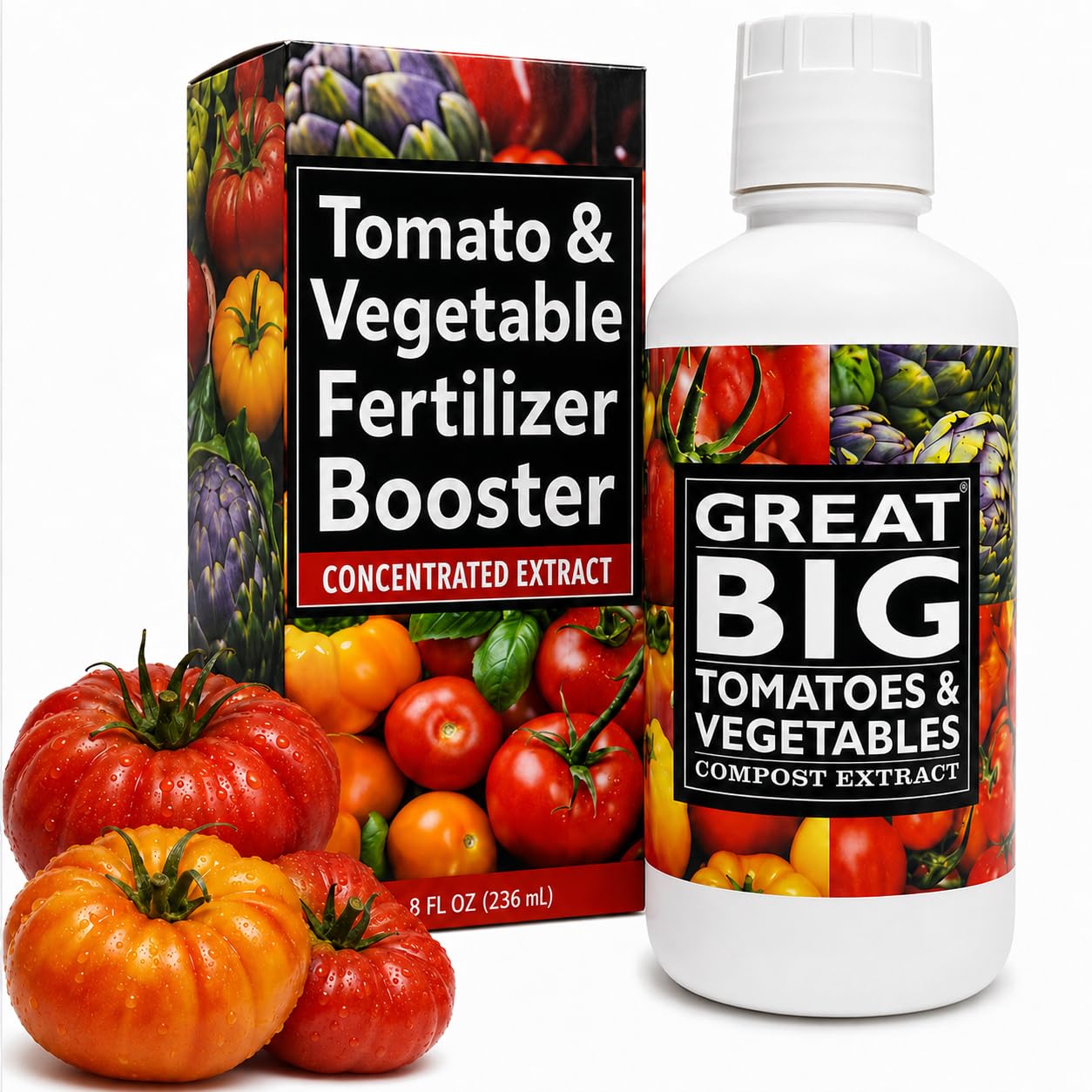
A humic-acid-rich compost extract that targets tomatoes specifically and delivers 70 chelated trace minerals.
If you grow tomatoes, this is the specialist pick. The proprietary formula supplies humic acid from leonardite (a mineral-rich organic sediment), over 70 chelated trace minerals, kelp seaweed, potassium sulfate, and citric acid — all designed to make soil nutrients more available to the root zone. Shoppers say achieving “1-pound-plus” tomatoes and needing “double or triple staking” to support the extra weight. One reviewer called it the “best tomato production I’ve had” in zone 8b.
The mixing ratio is 1 tablespoon per pint of water, making a concentrated formula that yields 256 feedings per gallon. Unlike the Neptune’s Harvest, which functions as a general soil builder, this one acts more like a targeted booster you apply alongside your regular fertilizer. It works for peppers, cucumbers, squash, pumpkins, and green beans too, but its real strength is pushing tomatoes past the typical size ceiling.
The catch is that it works best as an add-on, not a standalone complete fertilizer. It doesn’t carry its own balanced NPK for plant growth — it open up nutrients already in the soil. So you still need a base feed like the True Organic or Alaska Fish Fertilizer, then add the Great Big Booster to push fruiting into overdrive.
Best for dedicated tomato growers: If you want your tomato vines to produce 1-pound-plus fruit and require double staking, this booster turns up the volume on your existing fertilizer program.
Not for beginners: Since it is a supplement rather than a complete feed, you need to already be using a base fertilizer — this is a performance add-on, not a one-bottle solution.
5. Alaska Fish Fertilizer OMRI Listed 5-1-1

The high-nitrogen, large-bottle workhorse for leafy greens and big vegetable gardens.
The first thing you notice is the size — this bottle holds 115 fluid ounces and weighs 8.8 pounds, making it the largest volume in this roundup by a wide margin. The NPK of 5-1-1 is heavy on nitrogen, which fuels lush foliage growth in leafy greens, herbs, and other plants during the vegetative phase. Buyers with over a decade of experience call it “a garden staple” and report “stronger stems, vibrant leaf color, faster growth” on everything from tomatoes and peppers to berry bushes.
One 3-week application schedule covers about 1,000 square feet, so a single bottle can feed a sizable garden most of the season. The smell — characteristic of fish emulsion — is strong but one owner reported it “dissipates within a day” once watered in. This is the go-to for large gardens where a steady, predictable organic nitrogen supply matters more than precise fruit-stage nutrition. Unlike the True Organic which has a balanced NPK for all stages, this one leans hard into foliage growth, so you may need to supplement with a bloom booster when your tomatoes or peppers start flowering.
It is OMRI-listed, which gives organic growers confidence that the source meets the standard. The cold-processing method helps preserve micronutrients that heat-based processing would destroy, so the 5-1-1 you pour out is closer to what the fish naturally provides.
Why It Stands Out
- 115-ounce jug covers up to 1,000 square feet — best coverage per dollar
- 5-1-1 NPK is excellent for leafy greens, herbs, and starting transplants
- OMRI-listed organic certification
What to Watch For
- Low phosphorus and potassium (1-1) means it is not ideal for flowering or fruiting stages on its own
- The pungent fish smell is intense on application day
Get this for: Large gardens where you want one simple, high-nitrogen organic feed for the spring green-up and early growth phase — especially for leafy greens like spinach, kale, and lettuce.
Pass if: You are in the flowering and fruiting stage of tomatoes, peppers, or squash — the low phosphorus won’t support fruit set, so you would need a separate bloom feed.
6. The Grow Co Organic Fish Emulsion Fertilizer 1 Gallon

A straight-ahead fish emulsion in a gallon jug for gardeners who buy in bulk and feed heavy.
You get 128 fluid ounces — a full gallon of 2-3-1 NPK fish emulsion made from sustainably sourced fish processed with a 100% cold-pressed method that preserves amino acids and vitamins. The 1:100 mixing ratio (1 part fertilizer to 100 parts water) is the most diluted in this roundup, which means the 128-ounce bottle covers over 160 gallons of diluted feed. That is more total feeding volume than the 115-ounce Alaska despite the smaller NPK numbers.
The phosphorus-heavy 2-3-1 ratio is ideal for the flowering and fruiting stages of vegetables, so tomatoes, peppers, and zucchini get a targeted phosphorus boost without excessive nitrogen. One 50-plus-year gardener noted the consistency is “very thin” compared to other fish emulsions, which actually makes it easier to mix and pour through a watering can. The fish odor is “nasty” according to the same reviewer, but that is inherent to the emulsion process — and the manufacturer makes no apology: they state “if it doesn’t smell, then it’s not real fish.”
Compared directly to the Alaska 5-1-1, this product is the better choice for the fruiting stage of the season because the phosphorus is higher relative to nitrogen. You could use the Alaska for early leaf growth, then switch to this gallon jug for flower and fruit set without buying a different product line.
Advantages
- 128-ounce gallon covers 160+ gallons of diluted feed — best bulk value for heavy feeders
- 2-3-1 NPK is phosphorus-focused, ideal for fruiting vegetables and flowers
- 100% cold-pressed to retain all amino acids and micronutrients
Drawbacks
- Very strong fish odor — best used only outdoors and in ventilated areas
- Thin consistency means you need to be careful not to over-apply; it pours fast
Grab this for: Large-scale gardens going into the flowering and fruiting season — the 2-3-1 ratio supports production and the gallon size keeps you refilling less often.
pass on it if: You have a small balcony or indoor garden — the smell will be too strong and the 1-gallon size will outlast the growing season.
Understanding the Specs
NPK Ratio
The three dash-separated numbers (for example, 5-1-1 or 2-3-1) tell you the percentage by weight of nitrogen (N), phosphorus (P), and potassium (K) in the bottle. Nitrogen drives leaf and stem growth. Phosphorus supports root development, flowers, and fruit set. Potassium helps overall plant health, disease resistance, and water regulation. A high first number (like 5-1-1) makes for a good early-season green-up feed, while a high middle number (like 2-3-1) is better when your vegetables start setting fruit.
Mixing Ratio
This tells you how much concentrate to mix with water before applying. A ratio like 1:100 (1 part fertilizer to 100 parts water) produces a gentle, diluted feed you can use weekly. A ratio like 2 ounces per gallon means a higher concentration per feeding but usually a longer interval between applications. A more concentrated mixing ratio (like the Great Big Tomatoes’ 1 tbsp per pint) actually means you use less product per feeding, but the feed is more potent. Always follow the brand’s stated ratio to avoid root burn.
OMRI Listing
OMRI stands for the Organic Materials Review Institute, a nonprofit that independently reviews products to confirm they meet the National Organic Program standards. When a fertilizer is “OMRI Listed,” it means the ingredients and manufacturing process have passed this third-party scrutiny. You can use it in certified organic gardens without breaking the rules. Not all organic brands pursue this certification because it involves an application fee, so some genuinely organic products may not carry the seal but still use natural ingredients.
Humic Acid
This is a natural compound formed from decomposed organic matter. In fertilizers, it acts like a chelator, meaning it binds to mineral nutrients and makes them more available to plant roots for absorption. Products that list humic acid (like the Great Big Tomatoes booster) are designed to improve the efficiency of the other nutrients in your soil, not just add N-P-K. If your soil is sandy or low in organic matter, humic acid can make a big difference in how much of the fertilizer your plants actually use.
FAQ
Can I use fish emulsion on indoor vegetable plants?
How often should I apply liquid organic fertilizer to my vegetable garden?
Will liquid organic fertilizer burn my vegetable plants?
What is the difference between fish emulsion and fish hydrolysate?
Can I use these fertilizers in a hydroponic system?
What does “cover 60 sq. ft.” mean on the label?
Is it safe for pets and kids after application?
Can I mix these fertilizers with other garden additives?
How do I store an opened bottle of liquid fish fertilizer?
What is the difference between the 2-3-1 and 3-2-2 NPK ratios for vegetables?
Final Thoughts: The Verdict
Across the board, the organic liquid fertilizer for vegetables winner is the True Organic All Purpose Plant Food because it delivers a balanced 3-2-2 NPK (nitrogen-phosphorus-potassium ratio) from organic ingredients with minimal odor and works for both indoor and outdoor vegetable gardens. If you want a dedicated high-nitrogen feed for large leafy greens patches, grab the Alaska Fish Fertilizer 5-1-1. And for pushing tomato yields into the 1-pound-plus range, the humic-acid-rich Great Big Tomatoes and Vegetables Booster used alongside your regular organic feed is designed to help.
How We Picked
We do not accept paid placement. Every pick is matched to a real buyer and a real use-case; we do not hands-on test units.
Sources & Methodology
Specifications: manufacturer listings and product documentation. Review insights: verified customer reviews, as of July 2026. Pricing: not shown on this page (it changes often); check the current price via the retailer link.
As an Amazon Associate, Lawn Gear Lab earns from qualifying purchases. This does not affect which products we feature.