
Specs are compiled from manufacturer listings and verified buyer reviews and can change over time — please confirm the key details on the product page before buying.
A self-propelled mulching mower saves you from pushing a heavy machine and raking clippings afterward — the engine drives itself forward while the blade chops grass into tiny bits that disappear back into the lawn as fertilizer. The trick is finding one that starts reliably, cuts evenly, and drives at a pace you can actually keep up with, because a mower you fight with every weekend is not worth the garage space.
I’m Rikta — the founder and writer behind Lawn Gear Lab. This guide is built by comparing the manufacturers’ published specifications and the patterns across verified customer reviews, so you get each pick’s real strengths and trade-offs instead of marketing spin.
Whether you have a flat quarter-acre or a sloped half-acre, the right machine balances cutting width, engine power, height range, and drive system — get all four right and mowing turns from a chore into a quick weekly task. This guide covers the best self-propelled mulching lawn mower options for different yard sizes and budgets, pulling from real spec sheets and buyer experiences to help you decide.
Quick Picks
- PowerSmart 22 in. 170cc Self Propelled Gas Lawn Mower Rear-Wheel-Drive (V8622S2) — Best Overall
- SENIX 22″ Self Propelled Gas Powered Lawnmower with 170cc OHV Engine (LSSG-H4) — Premium Build
- PowerSmart 22-Inch Gas Lawn Mower, 150cc B&S Engine, Self-Propelled (B8622S) — Top Engine
- SENIX 22 Inch 3-in-1 Gas Lawn Mower, 201cc Rear Wheel Self-Propelled (G-H-FIVE) — Heavy Cutting
- BILT HARD 21″ Self Propelled Gas Lawn Mower, 201cc 4-Cycle OHV Engine — Most Height Options
- 21″ Self-Propelled Gas Lawn Mower – 170CC 4-Stroke Engine, 7 Cutting Heights (Ezasin EAWBLM01) — Budget Pick
- SENIX 21″ Self-Propelled Gas Lawn Mower (FWD), 170 cc 4-Cycle Engine (A025054-A) — Flat Yards
How To Choose The Best Self-Propelled Mulching Lawn Mower
A self-propelled gas mower with mulching capability is a durable-goods buy — expect it to serve you for years, so the specs you pick today set the tone for every Saturday from spring through fall. Focus your attention on three things: the cutting system, the drive setup, and how easy it actually is to live with (assembly, starting, cleaning).
Cutting Width and Deck Material
A 21-inch deck fits through standard garden gates and maneuvers around flower beds, while a 22-inch deck shaves a pass or two off a medium yard without being noticeably harder to turn. Both widths in this category use stamped steel decks — tough enough for seasonal use but light enough to lift and store. The difference per pass matters most if you are mowing over a half-acre.
Engine Size and Power
Most self-propelled mowers here run 170cc to 201cc 4-stroke engines. A 170cc engine (around 3.8 to 4.0 horsepower) handles regular weekly cuts on standard turf without strain. A 201cc engine (around 4.7 HP or 8.8 ft-lb torque) gives you more reserve for tall, damp grass or if you let the yard go an extra week. The trade-off is slightly more weight and fuel use — both minor if your grass grows thick.
Drive Type: Front-Wheel vs Rear-Wheel Drive
Rear-wheel drive (RWD) pulls the mower forward from the back, which keeps traction on your side when the grass catcher gets full and the front wheels lift slightly. Front-wheel drive (FWD) is lighter on the steering and easier to pivot around trees, but it can lose grip on slopes when the bag fills up. If your yard is mostly flat, FWD is fine; if you have any incline, lean toward RWD.
Height Adjustment Range and Positions
A wider cutting-height range gives you more control over lawn health. Lower limits around 1 inch allow a tight early-spring scalp, while upper limits near 4 inches let you leave grass longer in summer heat to shade the soil. More positions (6 to 8) between those endpoints let you fine-tune the cut. Single-lever adjustment that moves all four wheels at once is faster and less frustrating than reaching under each corner.
Quick Comparison
| Model | Best For | Cutting Width | Engine / Power | Height Range | Amazon |
|---|---|---|---|---|---|
| PowerSmart 22″ RWD (V8622S2) | Best Overall | 22 Inches | 170cc | 1.5″ – 3.9″ | Amazon |
| SENIX 22″ RWD (LSSG-H4) | Premium Build | 22 Inches | 170cc OHV | 1.25″ – 4″ | Amazon |
| PowerSmart 22″ B&S (B8622S) | Top Engine | 22 Inches | 150cc B&S EX625 | 1.5″ – 3.9″ | Amazon |
| SENIX 22″ 201cc (G-H-FIVE) | Heavy Cutting | 22 Inches | 201cc OHV 4.7HP | 1.25″ – 4″ | Amazon |
| BILT HARD 21″ 201cc | Most Height Options | 21 Inches | 201cc OHV | 1.2″ – 3.75″ | Amazon |
| Ezasin 21″ 170cc | Budget Pick | 21 Inches | 170cc 4.0HP | 1″ – 3″ | Amazon |
| SENIX 21″ FWD (A025054-A) | Flat Yards | 21 Inches | 170cc 3.8HP | 1.25″ – 3.75″ | Amazon |
In‑Depth Reviews
1. PowerSmart 22 in. 170cc Self Propelled Gas Lawn Mower Rear-Wheel-Drive (V8622S2)

A wide 22-inch cut and rear-wheel drive that climbs slopes without losing traction.
The very first thing you notice on this PowerSmart is the 22-inch all-steel deck — it is 5% wider than the 21-inch mowers below, so you cover more grass per lap without adding bulky size. The 170cc gas engine includes an auto choke (a device that adjusts the fuel mix automatically for a cold start) and recoil starter, which buyers report makes it “starts every time” after assembly. You get a 3-in-1 system for mulching, rear discharge, or bagging with a 60L grass catcher that empties fast.
Where this mower stands apart from the Ezasin and SENIX 21-inch models is the rear-wheel drive and the wider 1.5-inch to 3.9-inch height range — at its lowest setting it leaves 1.5 inches versus the Ezasin’s 1-inch minimum, but it also reaches 3.9 inches (30% more gap) compared to that mower’s 3-inch cap. The 6-position, rear-wheel height adjustment lets you dial in the cut without tools. One reviewer cautioned that the self-propelled “takes off fast” and to “be careful not to get dragged,” so take the first few steps slowly.
Real-world reach: A 22-inch RWD mower that starts reliably and handles uneven terrain — best for small to medium yards where you want a little more deck width and better traction than the entry-level options.
Honest catch: Owners mention a “faulty safety switch” in some units blocking spark — one owner fixed it with a DIY repair of the contact arm. Check the switch before your first mow.
Reach for this if: You have a sloped or uneven yard and want a 22-inch cut with a proven 170cc engine that fires first pull.
Look elsewhere if: You need a very low 1-inch scalp setting — this mower bottoms out at 1.5 inches.
2. SENIX 22″ Self Propelled Gas Powered Lawnmower with 170cc OHV Engine (LSSG-H4)
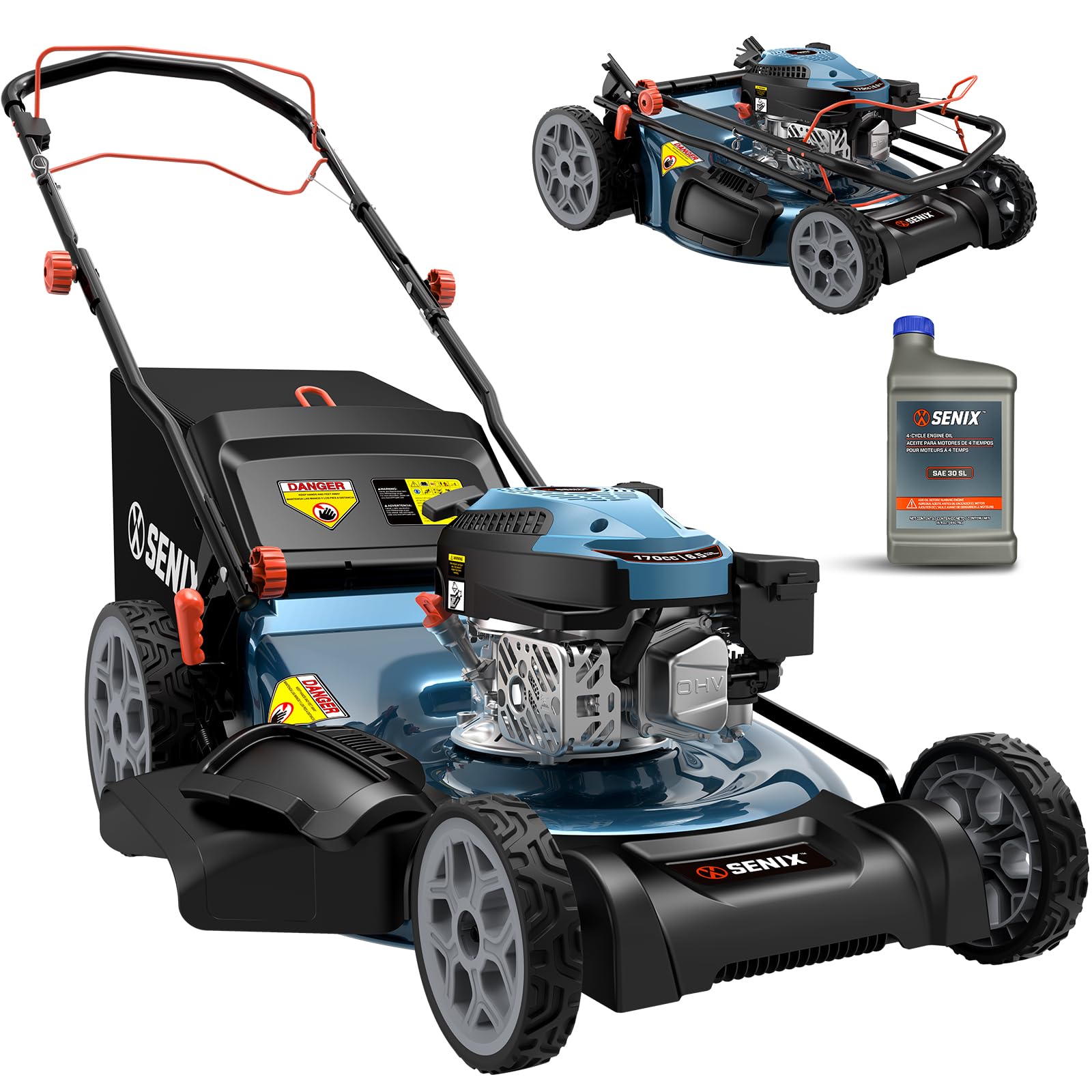
A higher top cut and a 19-gallon bagger for those who let the grass grow a bit longer.
The SENIX 22-inch takes the same 170cc OHV (overhead valve) engine and rear-wheel-drive formula as the PowerSmart above but lifts the maximum adjustable cutting height to 4 inches — useful for hot summer months when you want to leave the lawn taller. The 6-position single-lever height adjustment moves all four wheels from 1.25 inches to 4 inches, and the 19-gallon grass bag is a step up in capacity from the 1.7-bushel (a bushel equals about 8.5 gallons) bags on smaller models.
At 72.8 pounds, this is the heaviest mower in its core class, but the rear-wheel drive handles that extra heft well — it pulls forward and you just steer. The integrated washout port (a hose connection that lets you spray water under the deck to clean off wet clippings) lets you clean debris from under the deck with a garden hose, which is a time-saver. Customers note “easy 10-minute assembly” and that it handles “wet, 6-8 inch tall grass well when slowed down.”
Stronger top end: The 4-inch max height gives you more flexibility than the PowerSmart’s 3.9-inch cap, and the 19-gallon bag means fewer trips to the compost pile.
Assembly detail: One reviewer noted the instructions are small and do not label gas or oil ports — fill oil first (it is included), then add gas, and mark the ports yourself if you plan to store it.
Best suited for: Anyone who prefers a taller summer cut and wants a generous bag with a washout port for quick cleanup.
Not if: You need a very lightweight mower to lift over steps — at 72.8 pounds it is about 11 pounds heavier than the 21-inch mowers.
3. PowerSmart 22-Inch Gas Lawn Mower, 150cc B&S Engine, Self-Propelled (B8622S)
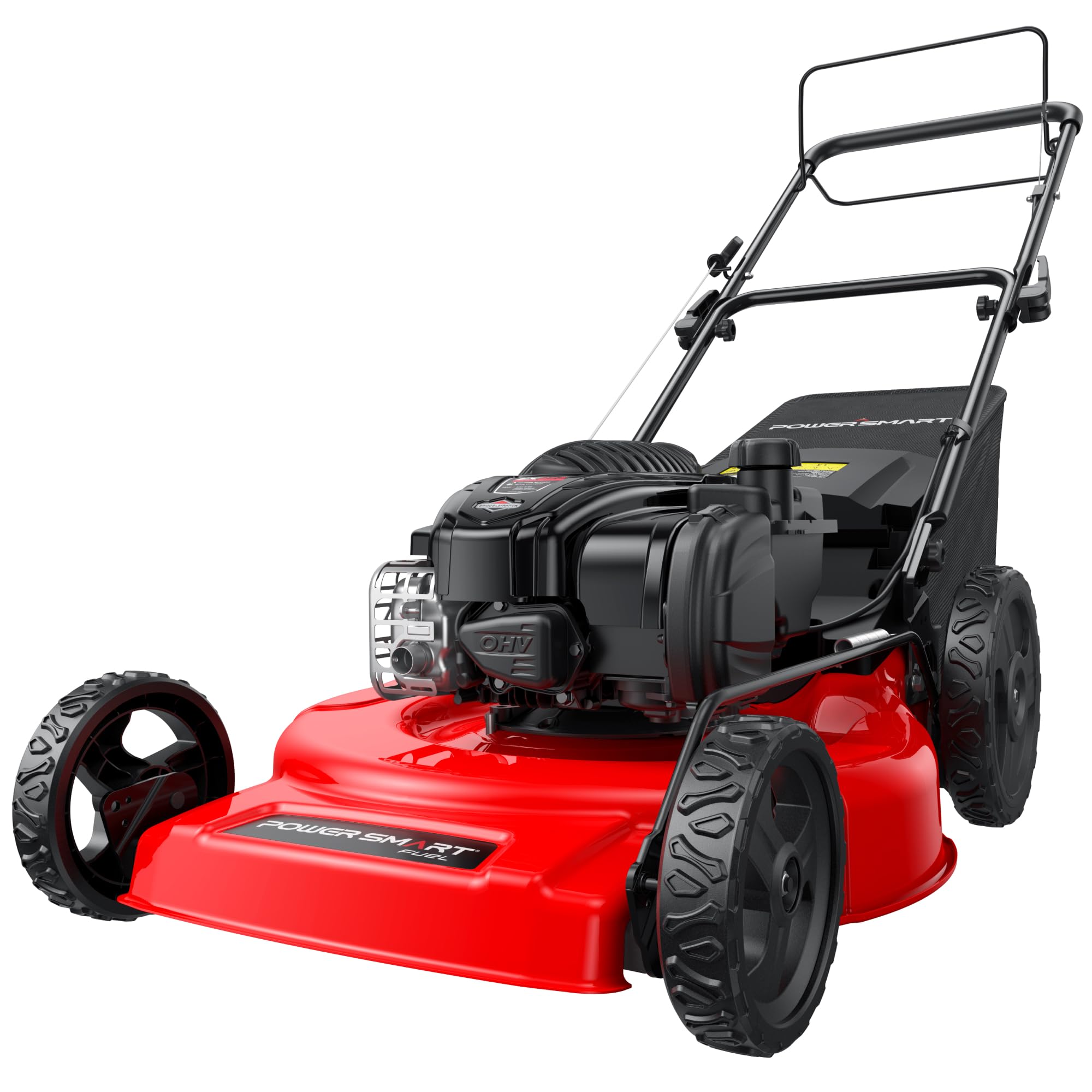
A USA-made Briggs & Stratton engine bolted to a 22-inch steel deck for reliable starts.
This PowerSmart swaps the generic 170cc engine for a Briggs & Stratton EX625 150cc engine with ReadyStart technology — meaning you skip the choke (a device that enriches the fuel mix for a cold start) and primer (a rubber bulb you push to inject gas before starting), just pull and go. The engine is built in the USA, which reviewers point out starts “on the 2nd pull” after assembly. The 22-inch heavy-duty steel deck with an aluminum alloy frame gives the same 1.5-inch to 3.9-inch height range as the earlier PowerSmart but is 0.8 pounds lighter at 72 pounds.
The single-lever height adjuster moves all four wheels at once — a convenience that saves bending. Buyers specifically praise the “excellent mulching” performance and the “solid metal deck.” One catch: the self-propelled has no speed adjustment (one reviewer called it “very slow”), and there is no hose hookup for deck cleaning. The mower comes with oil in the box, so you do not need to buy a separate quart.
Engine edge: The Briggs & Stratton EX625 is widely serviceable, and the ReadyStart tech genuinely cuts frustration — one pull, every time, per reviewer reports.
Known limit: No variable drive speed means you walk at the mower’s pace, and one buyer mentioned a metal clip holding the start wire broke after about six mows.
Choose this if: You want the brand-recognition and service network of a Briggs & Stratton engine in a 22-inch self-propelled package.
Skip if: Adjustable drive speed or a deck washout port matter more to you than the engine badge.
4. SENIX 22 Inch 3-in-1 Gas Lawn Mower, 201cc Rear Wheel Self-Propelled (G-H-FIVE)
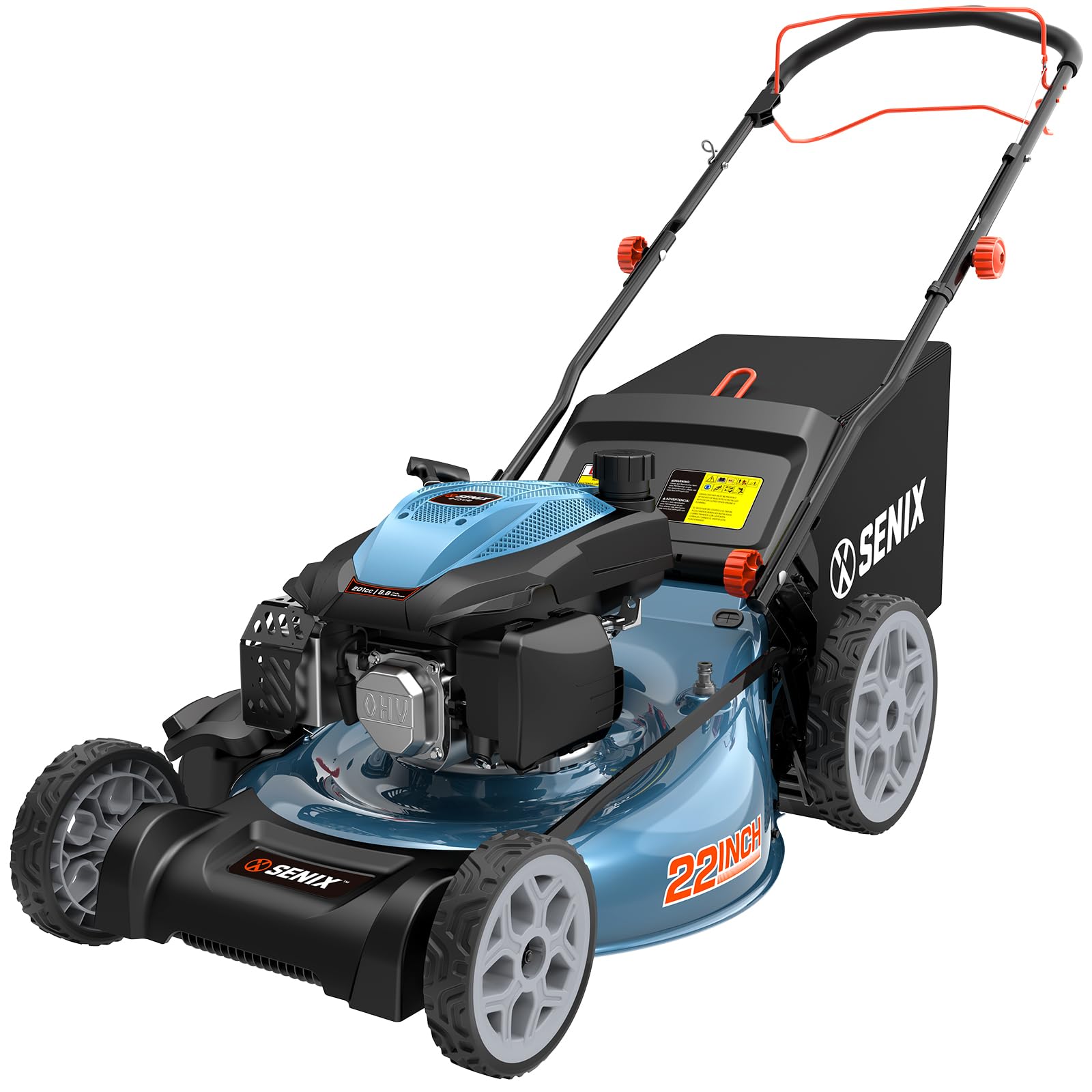
A 201cc engine and 4-inch top cut that chews through tall grass without bogging down.
By stepping up to a 201cc OHV engine delivering 4.7 HP and 8.8 ft-lb of torque (a measure of twisting force), this SENIX handles the kind of thick, tangled grass that smaller 170cc engines might stall on. The 22-inch deck uses a manganese steel alloy blade with 45–50 HRC hardness (Rockwell Hardness Scale — a standard rating for blade strength) — harder than standard steel, so it stays sharp longer. The self-propelled drive reaches up to 2.9 MPH, which is a useful cruising speed for a half-acre lot.
The 6-position height adjustment runs from 1.25 inches to 4 inches, and the vortex tunnel airflow design under the deck reduces grass buildup — less scraping out wet clumps mid-mow. One reviewer who upgraded from a 150cc Toro said this SENIX “cuts through grass like a hot knife through butter.” The foldable handle and vertical storage design save space in a shed. Some buyers caution that the front wheels can loosen; one owner reported wheels fell off after three uses.
Power advantage: The 201cc engine gives a real torque boost for overgrown patches — this is the pick for people who mow every two weeks, not every week.
Endurance note: The harder blade steel and vortex deck are smart for longevity, but check wheel nuts before each season.
Reach for this if: You have a medium to large yard with grass that grows fast and thick, and you want an engine that pulls through it without complaint.
Watch out: Assembly instructions lack gas and oil capacities; fill cautiously and buy a quart of oil — the mower includes 15 oz, but you may need a bit more.
5. BILT HARD 21″ Self Propelled Gas Lawn Mower, 201cc 4-Cycle OHV Engine
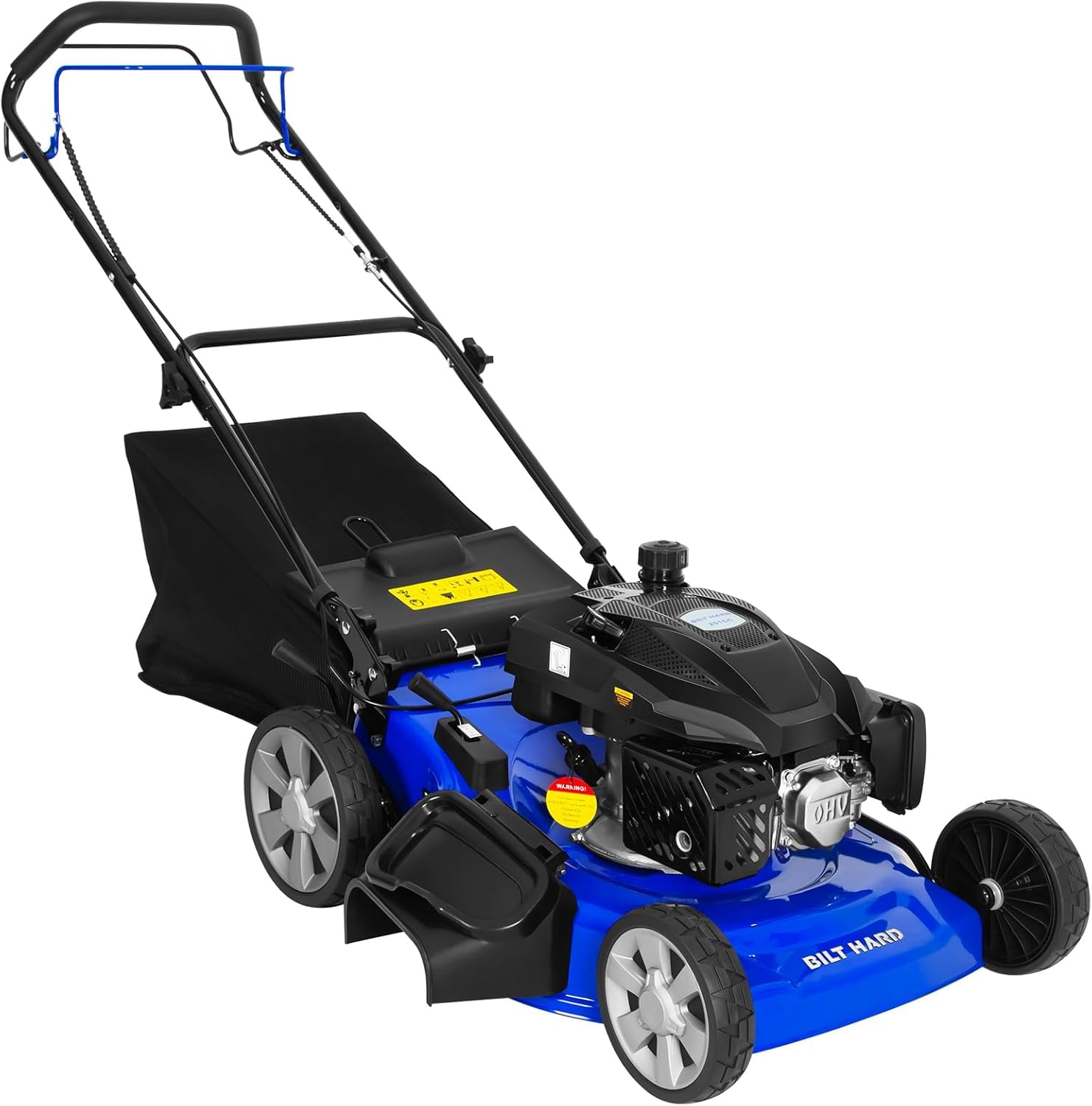
Eight height positions and a 201cc engine with rear-wheel drive for precise cut control.
The BILT HARD stands out in this lineup for its 8-position single-lever cutting height adjustment — more fine-grained steps than any other mower here, ranging from 1.2 inches to 3.75 inches. The 201cc 4-stroke OHV engine delivers 9.0 ft-lb of torque (the highest torque figure in this group), and the rear-wheel drive glides forward on a single-speed transmission. The foam-wrapped angled handle reduces hand fatigue, which matters when you are pushing over a larger yard.
Unlike the 22-inch SENIX and PowerSmart options, this is a 21-inch deck, so it is slightly more maneuverable around flower beds and narrow gates. One owner reported the height adjustment “slips” and used a tie wrap to secure it — a cheap fix if it happens to yours. Another buyer reported that the height adjustment levels are the feature they enjoy most. On the reliability front, one owner reported a “bent drive shaft caused vibration” after several uses, so early-season checks on the blade and shaft are wise.
Fine-tuning power: The 8-position lever gives you more control over cut length than any competitor here, and the 201cc engine has torque for tough spots.
Build concern: Some units arrive with a bent drive shaft or height-adjustment slipping; inspect and tighten before first use.
Best for: Homeowners who want granular cut-height control and extra engine torque at a reasonable price.
Not for: Anyone who wants a 22-inch deck — this is a 21-inch machine, so it takes an extra pass on larger lawns.
6. 21″ Self-Propelled Gas Lawn Mower – 170CC 4-Stroke Engine, 7 Cutting Heights (Ezasin EAWBLM01)
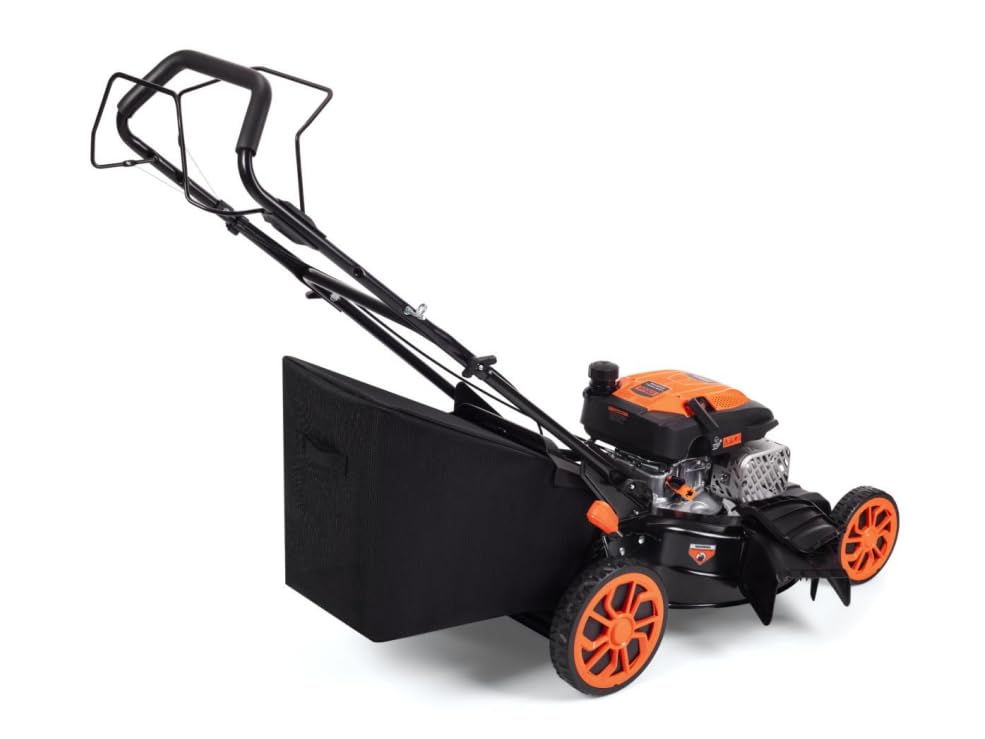
Seven cutting heights and a 1.9-bushel bag at a price that keeps the entry fee low.
The Ezasin 21-inch mower uses a 170cc 4-stroke OHV engine making 4.0 HP, paired with a single-lever height adjustment offering 7 positions from 1 inch to 3 inches. That 1-inch minimum is the lowest you will find in this roundup — great for a tight early-season scalp. The stamped steel deck spins the blade at 2900 RPM for a clean cut, and the 1.9-bushel grass collector is slightly larger than the 1.7-bushel bags on the SENIX models.
At 65.5 pounds, it is the lightest mower here, and the 10-inch rear and 8-inch front wheels glide over bumps. The trade-off is the narrowest height range (1 to 3 inches) — you cannot leave grass at 3.75 or 4 inches like the premium picks. One customer observed “it was broken but I managed to fix it” and then reported it “does an awesome job” afterward. Another called it “poorly designed” due to a plastic oil tank cover that did not fit securely. Check all fasteners during assembly.
Entry-level value: The low 1-inch cut and 7 height positions give you versatility at the lowest price point in this guide.
Common gripe: Handle assembly instructions are confusing per multiple reviews, and the plastic oil cap can be finicky.
Ideal for: Budget-conscious buyers with a small flat yard who want a light mower with a low scalp setting.
Avoid if: You need a taller summer cut above 3 inches, or you prefer a metal oil fill cap over a plastic one.
7. SENIX 21″ Self-Propelled Gas Lawn Mower (FWD), 170 cc 4-Cycle Engine (A025054-A)
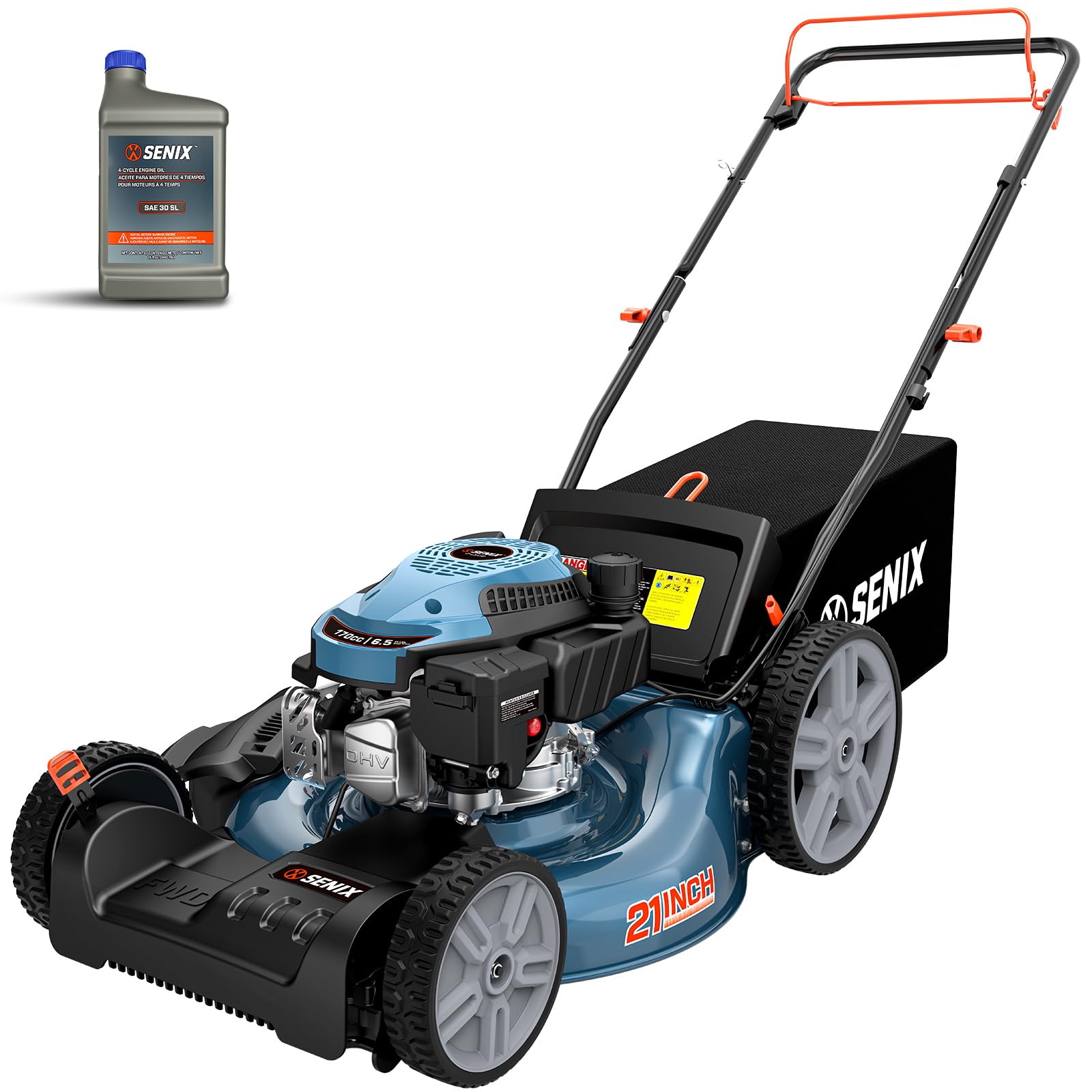
A front-wheel-drive self-propelled that is nimble around trees and garden beds on flat ground.
The SENIX 21-inch FWD mower uses a 170cc 4-cycle OHV engine delivering 3.8 HP and 6.5 ft-lb of torque, with front wheels doing the pulling so you lift the front to pivot around obstacles. It is designed for yards up to 1/3 acre, and the 6-position dual-lever height adjustment runs from 1.25 inches to 3.75 inches. The 1.7-bushel bagger and side discharge chute are included, and the engine comes pre-filled with oil for a faster first start.
At 61.7 pounds, it is about 4 pounds lighter than the 21-inch Ezasin, and the 11-inch rear wheels roll smoothly over dips. Shoppers say that it “starts on first pull” and that the self-propelled makes mowing “quick and enjoyable.” The trade-off: front-wheel drive can struggle on a slope when the grass bag fills up because the front lifts slightly. One reviewer described a serious failure: “heard metal knocking, then loud pop; mower died and won’t restart.” Another noted that the engine or driveshaft may fail if the blade strikes a rock hard, requiring a full replacement every two years.
Maneuverability edge: The front wheels pull, so you pivot around flower beds and trees without wrestling the mower — great for landscaped yards.
Durability report: Some buyers report engine failure after hitting a rock or after a few seasons; keep the blade sharp and avoid debris to extend life.
Reach for this if: Your yard is flat, under a third of an acre, and full of obstacles where nimble steering matters more than hill traction.
Skip if: You have even a mild slope — the front-wheel drive will lose grip when the bag is full.
Understanding the Specs
Engine Displacement (cc)
The number after “cc” (cubic centimeters — a measure of the engine’s internal cylinder volume) tells you the engine size. A 170cc engine (common in this class) provides enough grunt for weekly cuts on standard turf — think of it as a reliable commuter engine. A 201cc engine gives you extra torque (measured in ft-lb) for tall, damp grass or yards where you cannot mow every week. The trade-off is a few extra pounds and slightly higher fuel consumption, but for thick lawns the 201cc is worth the premium.
Cutting Height Range
This is the distance between the blade and the ground at the lowest and highest settings. A range from about 1 inch to 4 inches covers every season: short (1–1.5 inches) for early spring, medium (2–2.5 inches) for regular cuts, and tall (3.5–4 inches) for hot summer shade. More positions (6 to 8) between the endpoints let you dial in the exact length without guessing. Single-lever systems that move all four wheels at once save time.
FAQ
What does 3-in-1 mean on a lawn mower?
Is rear-wheel drive or front-wheel drive better for hills?
How tall should I cut my grass with a mulching mower?
Do I need to change the oil in a new lawn mower?
How often should I sharpen the mulching blade?
What size lawn is a 21-inch self-propelled mower good for?
Can I use a mulching mower without the bag if my yard is bumpy?
Why does my self-propelled mower sometimes not move forward?
Is it worth paying more for a 201cc engine over a 170cc engine?
How do I store a self-propelled gas mower for winter?
Final Thoughts: The Verdict
If you want one dependable pick, the best self-propelled mulching lawn mower is the PowerSmart 22″ RWD (V8622S2) because it combines a 22-inch steel deck with rear-wheel drive and a reliable 170cc engine at a strong value price point. If you want a premium build with a 4-inch top cut and a washout port, grab the SENIX 22″ (LSSG-H4). And for buyers who need maximum torque and blade hardness to handle overgrown grass without stalling, the SENIX 201cc (G-H-FIVE) is the best bet.
How We Picked
We do not accept paid placement. Every pick is matched to a real buyer and a real use-case; we do not hands-on test units.
Sources & Methodology
Specifications: manufacturer listings and product documentation. Review insights: verified customer reviews, as of July 2026. Pricing: not shown on this page (it changes often); check the current price via the retailer link.
As an Amazon Associate, Lawn Gear Lab earns from qualifying purchases. This does not affect which products we feature.