
Specs are compiled from manufacturer listings and verified buyer reviews and can change over time — please confirm the key details on the product page before buying.
That white, dusty coating on your rose leaves is powdery mildew, and if you do not stop it early, the leaves curl, the buds fail to open, and the whole plant weakens. The right fungicide knocks it out without burning your roses or leaving toxic residue on the soil, and the six picks here cover every approach — from a smothering oil that also kills insects to a biological immune booster that prevents the disease from ever taking hold.
I’m Rikta — the founder and writer behind Lawn Gear Lab. This guide is built by comparing the manufacturers’ published specifications and the patterns across verified customer reviews, so you get each pick’s real strengths and trade-offs instead of marketing spin.
Deciding on a fungicide for powdery mildew on roses depends on if you want a fast-acting oil, a biological preventative, or a copper spray that also handles black spot and rust.
Quick Picks
- Bonide All Seasons Horticultural & Dormant Spray Oil — Best Overall
- Neudorff Plant Fungicide Spray, Copper Soap for Roses — Solid Backup
- Earth’s Ally Disease Control Concentrate — Smart Prevention
- Arber Organic Fungicide for Plants – Liquid Concentrate — Biological Shield
- Bonide Revitalize Biofungicide Concentrate — Immune Booster
- Monterey 70% Neem Oil Fungicide/Insecticide/Miticide — High-Potency Oil
How To Choose The Best Fungicide For Powdery Mildew On Roses
Powdery mildew is a fungal disease that thrives in humid conditions with moderate temperatures. The wrong fungicide either fails to kill the fungus or damages the rose leaves, so matching the active ingredient to your situation is the most important step.
Active Ingredient: Oil vs Copper vs Biological
Oil-based fungicides like mineral oil and neem oil work by smothering the fungal spores on contact. They also kill soft-bodied insects like aphids, making them a two-in-one treatment. Copper soaps and copper salts kill a broad spectrum of fungi including black spot and rust, but some plants — including certain rose varieties — can be sensitive to copper, causing leaf burn. Biological fungicides use beneficial bacteria or yeast extracts to trigger the plant’s own immune system, making them ideal for prevention but slower at stopping an active outbreak.
Ready-to-Use vs Concentrate
A ready-to-use spray is the easiest option: you attach it to the hose or pull the trigger, and you are done. It costs more per application, but it eliminates the risk of mixing the wrong ratio. A concentrate is more economical — Earth’s Ally, for example, makes 10 gallons of spray from a 32-ounce bottle — but you need a separate sprayer and you have to measure carefully.
Application Timing and Temperature
Oil-based fungicides can burn rose leaves if you spray them when the temperature is above 85°F or when the plant is under drought stress. Copper fungicides work best when applied before the disease appears or at the first sign of infection. Biological fungicides need to be reapplied after heavy rain because the protective barrier washes off. Every product label tells you the reapplication interval — most are 7 to 14 days — and if you need to wait after rainfall.
Quick Comparison
| Model | Best For | Liquid Volume | Active Ingredient | Item Form | Amazon |
|---|---|---|---|---|---|
| Bonide All Seasons Oil | Smothering mildew and insects year-round | 32 Fluid Ounces | Mineral Oil | Ready-to-Spray | Amazon |
| Neudorff Copper Soap | Quick copper treatment for black spot and rust | 16 Fluid Ounces | Copper Soap | Ready-to-Use Spray | Amazon |
| Arber Organic Biofungicide | Prevention and root-level immunity | — | Biological / Plant-Derived | Liquid Concentrate | Amazon |
| Earth’s Ally Disease Control | Citric acid treatment for active outbreaks | 1 Quarts | Citric Acid | Liquid Concentrate | Amazon |
| Bonide Revitalize Biofungicide | Immune-boosting prevention on edible crops | 16 Fluid Ounces | Biological (Bacillus) | Spray Concentrate | Amazon |
| Monterey 70% Neem Oil | High-concentration neem for stubborn outbreaks | — | Neem Oil (70%) | Liquid Concentrate | Amazon |
In‑Depth Reviews
1. Bonide All Seasons Horticultural & Dormant Spray Oil

The year-round oil that smothers powdery mildew and aphids in one pass.
This mineral-oil spray works by physically coating and suffocating fungal spores and soft-bodied insects — no harsh chemical burn, no toxic residue. You can use it during the dormant season to clean up overwintering spores and then again during the growing season when you spot the first white patches on your rose leaves. Buyers report the product “killed the rose disease and shined my leaves too,” which gives you a sense of how clean the foliage looks afterward.
At 32 fluid ounces ready-to-spray, compared to the Neudorff Copper Soap at 16 fluid ounces, so you cover more area per bottle. It also weighs 32 ounces, while the Bonide Revitalize Biofungicide weighs 16 ounces — a simple reminder that you are buying a heavier, pre-mixed oil solution rather than a concentrate you dilute. The catch is that the included hose-end sprayer is poorly calibrated according to several reviews, so many experienced gardeners recommend using your own pump sprayer for better control and less waste.
Use it on roses, fruit trees, ornamentals, and vegetables. The active ingredient (mineral oil) is approved for organic gardening and leaves no toxic residue, so you can spray right up to harvest on edible crops.
Why it wins
- Smothers powdery mildew, rust, black spot, aphids, mites, and scale insects all at once
- 32-ounce ready-to-spray bottle covers a large garden without mixing
- Can be used in every season — dormant, green tip, and active growth
The trade-off
- The included hose-end sprayer is inaccurate and wasteful, per multiple reviews
- Oil can burn leaves if applied in temperatures above 85°F or during drought
- Not a curative for advanced infections — best as prevention or early treatment
Reach for it if: you want one product that handles both fungal diseases and insect pests on roses without needing a separate insecticide.
Look elsewhere if: you prefer a concentrate for better per-application economy or you need a curative spray for an already severe powdery mildew outbreak.
2. Neudorff Plant Fungicide Spray, Copper Soap for Roses

A copper soap spray that takes down black spot and rust alongside powdery mildew.
Neudorff’s ready-to-use spray uses a low concentration of copper soap to control a wide list of diseases: powdery mildew, rust, black spot, downy mildew, late blight, and peach leaf curl among them. One reviewer noted they “sprayed on my roses and noticed the difference,” and another mentioned it “worked great to eliminate a fungus that almost killed our decades old gardenia.” For roses especially, the copper formula protects buds and flowers that are forming during the growing season.
Compared to the Bonide All Seasons Oil above, this is a noticeably different approach — copper kills the fungus on contact rather than smothering it, and it stays active on the leaf surface longer. The trade-off is plant sensitivity: one buyer mentioned it “killed fungus on hostas but burned the plants,” so you need to be careful with copper-sensitive rose varieties or apply on overcast days. At 1 pound (16 fluid ounces), it is 1.0 pound lighter than the Bonide All Seasons Oil (2.26 pounds is the Earth’s Ally weight, but the oil is 32 ounces; the gap here is a 2.0x liquid-volume difference — 16 oz vs 32 oz — so the Neudorff is half the bottle size).
The label says to start treatment two weeks before disease normally appears or at the first sign, then repeat every 7 to 10 days. Reapply after rain. It is safe to use up to the day of harvest on vegetables and fruits.
What stands out
- Covers a very broad spectrum of fungal diseases including black spot, rust, and late blight
- Ready-to-use spray with a blue dye that helps you see where you have applied it
- Odorless and leaves no visible residue on petals or leaves
The catch
- Can burn or damage sensitive plant varieties (one reviewer saw leaf burn on hostas)
- 16-ounce bottle is small — you may need multiple bottles for a large rose bed
- Lower copper concentration than Cueva, so it may require more frequent reapplication
Choose this for: a ready-to-use copper treatment that tackles black spot and rust on roses as effectively as powdery mildew.
Skip it for: large gardens where a 32-ounce or concentrated product would be more practical per application.
3. Earth’s Ally Disease Control Concentrate
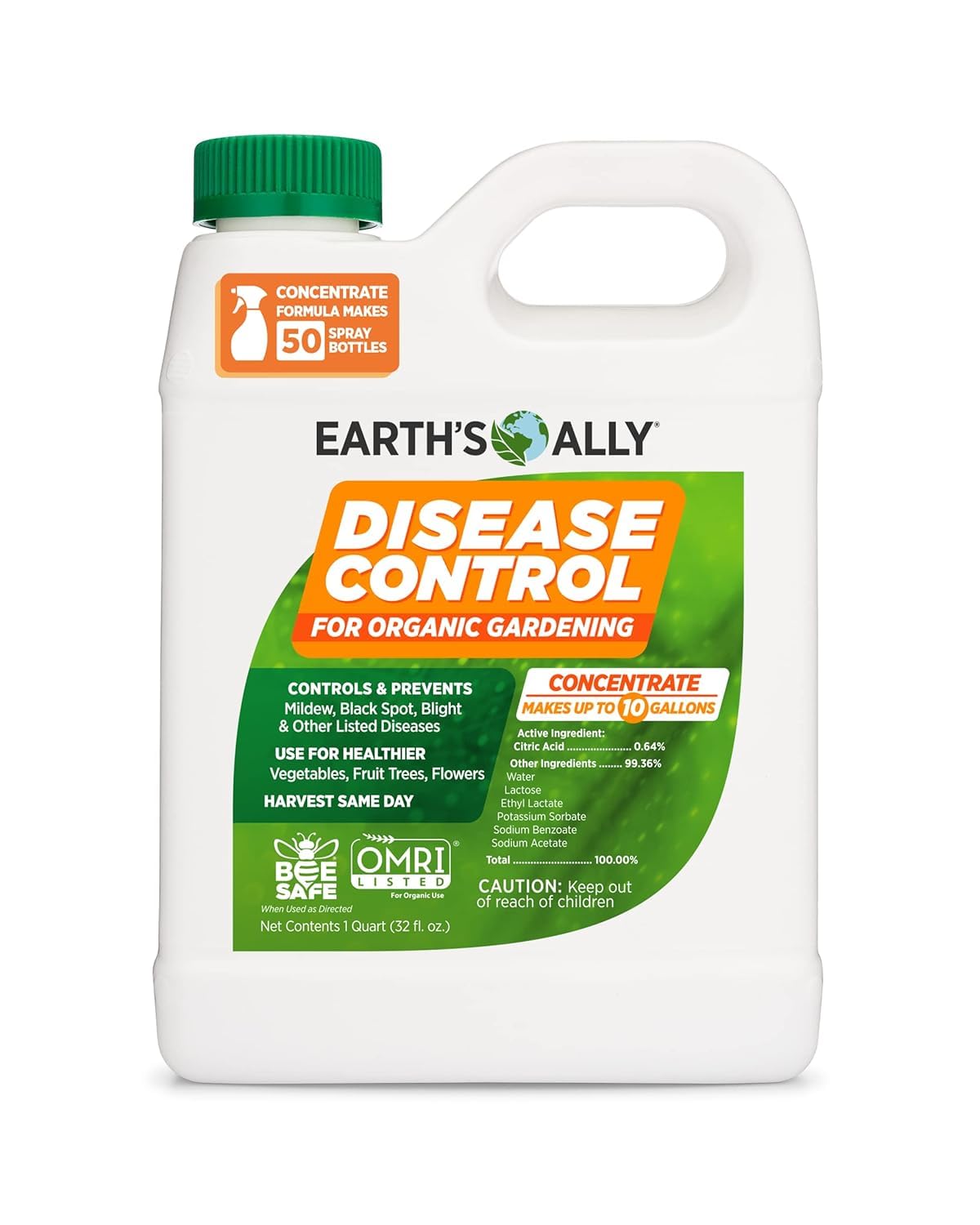
The citric-acid concentrate that stopped root fungus in just two applications.
Earth’s Ally uses citric acid as its active ingredient — a natural compound that kills fungal spores on contact without leaving harsh chemical residues. Mix 6 tablespoons per gallon of water, and a single 32-ounce bottle makes 10 gallons of ready-to-use spray, which is an economical choice for a rose bed or a small orchard. One owner reported it “stopped root fungus in 2 applications” on a Palo Verde tree, and multiple owners mention their rose leaves look “much healthier” after treatment.
At 2.26 pounds, this is the heaviest bottle in this lineup — compared to the Neudorff Copper Soap at 1 pound — because you are buying 32 ounces of concentrated liquid. Unlike the oil-based products, citric acid does not suffocate insects, so you still need a separate insecticide if aphids or mites are also a problem. It is OMRI Listed for organic gardening and safe to use on fruits and vegetables up to the day of harvest.
Because it is a contact fungicide rather than a systemic one, thorough coverage of every leaf surface — including the undersides — is essential. The concentrate has a 3-year shelf life, so you can keep it on hand for multiple seasons.
Strengths
- Concentrate makes 10 gallons of spray — very economical for large gardens
- Citric acid is a natural, OMRI-listed ingredient safe around people and pets
- Effectively treats powdery mildew, black spot, blight, and even root fungus
Weakness
- Must be mixed and sprayed with a separate pump or hose-end sprayer
- Contact-only — it will not cure a deep systemic infection without thorough coverage
- Does not kill insects, so you may need a separate product for pest control
Grab this for: organic gardeners who want an affordable concentrate that handles multiple rose diseases without harsh chemicals.
Pass if: you prefer a ready-to-use, no-mix formula or you also need insect control from the same spray.
4. Arber Organic Fungicide for Plants – Liquid Concentrate

The biological concentrate that protects roots and leaves without synthetic chemicals.
Arber uses certified-organic biologicals and plant-derived active ingredients that create a protective barrier on leaves and also support the soil microbiome. Instead of killing fungus directly like an oil or copper spray, it boosts the plant’s own ability to resist disease. One customer observed it “effectively stopped bacterial leaf blight on peach trees after 4 applications every 5 days, saving the fruit crop,” which shows how it works best as a consistent preventative program rather than a one-time rescue.
Unlike the Bonide All Seasons Oil above, which smothers on contact, this product needs to be applied early and regularly — several customers note that it works on powdery mildew only with daily spraying when used as a curative. It is safe around kids, pets, and pollinators, and it has no harsh odor, making it an excellent choice for indoor houseplant collections or greenhouses. The shelf life is up to 3 years, so a single bottle can serve you for multiple growing seasons.
Use it on roses, vegetables, trees, shrubs, and lawns. Mix and spray as a foliar treatment or soil drench. If you are in a wet climate, one buyer called it “my garden’s 1st aid kit” — essential for keeping mildew off your roses year-round.
What we like
- Strengthens plant immunity instead of just killing surface fungus
- Safe for beneficial insects, pollinators, kids, and pets — no harsh residues
- Can be used as a soil drench to address root-level fungal issues
What to know
- Needs consistent, frequent application — daily spraying for active outbreaks according to one review
- Does not instantly kill existing spores; works best as a preventative treatment
- Requires a separate sprayer and careful mixing for each application
Best suited for: gardeners who want to avoid any synthetic chemicals and are willing to apply a biological product on a regular schedule.
Not ideal for: a severe powdery mildew outbreak that needs immediate knockdown contact action.
5. Bonide Revitalize Biofungicide Concentrate

The biological concentrate that triggers an immune response against blight and mildew.
Revitalize works differently than chemical fungicides — rather than poisoning the fungus, it triggers the plant’s own immune system to resist powdery mildew, black spot, blight, and anthracnose. You mix the concentrate with water and apply it as a foliar spray or soil drench. One reviewer used it on mature pear trees with fire blight and after about a month of application every 3-4 days, the trees “started showing signs of rebounding — new leaves, no more black leaves.” Another said it “really turned my issue with septoria leaf spot” on tomatoes.
At 16 fluid ounces (16 ounces by weight), compared to the Bonide All Seasons Oil at 32 ounces, because it is a concentrate that you dilute rather than a ready-to-use product. It is approved for organic gardening and can be used up to the day of harvest on fruits, vegetables, nuts, and herbs. Unlike the copper-based Neudorff spray, there is zero risk of burning your rose leaves, making it a gentler option for sensitive varieties.
Use it on indoor and outdoor plants — houseplants, vegetables, fruit trees, shrubs, and ornamentals. Because it works through the plant’s immune system, you need to apply it before severe infection sets in for the best results.
Advantages
- Improves plant immunity rather than killing fungus externally — no resistance build-up
- Safe to use on edible crops up to harvest day with no chemical residues
- Can be applied as both a foliar spray and a soil drench for root-level protection
Limitations
- Slower acting than oil or copper fungicides — must be used preventatively or at the very first sign
- Requires reapplication every 3-4 days during active treatment, per one reviewer’s experience
- 16-ounce bottle is smaller than some concentrates; needs to be mixed for each use
Ideal for: organic gardeners who want a biological approach that strengthens the plant rather than relying on chemicals.
Not the best for: a sudden, advanced powdery mildew outbreak that needs immediate knockdown before it spreads.
6. Monterey 70% Neem Oil Fungicide/Insecticide/Miticide
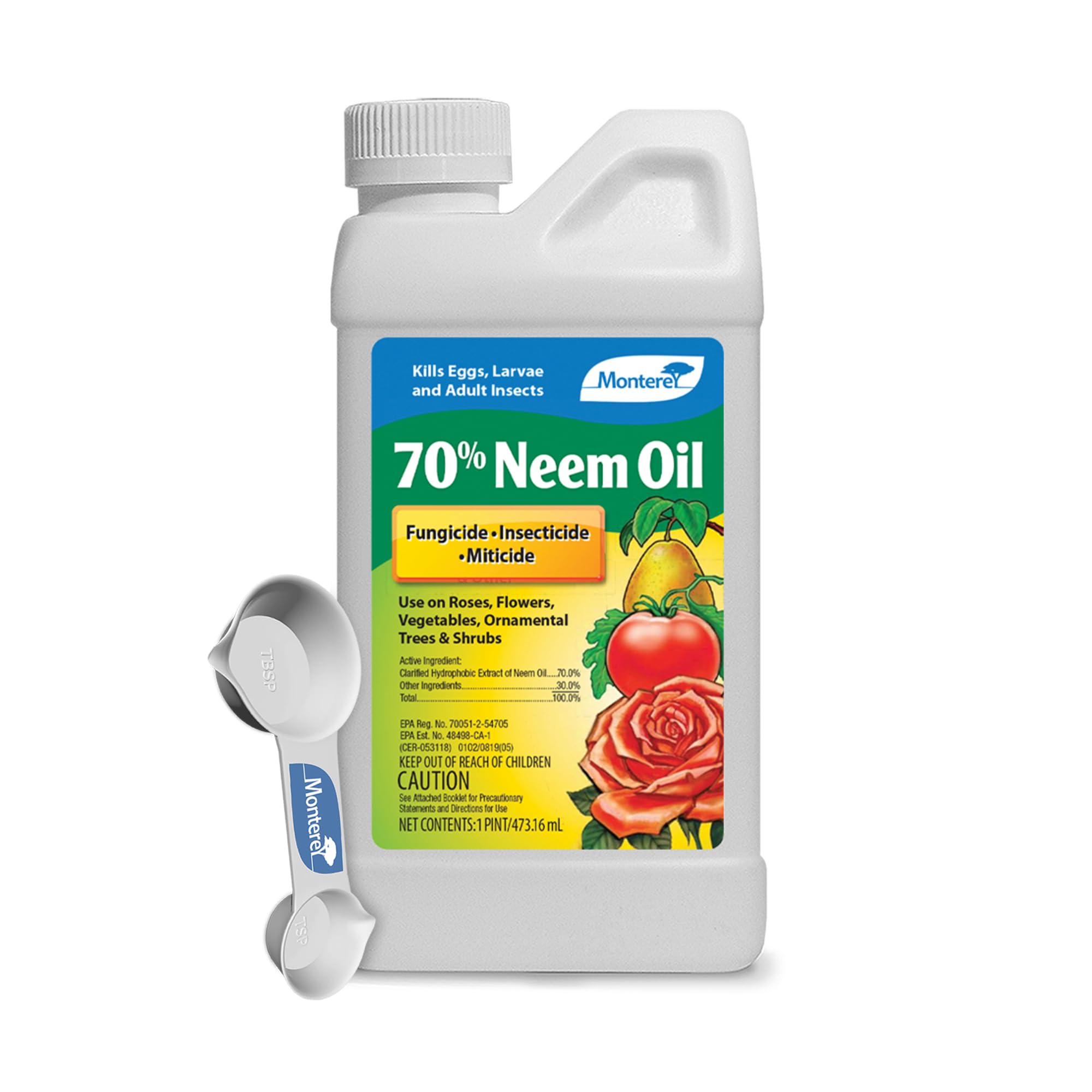
The highest-concentration neem oil on the shelf — 70% clarified hydrophobic neem.
Monterey’s neem oil concentrate is OMRI Listed for organic gardening and packs 70% clarified hydrophobic neem oil, the most concentrated neem you can buy without a commercial license. It works as a fungicide (powdery mildew, rust, black spot, downy mildew), insecticide (aphids, spider mites, whiteflies), and miticide — all in one bottle. One buyer in the humid South called it “a must have” for organic gardening, saying “no powdery mildew this year.” Another reviewer said it “kills aphids, spider mites, sooty mold fast.”
The main difference between this and the Bonide All Seasons Oil is that neem oil has an additional mode of action — it contains azadirachtin, which disrupts insect hormone systems, making it more effective against a broader range of pests. The trade-off is that neem oil has a strong, garlic-like odor that lasts a few hours after application, and it can damage certain sensitive plants like peppers and oregano if oversprayed. Apply at 5ml per liter of warm water and spray weekly for 2-3 weeks for best results.
Use it on roses, vegetables, fruit trees, ornamentals, and flowers. Because of the high oil concentration, avoid spraying in direct sun or temperatures above 85°F to prevent leaf burn.
Why it stands out
- 70% neem oil is the highest concentration available — very potent against stubborn outbreaks
- Controls fungi, insects, and mites simultaneously with one product
- OMRI Listed for organic gardening and safe for beneficial insects when dry
Things to note
- Strong odor that some users find unpleasant during application
- Can burn sensitive plants (oregano, peppers) if oversprayed, per buyer reports
- Needs to be mixed with warm water and a separate sprayer — not ready-to-use
Pick this for: stubborn powdery mildew or pest infestations where lower-strength treatments have failed — the 70% concentration makes a real difference.
Look elsewhere if: you are sensitive to strong odors or you want a ready-to-use spray that requires no mixing.
Understanding the Specs
Active Ingredient
The most important factor. Mineral oil and neem oil smother spores and insects on contact. Copper soap kills a wide range of fungi by disrupting cell membranes, but it can burn sensitive plants. Citric acid kills spores without residue but needs thorough coverage. Biological ingredients (Bacillus bacteria or plant extracts) boost the plant’s own immune system rather than killing the fungus directly — gentler but slower. Choose based on if you need immediate knockdown or long-term prevention.
Ready-to-Use vs Concentrate
Ready-to-use sprays attach to the hose or pull-trigger — no mixing, no measuring, but you pay more per application. Concentrates require a separate sprayer and careful mixing, but a single bottle like Earth’s Ally (makes 10 gallons) is much more economical for a large rose garden. If you have more than a few bushes, a concentrate almost always saves you money over the season. If you have a single potted rose on the patio, a ready-to-use spray is simpler.
Reapplication Interval
Most fungicides for powdery mildew need reapplication every 7 to 14 days during active growth or after rain. Oil-based sprays (like Bonide All Seasons) wash off in heavy rain. Biological treatments (like Arber and Bonide Revitalize) need more frequent application in wet weather because the protective barrier gets diluted. Check the label for the exact interval — skipping a treatment when conditions are humid is the fastest way for the mildew to return.
Plant Safety in Heat
Oil-based fungicides (mineral oil and neem oil) can burn leaves if the temperature is above 85°F or if the plant is already stressed from drought. Copper fungicides can also cause leaf burn on certain rose varieties, especially in hot sun. Citric acid and biological products are less likely to burn in heat. The safest strategy is to spray early in the morning when temperatures are cooler and the leaves have time to dry before the sun hits them directly.
FAQ
Can I spray a fungicide for powdery mildew on roses during hot weather?
How often should I apply a fungicide to my roses for powdery mildew?
Is it safe to use a rose fungicide up to the day I harvest flowers or fruit?
What is the difference between a preventative and a curative fungicide for roses?
Can I use the same fungicide for powdery mildew on my roses and on my vegetables?
Does neem oil work better than mineral oil for powdery mildew on roses?
How do I mix a concentrate fungicide correctly for my roses?
Will these fungicides harm bees or other pollinators visiting my roses?
What should I do if the powdery mildew keeps coming back after spraying?
Can I use a dormant-season oil spray on my roses during winter?
Final Thoughts: The Verdict
For most gardeners, the fungicide for powdery mildew on roses winner is the Bonide All Seasons Spray Oil because it smothers both mildew and insects year-round in a single ready-to-spray bottle. If you want a copper treatment that also handles black spot and rust on your roses, grab the Neudorff Copper Soap. And for an economical, citric-acid concentrate that makes 10 gallons of spray without harsh chemicals, the Earth’s Ally Disease Control is the smartest value per application.
How We Picked
We do not accept paid placement. Every pick is matched to a real buyer and a real use-case; we do not hands-on test units.
Sources & Methodology
Specifications: manufacturer listings and product documentation. Review insights: verified customer reviews, as of July 2026. Pricing: not shown on this page (it changes often); check the current price via the retailer link.
As an Amazon Associate, Lawn Gear Lab earns from qualifying purchases. This does not affect which products we feature.