
Specs are compiled from manufacturer listings and verified buyer reviews and can change over time — please confirm the key details on the product page before buying.
If you feed birds in the Pacific Northwest, you already know the struggle: steady rain turns dropped hulls into a sludgy mess, and the local Steller’s jays and squirrels treat your feeder like an all-you-can-eat buffet. The right seed mix changes that — it keeps the birds you actually want coming back while cutting the waste you don’t want to clean up.
I’m Rikta — the founder and writer behind Lawn Gear Lab. This guide is built by comparing the manufacturers’ published specifications and the patterns across verified customer reviews, so you get each pick’s real strengths and trade-offs instead of marketing spin.
After sorting through the specs and buyer feedback for the top blends, these are the seven best bird seed for pacific northwest feeders, starting with the shell-free mixes that save your yard from the rain-soaked aftermath of winter feeding.
Quick Picks
- Audubon Park Waste Free Wild Bird Seed – 12 lb. No Mess Blend — Best Overall
- Cool Birds Cardinal & Crew Wild Bird Seed – 10 lb — Best for Cardinals
- Audubon Park Cardinal Wild Bird Seed – 8 lb. No Corn, Milo, or Millet — Squirrel Deterrent
- Happy Wings Sunflower Hearts & Chips Bird Food – 2-Pack (10 lb total) — Value Pack
- Freebird Songbird Blend – 5 lb — Variety Blend
- Happy Wings Finch Blend Bird Food – 5 lb — Finch Specialist
- Mr. Bird’s Bugs, Nuts, Fruit Small Wild Bird Seed Cylinder – 2-Pack (24 oz each) — Protein Cylinder
How To Choose The Best Bird Seed For Pacific Northwest
The Pacific Northwest’s wet climate changes the game for bird feeding. You need a blend that resists moisture, avoids sprouting, and doesn’t leave a hull mess on your soggy lawn. Here is what to keep in mind as you compare.
Mess and germination
Seeds with hulls (like whole black oil sunflower) leave shells that turn into a muddy layer under your feeder in wet weather. “No-mess” blends use hulled hearts and chips that birds eat entirely, so nothing rots on the ground. “No-grow” seeds won’t sprout under your feeder, which stops invasive weeds from taking hold in damp PNW soil.
Squirrel deterrence
Safflower seeds are naturally unappealing to squirrels but remain a favorite of cardinals, chickadees, and finches. A safflower-heavy mix lets you keep feeder visits focused on songbirds without needing a separate baffle or spicy capsaicin coating.
Bird species in the region
Pacific Northwest yards draw a specific crowd: dark-eyed juncos, chestnut-backed chickadees, Steller’s jays, varied thrushes, house finches, and pine siskins. A mix with sunflower hearts, peanut pieces, and small seeds like nyjer covers this range, while safflower and whole sunflower cater to the cardinals that are expanding in the region.
Feeder compatibility
Loose seed blends work in tube, tray, hopper, and platform feeders. Cylinder blocks (like seed cakes) hold up better in rain and fit in mesh feeders. Shelled seeds pour easily through small ports, while whole seeds with hulls need larger openings. Check your feeder’s port size before picking a blend.
Quick Comparison
| Model | Best For | Weight | Key Ingredients | Mess Level | Amazon |
|---|---|---|---|---|---|
| Audubon Park Waste Free (12 lb) | Clean patios & decks | 12 lb | Sunflower hearts, peanut pieces | No mess | Amazon |
| Cool Birds Cardinal & Crew (10 lb) | Attracting cardinals | 10 lb | Black oil sunflower, sunflower hearts, safflower | Low (hearts reduce hulls) | Amazon |
| Audubon Park Cardinal (8 lb) | Squirrel-resistant feeding | 8 lb | Sunflower, safflower | Low (no corn/milo) | Amazon |
| Happy Wings Sunflower Hearts & Chips (2×5 lb) | Year-round no-waste feeding | 10 lb (2 bags) | Sunflower hearts & chips | No mess, no waste | Amazon |
| Freebird Songbird Blend (5 lb) | Diverse songbird variety | 5 lb | Black oil sunflower, striped sunflower, safflower, peanut pieces, millet | Moderate (hulled seeds) | Amazon |
| Happy Wings Finch Blend (5 lb) | Finch-focused feeders | 5 lb | Sunflower hearts, nyjer | No grow, low mess | Amazon |
| Mr. Bird’s Bugs, Nuts, Fruit Cylinder (2-Pack) | Woodpeckers & protein seekers | 24 oz per cylinder | Mealworms, tree nuts, pecans, peanuts, sunflower hearts, raisins, cranberries | No mess, no waste | Amazon |
In‑Depth Reviews
1. Audubon Park Waste Free Wild Bird Seed – 12 lb. No Mess Blend
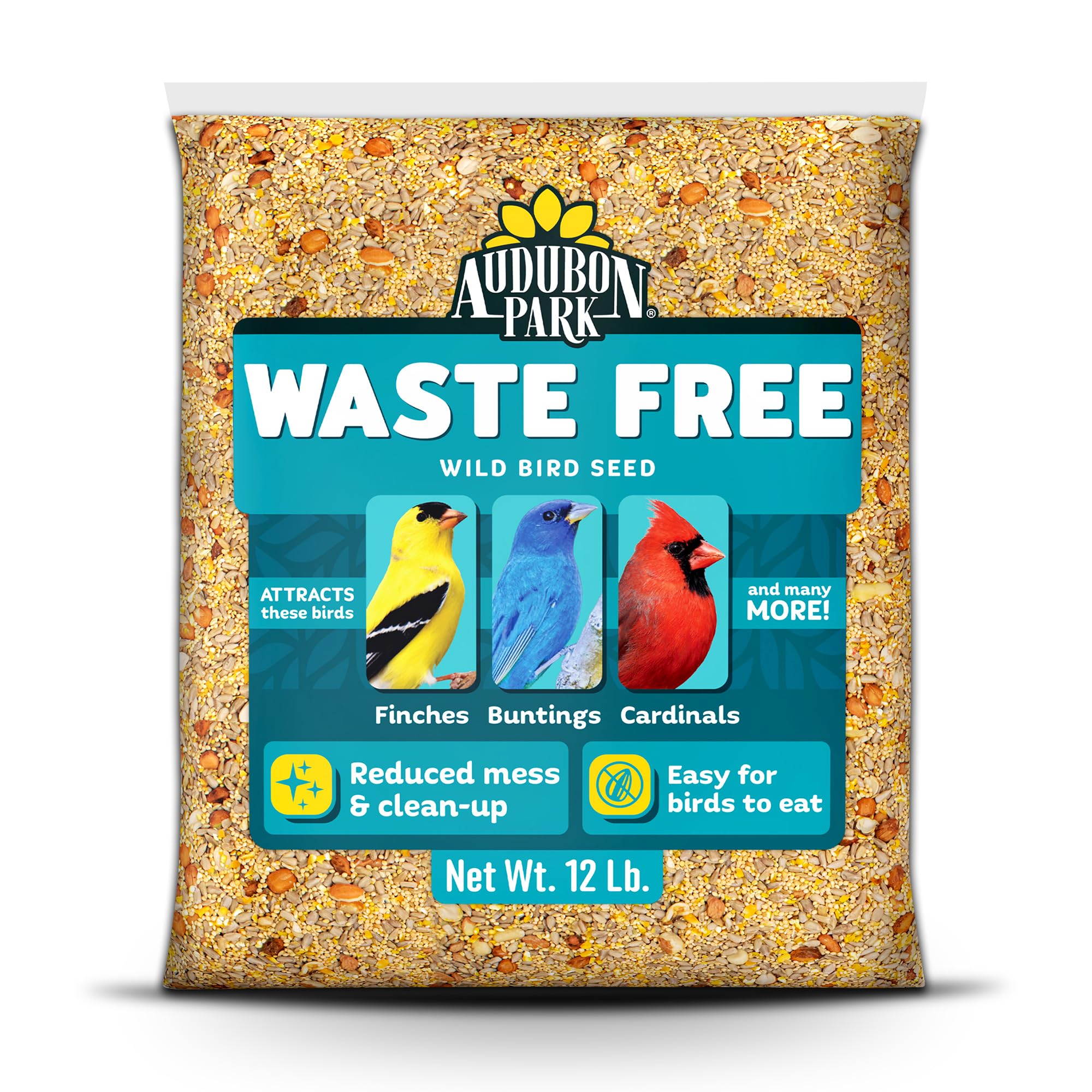
You get a 12-pound bag of shell-free sunflower hearts, chips, and peanut pieces, so your deck stays clean even after a week of PNW rain.
Every seed in this bag gets eaten — nothing rots under your feeder. The key spec is the 12-pound weight, which is 12 pounds compared to the 8-pound Audubon Park Cardinal bag, so you refill less often in cold weather. Buyers report that the “fresh blend with variety attracts songbirds, increasing birdwatching enjoyment,” and that a similar 15 lb bag “lasts weeks” with a wide variety of birds. The mix targets finches, cardinals, chickadees, thrushes, wrens, and buntings — the exact songbird lineup you see in the Pacific Northwest. It works in tube, tray, hopper, platform, and smart feeders, so you do not need a special setup.
One trade-off: the shelled hearts are smaller than whole seeds, so a few buyers mention that some birds “burn through the little seed to get to the big seeds.” You might occasionally top it off with whole sunflower seeds to keep the feeder balanced. However, if a clean patio is your priority, the shell-free formula beats the Cool Birds Cardinal blend hands down for mess management.
The mess-free reasoning
- Zero hulls mean zero cleanup under the feeder, even after heavy rain.
- Attracts finches, cardinals, chickadees, thrushes, wrens, and buntings.
- 12 lb bag reduces refill frequency compared to 5–8 lb competitors.
- Compatible with tube, tray, hopper, platform, and smart feeders.
A note on feeding patterns
- Smaller seeds may get picked through quickly as birds hunt for peanut pieces.
- Squirrels will still raid the feeder — no safflower deterrent in this blend.
Your patio pick: If you feed on a deck, balcony, or any spot where hull mess is a headache, this shell-free formula spares you the post-rain cleanup.
Squirrel caveat: If your yard has heavy squirrel traffic that you want to discourage, look at the safflower-heavy Audubon Park Cardinal blend instead.
2. Cool Birds Cardinal & Crew Wild Bird Seed – 10 lb
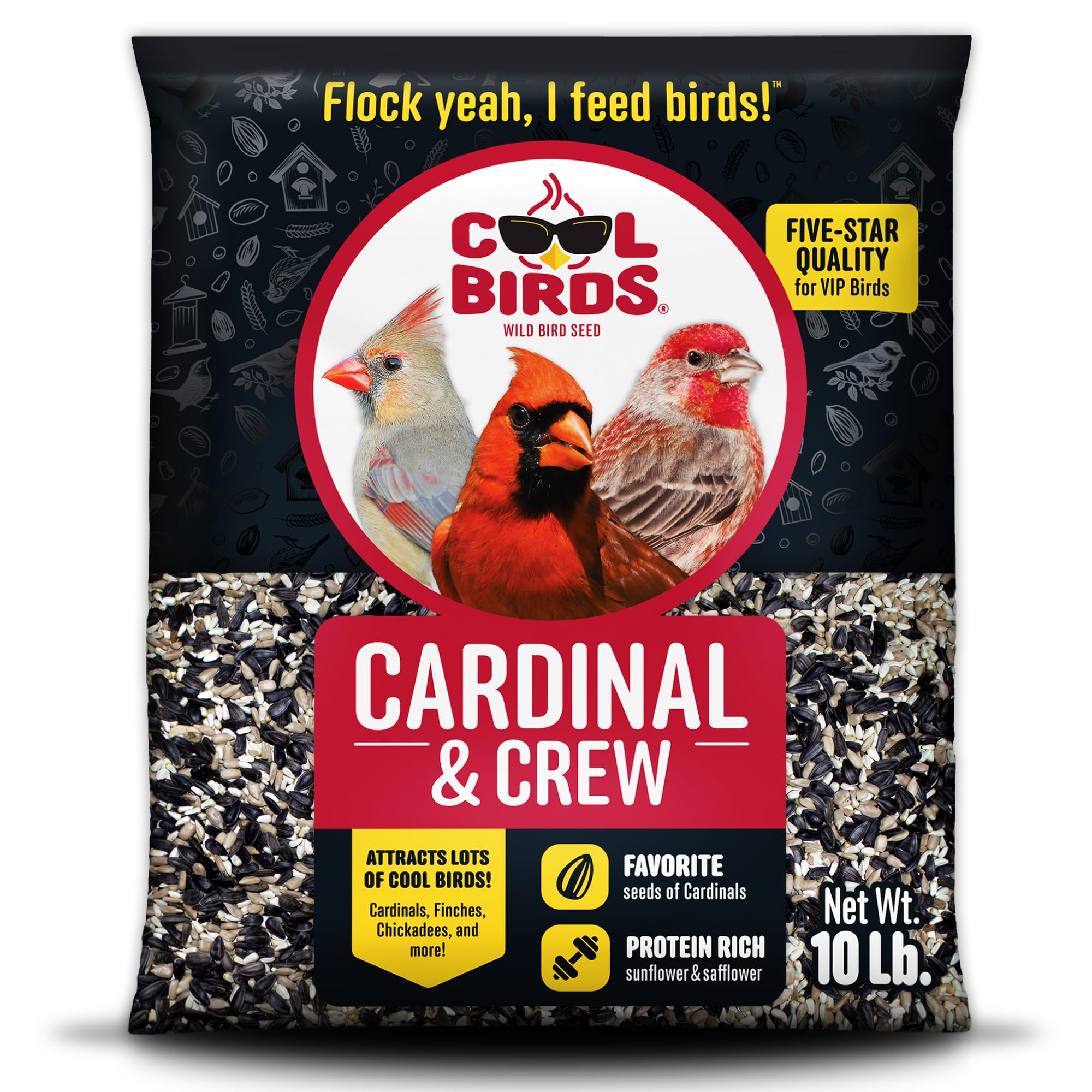
You get a 10-pound bag with only three ingredients — black oil sunflower, sunflower hearts, and safflower — so cardinals get exactly what they love.
That short recipe means no corn, milo, or millet, which are cheap fillers that often end up as waste on your lawn. One reviewer who tested it against five other brands called it the “best among 6 brands tested; birds love them.” The sunflower hearts (shelled kernels) alongside whole black oil seeds keep mess lower than a standard sunflower-only mix, since the hearts get eaten entirely. The safflower component naturally deters squirrels — squirrels dislike the taste, but cardinals, chickadees, and grosbeaks do not. Owners mention it works in tube, tray, hopper, and platform feeders. If you need a squirrel deterrent, this blend offers it without the capsaicin coatings of some other brands.
The honest catch: one reviewer found that their particular flock ignored the sunflower and safflower hearts, picking out the black oil sunflower seeds instead. Your birds’ preferences may vary, so start with one bag before stocking up. Also, unlike the shell-free Audubon Park Waste Free blend, this mix still has whole seeds with hulls that create some ground debris.
Straight ingredients
- No corn, milo, or millet — every seed is a high-value food.
- Safflower naturally reduces squirrel visits without chemical coatings.
- Customers note strong cardinal, chickadee, and finch attraction.
- 10 lb bag at a good per-pound value for a premium no-filler blend.
Pickiness factor
- Some birds may ignore the sunflower & safflower hearts in favor of whole black oil seeds.
- Not a no-mess formula — whole seeds still leave hulls on the ground.
Cardinal strategy: If your goal is to pull bright red cardinals to your feeder and keep squirrels at bay, the three-ingredient simplicity of this blend does exactly that.
Transition note: If your flock has never eaten hearts before, mix this with a familiar whole-seed blend for a week so they adapt.
3. Audubon Park Cardinal Wild Bird Seed – 8 lb. No Corn, Milo, or Millet
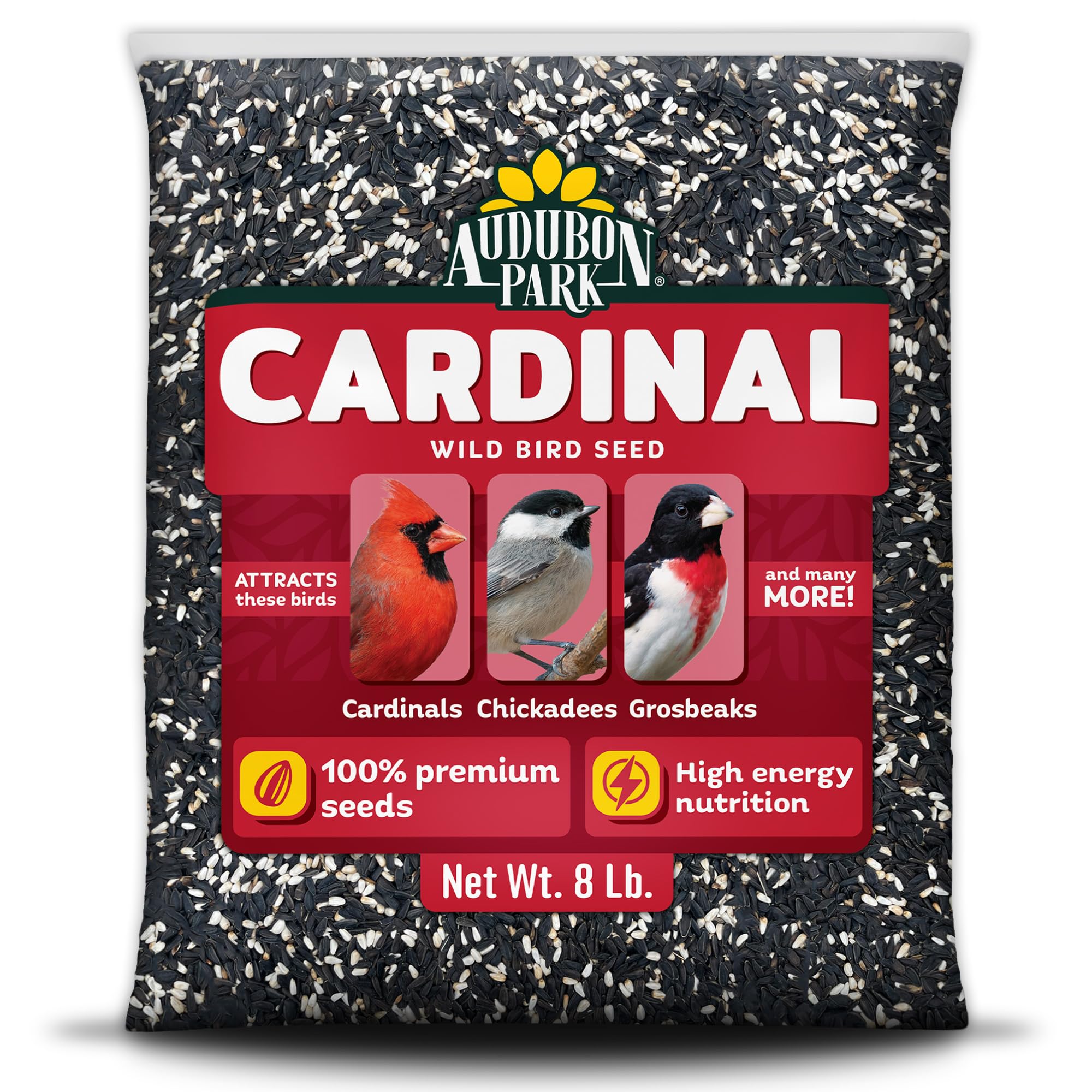
You get an 8-pound bag with just two seeds — black oil sunflower and safflower — so squirrels get a natural “no thank you” without any chemical sprays.
This is the simplest squirrel-deterrent formula on the list. Safflower seeds taste bitter to squirrels, but cardinals, chickadees, grosbeaks, and nuthatches eat them readily. However, buyers confirm that “the birds love it…but so do the squirrels and chipmunks” despite the safflower, so determined rodents may still test your feeder. The sunflower-safflower combo delivers year-round protein and energy through breeding season and winter. The lack of filler means less waste sprouts under your feeder in damp PNW soil. One reviewer noted a “high-quality blend with no filler,” and another praised it as “clean seed, no bugs or added oils.” But the same buyer flagged that the “price increased from to in 5 months; may switch if cost rises further,” so the value depends on your flock size. At 8 pounds compared to the 12-pound Audubon Park Waste Free bag, refills come more often.
Why it stands out
- Safflower seeds naturally repel squirrels while attracting cardinals, chickadees, and finches.
- No corn, milo, or millet — zero filler waste on your lawn.
- Reviewers point out high freshness, no bugs, and strong bird preference over other blends.
The cost reality
- Multiple long-term shoppers say price increases; may become less budget-friendly over time.
- Squirrels and chipmunks may still visit despite the safflower, per customer reports.
- 8 lb bag requires more frequent refills than the 10 or 12 lb alternatives.
Smart first step: If you are tired of squirrels emptying your feeder but do not want to use spicy deterrents, this two-seed blend is a clean, honest test.
Bag size alert: If you feed a large flock through winter, the 8 lb capacity means you will need to reorder every 1–2 weeks — a 12-pound no-filler option might suit you better.
4. Happy Wings Sunflower Hearts & Chips Bird Food – 2-Pack (10 lb total)
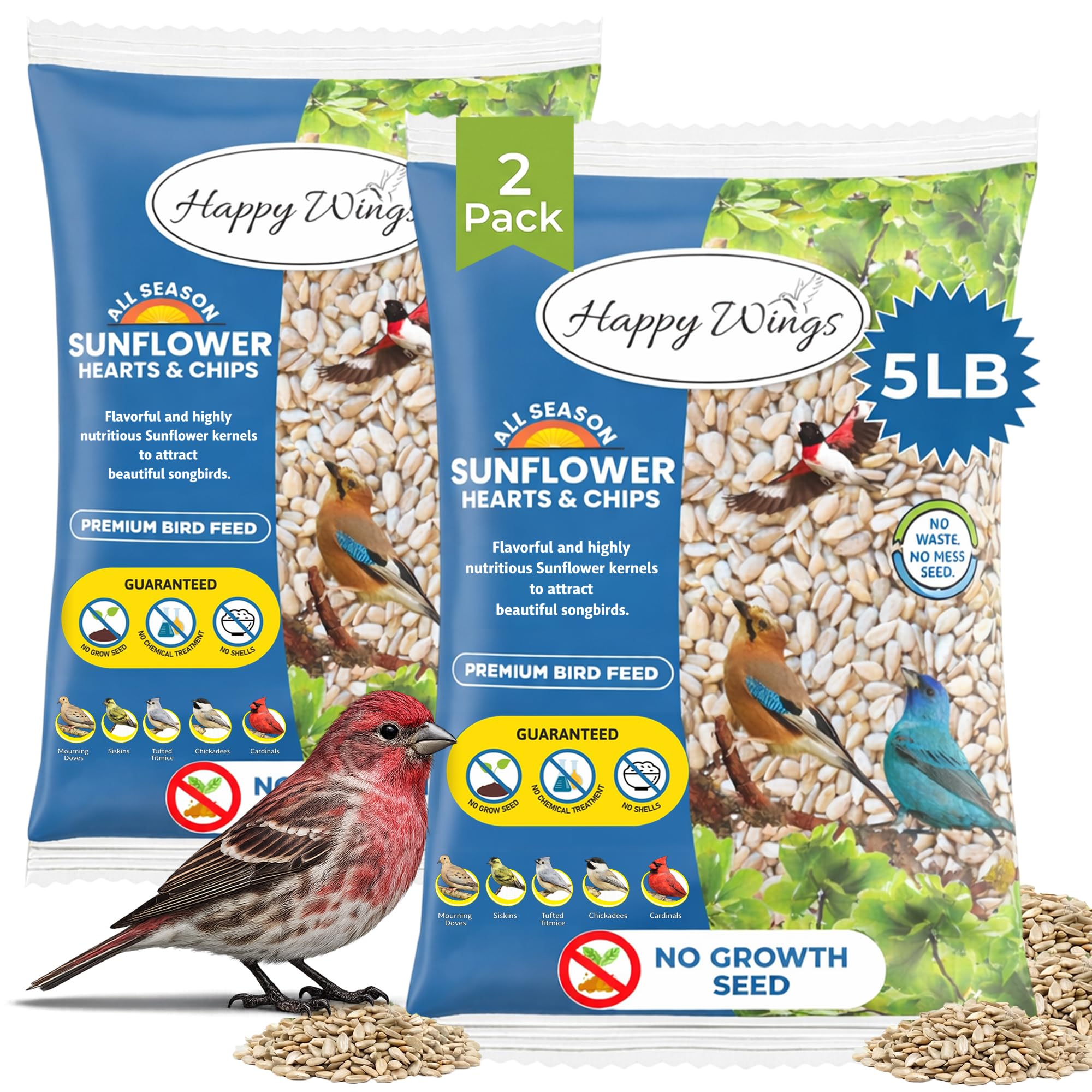
You get two 5-pound bags of pure sunflower hearts and chips, so zero hulls hit your lawn and nothing sprouts in your damp PNW yard.
This 10-pound 2-pack is strictly shelled sunflower hearts and chips — no hulls, no shells, no waste at all. One buyer called it a “no mess under feeder” solution, and another noted the “seeds won’t germinate” in the ground. The ingredients are simple and high-energy: sunflower hearts packed with protein and fat for year-round feeding. The blend attracts a broad range of PNW species including cardinals, chickadees, mourning doves, goldfinches, woodpeckers, nuthatches, and robins. Because the hearts are smaller than whole seeds, buyers report the “bag appears small because sunflower hearts are shelled” but that it is “long-lasting” and birds love it. For a similar shell-free value, this 2-pack outperforms a single 10 lb bag of whole seed that would leave hull debris.
A minor point: some seeds still have partial hulls attached, and one buyer mentioned “there are hulls on these seeds and the birds pick them off and leave them scattered.” It is not completely hull-free for every batch, but it is far cleaner than a standard whole-seed blend.
Shell-free advantage
- Sunflower hearts mean zero husk waste and no sprouting — ideal for rainy yards.
- Attracts 14+ bird species covering all common PNW backyard visitors.
- Comes as two separate 5 lb bags for easy storage and rotation.
- High protein and fat content support birds through cold, wet winters.
Partial hulls note
- A small number of seeds may arrive with hulls still attached, creating minor debris.
- The 2-pack format costs more upfront than a single 10 lb bag of whole seed.
Stock-up choice: If you want to keep a clean yard and have enough seed on hand to survive a PNW rainy stretch, the 2-pack format and shell-free hearts make this a smart buy.
Not for: If you prefer a mix with safflower for squirrel deterrence, this is pure sunflower hearts — rodents will enjoy it as much as the songbirds.
5. Freebird Songbird Blend – 5 lb
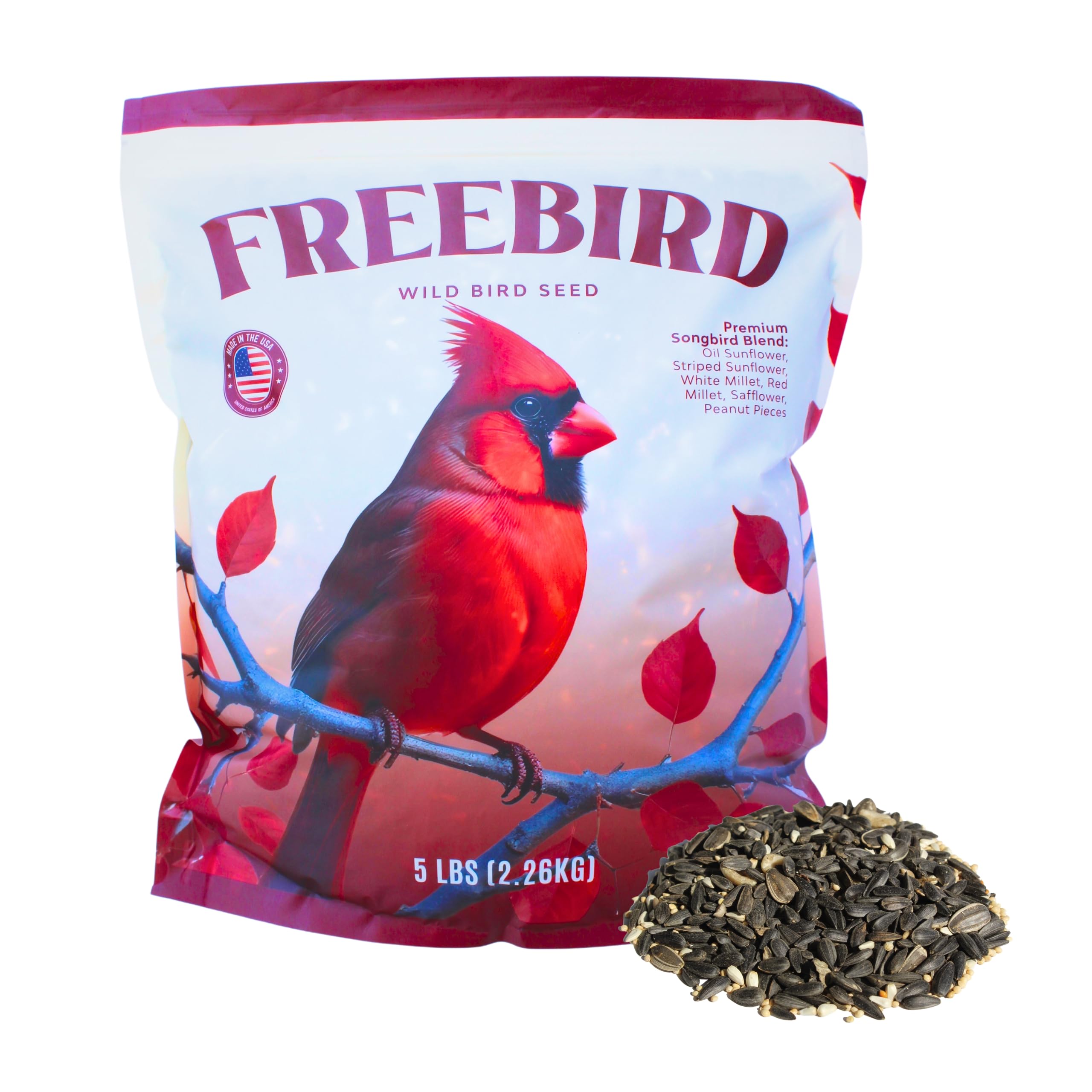
You get a 5-pound bag with six different seeds — black oil sunflower, striped sunflower, safflower, peanut pieces, white millet, and red millet — so you discover exactly which species your yard attracts.
Freebird packs six ingredients into the 5-pound bag for maximum variety. One owner reported that after switching to this blend, “my number of visiting Cardinals tripled (at least).” The seeds are sourced from US farms with no additives, and the bag features a strong resealable zipper — a practical detail for keeping seed fresh in humid PNW conditions. The all-natural claim (non-GMO, no artificial colors, no added hormones) matches what many backyard birders look for today. The bag is heavy-duty to prevent spills and preserve freshness. However, the main limitation is the 5-pound bag size. At this weight, it is the smallest capacity in the lineup outside the seed cylinders, and a busy feeder will empty it in under a week. You will either need to reorder frequently or buy multiple bags at once. Buyers also noted that the “bag is small” for the price point. Compared to the bulkier 10- or 12-pound bags, this is a sampler, not a stock-up solution.
What makes it different
- Six varied ingredients — black oil, striped sunflower, safflower, peanut pieces, two millets — for maximum species range.
- Resealable zipper bag keeps seed dry during PNW damp spells.
- US-sourced, non-GMO, additive-free formula with high oil content.
Portion reality
- 5 lb bag is small for the price; frequent reordering required for heavy feeders.
- Millet may get ignored by some birds and accumulate on the ground.
- Whole seeds with hulls create some ground debris under the feeder.
Species explorer: If you are new to bird feeding and want to see which species show up, the six-ingredient variety is a great test kit — you will learn exactly what your local birds prefer.
Reality check: If you already know your flock and just want to keep them full, a larger single-ingredient or two-ingredient bag will stretch further for the money.
6. Happy Wings Finch Blend Bird Food – 5 lb
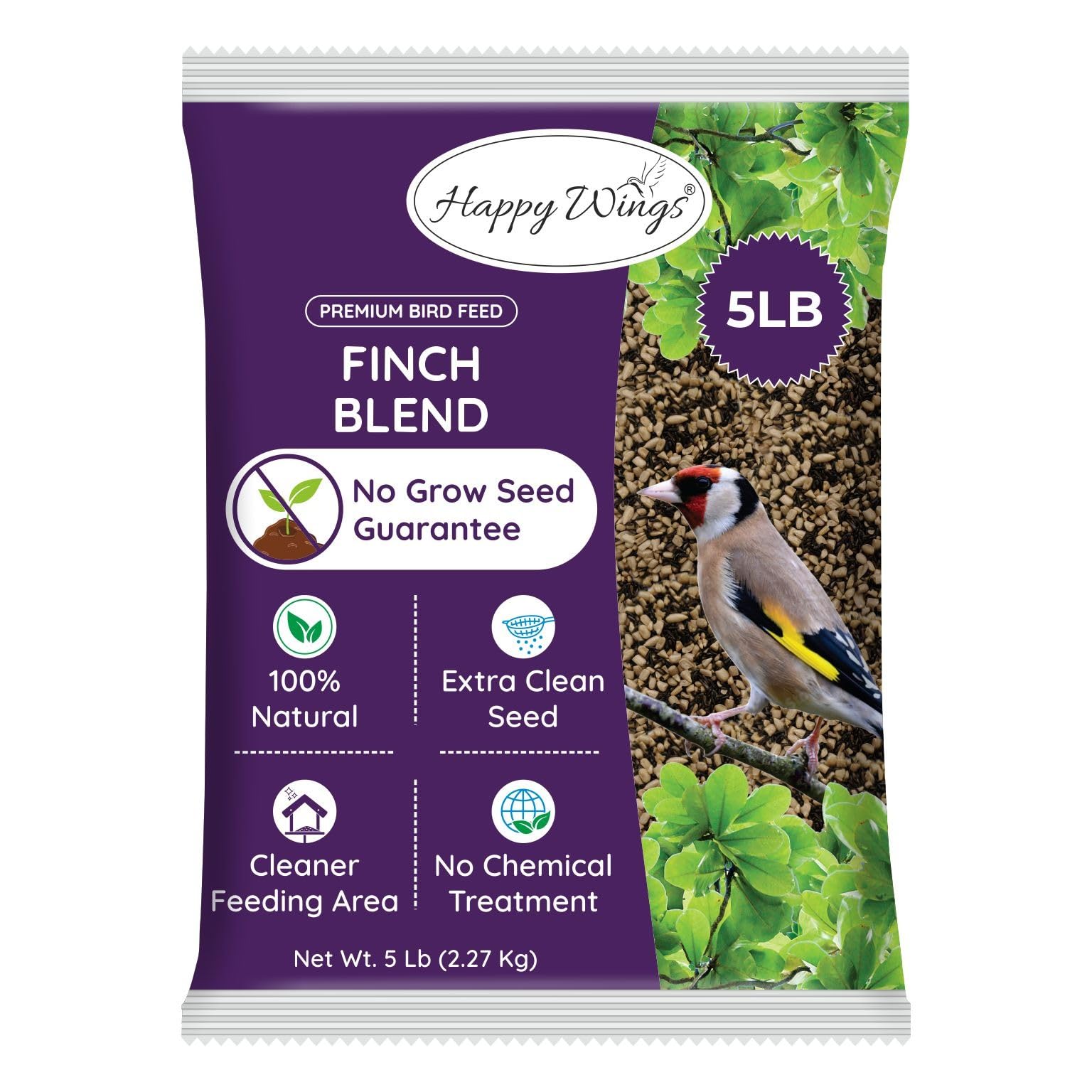
You get a 5-pound bag of sunflower hearts and nyjer (thistle) seed, so your finches get their favorite food and nothing sprouts under the feeder.
The nyjer is heat-treated to prevent germination — a critical feature in the Pacific Northwest where damp soil turns spilled thistle seed into a weedy mess. One reviewer put it plainly: “This is by far the best Finch birdseed I have ever found.” Buyers also report that it attracts house finches, sparrows, chickadees, and even woodpeckers when they swing through. The blend is processed in a USDA and BRC-GS approved facility with quality checks, and it meets the standards of the Wild Bird Feeding Institute — so the seed is clean and pest-free. The “no grow” label means you can fill a finch tube feeder without worrying about what sprouts underneath, even during Seattle’s wettest months. However, this blend uses small seeds that require the right feeder. If you pour it into a feeder with large ports, most of it will fall straight to the ground. One buyer warned to “make sure to use the correct type of feeder or it will all fall out.” A finch-specific tube feeder with small feeding ports is essential here. For a targeted finch solution, this blend beats the general-purpose mixes hands down.
Finch-first formula
- Sunflower hearts and nyjer target finches specifically — house finches, goldfinches, and pine siskins.
- No-grow nyjer means zero weed sprouts under the feeder in wet soil.
- Processed in a USDA and BRC-GS approved facility for quality assurance.
Feeder requirement
- Small seeds leak out of standard feeders with large ports — you need a finch-specific tube feeder.
- 5 lb bag is small; frequent refills needed if finch flocks are large.
- More expensive per pound than a bulk sunflower blend.
If finches are your focus: This no-grow blend paired with a finch tube feeder will keep your yard full of house finches and goldfinches without the weed problem.
skip it if: You use a platform or hopper feeder with wide openings — most of this seed will end up on the ground before the birds get to it.
7. Mr. Bird’s Bugs, Nuts, Fruit Small Wild Bird Seed Cylinder – 2-Pack (24 oz each)

You get a 4″ x 4″ x 7 3/4″ compressed cylinder packed with mealworms, tree nuts, pecans, peanuts, sunflower hearts, raisins, and cranberries, so woodpeckers and titmice get high-protein food that holds together in the rain.
This is not a loose seed blend. It is a rain-resistant block that buyers confirm “seems to hold together in the rain.” The mealworm content separates it from every other product on this list — it is the only one that delivers real insect protein, especially valuable during spring nesting season when birds need extra energy. One customer observed that “the birds absolutely ‘flock’ to these” and that a single cylinder “typically last[s] about month.” However, multiple buyers also report that a cylinder can be “gone in about a day” with a large flock, so your actual mileage depends on your bird traffic. The 2-pack gives you two 24-ounce cylinders (48 ounces total, or 3 pounds). The manufacturer states they never melt. For a protein boost during cold, wet PNW stretches, these cylinders beat any loose seed bag, but they cost more per feeding session. Use them as a supplement to a bulk seed blend rather than your main food source.
Unique protein source
- Mealworms provide real insect protein — class-leading for spring nesting and winter energy.
- Compressed cylinder holds shape in rain; works in mesh feeders without crumbling.
- Attracts woodpeckers, titmice, nuthatches — species that often ignore loose seed blends.
- No shells, no hulls, no mess under the feeder.
Consumption speed
- Large flocks can empty a cylinder in 1–2 days, requiring frequent replenishment.
- Higher cost per feeding session compared to bulk loose seed.
- Not suitable for standard tube or hopper feeders — needs a mesh cylinder feeder.
For the protein seekers: If woodpeckers and titmice are your target visitors, or you want to give your flock a high-energy boost during cold wet spells, these rainproof cylinders deliver something no loose blend can.
Budget note: If you feed a large flock daily, cylinders become expensive fast — use them as a supplement to a bulk seed blend rather than your main food source.
Understanding the Specs
Mess and no-grow claims
“No mess” means the seeds are shelled (hearts or chips) so birds eat the entire seed and nothing falls to the ground. “No grow” means nyjer or other seeds are heat-treated so they cannot sprout — essential for wet PNW yards where spilled seed turns into a weed problem fast.
Ingredient variety and filler
Some blends pack in corn, milo, or millet as cheap volume — birds often kick these out of the feeder, creating waste. Safflower and black oil sunflower are the high-value ingredients that local cardinals, chickadees, and finches actually eat. A shorter ingredient list (two or three seeds) usually means less waste per bag.
FAQ
Will safflower seed actually deter squirrels in my yard?
How long does a 10-pound bag of bird seed last for a typical backyard feeder?
What is the difference between sunflower hearts and whole sunflower seeds?
Can I mix no-grow nyjer seed with regular sunflower seed in the same feeder?
Does bird seed expire or go bad in humid PNW weather?
Why do some birds ignore safflower seeds in my feeder?
Which feeder type works best for cylinder seed blocks?
How do I know if a bird seed mix has cheap filler ingredients?
Does the Pacific Northwest have any bird species that prefer specific seed types?
Final Thoughts: The Verdict
For most people, the bird seed for pacific northwest winner is the Audubon Park Waste Free 12 lb No Mess Blend because its shell-free sunflower hearts and peanut pieces keep your patio clean through the rainiest months while attracting the full PNW songbird lineup. If you want to target cardinals and deter squirrels, grab the Cool Birds Cardinal & Crew 10 lb for its three-ingredient no-filler formula. And for woodpeckers and protein-hungry flocks during wet winter stretches, the standout is the Mr. Bird’s Bugs, Nuts, Fruit Cylinder 2-Pack for rainproof, mess-free feeding.
How We Picked
We do not accept paid placement. Every pick is matched to a real buyer and a real use-case; we do not hands-on test units.
Sources & Methodology
Specifications: manufacturer listings and product documentation. Review insights: verified customer reviews, as of July 2026. Pricing: not shown on this page (it changes often); check the current price via the retailer link.
As an Amazon Associate, Lawn Gear Lab earns from qualifying purchases. This does not affect which products we feature.