
Specs are compiled from manufacturer listings and verified buyer reviews and can change over time — please confirm the key details on the product page before buying.
The blade on your edger is the only thing between your sidewalk and a ragged, unkempt lawn line. A dull or wrong-size blade makes you fight the machine, leaving frayed grass and a sore back instead of a crisp edge. The right one slices clean through dirt and roots, letting the tool do the work so you move at a steady walking pace instead of wrestling it every few feet.
I’m Rikta — the founder and writer behind Lawn Gear Lab. This guide is built by comparing the manufacturers’ published specifications and the patterns across verified customer reviews, so you get each pick’s real strengths and trade-offs instead of marketing spin.
The trick is matching the center hole size, blade width, and thickness to your specific edger brand, then choosing a steel grade and blade shape that match how tough your edging conditions really are. That is exactly what this guide to the best edger blades lays out, one spec and one real-world review at a time.
Quick Picks
- MowerPartsGroup (10) Pk Edger Blades 8″ X 2″ — 10-Box Value
- Karbay 5 Pack 613223 Edger Blades — Pro Fit Pack
- HandyTek 2 Pack 9″ x 5/8″ Center Hole 3-Side Edger Star Blade — Star Cutter
- Huthbrother 9″ x 5/8″ Center Hole 3-Side Edger Star Blade (2 Pack) — Budget Star
- 3-Pack High Carbon Steel Replacement Edger Blades (Fits Worx, DeWalt, Craftsman) — Compact Fit
- Geosiry 3 Pack Edger Blades 1 Inch Center Hole — Thicker Steel
- Deckman 5 Pack Universal 9″ x 2″ Edger Blade (1/2 Hole) for Mclane — 5-Bar Flat
How To Choose The Best Edger Blades
Picking the wrong edger blade usually means a frustrating return trip to the hardware store or a wasted afternoon fighting a blade that does not fit. Three factors decide whether a blade will bolt right on and cut clean: the center hole diameter, the blade width and thickness, and the steel type and shape. Here is what each one means for your yard work.
Center Hole Diameter — The Absolute Fitment Gate
To mount a blade, you need the right center hole size — the round opening that slides over your edger’s shaft. Common sizes are 5/8 inch (found on many Craftsman, Troy-Bilt, and MTD push edgers), 1/2 inch (common on older Mclane and Power Trim models), 1 inch (standard on Stihl, Echo, Ryobi, Ego, and most straight-shaft trimmers with edger attachments), and 0.512 inch (specific to DeWalt and Worx electric edgers). If this number does not match your machine, the blade simply will not mount — no amount of force or adaptation makes it work. Check your owner’s manual or measure the hole on your current blade before you buy.
Blade Width, Length, and Thickness — The Cut and Durability Trade-Off
Width (typically 2 inches on most universal blades) determines how wide a trench the blade cuts. A 2-inch width is standard for sidewalks and driveways. Thickness matters for durability: a 0.12-inch blade feels noticeably more solid and resists bending against rocks and roots better than a 0.100-inch blade, but it requires a more powerful motor to spin without bogging down. Length is usually 8 or 9 inches, and you should stick to whatever length your edger was designed for — a longer blade can hit the housing or kick up debris.
Steel Type and Blade Shape — How It Handles Tough Edging
Heat-treated alloy steel resists bending, fracturing, and dulling far better than basic carbon steel, especially if you edge along rocky curbs or in compacted soil. The blade shape is just as important: a 3-sided star blade uses sharp serrated edges that slice aggressively through thick grass and roots, while a flat rectangular blade has a simple edge that works fine for light maintenance but struggles with heavy overgrowth. If your edger has a weaker motor, the star blade’s aggressive bite can actually stall the engine, so match the shape to your machine’s power.
Quick Comparison
| Model | Best For | Center Hole | Blade Width & Thickness | Pack Size | Amazon |
|---|---|---|---|---|---|
| MowerPartsGroup 10-Pack | High-volume edging | 1″ | 2″ x 0.120″ | 10 blades | Amazon |
| Karbay 5-Pack | Brand-name fit on a budget | 1″ | 2″ x 0.11″ | 5 blades | Amazon |
| HandyTek 2-Pack Star Blade | Aggressive cutting on Troy-Bilt/Craftsman | 5/8″ | 9″ x 9″ (star) | 2 blades | Amazon |
| Huthbrother 2-Pack Star Blade | Budget-friendly star blade for MTD/Craftsman | 5/8″ | 9″ x 9″ (star) | 2 blades | Amazon |
| 3-Pack High Carbon Steel | DeWalt / Worx electric edgers | 0.512″ | — x 0.100″ | 3 blades | Amazon |
| Geosiry 3-Pack | Thicker blade for Stihl/Ego/Echo | 1″ | 2″ x 0.12″ | 3 blades | Amazon |
| Deckman 5-Pack | Mclane and Power Trim edgers | 1/2″ | 2″ x —” | 5 blades | Amazon |
In‑Depth Reviews
1. MowerPartsGroup (10) Pk Edger Blades 8″ X 2″

A ten-blade bulk pack that turns a premium edge at a fraction of the per-blade cost.
If you edge a large property or run a crew, the per-blade price here beats buying singles at a big-box store — and buyers report these blades last as long if not longer than -a-piece blades from Lowe’s. Each blade measures 8 inches long and 2 inches wide with a 1-inch center hole, so it fits Stihl, Echo, Husqvarna, Ryobi, Shindaiwa, and Red Max straight-shaft edgers. One reviewer noted their Ego edger struggled until they swapped to this blade, then it carved a border like a hot knife through butter — even after 500-plus feet of untouched edging.
The catch is the weight: at 4.89 pounds for the 10-pack, it is the heaviest set here, but that weight comes from the quantity of USA steel, not a flaw. For homeowners who edge once a month, a 10-pack is overkill, but for anyone who wants a supply that lasts multiple seasons, this eliminates the “I need a blade now” panic trip to the store.
Thick-steel workhorse: At 0.120 inch thick and 2 inches wide, these blades cut clean through compacted soil and overgrown borders without flexing, matching or outlasting premium brands at roughly one-fifth the per-blade cost of name-brand singles.
Know before you buy: The 10-pack is a lot of blades for light-duty use — you are paying for quantity you may not need if you only edge a small lawn once a week.
Grab this if: You own a Stihl, Echo, or Ryobi edger and want a multi-season supply of thick, reliable blades at a per-blade price that undercuts the local hardware store.
Look elsewhere if: Your edger uses a 5/8-inch or 1/2-inch center hole, or you only need two blades to get through a single season.
2. Karbay 5 Pack 613223 Edger Blades
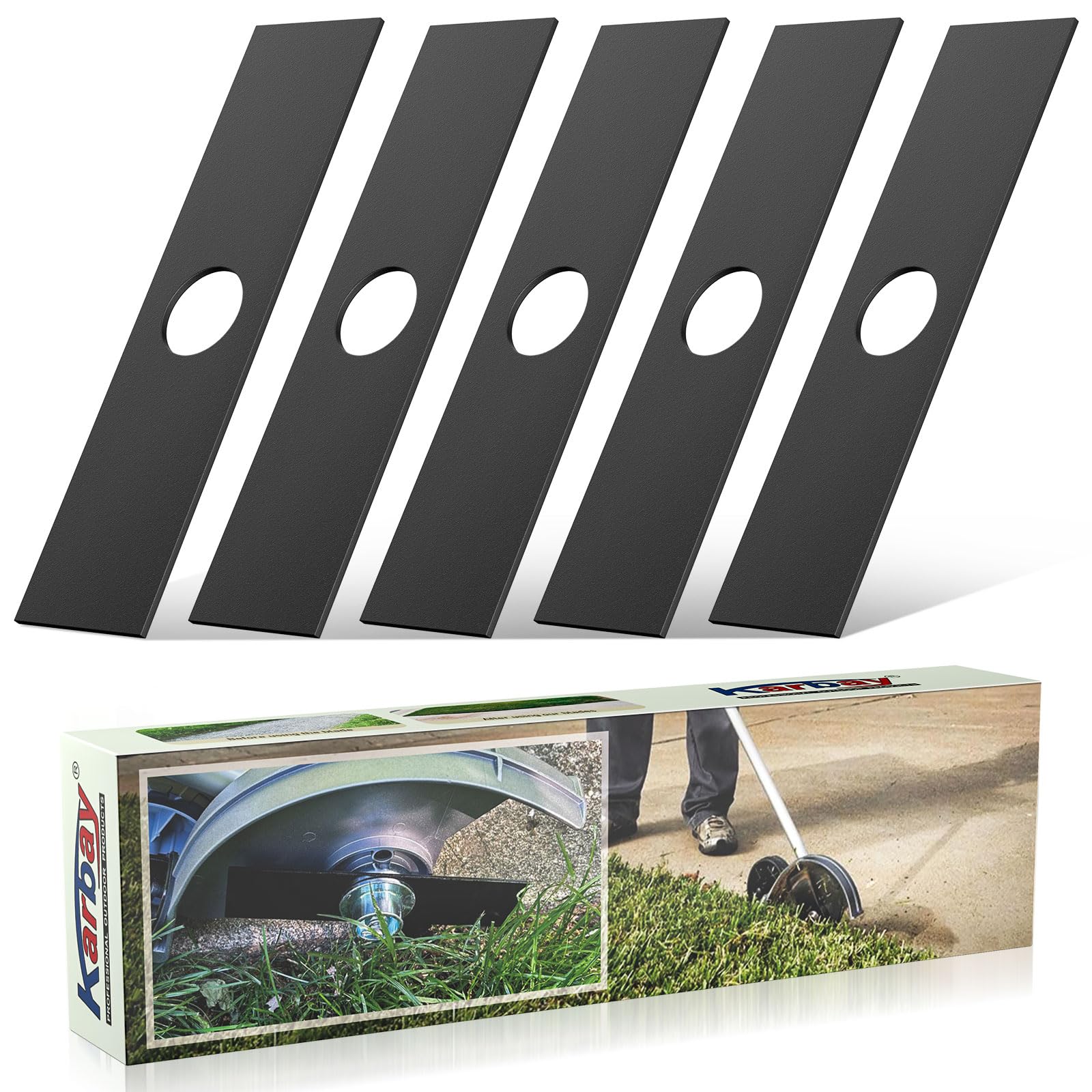
A five-pack that fits Milwaukee, Echo, and Stihl with a reversible edge for double the life.
Reversible blades double their useful life — when one edge dulls, you flip the blade over and get a fresh cutting surface. These Karbay blades are 8 inches long, 2 inches wide, and 0.11 inch thick with a 1-inch center hole, matching the same dimensions as the Geosiry pack but at a slightly thinner profile. They replace a long list of OEM part numbers including Echo’s 613223 and Stihl’s 4133-713-4101, and owners mention a perfect fit on Milwaukee edgers with a 30-second install time. One buyer mentioned they are not razor-sharp out of the package but cut perfectly once spinning — typical for steel edger blades that rely on impact, not a knife edge.
The trade-off is the thickness: at 0.11 inch, these are thinner than the MowerPartsGroup 0.120-inch blades and the Geosiry 0.12-inch option, so they may bend slightly more against buried rocks. But for routine sidewalk and driveway edging on a gas-powered or high-torque electric edger, the reversible design means you get ten effective edges from a five-blade pack — a smart value play.
Double-life design: Flipping the blade gives you a fresh edge without buying a new blade, effectively turning a 5-pack into 10 uses for the same money.
One real limitation: At 0.11 inch thick, it trails the 0.120-inch options in raw durability against hard curbs and large roots.
Pick it if: You edge a medium-sized lawn with a Stihl, Echo, or Ryobi and want the cost-per-use advantage of reversible blades.
skip it if: Your edging conditions are full of rocks and large roots — then the thicker 0.120-inch blades give you more confidence.
3. HandyTek 2 Pack 9″ x 5/8″ Center Hole 3-Side Edger Star Blade
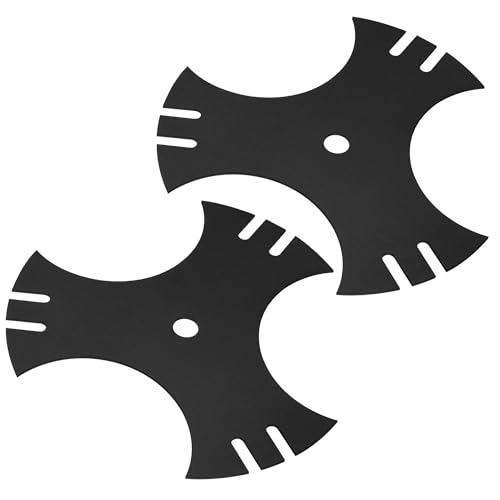
A three-sided star blade that slices aggressively but can overpower a weaker edger motor.
The star shape is the defining spec here — three sharp serrated edges that bite into grass and dirt from every angle, unlike a flat bar blade that only cuts on one side. These HandyTek blades are 9 inches long and 9 inches wide with a 5/8-inch center hole, fitting Craftsman, Troy-Bilt, and MTD push edgers. The alloy steel is heat-treated and quenched for hardness, which resists bending and fracturing in tough soil. One owner reported the blade sliced through and edged like a pro landscaper, noting the blade does all the work. Another mentioned these work great, but almost too well — the aggressive bite pulled the edger forward so strongly it could stall a wimpy motor unless you slow down and pull back.
That is a real hybrid warning: If you have a lower-power electric edger (especially a corded model or an older 2-cycle gas unit), the star blade’s self-feeding action may bog it down. On a strong gas push edger, however, it is noticeably faster than the original 2-sided blade. At 0.82 kilograms (about 1.8 pounds) for the pair, it is a mid-weight set that feels balanced on a wheeled edger.
Likes
- 3-sided design cuts faster than rectangular blades on thick grass and overgrowth
- Heat-treated alloy steel resists bending and fracturing in rocky soil
- Black powder coating adds weather and rust resistance for outdoor storage
Watch Out
- Aggressive self-feeding can stall low-power edger motors
- 9-inch length may not fit all edger housings — measure clearance first
Best for strong edgers: If you have a gas-powered push edger from Craftsman or Troy-Bilt, this star blade turns edging into a fast, one-pass job.
Not for weak motors: Stick with the rectangular bar-type blade if your edger is a lower-power electric model that struggles under load.
4. Huthbrother 9″ x 5/8″ Center Hole 3-Side Edger Star Blade (2 Pack)

An affordable star-blade twin pack that keeps a spare on hand for the same price as a single OEM blade.
This Huthbrother set is nearly identical in shape and dimensions to the HandyTek star blade above — same 9-inch length, 5/8-inch center hole, and 3-sided design — but comes from a different manufacturer at the same price point. It fits the same family of MTD, Troy-Bilt, and Craftsman edgers (part numbers 781-0748, 981-0748, 40-009). Customers note the blade works way better than the original 2-sided blade and that the 9-inch size fits perfectly, with one calling it a good buy with a second blade ready for future need. A more critical buyer noted the steel seems a little subpar compared to premium blades, though that same reviewer acknowledged the value is very good if the blades last.
The difference from the HandyTek set is subtle: the Huthbrother blades weigh 1 pound for the pair (vs. 1.8 pounds for the HandyTek pair), suggesting slightly thinner or lighter steel. If you are on a tight budget and edge a small lawn a few times a season, these work fine. But for heavy use along long driveways with concrete curbs, the extra heft of the HandyTek or MowerPartsGroup blades is worth the slight price bump.
Two for the price of one OEM: You get a backup blade in the box, so you are not hunting for a replacement mid-season.
Heavier use means more caution: The lighter steel (1 lb per pair) may dull faster than the 1.8 lb HandyTek pair in rocky or high-volume edging.
Reach for it if: Your edger uses a 5/8-inch center hole and you want a cheap spare blade on the shelf for occasional touch-ups.
Pass if: You need a blade that will survive a full season of weekly edging along concrete curbs — invest in the thicker HandyTek or MowerPartsGroup blades instead.
5. 3-Pack High Carbon Steel Replacement Edger Blades (Fits Worx, DeWalt, Craftsman)

The rare blade that fits DeWalt and Worx electric edgers with a precision 0.512-inch center hole.
Most universal blades use a 1-inch or 5/8-inch hole, which leaves DeWalt DCED400 and Worx WG896/WG895 owners stuck with overpriced OEM replacements. This set uses a 0.512-inch center hole and 0.100-inch thickness — a direct match to the factory specs. One reviewer who edges three yards weekly (over 1,000 feet) reported the blade held up without bending and had significant remaining material even after heavy use. Another said the blade made the DeWalt cut like new again, ripping through overgrown grass and compacted soil without bogging.
The only trade-off is the 0.100-inch thickness, which is thinner than the 0.120-inch MowerPartsGroup blades — so it will flex more against buried rocks. But for the specific DeWalt/Worx crowd, there is not a better price-to-fit option in this roundup.
Why It Wins
- Precision 0.512″ center hole fits DeWalt DCED400 and Worx edgers without modification
- High-carbon steel holds an edge longer than basic steel blades
- 3-pack costs significantly less than a single OEM replacement blade
The Limitation
- At 0.100″ thick, it is 20% thinner than the 0.120″ options — less resistant to hard rock impacts
- Only fits the narrow.512″ hole format; no use on other edger brands
Must-buy for DeWalt/Worx owners: If you have a DCED400 or WG896, this is the best fit and value you will find — 3 blades for less than a single OEM blade.
No use for other brands: Only works on the 0.512-inch center hole format; skip this if your edger uses a 1-inch or 5/8-inch hole.
6. Geosiry 3 Pack Edger Blades 1 Inch Center Hole
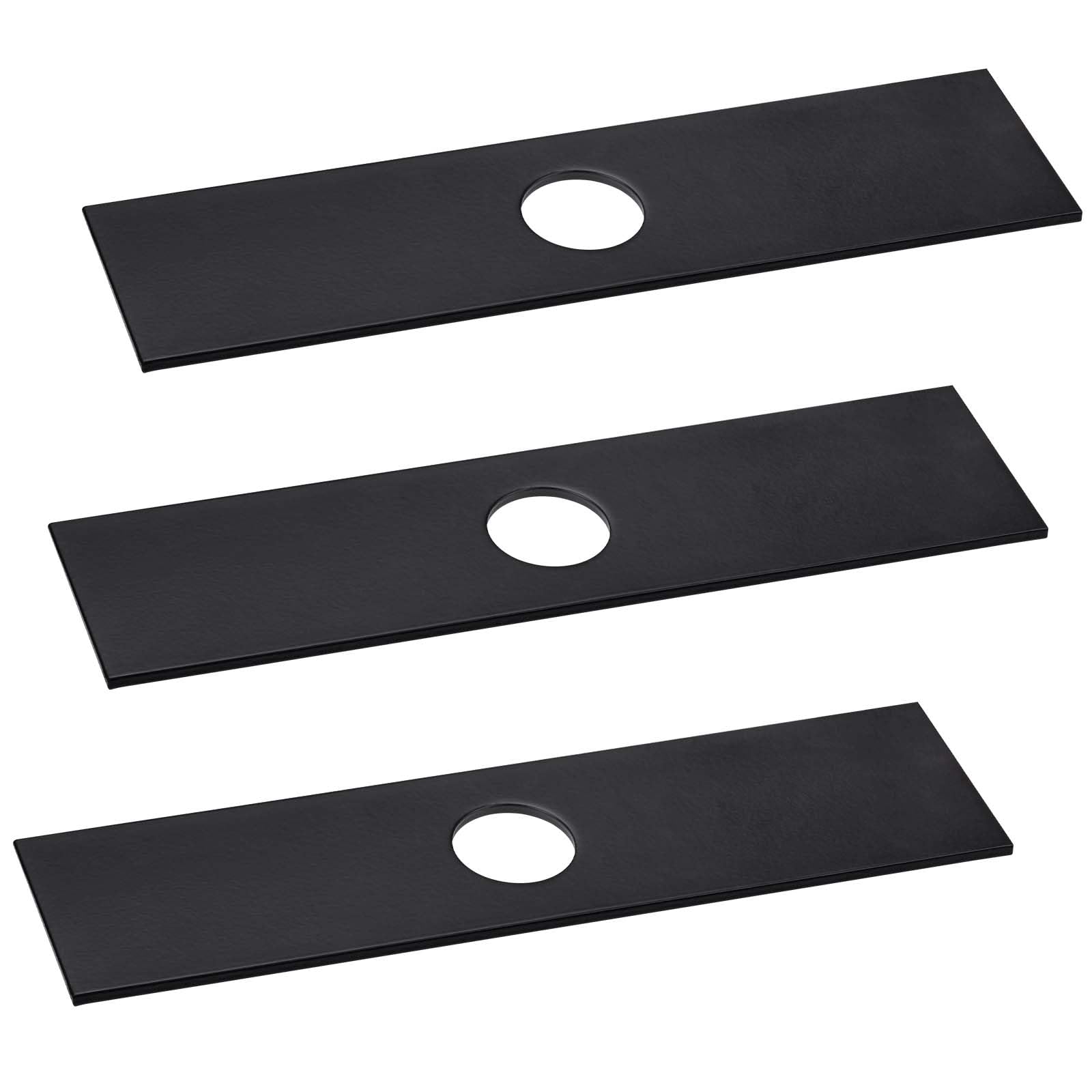
A three-pack with noticeably thicker steel that feels more solid than the stock blade on your Ego or Stihl.
At 0.12 inch thick, this blade is thicker than the 0.100-inch budget options and matches the 0.120-inch MowerPartsGroup blade for top-tier durability. It replaces a long list of OEM numbers including Stihl 4133-713-4101, Echo 613223, and Ryobi 720-237-001. One customer observed the thicker steel feels more solid than stock and holds up well on sidewalks and curbs without bending. The same buyer cautioned that the extra thickness may bog down weaker edgers on deep cuts — a trade-off note for lower-power trimmers with an edger attachment.
The blades are 8 inches long and 2 inches wide with a 1-inch center hole, making them a direct fit for Stihl FC72/FC75/FC85/FC110, Echo E3100/PE200/PE260/PE310, and most Ryobi and Kobalt straight-shaft edgers. At 1.61 pounds for the 3-pack, it is mid-weight but carries the thickness advantage. Unlike the Karbay 5-pack, these are not reversible, but the thicker steel means each blade lasts longer before dulling — a fair trade if you prefer fewer blade swaps.
Noticeably thicker than OEM: The 0.12-inch thickness provides 20% more material than the 0.100-inch DeWalt-compatible blades, giving better resistance to bending on concrete curbs.
Motor warning: The extra thickness creates more drag; weaker edger attachments may stall on deep, compacted cuts.
Choose it if: You edge with a Stihl, Echo, or Ryobi and want a blade that resists bending better than the stock blade without paying premium per-blade prices.
Avoid if: Your edger is a low-torque electric trimmer attachment — a thinner blade will put less strain on the motor.
7. Deckman 5 Pack Universal 9″ x 2″ Edger Blade (1/2 Hole) for Mclane
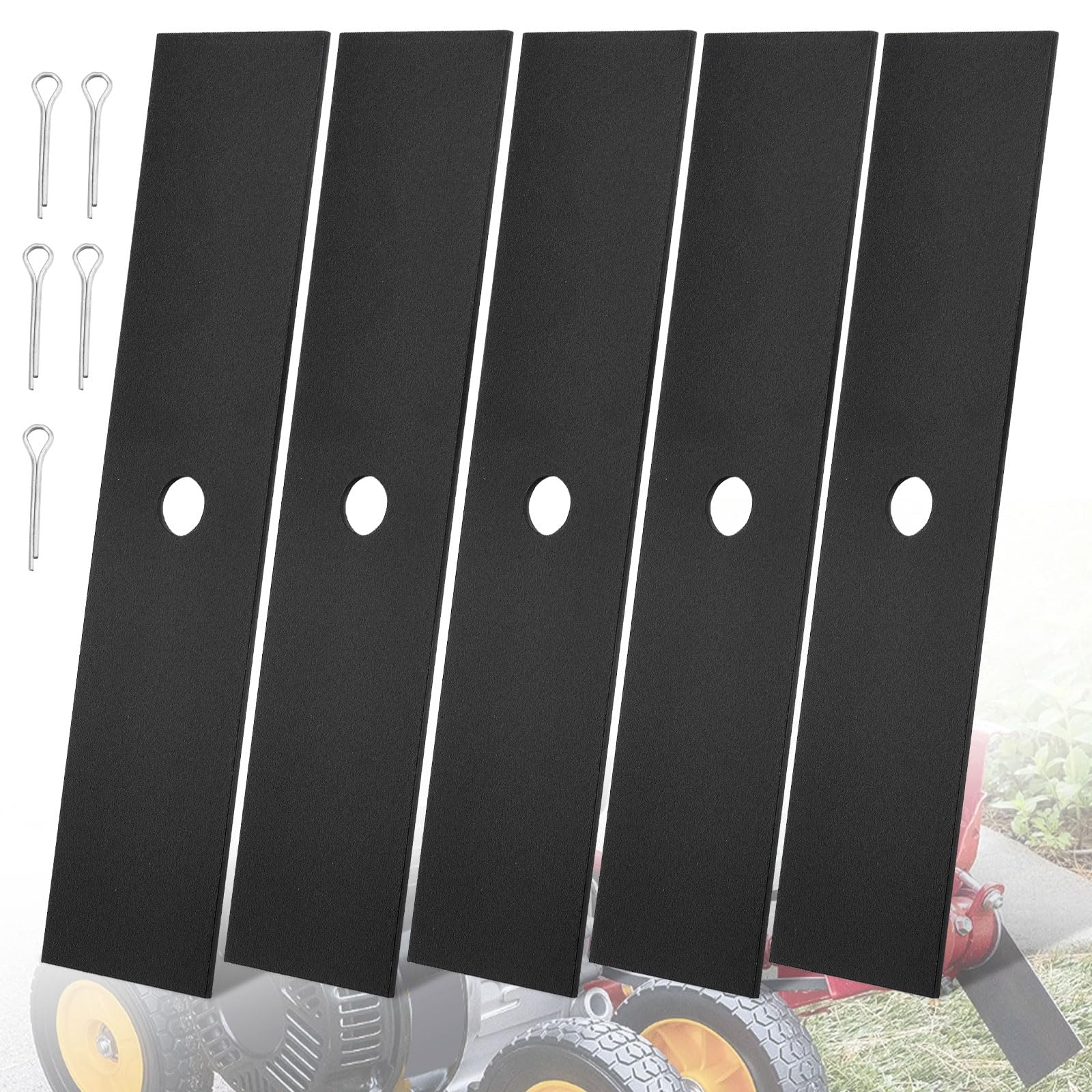
A flat rectangular blade that fills a niche for older Mclane-style edgers with a 1/2-inch center hole.
The 1/2-inch center hole sets this blade apart — it is the only one in this roundup that fits Mclane 2059, Power Trim, King O Lawn, and Tru-Cut edgers, which use the smaller hole size. At 2.35 pounds for a 5-pack, these are heavier than most, but that is because each blade is a simple rectangular strip of heat-treated steel, not a star shape. One buyer gave an honest heads-up: the blade has no cutting edge — just a flat rectangular strip with a 1/2-inch hole — but works okay for wide driveway block edging. Another confirmed the steel is hard and fits an Ariens gas lawn edger perfectly.
The flat shape means it cuts by scraping rather than slicing, which works fine for light maintenance but struggles with thick grass compared to a star blade. If your edger uses the 1/2-inch hole and you edge a small-to-medium lawn with mostly soft soil, this 5-pack gives you years of blades. But for anyone who does not need the 1/2-inch hole, the 9-inch length and 2-inch width are standard — the star blades above will cut faster with less effort.
What It Does Well
- Only blade in this guide with a 1/2-inch hole — essential for Mclane, Power Trim, and King O Lawn edgers
- Heat-treated steel resists chipping and cracking; gets sharper as you use it per the manufacturer
Honest Limitation
- Flat rectangular blade has no cutting edge — it scrapes rather than slices through grass
- Not suitable for heavy overgrowth compared to the 3-sided star blades
Your only option if: Your edger uses a 1/2-inch center hole — none of the other blades here fit that size.
Skip if: Your edger uses any other center hole size; a star blade will give you faster, cleaner cuts for the same money.
Understanding the Specs
Center Hole Diameter
The round opening in the middle of the blade that slides onto your edger’s mounting shaft. It is the single spec that determines whether a blade physically fits your machine. Common sizes are 5/8 inch (Craftsman, Troy-Bilt, MTD push edgers), 1/2 inch (older Mclane and Power Trim models), 1 inch (Stihl, Echo, Ryobi, Ego, and most trimmer-attachment edgers), and 0.512 inch (DeWalt, Worx, and Craftsman electric edgers). If the hole is wrong, the blade simply will not mount — no workaround exists. Measure your current blade’s hole or check your owner’s manual before ordering.
Blade Thickness
Measured in inches — common values are 0.100 inch, 0.11 inch, and 0.12 inch. Thicker blades (0.12 inch) resist bending against rocks, concrete curbs, and compacted soil, but they create more drag and require a more powerful motor to spin freely. Thinner blades (0.100 inch) put less strain on low-torque electric edgers but may bend or dull faster in tough conditions. The difference between 0.100 inch and 0.12 inch is about 20% more material, which translates to noticeably longer life in rocky edging.
FAQ
What size edger blade do I need?
Will a 9-inch blade fit my edger if the original was 8 inches?
Are star blades better than flat rectangular blades?
How often should I replace edger blades?
Can I sharpen edger blades instead of replacing them?
What does “heat-treated” mean on an edger blade?
Will a 2-inch wide blade cut a wider trench than a 1.5-inch blade?
Do thicker blades work on electric edgers?
What is the difference between carbon steel and alloy steel blades?
Can I use a 1-inch center hole blade on a 5/8-inch shaft?
Final Thoughts: The Verdict
For the majority of shoppers, the best edger blades winner is the MowerPartsGroup 10-Pack because it delivers the thickest steel (0.120 inch) at the lowest per-blade cost, fitting the widest range of popular edger brands with a 1-inch center hole. If you need a star blade for a Craftsman or Troy-Bilt push edger, the HandyTek 2-Pack gives you the fastest cutting action available. And for DeWalt or Worx electric edger owners, the 3-Pack High Carbon Steel set is the only precision-fit option that saves you money over OEM blades.
How We Picked
We do not accept paid placement. Every pick is matched to a real buyer and a real use-case; we do not hands-on test units.
Sources & Methodology
Specifications: manufacturer listings and product documentation. Review insights: verified customer reviews, as of July 2026. Pricing: not shown on this page (it changes often); check the current price via the retailer link.
As an Amazon Associate, Lawn Gear Lab earns from qualifying purchases. This does not affect which products we feature.