
Specs are compiled from manufacturer listings and verified buyer reviews and can change over time — please confirm the key details on the product page before buying.
You filled a pot with dirt, added a plant, and watered it — then the plant died. Container gardening punishes the wrong potting mix: roots either drown or dry out. The right supplies turn a sad windowsill basil into a mini harvest. The wrong ones keep your tomatoes as permanent seedlings. This guide cuts through the shelf clutter to find the mixes, soils, and systems that actually deliver, based on manufacturer specs and verified customer reviews.
I’m Rikta — the founder and writer behind Lawn Gear Lab. This guide is built by comparing the manufacturers’ published specifications and the patterns across verified customer reviews, so you get each pick’s real strengths and trade-offs instead of marketing spin.
Knowing which potting soil drains well, feeds your plants, and holds just the right amount of water makes the difference between a thriving container garden and a frustrating one. Here is the guide to the best container gardening supplies.
Quick Picks
- Miracle-Gro Moisture Control Potting Mix — Best Overall
- Espoma Organic Potting Soil Mix AP2 — Organic Power
- Coast of Maine Bar Harbor Blend Potting Soil — Garden Favorite
- EarthBox Container Gardening System (Terra) — System Solution
- EarthBox Garden Kit (Organic, Terracotta) — Complete Kit
- FoxFarm Cultivation Nation 70:30 Growing Media — Soilless Base
- Midwest Hearth Premium Potting Soil Mix — Starter Size
How To Choose The Best Container Gardening Supplies
Container plants live in a closed world. Unlike garden soil, where roots stretch deep into the earth, everything your potted plant needs must fit inside that container. That makes the potting mix and the container system your two most important decisions. Here is what to look for.
Drainage and Aeration — Letting Roots Breathe
Roots need oxygen as much as they need water. Soil that stays soggy suffocates roots and invites rot. Good potting soil includes perlite (volcanic glass that traps air pockets) or vermiculite (a mineral that holds both water and air) to keep the mix light. If the bag feels dense and heavy, water will pool at the bottom of your pot. The best mixes feel fluffy in your hand and hold their shape when squeezed, then break apart easily.
Water Retention — The Balance Every Plant Needs
Container soil dries out faster than garden soil, especially on a sunny deck. You need a mix that holds moisture long enough that you are not watering twice a day, but not so tightly that roots sit in a swamp. Ingredients like sphagnum peat moss, coco coir (shredded coconut husk), and moisture-control crystals help extend time between waterings. For gardeners who travel or tend to forget, a mix with built-in moisture control or a self-watering planter system can be a lifesaver.
Nutrient Content — Feeding Without Guesswork
Unlike plants in the ground, container plants cannot send roots into fresh soil. The nutrients in the potting mix are all they get. Many mixes include a slow-release fertilizer or are enriched with compost, worm castings, kelp meal, or bone meal. Some, like the Espoma AP2, come with mycorrhizae (beneficial fungi that help roots absorb nutrients). If you choose a soilless mix like FoxFarm’s coco coir and perlite blend, you will need to add liquid fertilizer yourself. Check the bag — a mix that “feeds for six months” saves you a lot of work.
Quick Comparison
| Model | Best For | Volume | Item Weight | Key Feature | Amazon |
|---|---|---|---|---|---|
| Miracle-Gro Moisture Control | Forgetful waterers / Big containers | 2 cu. ft. | 40.5 Pounds | AquaCoir formula reduces watering frequency | Amazon |
| Espoma AP2 Organic | Organic purists / Long-term potting | 2 cu. ft. | — | Myco-Tone root enhancer + organic nutrients | Amazon |
| Coast of Maine Bar Harbor | Vegetables & herbs in pots | 16 Quarts (2-Pack) | 14 Pounds (2-Pack) | Lobster & crab shell meal + kelp | Amazon |
| EarthBox Container System (Terra) | Self-watering / Set-and-forget | Holds up to 2 cu. ft. soil | 6 Pounds | 3-gallon water reservoir + aeration screen | Amazon |
| EarthBox Garden Kit (Terracotta) | All-in-one starter kit | Holds up to 2 cu. ft. soil | — | Includes casters, organic fertilizer & dolomite | Amazon |
| FoxFarm Cultivation Nation 70:30 | Custom feeding / Indoor grows | 2 cu. ft. | — | 70% coco coir / 30% perlite soilless mix | Amazon |
| Midwest Hearth Premium Mix | Small pots & seed starting | 8 Quarts | 1.25 Kilograms | Ready-to-use professional grower formula | Amazon |
In‑Depth Reviews
1. Miracle-Gro Moisture Control Potting Mix

This bag forgives your watering schedule and feeds plants for six months — your biggest margin for error in a single 40.5-pound purchase.
The AquaCoir formula (a blend of peat moss and coir fibers designed to hold more water) actively protects against both over- and under-watering. That matters when a sudden heatwave hits and you cannot get home at lunch. Miracle-Gro claims this mix absorbs up to 33% more water than basic potting soil. The 40.5-pound bag holds 2 cubic feet — enough to fill two 14-inch containers. The built-in slow-release fertilizer feeds your plants for up to 6 months, so you do not have to remember to add liquid feed every week. Buyers report that even struggling plants bounce back: one reviewer dug up weak pepper plants from the garden and replanted each in a one-gallon container filled with pure moisture control mix, watching them “do a 100% turn around” and produce a big harvest of red peppers. Unlike the Espoma AP2 (which costs more per bag for organic certification), this bag delivers more soil per dollar. The main trade-off: at 40.5 pounds, it is a heavy bag to carry up stairs.
Reasons to grab it
- Moisture control takes the guesswork out of watering
- Feeds plants for 6 months with slow-release fertilizer
- Enormous 2 cu. ft. bag fills multiple large pots
Think twice if
- You want certified organic ingredients — this is not organic
- You need a lighter bag to carry up stairs
The pick for busy gardeners: One bag does the watering and feeding work for months, especially in larger containers where drying out is the biggest risk. skip it if you are committed to organic growing methods that avoid synthetic fertilizers.
2. Espoma Organic Potting Soil Mix AP2

An organic blend that keeps 25-year-old houseplants thriving — with Myco-Tone fungi that help roots mine more nutrients.
Espoma AP2 is for anyone who wants to grow vegetables, herbs, or flowers without synthetic chemicals. The 2-cubic-foot bag packs sphagnum peat moss, humus, perlite, earthworm castings, alfalfa meal, kelp meal, and feather meal — all natural ingredients. A standout addition is Myco-Tone, a proprietary mix of endo and ecto mycorrhizae (beneficial fungi that form a partnership with plant roots to pull more water and nutrients from the soil). Buyers consistently report that Espoma lacks the large sticks and wood chunks that plague some other organic brands — one reviewer noted they found “big stick/wood pieces” in a competitor and would “continue to purchase this brand going forward.” Another gardener uses it for sentimental houseplants over 25 years old, trusting the quality to “keep my plants thriving.” Unlike the lighter Coast of Maine blend (which weighs 14 lb for 16 quarts), the Espoma bag holds 2 cubic feet, giving you better value for filling multiple medium-to-large pots.
Pros from the data
- Organic ingredients with no synthetic plant foods
- Myco-Tone root-boosting fungi included
- Clean, chunky texture without big debris
Cons from the data
- More expensive per bag than standard non-organic mixes
- Some buyers may find it rich for plants that prefer lean soil
The organic gardener’s pick: This is the mix to reach for when you want a full nutrient profile and a clean, consistent texture — especially for vegetables, herbs, and sentimental indoor plants. The higher upfront cost reflects the premium organic certification and natural amendments.
3. Coast of Maine Bar Harbor Blend Potting Soil
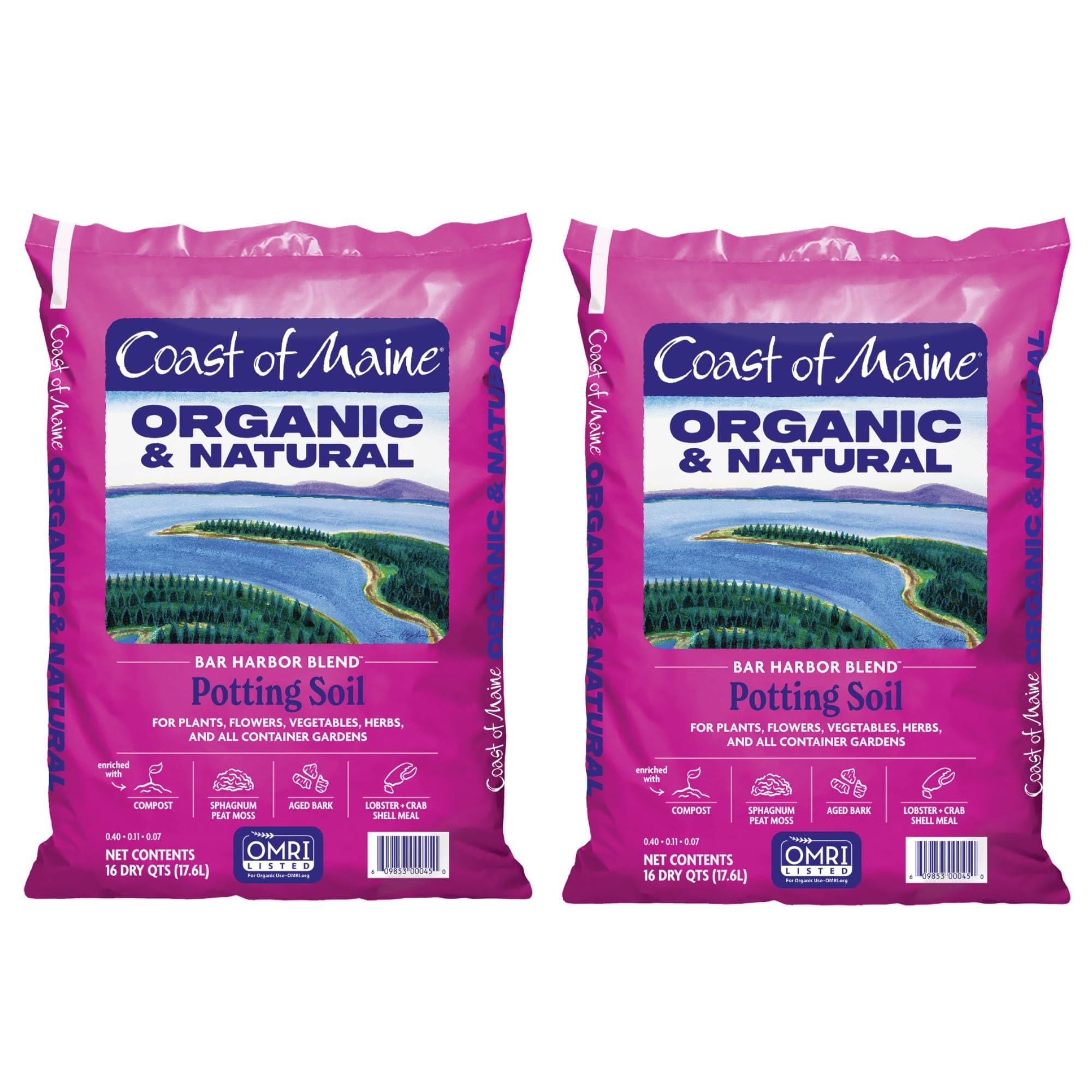
A marine-ingredient mix that turns a small patio into a vegetable factory — at 14 pounds for the set, it is far lighter than the 40.5-pound Miracle-Gro bag.
Coast of Maine brews its Bar Harbor mix with sphagnum peat moss, compost, perlite, lobster and crab shell meal, and kelp meal. Those marine ingredients release calcium and chitin, which many gardeners believe helps plants resist pests. The 16-quart bag (sold as a 2-pack) weighs just 14 pounds for the set — a huge advantage if you are hauling soil up stairs or across a patio. Buyers are enthusiastic: one buyer mentioned “two bags were enough to mound up 8 potato plants, and have extra for 2 more planters,” calling it “excellent value for the money.” Another gardener who had sworn by a “top brand” for years switched to Coast of Maine permanently after seeing how well their tomatoes performed. The dark, compost-rich texture has less peat moss than many mixes, and the natural slow-release nitrogen feeds consistently without requiring weekly liquid fertilizer.
Why it stands out
- Unique lobster/crab shell and kelp nutrient profile
- Lightweight at 14 pounds for a 2-bag set
- Approved for organic gardening
The trade-off
- 16-quart total volume is smaller than the 2 cu. ft. bags
- Not as widely available for fast delivery
The veggie container specialist: If you grow potatoes, tomatoes, or peppers on a patio or balcony, the lightweight composition and marine-based nutrients give you serious harvests without the back strain. The smaller bag size means you pay more per quart than the bulk bags.
4. EarthBox Container Gardening System (Terra)

A planter with a 3-gallon water reservoir that waters itself while you are at work — separating water from soil instead of trying to hold it longer.
This is the whole package — but you add your own potting soil. The EarthBox includes the container, an aeration screen, a water fill tube, and two reversible black/white mulch covers. The system works through a simple wicking mechanism: a 3-gallon water reservoir at the bottom, separated from the soil by the aeration screen. Water wicks upward through the soil as the plant needs it, so you never overwater and the plant never sits in a puddle. The container measures 29 inches long by 13.5 inches wide by 11 inches tall, and holds up to 2 cubic feet of growing media. Owners mention incredible yields: one reviewer measured “~50 Cherokee purple tomatoes per 2 plants” compared to the 1-2 tomatoes they got before, calling EarthBox “10 stars” worthy. Unlike the moisture-control mixes which try to hold water longer, this system physically separates water from soil — giving roots the ideal balance. The plastic is food-safe, UV-stabilized, and made in the U.S.A. Caster sockets are integrated, but the wheels are sold separately. Some users report the reservoir water can get a bit stinky as fertilizer seeps in.
what separates it
- Self-regulating water supply prevents both drought and root rot
- Built-in aeration screen keeps soil from getting waterlogged
- Durable U.S.-made plastic with UV stabilizers
Know before you buy
- Soil, casters, and fertilizer sold separately
- Some users report the reservoir water can get a bit stinky
The set-and-forget solution: Ideal for anyone who travels, works long hours, or simply hates the daily watering chore — fill the 3-gallon reservoir once and the plant draws what it needs for days. You will budget for the soil, casters, and fertilizer on top of the initial system cost.
5. EarthBox Garden Kit (Organic, Terracotta)

The all-in starter pack with casters and organic fertilizer — one box, no separate shopping trips like the base Terra model.
This is the EarthBox Terra system above, but bundled with everything you need to start immediately. Inside you get the same 29-by-13.5-by-11-inch container, aeration screen, water fill tube, and two reversible black/white mulch covers — plus a 1-pound bag of organic fertilizer (analyzed at 8-3-5: 8% nitrogen, 3% phosphorus, 5% potassium), a 1-pound bag of organic dolomite (a calcium and magnesium supplement that buffers soil pH), and 4 casters that let you roll the fully planted box around. The color is terracotta, a warm reddish-brown. Buyers rave: one reviewer who had tried for years to grow tomatoes with little success said with the EarthBox they “will have to give tomatoes away as I am going to have so many.” Another gardener who had struggled with “overwatering or underwatering” using regular 5-gallon buckets was stunned by the EarthBox’s performance, calling it “a low-maintenance package.” The biggest honest complaint is the cost — several reviewers wish the large box were priced lower. Soil is still sold separately.
Kit advantages
- Includes 1 lb organic fertilizer, 1 lb dolomite, and 4 casters
- Same proven self-watering system as the Terra model
- Castors let you roll plants into sun or shade easily
Kit drawback
- Higher upfront cost than the base EarthBox without accessories
- Soil is still sold separately
The one-box solution: Perfect for a first-time EarthBox buyer who wants everything in a single purchase — the casters alone are worth the upgrade over the base model. If budget is tight, you could buy the Terra system and source your own casters and fertilizer for less, but you lose the convenience and exact organic chemistry recommended by EarthBox.
6. FoxFarm Cultivation Nation 70:30 Growing Media

A blank canvas with zero fertilizer — you control every nutrient while roots breathe in 30% perlite air pockets.
FoxFarm’s Cultivation Nation is not potting soil. It is a soilless growing medium made from 70% buffered coconut coir (shredded coconut husk fibers that hold water well) and 30% perlite (white volcanic rocks that create air pockets). This mix contains zero fertilizer, zero compost, and zero synthetic nutrients. Instead, it gives you a sterile, lightweight base with excellent drainage and aeration — you add your own liquid fertilizer system. This is the choice for growers who want to control exactly what their plants eat, from seed to harvest. The 70:30 ratio is deliberate: the coconut coir retains water so you do not have to water as often as pure perlite, while the 30% perlite guarantees that roots never sit in stagnant water. The 2-cubic-foot bag gives you plenty of volume for a serious container setup. Unlike heavier, nutrient-dense mixes like Espoma or Miracle-Gro, this is a blank slate. It is ideal for indoor container gardens where you want a cleaner, bug-free starting point than outdoor soil mixes guarantee, but it requires you to add your own fertilizer.
Where it shines
- Excellent drainage prevents root rot every time
- Clean, sterile base — no weeds, bugs, or unknown nutrients
- Light and fluffy texture is easy to work with
What to know
- Requires you to add your own fertilizer — nothing is pre-mixed
- Not a complete “potting soil” for beginners who want simplicity
For the hands-on grower: If you already know your feeding schedule and want a consistent, sterilized base that drains fast, this is the bag to choose — especially for indoor containers. pass on it if you want a grab-and-go potting mix that feeds your plants for months with zero effort; Espoma or Miracle-Gro are better bets.
7. Midwest Hearth Premium Potting Soil Mix

The small-bag pro formula for seed starting and small pots — at 1.25 kg, the lightest bag here.
Midwest Hearth pitches this as “the same formulation as used by professional growers.” The ingredients: peat moss (for moisture and structure), perlite (for aeration), and vermiculite (for water retention and nutrient holding). The pH is controlled to work across a broad range of plant types, so you do not need to adjust acidity. At 8 dry quarts and just 1.25 kilograms (about 2.75 pounds), this bag is the smallest option here — a deliberate choice for seed starting, small pots, or first-time container growers who do not want to haul a 40-pound bag. The reviews are emphatically positive: one buyer called it an “excellent potting mix with ideal peat moss, vermiculite, perlite blend,” noting the light, fluffy texture that holds moisture without getting soggy. Another reviewer used it for germinating petunias and was “very happy,” praising the easy-open, resealable bag. A few gardeners pointed out the bag size is too small for larger pots — one owner reported “the bags are too small though” after their plumerias started thriving in it. Compared to the Coast of Maine Bar Harbor Blend (16 quarts in its 2-pack), the Midwest Hearth is clearly positioned for lighter duty.
Perfect for small jobs
- Light, fluffy texture ideal for starting seeds and nurturing young plants
- pH controlled so it works with almost any plant type
- Resealable bag and compact size easy to store
Not for big containers
- 8-quart bag is small — you would need several for a large pot
- Higher cost per quart than buying a 2 cu. ft. bag
Grab this for: Starting seeds indoors, repotting a few small houseplants, or keeping a bag on hand for emergency plant rescues. The 1.25 kg bag will not go far for a big patio container or raised bed — for those, a larger volume mix like Espoma or Miracle-Gro is more economical.
Understanding the Specs
Volume: Quarts vs Cubic Feet
The soil volume you need depends on your container size. A standard 10-inch pot holds roughly 5 dry quarts. A large 14-inch container needs around 14 quarts (about 0.5 cubic feet). The biggest bags here hold 2 cubic feet, which is 16 gallons of soil — enough for two of those 14-inch pots or one massive planter. Smaller 8-quart bags are perfect for starting seeds or repotting a handful of houseplants. Measure your container’s volume before you buy; running out of soil mid-project is frustrating, and buying too much means storing a heavy, open bag.
Weight: Lightness vs Heft
Bag weight tells you how hard it will be to carry home and roughly how much water the soil holds. Dense, heavy mixes like the 40.5-pound Miracle-Gro bag are packed with moisture-retaining peat and wetting agents — they hold water well but can be a chore to move. Lighter mixes, like the 14-pound Coast of Maine Bar Harbor Blend, are airier and easier to haul but may require more frequent watering in hot weather. For rooftop or balcony gardeners, lighter bags are worth a premium; for ground-level patios, heavier, denser mixes often deliver better value per gallon of soil.
FAQ
Can I use garden soil from my yard in a container?
How often should I replace potting soil in containers?
What is the difference between peat moss and coconut coir?
Does organic potting soil really make a difference for vegetables?
How do self-watering containers like the EarthBox work?
How big a container do I need for tomatoes or peppers?
Will adding extra perlite to my potting mix improve drainage?
What is the white stuff in my potting soil bag?
Can I reuse potting soil from last year’s containers?
Is it worth buying a 2 cu. ft. bag for small containers?
Final Thoughts: The Verdict
For most people, the best container gardening supplies winner is the Miracle-Gro Moisture Control Potting Mix because it delivers the widest margin for error on watering, feeds your plants for half a year with its built-in slow-release fertilizer, and comes in a large 2-cubic-foot bag that fills big containers affordably. If you want an organic mix that builds soil health naturally and gives you a custom root biology boost with Myco-Tone, grab the Espoma Organic AP2. And for a truly hands-off growing experience where the planter manages the water for you — perfect for busy or forgetful gardeners — the all-in-one EarthBox Garden Kit with casters and organic fertilizer is the system to beat.
How We Picked
We do not accept paid placement. Every pick is matched to a real buyer and a real use-case; we do not hands-on test units.
Sources & Methodology
Specifications: manufacturer listings and product documentation. Review insights: verified customer reviews, as of July 2026. Pricing: not shown on this page (it changes often); check the current price via the retailer link.
As an Amazon Associate, Lawn Gear Lab earns from qualifying purchases. This does not affect which products we feature.