
Specs are compiled from manufacturer listings and verified buyer reviews and can change over time — please confirm the key details on the product page before buying.
You walk out to your yard with a spray bottle ready to win the battle, but you end up standing there wondering two things: will this actually kill the weed? And more importantly, will it kill my grass along with it? The right weed killer spray stops the invasion without turning your lawn into a brown patchwork, but the wrong one wastes your money and your weekend. This guide cuts through the type confusion so you can pick a formula that matches your specific weed type and grass species.
I’m Rikta — the founder and writer behind Lawn Gear Lab. This guide is built by comparing the manufacturers’ published specifications and the patterns across verified customer reviews, so you get each pick’s real strengths and trade-offs instead of marketing spin.
if you need a ready-to-use wand for concrete cracks or a concentrated jug for a full-acre treatment, the best weed killer spray ultimately depends on matching the active ingredients (atrazine, dicamba, or diquat dibromide) to the weeds in your yard and the lawn grass you want to protect.
Quick Picks
- Spectracide Weed and Grass Killer Concentrate, 32 Ounces, With Accumeasure — Best Overall
- PBI/GORDON Trimec Lawn Weed Killer, one gallon — Pro Coverage
- Bonide Chickweed, Clover & Oxalis Killer, 128 oz Ready-to-Use Spray — Best Value
- Roundup Dual Action Weed and Grass Killer Plus 4 Month Preventer with Sure Shot Wand — Smart Prevention
- Hi-Yield (33431) Atrazine Weed Killer RTS (32 oz) — Lawn Safe
- Roundup Weed and Grass Killer₄ with Comfort Wand, 1.33 gal. — Quick Wand
- Roundup Weed & Grass Killer₄ Concentrate, 1 gal. — Bulk Prep
How To Choose The Best Weed Killer Spray
Weed killer sprays come down to three big decisions: whether your spray is selective or non-selective, how you want to apply it, and what active chemical does the job on your specific weeds. Here is what to sort through first.
Selective vs. Non-Selective: The single most important pick
A selective spray kills only specific types of weeds (like clover or dandelions) and leaves the grass alone. A non-selective spray kills every green thing it touches. If you want to walk your lawn and spot-spray creeping Charlie without nuking your fescue, you need a selective formula with active ingredients like atrazine, dicamba, or triclopyr. If you are clearing cracks in your driveway or bed prep for new flowers, a non-selective spray like one containing diquat dibromide is fast and effective.
Ready-to-Use vs. Concentrate: How much work do you want?
Ready-to-use sprays come in a bottle you just trigger and spray — no mixing, no measuring. They are perfect for small or medium yards and spot treatment. Concentrates require a pump sprayer or hose-end sprayer and a little math, but a single gallon of concentrate can cover 1,000 sq. ft. or more, which makes them far more economical for big lawns. If you only have a few weeds along a walkway, pay a bit more for the convenience of a ready-to-use bottle.
Rainfast time: How fast does the rain ruin your effort?
The “rainfast” spec tells you how long the herbicide needs to sit on the leaf before rain or watering washes it off. Some formulas are rainproof in as fast as 30 minutes, while others need a full couple of hours.
Quick Comparison
| Model | Best For | Type | Coverage | Volume | Amazon |
|---|---|---|---|---|---|
| Hi-Yield (33431) Atrazine Weed Killer RTS | Selective St. Augustine & Centipede lawns | RTU (Selective) | — | 32 oz | Amazon |
| Spectracide Weed and Grass Killer Concentrate | Fast-acting total kill on hardscapes | Concentrate (Non-selective) | 1,350 sq ft | 32 oz | Amazon |
| Bonide Chickweed, Clover & Oxalis Killer | Selective spot-spray on broadleaf lawn weeds | RTU (Selective) | — | 128 oz | Amazon |
| Roundup Weed & Grass Killer₄ with Comfort Wand | Non-selective wand-spray on patios & driveways | RTU (Non-selective) | 400 sq. ft. | 1.33 gal | Amazon |
| Roundup Dual Action Weed and Grass Killer Plus 4 Month Preventer | Kill + prevention in one pass | RTU (Non-selective + Pre-emergent) | 400 sq. ft. | 1.33 gal | Amazon |
| PBI/GORDON Trimec Lawn Weed Killer | Selective treatment for vast cool-season lawns | Concentrate (Selective) | 32,000 to 64,000 sq ft | 1 gal | Amazon |
| Roundup Weed & Grass Killer₄ Concentrate | Non-selective bulk area prep (flower beds, fences) | Concentrate (Non-selective) | 300 sq ft per gal mixed | 1 gal | Amazon |
In‑Depth Reviews
1. Spectracide Weed and Grass Killer Concentrate, 32 Ounces, With Accumeasure
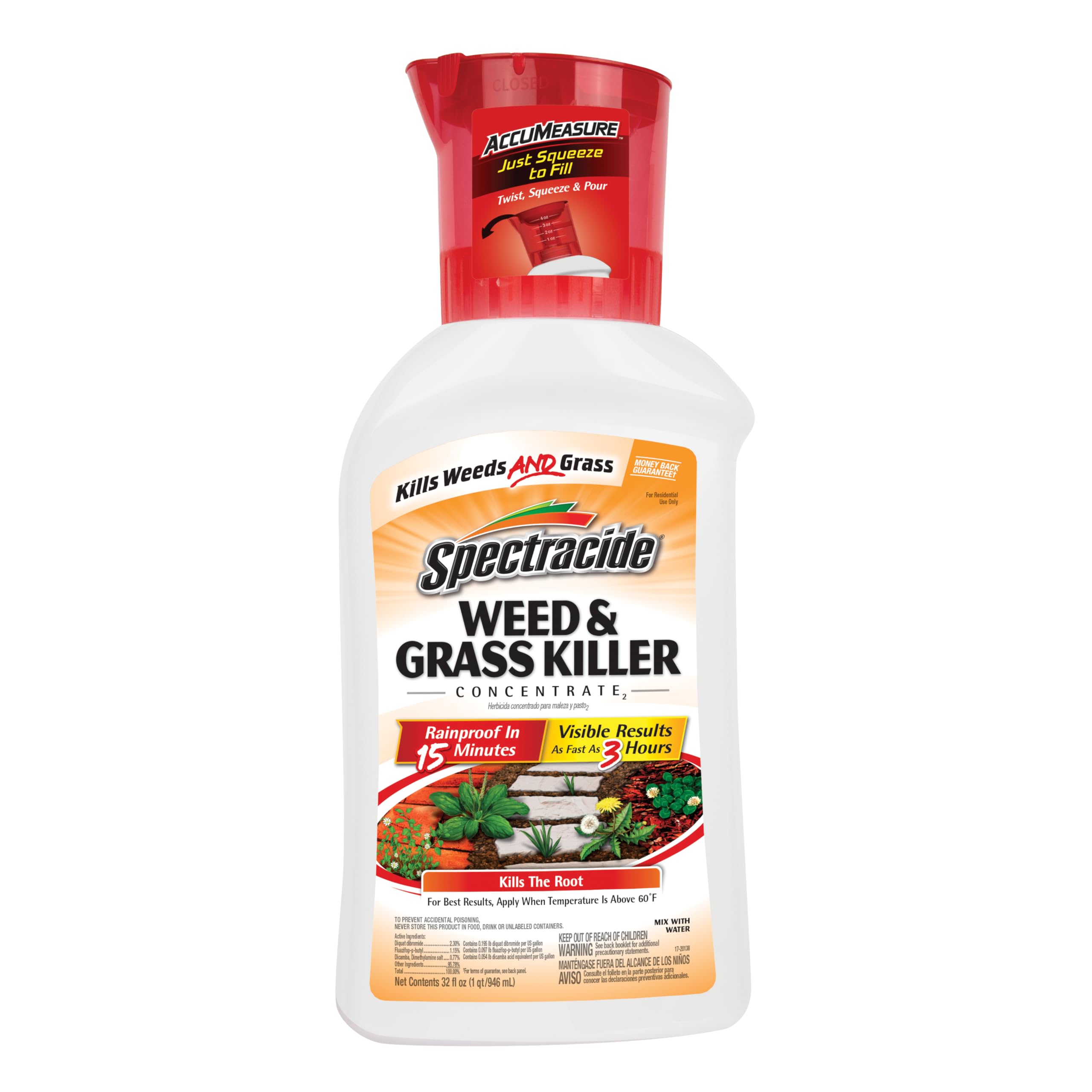
The budget-friendly concentrate that turns a single gallon into a massive 1,350 square feet of coverage.
You get 32 ounces of concentrate, which mixes into enough spray to cover 1,350 sq ft — that is a 3.4x coverage gap over the Roundup Comfort Wand (400 sq. ft.), giving you a huge advantage when you are tackling a long fence line or a wide driveway. The active ingredient is diquat dibromide, a non-selective formula that hits the root and shows visible results in as fast as 3 hours. It is rainproof just 15 minutes after you spray, so a surprise afternoon shower won’t undo your work.
Buyers report that when they mix this concentrate in a reusable 1-gallon sprayer, it kills the weeds along their curb within a single day. The Accumeasure cap twists, squeezes, and pours to make measuring less messy, but a few reviewers mention the cap is finicky and that they prefer swapping it for a regular lid off an old bottle. That is a minor nuisance relative to the speed and price of this stuff.
Speed vs. coverage: If you want the fastest visible results for the largest area at the lowest cost, this is the outright winner — you just supply your own sprayer.
The one warning: It is non-selective, so any overspray hitting your flower beds or lawn will kill those plants too. Use careful nozzle control around desirable vegetation.
Reach for this if: You need to blast a large area of weeds on driveways, walkways, fences, or gravel, and you are comfortable mixing concentrate with a tank sprayer.
Look elsewhere if: You want a selective formula that can spot-spray lawn weeds without killing the grass around them.
2. PBI/GORDON Trimec Lawn Weed Killer, one gallon

The highest-coverage selective spray that treats up to 64,000 square feet from a single gallon jug.
When your lawn is measured in acres rather than postage stamps, this is the one you reach for. A single 1-gallon jug of Trimec concentrate covers 32,000 to 64,000 sq ft depending on the weed pressure — that means one bottle does what six to twelve of the smaller bottles do. The active ingredient is Trimec (a three-way mix of 2,4-D, MCPP, and dicamba), and it is designed specifically for cool-season grasses (fescue, bluegrass, ryegrass). It is a selective formula, so it takes out dandelions, clover, and henbit without harming your lawn.
One reviewer who tackled tough Virginia buttonweed and creeping Charlie on St. Augustine turf noted that after two weeks the weeds turned black and died. The reviewer emphasizes that applying it below 85°F is crucial, and that using a hose-end sprayer with a metering dial made the job easy. It does require assembly (you need your own sprayer), and some buyers noted the bottle label is for a branded “Weed-Out” product despite the listing saying Trimec — the chemical itself is identical and works just as well.
Why acreage owners pick it
- Covers 32,000 to 64,000 sq ft — the biggest range in this list
- Selective Trimec formula kills broadleaf lawn weeds without damaging grass
- Economical per square foot; a single jug treats a full-acre property
What to watch for
- Requires a hose-end sprayer or pump sprayer — not ready-to-use
- Some batches ship under a “Weed-Out by ferti-lome” label instead of Trimec branding
- Must monitor temperature: applying above 85°F reduces effectiveness
Best for big lawns: If you have a property measured in thousands of square feet and you want to selectively kill broadleaf weeds in your cool-season grass, this is the best value-per-square-foot pick.
Skip if: You only have a small city lot or you prefer a simple ready-to-use trigger sprayer — you will be better served by a smaller, grab-and-go bottle.
3. Bonide Chickweed, Clover & Oxalis Killer, 128 oz Ready-to-Use Spray

A massive 128-ounce ready-to-use gallon that outlasts the competition with a 4x volume advantage over smaller sprays.
This is the largest ready-to-use bottle on the list: a full 128 fluid ounces, which is four times the volume of the Spectracide 32-ounce concentrate and four times the Hi-Yield 32-ounce bottle. The active ingredients are dicamba and triclopyr — a selective combination that targets chickweed, clover, oxalis, and dandelions while leaving the lawn grass alive. It is a spot-treatment formula, so you trigger-spray directly onto the weed leaves. Because it is a selective leaf-absorbed spray, you should not mow for two days before or after application to give the chemicals time to get into the plant system.
Owners mention that clovers will brown within three days and fade thereafter, and that dandelions die with one spray and do not come back. However, the attached hand sprayer is usable but slow for an entire lawn; several reviewers suggest pouring the contents into a pump sprayer to make the job faster. One reviewer noted that it was not effective on their clover patches, so results can vary based on weed size and coverage timing. The formula is clear and nearly odorless, which many users prefer over the strong chemical smell of some competitors.
Why large bottles matter
- 128 oz ready-to-use — 4x more volume than the Hi-Yield and Spectracide 32-oz bottles
- Selective formula targets broadleaf lawn weeds without killing the grass
- Nearly odorless and clear formula, a perk over strongly-scented alternatives
When it falls short
- Hand sprayer trigger is tiring for large lawns — best decanted into a tank sprayer
- Ineffective on crabgrass; not intended for non-selective hardscape use
- Some users reported it did not effectively kill clover patches on the first spray
Ideal for spot-spray loyalists: If you prefer a ready-to-use bottle for selective weed killing in your lawn and value a large volume that lasts all season, this is a strong, economical one.
Not for you if: You want a one-pass total kill on driveway cracks or a concentrate that lets you control the mix strength.
4. Roundup Dual Action Weed and Grass Killer Plus 4 Month Preventer with Sure Shot Wand
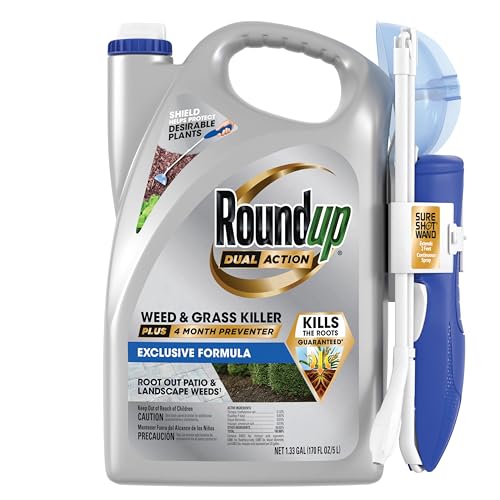
The only pick that kills existing weeds and blocks new growth for up to four months with one application.
This is the smart two-in-one pick. It kills weeds down to the root (visible results in as fast as 6 hours) and then prevents fresh weeds from germinating for up to 4 months. The “Dual Action” means you are getting both a non-selective killer and a pre-emergent preventer in the same bottle. The 1.33-gallon bottle covers 400 sq. ft., the same coverage as the standard Roundup Comfort Wand, but you do not have to re-spray for months afterward. It is rainproof in as fast as 30 minutes.
The standout difference is the Sure Shot Wand: it has a large protective cone that funnels the spray directly onto the weed and blocks drift onto nearby plants. Reviewers specifically praise that cone, saying it lets you completely isolate what you are spraying without worrying about flowers or shrubs six inches away. The trade-off is the coverage limit: 400 sq. ft. is enough for a driveway edge or a mulched bed but not for a large expanse. And because it prevents all growth, any desired seeds you want to plant in that treated area must wait four months.
One-pass convenience: If you hate re-treating the same spots every few weeks, the Dual Action’s 4-month prevention is a huge time saver.
The obvious trade-off: You can not plant ornamental bedding plants, trees, shrubs, sod, or seed in the treated area until 4 months after application. Plan your garden work around that window.
Go for this one if: You want to nuke a gravel path, rock bed, or fence line once and not see weeds again until next season — the prevention aspect really matters here.
Avoid it if: You need to plant flowers or lay sod in the same area within a few months; pick a standard kill-only spray instead.
5. Hi-Yield (33431) Atrazine Weed Killer RTS (32 oz)
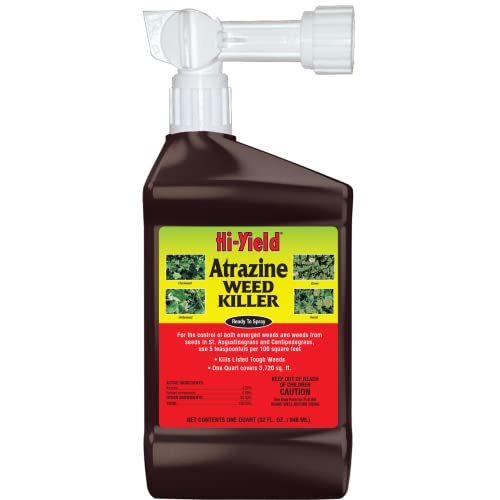
The selective atrazine spray that is safe for St. Augustine and Centipede lawns when other sprays would burn them.
If you grow St. Augustine or Centipede grass, most broadleaf weed killers will actually damage or kill the turf. That is where this spray comes in. The active ingredient is atrazine, a selective herbicide specifically labeled for use on these southern warm-season grasses. It targets henbit, clover, and chickweed without harming the lawn. The bottle is 32 fluid ounces and weighs only 2 pounds — a 6.8x weight difference compared to a heavier 13.6-pound tank like the Roundup Dual Action, making it a very light and easy-to-carry option for spot-treating around the yard.
This is a ready-to-use spray, so there is no mixing required — just attach the sprayer and walk the lawn. The coverage is listed as “Full,” meaning you treat until the leaf is wet. Because it is a specific atrazine formulation, you need to follow the label closely for application timing and grass type. It is not intended for Fescue or Bermuda in the same way, so read the label carefully if your lawn has a mix of grass types.
Why St. Augustine owners need this
- Atrazine formula is one of the few selective options safe for St. Augustine and Centipede grass
- Ready-to-use trigger spray means zero mixing — just walk and spray
- Very light at 2 pounds, easy to carry around the whole yard
Its limits
- Only 32 oz — small volume for larger lawns; you may need multiple bottles
- Not for cool-season grasses like Fescue or Bluegrass; check your grass type first
- Application timing is important — must be applied under the right weather and growth conditions
Best for southern lawns: If you live in the south with St. Augustine or Centipede turf and need to kill henbit and clover without torching the lawn, this is your go-to pick.
Pass on it if: You grow a cool-season grass (Fescue, Kentucky Bluegrass) — buy a Trimec or dicamba-based spray instead.
6. Roundup Weed and Grass Killer₄ with Comfort Wand, 1.33 gal.
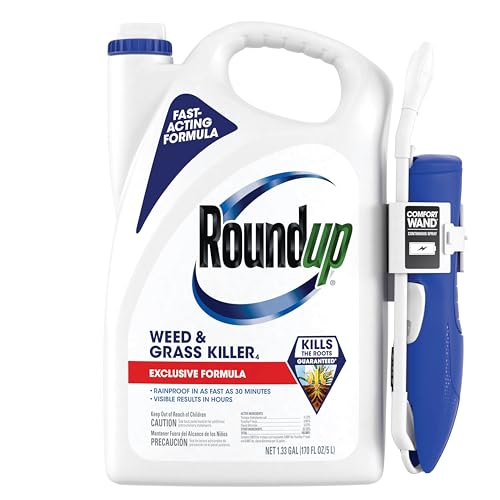
The classic Roundup wand that kills tough weeds to the root in a grab-and-go 1.33-gallon tank.
This is the pick for the person who does not want to own a separate sprayer. The attached Comfort Wand has a one-touch continuous trigger that gives your hands a break compared to squeeze-style spray bottles. The tank holds 1.33 gallons of ready-to-use formula and covers 400 sq. ft. The active ingredient is a non-selective formula that kills dandelion, crabgrass, poison ivy, clover, and other broadleaf weeds down to the root. It is rainproof in as fast as 30 minutes, and users report visible results in roughly 24 hours to 5 days, depending on the weed type and weather.
Customers note that weeds start dying within 24 hours, but that the dead weeds do need to be pulled by hand after they shrivel, and users strongly advise not to spray it on windy days near grass you want to keep — it is non-selective, so drift on to Bermuda or Fescue means those spots die too. The wand design has a shield that helps direct the spray, but it is less isolating than the cone on the Dual Action version. After spraying, you can plant in the area after 1 to 30 days (check the booklet for specifics).
True grab-and-go convenience: The Comfort Wand is genuinely comfortable for extended use, and the 1.33-gal tank is big enough to handle a driveway and patio without a refill.
What holds it back: At 400 sq. ft., it covers less than one-third of what the Spectracide concentrate covers, and the non-selective nature means you must be precise with your aim near lawn grass.
Right for you if: You have a smaller yard or just need to clean up weeds on a driveway, patio, or fence line without messing with mixing or separate sprayers.
Not ideal if: You have a large lawn of 1,000 sq. ft. or more — you will need multiple tanks or a concentrate.
7. Roundup Weed & Grass Killer₄ Concentrate, 1 gal.

The concentrate that lets you mix up a fresh batch every time and cover 300 sq. ft. per gallon of spray solution.
This is the same Roundup Weed & Grass Killer active formula as the Comfort Wand, but in a 1-gallon jug of concentrate that you mix yourself. Each gallon of concentrate mixes into multiple tank loads of spray solution, and each gallon of mixed solution covers 300 sq. ft. That means a single jug can treat a very large area, depending on your mix ratio. The active ingredients are Triclopyr, Triethylamine Salt, and Diquat Dibromide — a multi-pronged, non-selective kill that roots out dandelion, large crabgrass, poison ivy, clover, and more. It is rainproof in 30 minutes and shows visible results in hours.
Buyers confirm that it works great and arrives intact without leaking, but one reviewer specifically mentions that while it kills existing growth very fast, it does not prevent new weeds from popping up. That is an important distinction — this is a killer-only formula, so you will need to re-apply when fresh weeds germinate. It also needs to be used with a tank or hose-end sprayer, so you need to own one. The concentrate is the best value for money if you are preparing a large garden plot or taking down a full field of vegetation for lawn replacement, but the brew-it-yourself step is slower than a ready-to-use bottle.
Why bulk buyers choose this
- 1-gallon concentrate creates many gallons of spray solution, stretching your dollar for large areas
- Same fast-acting, root-killing formula as the Comfort Wand but in economical bulk form
- Rainproof in 30 minutes — good for unpredictable weather patterns
Downsides to consider
- Requires your own tank or hose-end sprayer — not ready-to-use
- Does not prevent new weeds; only kills what is currently growing
- Non-selective — any drift onto lawn or ornamentals will damage them
Ideal for massive jobs: If you are clearing a large area for a new garden, a lawn replacement, or you spot-spray a large property regularly and want the most cost-per-gallon efficiency, this concentrate is the one.
skip it if: You only need to spot-treat a few weeds on a paved path — a ready-to-use wand or bottle will be faster and less wasteful with the leftover mix.
Understanding the Specs
Selective vs. Non-Selective Herbicide
A selective weed killer (like atrazine, dicamba, or Trimec) is designed to kill specific broadleaf weeds while leaving the grass around them untouched. This is what you want when you walk your lawn and spot-spray dandelions. A non-selective formula (like diquat dibromide) kills every living plant it touches — perfect for driveway cracks, patios, and fence lines where you want nothing to grow. Picking wrong here is the biggest mistake people make; spraying non-selective on a lawn will kill the good grass too.
Coverage in Square Feet
This tells you how much area a bottle treats. A 32-ounce concentrate covering 1,350 sq ft will do a large driveway and some walkways. A ready-to-use 1.33-gallon tank covering 400 sq ft is meant for smaller spots. Match your bottle to the size of your job. If you have 3,000 sq ft of gravel driveway, you need either a concentrate or multiple ready-to-use bottles — reading the coverage spec before you buy prevents running out halfway through the job.
Rainfast Time
Rainfast is the time the spray must sit undiluted on the leaf before rain or irrigation can hit it without washing the chemical away. A fast rainfast time, like 15 or 30 minutes, is crucial if you live in an area with unpredictable summer storms or early morning dew. If the label says “rainproof in 30 minutes,” you can spray at 9 AM and be safe from a 9:30 sprinkle. Longer rainfast periods (like 2-4 hours) mean you need to check the forecast carefully.
Concentrate vs. Ready-to-Use (RTU)
Ready-to-use sprays come pre-mixed and are applied directly from the bottle — easier, but heavier and more expensive per ounce of active ingredient. Concentrates require a sprayer (pump tank or hose-end) and manual mixing, but they often cost half as much per treated square foot. If you treat weeds every season, a concentrate will save you money and produce less plastic waste. If you only treat a few spots once a year, the convenience of a ready-to-use bottle may be worth the extra cost.
FAQ
What is the difference between selective and non-selective weed killer?
Can I use Roundup on my St. Augustine grass?
How long does weed killer take to work?
Will rain wash away weed killer after I spray?
Should I mow before applying weed killer?
How do I mix weed killer concentrate?
Can I plant flowers or seeds after using weed killer?
What is the difference between a pre-emergent and a post-emergent weed killer?
Why is my weed killer not working on crabgrass?
How often should I reapply weed killer?
Final Thoughts: The Verdict
For the majority of shoppers, the best weed killer spray winner is the Spectracide Weed and Grass Killer Concentrate because it combines fast 3-hour action with exceptional 1,350 sq ft coverage at a budget-friendly price. If you want a selective formula that is safe for St. Augustine grass, grab the Hi-Yield Atrazine Weed Killer RTS. And for those with a large cool-season lawn to treat from fence to fence, the standout is the massive 64,000 sq ft coverage of the PBI/GORDON Trimec Lawn Weed Killer.
How We Picked
We do not accept paid placement. Every pick is matched to a real buyer and a real use-case; we do not hands-on test units.
Sources & Methodology
Specifications: manufacturer listings and product documentation. Review insights: verified customer reviews, as of July 2026. Pricing: not shown on this page (it changes often); check the current price via the retailer link.
As an Amazon Associate, Lawn Gear Lab earns from qualifying purchases. This does not affect which products we feature.