
Specs are compiled from manufacturer listings and verified buyer reviews and can change over time — please confirm the key details on the product page before buying.
Most machines are built for flat lawns. Take one up a 20-degree incline and you will find out fast — it spins out, tips, or leaves uncut patches. The real difference is in the drivetrain design. You need a mower that can shift power to the wheels that grip when the ground drops steeply under you.
I’m Rikta — the founder and writer behind Lawn Gear Lab. This guide is built by comparing the manufacturers’ published specifications and the patterns across verified customer reviews, so you get each pick’s real strengths and trade-offs instead of marketing spin.
if you need a self-propelled walk-behind with RWD (rear-wheel drive) that won’t spin out on wet grass, or a remote-controlled tracked machine that climbs like a goat, the mower for steep hills you choose must match the grade of your property and the kind of grass you’re cutting.
Quick Picks
- Segway Navimow X430 Robot Lawn Mower — Best Overall
- Mammotion LUBA 3 AWD 1500H Robot Lawn Mower — Premium Pick
- Mowrator S1 4WD 18Ah Remote Control Lawn Mower — Most Versatile
- AIWEIYA Oil-Electric Hybrid Crawler Track Mower — Extreme Terrain
- ZIPmow Remote Control Lawn Mower — Budget Remote
- Greenworks 48V (24V x 2) 21″ Brushless Cordless Self-Propelled Lawn Mower — Eco Self-Propelled
- SENIX 22 Inch 3-in-1 Gas Lawn Mower — Gas Value
- WORX Nitro Cordless Lawn Mower WG760 — Lightweight Self-Propelled
- YARDMAX 22 in. 201cc Select PACE 6 Speed CVT High Wheel FWD Gas Lawn Mower — High-Wheel Gas
How To Choose The Best Mower For Steep Hills
Buying a mower for a sloped yard is different than picking one for a flat suburban lot. The wrong choice can leave you wrestling a heavy machine that won’t drive uphill, or spending money on a robot that slides down the first incline. Focus on these three specs to get it right.
Drive System — Front-Wheel vs Rear-Wheel vs All-Wheel Drive
On a hill, the drive wheels need weight over them to grip. RWD (rear-wheel drive) puts the engine weight over the drive wheels, so the back tires dig in while you push the handle forward. FWD (front-wheel drive) is lighter on the nose and tends to spin out when the front lifts on an incline — several buyers report this exact issue with FWD gas mowers. AWD (all-wheel drive) gives you the best traction because both axles push, but it is heavier and more expensive. For slopes over 15 degrees, skip front-wheel drive entirely.
Slope Rating — Know the Number Before You Buy
Manufacturers publish a maximum slope rating, usually as a percentage or in degrees. A mower rated for 40% (about 22 degrees) is completely different from one rated for 80% (about 39 degrees). If your property has a section that drops away steeply near a ditch or retaining wall, look for a mower that explicitly states it handles that grade. Remote-control and robotic mowers tend to publish their rating clearly — walk-behind models rarely do, so you rely on drive type and reviews.
Cutting Width and Battery Life — Matching the Machine to Your Acreage
A wider deck means fewer passes, but on a steep hill a wider mower can feel heavier to turn. For a quarter-acre sloped lot, a 21-inch deck is a balance. If you go battery-powered, check the runtime carefully: a 45-minute battery will struggle on a half-acre with thick grass, especially if you need to run the blade at full speed uphill. Look for battery average life above 50 minutes, or a gas mower if the yard is larger.
Quick Comparison
| Model | Best For | Drive Type | Cutting Width | Item Weight | Amazon |
|---|---|---|---|---|---|
| Segway Navimow X430 | Automated slope mowing up to 84% | 4WD | 17″ | 63.7 lb | Amazon |
| Mammotion LUBA 3 AWD | LiDAR-guided precision on 80% slopes | 4WD / AWD | — | — | Amazon |
| Mowrator S1 4WD | Heavy-duty remote control on 75% slopes | 4WD | 21″ | 147.71 lb | Amazon |
| AIWEIYA AWY-550L | Extreme 100% slope with tracked traction | Crawler Track | 21.6″ | 286 lb | Amazon |
| ZIPmow RC Mower | Budget-friendly remote control for gentle hills | AWD | 18″ | — | Amazon |
| Greenworks 48V | Eco-friendly rear-wheel drive for moderate slopes | Rear-Wheel | 21″ | 77 lb | Amazon |
| SENIX 22″ Gas | Budget gas with rear-wheel drive for uneven terrain | Rear-Wheel | 22″ | 72 lb | Amazon |
| WORX Nitro WG760 | Lightweight self-propelled with variable speed | Self-Propelled | 21″ | 63.11 lb | Amazon |
| YARDMAX YG2860 | High-wheel FWD for flatter hills | Front-Wheel | 22″ | 84.9 lb | Amazon |
In‑Depth Reviews
1. Segway Navimow X430 Robot Lawn Mower
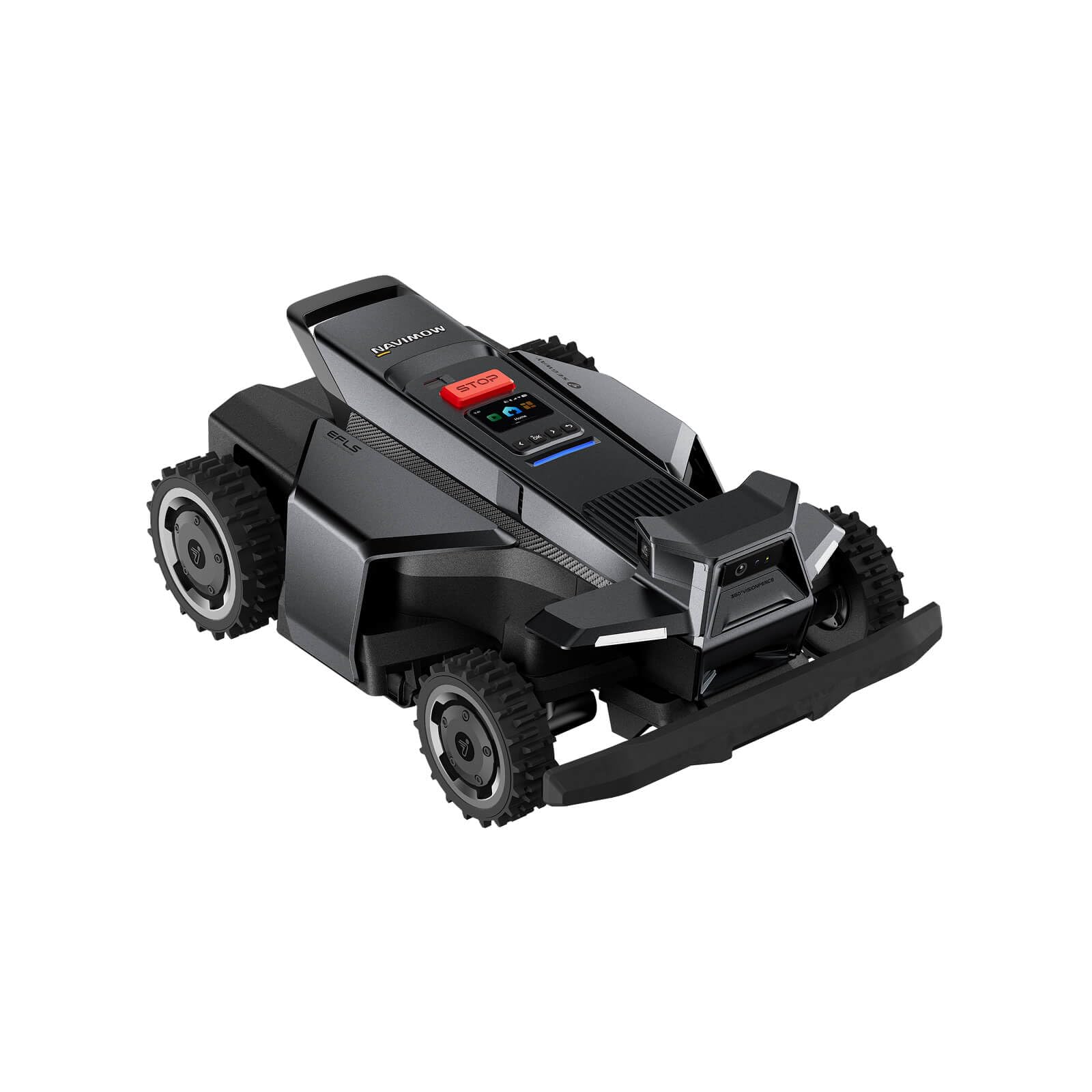
The robot that parks itself on slopes you would not walk up.
You want a hands-free hill solution. The Segway Navimow X430 climbs an extreme 84% (40°) slope thanks to its ORV-tuned dual suspension and 4WD (four-wheel drive) system. That rating beats the Mammotion LUBA 3 (80%) and the Mowrator S1 (75%), so if you have a genuinely steep bank, this is the automated choice. It uses EFLS tri-frequency Network RTK (a satellite positioning system) with 360° Vision and VIO (visual inertial odometry) to keep centimeter-level accuracy under trees or along fences. The AI-powered VisionFence detects over 200 obstacle types, so it avoids toys, pets, and rocks.
The Xero-Turn AWD with eccentric front-wheel steering and smart traction control prevents tearing the turf during tight turns. Dual 180W motors drive two cutting discs with 12 blades and a 17-inch cutting width, so you trim close to edges. EdgeSense reduces trimming margins to under 2 inches. You set it up with one-tap auto mapping — no antenna, no perimeter wire — and control it via voice through Alexa or Google Home.
The catch is the 63.7-pound weight is light for a robot, meaning it can cross obstacles up to 2.8 inches tall but may bounce on high-speed passes over roots. One reviewer noted the mower handles dense, tall grass efficiently with adaptive blade control.
Slope champion: If your property has a 40-degree drop and you want to mow it from your couch, the X430 is where you land. No gas, no wire, no pushing.
Who this is for: Owners with extreme slopes up to 40° (84%) who want full automation and wire-free setup — the highest slope rating in this guide.
What to know: The 17-inch cutting width is narrower than the 21-inch walk-behinds, so it takes slightly longer on a flat section, but the hands-free operation cancels that out.
2. Mammotion LUBA 3 AWD 1500H Robot Lawn Mower
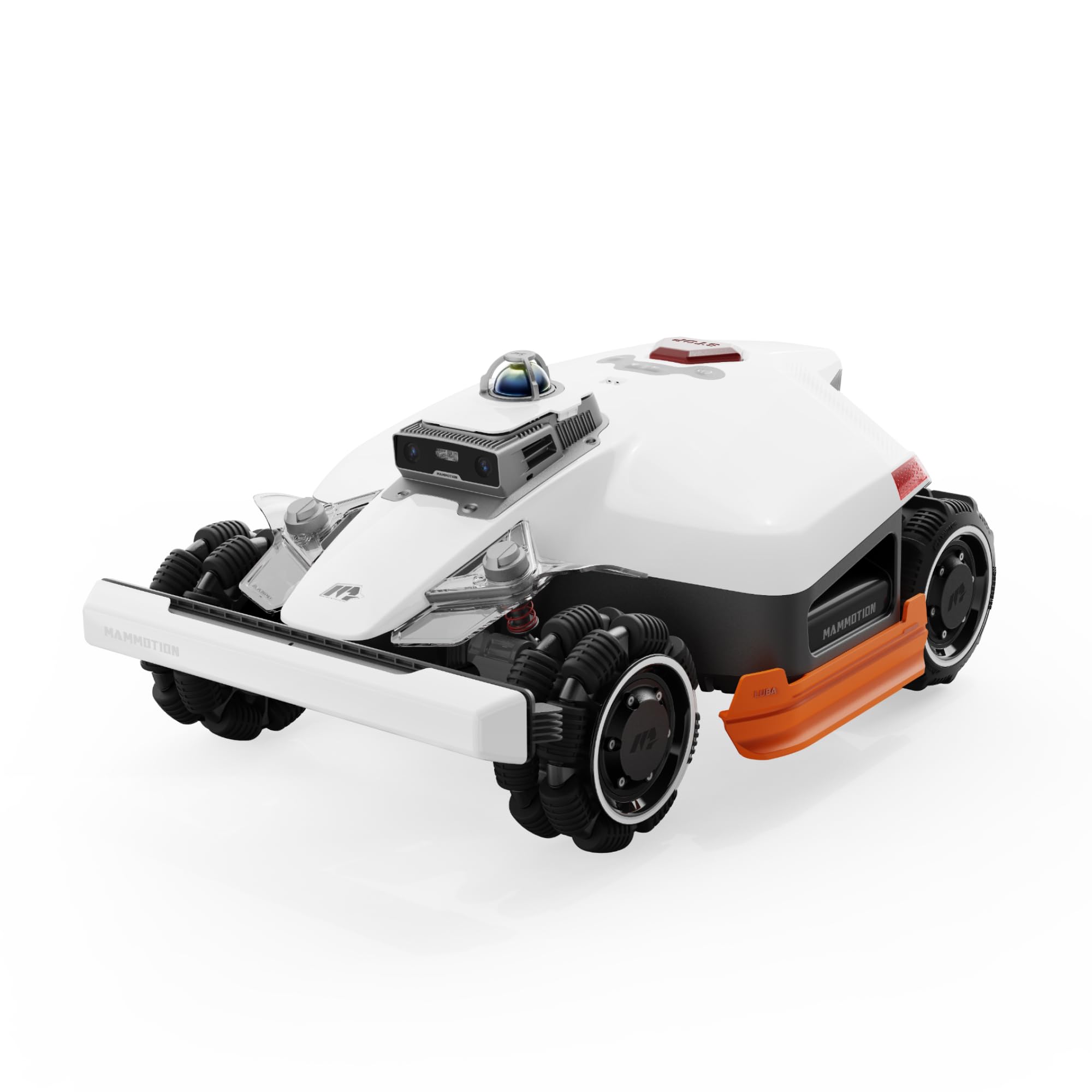
The autonomous mower that maps every bump before it cuts.
You get centimeter-level precision with the Mammotion LUBA 3 AWD 1500H. It combines 360° LiDAR (laser-based light detection and ranging) with a dual-camera AI vision system to achieve ±1 cm positioning accuracy. That means it knows exactly where it is on a slope — even under tree canopies or near fences — and adjusts its path in real time.
The upgraded AI chip performs 10 trillion operations per second and detects over 300 obstacle types, so it avoids flowerbeds, pet zones, and pathways better than the Segway’s 200-type detection. Two high-torque 88W motors with 6-blade discs provide 135 minutes of runtime (9.4Ah lithium battery) at a coverage rate of 400m² per hour. You can set 15 mowing zones, define no-go areas for pools and flowerbeds, and choose between perimeter-only, zigzag, checkerboard, or adaptive zigzag patterns.
One key difference from the Segway: the cutting height range here is 2.2 to 4.0 inches, which is tighter than the Navimow’s 0.75–4 inch range, so it is less suited for very short Bermuda lawns.
Precision king: If you have complex lawns with flowerbeds, pathways, and pet zones on a steep hill, this is the mower that avoids everything while staying on the line.
Reach for this if: You want centimeter-level mapping with LiDAR and AI — the best obstacle avoidance in this comparison — and need to manage multiple zones on an 80% grade.
Look elsewhere if: You need a cutting height below 2.2 inches for warm-season turf, or you want a wider deck than the 17-inch (the X430 shares the same size).
3. Mowrator S1 4WD 18Ah Remote Control Lawn Mower
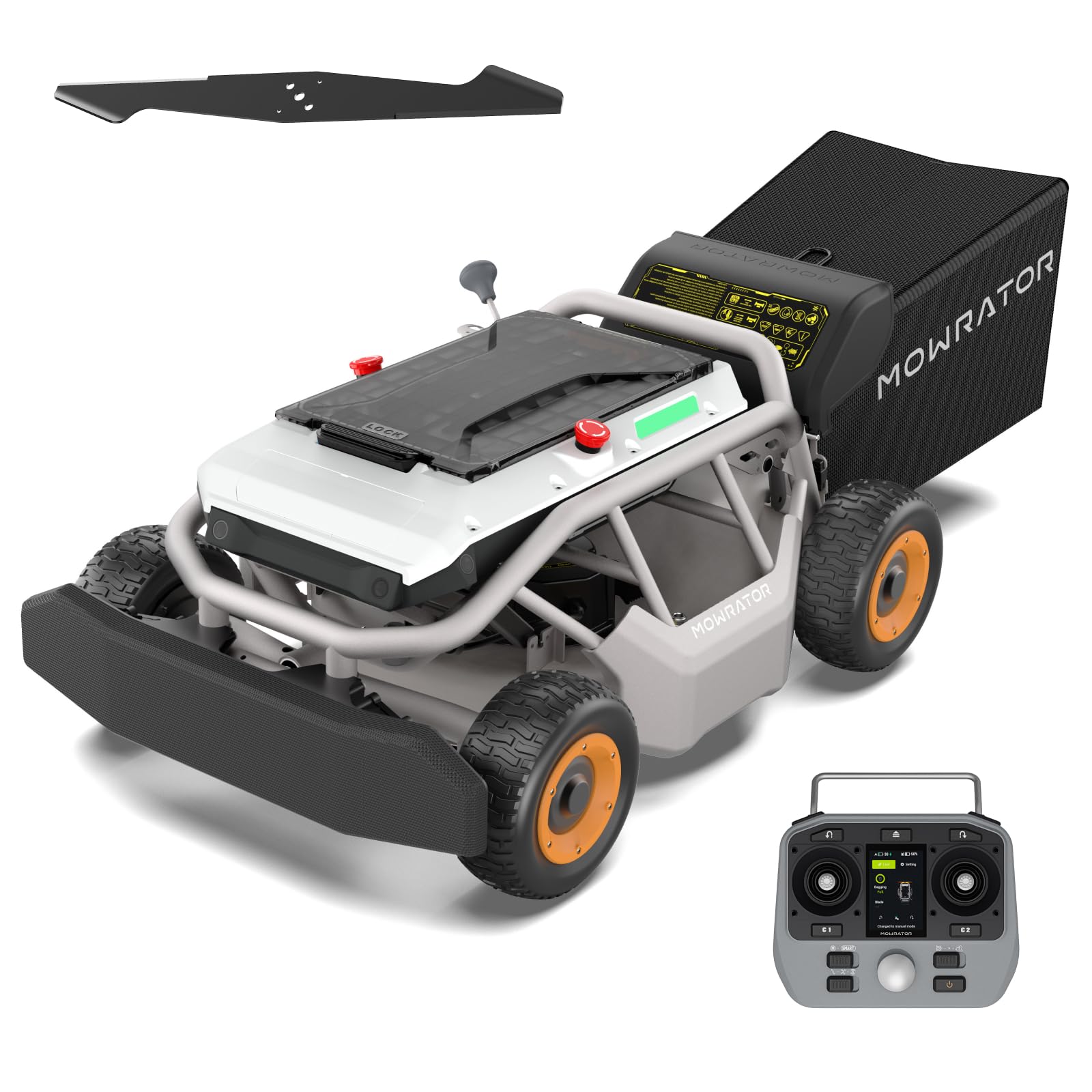
A 4WD workhorse that hauls, mows, and plows through the seasons.
You get a total 1000W 4WD (four-wheel drive) system for traction on the Mowrator S1. The blade motor peaks at 1985.6W with adjustable speed up to 3200 RPM and 6 ft·lb of cutting torque, so it chews through thick grass. The 56V 18Ah LiFePO4 (lithium iron phosphate) battery provides up to 2.25 hours of runtime, covering up to 1.125 acres per charge. That runtime is significantly longer than the ZIPmow’s 60 minutes — you can finish a large sloped yard in one session.
The 21-inch cutting width is the same as the SENIX and WORX walk-behinds, but here you control it from a remote with response times as low as 5 ms. It climbs a 75% (37°) slope, and the FOC E-Brake (field-oriented control electronic brake) provides precise stopping on steep descents. Year-round use is a differentiator: optional attachments include a tow hitch for hauling, a mulching blade for leaves, and a snow plow with chains. The mower operates at 63 dB, which is noticeably quieter than any gas model.
The trade-off is weight: at 147.71 pounds, this is a heavy machine you will not carry up steps, and the 600W fast charger (90-minute full recharge) is not portable.
Three-season tool: If you need one machine that mows a 37° hill in summer, hauls dirt in spring, and clears snow in winter, the Mowrator S1 earns its keep.
Ideal for: Large sloped properties (over an acre) where you want remote control, 21-inch deck, and all-season attachments — the highest runtime-to-coverage ratio in this guide.
Consider if: You have storage space for a 147-pound machine and plan to use the optional snow and hauling attachments to justify the investment.
4. AIWEIYA Oil-Electric Hybrid Crawler Track Mower
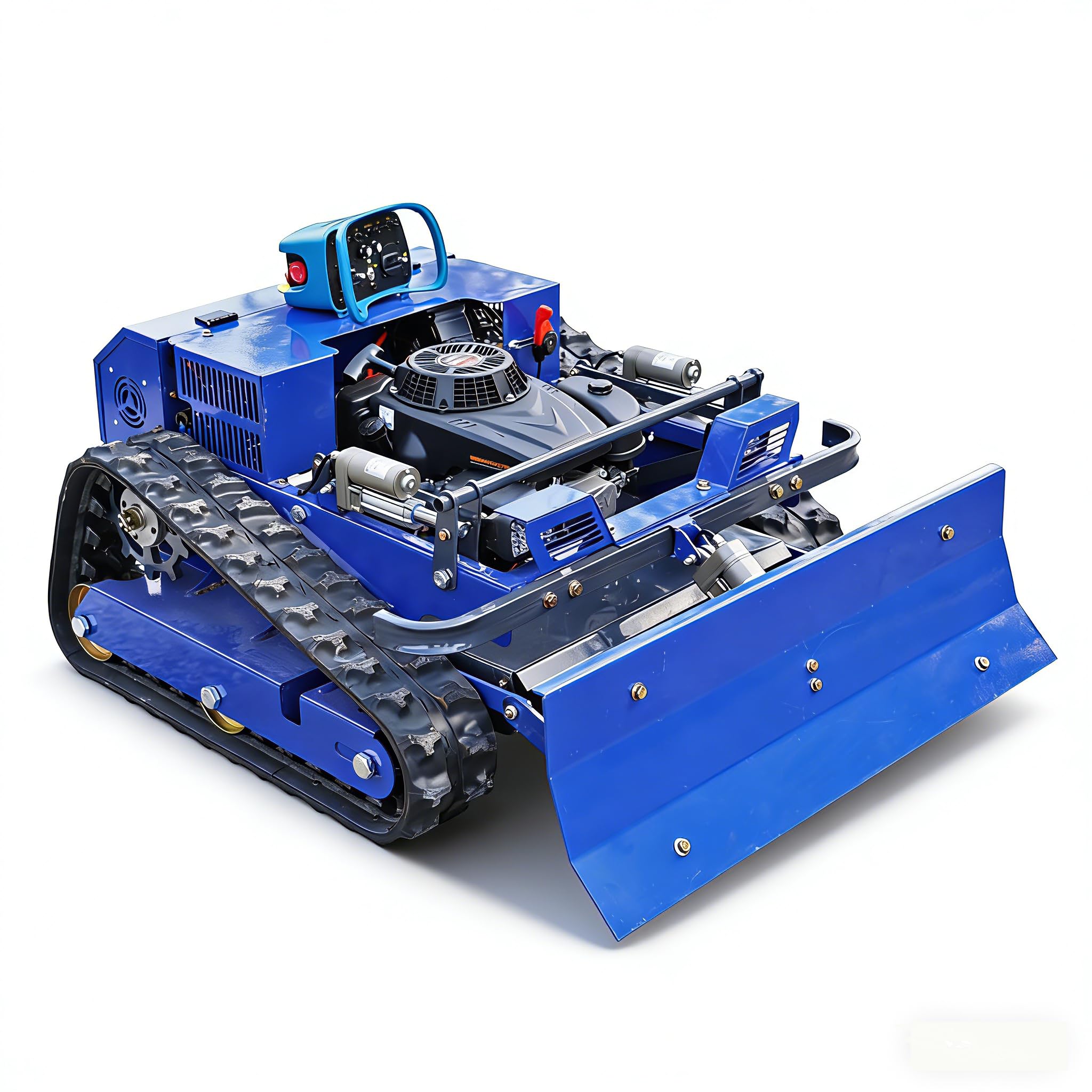
The tracked beast that climbs a vertical wall compared to wheeled mowers.
You get a slope rating of 100% (45°) with the AIWEIYA AWY-550L — that is a full vertical foot of rise for every foot of run. It achieves this through rubber crawler tracks driven by a 1600W 24V permanent magnet brushless motor paired with a gearbox, combined with a gasoline engine for extended run times. The cutting height adjusts from 1.1 to 5.9 inches via remote control, and the chassis itself can be raised or lowered at will, giving you 48 positions.
The cutting width is 21.6 inches, the widest deck in this comparison, and the two-piece manganese blade provides a fine cut. The mower can perform 360-degree rotations on the spot, making it highly maneuverable in tight sloped corners. It is designed for large-scale terrain: lawns, yards, reeds, grasslands, hills, terraces, weeds, and orchards.
At 286 pounds with a 38.5 x 22 x 36-inch footprint, this is not a machine you store in a small shed. One buyer mentioned the remote control allows you to stay clear of steep drop-offs while the tracked chassis just walks up the slope.
Maximum grip: If you have a 45-degree bank or muddy hills where wheels spin, the tracked AIWEIYA keeps going — it is the only mower here that can.
For the extreme property: Orchards, estates, or farmyards with slopes over 40° that no wheeled mower can touch — the tracks give 100% slope capability.
Not for small yards: The 286-pound weight and 3-foot length require a real garage or implement shed, and the hybrid gas/oil operation is more complex than pure electric.
5. ZIPmow Remote Control Lawn Mower
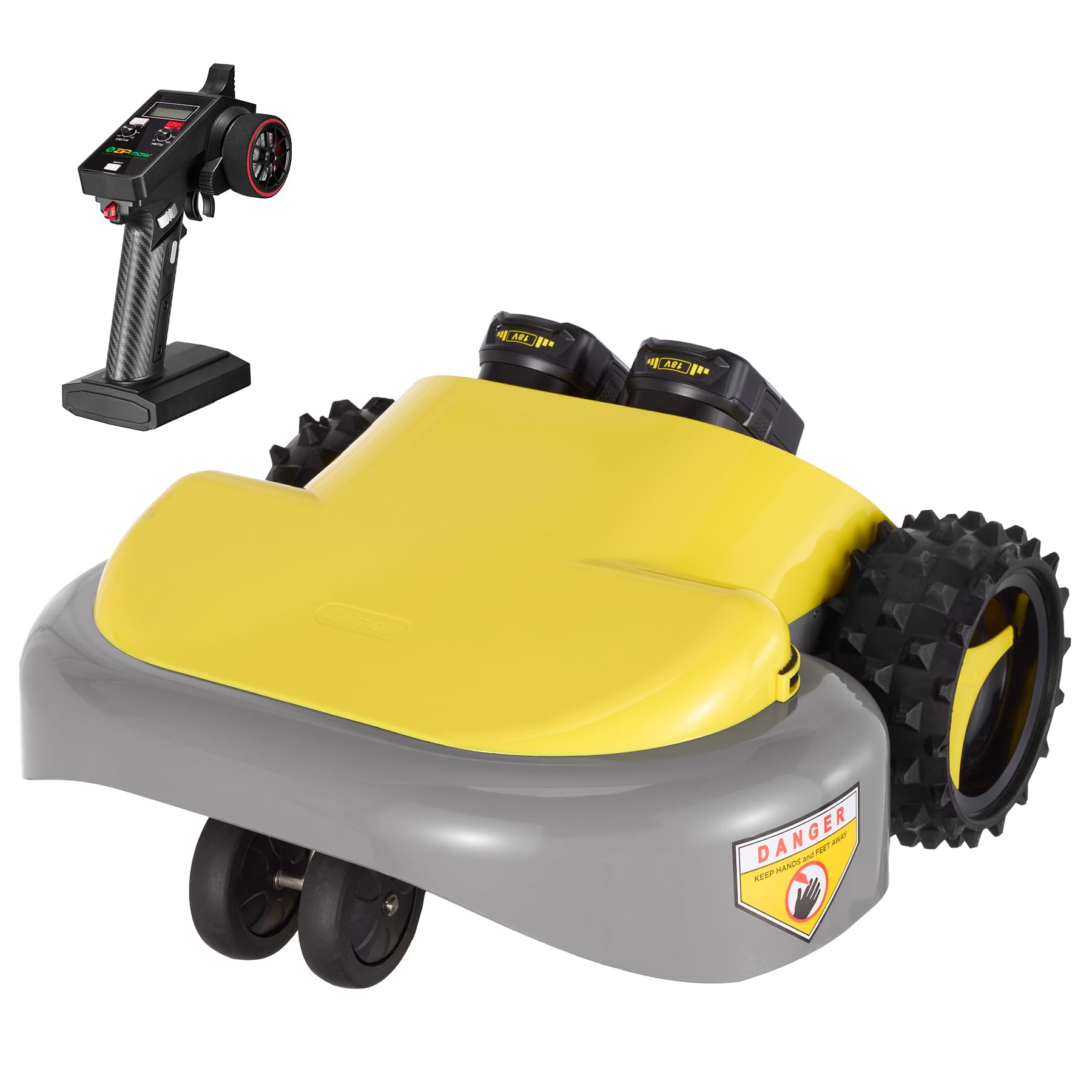
The RC mower that lets you mow from a lawn chair on gentle hills.
The ZIPmow is the entry-level remote control option for slopes up to 30 degrees — that is a 58% grade, which covers most residential hills but does not match the 75-100% machines above. All-wheel drive traction helps maintain control on uneven terrain, and you control the mower from up to 98 feet away with the 2.4GHz remote. The mower includes dual 3Ah batteries providing up to 60 minutes of runtime per charge, with a fast wall charger.
One standout point from buyer feedback: the batteries are interchangeable with Ryobi 18V batteries, so if you already own Ryobi tools, you have a larger battery pool to keep mowing without stopping. The adjustable speed (0.5–2.5 mph) and cutting height (2–3 inches) are set via the ergonomic remote, and the emergency stop button plus auto shutoff when tilted beyond 30 degrees provide safety on slopes.
The cutting width is 18 inches — noticeably narrower than the 21-inch decks — so coverage per pass is smaller. One owner reported the mower struggled on steeper hills and flipped over on the steepest sections, triggering the auto-shutoff, but had no problems on gentle slopes.
Why it works
- No assembly required — fully ready to mow from the start
- Ryobi battery compatible extends runtime
- Auto shutoff when tilted beyond 30° adds safety
Where it falls short
- 18″ cutting width is smaller than most walk-behinds
- Only rated for 30° (58%) — not for extreme hills
- Some owners mention wheel motor failures after months of use
Great for gentle hills: If your slope is under 30° and you want a fun, low-effort RC mower that uses Ryobi batteries, this is the budget remote pick.
Not for steep drops: The 30° limit is firm — customers note flips on steeper sections, so skip this if your hill is closer to 40°.
6. Greenworks 48V (24V x 2) 21″ Brushless Cordless Self-Propelled Lawn Mower

Rear-wheel drive traction without the gas smell or pull-start.
You get rear-wheel drive with variable speed control on the Greenworks 48V — the exact drive layout you want on a moderate hill. The brushless motor provides more torque and longer life than a brushed motor, and the push-button start means no yanking a cord on a slope.
The 21-inch cutting width handles up to half-acre lots, and the 4-in-1 system covers mulching, rear bagging, side discharge, and a turbo button for extra power in thick grass. The minimum adjustable cutting height is 1 inch, which is lower than the WORX’s 1.5-inch minimum, so you can scalp Bermuda or Zoysia closer. The 77-pound weight is moderate — lighter than the YARDMAX at 84.9 pounds but heavier than the WORX at 63.11 pounds — and the alloy steel deck adds durability. Unlike the SENIX gas mower, you never deal with oil changes or fuel mixing.
The 45-minute runtime means you may need a second battery set for a full acre — shorter than the WORX’s 50 minutes.
Solid electric RWD: If you want quiet, self-propelled mowing on moderate hills without the friction of a gas engine, the Greenworks delivers consistent rear-wheel traction.
Reach for this if: You have a quarter- to half-acre sloped yard and prefer push-button electric operation with rear-wheel drive for traction on grades up to 20°.
Plan around: The 45-minute runtime is shorter than some competitors — buy extra batteries if your lawn is closer to an acre.
7. SENIX 22 Inch 3-in-1 Gas Lawn Mower
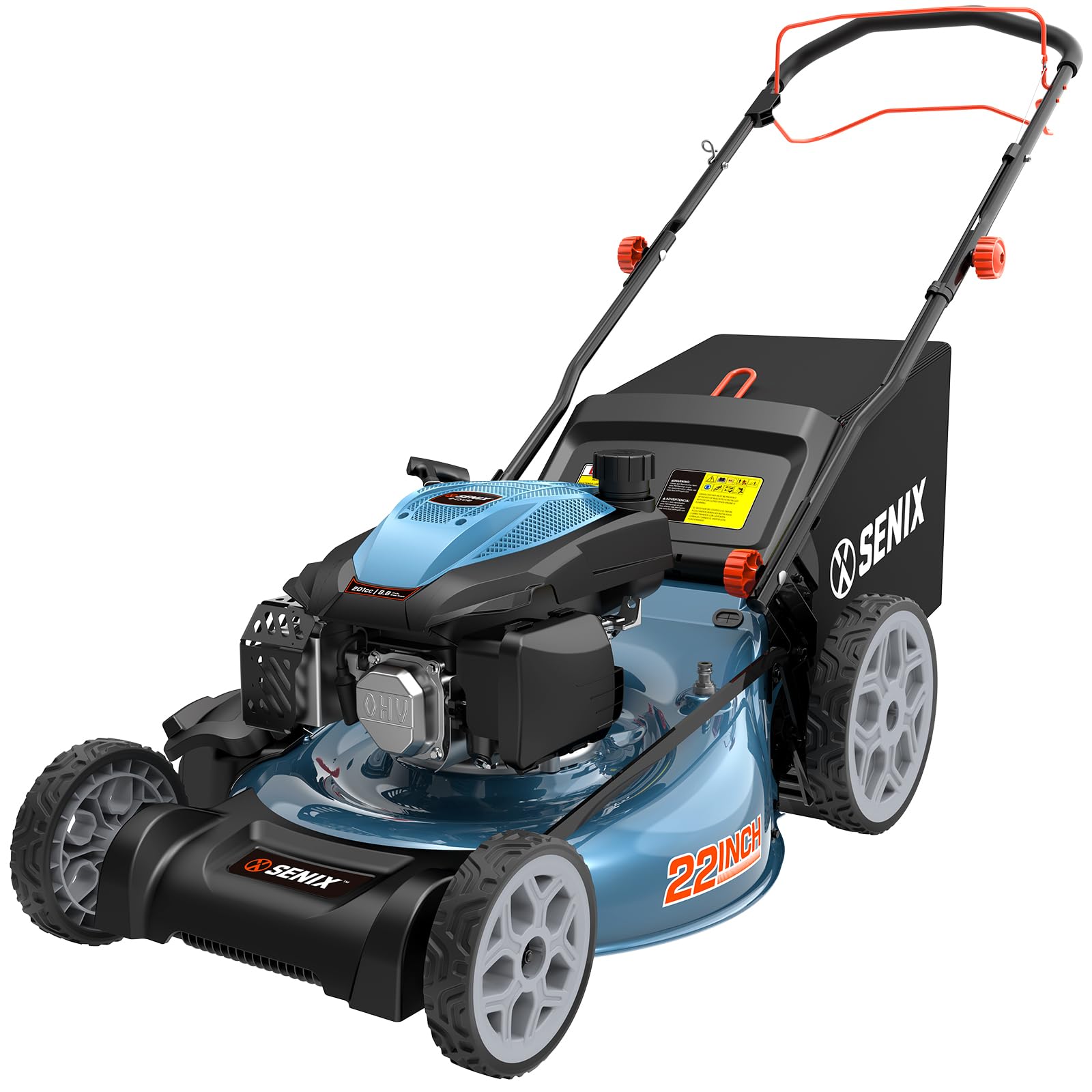
A 22-inch gas deck with rear-wheel drive at a down-to-earth price.
You get rear-wheel drive on a budget with the SENIX 22-inch mower. It uses a 201cc OHV (overhead valve) 4-cycle engine delivering 4.7HP and 8.8 ft-lb of torque, driving a single-speed rear-wheel self-propelled system that reaches up to 2.9 MPH. Reviewers point out it works very well on uneven terrain. The 22-inch cutting width is one inch wider than the WORX Nitro and Greenworks, covering more ground per pass. The recommended lawn size is up to 11/20 acre.
The heavy-duty steel deck uses a vortex tunnel airflow design to improve grass discharge and collection. The 6-position cutting height adjustment ranges from 1.25 to 4 inches. Assembly is tool-free for the handle, and the foldable handle design supports compact storage. One customer observed it started on the first pull and mowed smoothly. Another noted the rear-wheel drive on big wheels performs well on uneven terrain.
The trade-off: some buyers flagged the wheels as overly cheap and noted a dinging sound from the recoil cord — the trade-off for the budget-friendly gas segment. The cutting width is 5% bigger than the Greenworks’ 21 inches, so you finish slightly faster.
What works
- Rear-wheel drive provides good traction on uneven hills
- 22″ deck is the widest walk-behind here
- Tool-free assembly and compact folding handle
What to watch
- Single-speed drive — no variable speed control
- Budget wheels may not last multiple seasons
- Engine is louder than any battery model
Budget-friendly rear-drive gas: If you want a gas mower with rear-wheel traction for a sloped lot under 1/2 acre and do not need variable speed, the SENIX is a strong value.
Not if you need quiet: Gas operation is inherently louder than electric — skip this if noise is a concern near neighbors or early mornings.
8. WORX Nitro Cordless Lawn Mower WG760

The battery-powered mower that is 35% lighter than the beefiest gas competitor.
The WORX Nitro weighs 63.11 pounds — 35% less than the YARDMAX at 84.9 pounds — and that makes a real difference when you are pushing uphill. The brushless motor 2.0 is designed to deliver 40% more power and 10% longer runtime than first-gen brushless motors, according to the brand. The two included 20V 5.0Ah PowerShare Pro batteries provide up to 50 minutes of runtime, beating the Greenworks by 11% (50 vs 45 minutes).
The Aerodeck vented design prevents clogs and clumping in thick grass, and the Intellicut technology uses patented sensors to automatically increase cutting speed in dense patches and conserve runtime in thinner areas. The 7-position single-lever height adjustment ranges from 1.5 to 4 inches. The self-propelled variable speed reaches up to 3.7 MPH, and the same PowerShare batteries work across 140+ WORX tools.
Unlike the Greenworks, the minimum cutting height is 1.5 inches rather than 1 inch, so you cannot cut as low. The 21-inch deck is adequate for half-acre lawns, but shoppers say the 50-minute runtime is exactly that — you may not finish a larger sloped lot on one charge.
Lightest self-propelled: At 63.11 pounds, this is the easiest walk-behind to maneuver on a hill, and the 50-minute runtime plus Intellicut make the battery last where you need it most.
Ideal for: Half-acre sloped lawns where weight matters — the 35% weight advantage over the YARDMAX means less fatigue on uphill passes.
Consider if: You need a cutting height below 1.5 inches for warm-season turf, the Greenworks (1-inch min) is a better fit.
9. YARDMAX 22 in. 201cc Select PACE 6 Speed CVT High Wheel FWD Gas Lawn Mower
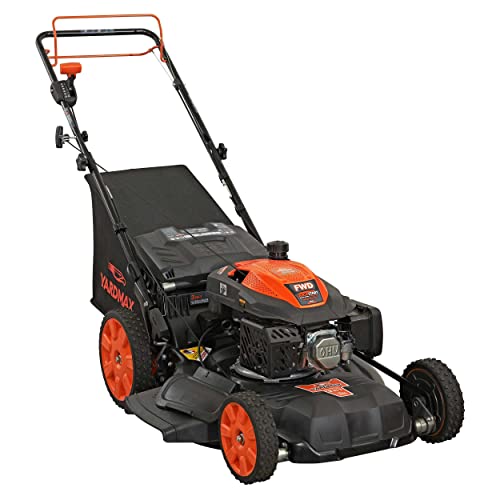
A powerful gas engine in a high-wheel frame that is best on flatter ground.
The YARDMAX YG2860 is powered by a 201cc engine with an exclusive CVT (continuously variable transmission) offering 6 speed settings to match your walking pace. The high-wheel design with aggressive spiked rubber tires provides increased traction and maneuverability on dry, moderate slopes. The automatic choke system means no priming or choking — buyers report it starts on the first or second pull consistently.
One honest buyer noted: “My yard is hilly and grows very unevenly. This mower handles it all easily.” That is real testimony for the engine power. However, there is a significant trade-off: the self-propel is front-wheel drive (FWD). Several buyers call this a major problem on hills. One reviewer stated: “in reality, it’s a terrible idea” — when you push down on the handle to turn on a slope, the front drive wheels lift and lose traction, leaving you wrestling 84.9 pounds. Reviewers also note the speed lever tension is too tight and the grass-cutting height adjustment handle rubs the rear wheel at the highest settings.
At 84.9 pounds, this is the heaviest walk-behind here — 35% heavier than the WORX Nitro — and buyers confirm it becomes “a workout” on sloped sections. The 22-inch cutting width is wide and effective on flat stretches, but the front-wheel drive limits its hill-climbing ability compared to the SENIX’s rear-wheel drive.
Strong points
- Powerful 201cc engine with CVT 6-speed drive
- Aggressive spiked tires improve traction on dry slopes
- Automatic choke for easy starting
Hill challenges
- Front-wheel drive loses traction when front lifts on inclines
- 84.9 lb is heavy — uphill maneuvering is tiring
- Speed lever does not stay in position; handle rubs rear wheel at high cut
Only for gentle slopes: If your yard has mild, dry hills and you want a powerful gas engine with wide 22-inch cut, the YARDMAX engine is strong, but the FWD system limits its hill use.
Skip it for steep hills: Between the 84.9-pound weight and front-wheel drive, buyers on hills report wrestling the mower — choose the rear-wheel SENIX or a lighter battery model instead.
Understanding the Specs
Slope Rating (% or °)
This is the most critical number for a hill mower. A 100% slope means you rise 1 foot for every 1 foot of horizontal distance — that is a 45-degree angle. A 30° (58%) slope is a steep residential hill; anything above 40° (84%) is extreme terrain. The mower must explicitly state its slope rating for that number to be trusted.
Drive Type — FWD vs RWD vs AWD vs Track
Front-wheel drive (FWD) puts the pulling wheels on the front axle, which lifts when going uphill and loses grip. Rear-wheel drive (RWD) keeps the engine weight over the drive wheels, so they dig in and push you up. All-wheel drive (AWD) drives all four wheels for maximum traction. Crawler tracks spread weight over a large surface and grip loose soil better than wheels on steep mud or wet grass.
FAQ
Can I use a regular self-propelled mower on a steep hill?
What is the difference between slope percentage and degrees on a mower?
Are robot mowers safe on hills?
Should I get a gas or electric mower for a hilly yard?
How do I keep a mower from slipping on wet grass on a slope?
Is a remote control mower worth it for steep hills?
Can a mower with a 21-inch deck handle a half-acre sloped lot?
What does cutting height range mean for hill mowing?
How long do batteries last on electric mowers for hills?
What is the heaviest mower I should consider for a steep hill?
Final Thoughts: The Verdict
For most people, the mower for steep hills winner is the Segway Navimow X430 because it handles an 84% slope completely hands-free with wire-free setup and AI obstacle avoidance. If you want the most precise robotic mower with centimeter-level mapping, grab the Mammotion LUBA 3 AWD. And for extreme terrain where no wheeled mower will do, the AIWEIYA tracked crawler climbs a full 100% slope. If you prefer a walk-behind with rear-wheel drive for moderate hills, the Greenworks 48V offers quiet electric operation with reliable traction.
How We Picked
We do not accept paid placement. Every pick is matched to a real buyer and a real use-case; we do not hands-on test units.
Sources & Methodology
Specifications: manufacturer listings and product documentation. Review insights: verified customer reviews, as of July 2026. Pricing: not shown on this page (it changes often); check the current price via the retailer link.
As an Amazon Associate, Lawn Gear Lab earns from qualifying purchases. This does not affect which products we feature.