
Specs are compiled from manufacturer listings and verified buyer reviews and can change over time — please confirm the key details on the product page before buying.
Walking into the garden center and facing a wall of bags with three-number codes like 24-0-6 or 5-7-3 can feel like trying to read a secret language. The wrong bag can scorch your lawn, starve your tomatoes, or leave you with a mess that does nothing but feed the weeds. This guide cuts through the numbers and matches each bag of fertilizer to the exact job it does best — whether you are feeding a hungry vegetable patch or reviving a tired lawn.
I’m Rikta — the founder and writer behind Lawn Gear Lab. This guide is built by comparing the manufacturers’ published specifications and the patterns across verified customer reviews, so you get each pick’s real strengths and trade-offs instead of marketing spin.
You will find a complete breakdown of the five best formulations for different yard needs, from a heavy-duty lawn reviver to a berry-friendly organic option, plus plain-English explanations of what those NPK numbers actually mean for your soil. This is the guide that finally makes bags of fertilizer easy to understand for every home gardener.
Quick Picks
- Yard Mastery Flagship Granular Lawn Fertilizer 24-0-6 — Best Overall
- The Andersons Professional PGF 16-0-8 Fertilizer with Humic DG — Precision Feeder
- FoxFarm Happy Frog Tomato & Vegetable Fertilizer — Garden MVP
- Jobe’s Organics Granular All Purpose Fertilizer — Organic Champion
- BGI Fertilizers BOUGAIN Bougainvillea Fertilizer — Bloom Specialist
How To Choose The Best Bags Of Fertilizer
You need a bag of fertilizer that matches what you are growing and the problem you want to fix. A bag high in nitrogen (the first number on the label, which fuels leafy green growth) turns a lawn lush and green, but on tomato plants it pushes leaves instead of fruit. A lawn formula with extra iron (a mineral that deepens green color) gives grass a rich blue-green shade, while an organic all-purpose blend stays gentle enough for a vegetable garden you will eat from.
Match the NPK Ratio to Your Goal
The three numbers on a bag — for example 24-0-6 — stand for Nitrogen, Phosphorus, and Potassium. Nitrogen fuels leafy green growth, phosphorus supports roots and flowers, and potassium helps overall plant health and stress tolerance. For a lawn you want to green up fast, look for a high first number (over 20). For tomatoes and peppers that need to fruit, you want a more balanced ratio with a good middle number, like 5-7-3. Zero phosphorus in a lawn fertilizer, like the 16-0-8 formula, is fine for established lawns where soil tests show enough phosphorus already.
Slow Release Versus Quick Release
Slow-release nitrogen is the feature that prevents the “surge and crash” cycle. It feeds the grass steadily over several weeks, so you do not get a sudden growth spurt followed by a yellow fade. Quick-release gives a fast green-up but can burn the lawn if applied heavily. Most premium lawn fertilizers use a mix of both: a small dose of quick-release for immediate color, and a larger dose of slow-release for long-term feeding that lasts up to eight weeks.
Specialty Formulas Make a Real Difference
If you are growing a specific plant that has unique needs, a general-purpose bag is rarely the best choice. Bougainvillea, for example, needs a very high iron content (5% in the BGI formula) to produce those dramatic blooms. Tomato and vegetable fertilizers need calcium to prevent blossom end rot, which is a common issue that ruins fruit. Buying a bag formulated for your exact plant type gives you a better result with less guesswork.
Quick Comparison
| Model | Best For | NPK Ratio | Bag Weight | Coverage | Amazon |
|---|---|---|---|---|---|
| Yard Mastery Flagship 24-0-6 | Reviving a dead lawn to deep green | 24-0-6 | 18 lb | 6,000 sq ft | Amazon |
| The Andersons PGF 16-0-8 | Even feeding with no phosphorus | 16-0-8 | 18 lb | — | Amazon |
| FoxFarm Happy Frog 5-7-3 | Tomatoes and vigorous feeders | 5-7-3 | 4 lb | Full | Amazon |
| Jobe’s Organics All Purpose 4-4-4 | Organic feeding for whole garden | 4-4-4 | 16 lb | Resealable | Amazon |
| BGI Bougainvillea Fertilizer | Bougainvillea bloom boost | — | 10 lb | Resealable | Amazon |
In‑Depth Reviews
1. Yard Mastery Flagship Granular Lawn Fertilizer 24-0-6
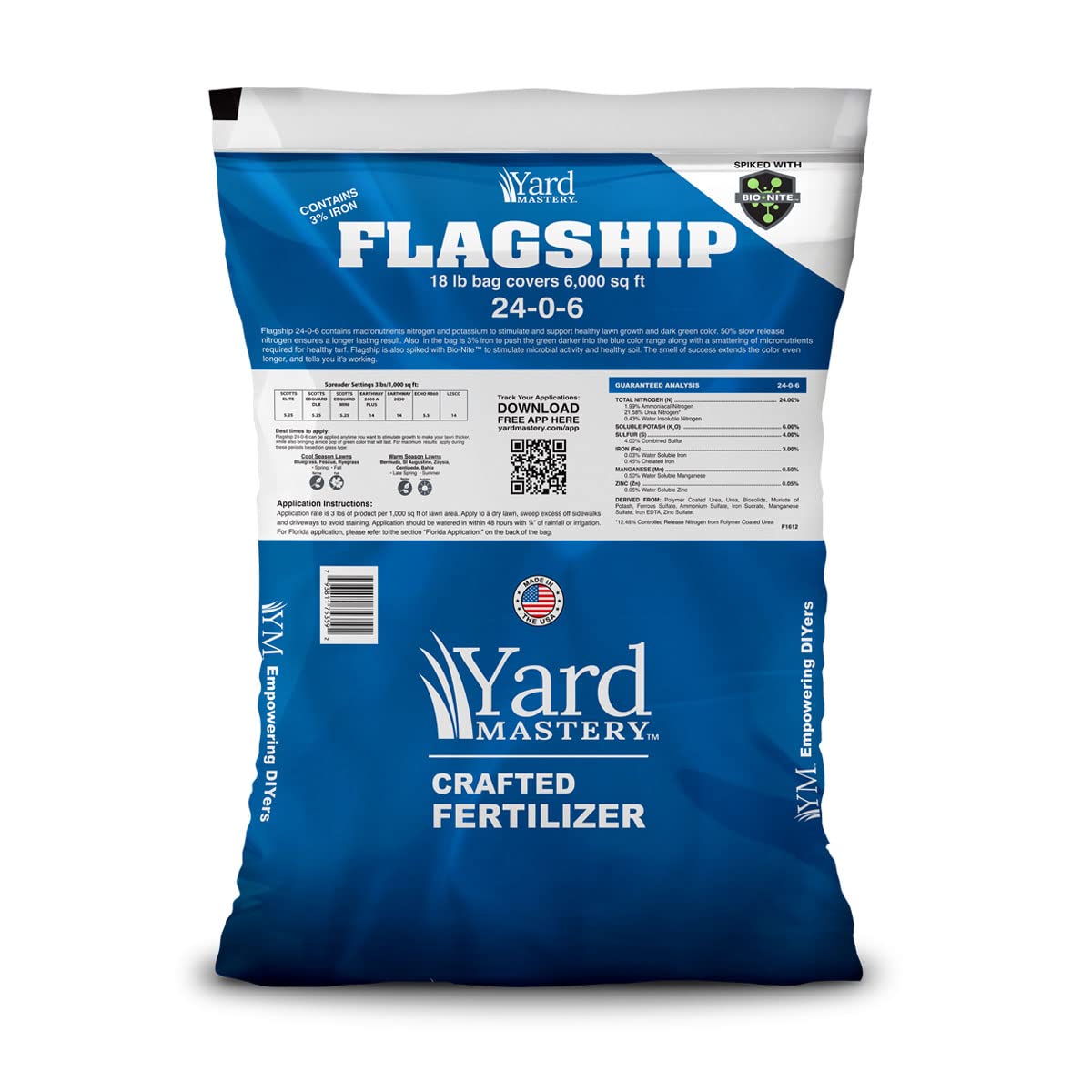
The heavy lifter that takes a brown lawn to lush green in one week.
If your lawn looks more like a hayfield than a sports field, this is the bag you want. The 24-0-6 ratio delivers 24% nitrogen (with a good portion being slow-release) plus 6% potassium, but the real hero here is the 3% iron. Iron is what gives grass that deep, rich blue-green color that makes neighbors ask which lawn service you use. Buyers report that this product “revived dead, patchy brown lawn to full deep green within a week,” calling it superior to 10 other methods they tried, including plugs and seed.
The formula includes Bio-Nite, which is an all-natural source of nitrogen that feeds the soil without harsh chemicals. It also comes with a full lineup of micronutrients — boron, copper, manganese, molybdenum, and zinc — that most basic fertilizers skip entirely. One 18-pound bag covers 6,000 square feet, which is a solid size for a typical suburban lawn. However, be prepared for the growth: one reviewer noted that the grass looked great all summer but warned you will be cutting it twice a week because the stuff really stimulates growth.
What Greens It Up
- High 24-0-6 ratio with 24% slow-release nitrogen for steady feeding
- 3% iron delivers a deep blue-green color fast
- Includes micronutrients (boron, copper, manganese) that many lawn foods lack
- 18 lb bag covers 6,000 sq ft — good value for the coverage
The Growth Surge
- Zero phosphorus (0 in the middle) means it is not for new lawns or seeding
- Stimulates so much growth you may need to mow twice a week
Reach for it if: you want the fastest, most dramatic green-up for an existing lawn and do not mind stepping up the mowing schedule.
Look elsewhere if: you are planting new grass seed or need a formula with phosphorus for root development.
2. The Andersons Professional PGF 16-0-8 Fertilizer with Humic DG
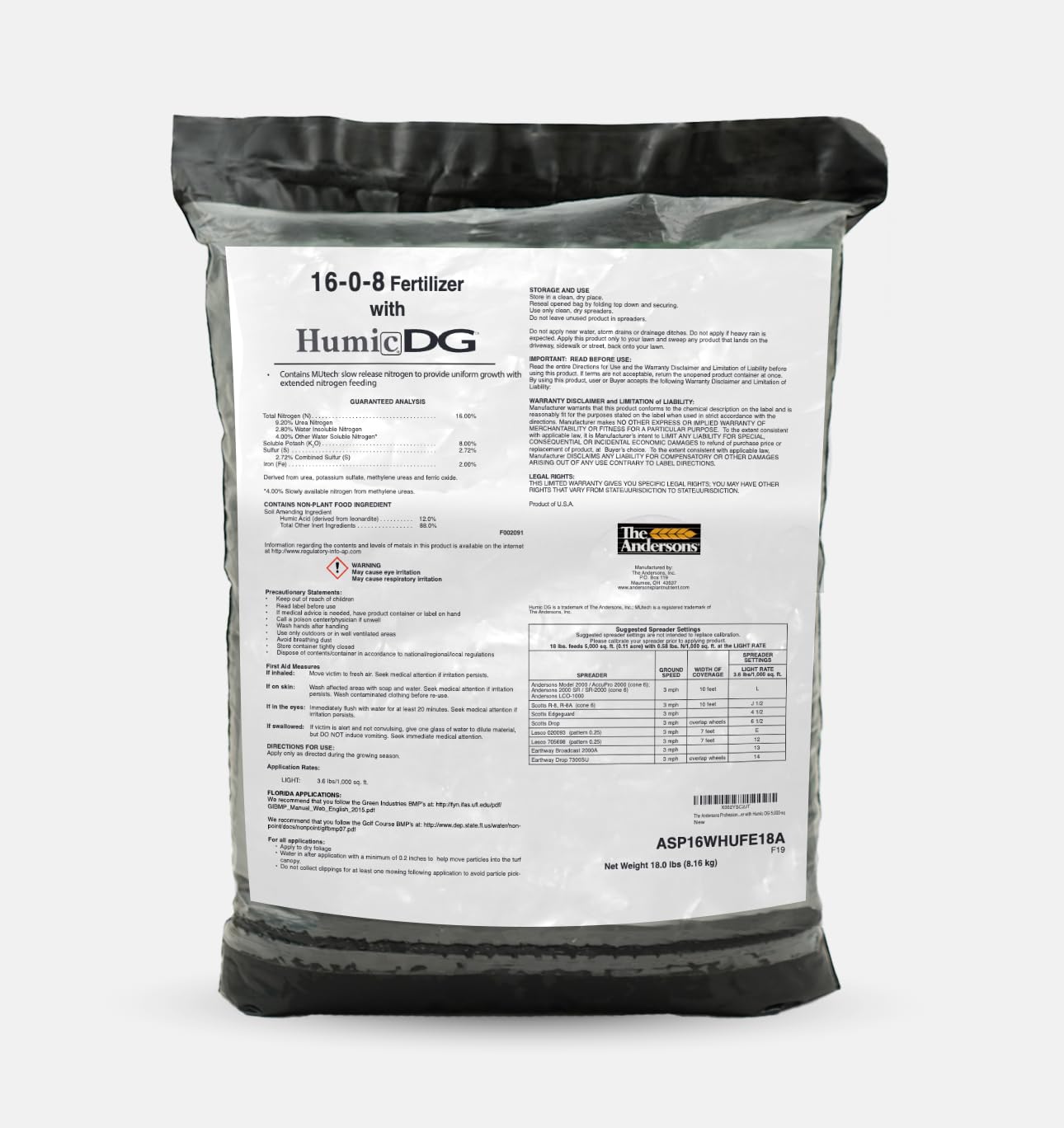
The phosphorus-free formula that spreads so evenly you cannot tell where you started.
Unlike the Yard Mastery bag above which relies on heavy iron for color, The Andersons PGF takes a different approach to feeding your lawn. The 16-0-8 ratio gives you plenty of nitrogen and potassium with zero phosphorus, making it a strong choice if a soil test already shows enough phosphorus in your ground. The star feature here is the “Humic DG” — humic acid delivered in a dispersible granule that improves soil structure and helps roots absorb nutrients more effectively. The company claims the super-fine particles give more particles per square foot than standard fertilizers, so you do not get the stripey green-and-yellow pattern that comes from uneven spreading.
The nitrogen is split between quick-release for an immediate color pop and slow-release that keeps feeding for up to eight weeks. That means one application does the work for nearly two months, which is longer than the 24-0-6 bag’s feeding window. It also includes iron and a full set of micronutrients for balanced nutrition. There is one big catch: this product is not for sale in California or Oregon, so buyers in those states need to look at the Yard Mastery option instead. And at 18 pounds, it weighs exactly as much as the Yard Mastery bag — 18 pounds compared to the 4-pound FoxFarm bag for tomatoes.
Spread and Feed
- Humic DG improves soil nutrient uptake, not just grass color
- Quick- and slow-release nitrogen for up to 8 weeks of feeding
- Ultra-fine particles prevent uneven striping on your lawn
Restricted Access
- Not available for sale in California or Oregon
- Zero phosphorus means it is not ideal for new lawns or flower beds
Best for: the lawn enthusiast in most states who wants precise, even feeding with added soil-conditioning benefits from Humic DG.
Not for: anyone in California or Oregon, or anyone establishing new grass from seed.
3. FoxFarm Happy Frog Tomato & Vegetable Fertilizer

The small bag that packs a big punch for fruiting vegetables.
Unlike the big lawn bags which focus on nitrogen-heavy ratios, this FoxFarm blend is designed for vigorous feeders like tomatoes, peppers, and berries. The 5-7-3 ratio differs from the 24-0-6 lawn formula, because vegetables need a different balance. The middle number (phosphorus) is the highest, which supports flower and fruit development. The 5-7-3 ratio includes calcium specifically to prevent blossom end rot — that frustrating black spot on the bottom of your tomatoes. It also includes mycorrhizal fungi to improve root function and help the plant absorb water and nutrients more efficiently.
The bag is a compact 4 pounds, weighing 4 pounds, which is lighter than the 18-pound Andersons bag, making it easy to carry and store. FoxFarm states it is ideal for a wide variety of plants including peppers, leafy vegetables, root crops, and berries. The granules are easy to work into the soil around established plants or mix into containers. Because it is a specialized formula, it does not work well as a general lawn food — you will get better results using it exactly where it belongs: on the things you plan to eat.
Fruit Focus
- 5-7-3 ratio with phosphorus high for flowers and fruit
- Calcium included to prevent blossom end rot in tomatoes
- Mycorrhizal fungi help roots absorb more nutrients
Small Bag, Specific Job
- Only 4 pounds — not enough for large garden beds or lawns
- Balanced ratio is not ideal for greening up a lawn
Grab this for: your tomato patch, pepper plants, and berry bushes where you want abundant fruit without blossom end rot issues.
Skip this for: any lawn application or general-purpose garden feeding where a larger, cheaper bag would do.
4. Jobe’s Organics Granular All Purpose Fertilizer

The 16-pound organic bag that feeds everything without the risk of chemical burn.
For gardeners who want to avoid synthetic chemicals, this Jobe’s Organics bag is OMRI listed for organic gardening by the USDA, which means it meets the standards for use in certified organic food production. The 4-4-4 NPK ratio is gentle and even, so you are unlikely to over-fertilize and burn your plants. It works for vegetables, flowers, shrubs, trees, and general landscaping — a true all-purpose option that simplifies your fertilizer storage to one bag. Jobe’s recommends applying it every 2-3 weeks during the growing season, which is more frequent than the slow-release lawn formulas above.
At 16 pounds, this bag splits the difference between the small 4-pound FoxFarm bag and a heavy 40-pound professional-grade sack. The maker claims the organic formula avoids harsh smells and wasteful runoff — a real benefit if you fertilize near patios or walkways. The resealable packaging keeps granules dry between uses. The trade-off: because it is a balanced 4-4-4 blend (equal parts nitrogen, phosphorus, and potassium), it will not green up a lawn as fast as a high-nitrogen lawn food. Think of it as a steady, gentle feed for the whole garden, not a quick fix.
Clean Garden Feed
- OMRI listed for USDA organic gardening
- No synthetic chemicals, avoids runoff and smells
- 16 lb bag with resealable package for easy storage
Gentle Pace
- Requires reapplication every 2-3 weeks — not a slow-release formula
- Balanced 4-4-4 ratio will not produce dramatic lawn greening
Ideal for: organic gardeners who want one bag that safely feeds vegetables, flowers, shrubs, and trees without worrying about chemical content.
Not the best fit for: anyone seeking a dramatic, fast lawn transformation or a set-and-forget slow-release product.
5. BGI Fertilizers BOUGAIN Bougainvillea Fertilizer
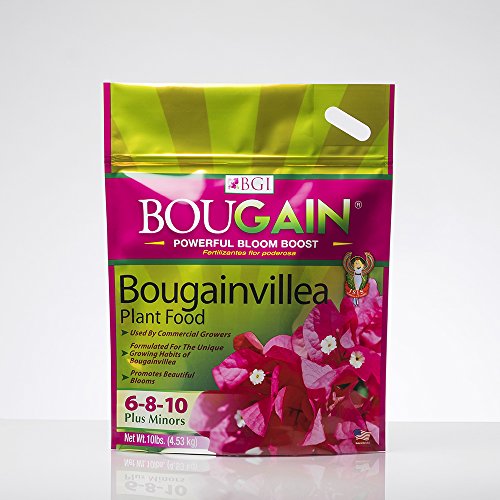
The bag built for one job: turning bougainvillea into a wall of blooms.
Bougainvillea is a plant that demands very specific nutrition to flower heavily, and general-purpose fertilizers rarely deliver. This BGI formula was developed by Bougainvillea Growers International, which is the largest bougainvillea nursery in the country, so it is a specialist product for a specific plant. The key feature is the 5% iron content — that is what creates the intense bloom color that bougainvillea is known for. It is a granular formula that requires no mixing; you simply apply it once a month and let the granules break down.
The 10-pound bag is a practical size for several large potted bougainvilleas or a row of planted specimens. It is also marketed for use on other tropical and flowering plants, but its primary purpose is bougainvillea. One thing to note is that because this is a specialty fertilizer, it is not suitable for lawns or vegetable gardens. The 5% iron is great for blooming plants but would be excessive for general use. If you do not grow bougainvillea, this bag is not for you — but if you do, there is not a better formulated product available.
Bloom Trigger
- 5% iron content is the key to dramatic bougainvillea blooms
- Once-a-month granular application requires no mixing
- Developed by the largest bougainvillea nursery in the country
Niche Only
- Formulated specifically for bougainvillea — not for lawns or vegetables
- 10 lb bag may be more than needed for a single small plant
Perfect match for: anyone who owns bougainvillea and wants to see it covered in flowers with minimal effort.
Wrong bag for: anyone who does not grow bougainvillea or needs a general-purpose garden fertilizer.
Understanding the Specs
NPK Ratio
The three large numbers on the front of every bag stand for Nitrogen (N), Phosphorus (P), and Potassium (K) — in that order. Nitrogen fuels leaf and stem growth, which is why lawn fertilizers have a high first number (like 24-0-6). Phosphorus supports root development, flowers, and fruit, so vegetable and bloom fertilizers have a higher middle number (like 5-7-3). Potassium helps overall plant health, disease resistance, and stress tolerance. A zero in any position means that nutrient is not in the bag, which is fine if your soil already has enough of it from prior applications or a soil test.
Slow-Release Nitrogen
Not all nitrogen works the same way. Quick-release nitrogen dissolves in water fast and gives your lawn an immediate green pop, but it can burn the grass if applied too heavily and it fades away within a week or two. Slow-release nitrogen is coated or chemically formulated to break down gradually over several weeks or months. It provides steady feeding, reduces the risk of burn, and means you apply fertilizer less often. Most premium lawn fertilizers combine both types — a small amount of quick-release for instant color and a larger amount of slow-release for long-term nutrition that can last up to 8 weeks.
FAQ
How often should I apply a granular bag of fertilizer to my lawn?
Can I use a lawn fertilizer on my vegetable garden?
What does OMRI listed mean on a bag of fertilizer?
How do I know if my soil needs phosphorus before buying a bag?
What is iron doing in my lawn fertilizer?
Will a 10-pound bag of bougainvillea fertilizer work for other flowering plants?
How do I apply granular fertilizer without burning my lawn?
Can I mix two different bags of fertilizer together?
Is a 16-pound bag of fertilizer enough for a large lawn?
What is the difference between a bag labeled for tomatoes and a bag labeled for lawns?
Final Thoughts: The Verdict
If you want one dependable pick, the bags of fertilizer winner is the Yard Mastery Flagship 24-0-6 because it delivers the fastest, most dramatic green-up for an existing lawn with its 3% iron and slow-release nitrogen. If you want a phosphorus-free formula with added soil conditioning that feeds for up to eight weeks, grab the The Andersons PGF 16-0-8. And for organic vegetable gardeners seeking a gentle, balanced feed for the whole garden, the Jobe’s Organics 4-4-4 is the safe, OMRI-listed choice.
How We Picked
We do not accept paid placement. Every pick is matched to a real buyer and a real use-case; we do not hands-on test units.
Sources & Methodology
Specifications: manufacturer listings and product documentation. Review insights: verified customer reviews, as of July 2026. Pricing: not shown on this page (it changes often); check the current price via the retailer link.
As an Amazon Associate, Lawn Gear Lab earns from qualifying purchases. This does not affect which products we feature.