
Specs are compiled from manufacturer listings and verified buyer reviews and can change over time — please confirm the key details on the product page before buying.
Tired of buying a greenhouse that looks great in the picture but buckles in your first real wind? The difference between a kit that works and one that frustrates depends on the thickness of the panels, the bracing of the frame, and how many vents actually open — not the paint color on the box.
I’m Rikta — the founder and writer behind Lawn Gear Lab. This guide is built by comparing the manufacturers’ published specifications and the patterns across verified customer reviews, so you get each pick’s real strengths and trade-offs instead of marketing spin.
Your fourth tomato plant flops because a pop-up tent gave up, but a polycarbonate box with locked vents just keeps going, and that is the difference worth paying for when you are picking from the best rated greenhouse kits.
Quick Picks
- Backyard Discovery Willow 9′ x 6′ Cedar Wood and Polycarbonate Walk-in Greenhouse Kit — Top Performer
- Yardenaler 8×16 FT Greenhouse for Outdoor, 6MM Thick Polycarbonate Panel Wooden Walk-in Green House — Best Overall
- YITAHOME 12x6FT Polycarbonate Greenhouse Large Heavy Duty — Premium Pick
- Sylviera 8x10FT Greenhouses for Outdoors with Hygrometer, Polycarbonate — Best Value
- WUKHG 6×7.5FT Greenhouse for Outdoors, Polycarbonate with Electronic Thermometers — Compact Pick
- VEVOR Walk-in Tunnel Greenhouse, 19.4×9.7×6.5 ft Hoop House — Budget Grower
- CROWN SHADES 8×6 Walk-in Greenhouse, Pop Up Portable — Instant Setup
How To Choose The Best Rated Greenhouse Kits
A greenhouse kit lets you extend your growing season, but the wrong one leaves you with bowed frames, ripped covers, and wasted weekends. You need to match the structure to your local weather, your available space, and how much assembly headache you can tolerate.
Frame and Panel Materials
The frame holds everything together. Aluminum alloy resists rust and stays light, making it a common pick for mid-range and premium kits. Wood, particularly cedar, offers natural decay resistance and a classic look but adds significant weight — the Backyard Discovery unit weighs 259 kilograms. On panels, polycarbonate (PC) blocks UV rays and insulates far better than polyethylene (PE) film. A 4mm double-wall PC panel lets in light while keeping the interior stable, whereas thin PE covers puncture easily and degrade in full sun.
Ventilation and Door Style
Stale, overheated air kills plants faster than cold does. Look for adjustable roof vents — at least two — plus mesh-covered windows. A roll-up zipper door or a sliding door helps you regulate airflow without losing floor space. Premium kits sometimes add an exhaust fan for forced ventilation, which makes a real difference on still summer afternoons.
Space and Anchoring
You need room to stand, reach, and move trays. A 6×7.5 foot footprint offers basic walk-in access, while an 8×12 or 8×16 foot floor gives you proper staging. But bigger means more wind load, so check the anchoring system. Kits with U-shaped stakes, diagonal braces, and tie-downs survive gustier conditions. A concrete or wood foundation is your best bet for a permanent installation.
Quick Comparison
| Model | Best For | Frame Material | Cover Material | Dimensions (L x W x H) | Amazon |
|---|---|---|---|---|---|
| Backyard Discovery Willow | Year-round heavy-use gardening | Cedar Wood | Polycarbonate | 114.25″ x 72.75″ x 94″ | Amazon |
| Yardenaler 8×16 FT | Large wooden walk-in with adjustability | Wood | Polycarbonate | 190.2″ x 96″ x 90.6″ | Amazon |
| YITAHOME 12x6FT | Large heavy-duty with sliding door | Aluminum | Polycarbonate | 144″ x 72″ x 77″ | Amazon |
| Sylviera 8x10FT | Mid-size polycarbonate value | Aluminum | Polycarbonate | 120″ x 97″ x 81″ | Amazon |
| WUKHG 6×7.5FT | Compact economical polycarbonate | Aluminum | Polycarbonate | 66.53″ x 88.18″ x 76.77″ | Amazon |
| VEVOR Tunnel | Large growing area on a budget | Galvanized Steel | High-Density PE | 236.22″ x 118.11″ x 78.74″ | Amazon |
| CROWN SHADES 8×6 | Instant pop-up portability | Steel | PE | — | Amazon |
In‑Depth Reviews
1. Backyard Discovery Willow 9′ x 6′ Cedar Wood and Polycarbonate Walk-in Greenhouse Kit

The cedar-and-polycarbonate kit that is tested against 100 mph winds and 30 inches of snow.
You get year-round climate control without running extension cords because this kit includes a temperature-activated exhaust fan for forced ventilation and a built-in PowerPort with 3 electrical outlets and 3 USB ports inside the greenhouse. Interior and exterior hose hook-ups mean you water plants from day one without dragging hoses across the yard. The frame is 100% cedar wood — naturally rot-resistant and pre-stained in a light brown finish. The commercial-grade 4-wall polycarbonate roof and window panels improve heat retention by 30% compared to standard double-wall polycarbonate (a 2-layer plastic sheet), which helps seedlings survive a frost. Buyers report the unit stands up to 50+ mph winds and blizzards with no snow intrusion after proper anchoring, making it a serious year-round structure.
The trade-off is size: at 54 square feet of interior space with 13 linear feet of fixed staging shelves, it is not the largest footprint here. The weight is also substantial at 259 kilograms, so you need a solid foundation. But the 5-year warranty and pre-cut, pre-drilled, pre-stained pieces that pair with the interactive BILT app make assembly about as painless as a wood kit gets.
Standout inclusions
- Temperature-activated exhaust fan for automatic ventilation
- PowerPort with 3 outlets and 3 USB ports
- Interior and exterior hose hook-ups
- 5-year warranty backs the build
Size reality check
- 9×6 foot footprint limits large-scale planting
- Very heavy at 259 kilograms — needs a proper foundation
Designed for the committed grower: If you want power, water, fan-forced ventilation, and a cedar frame that outlasts painted steel, this is your one-kit solution.
Consider the ground first: The weight and wind rating demand a permanent anchored base — not a weekend gravel pad.
2. Yardenaler 8×16 FT Greenhouse for Outdoor, 6MM Thick Polycarbonate Panel Wooden Walk-in Green House
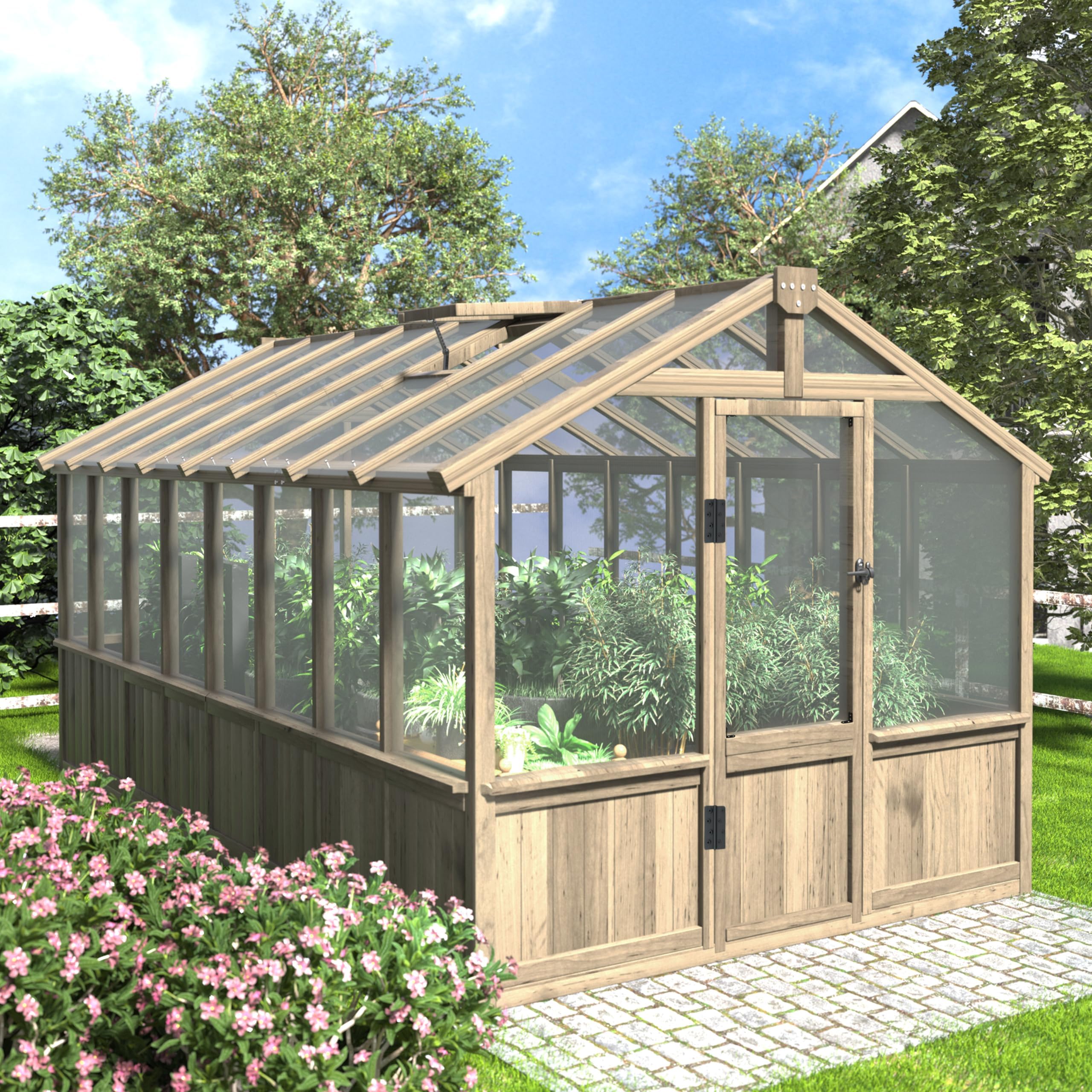
A spacious 8×16 wooden walk-in with 6 mm multi-wall polycarbonate that stands up to real weather.
You get nearly double the floor area of the Backyard Discovery Willow above, with a 190.2-inch long by 96-inch wide footprint, and it uses 6 mm thick multi-layer polycarbonate panels for high light transmission and UV protection. The adjustable roof vents open up to a 45-degree angle, giving you fine control over airflow. Buyers who built theirs on a 4×4 foundation with pea gravel report the structure withstood 60 to 70 mph winds for a full year after securing it with ties. The frame is wood, finished in light mocha brown, and owners mention that the cedar frame attaches well and smells nice during assembly. The hinged door measures 29.1 inches wide and 71.4 inches tall — a comfortable entry for carrying pots and tools. Several owners mention that assembly is labor-intensive and recommend pre-drilling the thinner wood holes, but no missing parts were reported. One reviewer noted even after six months of use, the only leak was at the vent window area.
At 427 pounds, this is a permanent structure, so you should plan for a concrete or compacted gravel base. The frosted film on some panels does not adhere perfectly, according to one reviewer, but that does not affect the structural integrity. For the price, you are getting nearly double the floor area of the Backyard Discovery kit, though without the exhaust fan and electrical ports.
Why it wins on space
- Large 8×16 foot interior for staging and storage
- 6 mm thick polycarbonate for better insulation
- Adjustable roof vents open to 45 degrees
- Reviewers confirm it survived 60-70 mph winds
Assembly notes from buyers
- Labor-intensive build; pre-drilling helps
- Frosted film adhesion issues on some poly panels
Best for the dedicated gardener with space: You get a huge, storm-tested wooden kit that lets you walk around freely.
Reality check: You need a foundation and patience for a multi-day assembly, and you will want to caulk every seam.
3. YITAHOME 12x6FT Polycarbonate Greenhouse Large Heavy Duty
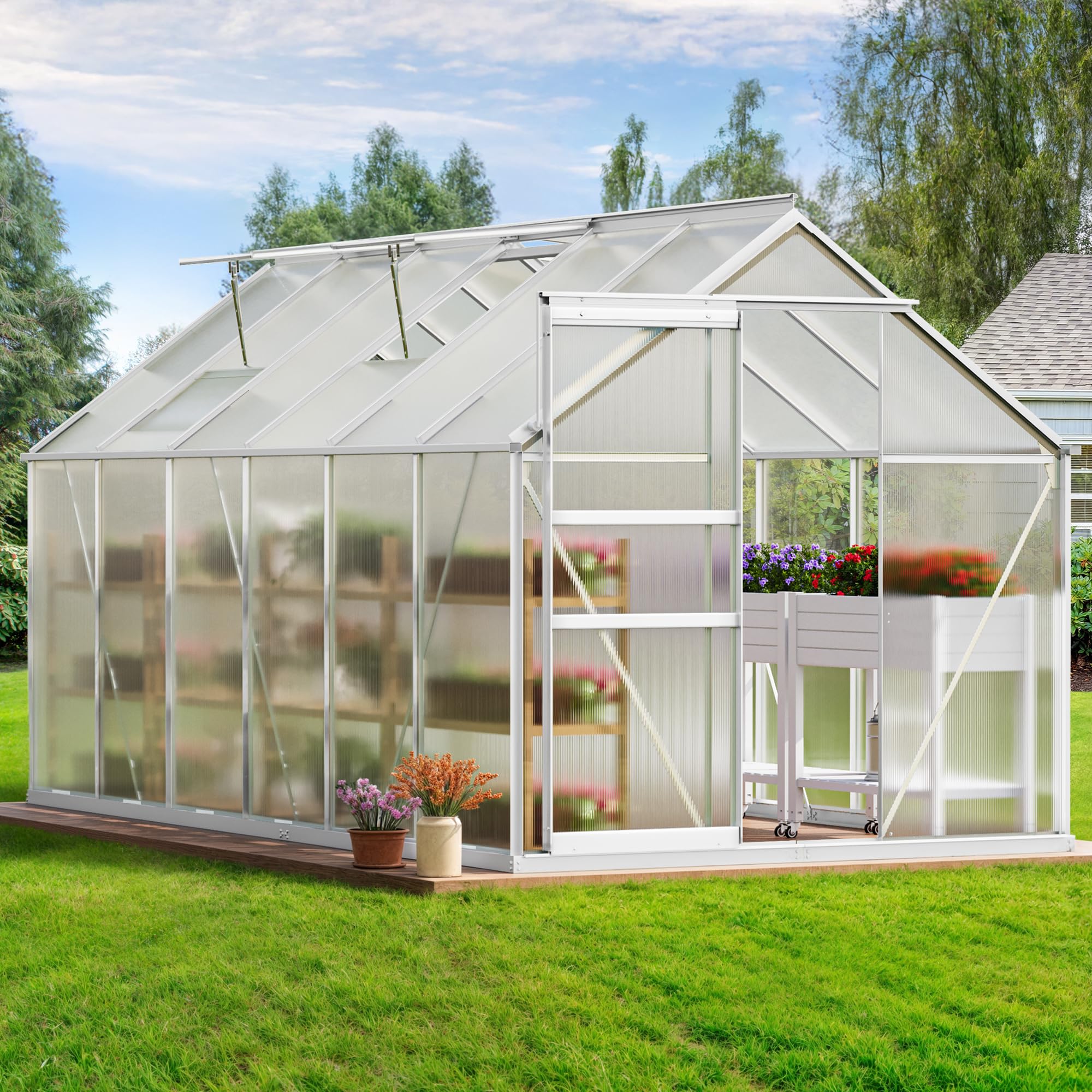
A heavy-duty 12×6 aluminum frame with a space-saving sliding door and dual adjustable skylights.
You get a 144-inch long by 72-inch wide growing area without the rust worries of steel, because the aluminum alloy frame with reinforced side rods and diagonal rod fixation keeps it rigid. The double-wall polycarbonate boards are 4mm thick with UV protection that the brand says blocks 99% of UV radiation — so your seedlings get sunlight without the burn. Unlike the hinged doors on the wooden kits (like the Yardenaler 8×16), the innovative sliding door opens and closes without eating into interior floor space. Two adjustable skylights let you fine-tune airflow, and the top tilt angle design helps with wind resistance and drainage. The manufacturer recommends placing the bottom frame in a pre-dug trench and using the included expansion screws to anchor it to the ground, plus applying glass glue to PC board connections for better waterproofing. As with the larger wood units, the unit is shipped in two packages that may arrive on different days.
Buyer feedback is mixed on long-term durability: some report the structure feels solid and has weathered many storms, while one reviewer found it flimsy in small winds and cautioned against it. Several owners note that assembly is straightforward, though a few pieces had off-center holes that needed tape to correct. This is a premium-sized aluminum kit that sits between the small polycarbonate boxes and the massive wood structures in both price and permanence.
Big space, smart door
- Sliding door saves interior room
- 99% UV protection from 4mm double-wall panels
- Dual adjustable skylights for ventilation
- Aluminum frame resists rust
Points to watch
- Mixed durability reports from buyers
- Off-center holes mentioned in some reviews
- Shipment arrives in two separate packages
Go for it if: You want the large 12×6 aluminum footprint and like the convenience of a sliding door over a hinged one.
The honest limit: Some buyers found the frame vulnerable in winds, so anchor it well and add sealant at every connection.
4. Sylviera 8x10FT Greenhouses for Outdoors with Hygrometer, Polycarbonate
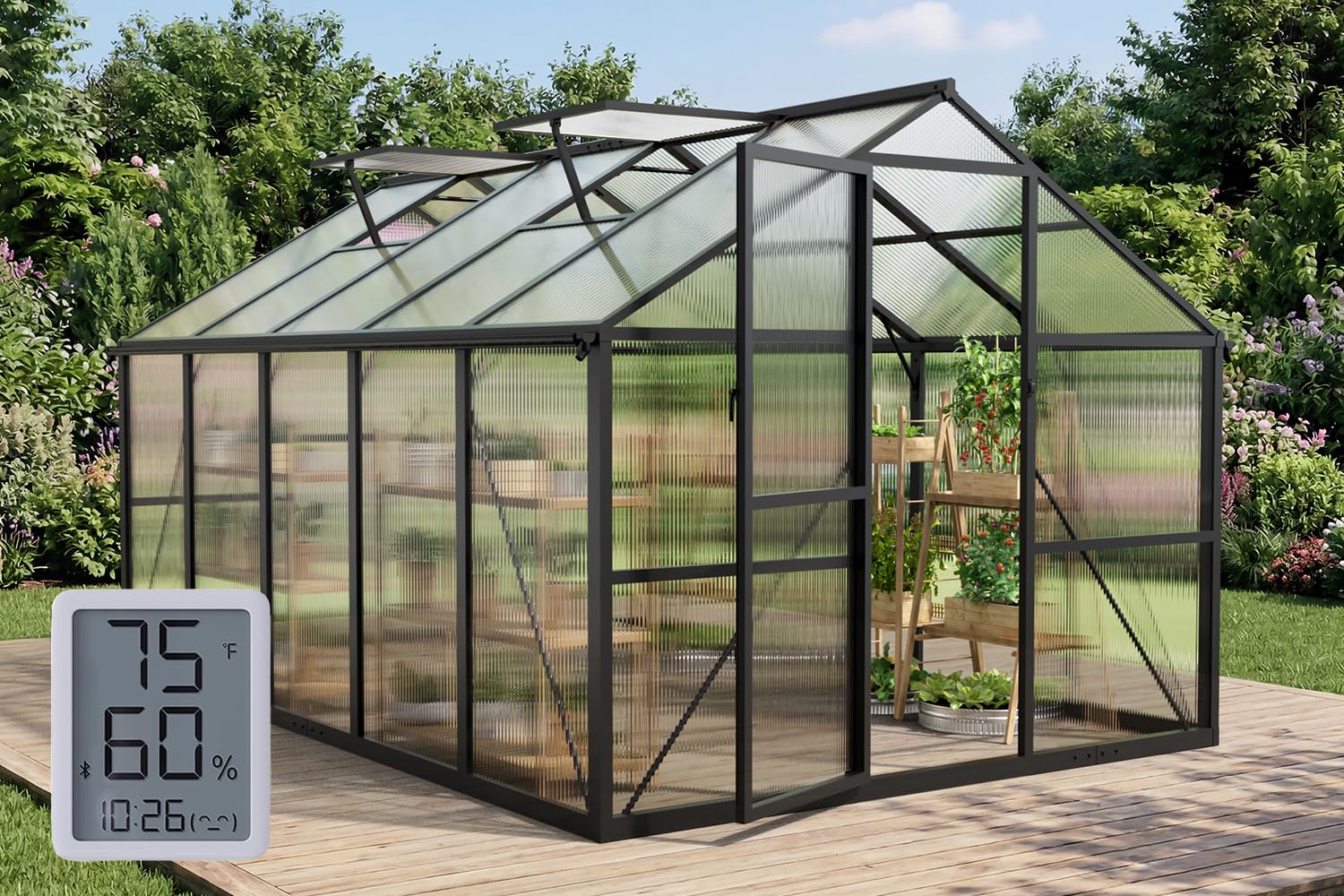
An 8×10 aluminum frame with 4mm double-wall polycarbonate and a built-in hygrometer — a strong mid-range value.
You skip the weight and rot worries of wood because the frame is high-quality reinforced aluminum alloy with strengthened corners, and the panels are 4mm thick double-wall polycarbonate that weighs 580 grams per square meter — substantial enough to resist impact while letting in plenty of light. It comes with adjustable roof vents and a lockable door, plus a built-in hygrometer so you can monitor humidity inside without buying extra gear. At 120 inches long by 97 inches wide by 81 inches tall, the interior is roomy enough to walk around and arrange multiple shelves. The drainage channel roof vent design helps channel rainwater away from the frame. Sylviera recommends sealing the panel gaps with silicone for extra strength, which is common for any polycarbonate kit. Unlike the wooden units, the aluminum frame is lighter and will not rot, making it a lower-maintenance choice for a permanent or semi-permanent installation.
The unit count of 489 is note — that is the number of individual parts and panels in the kit, not square footage, so expect a methodical assembly process with labeled parts and the included tools. Buyers have not posted specific reviews for this model yet, but the materials and dimensions put it ahead of lighter pop-up greenhouses in terms of weather resilience.
Mid-range strength
- Reinforced aluminum alloy frame resists rust
- 4mm double-wall polycarbonate with UV protection
- Built-in hygrometer included
- Adjustable roof vents and lockable door
What to expect
- 489 parts means a real time commitment to assemble
- Silicone sealant recommended for best weatherproofing
For the budget-minded planter: You get a real aluminum-and-polycarbonate walk-in at a fraction of the cost of wood kits, with a hygrometer thrown in.
Not for instant gratification: The part count is high, so set aside a full weekend for assembly.
5. WUKHG 6×7.5FT Greenhouse for Outdoors, Polycarbonate with Electronic Thermometers
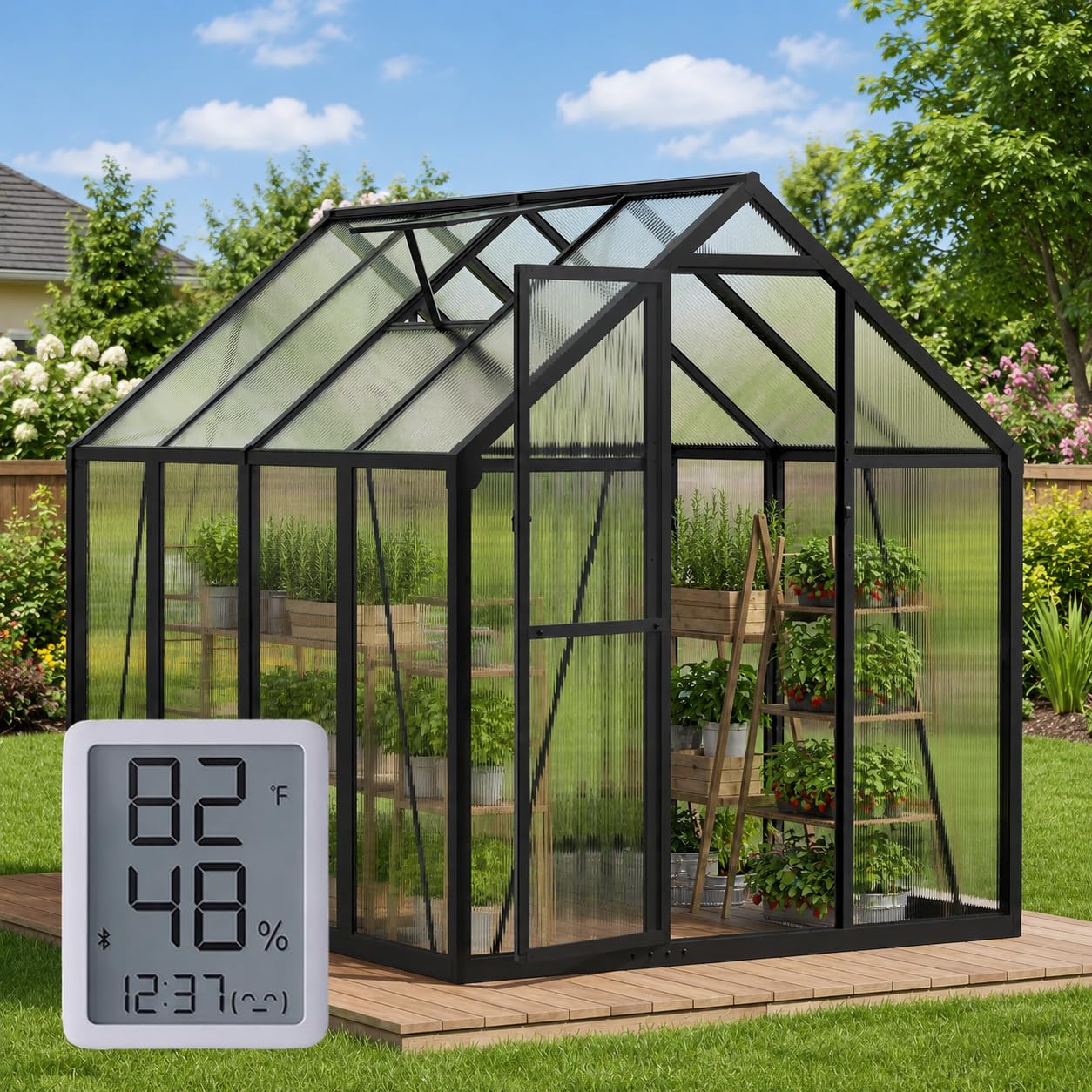
A compact aluminum and polycarbonate walk-in with 5mm panels — the smallest footprint that still lets you stand inside.
At 66.53 inches long by 88.18 inches wide by 76.77 inches tall, this is a compact unit compared to the 8×10 or 8×16 models above, but it still gives you walk-in access. The frame is aluminum alloy, and the cover material is heavy-duty polycarbonate with a 5mm nominal wall thickness — slightly thicker than the 4mm panels on the Sylviera and YITAHOME kits. The single adjustable ventilation window and lockable door help regulate temperature without drafts. Customers note a tricky assembly that can take three people. One reviewer wrote, “Roof window blew out first night.” The same buyer noted the greenhouse heats to 100°F when outside temps are only 40°F, then cools to ambient by midnight, making it good for pre-planting weeks but not year-round growing. Another owner found the panels thin and the instructions unclear, saying the windows fell out before the roof was even built. On the positive side, several reviewers point out the frame feels sturdy in wind once the braces are in place, and the compact size fits easily into smaller backyards.
The number of vents is 1 — the lowest in this roundup compared to the VEVOR which has 12 vents and the Yardenaler with 2 adjustable roof vents. That single vent limits your ability to manage heat on still days. For a temporary seasonal greenhouse on a small lot, this kit can work, but the buyer reviews suggest you should budget for extra sealant and reinforcement.
Small but functional
- 5mm polycarbonate panels are thicker than many competitors
- Aluminum frame resists rust
- Compact footprint fits tight spaces
- Includes electronic thermometers
Buyer-reported issues
- Assembly requires three people
- Roof window blew out first night for one owner
- Single vent limits hot-day airflow
- Some panels described as thin and fragile
Best for seasonal starters: If you need a temporary shelter for early spring seedlings and have a helper or two, this fits the bill at a moderate investment.
Look elsewhere if: You want a year-round structure that handles wind and snow without extra reinforcement.
6. VEVOR Walk-in Tunnel Greenhouse, 19.4×9.7×6.5 ft Hoop House
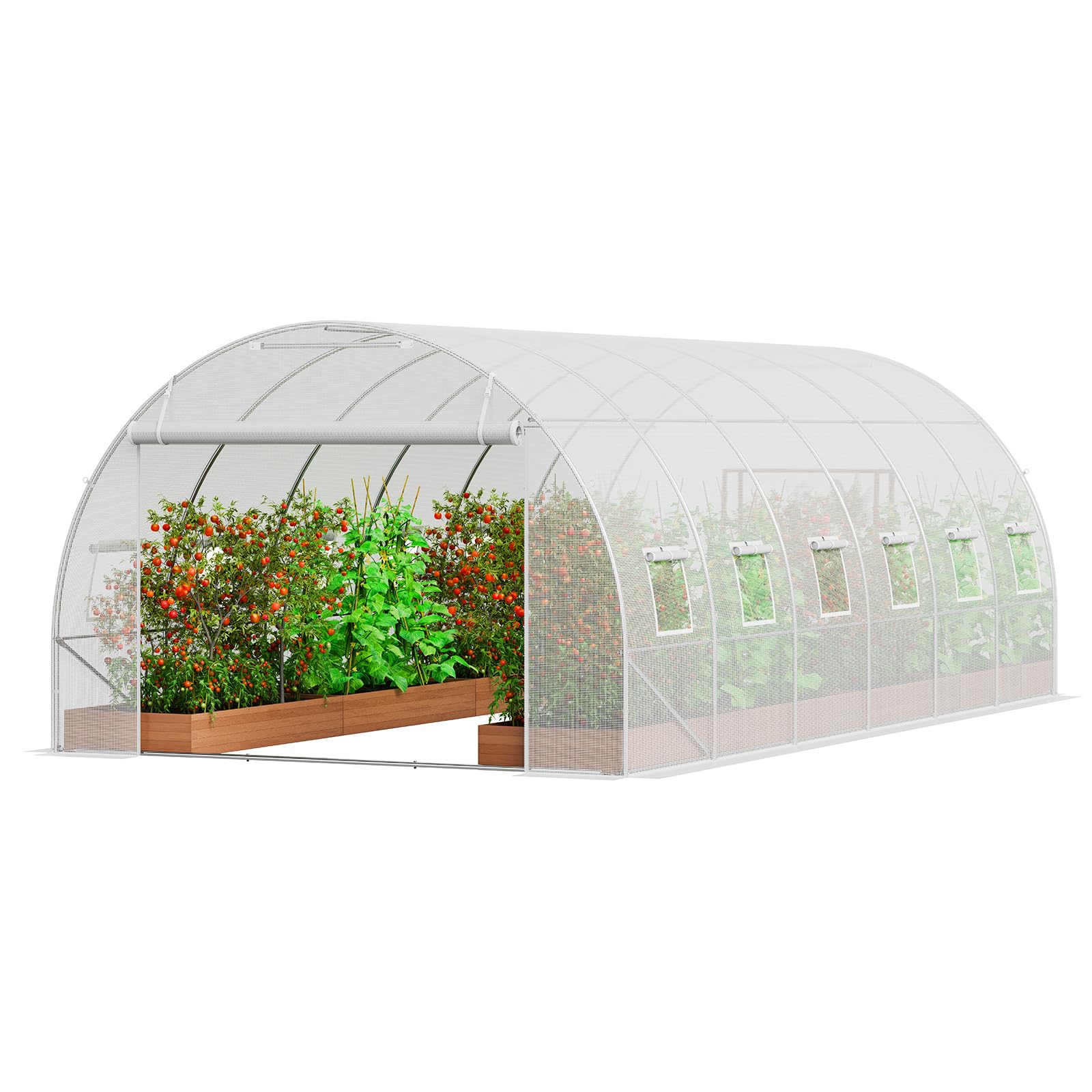
A massive 19.4×9.7 foot hoop house with 12 windows — the cheapest way to cover a lot of ground.
If your priority is covering maximum square footage for the lowest cost, this tunnel-style greenhouse delivers. The dimensions are 236.22 inches long by 118.11 inches wide by 78.74 inches tall, which is 3.6 times longer than the WUKHG compact unit above. The frame uses reinforced galvanized pipes with a 1-inch diameter and 0.02-inch wall thickness, plus diagonal bars, U-shaped stakes, and tie-downs to improve stability. The cover is a 140g/m² high-density PE material that is waterproof and sun-resistant, with double-stitched seams for tear resistance. Ventilation is this kit’s standout spec: it has 12 windows plus a large zipper door, which is 12 times more windows than the WUKHG model. The velcro on doors and windows lets you adjust airflow in sections, and the mesh netting keeps insects out. This makes a real difference on hot afternoons when a solid-panel greenhouse would bake the interior. The tunnel shape also sheds wind better than a flat-roofed box.
The trade-off is that PE cover will not insulate like polycarbonate; it is a single-layer film that extends the season but does not create a true cold-weather barrier. The greenhouse weighs 70.55 pounds, so it moves around in strong wind unless you bury the extended cover edges or weight them down. Buyers have not posted specific reviews for this model, but based on the materials, expect this to work best as a season extender and windbreak rather than a heated winter growing space.
Coverage champion
- Largest growing area of any kit here at 19.4×9.7 feet
- 12 windows for excellent airflow
- Galvanized steel frame resists rust
- Very affordable for the square footage
Film versus panels
- PE cover degrades faster than polycarbonate
- Single-layer film offers minimal cold insulation
- Needs strong anchoring to stay put in wind
Best for ground coverage: You want the most growing space per dollar for seedlings, rows, and temporary season extension.
The catch: It is a film tunnel, not a rigid greenhouse — plan for wind anchoring and replace the cover every couple of seasons.
7. CROWN SHADES 8×6 Walk-in Greenhouse, Pop Up Portable
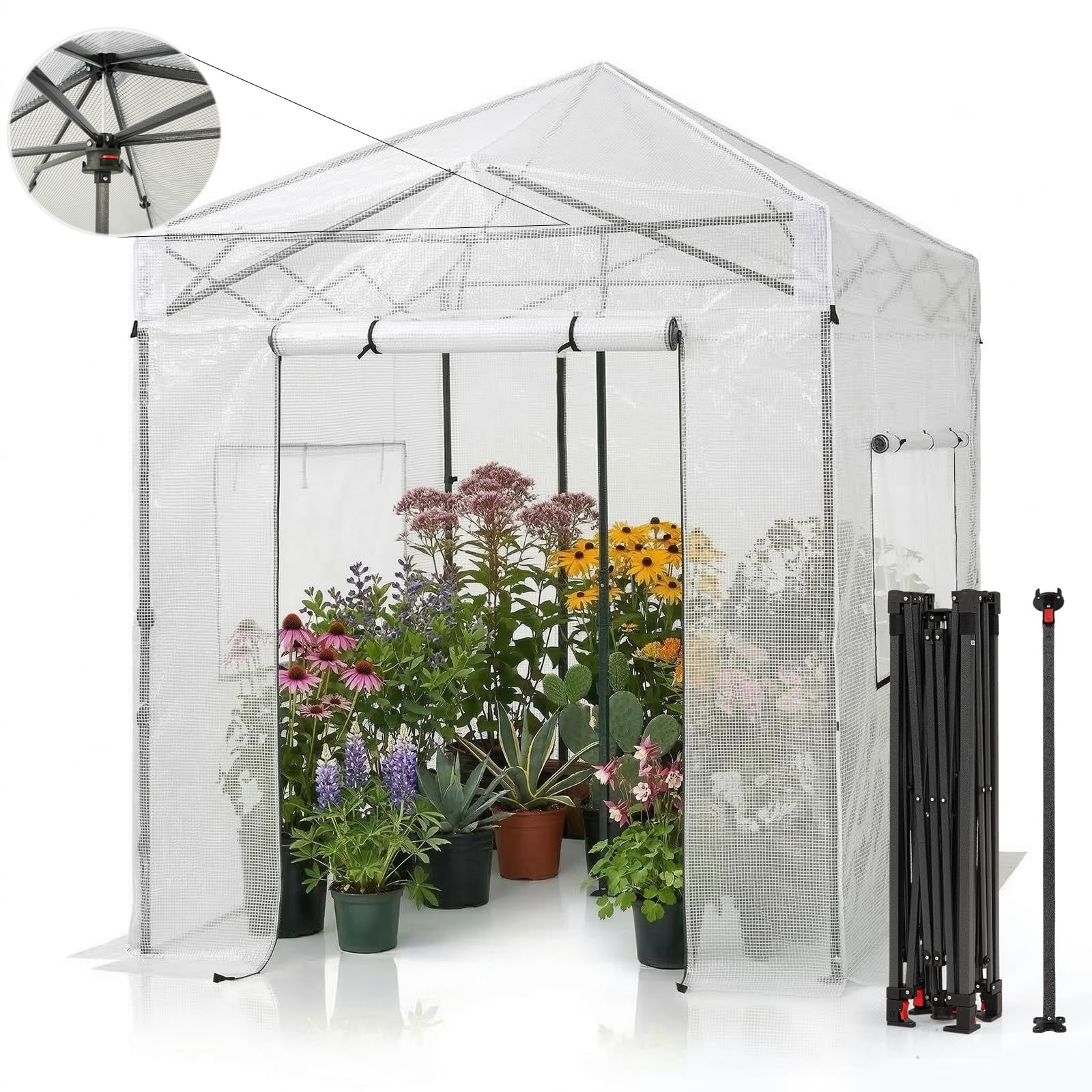
A pop-up greenhouse that goes from bag to standing in seconds with the one-push center lock system.
You get a walk-in shelter instantly because the patented one-push center lock system pops the 8×6 foot structure open without any tools. An internal support pole under the hub improves frame stability compared to basic pop-up designs. The steel frame is reinforced for light outdoor use, and the upgraded anti-aging PE cover protects plants from sunlight, light rain, and dust. You also get 3 adjustable height levels so you can raise the roof as plants grow. Ventilation comes from a roll-up zippered door and mesh windows on both sides — the number of vents is listed as 2 — which helps reduce heat buildup on sunny days. The unit count is 1, meaning it is one assembled tent, not a box of parts. This makes it ideal for renters or anyone who needs a portable greenhouse they can collapse and store between seasons. The PE cover is far less durable than the polycarbonate panels on the first five picks, so do not expect it to survive heavy snow or strong winds without careful anchoring.
Compared to the VEVOR tunnel, this is a fraction of the coverage area, but it sets up in a minute versus an afternoon. Compared to the polycarbonate kits, it is a seasonal shelter rather than a permanent structure. Buyers have not posted specific reviews, but the brand emphasizes this as a lightweight, everyday backyard solution — think of it as a weather-protected plant cover rather than a year-round greenhouse.
Pop-and-go convenience
- Patented one-push setup — no tools, no instructions
- Roll-up zippered door and mesh windows for airflow
- Adjustable height for different plant stages
- Collapsible for off-season storage
Not a permanent house
- PE cover is less durable than polycarbonate
- Needs proper anchoring in mild weather only
- Limited insulation for cold climates
Best for instant gardening: If you want a walk-in shelter that sets up in seconds and stores away between seasons, this is your pick.
skip it if: You need a year-round structure that handles snow, strong winds, and temperatures below freezing.
Understanding the Specs
Frame Material and Build
The frame is the skeleton. Aluminum alloy is lightweight, rust-proof, and the most common choice for mid-range polycarbonate kits. Galvanized steel is stronger but heavier and prone to rust if the coating scratches. Cedar wood offers natural decay resistance and better insulation but adds significant weight — the Backyard Discovery kit weighs 259 kilograms. A frame with diagonal braces and U-shaped stakes handles wind far better than one without them.
Cover Material and Thickness
Polycarbonate (PC) panels are rigid, UV-resistant, and insulate well. Thickness ranges from 4mm to 6mm; thicker panels are more impact-resistant and retain heat better. Polyethylene (PE) covers are cheaper and lighter but degrade in sunlight and tear easily. A 140g/m² PE is heavier than standard film, but still a single layer. For year-round use, look for multi-wall polycarbonate — the Yardenaler uses 6mm multi-layer panels, while the Backyard Discovery uses 4-wall panels that improve heat retention by 30%.
Ventilation and Windows
Hot, stagnant air is the fastest way to kill your plants. Adjustable roof vents let hot air escape naturally, while side windows with mesh netting provide cross-flow and keep insects out. The number of vents matters: the VEVOR tunnel has 12 windows, while the compact WUKHG has only 1. A roll-up or sliding door also helps regulate airflow without sacrificing floor space. Premium kits like the Backyard Discovery include a temperature-activated exhaust fan for forced ventilation.
Assembly and Foundation
Pop-up greenhouses take seconds, but polycarbonate kits can require a full weekend. Look for pre-drilled, pre-cut parts and labeled hardware. The Backyard Discovery pairs with an interactive BILT app for step-by-step guidance. Most rigid kits recommend a flat foundation — concrete, wood, or compacted gravel — and sealing panel gaps with silicone. Anchoring is critical: expansion screws, tie-downs, and burying cover edges all improve wind resistance.
FAQ
What is the difference between polycarbonate and PE greenhouse covers?
How many vents do I need in a walk-in greenhouse?
Can a greenhouse kit survive snow and strong winds?
Do I need a foundation for a polycarbonate greenhouse?
How long does it take to assemble a greenhouse kit?
What size greenhouse do I need for a small backyard?
Can I use a pop-up greenhouse year-round?
What does “unit count” mean in greenhouse specs?
How do I anchor a greenhouse kit to the ground?
Is a wood or aluminum frame better for a greenhouse?
Final Thoughts: The Verdict
For the majority of shoppers, the best rated greenhouse kits winner is the Yardenaler 8×16 because it combines a spacious wooden frame, thick 6mm polycarbonate panels, and adjustable roof vents at a price that undercuts similarly sized premium models. If you want built-in power outlets, a fan, and a cedar frame with a 5-year warranty, grab the Backyard Discovery Willow. And for a budget-friendly season extender that covers the most ground per dollar, the VEVOR tunnel greenhouse with its 12 windows is the flexible option.
How We Picked
We do not accept paid placement. Every pick is matched to a real buyer and a real use-case; we do not hands-on test units.
Sources & Methodology
Specifications: manufacturer listings and product documentation. Review insights: verified customer reviews, as of July 2026. Pricing: not shown on this page (it changes often); check the current price via the retailer link.
As an Amazon Associate, Lawn Gear Lab earns from qualifying purchases. This does not affect which products we feature.