
Specs are compiled from manufacturer listings and verified buyer reviews and can change over time — please confirm the key details on the product page before buying.
If your drip irrigation system is popping emitters off like popcorn, the culprit is almost certainly high incoming water pressure. Drip systems thrive on low, steady pressure — usually between 20 and 30 PSI (pounds per square inch) — while your house supply can easily hit 60 PSI or more. A dedicated pressure regulator turns a frustrating, leaky setup into a reliable one that waters your garden exactly as planned.
I’m Rikta — the founder and writer behind Lawn Gear Lab. This guide is built by comparing the manufacturers’ published specifications and the patterns across verified customer reviews, so you get each pick’s real strengths and trade-offs instead of marketing spin.
A simple inline regulator for a faucet or a combined filter-regulator for a main line — the right pressure regulator for drip irrigation protects your emitters and keeps your plants thriving without constant maintenance.
Quick Picks
- Raindrip PRYF 30 — Best Overall
- NDS PRYF 30 — Best Value Combo
- Heavy Duty 25 psi Brass Regulator — Tough & Sunny
- Raindrip 45100UB — Compact & Simple
- 3-pack Orbit Drip Irrigation Pressure Regulator — Multi-Zone Value
- Rain Bird PRF100RBY 1″ 40 PSI — Large Line Specialist
How To Choose The Best Pressure Regulator For Drip Irrigation
Picking the right regulator depends on matching it to your water source, your tubing size, and whether you also need filtration. The biggest mistake is buying a regulator that handles too much flow or too little pressure, which can starve your drip line or still blow fittings apart.
Match the PSI to your drip components
Most drip tubing and emitters are rated for a maximum of 30 PSI, and many work best around 20 to 25 PSI. If your house pressure is 60+ PSI, a 30 PSI regulator provides a wide safety margin. For systems with many small emitters or soaker hoses, a 25 PSI or 20 PSI regulator is often the better choice to prevent blowouts.
Consider a combo unit if you have dirty water
A pressure-regulating Y filter combines a 200-mesh (a fine stainless steel screen that traps particles as small as 75 microns) regulator and filter in one piece. This saves you a connection and protects emitters from clogging in one step. If your water comes from a well or contains sediment, this is the smarter buy over a standalone regulator.
Check the thread type and size
Most regulators connect with standard 3/4-inch threads, but the gender matters. You will see FHT (female hose thread), MHT (male hose thread), FPT (female pipe thread), and MPT (male pipe thread). Make sure the regulator’s inlet matches your faucet or valve outlet and the outlet matches your tubing adapter.
Plastic vs. brass construction
Plastic regulators are lightweight and inexpensive, but UV rays can make them brittle over years in direct sunlight. Brass regulators cost more but are impervious to sunlight and handle higher inlet pressures — a good upgrade if you are tired of replacing plastic units every few seasons.
Quick Comparison
| Model | Best For | Preset PSI | Filtration | Material | Amazon |
|---|---|---|---|---|---|
| Raindrip PRYF 30 | Best Overall Combo | 30 | 200 mesh | Glass-filled polypropylene | Amazon |
| NDS PRYF 30 | Value Combo | 30 | 200 mesh | ABS / Stainless Steel | Amazon |
| Heavy Duty Brass Regulator | Sunlight Durability | 25 | None | Lead-free brass | Amazon |
| Raindrip 45100UB | Budget Faucet Regulator | 20 | None | ABS Plastic | Amazon |
| 3-pack Orbit Regulator | Multi-Zone Systems | 25 | None | Plastic | Amazon |
| Rain Bird PRF100RBY | Large 1″ Main Lines | 40 | 200 mesh | Mesh / Plastic | Amazon |
In‑Depth Reviews
1. Raindrip PRYF 30

The all-in-one Y filter that pairs regulation with reliable long-term protection.
This unit combines a 200-mesh stainless steel filter with a 30 PSI pressure regulator in a single sturdy body, saving you a connection and speeding up installation. The body and cap are made from glass-filled polypropylene — a hard composite that handles tough outdoor conditions without getting brittle. It is rated to handle up to 150 PSI (the maximum water pressure it can safely withstand before components fail), which gives you a huge safety margin even if your supply fluctuates.
Buyers report installing this unit downstream of Rain Bird valves across 1500 feet of drip line with hundreds of emitters — and the oldest unit is 5 years old with zero maintenance beyond an annual rinse of the micro-mesh screen. The 150 PSI rating means you can install it after a shutoff valve without worrying about damaging the regulator itself.
Unlike the simpler standalone regulators in this list, the PRF07530S does double duty: it filters out sediment and debris (crucial if your water has any particles), then drops the pressure to a safe 30 PSI for your emitters. For most home drip systems, this is the single best upgrade you can make.
What gives it the edge
- Combines 200-mesh filtration and 30 PSI regulation in one piece — fewer joints to leak.
- 150 PSI pressure rating means it shrugs off typical surges.
- Glass-filled polypropylene body resists UV cracking better than standard ABS plastic.
One honest trade-off
- Heavier and bulkier than a standalone plastic regulator at 4.16 ounces and 4.3 x 2.1 x 5.88 inches.
- Overkill if you only need a simple faucet-side regulator and already have a separate filter.
Reach for this if: You are building or upgrading a permanent drip zone and want one component to both filter and regulate — it beats buying two separate parts.
Look elsewhere if: You just need a quick faucet regulator for a small container garden without filtration.
2. NDS PRYF 30

A reliable filter-regulator combo that gives the Rain Bird a run for its money.
Like the Raindrip PRYF 30, this NDS unit combines a 200-mesh stainless steel filter with a 30 PSI preset pressure regulator. It handles a flow range of 0.2 to 5 GPM (gallons per minute — the amount of water it can pass while still effectively regulating pressure), which covers most home drip systems. The Y shape makes the filter cartridge easy to access: remove the flush cap and run water through to clean it, or take the whole middle housing apart.
One reviewer noted they replaced the same product after 5 years when the tubing junction started leaking — a solid run for any plastic irrigation component. The body uses ABS plastic with a stainless steel filter, giving you a lightweight unit at 1.31 x 6.5 x 8.5 inches that is noticeably simpler to install than the Rain Bird.
On paper, this NDS covers the same ground as the Raindrip PRYF 30 — 200 mesh, 30 PSI — but at a slightly lower price point. The trade-off is the ABS plastic body, which is more prone to UV degradation over many years compared to the glass-filled polypropylene of the Rain Bird.
Why it stands out
- Same 200-mesh filtration and 30 PSI regulation as the premium pick, for less.
- Flush cap makes cleaning the filter quick without removing it from the line.
- Owners mention it works great on sprinkler-to-drip conversions.
Where it falls short
- ABS plastic body is less UV-resistant than glass-filled polypropylene in direct sun.
- No 150 PSI rating — its maximum pressure is lower, though adequate for most residential systems.
Grab this for: A cost-effective filter-regulator combo on a budget that still delivers 200-mesh protection and 30 PSI output.
Consider the Rain Bird instead if: Your system lives in full sun and you want maximum long-term UV resistance from a glass-filled body.
3. Heavy Duty 25 psi Brass Regulator
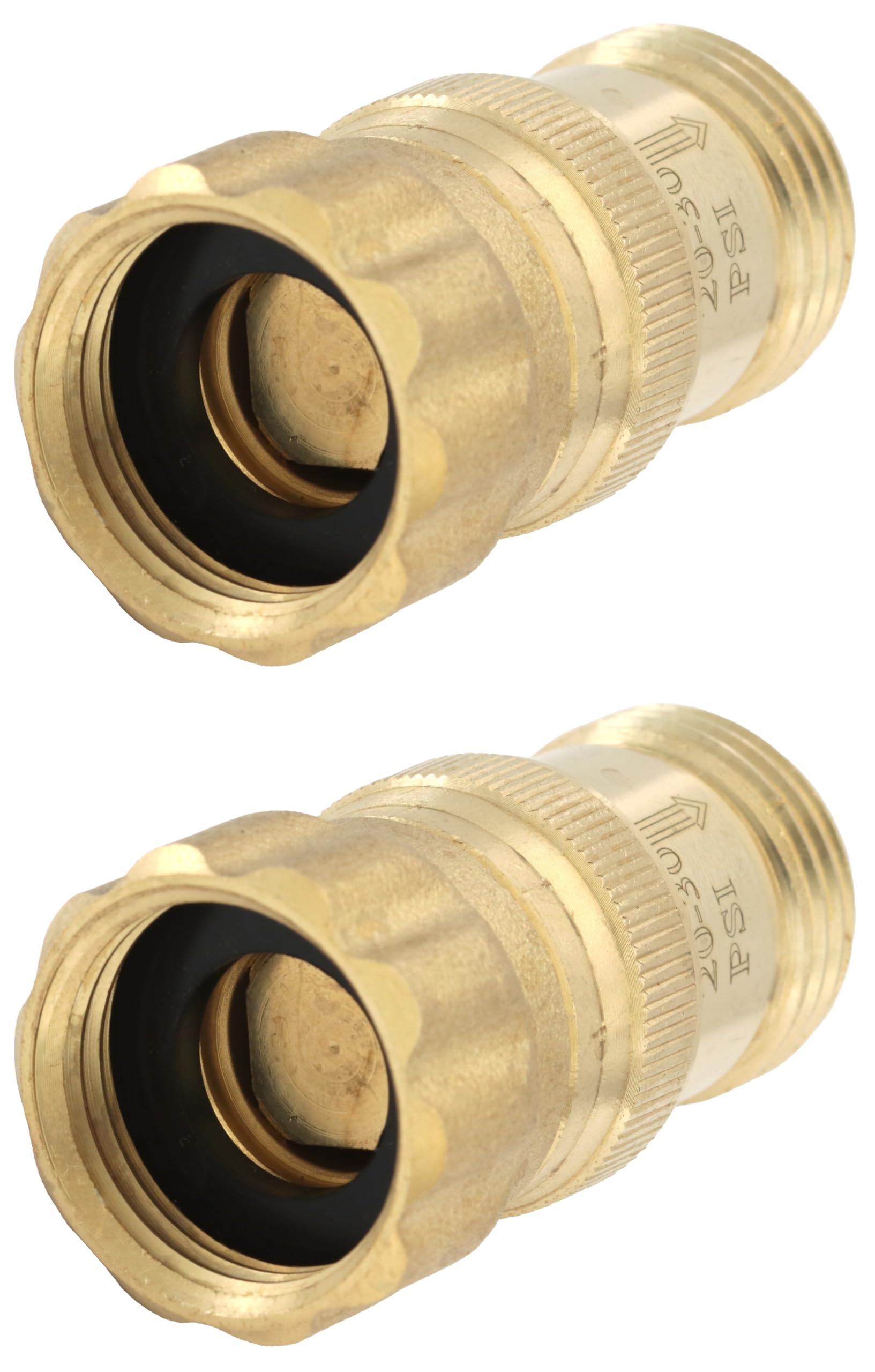
A brass regulator built to sit in full sun and shrug off high inlet pressure.
Where plastic regulators can become brittle and crack after a few seasons in direct sunlight, this regulator from Vibrant Yard Company is made of solid lead-free brass with less than 0.25% lead content. It maintains water pressure at a nominal 25 PSI (it outputs between 20 and 30 PSI) and handles a flow rate of up to 6.8 GPM — more than enough for most residential drip systems. The 3/4-inch FHT (female hose thread) inlet screws directly to a standard hose bib, and the 3/4-inch MHT (male hose thread) outlet connects to your system.
One buyer mentioned that it reduced their house pressure from 60+ PSI to a safe level for soaker hoses rated at a max of 25 PSI, with no leaks from the regulator itself. The maximum inlet pressure is 145 PSI — far beyond what typical plastic regulators can survive. At 0.29 kilograms (about 10.2 ounces), it is heavier than the plastic options, but that weight comes from the durable brass construction.
The catch is the warning about galvanic corrosion: do not connect this brass regulator to garden hoses with aluminum fittings for extended periods, because the dissimilar metals can react.
What makes it tough
- Solid lead-free brass body is impervious to sunlight and handles 145 PSI max inlet pressure.
- Buyers confirm it stops high house pressure (60+ PSI) from damaging soaker hoses.
- Easy to install before a timer or valve with standard 3/4-inch hose threads.
What to watch for
- Do not connect to aluminum hose fittings long-term to avoid galvanic corrosion.
- No integrated filter — you will need a separate inline filter if your water has sediment.
Best bet for: A permanent outdoor installation in direct sun where plastic regulators have failed you before.
skip it if: You need a combined filter and regulator in one unit, or if your setup uses aluminum fittings exclusively.
4. Raindrip 45100UB

A basic 20 PSI regulator that gets the job done at the faucet for small setups.
If you have a simple drip system attached to an outdoor faucet, the Raindrip 45100UB drops the incoming pressure to 20 PSI — the lowest preset in this list. It uses 3/4-inch FPT (female pipe thread) on both ends, so it connects directly to your hose bibb or valve. At 4 ounces and 2.25 x 2.25 x 4.75 inches, it is compact and unobtrusive.
The ABS plastic body has UV inhibitors to resist fading and cracking, but one owner reported that after a month, one of their two units started leaking from the seam between the white and black parts. The other unit continued working fine, which points to some quality variance between units. Raindrip offers a 1-year satisfaction guarantee, so you can get a replacement if yours leaks.
For its 20 PSI output, it is a legitimate option if you are running low-pressure soaker hoses or small emitter lines that cannot handle higher pressure. Just be aware that the plastic construction and occasional quality issues mean it is best treated as an entry-level or temporary solution.
The appeal
- 20 PSI preset is ideal for low-pressure drip tubing and soaker hoses.
- Lightweight and small at 4 ounces — easy to fit in tight spaces.
- Compact 3/4-inch FPT threads connect directly to standard faucets.
Proceed with caution
- A buyer reported a leak at the seam after a month on one of two units purchased.
- Maximum pressure is 20 PSI, versus the 25 PSI Orbit pack — not enough for systems needing higher flow.
Pick this for: A cheap, simple faucet regulator for a very small garden or single container system that runs on 20 PSI.
Step up if: You want a more durable regulator or need 25-30 PSI for larger emitter runs.
5. 3-pack Orbit Drip Irrigation Pressure Regulator

Three regulators for the price of one — a cost-effective way to protect every zone.
If you have multiple drip zones or separate faucets, the 3-pack Orbit regulators let you cover them all at once. Each unit is preset to 25 PSI and designed for above or below ground installation. The 3/4-inch FIPT (female iron pipe thread) connections make for quick, tool-free installation onto standard valves or adapters.
One customer observed that the regulator solved drip system separation issues caused by high water pressure — their connections stopped popping apart after installing it. However, another reviewer flagged that this is not a true regulator with a diaphragm and shutoff valve, but rather a flow restrictor. For basic protection against high pressure, that is often enough, but it will not maintain a steady PSI under varying flow like a diaphragm-based unit would.
At 3 x 1.38 x 1.38 inches each, these are the smallest regulators in the list, making them easy to hide inside a valve box. The trade-off for the low price and compact size is the plastic construction, which is less durable than the composite Rain Bird or the solid brass option.
What sells it
- Three regulators in one pack — covers multiple zones without buying separate units.
- Compact enough to fit in tight valve boxes at 3 x 1.38 inches each.
- Customers note it fixes blowout issues from high pressure in drip systems.
The honest limit
- Not a true diaphragm regulator — it acts as a flow restrictor, not a precision pressure controller.
- Plastic construction is less UV-resistant and may degrade faster in direct sun than brass or glass-filled options.
Ideal for: Budget-conscious gardeners with 2-3 small zones who just need to stop fittings from blowing apart.
Not for you if: You need precise pressure regulation for sensitive emitters, or you want a single, long-lasting unit.
6. Rain Bird PRF100RBY 1″ 40 PSI

A bigger filter-regulator for 1-inch main lines feeding large drip zones.
If your drip system runs off a 1-inch main line, the Rain Bird PRF100RBY steps up the capacity with a 40 PSI preset and a 200-mesh filter screen. The RBY (Rain Bird Y) filter cap has a sealing O-ring and unthreads for easy access to the filter element. One buyer with a well-water system reported that it solved clogged drip lines by filtering out well dirt and providing consistent pressure, saving their plants.
However, not every unit arrives flawless. One buyer received two regulators — one had a plastic plug blow out, causing a leak, while the other worked fine. They missed the return window, so check your unit promptly after installation. At 17 x 7 x 6 inches, this is the largest component in the list, intended for more permanent, larger-scale installations, not quick faucet hookups.
The 40 PSI output is higher than the other regulators here — it is designed for systems that use 1/2-inch or larger drip tubing and need more pressure to push water across long distances. Make sure your emitters and tubing are rated for at least 40 PSI before installing this unit.
The big advantage
- 1-inch connections and 40 PSI output handle large-scale drip systems with long runs.
- Integrated 200-mesh filter protects emitters from sediment and well dirt.
- Reviewers point out it has saved plants by stopping clogs from dirty well water.
Know before you buy
- One user highlighted a defective unit with a blown plug — inspect and test immediately.
- 40 PSI is too high for standard 1/4-inch drip tubing and most drip emitters rated at 30 PSI max.
Choose this if: You have a large drip system on a 1-inch main line with well water and need both filtration and regulation at higher flow.
Avoid it if: Your system uses standard 3/4-inch components or your emitters are rated for 30 PSI or less.
Understanding the Specs
PSI — Pressure per Square Inch
PSI stands for pounds per square inch, and it simply measures how much force the water has when it comes out. Drip irrigation works best at low pressure, typically between 20 and 30 PSI, because it lets the small emitters and tubing operate without bursting. If the pressure is too high, the fittings will pop off. A preset regulator locks the output at a specific PSI, so you get a steady, safe flow every time you turn on the water.
200-mesh filter
Mesh refers to the number of holes per square inch in the filter screen. A 200-mesh filter has 200 openings per square inch, which is fine enough to catch sand, rust flakes, and other tiny particles (down to about 75 microns) that would clog your drip emitters. If your water comes from a well or an older pipe system, a 200-mesh filter is essential. Without it, you will spend your weekends taking apart clogged drip lines.
Y filter vs. standalone regulator
A Y filter combines a pressure regulator and a filter in one Y-shaped body, saving you one threaded connection. This reduces potential leak points and speeds up installation. A standalone regulator has no filter, so you must add a separate filter upstream if you need protection from debris. For most home systems, a Y filter is the cleaner, simpler choice, especially if you have any sediment in your water.
Material: Plastic vs. brass vs. glass-filled polypropylene
Standard plastic (ABS) regulators are cheap and lightweight, but UV rays from the sun can make the plastic brittle and crack within a few years. Brass regulators are heavier, cost more, and are impervious to sunlight — they can easily last a decade or more outdoors. Glass-filled polypropylene is a tough composite that resists UV degradation better than ABS plastic, offering a middle ground between cost and long-term outdoor durability.
FAQ
Can I use a water pressure regulator meant for sprinklers on a drip system?
What happens if I do not use a pressure regulator on my drip system?
How do I know if I need 20 PSI or 30 PSI?
Will a filter-regulator combo replace the need for a separate inline filter?
How long does a plastic pressure regulator last outdoors?
Can I install a pressure regulator below ground?
What is the difference between FHT, MHT, FPT, and MPT threads?
How often should I clean the filter in a Y filter regulator?
Can I daisy-chain two pressure regulators for lower pressure?
Why does my drip system still leak after I installed a regulator?
Final Thoughts: The Verdict
For the majority of shoppers, the pressure regulator for drip irrigation winner is the Raindrip PRYF 30 because it combines reliable 200-mesh filtration with a 30 PSI preset in a durable glass-filled polypropylene body that stands up to years of outdoor use. If your system sees full sun and you want maximum longevity with no UV worries, grab the Heavy Duty Brass 25 PSI Regulator — it is the most sunlight-resistant option here. And for the budget-conscious gardener covering multiple small zones, the standout is the value of the 3-pack Orbit 25 PSI regulators.
How We Picked
We do not accept paid placement. Every pick is matched to a real buyer and a real use-case; we do not hands-on test units.
Sources & Methodology
Specifications: manufacturer listings and product documentation. Review insights: verified customer reviews, as of July 2026. Pricing: not shown on this page (it changes often); check the current price via the retailer link.
As an Amazon Associate, Lawn Gear Lab earns from qualifying purchases. This does not affect which products we feature.