
Specs are compiled from manufacturer listings and verified buyer reviews and can change over time — please confirm the key details on the product page before buying.
Starting your garden from seed is thrilling — until your tiny sprouts flop over and die. That heartbreaking “damping off” hit usually comes from a mix that is too heavy, too wet, or full of synthetic fillers. You need a lightweight, organic blend that holds just enough moisture without suffocating delicate roots. The right bag makes the difference between a tray of green and a tray of mush.
I’m Rikta — the founder and writer behind Lawn Gear Lab. This guide is built by comparing the manufacturers’ published specifications and the patterns across verified customer reviews, so you get each pick’s real strengths and trade-offs instead of marketing spin.
First-timer or seasoned grower, you need a mix that germinates reliably and nurtures strong roots. Here is the honest breakdown of the best organic seed starting mixes that actually work for real gardeners.
Quick Picks
- Espoma Organic Seed Starter Premium Potting Soil Mix — Best Overall
- 1016041RGCE Organic Pro Seed Starting Mix — Top Performer
- Jiffy Natural & Organic Seed Starting Soil Mix — Budget Champion
- Purple Cow Organics Seed Starter — Compact Pick
How To Choose The Best Organic Seed Starting Mix
Picking the wrong bag is easy — many bags look alike on the shelf. But the right organic seed starting mix boils down to a few specific things that control how well your seeds will actually grow. Here is what to look for.
Texture: Fine vs Chunky
A seed starting mix needs a fine, light texture so tiny roots can push through without resistance. Big bark chunks or dense clumps can bury a seed too deep or block moisture. Look for descriptions that mention “fine texture” or “sifted” — and read the reviews to see if buyers mention large chunks you must pick out by hand.
Moisture Retention vs Drainage
Your mix should hold water like a sponge, but not turn into mud. Ingredients like peat moss and vermiculite are what make that happen. Peat moss can soak up to 20 times its weight in water, while vermiculite absorbs 3-4 times its volume — both keep the root zone consistently damp without getting waterlogged.
Nutrient Start: Gentle at First
Seeds contain their own food for the first week or two. After that, they need a light nutrient boost. Some mixes include an organic fertilizer that feeds for up to 3 months, meaning you won’t need to add liquid fertilizer as early. Others rely on compost, which provides a slower, gentler release over roughly 45 days.
Quick Comparison
| Model | Best For | Volume | Weight | Key Ingredient | Amazon |
|---|---|---|---|---|---|
| Espoma Organic Seed Starter | Premium all-around performance | 16 qt (2-pack) | 512.0 Ounce (total) | Sphagnum Peat Moss & Perlite | Amazon |
| 1016041RGCE Organic Pro | Feeds seedlings for months | 16 qt | 6.5 Pounds | Organic Fertilizer | Amazon |
| Jiffy Natural & Organic | Reliable classic for beginners | 10 qt | 320.0 Ounce | Peat Moss & Vermiculite | Amazon |
| Purple Cow Organics Seed Starter | Compost-based for soil blocking | 12 qt | 8 Pounds | Activated Compost | Amazon |
In-Depth Reviews
1. Espoma Organic Seed Starter Premium Potting Soil Mix
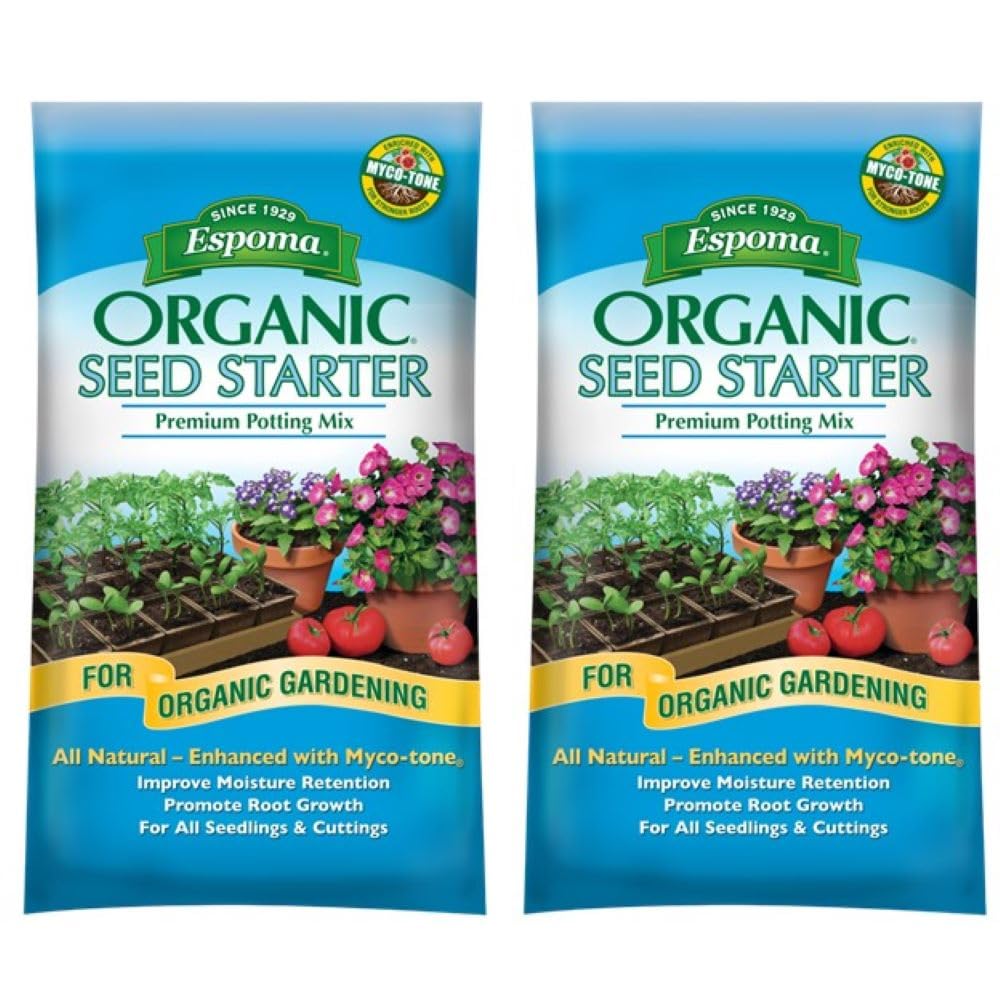
The premium two-bag deal that feeds your seedlings from the first root.
You get two bags totaling 16 quarts — and one reviewer noted that a single bag was “more than enough for the 5 trays” of their Gardzen set. That makes this a great value for anyone starting multiple trays. The blend uses sphagnum peat moss and perlite with yucca extract and lime to keep the pH correct right out of the bag.
The secret weapon here is MYCO-TONE, a blend of endo and ecto mycorrhizae (beneficial fungi that attach to roots and help them absorb water and nutrients). This is the only mix in this guide that includes those microbes, which means your seedlings can build stronger root systems from day one. It is also designed for rooting stem and leaf cuttings — not just seeds.
One note: the texture is described as “light and airy” and “well draining,” so you get good moisture retention without it turning into mud. Unlike the Organic Pro mix which is a bit chunkier, this one feels uniformly fine. That fluffy texture matters for tiny seeds like lettuce or basil.
What it does well
- Includes mycorrhizae for stronger root development
- Two-bag pack covers up to 5 standard trays
- Light, airy texture with good drainage
A couple trade-offs
- Premium price vs single-bag options
- Some buyers may prefer a mix with built-in fertilizer for longer feeding
Reach for this if: You want the biological boost of mycorrhizae for your seedlings and need enough mix to fill multiple trays.
Look elsewhere if: You only need a single bag for a small windowsill start — the Jiffy 10 qt is more cost-effective.
2. 1016041RGCE Organic Pro Seed Starting Mix

The bag that sprouted every single seed — buyers call it magic.
At 16 quarts, this is the same volume as the Espoma (though you only get one bag), but it weighs just 6.5 pounds — meaning it is lighter than the Purple Cow despite holding more volume. That light weight comes from the high peat content mixed with an organic fertilizer that gradually feeds your plants for up to 3 months. You won’t need to add liquid nutrients as early as with compost-only mixes.
Buyers are emphatic about the results. One buyer mentioned: “There was not a seed that didn’t sprout.” Another said it is the “only thing that starts my seeds” and described a simple method — dump half a bag in a 5-gallon bucket, add water, let it sit for 30 minutes, and fill your trays. That gentle rehydration step prevents dry pockets that can kill a germinating seed. It also contains MYCOACTIVE, a stimulant for vigorous growth and greater resistance.
A repeat buyer did note one honest trade-off: “slightly chunky” texture that needs hand-sifting to remove larger pieces. Unlike the Jiffy mix with its consistently fine texture, this one is better for seeds that don’t mind a bit of coarseness — think peas, beans, or squash — but you may want to sift it for tiny seeds like petunias.
Where it shines
- Built-in organic fertilizer feeds for up to 3 months
- Lightweight at 6.5 pounds for a 16-quart bag
- Phenomenal germination rate — buyers report every seed sprouts
What to watch for
- Some buyers find chunks that need sifting
- Denser than the Espoma — requires a 30-minute soak before use
Best for the serious starter: If you are starting a whole garden of perennials and flowering shrubs and want built-in feeding for months.
Not ideal for: Seed starting with the tiniest seeds where a uniform fine texture is critical — the Espoma or Jiffy may work better there.
3. Jiffy Natural & Organic Seed Starting Soil Mix

The classic blend that beginners and pros both swear by.
This is the smallest bag in the guide at 10 quarts, and at 320 ounces it has 60% less volume than the 16-quart bags from Espoma and Organic Pro (which are 512 ounces each). For a casual gardener starting a few trays of tomatoes or peppers, this size is perfect. The mix uses three ingredients: peat moss (which can absorb up to 20 times its weight in water), vermiculite (prevents compaction and holds 3-4 times its volume in water), and lime to balance the pH.
Buyers consistently praise the fine, uniform texture — one reviewer called it “fine texture without bark chunks,” which is important for tiny seeds that need close contact with the soil to germinate. The consensus is strong: “Excellent germination rate, healthy seedlings” and “my seedlings have done very well with this product.” Unlike the Organic Pro mix that has occasional chunks, this one stays consistent bag after bag.
But for many buyers, that is the right amount — you are not stuck with a half-used bag that dries out over the winter. The trade-off is that you may need to buy two if you are filling more than 3 or 4 standard seed trays.
The strong points
- Consistently fine texture with no large bark chunks
- Excellent moisture retention from peat moss and vermiculite
- Proven germination — owners mention fast, healthy seedlings
The downsides
- Smaller bag means less volume per purchase
- No built-in fertilizer — you will need to feed seedlings after 2-3 weeks
Perfect for the small-starter: First-time seed starter or windowsill gardener who wants a reliable, fine-grained mix for a few trays.
skip it if: You are filling a large greenhouse — grab the 16-quart Organic Pro or Espoma instead.
4. Purple Cow Organics Seed Starter

The compost-based mix that soil blockers love.
At 8 pounds for 12 quarts, this is the heaviest bag in the guide — it is 23% heavier than the 16-quart Organic Pro (6.5 pounds) despite having less volume. That weight comes from its base ingredient: Activated Compost, a premium soil amendment with over 20 years of growing success. The compost provides gentle fertility for up to 45 days, so your seedlings get a steady but mild nutrient supply without the risk of burning tender roots.
One owner reported: “A lot of my seeds came up and I didn’t buy expensive seeds,” which shows that the mix performs well even with budget-friendly seed varieties. The compost-based formulation also makes this a standout for soil blocking — one reviewer specifically said it “worked beautifully for making soil blocks” that held together perfectly. Unlike peat-heavy mixes that can fall apart, the compost gives the blocks enough structure to stay intact during transplanting.
A small trade-off: one customer observed it is “a little too compact” but added that “all seeds started” anyway. If you are using standard trays (not blocks), you may want to fluff it up with a bit of perlite or vermiculite to improve aeration. But for the soil-blocking crowd, this is likely the best pick in this guide.
What makes it special
- Compost-based for slower, gentler nutrient release over 45 days
- Excellent for soil blocking — cubes hold together well
- Good germination with even non-expensive seed varieties
What to consider
- Heavier and more compact than peat-based mixes
- May need extra aeration for standard tray use
Reach for it if: You are a soil blocker or want a compost-based mix that feeds seedlings gently for over a month.
Pass if: You prioritize a light, fluffy texture and are filling standard trays — the Jiffy or Espoma will be easier to work with.
Understanding the Specs
Volume vs Weight
The volume (quarts) tells you how much space the mix fills, but the weight tells you how dense it is. A 12-quart bag that weighs 8 pounds (Purple Cow) is much denser than a 16-quart bag that weighs 6.5 pounds (Organic Pro). A lighter, fluffier mix drains better and is easier for tiny roots to push through. A heavier, compost-based mix holds more structure for soil blocking.
Mycorrhizae
These are beneficial fungi (pronounced my-core-rye-zee) that attach to plant roots and help them absorb water and nutrients from the soil. When a mix contains mycorrhizae — like the Espoma’s MYCO-TONE blend — your seedlings can develop stronger root systems and be more resilient against stress. It is a biological boost you do not get from plain peat-vermiculite blends.
Fertilizer vs Compost
Some mixes include a built-in organic fertilizer that releases nutrients over a specific period (like the Organic Pro’s 3-month feed). Others rely on compost, which provides a slower release over roughly 45 days. If you want to avoid mixing liquid fertilizer later, a mix with built-in feeding saves you time. If you prefer a more natural, gentle start, a compost-based mix gives you that steady release.
Peat Moss and Vermiculite
Peat moss is lightweight and can soak up to 20 times its weight in water, giving you excellent moisture retention. Vermiculite is a mineral that prevents soil from compacting and can absorb 3-4 times its volume in water. Together they create a light, airy medium that stays damp without getting waterlogged — exactly what germinating seeds need.
FAQ
Can I use regular potting soil instead of a seed starting mix?
How do I rehydrate a dry seed starting mix?
What is the difference between 10 quarts and 16 quarts for seed starting?
Should I add fertilizer to my seed starting mix?
What does lime do in a seed starting mix?
Can I reuse seed starting mix from last year?
What is soil blocking and which mix is best for it?
Is a mix with chunks fine for big seeds like beans?
Final Thoughts: The Verdict
For most people, the best organic seed starting mix winner is the Espoma Organic Seed Starter because it combines mycorrhizae for root health with a light, airy texture and comes as a two-bag pack that covers multiple trays. If you want built-in fertilizer that feeds for up to 3 months so you can skip liquid feeding, grab the 1016041RGCE Organic Pro. And for soil blockers or anyone who prefers a compost-based mix, the Purple Cow Organics Seed Starter holds blocks beautifully and feeds seedlings gently for 45 days.
How We Picked
We do not accept paid placement. Every pick is matched to a real buyer and a real use-case; we do not hands-on test units.
Sources & Methodology
Specifications: manufacturer listings and product documentation. Review insights: verified customer reviews, as of July 2026. Pricing: not shown on this page (it changes often); check the current price via the retailer link.
As an Amazon Associate, Lawn Gear Lab earns from qualifying purchases. This does not affect which products we feature.