
Specs are compiled from manufacturer listings and verified buyer reviews and can change over time — please confirm the key details on the product page before buying.
Keeping a bonsai alive indoors depends on one thing: enough light. Without it, even the most careful watering and pruning routine cannot stop a tree from stretching thin and losing its compact shape. The right grow light replaces missing sunlight so your miniature tree holds its dense foliage year-round.
I’m Rikta — the founder and writer behind Lawn Gear Lab. This guide is built by comparing the manufacturers’ published specifications and the patterns across verified customer reviews, so you get each pick’s real strengths and trade-offs instead of marketing spin.
Matching the right amount of light to your setup is the single most important decision you will make as a bonsai owner, whether you grow a ficus, juniper, or Chinese elm. The JINHONGTO 54W Tripod delivers the most power per dollar for medium-to-large trees, while the Orchbloom 25W Tabletop solves the small-desk problem without sacrificing brightness.
Quick Picks
- JINHONGTO 54W Tripod Stand Grow Light — Best Overall
- GLOWRIUM 36W Double-Head with Stand — Premium Pick
- GLOWRIUM Dual-Head (Upgraded) 70.9″ — Tall Timber Pick
- FECiDA 25W Floor Lamp Grow Light — Value Champion
- Orchbloom 25W Tabletop Grow Light — Tabletop Ace
- SANSI 20W Dual-Head Clip Light — Clip-On Pick
How To Choose The Best Grow Light For Bonsai
Bonsai trees evolved outdoors under direct sun, so bringing one inside demands a light that comes close to that intensity. Your main choices are wattage (which drives brightness), the timer (which keeps the schedule honest), and the form factor (which determines if the light reaches your tree at the right angle).
Wattage and Brightness — Not All Watts Are Equal
A 20W light and a 54W light deliver very different punch. Higher wattage generally means a higher PPFD (the light intensity your plant actually uses for photosynthesis), so a taller or denser bonsai needs more watts hitting the canopy. If you only have a small tree on a desk, a 20–25W unit often works; a larger or more light-hungry species calls for the top end of the range.
Timer — Consistency Is Everything
Bonsai need a reliable day/night cycle. The best lights offer a built-in timer with settings like 4, 8, 12, 16, or 20 hours that repeat every 24 hours. Look for a model that remembers its schedule even after a power cut, or one that uses simple buttons you can reset quickly.
Stand and Height Adjustment
Tabletop trees do well with clip or small gooseneck lights. Taller specimens — a bonsai on a plant stand or a larger juniper — need a freestanding tripod or floor lamp that adjusts from about 24 inches up to 76 inches so the light covers the whole canopy evenly.
Quick Comparison
| Model | Best For | Wattage | Timer Options | Max Height | Amazon |
|---|---|---|---|---|---|
| JINHONGTO 54W Tripod | High-output coverage | 54W | 4/8/12/16/20H | 64″ | Amazon |
| GLOWRIUM 36W Double-Head | Adjustable height & dimming | 36W | 3/9/12H | 63″ | Amazon |
| GLOWRIUM Dual-Head (Upgraded) | Tall trees & premium design | — | 3/9/12/16H | 70.9″ | Amazon |
| FECiDA 25W Floor Lamp | Tall bonsai & daisy-chain | 25W | 4/8/12/16/20H | 76″ | Amazon |
| Orchbloom 25W Tabletop | Tabletop & small trees | 25W | 4/8/12/16/20H | 24″ | Amazon |
| SANSI 20W Clip | Compact & clip-on setups | 20W | 4/8/12H | Gooseneck | Amazon |
In‑Depth Reviews
1. JINHONGTO 54W Tripod Stand Grow Light
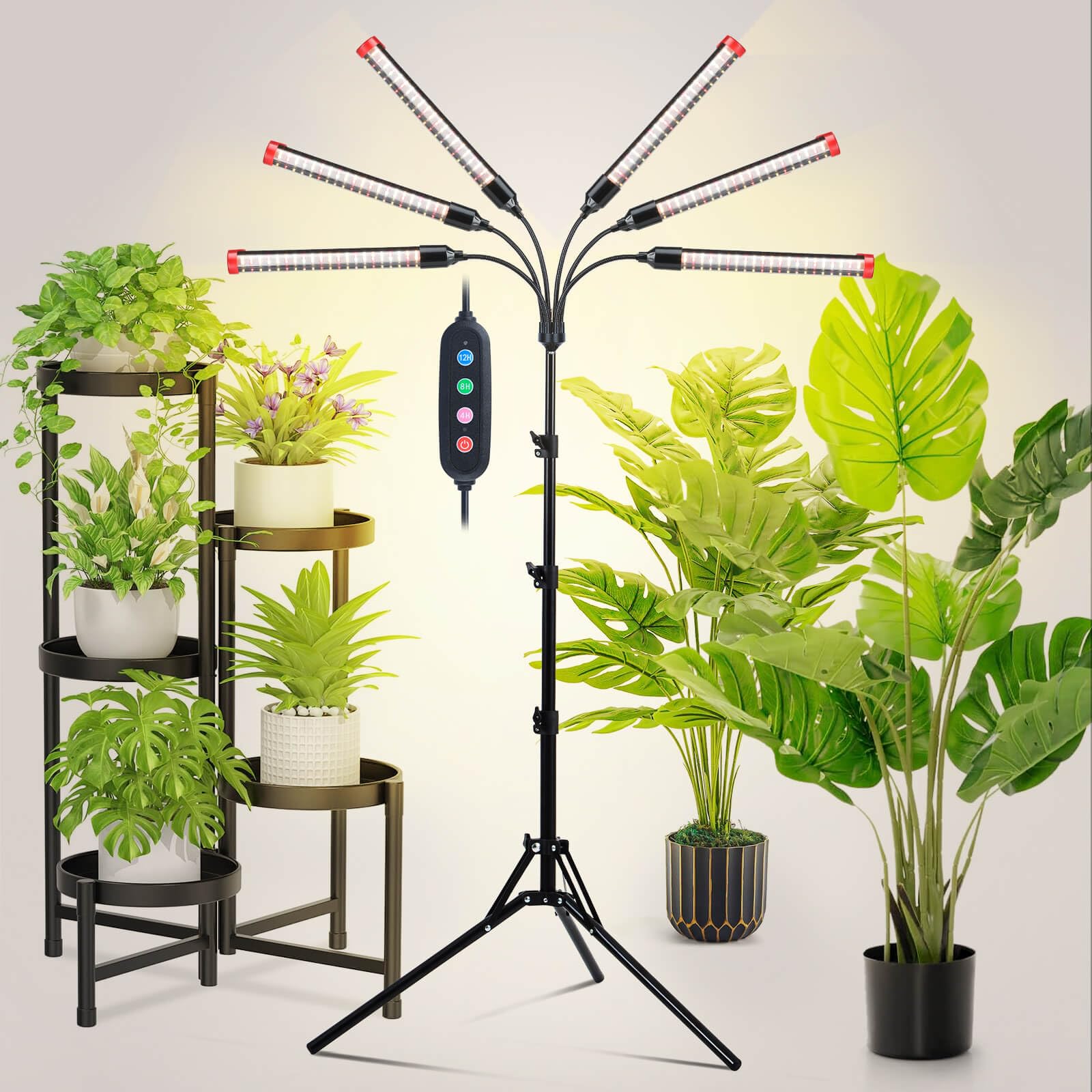
The brute-force light that rescues seedlings and powers dense foliage.
This JINHONGTO delivers 54W of power versus the 20W SANSI clip light, making it the most potent option here for a light-hungry bonsai. Each bar packs 42 high-quality LEDs with 1000 lumens of brightness, so the light penetrates deeper into the canopy than a smaller single-head unit. Buyers report it “saved seedlings during unexpected cold front” and praise the “reliable daily timer, easy setup, plants thriving,” calling it “good value vs. smaller, less adjustable lights.”
The tripod stand adjusts from 24 to 64 inches, and the 360-degree gooseneck heads let you aim the light exactly where your tree needs it. The 60-degree spotlight design keeps the beam focused on the plant rather than spilling across the room. Unlike the Orchbloom tabletop light, this one uses a home plug directly with no adapter required — one less thing to lose.
The built-in timer offers 4, 8, 12, 16, and 20-hour cycles (push 4 and 12 together for 16 hours, or 8 and 12 for 20 hours) so you can run a long winter photoperiod for your juniper without touching it again. One reviewer noted that after three years one of the light heads dislodged slightly from the mainframe, but it did not affect usage — still rated it five stars.
What pulls ahead
- Class-leading 54W output for deep canopy penetration
- Adjustable tripod stand (24″–64″) with gooseneck heads
- 5 timer modes including 16H and 20H combos
- Direct plug-in — no external adapter needed
The trade-offs
- Heavier than tabletop or clip models — less portable
- One buyer mentioned a head loosening after years of use
Reach for it if: you have a medium-to-large bonsai that demands real power — or you are starting seeds and want a light that will also serve a full-grown tree later.
Look elsewhere if: you need a tiny, portable unit for a single desk tree, or your bonsai is small enough that a lower wattage and simpler setup will do.
2. GLOWRIUM 36W Double-Head with Stand
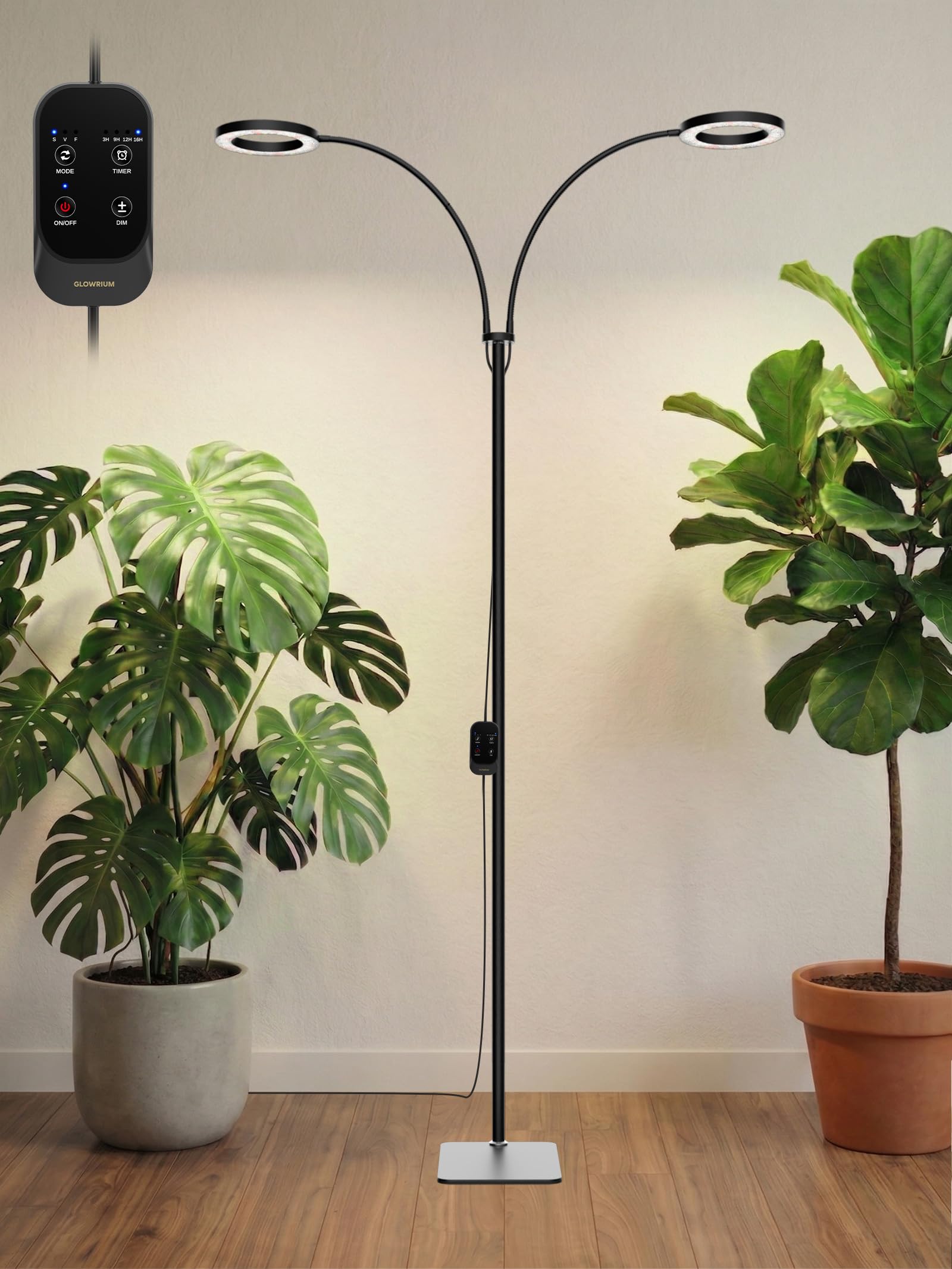
The dimmable design that tailors intensity to your tree’s stage of growth.
GLOWRIUM takes a more nuanced approach than a single-wattage spike. This unit covers the full 380–780 nm spectrum and breaks it into three distinct modes: a warm white for germination (useful if you start bonsai from seed), a white-and-red mix for flowering, and a full-spectrum mode for general growth. The real a neat extra is the 6 dimming levels from 10% to 100%, so you can dial the power back for a delicate ficus or crank it up for a sun-loving juniper. Owners mention “noticed new growth and better color within days” and like the “clean, natural light (not harsh purple),” saying it does not look out of place in a living room.
Height adjusts to 32, 47, or 63 inches via a detachable three-section pole, and the lamp head rotates 360 degrees. The base is heavy and non-slip, which matters when you have a valuable bonsai below — nobody wants a tipped-over light on a tree they have shaped for years. The included 13-foot power cord gives you placement flexibility without needing an extension cable. Compared to the JINHONGTO 54W, this GLOWRIUM trades raw wattage for precision control: you get dimming and mode switching that the JINHONGTO lacks, but you cap out at 36W versus 54W.
The timer runs three cycles (3, 9, or 12 hours), which is simpler than the 5-mode timers on some competition. One reviewer found the picture “deceiving” and wished for clearer wattage specs, though the unit performed well for them. The aluminum lamp head keeps heat dissipation strong, so the light stays cooler than cheaper plastic units through a 12-hour session.
Why it stands out
- 6 dimming levels plus 3 spectrum modes for stage-specific light
- Clean, non-lab design that fits home decor
- Heavy non-slip base with 13-ft power cord
- Adjustable 32″–63″ pole
Know before you buy
- Only 3 timer options (3/9/12H) vs. 5 on some rivals
- Lower max wattage than the 54W tripod option
Ideal for: the bonsai owner who wants fine-grained control over intensity and spectrum, especially if the tree lives in a visible part of the home where a lab-style purple light would look wrong.
Not for you if: you want maximum raw power or a longer timer range — the JINHONGTO or FECiDA give you more hours per day.
3. GLOWRIUM Dual-Head (Upgraded) 70.9″
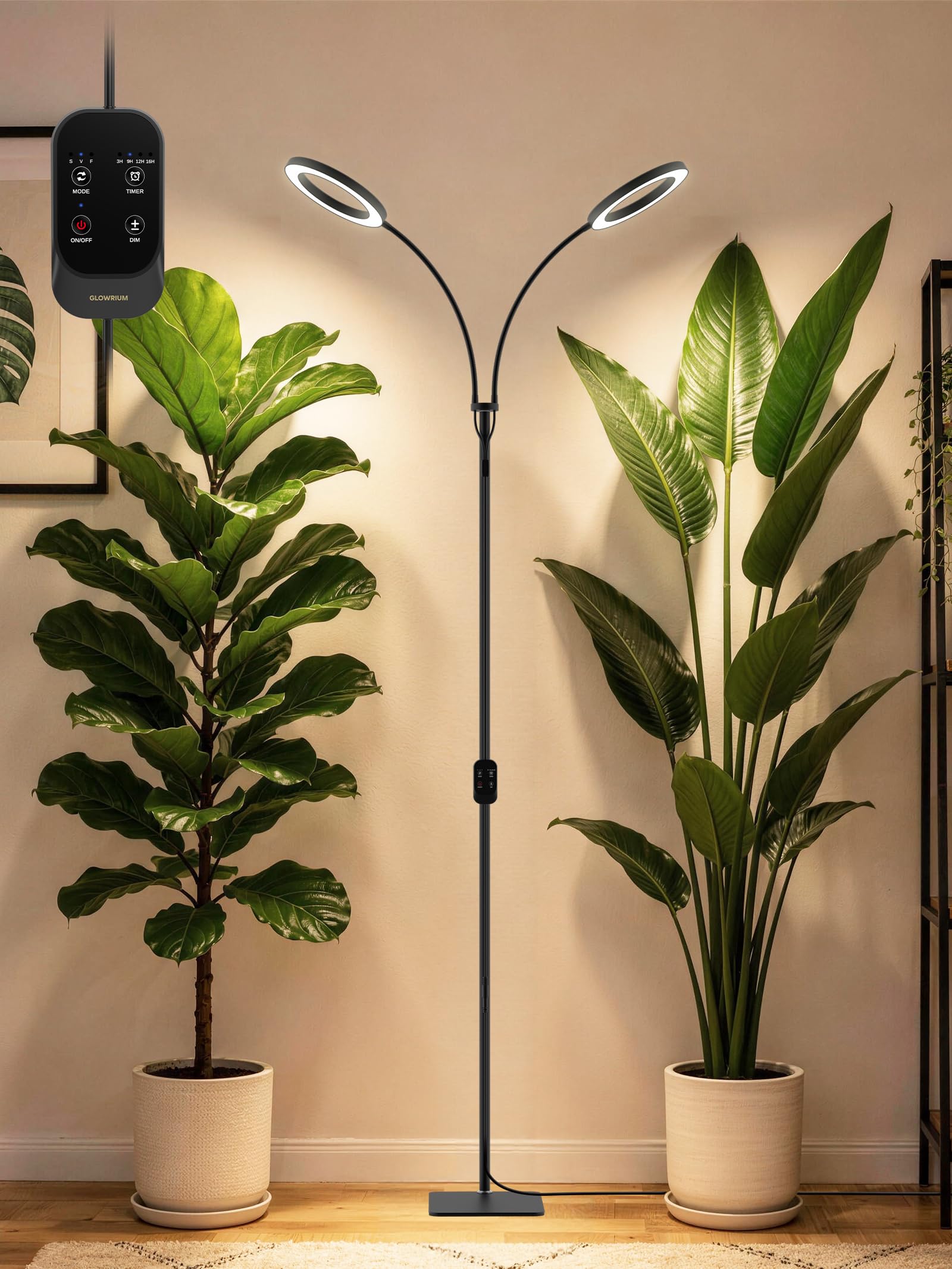
The tallest pole in the lineup, built for specimen bonsai that sit high off the ground.
Where the FECiDA hits 76 inches but at a lower 25W, this GLOWRIUM extends to 70.9 inches with a 4-section pole and an enlarged lamp head that gives wider, even coverage. The goosenecks on each head rotate 360 degrees, so you can aim one bar at the upper canopy and another at the lower branches — a real benefit for a large bonsai with a thick trunk and layered branching. One owner reported their African violets bloomed and they had “fresh cherry tomatoes all winter,” calling it the “best plant grow lights ever.”
The upgraded model adds a 16-hour timer option to the standard 3/9/12 schedule, giving you four automatic cycles total. Stepless dimming means you are not stuck at 10% increments — you can turn a knob from a low glow up to high intensity. The unit runs on a 24V low-voltage system, which keeps the electronics stable and safe for long-term use. A reviewer mentioned that “securing the base with a zip tie” helped stability, and noted the “lights get hot, but not a problem if positioned safely.” The two-year warranty is a solid confidence signal for a premium-priced model.
Compared to the 36W GLOWRIUM, this one gives you taller reach and a broader light spread, plus the extra 16-hour timer. The catch is the same as with any large stand: it takes up more floor space and is not the choice for a tiny windowsill tree.
What makes it special
- 70.9″ max height — highest in this list outside the FECiDA
- Stepless brightness dial plus 4 timer options (3/9/12/16H)
- Enlarged lamp head with 360° goosenecks for wide coverage
- 24V low-voltage system for safe, stable operation
One thing to watch
- Base may need extra weight or a zip tie for full stability with tall, heavy bonsai
- Premium tier cost — more than simpler clip and tabletop units
Grab this for: a tall bonsai on a raised stand, or any situation where you need a light that reaches well above eye level and covers a broad radius.
skip it if: your tree sits low on a desk — the 36W GLOWRIUM or a tabletop unit will do the same job for less.
4. FECiDA 25W Floor Lamp Grow Light
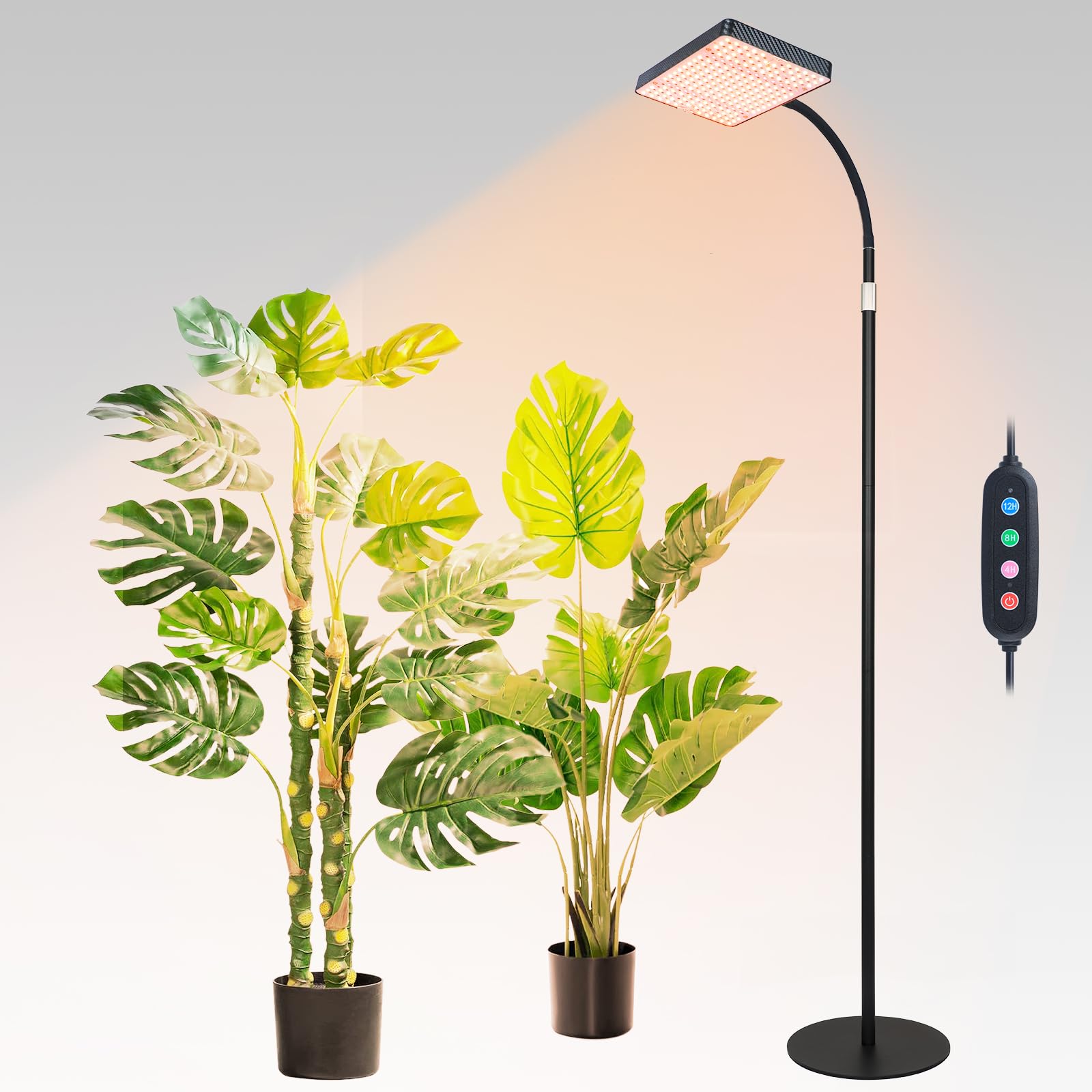
The budget floor lamp that daisy-chains to cover a whole bonsai collection.
FECiDA delivers the tallest adjustable range in the roundup — from 40 to 76 inches — at a mid-range price that undercuts the premium GLOWRIUM models. The 25W draw (2000 lumens, equivalent to a 200W incandescent) is enough for a medium-sized bonsai, but the real differentiator here is the daisy-chain feature: you can connect up to three units together using one wall socket. That makes this the go-to choice if you have multiple bonsai spaced across a shelf or a plant rack and want one cord to manage.
The 208 LEDs emit a full-spectrum white light, and the 4/8/12/16/20-hour timer (same 5-mode system as the JINHONGTO) covers the full photoperiod range. One buyer who owns multiple units noted the aluminum base is stable and the IR touch control on the pole is responsive, though there are no customer reviews in the data to pull a specific anecdote. The 25W rating sits between the 20W SANSI and the 54W JINHONGTO, so it is a middle ground for brightness without the high power draw of the premium units.
Unlike the Orchbloom tabletop light, this one is a floor-standing unit, so it frees up your desk surface. The trade-off at this price point is simpler construction — the FECiDA uses a single pole with a natural finish rather than the multi-section, dimmable design of the GLOWRIUM. If you need dimming or app control, you will need to step up.
Why it earns a spot
- 76″ max height — tallest option in this guide
- Daisy-chain up to 3 units from one outlet
- 5-mode timer (4/8/12/16/20H) for flexible scheduling
- Aluminum base for stability
Where it gives ground
- No dimming or spectrum modes — single full-spectrum setting
- 25W may be underpowered for very light-hungry species
Best for: multiple bonsai on a shelf or rack where you want one cord and enough height to reach the top of a tall tree, all without spending premium money.
Consider other options if: you need adjustable brightness, or your single tree needs more than 25W to stay compact and dense.
5. Orchbloom 25W Tabletop Grow Light
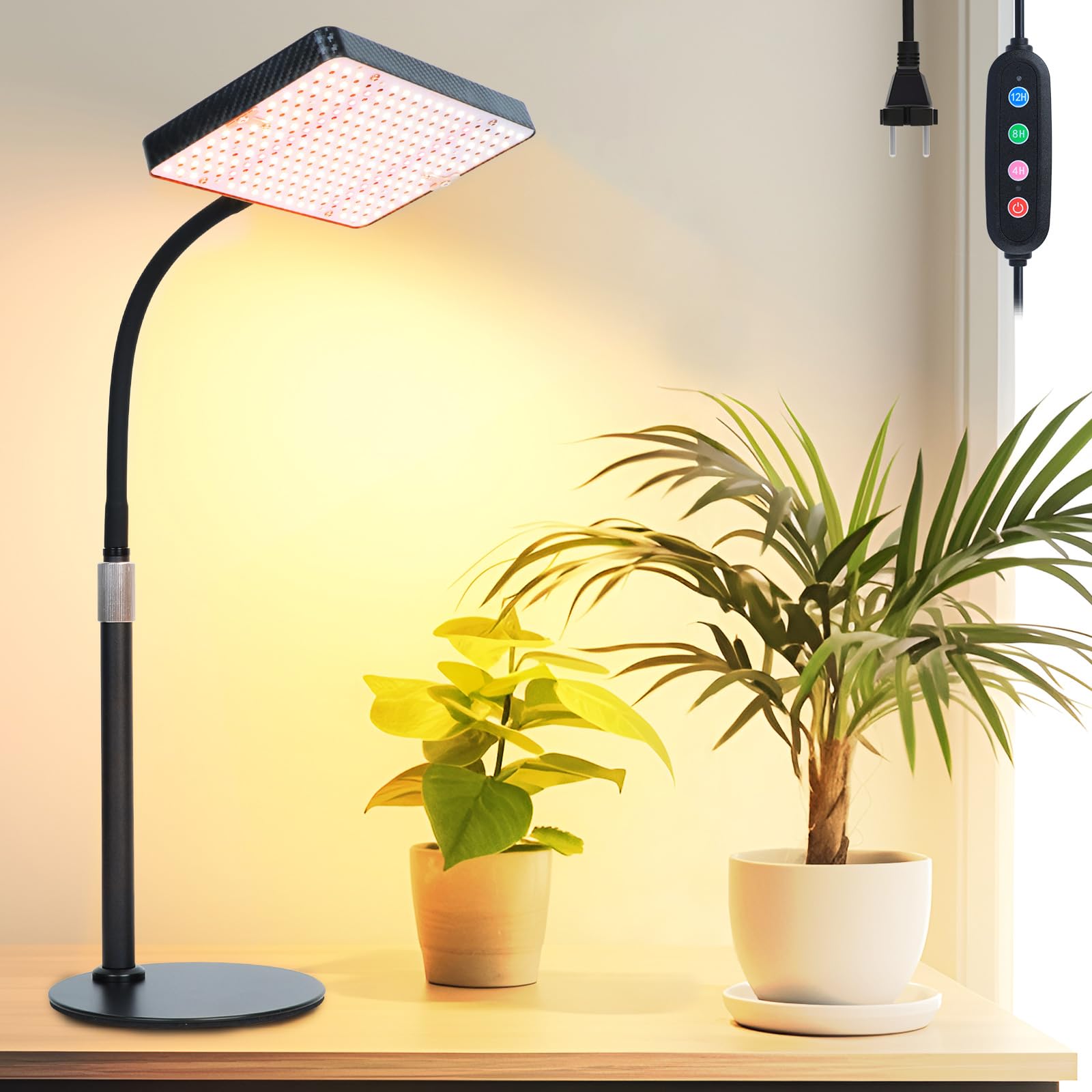
A desk-friendly light that sprouted noticeable growth in days.
If your bonsai lives on a desk, bookshelf, or side table, this Orchbloom light is the compact solution. At just 0.8 inches thick and 8 inches long, it takes very little real estate, and the 2500-lumen output (the highest lumen count of any unit here per watt) punches above the 25W rating. Customers note they “noticed the growth in the plants” after using it for only a short period — one reviewer in a dark apartment said their plants turned around after moving them under this light.
The height adjusts from 16 to 24 inches — a shorter range than the floor-standing models, but appropriate for a tree sitting on a table or plant stand. The gooseneck at the top bends 360 degrees, so you can tilt the light panel to follow the sun’s angle or focus on a specific branch. The 4000K color temperature matches noon daylight, which is kind on your eyes if you work next to the tree. Unlike the SANSI clip light, this one has a stable base that stays put, though one customer observed the plastic casing “cracks easily if tipped over.”
The timer offers 4, 8, 12, 16, and 20-hour cycles — the same full suite as the JINHONGTO and FECiDA — so you get the same scheduling flexibility in a smaller package. At 0.9 kg (about 2 lbs), it is light enough to move between rooms if your tree needs a change of scenery. The catch: the thin plastic build means it is not as durable as the aluminum-framed GLOWRIUM or JINHONGTO, so handle it gently.
High points
- 2500 lumens at 25W — very bright for the wattage
- 5 timer modes (4/8/12/16/20H) in a compact frame
- Adjustable 16″–24″ height with 360° gooseneck
- 4000K natural daylight color, easy on the eyes
Low points
- Plastic casing reported to crack if tipped over
- Only 24″ max height — not for tall bonsai
Choose this if: you keep a single small-to-medium bonsai on a desk or shelf and want a bright, adjustable light that fits neatly into your workspace.
Pass on it if: your bonsai is taller than 24 inches, or you expect the light to take accidental knocks regularly.
6. SANSI 20W Dual-Head Clip Light

The two-headed clip that stays out of the way and shines bright.
When you have no floor space and no desk to spare, the SANSI clip light hooks onto a shelf edge, a grow tent frame, or the lip of a bookshelf. Each of the two heads consumes 10W (20W total, equivalent to a 300W traditional bulb) and produces 2000 lumens of bright white light across the 380–800 nm range — essentially full-spectrum sunlight in a mini package. Buyers describe it as “very bright, effective for dark rooms,” and note the “strong clips, effective timer, sturdy, goosenecks hold shape.”
The timer runs 4, 8, or 12-hour cycles — fewer options than the 5-mode timers on other picks, but still enough for a standard daylight schedule. SANSI includes a lifetime free bulb replacement policy, which is rare at this price point, and the bulbs are E26-base, so you could theoretically swap them with other PAR20 bulbs if needed. The unit weighs 1.76 pounds and uses aluminum construction for heat dissipation. Reviewers warn that all four lights must be used together if you are bypassing the built-in timer, and the “clips [are] weak for [the] light weight” — meaning the clip itself is strong, but the gooseneck’s hold on the heavy bulb can sag over time.
The 20W total is the lowest wattage here, so this is best for a small to medium bonsai placed close to the light. Compared to the JINHONGTO’s 54W, the SANSI covers about a third of the photosynthetic power — but for a single shohin-sized tree sitting 6 to 8 inches from the bulb, it can be enough. One reviewer kept “outdoor plants alive in a dark garage” with it, and another ran it a full year with no problems.
What clicks
- Lifetime free bulb replacement — no full unit repurchase needed
- Dual gooseneck heads for flexible aiming
- 2000 lumens from 20W — energy efficient
- Compact clip design for tight spaces
Watch for
- 20W is the lowest wattage here — less intensity for bigger trees
- Necks sag under bulb weight over time, per some reviews
- Timer resets after power cut — no memory
Reach for this when: your bonsai is small (a shohin-sized tree under 8 inches), you have zero surface space, and you need a clip that tucks onto a shelf edge.
Look for more power if: your bonsai is larger or needs strong overhead light — the 54W JINHONGTO or the 36W GLOWRIUM deliver more punch.
Understanding the Specs
Wattage vs. Brightness
The wattage number (20W, 25W, 36W, 54W) tells you how much power the light draws, not directly how bright it is, but in LED grow lights it is a reliable proxy for intensity at a given efficiency level. A 54W light draws more power than a 20W unit, meaning deeper canopy penetration for a taller bonsai. Lumen output (like 2000 or 2500) gives you a more direct brightness metric — the Orchbloom 25W produces 2500 lumens, which is the highest lumen-per-watt ratio here.
Timer Autonomy
A built-in timer that auto-repeats a 24-hour cycle is the difference between a light you can ignore and a light you have to turn on and off every day. The 4/8/12/16/20-hour timers on the JINHONGTO, FECiDA, and Orchbloom give you the widest scheduling range. The SANSI and GLOWRIUM 36W offer shorter cycles (4/8/12 and 3/9/12 respectively). For bonsai, a 12–16 hour photoperiod during active growing season and 8–10 hours in winter is typical — so a 16-hour or 20-hour option gives you room to adjust.
FAQ
Can I use a regular LED bulb as a grow light for bonsai?
How far should the grow light be from my bonsai?
What is the difference between full spectrum and blurple (red/blue) lights?
How many hours a day should my bonsai light run?
Will a 20W light be enough for my bonsai?
Do these lights produce heat that could damage my tree?
Can I connect multiple grow lights together?
What is a PAR and PPFD and why does it matter for bonsai?
Will a grow light with a timer increase my electricity bill significantly?
Which light is best for a tall bonsai on a floor stand?
Final Thoughts: The Verdict
For most people, the grow light for bonsai winner is the JINHONGTO 54W Tripod because its 54W output outperforms every other light here, the adjustable tripod fits most tree sizes, and the 5-mode timer gives you full scheduling flexibility. If you want a dimmable, decor-friendly unit with spectrum control, grab the GLOWRIUM 36W Double-Head. And for a compact desk-sized tree where a small footprint matters, the Orchbloom 25W Tabletop delivers bright light in a tidy package.
How We Picked
We do not accept paid placement. Every pick is matched to a real buyer and a real use-case; we do not hands-on test units.
Sources & Methodology
Specifications: manufacturer listings and product documentation. Review insights: verified customer reviews, as of July 2026. Pricing: not shown on this page (it changes often); check the current price via the retailer link.
As an Amazon Associate, Lawn Gear Lab earns from qualifying purchases. This does not affect which products we feature.