
Specs are compiled from manufacturer listings and verified buyer reviews and can change over time — please confirm the key details on the product page before buying.
If your lawn feels spongy underfoot, water pools instead of soaking in, and grass looks thin no matter what you feed it, the soil beneath is likely compacted — and the only real fix is a core aerator that pulls actual plugs of soil out, not just pokes holes. A spike aerator pushes soil aside and can actually make compaction worse, while a true core (plug) aerator removes a solid slug of dirt so air, water, and nutrients can finally reach the root zone where they matter most.
I’m Rikta — the founder and writer behind Lawn Gear Lab. This guide is built by comparing the manufacturers’ published specifications and the patterns across verified customer reviews, so you get each pick’s real strengths and trade-offs instead of marketing spin.
Below, you’ll find six of the best options money can buy, from manual walk-behind tools to heavy-duty tow-behind rigs, all designed to punch through tough soil and pull clean plugs. We have compared each model head-to-head so you can confidently choose the core aerator that fits your yard size, soil type, and budget.
Quick Picks
- Step ‘N Tilt Core Lawn Aerator Version 4 — Best Overall
- Brinly Tow Behind Plug Aerator — Terrific Value
- Craftsman 40 Inch Tow Behind Plug Aerator — Premium Pick
- Suchtale 40-Inch Tow Behind Plug Aerator — Best for Tough Clay
- Agri-Fab 45-0474 SmartLink Plug Aerator — Smart-Value Tow
- Lawn Aerator Tool (Xuperace) — Budget Champion
How To Choose The Best Core Aerator
Choosing the right core aerator depends on the size of your lawn, the type of soil you have, and how much time and physical effort you are willing to put in. Manual core aerators are great for small to medium yards where you want precision and low cost, while tow-behind models can cover an acre or more in a single afternoon from the seat of your lawn tractor.
Manual vs. Tow-Behind
A manual walk-behind core aerator (like the Step ‘N Tilt or the basic hollow-tine tool) relies on your body weight to push the tines into the ground. These are ideal for yards under roughly a quarter acre and for operators who don’t mind a bit of physical work. Tow-behind models attach to a riding lawn mower, ATV, or garden tractor — they use the machine’s pulling power and added weight (via a weight tray) to drive the tines deep. Tow-behind units are the right choice for a half-acre lawn or larger, especially if the soil is hard or clay-heavy.
Core Depth and Plug Diameter
Look for a core aerator that pulls plugs at least 2 to 3 inches deep. Deeper plugs mean more relief for compacted soil and better conditions for root growth. The plug diameter (how wide the hole is) usually ranges from about 0.5 to 0.79 inches. Wider plugs remove more soil, but the trade-off is that the tines require more force to sink in. For heavy clay, a slightly narrower plug with sharpened edges (like those on the Brinly model) can penetrate more easily.
Weight Tray Capacity
If you have heavy or clay soil, a weight tray is a standout. Tow-behind aerators with a weight tray allow you to add concrete blocks, sandbags, or water containers to drive the tines deeper. Look for a weight capacity that matches your soil conditions — models range from about 125 lbs to 150 lbs of added ballast. More weight almost always means better penetration in tough ground.
Number and Durability of Tines
Most tow-behind aerators come with 24 tines (sometimes called coring plugs or knives) arranged across a 40-inch width. That width is standard because it covers a good swath behind a lawn tractor while still being maneuverable around trees and flower beds. Check that the tines are heat-treated or galvanized steel — they resist rust and stay sharp longer. Some premium models feature independently rotating tine sections that minimize turf damage when you turn.
Quick Comparison
| Model | Best For | Core Depth | Weight | Number of Tines | Amazon |
|---|---|---|---|---|---|
| Step ‘N Tilt Core Lawn Aerator V4 | Small to medium yards, low physical effort | 3.4 inches | 21 lbs | 2 to 4 (adjustable) | Amazon |
| Lawn Aerator Tool (Xuperace) | Budget-conscious, smaller areas | — | 5.69 lbs | 3 (removable) | Amazon |
| Agri-Fab 45-0474 SmartLink Plug Aerator | Tow-behind entry point, medium lawns | 3 inches | 29 lbs | 24 | Amazon |
| Suchtale 40-Inch Tow Behind Plug Aerator | Heavy clay soil, large yards, high value | 2 inches | 55 lbs | 24 | Amazon |
| Craftsman 40 Inch Tow Behind Plug Aerator | Hard/rocky soil, premium build | 3 inches | 78.8 lbs | 24 | Amazon |
| Brinly Tow Behind Plug Aerator | Maximum penetration, premium US-made construction | 3 inches | 63.9 lbs | 24 | Amazon |
In‑Depth Reviews
1. Step ‘N Tilt Core Lawn Aerator Version 4

The manual aerator that tilts instead of stomps, saving your back while pulling deep plugs.
Instead of forcing you to jump on a crossbar, the Step ‘N Tilt uses a patented tilting motion that is easier on your shoulders and back. You simply step onto the larger platform surface and tilt the handles forward — the tines sink in with your body weight. It creates 3.4-inch deep, 0.79-inch diameter holes, which is deeper than many tow-behind models that top out at 3 inches. One reviewer noted they “aerated front yard in one hour,” which shows how fast the tilting motion can be once you find your rhythm.
The design includes an adjustable tine setup: start with one set (two tines) if you weigh under 150 lbs, and add a second set for more aggressive aeration once you have the hang of it. The tines are case-hardened for extra durability, and you can sharpen or replace them when they wear. Buyers report it feels “high quality, not typical Chinese manufacture,” and it works on heavy clay soil as long as the ground is moist but not soaking wet. An optional soil core container clips on to collect plugs for filling ruts.
When you compare it to the lightweight Lawn Aerator Tool (Xuperace) at 5.69 lbs, the Step ‘N Tilt is a much more substantial 21 lbs, which gives it the heft to penetrate tougher ground without bouncing. This is the best choice for anyone with a small to medium lawn who wants real core depth without hiring a machine or spending on a tow-behind rig.
Walk-behind core model: Buyers consistently call it the “best manual aerator hands down,” praising its sturdy build and low fatigue during extended use.
Heavy manual push: Manual aeration still takes effort on a large yard — this is not a set-and-forget tool for an acre-plus lawn.
2. Brinly Tow Behind Plug Aerator

A US-made tow-behind built to punch through clay with sharpened spoons and a massive weight tray.
The Brinly PA-403BH-A3 is a serious piece of equipment for large lawns. It uses 24 heat-treated, 16-gauge steel plugging spoons that are narrower and sharpened at the ends, which owners mention allows easier penetration and requires less added weight than competing designs. The aerator can pull up to 3-inch plugs of soil, and its fully-enclosed weight tray holds up to 150 pounds of any type of ballast (concrete blocks, sandbags, water containers) for maximum penetration in hard ground.
One of the standout features is its three independently rotating tine sections. This design minimizes turf damage when you make turns, and it helps each tine section follow the contours of uneven ground for more consistent plug depth. The 10-inch semi-pneumatic rubber tread tires and a single transport lever let you lift the tines clear when crossing driveways or walks. One buyer mentioned they “aerated 0.5 acre with riding mower” and pulled “2-3 inch plugs” after adding two concrete blocks for weight.
Assembly runs about 1 to 2.5 hours depending on your familiarity with tools — some owners found the multi-size instruction sheet confusing, but the included extra parts and helpful customer support smooth things out. At 63.9 lbs, it is noticeably heavier than the Suchtale (55 lbs), which gives it more inherent downforce before you even load the tray. This is the pick for homeowners who want a premium US-made aerator that will last years and handle tough clay soil with minimal fuss.
Tow-behind plug design: Customers note it works “like a champ” and is a “great purchase” for improving poor lawns, with some noting assembly is straightforward for a handy person.
Needs large lawn: At 63.9 lbs and 37 x 51 x 28 inches, storage space and maneuvering in tight spaces require planning.
3. Craftsman 40 Inch Tow Behind Plug Aerator

Heavy-duty construction and deep 3-inch plugs make this the choice for rock-hard soil.
Built by Agri-Fab in Sullivan, IL, the Craftsman CMXGZBF7124213 combines premium materials with a design that prioritizes raw aeration power. Its 24 galvanized steel coring points pull plugs up to 3 inches deep, and the wide weight tray supports 140 pounds of ballast to drive those tines into compacted or rocky soil. Unlike the Suchtale’s 2-inch depth, the Craftsman consistently reaches 3 inches, which gives roots significantly more room to expand.
The lift handle release system makes it easy to raise and lower the tine bank without dismounting, and the flat-free tires mean you never have to worry about a puncture mid-job. Reviewers point out that it tows well on steep hills and “punches soil well” even in hard conditions. One reviewer who aerated 1.5 acres with it said it “pierces hard/rocky soil” easily while a previous cheaper model broke. Assembly is a project — buyers mention 1.5 to 3 hours — but the clear instructions and quality parts make the process straightforward.
When you compare it to the Brinly (63.9 lbs), the Craftsman is heavier at 78.8 lbs, which gives it more natural penetrating weight before you load the tray. That extra heft, combined with the 3-inch coring depth and flat-free tires, makes this a top-tier option for anyone with a larger property who wants a tow-behind that feels built to last a decade.
Wide 40-inch coverage: Buyers call it “heavy duty, well made parts” and note it is a “great product” that delivers excellent results despite a time-consuming assembly.
Heavy steel frame: Assembly can take up to three hours, and the 50-inch length requires a decent storage area.
4. Suchtale 40-Inch Tow Behind Plug Aerator

A burly 55-pound tow-behind with reinforced steel that stands up to heavy clay while staying affordable.
The Suchtale LTA-005A is designed for the homeowner who faces tough clay soil and wants a tow-behind aerator that won’t bend or break. It features 24 heat-treated plugs that penetrate compacted soil up to 2 inches deep, and its all-steel weight tray can hold up to 125 pounds of extra ballast. The company uses a 6 mm thick adjust handle — thicker than the usual 4 mm — to prevent bending under load, and the entire frame is made from high-quality alloy steel with a reinforced side plate and solid steel axle.
Buyers praise its size and sturdiness. One owner reported it is “wider and heavier than cheaper models” and works “excellent on NC clay soil.” The 2-piece steel draw bar with a universal hitch pin connects easily to lawn tractors and ATVs. The structure of the wheel with bearings gives it a greater load-bearing capacity, and the transport handle lets you raise the tines when crossing driveways without dismounting. Assembly takes about 1 to 2 hours solo, and the instructions are printed clearly with large diagrams.
A comparison point: the Suchtale weighs 55 pounds, which is notably heavier than the Agri-Fab SmartLink (29 lbs), giving it more inherent penetrating force without needing to load the weight tray. If you have clay soil and a mid-sized lawn, this is the value-packed option that delivers real performance without jumping to the premium price tier.
Budget-friendly option: Shoppers say it is “perfect size even for big yards” and works great for plugging, seeding, and light dethatching, with grass sprouting in as little as four days.
Plastic tines wear: A few buyers report missing bolts in the package, and the 44 x 16 x 3.9 inch dimensions make it less maneuverable on hills compared to more compact models.
5. Agri-Fab 45-0474 SmartLink Plug Aerator

A lightweight, rust-proof 24-knife tow-behind that is the easiest entry into power-assisted aeration.
The Agri-Fab 45-0474 is the most straightforward tow-behind aerator on this list. At just 29 pounds (far lighter than the 55-78 lb range of other tow-behinds), it is easy to handle during assembly and storage. Its 24 rustproof aerator knives loosen 3-inch soil plugs — the same depth as the premium Craftsman and Brinly models — so you do not sacrifice performance for the lower weight. Owners mention “easy 30-min assembly” and a “sturdy build” that pulls clean plugs even across a 3-acre property.
The SmartLink system means this unit attaches to any SmartLink-compatible platform or can be adapted to many off-brand hitches with minor modifications. The knives are sharp and made from metal that resists corrosion, so you can store it outdoors without worrying about rust. One customer observed it works well on dry soil with the spike aerator function (penetrating 2+ inches), and the dethatcher attachment removed 10 bags of thatch. The 3-year limited warranty adds confidence for a mid-range investment.
Where the Agri-Fab falls short is weight. At 29 lbs, it does not have the natural penetrating force of the Suchtale (55 lbs) or the Craftsman (78.8 lbs), so you will need to tow it over moist ground to get the best plugs. For homeowners with decent soil and a small-to-medium lawn who want to move up from a manual tool without jumping to a 55+ lb machine, this is a smart stepping stone.
SmartLink quick attach: Buyers describe it as “solid metal throughout” and say it is a “easy!” solution that fits off-brand platforms with minor work.
Higher price point: The packaging often arrives damaged, and the lightweight frame requires good soil moisture to penetrate deeply without extra weight.
6. Lawn Aerator Tool (Xuperace)
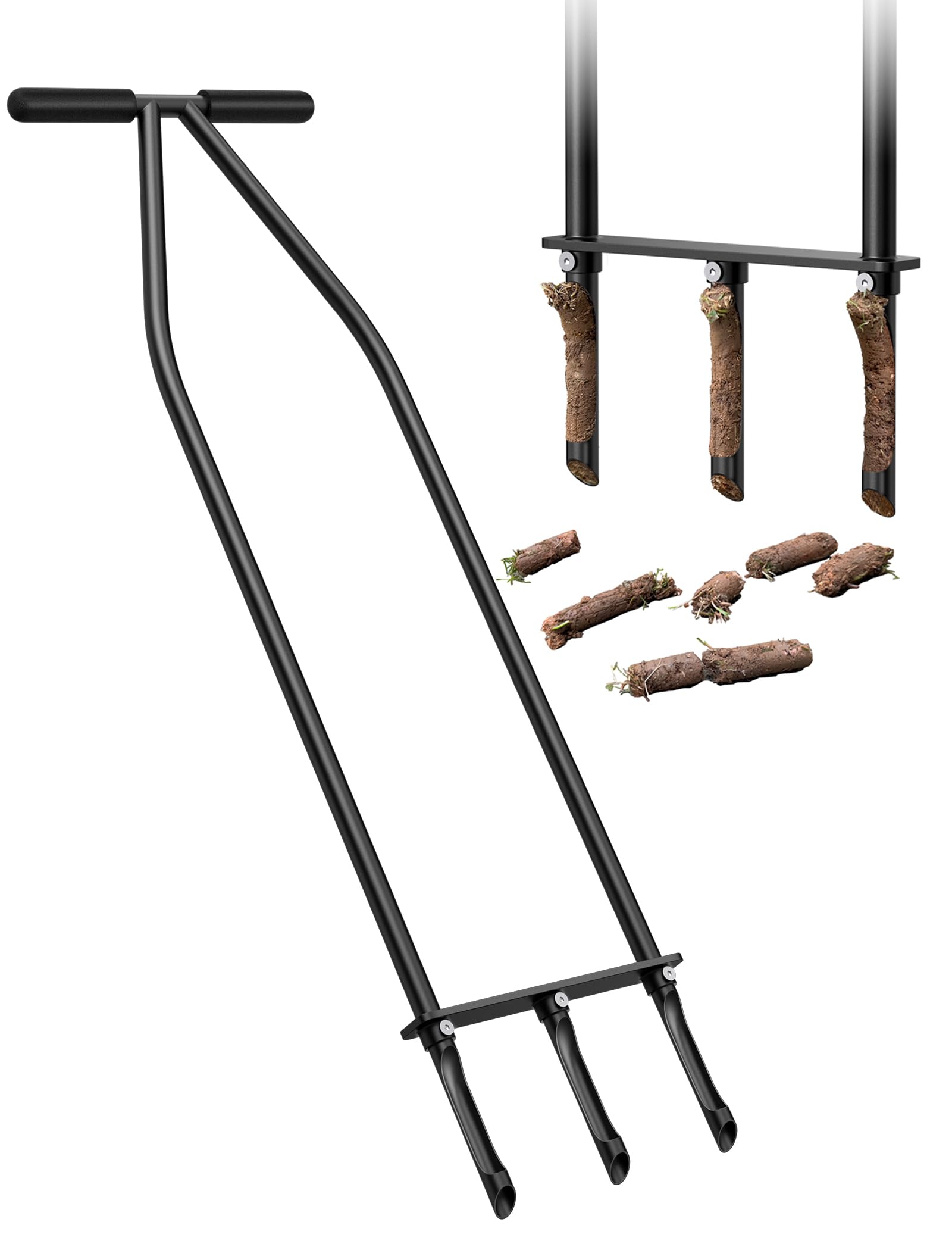
An ultra-lightweight manual tool that solves clogging with a patented side-eject design.
At just 5.69 pounds, the Xuperace GD0001-02 is the lightest core aerator in this lineup — almost a tenth the weight of the Suchtale tow-behind (55 lbs). But its real innovation is in the tines: instead of pushing soil straight up (which clogs quickly), the patented curved design ejects soil plugs out the side of the tine. One 72-year-old female reviewer says she “can use ~1 hour at a time,” which tells you the physical effort is manageable for most people.
The tool has three hollow tines made of high-strength alloy steel, and the frame is integrally formed for durability. If the ground is too hard for all three tines, you can remove the middle one for easier operation in tough spots. The tines are replaceable and connect to the frame with screws, so you can tighten them if they loosen after first use (one user highlighted you should save the included Allen wrench for that purpose). It works best on moist grass — a tip the manufacturer includes in the product description.
Compared to the Step ‘N Tilt, which costs more and weighs 21 lbs, the Xuperace is a budget-friendly entry point that still pulls real cores (not just spikes). The trade-off is that it relies entirely on your body weight, so the 2-inch or so plug depth may not reach as deep as the Step ‘N Tilt’s 3.4 inches. This is the right tool for a tiny lawn patch, a renter, or anyone who wants to try core aeration for the first time without a big investment.
Handheld manual tool: Buyers call it “solid and sturdy” and “the best of its kind in the market,” praising the non-clogging design and the knee-friendly open-center frame.
Small area only: The screws can loosen after first use, and the lightweight frame means you need good soil moisture to get clean plugs in hard or dry ground.
Understanding the Specs
Core Depth
Core depth is how deep the aerator tines penetrate into the soil. A deeper core (3 inches or more) provides more relief for compacted soil, allowing air, water, and nutrients to reach a larger root mass. Most tow-behind models achieve 2 to 3 inches, while manual tools like the Step ‘N Tilt can reach 3.4 inches. For heavy clay or lawns that have never been aerated, deeper is almost always better — it breaks up the compacted layer that is choking the grass roots.
Weight and Weight Tray Capacity
For tow-behind aerators, the unit’s own weight plus any ballast you add in the weight tray determines how easily the tines sink in. Heavier machines like the Craftsman (78.8 lbs) have a natural advantage in hard soil. The weight tray capacity (usually 125 to 150 lbs) tells you how much extra concrete blocks or sandbags you can load. More weight means deeper, more consistent plugs without having to make multiple passes. Manual tools rely on your body weight alone — lighter models like the Xuperace (5.69 lbs) require you to step down firmly, while the Step ‘N Tilt (21 lbs) has more mass to aid penetration.
Number of Tines
Almost all 40-inch tow-behind aerators use 24 tines (also called knives, spoons, or coring plugs). This number provides a good balance between coverage per pass and the force required to pull the tines through the ground. Manual aerators typically use 2 to 4 tines — fewer tines reduce the force needed per step, making them more manageable for one person. If a manual tool has removable tines (like the Xuperace), you can drop to 2 tines for harder ground.
Transport Mode
Transport mode is the mechanism that lifts the tines off the ground when you are crossing a driveway, sidewalk, or just moving the aerator to a different part of the yard without aerating. On tow-behind models, this is usually a single lever (as on the Brinly) or a lift handle that rotates the tine bank upward. Good transport mode design prevents accidental damage to the tines and makes maneuvering around obstacles much easier. Some models also include a vertical storage feature so you can stand the aerator against a wall when not in use.
FAQ
How deep should a core aerator go for a healthy lawn?
Can I use a core aerator on clay soil?
What is the difference between a spike aerator and a core aerator?
How often should I aerate my lawn?
Will a manual core aerator work on a large lawn?
How much weight should I add to a tow-behind aerator’s tray?
Can I leave a tow-behind aerator outside?
Will aerating help with standing water in my yard?
Are the tines on these aerators replaceable?
Do I need to remove plugs after aeration?
Final Thoughts: The Verdict
For most homeowners, the best core aerator is the Step ‘N Tilt Core Lawn Aerator Version 4 because it delivers 3.4-inch deep plugs with a tilting action that protects your back — the strongest combination of core depth, ease of use, and build quality without needing a tractor. If you have a large property with tough clay soil, go with the Brinly Tow Behind Plug Aerator for its US-made construction, 150 lb weight tray, and independently rotating tine sections that protect your turf on turns. And for a budget-friendly way to see what core aeration can do for a small patch of lawn, the Xuperace Lawn Aerator Tool at 5.69 lbs is an easy, no-regret entry point.
How We Picked
We do not accept paid placement. Every pick is matched to a real buyer and a real use-case; we do not hands-on test units.
Sources & Methodology
Specifications: manufacturer listings and product documentation. Review insights: verified customer reviews, as of July 2026. Pricing: not shown on this page (it changes often); check the current price via the retailer link.
As an Amazon Associate, Lawn Gear Lab earns from qualifying purchases. This does not affect which products we feature.