
Specs are compiled from manufacturer listings and verified buyer reviews and can change over time — please confirm the key details on the product page before buying.
You have a greenhouse frame up, but the wrong clear plastic turns into a brittle mess after one season of sun, or it fogs up so badly your seedlings starve for light. A good cover needs to balance light transmission, thickness to survive wind and snow, and UV resistance so you are not re-skinning the whole structure every year. This guide cuts through the tarp confusion to find the sheet that actually fits your build and your climate.
I’m Rikta — the founder and writer behind Lawn Gear Lab. This guide is built by comparing the manufacturers’ published specifications and the patterns across verified customer reviews, so you get each pick’s real strengths and trade-offs instead of marketing spin.
Whether you are covering a small hoop house or a large walk-in greenhouse, choosing the right clear plastic for greenhouse depends on matching the thickness, UV rating, and size to your local weather and structure type.
Quick Picks
- Farm Plastic Supply – String Reinforced 10 mil — Best Overall
- Ansgery 16 Mil Clear Tarp — Premium Choice
- Aluf Plastics Plastic Sheeting 6 MIL — Best for Large Covers
- Yowlieu 6 Mil Greenhouse Plastic — Plants First Pick
- Inslat 6 Mil Greenhouse Plastic — Best Value
- Greenhouse Plastic Sheeting 6 mil — Budget Champ
- Doniks 14 Mil Clear Tarp — Compact Tarp
How To Choose The Best Clear Plastic For Greenhouse
The right greenhouse plastic keeps your plants warm, lets in sunlight, and withstands your local weather without turning into confetti. Here are the three things to check before you buy.
Thickness (Mil)
The thickness of the plastic is measured in “mils” (one mil is one-thousandth of an inch). Thicker plastic (like 10 mil and above) resists tearing and holds up to stronger winds better, but it often lets through a little less light and costs more. Standard 6 mil film is a good middle-ground for smaller hoops or seasonal covers, while 14-16 mil materials are better for permanent structures in cold or windy areas.
UV Resistance and Anti-Drip Coatings
Untreated clear plastic degrades quickly in direct sunlight. A “UV resistant” film has additives that stop the material from becoming brittle and cracking. An “anti-drip” or “anti-condensation” coating prevents water droplets from forming on the inside of the plastic (which can block light and cause leaf burn when the sun hits the drops). For most buyers, a film that has at least UV protection is essential for a cover to last through even one full growing season.
Size and Attachment Type
Measure your greenhouse frame’s length and width, and add a few inches on each side for overlap and tying down. Some products come as a simple continuous roll (film), which you fasten with staples, clips, or batten strips. Others are made as tarps with pre-installed grommets (metal eyelets), which makes them easier to secure with ropes or bungee cords but can limit how tightly you stretch the material. Grommet spacing matters — every 18 inches is much better for high wind than every 35 inches.
Quick Comparison
| Model | Best For | Thickness | Size | UV Protection | Amazon |
|---|---|---|---|---|---|
| Farm Plastic Supply 10 mil | Permanent greenhouses in high wind | 10 Mil | 12′ x 50′ | 4-Year UV Resistant, String Reinforced | Amazon |
| Ansgery 16 Mil Tarp | Durable tarp with tight grommets | 16 Mils | 16′ x 20′ | UV Resistant | Amazon |
| Aluf Plastics 6 Mil | Large area coverage on a budget | 6 MIL | 20′ x 100′ | Not specified | Amazon |
| Yowlieu 6 Mil | Mid-sized hoop houses | 6 Mil | 12′ x 25′ | UV Resistant, Anti-Drip | Amazon |
| Inslat 6 Mil | Low tunnels and bed covers | 6 Mil | 10′ x 26′ | UV Resistant, Anti-Drip | Amazon |
| Greenhouse Plastic Sheeting 6 mil | Value-priced all-purpose film | 6 Mil | 12′ x 25′ | UV Resistant, Anti-Drip | Amazon |
| Doniks 14 Mil Tarp | Small, secure tarps with grommets | 14 Mils | 8′ x 6′ | UV Resistant | Amazon |
In‑Depth Reviews
1. Farm Plastic Supply – String Reinforced 10 mil
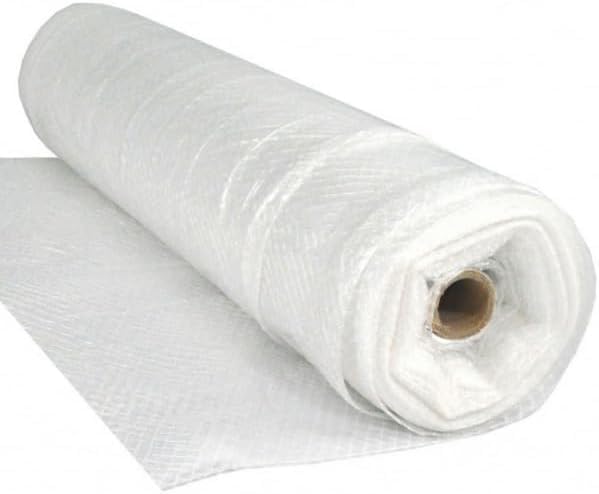
The string-reinforced workhorse built to stand up to brutal wind and hard freezes.
This 10 mil clear plastic is the heaviest-gauge film in the lineup with a built-in scrim — a crisscross string reinforcement (laminated between two layers of polyethylene) that makes it extremely resistant to tearing. Unlike the 6 mil films that can rip if a branch falls on them, the Dura Skrim construction keeps the sheet intact even when stressed. Buyers report it survived a “hard freeze with unplugged heater” and is “standing up to our terrible winds” thanks to the added thread.
It is a bulk roll (12′ x 50′) without grommets, so you will need to cut it to size and attach it with clips, staples, or battens, which gives you a cleaner, tighter fit than a pre-made tarp. The 4-year UV resistance means you are not replacing it every spring. One reviewer noted the 6ft x 75 ft white variant fit their greenhouse perfectly and let in enough light that they did not need grow lights. The main trade-off? At 30 pounds, this roll is heavy and unwieldy during installation — you will definitely want a helper.
It is also noticeably more expensive than the other picks, but if you are covering a permanent structure in a windy zone, the reinforcement alone makes it worth the jump.
Built to Last
- 10 mil thickness plus internal string scrim for extreme tear resistance and wind strength.
- 4-year UV treatment keeps the plastic from degrading in sunlight.
- Lets through high light transmission, so plants thrive without needing grow lights.
Installation Considerations
- Heavy 30-pound roll requires two people to handle and install safely.
- No pre-installed grommets — you must fasten it with clips or staples.
Reach for this if: you are building a permanent greenhouse in an area with high wind, snow, or intense sun.
Look elsewhere if: you need a quick, lightweight tarp for a temporary structure or a small hoop house.
2. Ansgery 16 Mil Clear Tarp
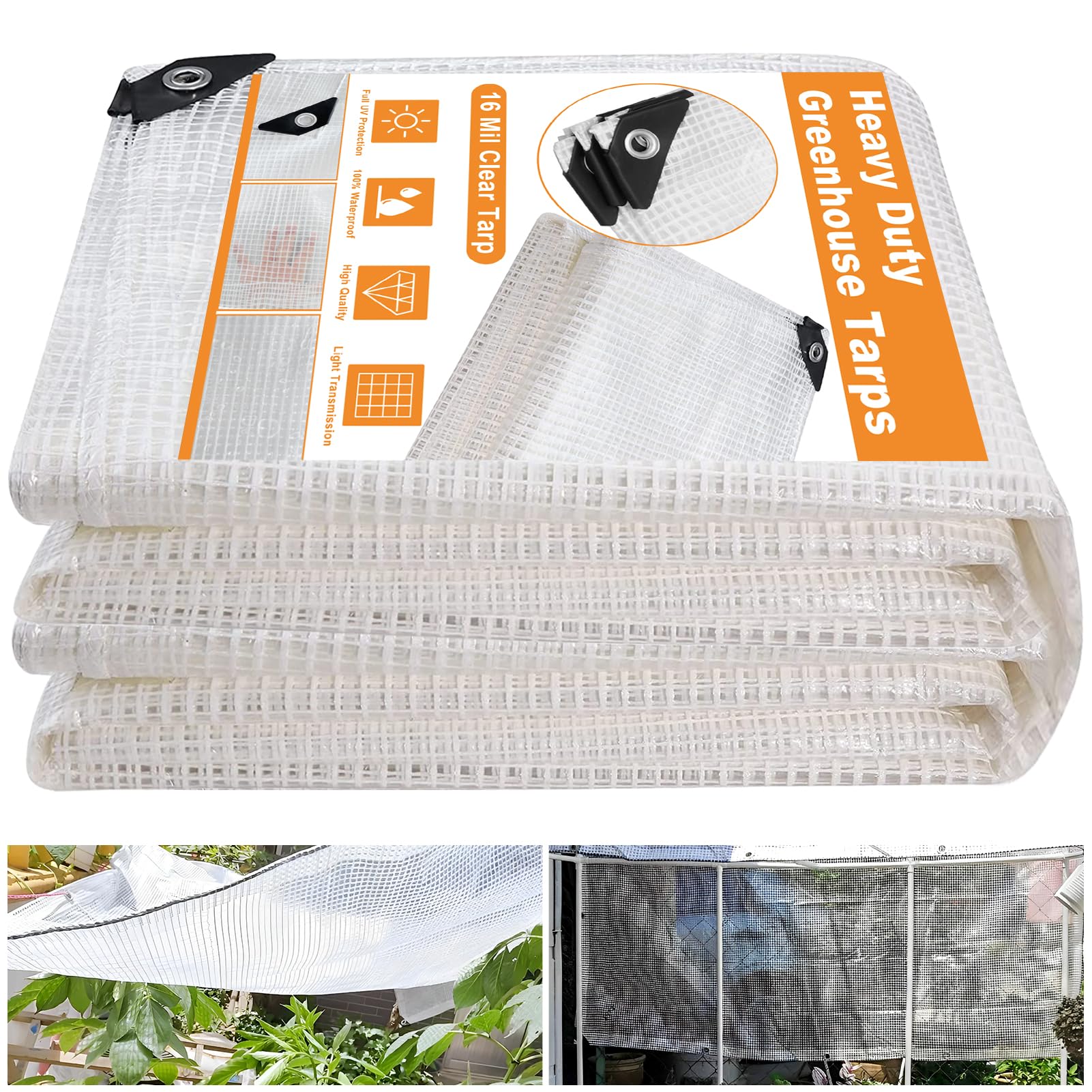
The thickest tarp in this list with dense grommets for a secure, no-slack fit.
At 16 mils, this is the thickest clear plastic sheet in the roundup, made from a woven and double-coated 3-layer polyethylene. Thickness translates directly into toughness — it resists punctures from staple guns and rough frames much better than standard 6 mil film. The tarp has double-reinforced corners and rust-proof grommets spaced every 18 inches (much tighter than the 35-inch spacing on the Doniks tarp), so you can tie it down firmly without the tarp pulling loose at the eyelets.
Buyers have used it to cover duck pens and chicken runs, noting it easily handled staple gun installation and winter snow loads. The main catch is that this material is a “tarp” with a defined 16′ x 20′ size, so it works best if your frame dimensions happen to match that footprint closely. If you need a custom, continuous film for a long hoop house, a roll like the Farm Plastic Supply is a better fit.
Compared to the thinner 6 mil options, the Ansgery gives significantly more structural stiffness, meaning less flapping in strong winds for a more stable greenhouse environment.
Maximum Toughness
- 16 mil 3-layer woven construction is extremely puncture- and tear-resistant.
- Grommets spaced every 18 inches allow for very secure, tight fastening.
- UV resistant coating stops the tarp from degrading in the sun.
Fixed Size Limitation
- Comes as a pre-sized tarp, not a continuous roll — may not cover odd-sized frames cleanly.
- Not completely clear; the weave can create a slightly cloudy appearance.
Grab it when: you need a pre-cut, no-fuss cover with maximum wind resistance for a standard-sized structure.
Pass on it if: your greenhouse has an unusual length or you need glass-like clarity.
3. Aluf Plastics Plastic Sheeting 6 MIL
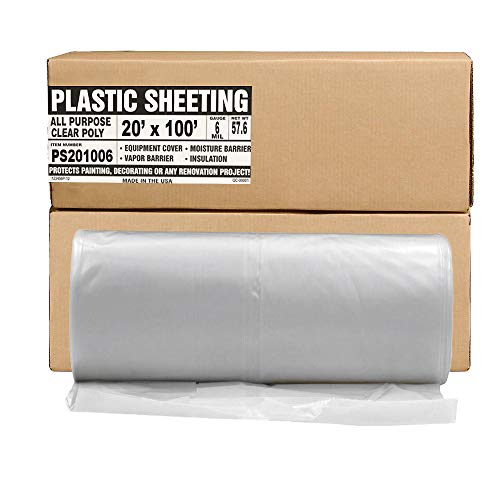
A massive roll for when you need to cover a long structure without seams.
The raw size of the roll — 20 feet wide, 100 feet long — is the main attraction here. If you have a long tunnel or a large frame, this lets you lay a single continuous sheet without taping or overlapping smaller pieces, which is a weak point for leaks. This is a 6 mil Low Density Polyethylene (LDPE) film, which buyers confirm is “thicker, puncture resistant” than throwaway painter’s plastic and “very strong.” The roll is heavy, and several customers note you should plan to have a second person to help unroll and place it.
One trade-off to know: reviewers describe the plastic as “slightly hazy” and “translucent, not clear,” which means it diffuses light rather than giving a crisp view of your plants. This is fine for general greenhouse use but not ideal if you want full visibility. Also, the Aluf product is listed as a general “vapor barrier” rather than a dedicated greenhouse film, and it does not explicitly advertise UV resistance in the specs like the Inslat or Yowlieu options do. In direct year-round sun, it may degrade faster.
Compared to the Doniks 14 mil tarp which offers more thickness at a smaller size, the Aluf roll trades some durability for sheer surface area coverage at a great cost per square foot.
Uninterrupted Coverage
- Massive 20′ x 100′ roll can cover long greenhouses in a single, smooth sheet.
- 6 mil thickness provides good tear and leak resistance for general use.
- Priced affordably per square foot, making it a smart choice for large projects.
Important Shortfalls
- No UV treatment listed in the specs, which may shorten its lifespan in constant sun.
- The plastic is hazy/translucent, not crisp, reducing visibility inside the greenhouse.
Ideal for: covering a large hoop house where you want a single continuous sheet without joining smaller tarps.
Not for: high-sun climates or if you need the maximum light clarity for your plants.
4. Yowlieu 6 Mil Greenhouse Plastic

The strong 6 mil film that also fights drips for healthier plants underneath.
The Yowlieu film covers a typical hoop house or raised bed setup at 12′ x 25′, and its defining advantage over standard plastic is the anti-drip treatment. Instead of condensation forming droplets that can burn leaves like magnifying glasses, the special coating makes the water spread into a thin sheet that runs off the edges. One reviewer in Arizona used it to “protect potatoes from sun, rain, hail,” underlining how well the UV resistance works in harsh sun.
Buyers also note it is “relatively transparent but disperses enough of the light to wash shadows,” which helps with even plant growth. A word of caution from the reviews: in 40 mph gusts, the plastic can become a sail, so you need a strong frame and secure attachments (stainless steel clamps or batten strips). Unlike a reinforced tarp, this is just film, so high-wind areas require careful planning for the attachment method.
Its 6 mil thickness is identical to the Inslat and basic Greenhouse Sheeting, meaning its durability is roughly similar — the tiebreaker is the anti-drip coating and its proven track record in a tough Arizona garden.
Plant-Friendly Features
- Anti-drip treatment prevents damaging water droplets from forming on the inside.
- UV-resistant polyethylene holds up well to intense sun, as verified by buyers in Arizona.
- Good light diffusion reduces harsh shadows for more uniform plant growth.
Wind Vulnerability
- Standard 6 mil film can billow or fly away in strong winds without very secure fastening.
- The film has no grommets, so you must use clips or staples, which requires extra preparation.
Choose this for: growing seedlings or vegetables where you want to minimize leaf burn and get even light distribution.
Step away if: your greenhouse is in an exposed, high-wind spot without a very sturdy anchoring method.
5. Inslat 6 Mil Greenhouse Plastic

A proven 6 mil film that handles snow, winter cold, and the Tucson desert heat.
The Inslat is a favorite for low tunnels and hoop covers. Its dimensions — 10 feet wide by 26 feet long — are perfect for covering a typical 4′ x 8′ raised bed with an arched PVC frame. Owners mention the “6 mil UV protection holds up well” and that it survived a winter with “a couple inches of snow/ice on top” without tearing. The anti-drip treatment and anti-aging additives give it an advantage over generic utility sheeting, promising a longer service life.
One reviewer in Tucson noted the sheerness was “unaffected by knicks” and that the plastic held up through the first winter. They did mention removing it “during high summer heat,” which implies it works best as a 3-season cover in hot climates. A common point in the reviews is that the film is “not as clear as expected, in fact it is almost white-ish,” so like many greenhouse films, clarity is sacrificed for UV diffusion and temperature stability.
It is a hair more expensive than the basic Greenhouse Sheeting but comes from a brand with a very strong verified review track record for weather durability.
Weather Tough
- Has anti-aging UV additives and anti-drip coating for multi-year use.
- Buyers confirm it held up well against snow and ice loads.
- Good thickness (6 mil) that resists tearing during installation and storms.
Visual Clarity
- Several users note the film is hazy or white-ish, not crisp.
- May need to be removed or shaded during extreme peak summer heat to prevent plant overheating.
Perfect for: covering low-tunnel hoops and vegetable beds with a budget-friendly, durable film.
skip it if: you need the clearest possible view of your plants for display or observation.
6. Greenhouse Plastic Sheeting 6 mil

The entry-level 6 mil film that punches above its price with 5-layer construction.
This is the least expensive pick and the one to reach for if you are on a tight budget but still want a proper greenhouse film (not just a painter’s drop cloth). It offers 5-Layer Co-Extrusion technology, which gives it better mechanical strength than the cheapest single-layer poly. One smart reviewer “covered a 16×8 chicken run; cut in half, more than enough,” and noted it kept the space “noticeably warmer inside” during negative temperatures.
The spec sheet highlights an “anti-drip” surface, but it also admits the film “will not be very clear, but a little hazy,” which you will hear echoed in the reviews. It works well as a seasonal barrier against cold, rain, and wind. However, it does not have the same proven multi-year track record as the Inslat or Yowlieu products; the brand is less established in the greenhouse niche, and the long-term UV performance is less documented by buyers.
For a small hoop house or a temporary winter cover, it is a solid value, but if you need a cover that can reliably survive multiple summers, spending a bit more on a UV-focused brand like Inslat is a safer bet.
Excellent Entry Point
- Very low cost per square foot makes it easy to replace if needed.
- 5-Layer Co-Extrusion adds extra strength over basic single-layer sheets.
- Includes anti-drip hydrophobic layer to reduce condensation issues.
Longevity Questions
- Less proven for long-term UV exposure compared to more established brands.
- The haze mentioned in the spec sheet reduces visibility and light intensity.
Great for: first-time builders or covering a chicken coop/run where budget is the top priority.
Consider upgrading if: your greenhouse is a permanent structure that needs to last several years in direct sun.
7. Doniks 14 Mil Clear Tarp

A thick, small tarp with aluminum grommets for quick fastening on modest frames.
At 14 mils, the Doniks is the second-thickest option here, and its 8′ x 6′ size makes it best suited for small cold frames, chicken runs, or as a temporary storm cover. It comes with pre-installed aluminum grommets every 35 inches, which makes setup fast — just tie it down. One buyer mentioned it “creates a greenhouse effect with a 20°F temperature rise,” making it useful for extending the season.
There are two trade-offs from real buyers to know. First, the surface is “waffle-textured,” which creates a “foggy view, not fully clear.” Second, the grommet spacing at 35 inches is the widest of any tarp here, which can make it difficult to secure the tarp without sagging in the middle. One reviewer had grommets pull out in extreme winds and had to use “fender washers and screws” as a workaround. The Ansgery tarp with 18-inch spacing is a much stronger design for windy conditions.
For its intended purpose — a small, thick cover for a mini greenhouse or a wind block — the Doniks delivers solid thickness. But if you are covering anything in an exposed location, the wide grommet gap is a legitimate weak point.
Strong and Easy
- Thick 14 mil polyethylene material resists tearing and wear during setup.
- Pre-installed grommets allow for quick tying to a frame without needing clips.
- Good for maximizing heat retention in small structures.
Design Flaws Noted
- Grommets are spaced 35 inches apart, which is too wide to prevent sagging in the middle.
- Waffle texture makes the plastic foggy rather than clear, reducing light transmission.
Reach for it when: you need a quick, thick cover for a very small greenhouse or cold frame in a sheltered spot.
Look elsewhere when: your structure is larger than 8×6 or regularly faces strong winds.
Understanding the Specs
Mil Thickness
This is the thickness of the plastic sheet, where one “mil” equals 0.001 inches. Common choices are 6 mil, 10 mil, 14 mil, and 16 mil. A higher number means the plastic is tougher, more resistant to punctures from wind or tools, and stiffer so it flaps less. However, thicker plastic can be slightly less transparent and is harder to fold or roll. For a permanent greenhouse structure in a windy area, choose 10 mil or higher. For a seasonal hoop house or cold frame, 6 mil is usually plenty.
UV vs. Non-UV Plastic
Greenhouse film that is labeled “UV Resistant” or “UV Treated” has chemical additives that stop the plastic from breaking down when sunlight hits it. Without UV treatment, most clear polyethylene will become brittle and crack within one sunny season. A “4-Year UV” rating means the manufacturer has tested the film to stay usable for at least four years of continuous exposure. If you are leaving the cover up year-round, you absolutely want UV treatment — otherwise, you will be replacing the plastic annually.
FAQ
What does “mil” mean for greenhouse plastic?
Can I use a clear tarp with grommets on a hoop house?
How long does clear greenhouse plastic last?
Is thicker greenhouse plastic always better?
What is anti-drip greenhouse plastic?
How do I attach clear plastic to a greenhouse frame?
Can I use clear painter’s plastic for a greenhouse?
What size clear plastic do I need for my greenhouse?
Is clear greenhouse plastic waterproof?
Does greenhouse plastic block wind?
Final Thoughts: The Verdict
Across the board, the clear plastic for greenhouse winner is the Farm Plastic Supply 10 Mil because its string reinforcement and UV additives give you a low-maintenance cover that lasts for years in wind, snow, and sun. If you want a pre-cut tarp that is easy to tie down, grab the Ansgery 16 Mil. And for the best value on a standard hoop house film, the Inslat 6 Mil offers proven durability at a budget-friendly price.
How We Picked
We do not accept paid placement. Every pick is matched to a real buyer and a real use-case; we do not hands-on test units.
Sources & Methodology
Specifications: manufacturer listings and product documentation. Review insights: verified customer reviews, as of July 2026. Pricing: not shown on this page (it changes often); check the current price via the retailer link.
As an Amazon Associate, Lawn Gear Lab earns from qualifying purchases. This does not affect which products we feature.