
Specs are compiled from manufacturer listings and verified buyer reviews and can change over time — please confirm the key details on the product page before buying.
A half-acre lawn sits in that tricky middle ground — too big for a cheap push mower that leaves you huffing, but not quite large enough to justify the cost of a full-size riding tractor. The real challenge is finding a machine that covers the ground efficiently without breaking your back or your budget.
I’m Rikta — the founder and writer behind Lawn Gear Lab. This guide is built by comparing the manufacturers’ published specifications and the patterns across verified customer reviews, so you get each pick’s real strengths and trade-offs instead of marketing spin.
The self-propelled gas mowers reviewed below each handle the demands of a half-acre plot differently, so knowing which engine size, cutting width, and drive system matters most to you is what separates a chore from a pleasure. The right lawn mower for half acre makes that weekly circuit feel like a quick victory lap instead of an all-morning project.
Quick Picks
- PowerSmart 22-Inch Self Propelled Gas Lawn Mower — Best Value
- YARDMAX 22 in. 201cc Select PACE 6 Speed CVT High Wheel FWD — Top Performer
- GasXcel 21″ Self-Propelled Gas Lawn Mower, 170CC 4-in-1 — Precision Pick
- Baotree Professional Self-Propelled Gas Lawnmower, 21-Inch, 201cc — Premium Pick
- BILT HARD 21″ Self Propelled Gas Lawn Mower, 201cc — Most Adjustable
- SENIX 22 Inch 3-in-1 Gas Lawn Mower, 201cc — Best Build
How To Choose The Best Lawn Mower For Half Acre
If you own a half-acre lot, a walk-behind self-propelled mower gives you the speed of a wider deck without the storage and maintenance of a riding mower. Your key choices — deck width, engine power, and cutting height — directly affect how long the job takes and how much effort you put in.
Cutting Width and Time Savings
The biggest time-saver on a half-acre is a cutting deck 21 inches or wider. A 22-inch mower covers more grass per pass than a 21-inch mower. Over a 22,000 sq ft lot, that extra inch per row shaves a noticeable number of laps off your mowing session.
Engine Power Matters
The engine size, measured in cubic centimeters (cc), dictates how well the mower powers through tall or wet grass. A 170cc engine handles regular weekly cuts on a half-acre just fine. A 201cc engine gives you more torque and reserve power, which helps when the grass gets slightly overgrown or damp without the engine bogging down.
Self-Propelled Drive Type
On a half-acre, a self-propelled mower is non-negotiable. Rear-wheel drive (RWD) gives you better traction going uphill because the weight of the engine sits over the drive wheels. Front-wheel drive (FWD) can lose grip on slopes and wet grass. Single-speed drive systems are simpler and cheaper, while variable-speed systems let you match the mower’s pace to your walking speed.
Quick Comparison
| Model | Best For | Engine Size | Cutting Width | Deck Positions | Amazon |
|---|---|---|---|---|---|
| PowerSmart 22-Inch | Lightweight maneuverability | 170cc | 22 Inches | 6 | Amazon |
| YARDMAX 22 in. 201cc | Variable speed on tough terrain | 201cc | 22 Inches | 6 (single lever) | Amazon |
| GasXcel 21-Inch | Precision cutting height | 170cc | 21 Inches | 7 | Amazon |
| Baotree Professional 21-Inch | Lowest cut for manicured lawns | 201cc | 21 Inches | 7 | Amazon |
| BILT HARD 21-Inch | Widest height adjustment range | 201cc | 21 Inches | 8 | Amazon |
| SENIX 22 Inch | Heavy-duty steel deck durability | 201cc | 22 Inches | 6 | Amazon |
In‑Depth Reviews
1. PowerSmart 22-Inch Self Propelled Gas Lawn Mower
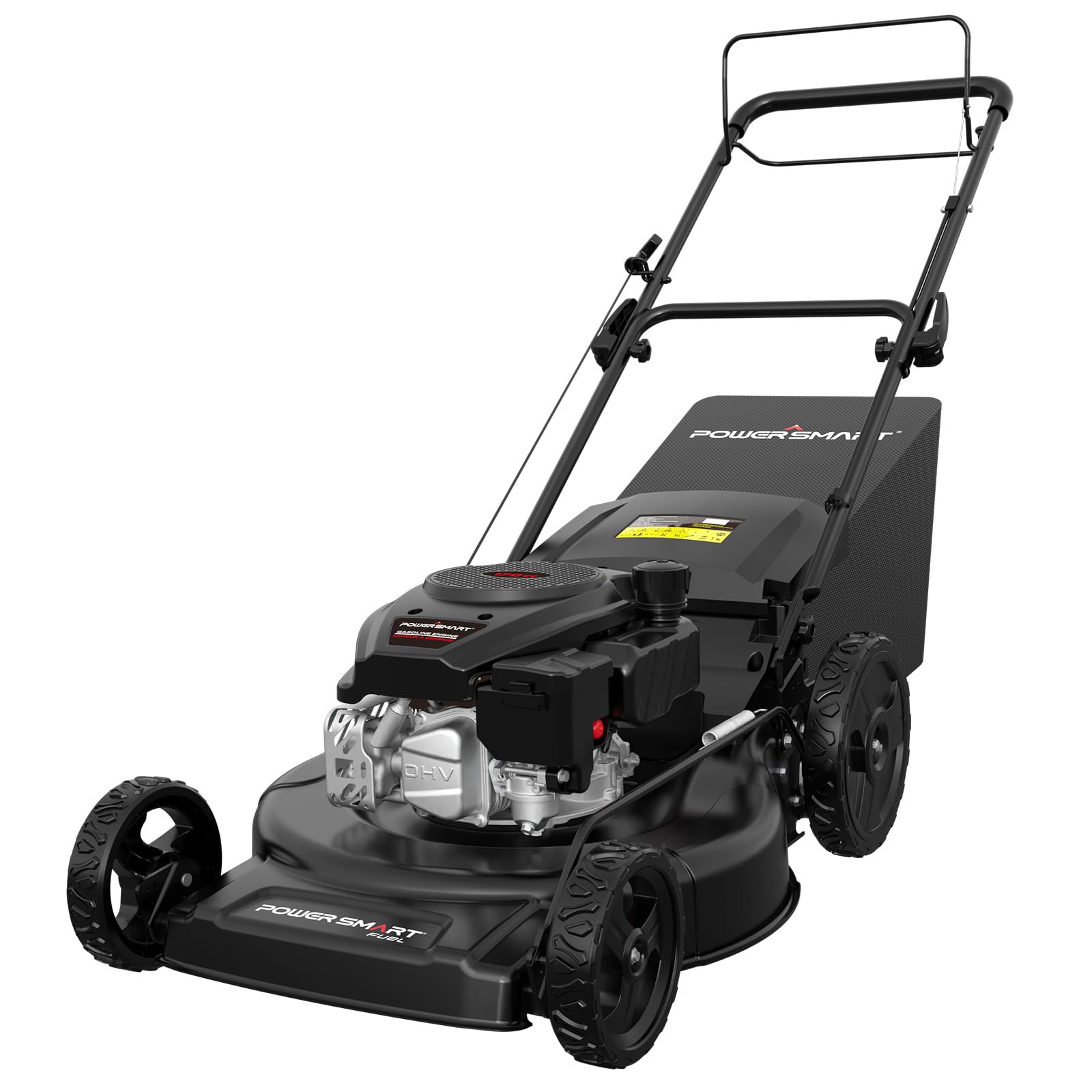
The featherweight that climbs hills without wearing you out before you finish.
A half-acre mower that weighs just 68 pounds and still gives you rear-wheel drive traction on slopes is a rare combination. The PowerSmart’s 170cc engine starts reliably, and buyers report that “after a couple mows, the product works as has hoped,” praising its easy assembly and first-pull starts. The 22-inch cutting deck covers more ground per pass than the 21-inch models below, which helps trim a few laps off that half-acre circuit.
The rear-wheel drive system puts the traction under the engine weight, giving you strong grip when pushing uphill — a real advantage over the front-wheel-drive YARDMAX. You get six cutting heights ranging from 1.5 inches up to 3 inches, so you can drop it low for a clean spring cut or leave it tall during hotter months. The 60L grass bag is generous, meaning fewer trips to the compost pile.
Some owners note that the handle bolts can loosen over time and that the rear rubber flap is on the cheaper side. The minimum cutting height of 1.5 inches also means it won’t scalp as low as the Baotree’s 0.7-inch minimum, so it is less suited for an ultra-manicured golf-green look.
Why It Leads the Pack
- At 68 lbs versus the YARDMAX at 84.9 lbs, it is easier to maneuver and push manually if needed
- RWD provides excellent hill-climbing traction
- 22-inch deck covers more ground than 21-inch competitors
A Few Trade-Offs
- Minimum cutting height of 1.5 inches won’t go as low as some rivals
- Rear rubber flap and mulching chute feel less durable
- No variable speed control — single-speed self-propel only
Best for this buyer: Someone who wants a lightweight, affordable self-propelled mower with rear-wheel drive for a gently sloping half-acre lot, and who values easy starting over premium build feel.
Look elsewhere if: You need an ultra-low cut below 1.5 inches or want variable-speed self-propel to match your walking pace.
2. YARDMAX 22 in. 201cc Select PACE 6 Speed CVT High Wheel FWD
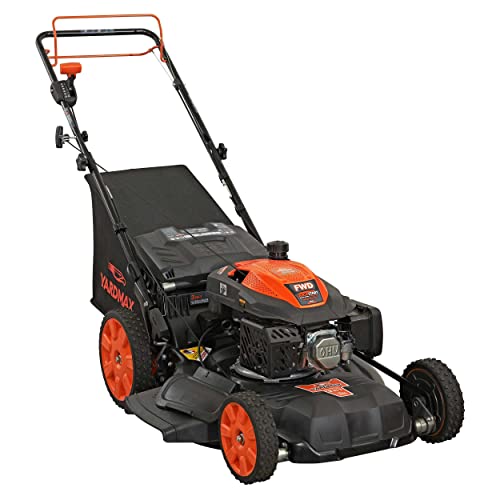
The 201cc torque monster that chews through tall grass but demands some muscle.
The YARDMAX brings a 201cc engine and a continuously variable transmission (CVT) — a gearbox that lets you smoothly shift through six speeds to match your walking pace. That is a real luxury on a half-acre where the terrain changes: dial it down for thick patches near the fence and speed up across the open stretch. The automatic choke takes the guesswork out of starting, and the deck cleanout port lets you blast debris off the underside with a garden hose.
The catch is weight. At 84.9 pounds versus the PowerSmart at 68 pounds, it uses front-wheel drive (FWD). Owners mention that on wet grass the front wheels lose traction, and the mower becomes hard to turn. One reviewer called it “unstoppable” on hills, while another warned that the “speed lever won’t stay” in place. The aggressive spiked tires do grip well on dry slopes, but the FWD layout puts the pulling force on the lighter front end.
For a half-acre with mostly flat, dry terrain and uneven patches of tall grass, the 201cc engine makes quick work where a 170cc might strain. Rear-wheel drive would have made this a near-perfect machine, but the FWD limits its slope performance compared to the RWD PowerSmart.
Straight talk on the drive: The 6-speed CVT is genuinely useful for matching your pace, but front-wheel drive on a 84.9-pound mower means wet grass and tight turns require more arm strength than a rear-drive machine.
Who should take it home: If your half-acre is flat, has thick grass that bogs smaller engines, and you value variable speed over easy maneuverability, this is a strong pick.
Reach for this if: You have thick, tough grass on mostly flat ground and want the adjustability of a CVT transmission.
skip it if: Your half-acre has slopes or sections that stay wet — the FWD system will frustrate you.
3. GasXcel 21″ Self-Propelled Gas Lawn Mower, 170CC 4-in-1
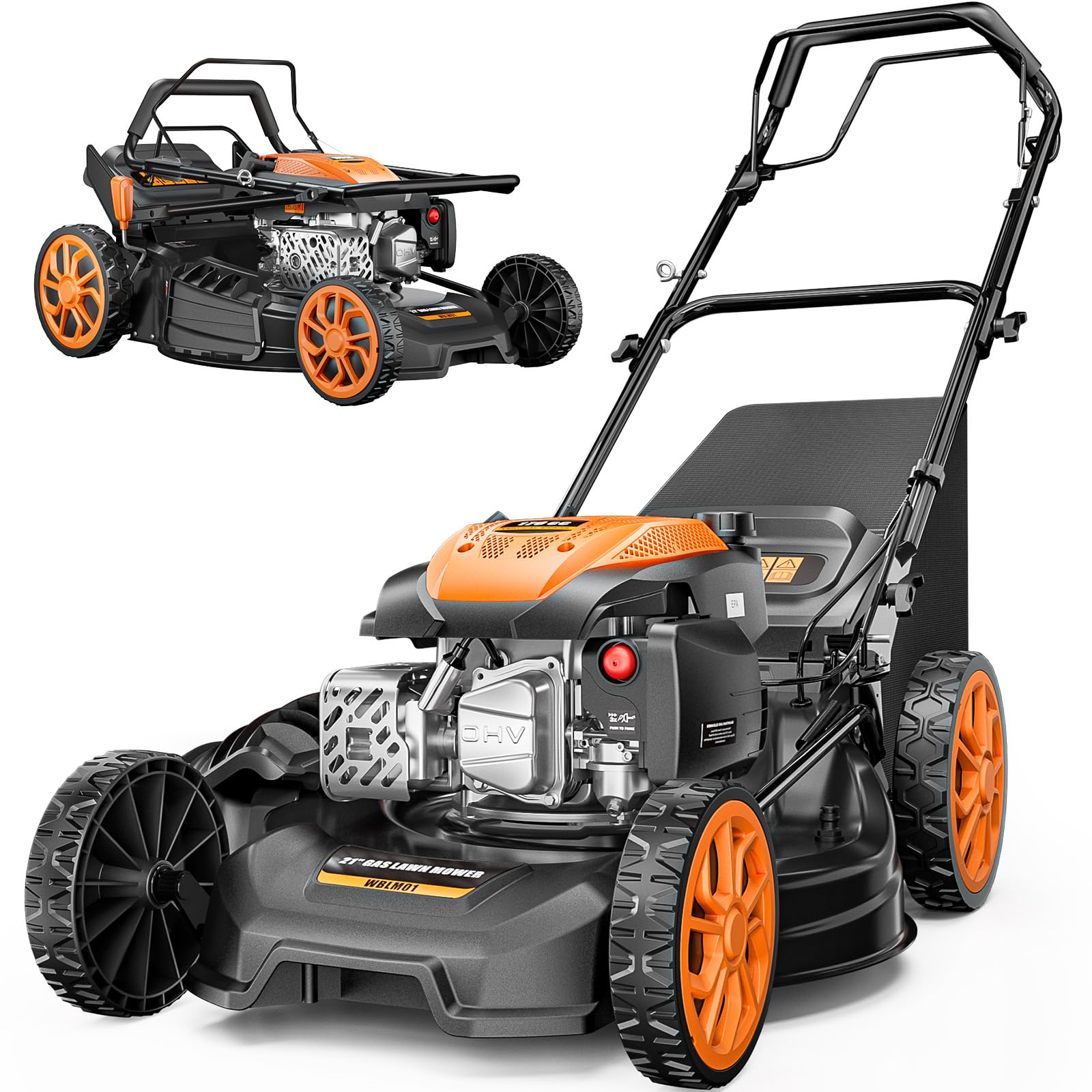
The 4-in-1 cutter that gives you a choice for every season’s grass.
Most mowers in this class offer three discharge modes — this one adds a fourth option: rear discharge, alongside mulching, side discharge, and rear bagging. For a half-acre where you sometimes bag in spring and mulch in summer, that extra flexibility means you never have to switch attachments. The 170cc 4-cycle OHV (overhead valve) engine is fuel-efficient, and the manufacturer claims it runs up to 1.5 hours on a full tank, which covers a half-acre comfortably.
The 7-position height adjustment range goes from 1 inch to 3 inches, giving you more notch options than the PowerSmart’s 6 positions. However, the self-propel system has drawn complaints. One reviewer noted that the “self-propel belt came off first use; inaccessible due to cotter pin cover,” effectively turning it into a push mower. Another noted the self-propel has only one speed — and that speed is quite fast for a relaxed walk.
When it works, the cut quality is good and the mower feels light enough to push manually if the drive fails. The 8-inch front and 10-inch rear wheels roll smoothly over bumpy terrain, but the single-speed drive and reported reliability issues make it a less sure bet than other picks for regular half-acre use.
The 4-in-1 Advantage
- Four discharge modes (mulch, rear bag, side, rear discharge) — most versatile in the lineup
- 7-position deck gives you fine height control
- Quick assembly with no tools required
The Drive Concerns
- Self-propel has only one fixed speed — no pace matching
- Multiple reports of the drive belt failing early
- Minimum height is 1 inch, not as low as the Baotree’s 0.7 inches
Best suited for: A buyer who values mowing-mode flexibility above all else and is comfortable with a single-speed drive, possibly needing to push manually at times.
Not ideal for: Anyone who needs reliable self-propel on every mow — the belt issue is a real risk.
4. Baotree Professional Self-Propelled Gas Lawnmower, 21-Inch, 201cc
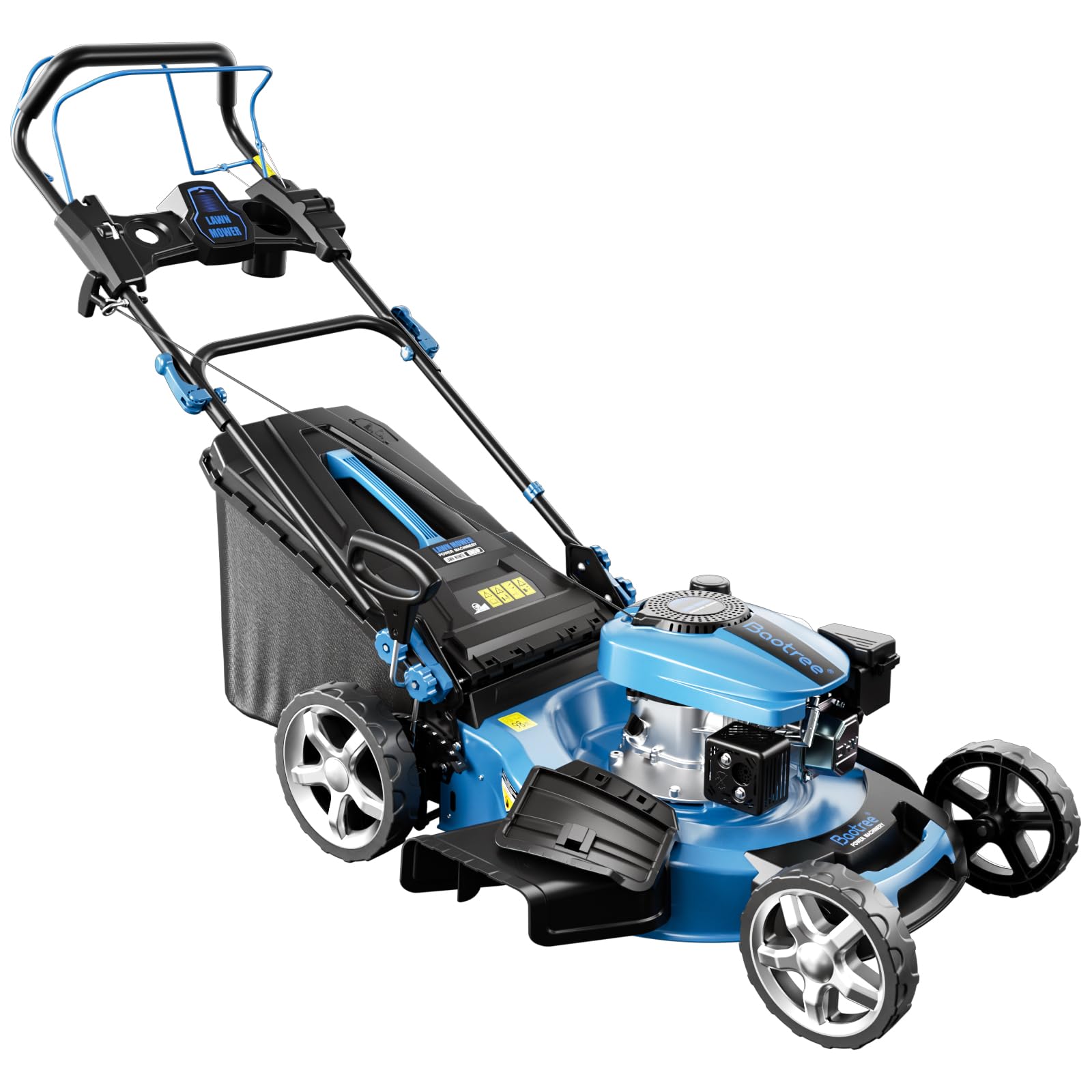
The lowest-scraping deck that cuts as close as a manicurist’s clippers.
That is a 0.7-inch minimum height versus 1.5 inches on the PowerSmart, making this the only mower in the group that can scalp a lawn down to near-putting-green level for a spring clean-up or Bermuda grass scalping. The 201cc 4-cycle OHV engine provides the muscle to handle that deep cut without bogging down. The 3-in-1 system covers mulching, bagging, and side discharge.
Buyers confirm the engine is a standout: one reviewer called it a “powerful 201cc engine, self-propelled saves time,” and another said it “moves smoothly across the yard and makes mowing much faster.” The professional-grade components and thickened steel chassis are built for longevity. The claimed minimum cutting height of 0.7 inches offers precision that the other 21-inch mowers here can’t match — the GasXcel bottoms out at 1 inch.
The ergonomic adjustable handle reduces strain, and the non-slip grip keeps control in wet conditions. The trade-off is that at 73.41 pounds it is heavier than the PowerSmart (68 lbs) but still lighter than the YARDMAX. A small number of buyers reported quality control issues, including a broken height lever on arrival. For half-acre owners who want the tightest possible cut and a sturdy engine, this is the specialist pick.
Cutting height champion: The 0.7-inch minimum and 3.2-inch maximum range (7 positions total) give you a much lower floor for specialized lawn care than the PowerSmart’s 1.5-inch to 3-inch range.
Grab this for: A meticulous half-acre lawn where you want the option of a very close cut and have a 201cc engine to power through it.
Pass on it if: You prefer a lighter mower or want a 22-inch deck for maximum coverage per pass.
5. BILT HARD 21″ Self Propelled Gas Lawn Mower, 201cc
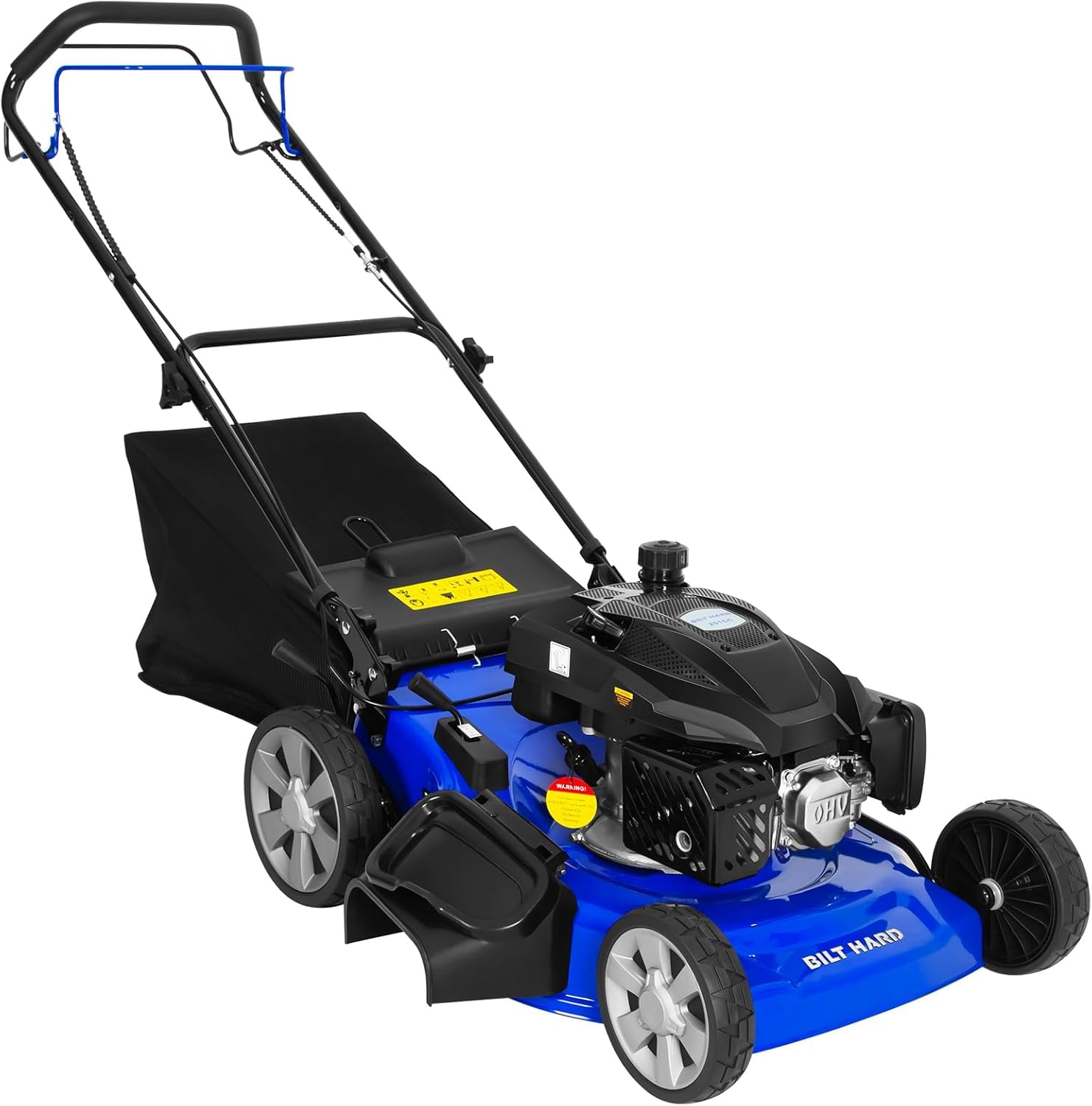
The 8-notch deck that lets you dial in your grass length with surgical precision.
The BILT HARD stands out for its 8-position single-lever height adjustment, spanning from 1.2 inches to 3.75 inches — the widest range in our lineup. That means you get more granular height choices than the YARDMAX’s 6 positions and a taller maximum cut than the Baotree’s 3.2 inches. The 201cc engine delivers 9.0 ft·lb of torque, giving it more twisting force than the SENIX’s 8.8 ft·lb, which helps when cutting through overgrown patches on your half-acre.
The rear-wheel drive system and single-speed self-propel provide solid traction on slopes, avoiding the front-wheel-drive slip issues of the YARDMAX. The foam-wrapped ergonomic handle reduces vibration fatigue. The no-choke, no-primer design simplifies starting — buyers confirm it “starts on the first pull” and that “height adjustments are simple and clearly marked.”
The durability question is unresolved. One detailed account described the mower vibrating itself apart within 8 hours of use, with plastic components cracking and falling off. Another buyer reported the “wheel fell off during first use” but found it fixable. For a half-acre weekly user, the build quality variance is a meaningful risk compared to the SENIX’s more established reputation. The 1.2-inch minimum height also doesn’t go as low as the Baotree’s 0.7 inches for that ultra-short cut.
Strengths in Height
- 8-position adjustment from 1.2″ to 3.75″ — widest range in the group
- 201cc engine with 9.0 ft·lb torque for tough grass
- Rear-wheel drive provides slope traction
Build Concerns
- Mixed reports of parts vibrating loose or breaking early
- Only 1.2-inch minimum height — not as low as the Baotree
- Long-term reliability is unproven in reviews
Best for a buyer who: Wants the widest possible cutting height range on a half-acre and trusts a newer brand’s customer support if issues arise.
Consider another if: You want proven long-term reliability or need a sub-1-inch minimum cut.
6. SENIX 22 Inch 3-in-1 Gas Lawn Mower, 201cc
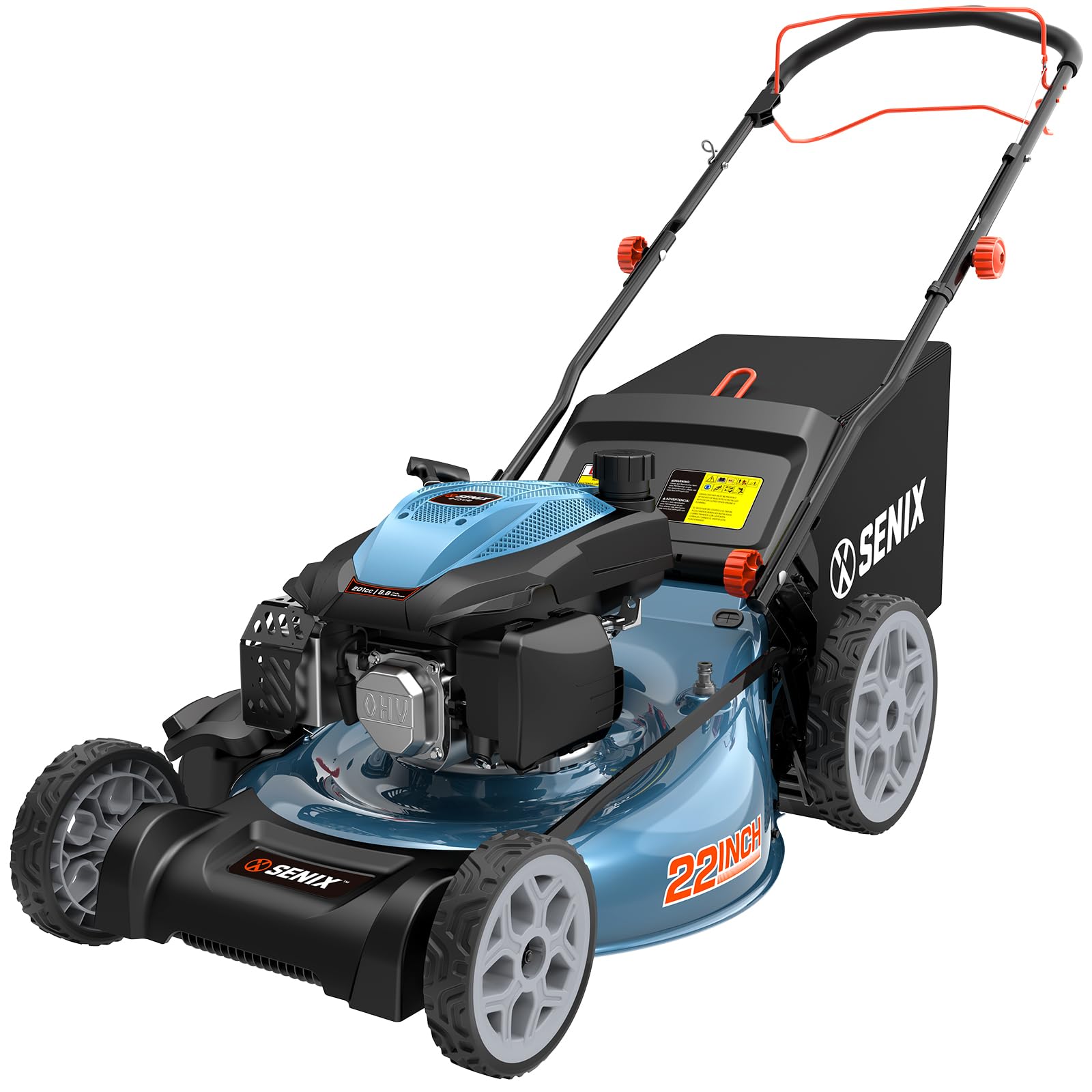
The heavy-duty steel chassis that laughs at rocks and rough terrain.
The SENIX uses DC04-06 low-carbon high-strength steel for its 22-inch deck, which is a step up in impact resistance compared to the stamped steel or alloy steel decks on cheaper mowers. That matters on a half-acre where hidden tree roots, rocks, or uneven ground can dent a thinner deck. The 201cc OHV engine produces 4.7HP and 8.8 ft-lb of torque, and the single-speed rear-wheel drive reaches up to 2.9 MPH — enough to cover a half-acre without feeling rushed.
The vortex tunnel airflow design inside the deck improves grass lift and discharge, so you get a cleaner cut with less clumping in wet grass. The 6-position cutting height adjustment ranges from 1.25 inches to 4 inches — the maximum height goes higher than the BILT HARD, which tops out at 3.75 inches. That extra quarter-inch at the top end is useful in hot summer months when you want to leave the grass longer to shade the soil.
Customers note it is “heavy but also heavy duty” and that the rear-wheel drive handles uneven terrain well. A small number reported the wheels falling off after a few uses, and the manual lacks basic oil and gas capacity information. At 72 pounds it sits between the PowerSmart and Baotree in weight, and the foldable handle saves storage space.
Deck durability leader: The DC04-06 high-strength steel deck is a genuine upgrade over standard stamped steel decks, offering better resistance to dents and impact from debris.
Quietly capable: The 22-inch cutting width is wider than the Baotree and BILT HARD, saving you passes on a half-acre, and the 4-inch maximum height is higher than the PowerSmart’s 3-inch max.
Pick this if: You want the most durable deck in the lineup and a 22-inch cut width combined with a 201cc engine on a half-acre that has rough terrain or obstacles.
pass on it if: You need a variable-speed drive or a super low minimum cut below 1.25 inches.
Understanding the Specs
Engine Displacement (cc)
The engine size, measured in cubic centimeters (cc), tells you how much air and fuel the engine can burn per cycle. A 170cc engine is the standard entry point for a half-acre — it has enough power for regular weekly cuts on typical grass. A 201cc engine gives you extra torque, which matters when the grass is thick, damp, or slightly overgrown. The larger engine doesn’t just cut faster; it maintains blade speed under load, so you don’t get that bogged-down, struggling sound.
Cutting Deck Width (Inches)
The deck width determines how much grass you cover with each pass. A 22-inch deck covers more ground per pass than a 21-inch deck. Over a standard half-acre lot that is roughly 22,000 square feet, that extra inch per row translates to fewer laps and a few minutes shaved off your total mowing time. The trade-off is that wider decks can be harder to maneuver around flower beds and trees.
Self-Propelled Drive (RWD vs FWD)
Rear-wheel drive (RWD) puts the motor’s power on the rear wheels, which carry more weight from the engine. This gives you better traction when mowing uphill because the drive wheels are pushed down by the weight of the mower. Front-wheel drive (FWD) pulls the mower from the front, which can cause the front wheels to lose grip on wet grass or steep slopes, making the mower harder to steer. For a half-acre with any slope at all, RWD is the smarter choice.
Cutting Height Adjustment Range
This is the range of grass lengths you can set, measured in inches. A wider range gives you more flexibility — you can cut short in spring for a clean start, leave it tall in summer to shade the soil and retain moisture, and adjust for different grass types. More positions (7 or 8 vs 6) mean you can fine-tune the height more precisely. The minimum height matters if you want a very close manicured look; the maximum matters if you prefer to let the grass grow longer between cuts.
FAQ
Is a 21-inch or 22-inch mower better for half an acre?
Do I need a 201cc engine or is 170cc enough for half an acre?
Front-wheel drive vs rear-wheel drive — which is better for a sloped half-acre?
How long should a gas mower last on a half-acre lot?
Can a self-propelled mower handle half an acre without overheating?
What is the difference between 3-in-1 and 4-in-1 mowing systems?
Do I need to buy oil separately for a new gas mower?
What cutting height should I set for my half-acre lawn in summer?
How do I store a gas mower for the winter on a half-acre property?
Is a walk-behind mower better than a riding mower for half an acre?
Final Thoughts: The Verdict
For most buyers, the lawn mower for half acre winner is the PowerSmart 22-Inch Self Propelled Gas Lawn Mower because it combines the widest cutting deck in the group with a lightweight 68-pound frame and reliable rear-wheel drive at a mid-range price. If you want the most powerful engine with a variable-speed transmission for thick grass on flat ground, grab the YARDMAX 22 in. 201cc Select PACE. And for the lowest possible cut with a sturdy 201cc engine and professional-grade components, the Baotree Professional 21-Inch gives you a 0.7-inch minimum height that nothing else here can match.
How We Picked
We do not accept paid placement. Every pick is matched to a real buyer and a real use-case; we do not hands-on test units.
Sources & Methodology
Specifications: manufacturer listings and product documentation. Review insights: verified customer reviews, as of July 2026. Pricing: not shown on this page (it changes often); check the current price via the retailer link.
As an Amazon Associate, Lawn Gear Lab earns from qualifying purchases. This does not affect which products we feature.