
Specs are compiled from manufacturer listings and verified buyer reviews and can change over time — please confirm the key details on the product page before buying.
Stopping weeds in your lawn often feels like fighting a two-front war — you need something that kills what is already there and prevents new seeds from sprouting. A pre and post emergent herbicide handles both jobs, saving you time and giving your grass a real fighting chance. This guide breaks down four top contenders so you can pick the one that fits your yard, your grass type, and your patience level.
I’m Rikta — the founder and writer behind Lawn Gear Lab. This guide is built by comparing the manufacturers’ published specifications and the patterns across verified customer reviews, so you get each pick’s real strengths and trade-offs instead of marketing spin.
Whether you are battling crabgrass, clover, or stubborn wild onions, the right pre and post emergent herbicide can mean the difference between a lush lawn and a patchy mess.
Quick Picks
- Agrisel Sulfentrazone 4F Weed Killer — Best for Tough Weeds
- Mesotrione – 16 Ounces – (Compare to Tenacity) — Best Overall
- Liquid Harvest Mesotrione Bundle – 8 Ounces — Best Starter Kit
- Sunday Weed & Green — Easiest Application
How To Choose The Best Pre And Post Emergent Herbicide
A two-in-one herbicide simplifies your lawn care routine, but the wrong choice can damage your grass or waste your money. Focus on these factors first.
Active Ingredient: Mesotrione vs. Sulfentrazone
Mesotrione works by stopping photosynthesis in weeds, turning them white before they die. It is excellent for crabgrass and a wide range of broadleaf weeds, but it will temporarily bleach your turfgrass too, which worries some homeowners. Sulfentrazone targets a different set of weeds — think wild onions, garlic, nutsedge, and thistle — and acts faster on those species, with results visible in just days. Your main weed problem decides which one you need.
Grass Type Compatibility
Not every herbicide is safe for every lawn. Mesotrione works on Kentucky Bluegrass, Tall Fescue, Perennial Ryegrass, St. Augustine (sod only), Centipede grass, and Buffalo grass. But it will harm Zoysia, Bermudagrass, and Bentgrass if applied during active growth. Sulfentrazone is generally safer on more grass types, but at higher rates it can still cause some turf injury. Always check the label against your specific grass species before mixing.
Coverage and Concentration
A larger bottle does not always mean more coverage. The Sunday brand covers just 1,250 square feet from a 32-ounce bottle, while a concentrated 8-ounce bottle of the Liquid Harvest bundle covers 2,000 square feet. You need to match the product to your lawn’s actual size — a concentrated formula often goes further and gives you more control over the application rate.
Application Method
Some products come with a hose-end sprayer for simple “attach and spray” use, while others require you to mix concentrate with water in a separate sprayer. The Sunday Weed & Green comes ready to use with its own sprayer, making it the easiest option for small yards. The concentrated products from Liquid Harvest and Agrisel need a separate sprayer, but they let you treat much larger areas for the money.
Quick Comparison
| Model | Best For | Active Ingredient | Coverage | Liquid Volume | Amazon |
|---|---|---|---|---|---|
| Agrisel Sulfentrazone 4F | Stubborn onions, sedge, thistle | Sulfentrazone | 2,500 sq ft | 8 fl oz | Amazon |
| Mesotrione 16 oz (Compare to Tenacity) | Maximum coverage per bottle | Mesotrione | 2,000 sq ft | 16 fl oz | Amazon |
| Liquid Harvest Mesotrione Bundle | Versatile spot treatment with surfactant | Mesotrione | 2,000 sq ft | 8 fl oz | Amazon |
| Sunday Weed & Green | Quick hose-on ease, small yards | Iron (FeHEDTA) | 1,250 sq ft | 32 fl oz | Amazon |
In‑Depth Reviews
1. Agrisel Sulfentrazone 4F Weed Killer
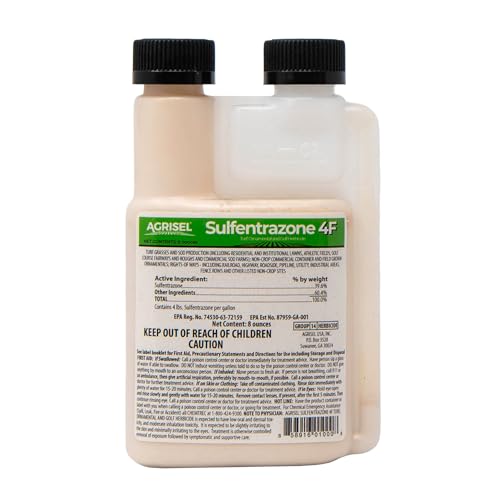
The specialist that nukes wild onions and sedge in days, not weeks.
If your yard is plagued by wild onions, garlic, nutsedge, or thistle — weeds that laugh at many general-purpose sprays — this is the one. Buyers report it kills wild onions and garlic, turning them brown or yellow by day two, and thistle goes black the very next day. That is noticeably faster than mesotrione-based products, which take two to three weeks for full kill. The active ingredient sulfentrazone acts through both root and leaf absorption, stopping over 100 weed types, and also works as a pre-emergent by targeting seeds as they germinate.
At just 8 fluid ounces, this bottle covers about 2,500 square feet, versus 2,000 square feet for either of the mesotrione options. The “Tip and Pour” bottle design makes measuring easy, but you do need your own sprayer — the product does not include one. Some reviewers noted that applying too heavily can damage fescue grass, so stick to the suggested rate of 1.5 teaspoons per gallon with a surfactant for the best balance of weed kill and turf safety.
It is the most premium-priced option here, but for the specific weeds it targets, buyers consistently call it worth it. One reviewer summed it up simply: “Yes, you need this in your yard arsenal.”
Fast Acting on Tough Targets
- Visible results on wild onions and thistle in 1-2 days
- Covers 2,500 sq ft — the best coverage per bottle
- Controls 100+ weed species including sedges
- Effective as both pre and post emergent
Things to Watch
- No sprayer included — you provide your own
- Can damage fescue if applied at too high a rate
- Premium price point
Reach for this when: your main weed problems are wild onions, garlic, nutsedge, or thistle and you want results measured in days, not weeks.
Look elsewhere if: you need a simple hose-end sprayer or your primary target is crabgrass — mesotrione is a better fit for that.
2. Mesotrione – 16 Ounces – (Compare to Tenacity)

A 16-ounce mesotrione bottle instead of the bundle’s 8-ounce bottle — more liquid for roughly the same money.
This 16-ounce bottle of mesotrione is the value king among the concentrated options. It gives you 16 ounces of product versus 8 ounces for the Liquid Harvest bundle, yet it costs only a bit more. It covers 2,000 square feet and targets 46 broadleaf species and grasses including crabgrass, clover, dandelion, and chickweed. One reviewer noted crabgrass died in about two weeks, with the bleached remains gone in a month, calling it “85% effective after reapplication.”
The trade-off is the temporary white bleaching effect — the herbicide turns both weeds and grass white for about three weeks as it disrupts photosynthesis. Your grass fully recovers after a couple of mowings, but the look is jarring if you are not expecting it. This product works on most cool-season lawns (Kentucky Bluegrass, Tall Fescue, Perennial Ryegrass) and also on St. Augustine sod, but you must avoid using it on active Bermudagrass, Zoysia, or Bentgrass unless you want bare patches.
You will need to add a surfactant and a dye for best results, as several reviewers mentioned. Activation requires water within 10 days — if it does not rain, you need to water in 0.15 inches. Buyers repeatedly note it is the same active ingredient as the brand-name Tenacity, but at a better price point, so you are not losing performance.
The Upside
- 16 fl oz versus 8 fl oz for the smaller bundle
- Effective on crabgrass, clover, and 46 weed types
- Fits a wide range of cool-season and St. Augustine lawns
- Same active ingredient as Tenacity, fraction of the cost
The Catch
- Temporary white bleaching on turf for ~3 weeks
- Requires a surfactant and dye for even application
- Needs water activation if no rain within 10 days
Best overall value: for homeowners with cool-season grass who want the most product for their money and can tolerate a short bleaching phase for thorough weed control.
skip it if: your lawn is Zoysia, active Bermudagrass, or Bentgrass, or you cannot stand the white look while the grass recovers.
3. Liquid Harvest Mesotrione Bundle – 8 Ounces
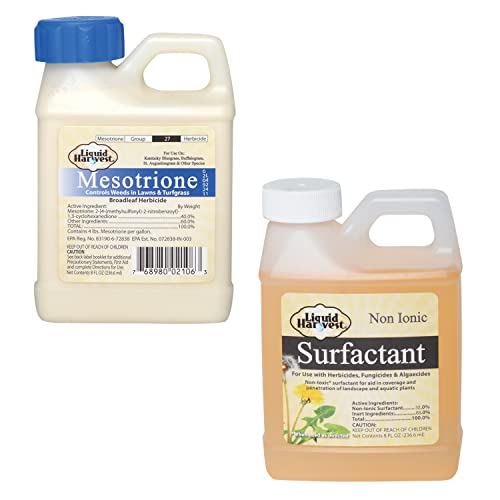
Comes with surfactant included — everything you need in one bag.
This bundle takes the guesswork out of mixing. It pairs an 8-ounce bottle of mesotrione concentrate with an 8-ounce bottle of surfactant, so you do not have to buy a separate product to help the herbicide stick to the leaves. Owners mention it kills clover, creeping Charlie, and crabgrass effectively, though the same temporary whitening occurs as with the larger bottle. The bundle covers 2,000 square feet, the same as the 16-ounce bottle, and the mesotrione bottle is 8 ounces versus 16 ounces for the larger bottle.
The formula is versatile enough for Kentucky Bluegrass, Centipede, Buffalo, Tall Fescue, Perennial Ryegrass, Fine Fescue, and St. Augustine (sod only). Avoid it on Bentgrass, Poa annua, Kikuyugrass, Zoysiagrass, seashore paspalum, and Bermudagrass unless the lawn is fully dormant. A few buyers mentioned the surfactant leaked a little during shipping, but that is an occasional packaging issue rather than a product flaw.
One reviewer with a 5,000 square foot lawn called it “cost-effective” at 1 teaspoon per gallon, and noted that after treating in 2024, he only needed minimal spot spraying in 2025. That is the pre-emergent benefit working — fewer weeds sprouting the following season.
What You Get
- Includes surfactant — no extra purchase needed
- Kills clover, creeping Charlie, crabgrass effectively
- Covers 2,000 sq ft
- Works on most common cool and warm season grasses
What To Note
- Only 8 fl oz of mesotrione versus 16 fl oz for the larger bottle
- Temporary whitening during recovery phase
- Surfactant can sometimes leak in transit
Great starting point: if you have never used mesotrione before and want the surfactant included with no separate shopping trip.
Go bigger if: you have a larger lawn or prefer a single purchase that lasts multiple seasons — the 16-ounce bottle gives you double the active ingredient.
4. Sunday Weed & Green
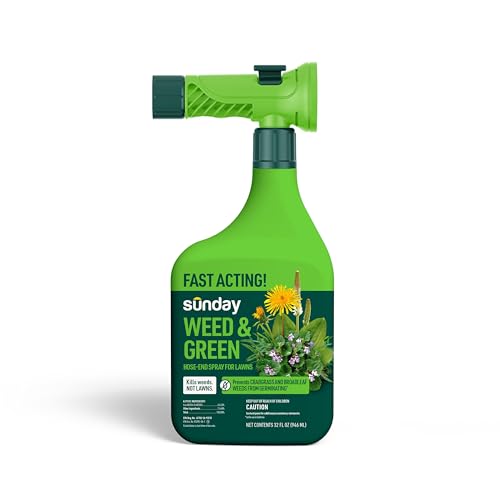
Hose and spray — no mixing, no measuring, no surfactant needed.
If the thought of mixing concentrates and measuring teaspoons puts you off, this is your product. The Sunday Weed & Green comes with a hose-end sprayer, so you just attach it, turn on the water, and spray. It uses chelated iron (FeHEDTA) instead of a synthetic chemical, so it greens up your lawn while killing weeds like dandelion, oxalis, white clover, chickweed, thistle, and plantain. One buyer mentioned, “The weeds turn dark and die,” confirming it works on visible growth.
The coverage is the tightest here at 1,250 square feet, which means it is best suited for smaller yards or targeted spot treatments. The formula also suppresses common lawn diseases like dollar spot, rust, and snow mold. Because it relies on iron rather than a systemic herbicide, it is gentler on the environment and safer for pets once dry — but that also means it is less potent on large, established weeds. A few reviewers had the opposite experience, with one finding it “zero effectiveness” on their weeds, so your mileage depends on weed size and type.
This is the entry-level option in terms of price, and it fits a specific niche: the casual homeowner who wants convenience and a quick green-up without the complexity or the temporary white bleaching that mesotrione causes. If your yard is small and your weeds are young, this is a solid pick.
Why It Stands Out
- Included hose-end sprayer — no mixing or measuring
- High-iron formula greens the lawn while killing weeds
- Suppresses lawn diseases like dollar spot and rust
- No bleaching phase — grass stays green
Limitations
- Only covers 1,250 sq ft — smaller than any concentrate
- Less effective on large or established weeds
- Mixed reviews on long-term results
Best for convenience seekers: small-yard owners who want a simple spray-and-go solution without harsh chemicals and do not mind re-treating tough spots.
Not for heavy infestations: if your lawn is full of mature crabgrass or deep-rooted perennials, a concentrated mesotrione or sulfentrazone product will work better.
Understanding the Specs
Mesotrione — The Whitening Herbicide
Mesotrione works by blocking a key enzyme in the photosynthesis pathway of weeds. The plant starves and turns white over two to three weeks before dying. It is excellent for crabgrass prevention and broadleaf control but temporarily bleaches desirable turfgrass too. It requires a surfactant (a soap-like substance that helps the spray stick to leaf surfaces) and activation by rain or watering within 10 days. Safe for most cool-season lawns and St. Augustine sod, but toxic to Bermudagrass, Zoysia, and Bentgrass if applied during active growth.
Sulfentrazone — The Fast-Acting Specialist
Sulfentrazone disrupts cellular processes in weeds, causing rapid wilting and death — visible in as little as one to two days on sensitive species like wild onions and thistle. It kills through both root and leaf uptake and also prevents seed germination, making it a true dual-action product. It covers a broader range of weeds (100+ species) than mesotrione and is generally safer on a wider range of turf types, but it can still injure grass if applied at too high a rate. It works best when soil temperatures are between 55°F and 75°F.
FAQ
What is the difference between pre-emergent and post-emergent herbicide?
Will mesotrione kill my grass?
How long does it take for sulfentrazone to work?
Can I use a pre and post emergent on St. Augustine grass?
Do I need a surfactant with mesotrione?
How often should I reapply a dual-action herbicide?
Is the Sunday Weed & Green safe for pets?
Why do my weeds turn white before they die?
Can I mix mesotrione with other herbicides?
What is the best time of year to apply a pre and post emergent?
Final Thoughts: The Verdict
Across the board, the pre and post emergent herbicide winner is the Mesotrione 16 oz (Compare to Tenacity) because it delivers the same active ingredient as the brand-name product at a lower price, covering 2,000 square feet with a 16-ounce bottle versus the smaller bundle’s 8-ounce bottle. If your yard is plagued by wild onions or thistle, grab the Agrisel Sulfentrazone 4F for fast, targeted results. And for small yards where convenience matters more than concentration, the Sunday Weed & Green makes weed control as simple as watering the lawn.
How We Picked
We do not accept paid placement. Every pick is matched to a real buyer and a real use-case; we do not hands-on test units.
Sources & Methodology
Specifications: manufacturer listings and product documentation. Review insights: verified customer reviews, as of July 2026. Pricing: not shown on this page (it changes often); check the current price via the retailer link.
As an Amazon Associate, Lawn Gear Lab earns from qualifying purchases. This does not affect which products we feature.