
Specs are compiled from manufacturer listings and verified buyer reviews and can change over time — please confirm the key details on the product page before buying.
You water your cucumber vines every day, and they still produce leaves but very few actual fruit. Or the leaves turn yellow no matter what you do. The problem is usually in the soil — your plants need a specific balance of nutrients that general-purpose fertilizers often get wrong. Choosing the right ratio of nitrogen (N), phosphorus (P), and potassium (K) — called the NPK ratio — and deciding between a fast-acting liquid or a low-maintenance granule is what turns a handful of cucumbers into a full harvest basket.
I’m Rikta, the writer behind Lawn Gear Lab. This guide uses the manufacturers’ published specs and patterns from verified customer reviews. You get each pick’s real strengths and trade-offs, not marketing spin.
Choosing the best cucumber fertilizer means matching the NPK ratio to your plant’s growth stage, picking liquid or granular form, and deciding whether organic or synthetic ingredients suit your garden.
Quick Picks
- Growth Technology GT Vegetable Focus – Premium Liquid Plant Nutrient — Complete Formula
- Osmocote Smart-Release Plant Food Flower & Vegetable – 14-14-14 NPK — Best Overall
- 2.25lb Tomato & Vegetable Plant Food Fertilizer Triple Play 8-8-8 (Purely Organic) — Gentle Organic
- Easy Gardener Vegetable Fertilizer Spikes – OMRI Listed — Mess-Free Spike
- Fox Farm Big Bloom Liquid Plant Food – Organic Liquid Concentrate — Bloom Booster
- Bloom City Tomato & Veggie Plant Food – Liquid Concentrate, 32 oz — Budget Fresh
- Miracle-Gro Watering Can Singles All Purpose Water Soluble Plant Food – 24 Packets — Quick Fix
How To Choose The Best Cucumber Fertilizer
Cucumbers are heavy feeders — they pull a lot from the soil in a short growing season. Getting it right means understanding the three numbers on the bag (NPK), how the nutrients are released, and whether the ingredients fit your style. Here is what to look for.
The NPK Ratio
The three numbers on the label stand for Nitrogen (N), Phosphorus (P), and Potassium (K) — in that order. Nitrogen fuels leafy growth early on. Phosphorus and potassium support flowers and fruit. For cucumbers, a balanced ratio like 8-8-8 or 14-14-14 works at planting and during early growth. Once the plant starts flowering, switch to a formula lower in nitrogen and higher in phosphorus and potassium to push fruit instead of leaves.
Release Speed: Liquid vs. Granular
Liquid fertilizers, like those you mix into a watering can, go to work within hours — your cucumber plants get nutrients immediately. That is great for a quick boost, but you must mix and apply every 7 to 14 days. Granular slow-release options, like Osmocote or plant spikes, feed continuously over weeks or months. They are forgiving if you forget to fertilize, but they take a few days to start working because soil microbes or water must break them down first.
Organic vs. Synthetic Ingredients
Organic fertilizers get their nutrients from natural sources like earthworm castings, bat guano, or processed plant proteins. They improve soil health over time and are less likely to burn roots if you over-apply. However, they may release nutrients more slowly. Synthetic fertilizers, like the water-soluble Miracle-Gro Singles, are lab-formulated for a precise NPK ratio and deliver fast, visible results — one reviewer noted a dramatic revival of struggling pepper plants within days. Choose organic for long-term soil structure; choose synthetic for a fast, controlled feed.
Quick Comparison
| Model | Best For | NPK Ratio | Item Form | Coverage | Amazon |
|---|---|---|---|---|---|
| Growth Technology GT Vegetable Focus | Complete mineral nutrition | — | Liquid | Full | Amazon |
| Fox Farm Big Bloom Liquid Plant Food | Organic bloom support | 0-0.5-0.7 | Liquid | Full | Amazon |
| Osmocote Smart-Release Plant Food | Set-and-forget feeding | 14-14-14 | Granules | 40 sq. ft. | Amazon |
| Purely Organic Triple Play 8-8-8 | Gentle organic no-odor | 8-8-8 | Granules | 250 sq. ft. | Amazon |
| Bloom City Tomato & Veggie Plant Food | Garden beds & containers | — | Liquid | Medium | Amazon |
| Miracle-Gro Watering Can Singles | Quick instant feeding | — | Soluble powder | 10 sq. ft. per packet | Amazon |
| Easy Gardener Vegetable Fertilizer Spikes | Mess-free organic feeding | — | Sticks | 8 weeks per spike | Amazon |
In‑Depth Reviews
1. Growth Technology GT Vegetable Focus – Premium Liquid Plant Nutrient
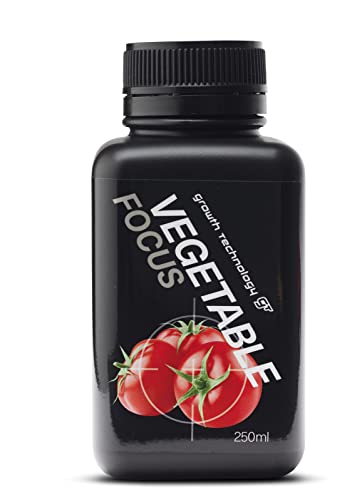
All 12 essential minerals in one liquid, including calcium — which most fertilizers leave out — so cucumbers avoid blossom-end rot.
Cucumbers often get blossom-end rot (a dark, sunken spot on the fruit) when calcium runs short. Growth Technology GT Vegetable Focus solves that by including all 12 essential minerals, including calcium, in a balanced liquid concentrate. Your cucumbers get the full spectrum they need for sturdy roots and productive fruit all season. It works in garden soil, raised beds, and containers, plus it mixes cleanly for hydroponics (growing in water without soil).
You adjust the dose by growth stage: use 5 to 7 milliliters per liter for hydroponics, or 3 to 5 milliliters per liter for soil and potting mix. Apply with every watering, then increase the dilution as your plants mature. The 8.45-fluid-ounce bottle concentrates more than most liquids at this price — one bottle goes a long way even for a full row of cucumbers. Unlike the simpler Osmocote granules, this is a start-to-finish liquid that covers every mineral base.
Full-spectrum nutrition: The 12-mineral profile, including calcium, directly tackles common cucumber issues like blossom-end rot and weak growth — a smarter option than simpler formulas like Fox Farm Big Bloom’s 0-0.5-0.7.
Measured approach needed: Best for gardeners comfortable with liquid measuring. Newer growers may prefer a no-mix granular at first.
Reach for this if: you want a single liquid fertilizer that follows your cucumbers from seedling to harvest, covering all mineral bases.
Look elsewhere if: you prefer a one-time scatter-and-forget granular, or you only want an organic-certified formula.
2. Osmocote Smart-Release Plant Food Flower & Vegetable – 14-14-14 NPK

Apply once at planting, and this 14-14-14 NPK granule feeds cucumbers for months with no mixing and almost zero risk of burning.
Osmocote is the original slow-release plant food. Its 14-14-14 NPK formula — the highest total nutrient formula Osmocote offers — supports strong roots and vigorous growth for cucumbers, tomatoes, and other seasonal vegetables. You apply one capful per 4 square feet, mix it into the top 1 to 3 inches of soil, and let soil temperature control the release. As the soil warms, the granules release more nutrients in natural sync with how fast your cucumber plant is growing. One pound covers 40 square feet, which is roughly a 6.5-foot by 6.5-foot bed. That is a tighter coverage than the Purely Organic Triple Play 8-8-8, which covers 250 square feet per bag, but Osmocote is all about simple to use slow-release.
A key safety net: Osmocote states it is mistake-proof when used as directed. Reviewers frequently mention this as a major plus — one buyer says, “I’m on my 3rd bag now and it seems to work great. I haven’t had it burn any plants.” A couple of users note the recommended amount can be too strong for very small pots and advise adjusting down. Still, for consistent, mistake-proof feeding, this tops the list for cucumber growers who want to apply once and forget it.
Set-and-forget simplicity: One application at planting keeps cucumbers fed all season — no mixing, no measuring each week. Ideal for busy or forgetful gardeners.
Pot-size caveat: in small containers, cut the dose slightly to avoid over-concentration.
Best for: the gardener who wants the lowest-maintenance route — apply once at the start and let the granules do the work for months.
skip it if: you need an immediately available nutrient boost for a plant that is already struggling; use a liquid formula instead.
3. 2.25lb Tomato & Vegetable Plant Food Fertilizer Triple Play 8-8-8 (Purely Organic)

An odor-free organic granule — buyers report it turned droopy yellow cucumbers green in two weeks, with 250 sq. ft. of coverage per bag.
Purely Organic uses a patented protein technology that avoids chicken manure entirely — meaning zero smell. That alone makes it much more pleasant to scatter around your cucumber patch compared to strong-smelling organic meals. The NPK is 8-8-8, a balanced ratio that supports both leaf growth and fruiting without overloading nitrogen. At 2.3 pounds, this bag covers up to 250 square feet — the largest coverage per pound among these granular picks. It is listed for tomatoes, fruit, vegetables, herbs, trees, and shrubs, so it is a single-bag solution for your whole garden. You get more ground covered than the Osmocote 14-14-14, which only covers 40 square feet per pound.
One buyer shared: a “dramatic turnaround for droopy, yellow tomato plants in raised planter after one sprinkle; turned green with more tomatoes in 2 weeks.” Cucumbers respond similarly — the low burn risk (no harsh ingredients) means you can sprinkle it around young transplants without worry. Another owner mentions their dogs ignore it, a small but real win for pet-owning gardeners.
What you get
- No chicken manure means no smell, even in hot weather
- Covers 250 sq. ft. per bag — the most ground per pound
- Shows visible results in about two weeks on struggling plants
The trade-off
- Slower nutrient release than synthetics; not for immediate rescue feeding
- Some may prefer a higher phosphorus ratio for heavy flowering
Grab this if: you garden organically, hate strong fertilizer smells, and want one gentle granule that works on cucumbers, tomatoes, herbs, and shrubs.
Pass if: you need a quick boost for already-stressed vines; choose a liquid option for speed.
4. Easy Gardener Vegetable Fertilizer Spikes – OMRI Listed

Push an OMRI-listed stick into the soil once, and it feeds cucumbers organically for eight weeks with zero measuring or spills.
If you dislike measuring, mixing, or spilling, spikes are your answer. Easy Gardener Vegetable Fertilizer Spikes are pre-measured sticks you push into the ground around your cucumber plants. They slowly release nutrients at the root zone for up to eight weeks. They are OMRI-listed (Organic Materials Review Institute — approved for organic food production). They promote microbial activity right where your cucumber roots can use it. Unlike the Osmocote granules that you mix into soil, these spikes are completely hands-off after insertion.
One reviewer used 4 spikes per plant instead of the recommended 8, and their vegetables still started appearing. They admit the plants needed more, but it shows the spikes are forgiving even at half-rate. Another gardener called them “vegetable steroids” for the growth speed. The only real catch: you must estimate how many spikes your cucumber patch needs before inserting them, because you cannot pull them back out easily. For a small backyard bed of 4 to 6 cucumber plants, this box is a clean, effective choice.
Truly hands-off feeding: Push into soil, water normally, and get eight weeks of steady organic nutrition. No measuring cups, no mixing, no cleanup.
One-shot placement: you cannot adjust the dose mid-season, so start with the per-plant recommendation from the label.
Perfect for: the gardener who wants the absolute simplest application — push and forget for two months.
Not for: large gardens requiring dozens of spikes; granules work out more economical at scale.
5. Fox Farm Big Bloom Liquid Plant Food – Organic Liquid Concentrate

Use this low-nitrogen liquid (0-0.5-0.7) once flowers appear, and owners mention it “doubles plant size” within 1–2 weeks.
Fox Farm Big Bloom is a liquid concentrate with an NPK of 0-0.5-0.7 — very low in nitrogen and higher in the phosphorus and potassium that support flowering and fruiting. The ingredients — earthworm castings and bat guano — are both organic and rich in micronutrients. Cucumbers in the flowering stage benefit from this formula because it encourages more blossoms and fruit instead of pushing leafy growth. Mix 4 tablespoons (60 milliliters) per gallon of water and apply every other watering. The 16-fluid-ounce bottle yields multiple batches. Unlike the 10.24-ounce Miracle-Gro singles, this is a full liquid concentrate with 56% more volume to mix up.
Reviewers consistently note its effect — one user says it “doubles plant size” when used every 1 to 2 weeks. A couple of buyers mention the liquid requires vigorous shaking before use because the guano and castings settle, but they agree the results justify the extra shake. For cucumbers, use this as a bloom-stage booster after the plants have good foliage from a balanced early-season fertilizer like the Osmocote 14-14-14.
Strengths
- Organic ingredients feed soil microbes, improving long-term soil health
- Low NPK (0-0.5-0.7) targets flowering without burning roots
- Easy to mix into watering can or hose-end sprayer
Caveats
- Must shake bottle frequently to keep particles suspended
- Needs a balanced fertilizer partner early in the season
Choose this: to give your flowering cucumber vines an organic push with more phosphorus and potassium without piling on nitrogen.
Skip it: if you want a complete feeding solution from planting to harvest; Big Bloom is a booster, not a full-season solo product.
6. Bloom City Tomato & Veggie Plant Food – Liquid Concentrate, 32 oz

You get 32 fluid ounces of liquid concentrate — double the volume of Fox Farm Big Bloom and more than three times the Miracle-Gro singles — at a competitive price.
Bloom City packs 32 fluid ounces of liquid concentrate into one bottle. That is double the 16 ounces of the Fox Farm Big Bloom and more than three times the 10.24 ounces of the Miracle-Gro singles. The recommended mixing ratio is 2 ounces per gallon of water, so a single bottle lasts through most of the cucumber growing season. It is formulated for tomatoes and common garden vegetables, including cucumbers, with a balanced nutrient profile that supports steady growth without overstimulation.
One first-time tomato grower says the product helped their plant “thrive and produce tons of delicious beefsteak tomatoes” and noted the bottle still had plenty for next year. Another reviewer did not see a noticeable difference compared to their usual granular food, though they appreciated the easy liquid application. For cucumbers in raised beds or containers, this liquid feeds quickly with no mixing fuss — just stir into a watering can and pour.
High volume for the price: 32 ounces at a competitive rate means fewer bottle runs during the season. Works well in garden beds and potted plants.
Mixed results on potency: some users saw clear gains, while others found it comparable to their standard granular food — expect steady support rather than dramatic transformation.
Best for: container gardeners and raised-bed growers who want a large supply of easy-to-use liquid feed without frequent repurchasing.
Consider alternatives if: you are looking for a slow-release solution or an organic-certified formula.
7. Miracle-Gro Watering Can Singles All Purpose Water Soluble Plant Food – 24 Packets
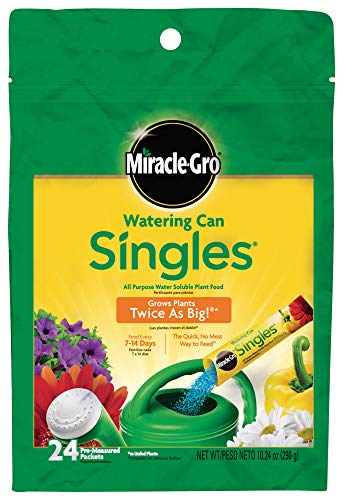
Tear open a pre-measured packet, pour it into your watering can, and feed 10 square feet instantly — with 24 packets per box.
Miracle-Gro Watering Can Singles are individual pre-measured packets of water-soluble powder. Each packet covers 10 square feet of garden or container space. The box contains 24 packets. You simply tear one open, pour it into a watering can, add water, and feed your plants while watering. Reapply every 7 to 14 days. The formula is all-purpose, working on cucumbers, tomatoes, flowers, houseplants, trees, and shrubs — you can use the same box across your entire garden. At 8 ounces total weight, it is one of the lightest options, but its convenience per packet is class-leading.
One buyer mentioned: “synthetic fertilizer revived struggling pepper plants with insane growth,” and found that using half-strength — one packet per 2 gallons instead of per 1 gallon — kept aphids away better than organic alternatives. Another long-time user likes the single-packet ease for weekly feeding on summer flowers. The catch is the per-use cost: 24 packets run out faster than a concentrated bottle like the Bloom City 32-ounce liquid, so for a large cucumber patch, you may want a concentrate or granular instead.
Why you’d pick it
- Zero measuring — each packet is pre-portioned for 1 gallon
- Portable enough to keep in your garden tool caddy or take on trips
- Works instantly for a quick rescue feed on struggling plants
Why you might not
- Small packets add up fast for large gardens or full-season feeding
- Not organic or slow-release; requires weekly or biweekly reapplication
Great for: the small-space cucumber grower who wants grab-and-go convenience — no scoops, no spills, just tear and water.
Not ideal for: large vegetable plots or any gardener who prefers a single application that lasts the season.
Understanding the Specs
NPK Ratio
The three numbers stand for Nitrogen (N), Phosphorus (P), and Potassium (K) — in order. Nitrogen drives leaf and vine growth. Phosphorus supports flowers, fruit development, root growth, and energy transfer. Potassium helps with overall plant health, disease resistance, and water regulation. For cucumbers, a balanced ratio like 8-8-8 works from planting through early growth, while a formula lower in nitrogen and richer in phosphorus and potassium (like Fox Farm’s 0-0.5-0.7) is better once the plant starts producing blossoms.
Release Mechanism
Liquid concentrates and soluble powders (like Miracle-Gro Singles and Fox Farm Big Bloom) enter the soil immediately — your cucumber roots can take up nutrients within hours. Slow-release granules (like Osmocote’s 14-14-14) and spikes (like Easy Gardener’s) use a coating or physical form that releases nutrients gradually over weeks or months as soil moisture and temperature break them down. Liquids give you faster, more controllable feeding but require frequent reapplying. Slow-release options are less work but do not provide an instant rescue for plants that are already struggling.
FAQ
What is the best NPK ratio for cucumbers?
Should I use liquid or granular fertilizer for cucumbers?
How often should I fertilize cucumber plants?
Can I use a tomato fertilizer on cucumbers?
What is the difference between organic and synthetic cucumber fertilizer?
Will cucumber fertilizer burn my plants if I use too much?
Can I use cucumber fertilizer in containers and raised beds?
How long does a bag or bottle of cucumber fertilizer last?
Should I fertilize cucumbers when they are already fruiting?
Is slow-release or fast-release fertilizer better for cucumbers?
Final Thoughts: The Verdict
For most gardeners, the best cucumber fertilizer is the Osmocote Smart-Release Plant Food — one application at planting, and its 14-14-14 NPK feeds your plants steadily for months with no mixing and a very low risk of burning. If you prefer an organic option with zero odor and a proven track record of turning around struggling vines, grab the Purely Organic Triple Play 8-8-8. And for quick, concentrated feeding during the critical flowering and fruiting stage, the Fox Farm Big Bloom Liquid Plant Food gives your cucumber vines the phosphorus and potassium boost they need without pushing excessive leaf growth.
How We Picked
We do not accept paid placement. Every pick is matched to a real buyer and a real use-case; we do not hands-on test units.
Sources & Methodology
Specifications: manufacturer listings and product documentation. Review insights: verified customer reviews, as of July 2026. Pricing: not shown on this page (it changes often); check the current price via the retailer link.
As an Amazon Associate, Lawn Gear Lab earns from qualifying purchases. This does not affect which products we feature.