
Specs are compiled from manufacturer listings and verified buyer reviews and can change over time — please confirm the key details on the product page before buying.
You spend weeks nursing your tomatoes or blueberries, and then a flock of birds strips the whole harvest in one morning. Bird netting is the only physical barrier that stops this without chemicals or traps, but the wrong net tangles instantly, tears within a season, or lets small pests slip through. You need one that protects your crops without adding more frustration to your gardening day.
I’m Rikta — the founder and writer behind Lawn Gear Lab. This guide is built by comparing the manufacturers’ published specifications and the patterns across verified customer reviews, so you get each pick’s real strengths and trade-offs instead of marketing spin.
The five picks below cover every common garden size, mesh density, and price tier so you can match the protection to your specific beds and trees. Let’s find the bird netting for garden that will keep your crops safe all season long.
Quick Picks
- RIFNY Garden Netting, 2 Pack 10x33Ft Ultra Fine Mesh — Best Overall
- JUNKOGO Bird Netting 25×25 Ft, 1/2In Mesh Heavy Duty — Heavy Guardian
- Bird Netting for Garden – 13 x 40 FT Heavy Duty Anti Bird Netting Mesh — Best Coverage
- GWHOLE 33 x13 Ft Bird Netting for Garden Tree and Plant Protection — Budget Champion
- SnugNiture Garden Netting 10x33FT Ultra Fine Mesh — Light Duty
How To Choose The Best Bird Netting For Garden
Picking the right netting depends on three decisions: what mesh size you need, how much area to cover, and what material will hold up through your local weather. Get these right and you avoid nets that tangle or rip, while matching the mesh to the pests you need to block.
Mesh Size: The Only Real Decider
This is the most important spec by far. A 1-inch mesh blocks birds and animals while still allowing sunlight, rain, and air through. A 1/2-inch mesh blocks nearly all birds and small rodents, but still lets bees and sunlight reach your plants. An ultra-fine mesh (0.04 inches) stops even insects and mosquitoes, but it cuts down air circulation slightly.
Material and Durability
Nylon monofilament is light, stretches a bit under weight, and resists UV (ultraviolet sunlight) for a few seasons. Polyethylene (PE) is waterproof and cheap, but can get brittle in direct sun over time. High-Density Polyethylene (HDPE) is the toughest option — it resists tearing from squirrels and stays flexible through temperature swings. If you want the net to last more than two years, lean toward HDPE or premium nylon.
Coverage Area and Weight
Bigger is not always better if you are draping a single raised bed. A 10×33-foot roll covers multiple rows, but a 25×25-foot square is better for a whole orchard section. Heavier netting (over 1.5 kg) stays in place better in wind, so it does not blow off your plants. Lighter netting (below 0.5 kg) is easier to handle but may need extra stakes or rocks to hold it down.
Quick Comparison
| Model | Best For | Mesh Size | Coverage | Weight | Amazon |
|---|---|---|---|---|---|
| RIFNY Garden Netting 2 Pack | Ultra-fine insect & bird protection | 0.04 in | 2 x 10×33 ft | 1.08 kg | Amazon |
| JUNKOGO Bird Netting 25×25 Ft | Small rodent & bird defense | 1/2 in | 25×25 ft | 1.62 kg | Amazon |
| RIFNY Bird Netting 13×40 Ft | Large fruit tree coverage | 5/8 in | 13×40 ft | 0.65 oz/yd² | Amazon |
| GWHOLE 33×13 Ft Bird Netting | Budget-friendly all-rounder | 1 in | 33×13 ft | 0.49 kg | Amazon |
| SnugNiture Garden Netting 10x33FT | Lightweight temporary barrier | Ultra fine | 10×33 ft | 1.2 lb | Amazon |
In‑Depth Reviews
1. RIFNY Garden Netting, 2 Pack 10x33Ft Ultra Fine Mesh

You get two separate 10×33-foot nets in one package, so you can cover two large beds without buying extra rolls.
The ultra-fine mesh (0.04 inches) is dense enough to block insects, mosquitoes, and even small chipmunks, yet its oblong holes let water and air pass through freely — you do not need to remove the netting when you water. It is made from stabilized polyethylene (PE) that holds up well for reuse season after season, provided you fold it out of direct sunlight when not in use. Unlike the 1-inch GWHOLE net below, this ultra-dense mesh is the right pick if you are also fighting insect pests, not just birds.
Buyers report that the lightweight material does not burden delicate plant buds, and the white mesh lets you clearly observe how your crops are growing underneath. The catch is that the fine weave reduces a bit of airflow compared to an open 1-inch square mesh, so it is best for crops that prefer sheltered conditions.
Why it stands out
- Two 10×33-foot nets for wide coverage, while the GWHOLE comes as 1 net.
- Ultra-fine 0.04-inch mesh blocks insects, mosquitoes, and tiny pests other nets miss.
- Oblong hole design lets you water and feed plants right through the mesh.
A honest caveat
- The fine weave slightly restricts airflow compared to a 1/2-inch or 1-inch diamond mesh.
- PE material can become brittle if stored in direct sunlight or humidity.
Reach for this if… you want a single purchase that covers pest birds, insects, and mosquitoes all at once across two large beds.
Look elsewhere if… you only need a quick barrier for fruit trees and do not care about stopping insects — a larger single roll like the 13×40 ft RIFNY will cost less per square foot.
2. JUNKOGO Bird Netting 25×25 Ft, 1/2In Mesh Heavy Duty

At 1.62 kilograms versus the 0.49-kilogram GWHOLE net, this 25×25-foot net stays put in wind and resists chewing from squirrels.
That heft comes from High Density Polyethylene (HDPE) — the toughest material here — which resists tearing from squirrels and raccoons far better than basic nylon or PE nets. The diamond-shaped 1/2-inch mesh blocks pigeons, rabbits, and even opossums while letting you water your plants directly through the holes without removing the net. This 1/2-inch mesh is tighter than the 5/8-inch on the 13×40 foot RIFNY net below, so it is the better pick if you want a smaller opening.
However, because the net is diamond-shaped, stretching it in different directions can change its length and width. The maker notes this is normal, not a defect, but you should plan for a bit of give when draping it over a trellis or arch.
What makes it tough
- 1/2-inch mesh blocks birds, rabbits, squirrels, and raccoons — tighter than any other net here except the ultra-fine.
- HDPE material is extra strong against tearing and chewing, unlike standard PE nets.
- Large 25×25-foot square area covers a whole orchard or multiple raised beds.
A thing to watch
- At 1.62 kilograms it is noticeably heavier, so it may require extra stakes to hold in place.
- Diamond shape can shift dimensions when stretched, which may throw off a precise fit.
Choose this for… a full-season heavy-duty barrier against birds and small rodents in a large garden or orchard that needs the tightest animal-proof mesh.
Pass if… you are covering delicate young seedlings that could be flattened by the net’s weight — the lighter SnugNiture or GWHOLE net is gentler.
3. Bird Netting for Garden – 13 x 40 FT Heavy Duty Anti Bird Netting Mesh
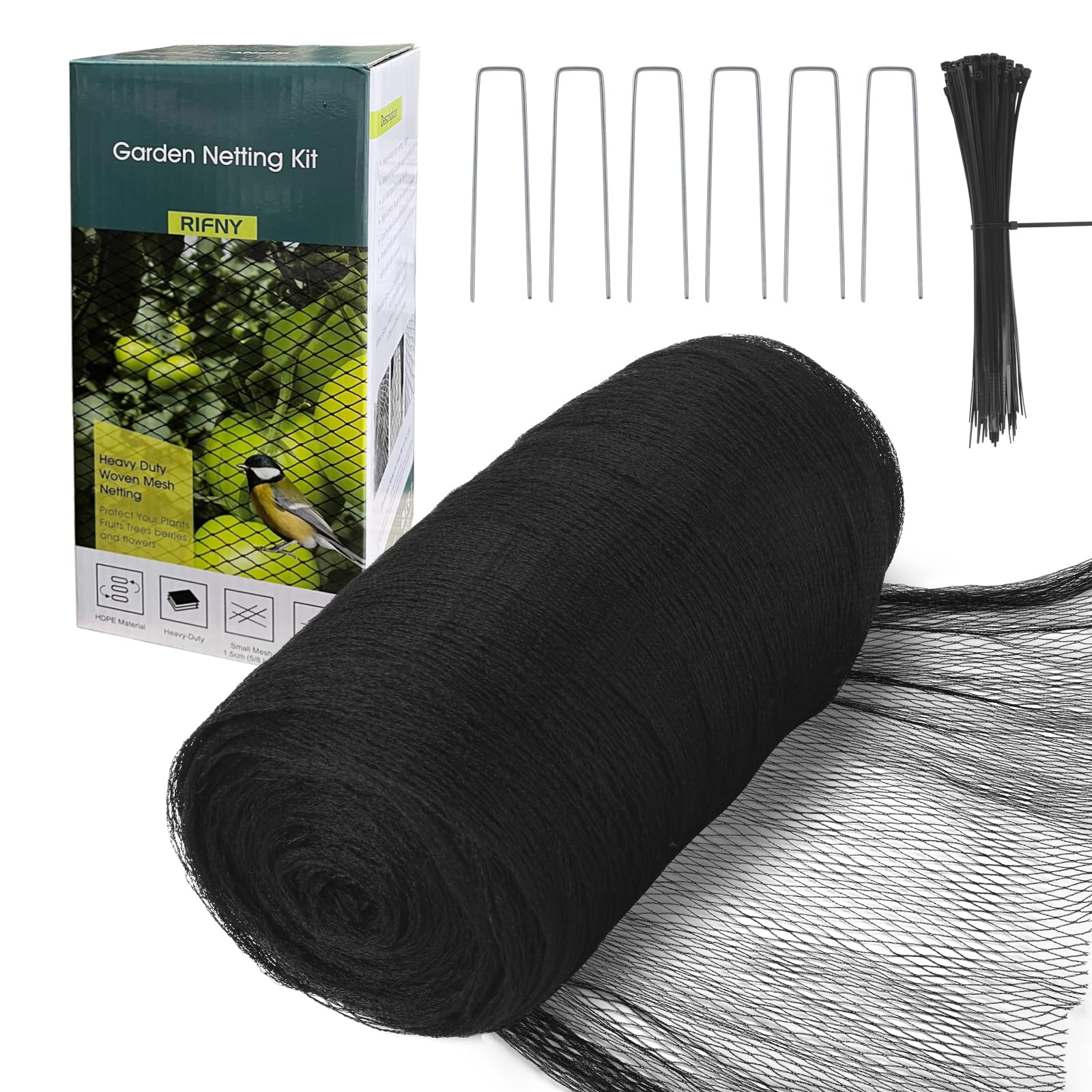
At 40 feet long by 13 feet wide, versus 25×25 feet for the JUNKOGO net, it lets you wrap entire fruit tree rows without splicing pieces together.
The 5/8-inch mesh sits right between the tight 1/2-inch and the standard 1-inch, stopping birds, poultry, deer, and squirrels while still letting plenty of light and rain through. The net weighs just 0.65 ounces per square yard, so it is light enough to drape over tall fruit trees without breaking branches. Owners mention this netting is “fabulous” and that it “doesn’t tangle or tear” and keeps birds and small critters out — one reviewer has reordered it four times.
It comes with 6 landscape staples (7 inches long) and a pack of twist ties, which is a welcome bonus because most nets sell those separately. The trade-off is that the 5/8-inch mesh is not as tight as the 1/2-inch JUNKOGO, so the tiniest rodents might still get through, but for birds and squirrels it is more than enough.
What you get
- 13×40-foot roll covers tall fruit trees or long raised rows in one run, versus 25×25 feet for the JUNKOGO net.
- Light 0.65 oz/yd² fabric does not break branches or crush plants.
- Includes 6 landscape staples and twist ties for immediate installation.
One thing to check
- 5/8-inch mesh may let small chipmunks or baby squirrels through if they are determined.
- You need to cut carefully to avoid running short on a deep wrap around a large tree.
Ideal for… wrapping long rows of fruit trees or full vegetable beds with a single piece of netting that will not tangle or tear in wind.
Skip if… you need to stop insects or tiny rodents — then the ultra-fine RIFNY 2-pack or the 1/2-inch JUNKOGO is a better fit.
4. GWHOLE 33 x13 Ft Bird Netting for Garden Tree and Plant Protection

At 0.49 kilograms versus 1.62 kilograms for the 25×25-foot JUNKOGO net, this 33×13-foot net is the easiest to handle and the most affordable pick here.
The 1-inch mesh is the widest in this lineup, and the maker says the 1×1 inch square mesh blocks birds and animals from damaging crops. It is made from nylon monofilament with UV (ultraviolet) resistance, so the maker claims it holds up against sun and rain across multiple seasons. Buyers have found a surprising secondary use: one reviewer uses it as a cat barrier for a guinea pig cage, saying it “stretches under weight but never broke despite biting/clawing.”
Another reviewer replaced their balcony screen with it to keep their cats from jumping. That is proof of the nylon’s durability, but for dedicated garden bird defense, the 1-inch mesh is simply not as thorough as the 1/2-inch or 5/8-inch options above.
Why it wins on value
- Lightest weight at 0.49 kg makes it easy to unroll, cut, and reposition over plants.
- UV-resistant nylon monofilament — according to the maker, it withstands sun and storms for multiple seasons.
- Buyers confirm it doubles as a pet barrier without tearing under pressure.
The obvious trade-off
- 1-inch mesh is not effective against small insects.
Grab this for… a budget-friendly bird barrier that is easy to handle and also works as a pet or balcony screen.
skip it if… you are dealing with persistent small birds or squirrels — you need a tighter 1/2-inch or 5/8-inch mesh like the JUNKOGO or the 13×40 foot RIFNY net.
5. SnugNiture Garden Netting 10x33FT Ultra Fine Mesh

At 1.2 pounds, this lightweight option is easy to drape directly over young plants.
You get a 10×33-foot roll of ultra-fine mesh netting made from polyethylene (PE). The white mesh is see-through, so you can monitor growth without lifting it. The ultra-fine weave is dense enough to block mosquitoes and insects, not just birds, which makes it a versatile option if you also have flying pests in your garden. You can cut this net to any size you need, and you set it by laying it flat over plants and burying the edges with stones, soil, or nails.
Because the material is PE rather than nylon or HDPE, it is waterproof and sunproof at first, but may become brittle after a couple of years of direct exposure. It is a solid entry-level roll for a small garden, but it does not have the tear-resistance or rodent-proofing of the heavier JUNKOGO or the 13×40 foot netting.
Good for starters
- Ultra-light at 1.2 pounds, gentle on delicate shoots and buds.
- Ultra-fine mesh blocks insects and mosquitoes alongside birds.
- Can be cut to any size without fraying or unravelling.
Limits to know
- PE material is less durable than nylon or HDPE — expect 1-2 seasons of heavy use.
- Not strong enough to resist chewing from squirrels or determined raccoons.
Best for… a first-time gardener covering a small bed who wants insect and bird protection at the lowest entry cost.
Not for… anyone who needs a multi-year, heavy-duty barrier against squirrels and rodents — that is the JUNKOGO HDPE net’s territory.
Understanding the Specs
Mesh Size (inches)
This is the gap between threads in the net. A 1-inch mesh blocks birds and animals while still allowing water, air, and sunlight through. A 1/2-inch mesh is tighter and blocks nearly all birds, rabbits, and squirrels. An ultra-fine mesh (0.04 inches) stops even mosquitoes and insects — but it also cuts down airflow a little. Pick the size that matches the pests you actually have in your garden.
Material Type
Nylon monofilament is lightweight and UV-resistant, stretching under weight without breaking. PE (polyethylene) is waterproof and cheap but can get brittle after a few seasons of direct sun. HDPE (High Density Polyethylene) is the toughest in the group — it resists chewing from squirrels and stays flexible in heat and cold. If you want the net to last more than two years, lean toward HDPE or reinforced nylon.
FAQ
Will 1-inch mesh bird netting keep out squirrels?
How do I keep bird netting from tangling?
Can I leave bird netting on my plants all winter?
Does bird netting let rain and sunlight through?
How do I install bird netting over a raised bed?
Will bird netting hurt the birds if they fly into it?
How many seasons does a PE net last?
Can I use bird netting for strawberries and blueberries?
Final Thoughts: The Verdict
For most gardeners, the bird netting for garden winner is the RIFNY Garden Netting 2 Pack because you get two ultra-fine mesh nets that block birds, insects, and mosquitoes in one purchase. If you want the toughest rodent-proof barrier, grab the JUNKOGO Bird Netting 25×25 Ft with its heavy HDPE material and tight 1/2-inch mesh. And for covering long fruit tree rows with a single tangle-free roll, the 13×40 FT Bird Netting includes staples and ties for immediate setup.
How We Picked
We do not accept paid placement. Every pick is matched to a real buyer and a real use-case; we do not hands-on test units.
Sources & Methodology
Specifications: manufacturer listings and product documentation. Review insights: verified customer reviews, as of July 2026. Pricing: not shown on this page (it changes often); check the current price via the retailer link.
As an Amazon Associate, Lawn Gear Lab earns from qualifying purchases. This does not affect which products we feature.