
Specs are compiled from manufacturer listings and verified buyer reviews and can change over time — please confirm the key details on the product page before buying.
Walking past drooping leaves or yellowing stems day after day is frustrating — especially when you are not sure if you are underwatering, overwatering, or simply starving your plants of the right nutrients. The real challenge with plant food is cutting through the alphabet soup of NPK ratios, application methods, and organic labels to find the one formula that actually fits what you grow and how you grow it.
I’m Rikta — the founder and writer behind Lawn Gear Lab. This guide is built by comparing the manufacturers’ published specifications and the patterns across verified customer reviews, so you get each pick’s real strengths and trade-offs instead of marketing spin.
For most people, the winner is the HiThrive 16oz liquid (6-2-4 NPK): it makes 85+ gallons of feed from one compact bottle, covers nearly every common houseplant, and requires just 1 teaspoon per gallon — simple enough for a beginner, concentrated enough for a collection. If you want zero measuring, grab the Instant Biologics tablets. For a large organic vegetable garden, Jobe’s Organics 16-pound bag offers the most value per pound.
Quick Picks
- HiThrive 16oz Houseplant Fertilizer (6-2-4) — Best Overall
- Instant Biologics Houseplant Fertilizer Tablets (4-3-6) — Easiest to Use
- Fertilome All Purpose Water Soluble Plant Food 20-20-20 (3 lb) — Top Performer
- FoxFarm Happy Frog All Purpose Fertilizer (6-4-5, 4 lb) — Container Garden Hero
- Espoma Organic Plant-Tone 5-3-3 (4 lb, Pack of 2) — Best Organic Granular
- Dyna-Gro Foliage Pro Liquid Fertilizer (9-3-6, 32oz) — Professional Grade
- Jobe’s Organics Granular All Purpose Fertilizer (4-4-4, 16 lbs) — Garden-Sized Value
How To Choose The Best Plant Food
Pick the wrong plant food and you risk burnt roots, weak stems, or zero bloom. The three factors below — the nutrient ratio, the physical form, and the organic label — narrow your choices fast.
Match the NPK Ratio to Your Plant’s Goal
The three numbers on the label — Nitrogen (N) (drives leaf and stem growth), Phosphorus (P) (supports roots and flowers), and Potassium (K) (strengthens cell walls to resist stress) — tell you what the food prioritizes. High nitrogen (the first number, like 6-2-4 or 9-3-6) pushes leafy green growth, ideal for houseplants like pothos and fiddle leaf figs. Balanced numbers (20-20-20) work for flowering annuals where you want both foliage and blooms. Lower nitrogen formulas (4-3-6) favor root and flower development, making them a fit for succulents and fruiting vegetables.
Liquid, Granular, or Tablets — Which Form Fits Your Routine?
Liquid concentrates (like the 16oz HiThrive or the Dyna-Gro Foliage Pro) give you immediate feeding control — you mix a small amount with water each time you water, and the plants absorb nutrients within hours. Granular slow-release options (Espoma Plant-Tone, FoxFarm Happy Frog, Jobe’s Organics) break down over weeks, feeding the soil gradually with less frequent application. Tablets (Instant Plant Food) sit in the middle: they dissolve on contact with water and require zero measuring, which is a huge convenience if you have a handful of pots and a busy week.
Organic vs. Synthetic — What “OMRI Listed” Actually Means
Organic fertilizers (Espoma, FoxFarm, Jobe’s) use naturally derived ingredients like bone meal, feather meal, and composted manure. The OMRI (Organic Materials Review Institute) listing means the product is allowed for certified organic food production. These formulas tend to smell earthier (sometimes stronger — buyers of the FoxFarm Happy Frog warn about its manure scent) and release nutrients more slowly. Synthetic formulas (Fertilome 20-20-20) deliver nutrients in a form plants absorb instantly, which is great for a quick rescue but requires careful mixing to avoid salt burn.
Quick Comparison
| Model | Best For | NPK Ratio | Item Form | Item Weight | Amazon |
|---|---|---|---|---|---|
| HiThrive 16oz Liquid | All-purpose indoor plants | 6-2-4 | Liquid | 1.2 lbs | Amazon |
| Instant Biologics Tablets | Zero-mess feeding | 4-3-6 | Tablets | 0.48 oz | Amazon |
| Fertilome 20-20-20 | Fast rescue / flowers | 20-20-20 | Granules | 3 lbs | Amazon |
| FoxFarm Happy Frog | Organic container gardens | 6-4-5 | Granules | 4 lbs | Amazon |
| Espoma Plant-Tone | Long-term organic feeding | 5-3-3 | Granules | 4 lbs | Amazon |
| Dyna-Gro Foliage Pro | Year-round green growth | 9-3-6 | Liquid | 2 lbs | Amazon |
| Jobe’s Organics 16 lb | Large gardens / high yield | 4-4-4 | Granules | 16 lbs | Amazon |
In‑Depth Reviews
1. HiThrive 16oz Houseplant Fertilizer (6-2-4)

The fast-acting liquid that turns a 16-ounce bottle into 85+ gallons of feed for months of indoor jungle care.
This is the set-and-forget liquid for anyone with a mixed collection of houseplants — pothos, fiddle leaf figs, peace lilies, snake plants, you name it. The 6-2-4 NPK ratio (high nitrogen for green leaves, moderate phosphorus and potassium for roots and resilience) hits the balance for foliage-heavy indoor plants that need steady growth rather than a bloom push. At 16 fluid ounces, the bottle is compact, yet one bottle makes 85+ gallons of finished fertilizer — buyers report that “a small amount to the jug I use to water goes a long way” and that it “helped my snake plant and seedlings sprout for our garden.” The mixing ratio (1 teaspoon per gallon of water) is simpler than most concentrates, and the 2X concentration means you are not buying a new bottle every month. For context, the liquid volume here is 16oz, while the FoxFarm Happy Frog is a 4 lb granular product.
Use it as a root drench (pour on the soil) or a foliar spray (mist on the leaves) — the instructions cover both. The one watch-out: a reviewer notes that you should not water with it every single watering — spacing out applications prevents nutrient overload. If you have 5 to 15 indoor pots and want one simple bottle that covers them all, this is your anchor pick.
Why it earns the top spot
- 85+ gallons from one 16oz bottle — a full season of feeding for most collections
- Fast-acting liquid delivers visible results within days on leaves and stems
- Gentle enough for sensitive plants like snake plants, per buyer reports
The one thing to manage
- Liquid concentrates require mixing each time — not as easy as tablets or slow-release granules
Perfect for: The indoor plant parent with a mixed collection who wants one simple, concentrated liquid that covers every pot from pothos to fiddle leaf.
Consider another if: You hate measuring and mixing — the tablet option below is fundamentally zero-effort.
2. Instant Biologics Houseplant Fertilizer Tablets (4-3-6)
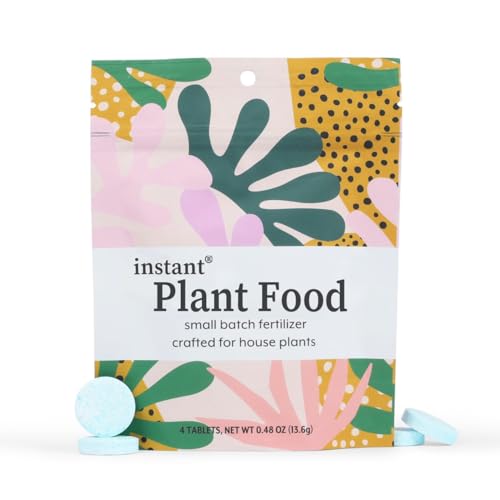
Drop a tablet in water and walk away — the only measuring stick is the tablet itself.
If you are a beginner plant parent or someone whose watering routine is already chaotic enough, this is the pick that eliminates the biggest friction point: mixing. The self-dissolving tablets contain a 4-3-6 NPK formula (slightly lower nitrogen, higher potassium for root and flower support) and each tablet feeds a large houseplant or several small ones for up to 3 months. You just drop one in a glass of water or a watering can, wait for it to dissolve, and water. Owners mention that the tablets “revived withering plants within days; leaves greened, stems strengthened” and that one tablet per pitcher monthly “lasted 2 months without reapplication.” There is zero mess, no measuring spoons, and no leftover concentrate to store.
The trade-off is that a pack of 4 tablets covers a smaller number of plants compared to the volume you get from the HiThrive liquid (which makes 85+ gallons from one bottle). For a single large pot or a small shelf of houseplants, these tablets are perfect — for a 20-plant collection, you will need to buy refills more often. The formula is also optimized for indoor plants, so it is not the right choice for a large vegetable garden.
Why convenience wins here
- No measuring, no mixing, no mess — drop and water
- Effects last up to 3 months per tablet, reducing watering-day decisions
- Vegan, cruelty-free, and made in the USA
The volume reality
- Only 4 tablets per pack — not cost-effective for large plant collections
Reach for it if: You want the absolute minimum-effort feeding routine for a few indoor pots and hate measuring liquids.
Look elsewhere if: You have a large collection or outdoor plants — the liquid or granular options below give you more feedings per dollar.
3. Fertilome All Purpose Water Soluble Plant Food 20-20-20 (3 lb)

The balanced, instant-dissolve powder that saved a drooping Hosta within two hours, per a reviewer.
This is the workhorse powder for anyone growing flowering annuals (geraniums, petunias, impatiens), hanging baskets, or perennials in both indoor and outdoor settings. The 20-20-20 NPK is perfectly balanced — equal parts nitrogen, phosphorus, and potassium — which means it supports both foliage growth and flower production at the same time. The water-soluble granules dissolve quickly in water (mix 1 to 2 teaspoons per gallon for soil drench, or a weaker 1/4 to 1 teaspoon per gallon for foliar spray), and the 3-pound bag feeds a lot of plants over many applications. One reviewer noted that a foliar feed “revived drooping Hosta within 2 hours” and that it “increased Philodendron leaf size 5x.” Another buyer noted that the 3-pound bag “will take care of my outdoor plants and trees for months.”
The catch with a 20-20-20 formula is precision: because the nutrient concentration is high, overdoing it can burn roots fast. Follow the mixing chart carefully, and note that some plants need a weaker dose (one reviewer advises only 1 teaspoon per gallon for certain tropicals). This is also a synthetic formula, so if you are gardening organically, the Espoma or FoxFarm options below are better suited.
Where it shines
- Balanced 20-20-20 ratio works for leafy plants AND flowers in one product
- Fast foliar absorption — visible recovery in hours, per buyer reports
- 3-pound bag provides many applications at a solid mid-range cost
Watch out for
- Easy to over-fertilize if you mis-measure — root burn is real
- Not organic; no OMRI listing for certified organic gardens
Best for: The gardener who wants one balanced powder for everything from petunias to tropicals and values fast foliar rescue.
skip it if: You need an organic input for edible crops — go with the Espoma Plant-Tone instead.
4. FoxFarm Happy Frog All Purpose Fertilizer (6-4-5, 4 lb)

The OMRI-listed granular that revived yellow tomato plants in a week — but be ready for the farmyard smell.
FoxFarm Happy Frog is a slow-release granular fertilizer packed with beneficial soil microbes and mycorrhizal fungi (tiny soil organisms that help roots absorb water and nutrients). The 6-4-5 NPK is gently tilted toward nitrogen for green growth while still supporting flowers and fruit, making it a strong match for container vegetables and ornamentals alike. Buyers confirm it works: one gardener reported it “revived yellow tomato & zucchini plants within a week” and that monthly use led to “best garden ever.” Another uses it in a Green Stalk vertical planter system with good results. At 4 pounds, the bag is manageable for raised beds and large pots, and the OMRI listing means it is approved for organic food production.
The honest trade-off is the odor. Multiple reviewers warn that the fertilizer “smells bad but effective dry fertilizer” and has “a strong manure smell lasting days after watering.” If you are feeding plants near an open window, a patio table, or a front door, the scent can be a real issue. Compared to the 16oz liquid volume of the HiThrive concentrate, the FoxFarm bag is a 4-pound granular format — a very different product type that feeds the soil over weeks rather than delivering an instant liquid dose.
What makes it special
- Beneficial soil microbes and mycorrhizal fungi improve long-term root health
- OMRI listed — safe for organic vegetable gardens
- Slow-release format means fewer applications throughout the season
The one real downside
- Strong manure-like odor that lingers for days after watering
Pick it if: You want an organic, soil-building granular for container vegetables and ornamentals and can tolerate the natural barnyard smell.
Pass on it if: You are feeding houseplants near living spaces — the smell will follow you indoors.
5. Espoma Organic Plant-Tone 5-3-3 (4 lb, Pack of 2)

A century-old organic formula that feeds your soil slowly — not your plants in a rush.
Espoma has been making natural organics since 1929, and Plant-Tone is their all-purpose flagship. The 5-3-3 NPK is lower and slower than synthetic options, which means you apply it spring and fall to trees and shrubs, or monthly to flowers and vegetables throughout the growing season. The granules contain a proprietary Bio-tone formula plus 5% calcium (important for cell wall strength and blossom-end rot prevention in tomatoes and peppers). Because it is a slow-release granular, you scatter it around the drip line (the outer edge of the plant’s canopy) and water it in — no mixing, no measuring beyond a scoop. Customers note it is “recognized by plant organizations” and produces “visible growth response in Spring.” One reviewer loves that it is “foul smelling as chicken poop so I would advise standing upwind when applying” — the organic scent is part of the deal.
The pack of two 4-pound bags gives you 8 pounds total, which is enough for a sizeable flower bed or a row of shrubs. Compared to the FoxFarm Happy Frog, the Espoma has a slightly lower ratio (5-3-3 versus 6-4-5) and the same 4-pound weight per bag, but Espoma packs two bags together for 8 pounds total. The catch: slow-release means you will not see an overnight green-up like you would with a liquid feed — patience is required.
What you get with Espoma
- 100+ years of organic formulation expertise and a proven Bio-tone additive
- Pack of 2 provides 8 pounds total — substantial coverage for beds and borders
- Works on everything: flowers, vegetables, trees, shrubs
The slow truth
- Results take weeks, not days — not suitable for a quick rescue
- Strong organic odor (like chicken manure) during and after application
Best suited for: The organic gardener who wants a trusted, slow-release granular for a whole landscape of flowers, vegetables, trees, and shrubs — and does not need instant results.
Try a liquid instead if: You need to fix yellowing leaves within a couple of days.
6. Dyna-Gro Foliage Pro Liquid Fertilizer (9-3-6, 32oz)
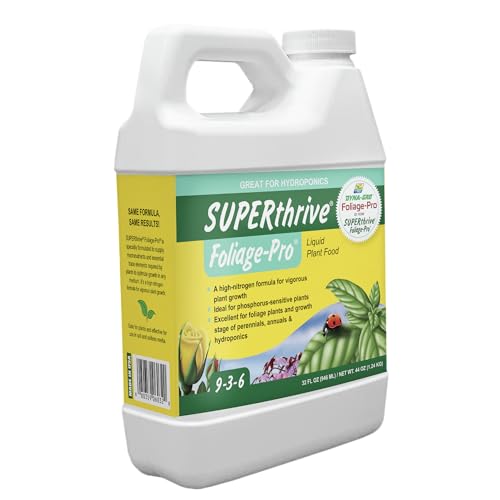
The professional liquid that serious growers recommend for year-round lush foliage — if you follow the dosage closely.
Dyna-Gro Foliage Pro is a liquid concentrate with a 9-3-6 NPK ratio (the 3:1:2 ratio is a staple among serious indoor growers because it matches what most foliage plants naturally need). This is a comprehensive formula: it is designed as the sole nutrient source for tropical foliage plants, low-light interiorscapes, and even hydroponic systems. The 32-ounce bottle is larger than the HiThrive 16oz, and because it is highly concentrated (you only need a tiny amount per gallon), a single bottle lasts many months — buyers confirm it “lasts a long time since only a small amount is needed when mixed with water.” Professional growers recommend it, and reviewers report “fast, abundant new growth within days” and foliage that stays “healthy, green” with “stems and leaves sturdy.”
The critical warning here: dosage matters enormously. One buyer nearly killed all their plants by adding too much, noting “Dyna Gro Foliage Pro works really well and helped my plants grow, but be careful with the dosage. I didn’t read the label carefully and added too much, which nearly killed all my plants.” If you are a careful measurer, this is a superb, professional-grade liquid. If you prefer a more forgiving application, the HiThrive (6-2-4) or the Instant Biologics tablets are harder to overdo.
Why experienced growers love it
- 9-3-6 NPK with a 3:1:2 optimal ratio for year-round green growth
- 32oz bottle is highly concentrated — a little goes a very long way
- Works in both soil and hydroponic systems
The risk
- Overdosing burns plants fast — you must measure precisely every time
Ideal for: The attentive indoor grower who wants professional-grade nutrition for tropical foliage and is comfortable measuring exact doses.
Not for: Casual or beginner plant owners — mix up the dose and you can damage your plants quickly.
7. Jobe’s Organics Granular All Purpose Fertilizer (4-4-4, 16 lbs)

The 16-pound organic bag that, per one buyer, turned their family’s garden into a zucchini surplus.
If you have a large vegetable garden, a stand of shrubs, or a lawn you want to feed organically, Jobe’s Organics in the 16-pound bag is the economy-size solution. The 4-4-4 NPK is a gentle, balanced formula that will not burn roots easily, and it is OMRI listed for organic gardening by the USDA. Application is straightforward: apply every 2-3 weeks during the growing season and water it in. One reviewer who combined granular with a Jobe’s liquid steep reported that “squash, cucumber, pepper yields” were boosted noticeably and that “flowers opened 48 hours after feeding.” Another buyer used it with a hand-crank spreader on their lawn and praised that it “doesn’t send out a cloud of dust.” The 16-pound bag is heavier than the 4-pound bags of FoxFarm and Espoma — at 16 pounds versus 4 pounds, you are getting more product for broader coverage.
The trade-off: a 16-pound bag is heavy to carry and store, and it takes up real shelf space. If you only have a few pots, this is overkill — go with the 4-pound Espoma or FoxFarm instead. Also, the balanced 4-4-4 ratio is generalist; if your plants specifically need more nitrogen (leafy greens) or more phosphorus (blooms), you may want a formula with a higher first or second number.
Why size matters
- 16 pounds of organic granular fertilizer — covers large gardens and lawns for an entire season
- OMRI listed and free of synthetic chemicals
- Measurable results: faster blooming and higher vegetable yields per buyer reports
The size trade-off
- Heavy bag (16 lbs) requires dedicated storage space
- Generalist 4-4-4 ratio is not optimized for specific plant phases like high-nitrogen leaf growth
Grab it for: Big vegetable gardens, shrub borders, or lawns where you need a lot of organic fertilizer for a reasonable cost per pound.
pass on it if: You have a handful of houseplants — the 16-pound bag will last years and take up too much closet space.
Understanding the Specs
NPK Ratio
The three numbers on the bag (like 6-2-4 or 20-20-20) stand for Nitrogen, Phosphorus, and Potassium by percentage. Nitrogen (N) drives leaf and stem growth — high first numbers are for foliage plants like pothos or fiddle leaf figs. Phosphorus (P) supports root development and flowers — middle numbers matter more for blooming annuals. Potassium (K) strengthens cell walls and helps the plant resist stress. A balanced ratio like 20-20-20 covers everything, while a specialized ratio like 9-3-6 targets foliage.
Application Form
Liquid concentrates (16oz HiThrive, 32oz Dyna-Gro) mix with water and feed the plant immediately — you see results within days but must mix each time. Granular slow-release products (Espoma, FoxFarm, Jobe’s) break down in the soil over weeks, feeding gradually with less frequent effort. Tablets (Instant Biologics) dissolve on contact with water and require zero measuring — the ultimate convenience for a small number of pots. Your choice depends on how much time you want to spend mixing versus how quickly you need results.
Organic Certification (OMRI)
The OMRI (Organic Materials Review Institute) seal means the product meets USDA standards for certified organic food production. It is critical if you are growing vegetables, herbs, or fruits and want to maintain organic integrity. Synthetic formulas (Fertilome 20-20-20) are faster-acting but not allowed in certified organic gardens. Organic formulas (Espoma, FoxFarm, Jobe’s) release nutrients more slowly but improve soil health over time. A word of caution: organic granular fertilizers often have a noticeable manure-like smell that lasts for days after watering.
Yield / Coverage
For liquids, look at how many gallons of finished fertilizer the concentrate makes — the HiThrive makes 85+ gallons from a 16oz bottle. For granules, the weight (4 lb, 16 lb) tells you how many square feet or plants you can feed. Heavier bags give you more coverage but require more storage space. A 16-pound bag of Jobe’s can feed a large vegetable patch all season, while a 4-pound bag of Espoma is better suited to a flower bed or a row of shrubs. Always match the bag size to the scale of your garden to avoid buying more than you can use in a season.
FAQ
What does NPK stand for and which ratio should I use for my houseplants?
How often should I feed my indoor plants with liquid fertilizer?
Can I use outdoor garden fertilizer on my houseplants?
What is the difference between slow-release granules and fast-acting liquid plant food?
How do I use self-dissolving fertilizer tablets?
What does OMRI listed mean for plant food?
Can I over-fertilize my plants? What are the signs?
Which plant food is best for a vegetable garden?
What is the difference between a foliar spray and a soil drench?
How long does a bottle or bag of plant food typically last?
Final Thoughts: The Verdict
For most buyers, the plant food winner is the HiThrive 16oz Houseplant Fertilizer because its 2X liquid concentrate (makes 85+ gallons from one bottle) and balanced 6-2-4 NPK cover the widest range of indoor plants without the measuring complexity of professional-grade formulas. If you want the ultimate in zero-effort convenience, grab the Instant Biologics Tablets. And for a large organic vegetable garden requiring season-long feeding, the standout is the sheer value of the Jobe’s Organics 16 lb bag.
How We Picked
We do not accept paid placement. Every pick is matched to a real buyer and a real use-case; we do not hands-on test units.
Sources & Methodology
Specifications: manufacturer listings and product documentation. Review insights: verified customer reviews, as of July 2026. Pricing: not shown on this page (it changes often); check the current price via the retailer link.
As an Amazon Associate, Lawn Gear Lab earns from qualifying purchases. This does not affect which products we feature.