
Specs are compiled from manufacturer listings and verified buyer reviews and can change over time — please confirm the key details on the product page before buying.
You spent an afternoon bent over a handheld trimmer fighting thick weeds. The line snapped. Grass wrapped around the head. You know the frustration. A walk-behind trimmer fixes that by rolling the cutting head ahead of you on wheels. You stand upright and push it through overgrowth that would stall a standard string trimmer (a tool that cuts grass with a rapidly spinning plastic line) in seconds. These machines handle larger properties, rough terrain, and serious vegetation that a push mower cannot touch.
I’m Rikta — the founder and writer behind Lawn Gear Lab. This guide is built by comparing the manufacturers’ published specifications and the patterns across verified customer reviews, so you get each pick’s real strengths and trade-offs instead of marketing spin.
You are clearing a fence line, reclaiming an overgrown field, or just tired of replacing trimmer line every ten minutes. This look at the walk-behind trimmer market breaks down the top gas and battery-powered options to match your property and your back.
Quick Picks
- Earthquake Walk Behind String Mower With 160cc Viper 4-Cycle Engine, 22” Cutting Diameter, Model #40314 — Best Overall
- Earthquake 60V Walk Behind String Mower, Includes Two 4Ah Batteries, 22” Cutting Diameter, Model #44965 — Top Performer
- BILT HARD Walk Behind String Trimmer, 170cc 4-Cycle Gas Brush Hog Mower, 22 Inch Cutting Diameter — Best Value
- YARDMAX YL2250 22 in. 170cc Gas Walk Behind String Trimmer Mower, Orange — Pro Pick
How To Choose The Best Walk-Behind Trimmer
Walk-behind trimmers are not one-size-fits-all. Your choice depends on property size, vegetation type, and if you want to handle gas and oil or manage batteries. These key specs separate a great buy from a frustrating one.
Engine Power vs. Battery Runtime
Engine displacement, measured in cubic centimeters (cc), tells you how much raw cutting force the machine has. A 160cc to 170cc gas engine can chew through woody stalks and inch-thick weeds without bogging down (slowing or stalling). Battery-powered models are quieter and start instantly, but watch the runtime. A 60V system (a 60-volt battery system) with two 4Ah (amp-hour, a measure of battery capacity) batteries is rated for up to 90 minutes, with an average battery life of 45 minutes. That is plenty for most residential lots but may not finish a multi-acre field on a single charge.
Cutting Height Range
Raising and lowering the cutting head determines what terrain you can handle. A range from 1.5 inches to at least 3.5 inches (ideally 4 inches) lets you scalp low for a manicured look or ride high over bumpy ground without scalping (cutting into the dirt). More adjustment positions (5 or 6) let you fine-tune the cut height for specific grass types and conditions.
Wheel Size and Deck Design
Bigger wheels mean easier rolling over uneven, rocky, or sloping ground. Look for 14-inch wheels or larger, especially airless (never-flat) designs that eliminate flat tires. A one-piece steel deck adds durability and reduces vibration. An offset head or extended deck lets you reach under fences and around obstacles without walking the machine into them.
Quick Comparison
| Model | Best For | Engine/Power | Cutting Width | Max Cutting Height | Item Weight | Amazon |
|---|---|---|---|---|---|---|
| Earthquake 40314 (Gas) | Heavy brush & large properties | 160cc Gas | 22″ | 3″ | 70 lbs | Amazon |
| Earthquake 44965 (60V) | Quiet, cordless convenience | 60V Brushless (2x 4Ah) | 22″ | 4″ | 40 lbs | Amazon |
| BILT HARD 170cc | Budget-friendly gas power | 170cc Gas | 22″ | — | 54.12 lbs | Amazon |
| YARDMAX YL2250 | Fence-line trimming | 170cc Gas | 22″ | 3.5″ | 61.7 lbs | Amazon |
In‑Depth Reviews
1. Earthquake Walk Behind String Mower With 160cc Viper 4-Cycle Engine, 22” Cutting Diameter, Model #40314

The gas-powered brute that buyers report turns thick brush into a walk in the park.
You bring this machine out when handheld trimmers give up. The 160cc (cubic centimeter) Viper 4-cycle engine, with automatic compression release for easy starting, powers a 22-inch cutting head fed with 0.155 (inch thick) cutting line. That combination, plus the 14-inch never-go-flat wheels, lets you roll through heavy overgrowth that would stop a push mower cold. Owners mention that “three foot weeds and inch and half vegetation knocked down like using a hot knife in butter”. That is proof of how much power this thing delivers.
At 70 pounds, it is noticeably heavier than the 60V Earthquake model (which weighs 40 pounds). That weight comes from the all-steel one-piece deck and the sturdy engine package. The adjustable handlebar and folding design make storage manageable. An engagement bail (a lever you squeeze) lets you stop the cutting head without killing the engine — handy when you need to clear a path or walk over a rock. While the maximum cutting height of 3 inches is lower than the battery model’s 4 inches, for serious brush-clearing duty the gas Earthquake is the clear leader.
Reviewers consistently praise its ability to handle monster weeds and woody stalks up to half an inch thick without stalling. A few note that the handle bolts can loosen over time and that grass sometimes wraps around the head, requiring a ten-minute cleanup with pliers. But the 5-year limited warranty and the sheer cutting authority make this the pick for large, overgrown properties.
What owners love
- 160cc engine rips through thick brush and woody stalks without bogging
- 14-inch never-go-flat wheels roll easily over uneven terrain
- Engagement bail lets you stop the head without restarting the engine
- Folding handlebar saves storage space
- 5-year limited warranty is best in class
Watch out for
- At 70 lbs, heavier than battery-powered alternatives
- Max cutting height of 3″ is lower than some rivals
- Grass can wrap around the cutting head, requiring occasional manual cleanup
- Handle bolts need periodic tightening
Best for the overgrown property: If you have acres of tall grass, blackberry vines, or saplings to knock down, the gas Earthquake 40314 is the tool that actually finishes the job without calling for backup.
The trade-off to know: It is heavier and louder than battery models, and the 3″ max cutting height means you cannot ride as high over bumpy ground. But for raw cutting power, nothing here beats it.
2. Earthquake 60V Walk Behind String Mower, Includes Two 4Ah Batteries, 22” Cutting Diameter, Model #44965
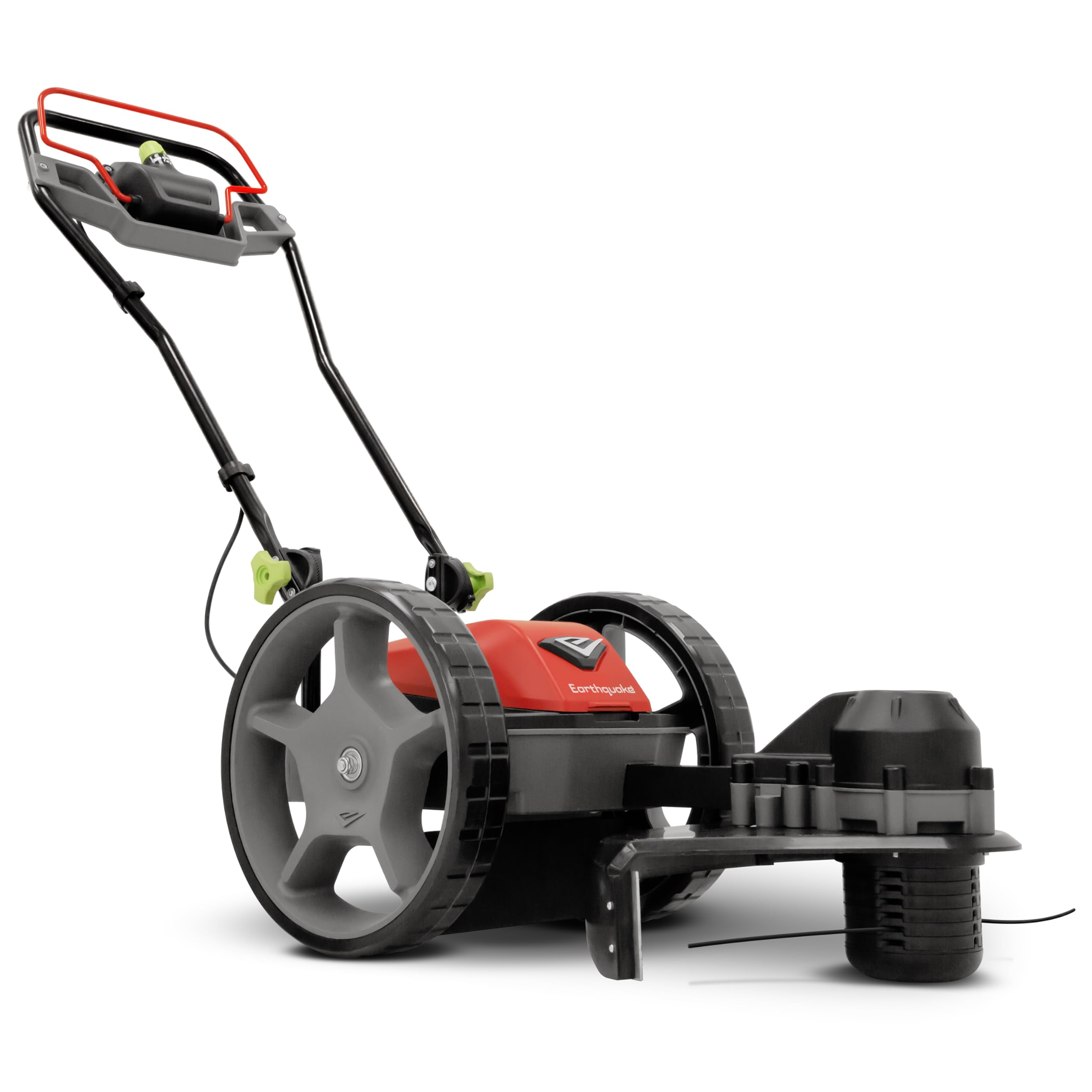
A battery-powered walk-behind that trades gas fumes for quiet, instant-start convenience.
You want walk-behind power without the smell of gasoline or the pull-start ritual. The 60V Earthquake is the answer. It runs on two included 4Ah (amp-hour) batteries that are rated for up to 90 minutes of runtime, with an average battery life of 45 minutes — enough for most residential cutting sessions. At just 40 pounds versus the gas Earthquake at 70 pounds, it is easier to maneuver on slopes or load into a truck. That makes it far easier to maneuver on slopes or load into a truck.
The direct-drive brushless motor (a motor without brushes that is more efficient and needs less maintenance) extends battery life and needs less maintenance than a gas engine. The innovative cutting head is designed to reduce weed wrap — a common frustration with string trimmers. You get a three-speed cutting dial so you can dial in the power for light grass or heavy weeds. The tool-less adjustable cutting height ranges from 1.5 inches to 4 inches across 6 positions. That 4-inch maximum versus the gas model’s 3-inch limit is a real advantage on uneven or rocky terrain where you want to avoid scalping.
A starter pack of cutting line is included: five pieces of 0.095-inch line and five of 0.155-inch. The 5-year limited tool warranty and 3-year limited battery warranty give confidence in the investment. For smaller properties or anyone who values quiet operation and instant starting, this is the premium cordless choice.
Why it stands out
- 60V brushless motor with 90-min runtime from two 4Ah batteries
- At 40 lbs, dramatically lighter than any gas model here
- Variable cutting speed dial matches power to the job
- Tool-less 1.5″–4″ height adjustment with 6 positions
- Innovative head reduces weed wrap
Consider this
- Runtime may not be enough for very large properties without spare batteries
- Premium price point reflects battery technology
- Not as raw-power capable against thick woody stalks as the 160cc gas model
The quiet solution: If your property is under an acre or two, you value a quiet cutting experience, and you want to skip gas and oil entirely, the 60V Earthquake 44965 delivers walk-behind power without the noise or fumes.
Who might want more: If you face dense brush, saplings, or woody vegetation regularly, the lighter battery system may struggle where a 160cc gas engine powers right through. The gas Earthquake 40314 is the better fit for that job.
3. BILT HARD Walk Behind String Trimmer, 170cc 4-Cycle Gas Brush Hog Mower, 22 Inch Cutting Diameter
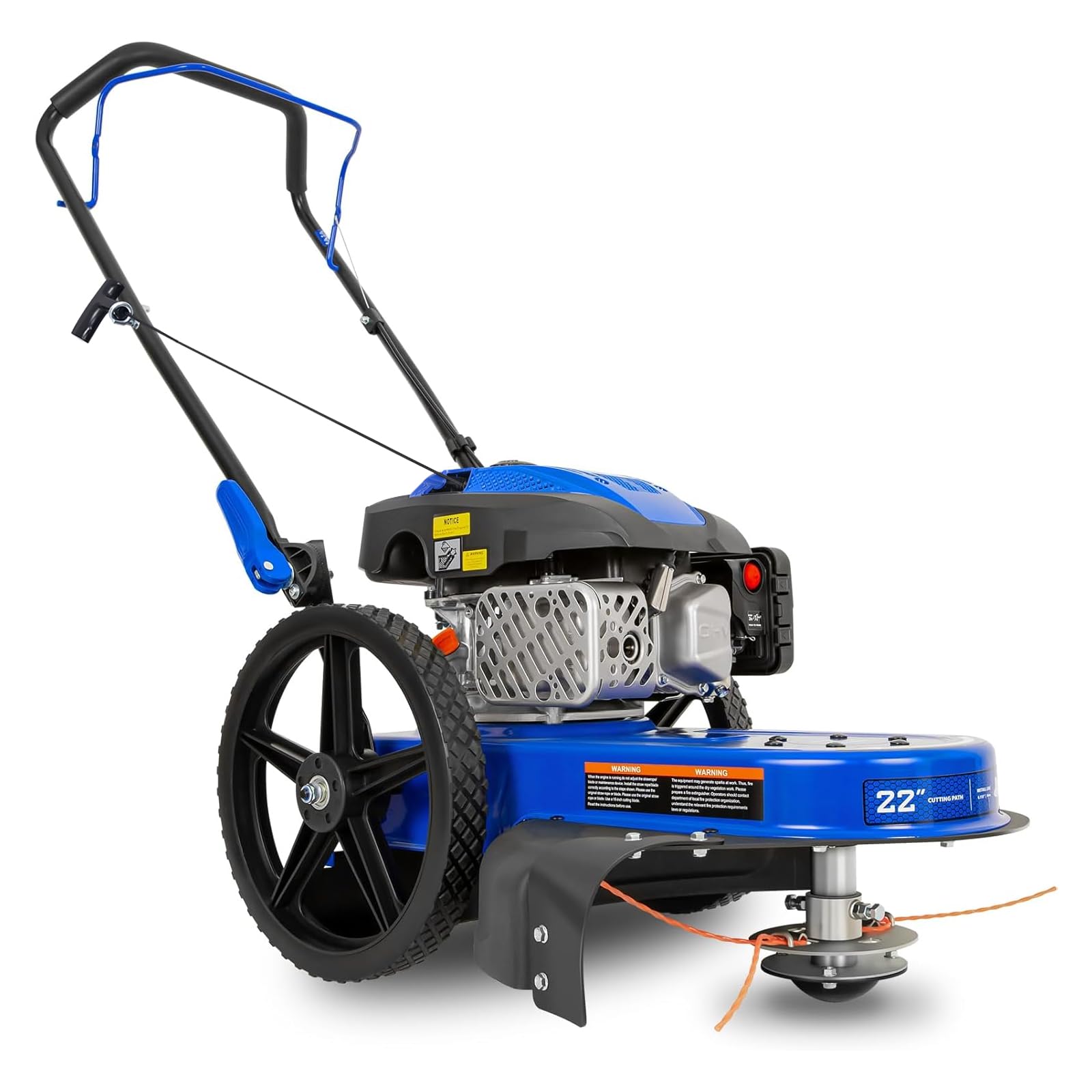
An entry-level gas walk-behind with the largest engine displacement in this lineup — 170cc.
The BILT HARD trimmer delivers a surprising amount of cutting capacity for its cost. The 170cc 4-cycle OHV (overhead valve) engine is the largest displacement in this lineup, bigger than the 160cc Earthquake gas model. It powers a 22-inch cutting width. The one-piece steel deck is designed to reduce vibration and add stability, and the 14-inch never-flat wheels handle all terrains. The foldable ergonomic handle folds down for compact storage. At 54.12 pounds, it sits between the heavy gas Earthquake (70 lbs) and the light battery model (40 lbs), making it manageable for most users.
It lacks some refinements found on more expensive models. There is no listed cutting height range or number of positions in the specifications. There is no engagement bail (a lever to stop the head without restarting the engine) like the Earthquake has. But for budget-conscious buyers who need gas-powered walk-behind performance for clearing fence lines, overgrown grass, and light brush, the BILT HARD is a solid entry point that does not cut corners on engine power.
Just note that Amazon does not handle returns of gasoline-related products. Any issues go through the manufacturer directly. For the price, this gets you into the walk-behind game with the biggest engine of the bunch.
What works
- 170cc engine is the most powerful in this comparison
- One-piece steel deck reduces vibration
- 14-inch never-flat wheels roll over all terrain
- Folding handlebar for easy storage
What is missing
- No published cutting height range or adjustment positions
- No engagement bail to stop the head without restarting
- Returns handled by manufacturer, not Amazon
The budget-friendly gas option: If your budget is tight but you need the cutting power of a large gas engine, the BILT HARD delivers 170cc for a low entry price.
Consider stepping up if: Adjustable cutting height and an engagement bail matter to you. The YARDMAX or Earthquake models offer those features for a higher cost.
4. YARDMAX YL2250 22 in. 170cc Gas Walk Behind String Trimmer Mower, Orange

A farm-ready walk-behind with an offset head that trims flush along fences without weaving the whole machine in and out.
The YARDMAX YL2250 is built for precision around structures. Its offset head position lets you trim straight along fence lines, barns, and landscaping without maneuvering the whole machine. That is a real time-saver on a large property. The 170cc engine gives it the same displacement (the volume of the engine’s cylinders, measured in cc) as the BILT HARD. But the YARDMAX adds tool-free height adjustment with 5 cutting heights ranging from 1.5 inches to 3.5 inches. That 3.5-inch maximum versus the gas Earthquake’s 3 inches gives you more room to ride over bumpy ground without scalping.
Rugged 14-inch ball bearing wheels travel easily across any terrain. The onboard trimmer string storage (a cord caddy) means you are never caught short a fresh line. At 61.7 pounds, it is heavier than the BILT HARD and lighter than the 70-pound gas Earthquake. A 2-year manufacturer limited warranty is standard.
For anyone who regularly trims around buildings, fencing, or landscaping beds, the offset head design makes the YARDMAX a more efficient tool than the straight-deck competition.
what separates it
- Offset head trims flush along fences and walls without maneuvering the whole machine
- Tool-free 1.5″–3.5″ height adjustment with 5 positions
- 14″ ball bearing wheels roll over all terrain
- Onboard cord caddy for spare trimmer line
Downsides
- At 61.7 lbs, not the lightest gas model
- No engagement bail for stopping the head without killing the engine
- 2-year warranty is shorter than Earthquake’s 5-year
For the fence-line specialist: If the bulk of your trimming work is along fences, barns, and landscaping, the offset head on the YARDMAX saves you from walking the whole machine in and out of tight spots.
The feature gap to note: It lacks an engagement bail and the 5-year warranty of the Earthquake gas model. If those matter, the Earthquake 40314 is a better long-term investment.
Understanding the Specs
Engine Displacement (cc)
Engine displacement, measured in cubic centimeters (cc), is the single biggest indicator of a walk-behind trimmer’s cutting power. A 160cc or 170cc engine can power through thick brush, woody stalks, and overgrown grass that would stall a smaller engine. More displacement means more torque (twisting force) at the cutting head, so you untangle or restart the machine less often. For light residential trimming, smaller engines work fine. For heavy vegetation, stick with 160cc or above.
Cutting Height Range and Positions
This spec tells you how low or high you can set the cutting head. A range from 1.5 inches to at least 3.5 inches (ideally 4 inches) lets you scalp low for a tidy cut or ride high over rocky, uneven ground without damaging the head. The number of positions (5 or 6) gives you fine-grained control. More positions let you dial in exactly the right height for your grass type and terrain conditions. If your property has slopes, bumps, or varied grass types, a wider range and more positions are worth paying for.
FAQ
Will a walk-behind trimmer cut through small saplings and woody brush?
How does a walk-behind trimmer compare to a brush cutter or brush hog attachment?
Is a gas or battery walk-behind trimmer better for my property?
What cutting line should I use in a walk-behind trimmer?
How much maintenance does a gas walk-behind trimmer need?
Can I use a walk-behind trimmer on slopes?
Do walk-behind trimmers come with a warranty?
Will a walk-behind trimmer fit in my car or shed for storage?
Do I need to assemble a walk-behind trimmer when it arrives?
Can I replace the trimmer line on a walk-behind trimmer myself?
Final Thoughts: The Verdict
For most buyers, the best walk-behind trimmer is the Earthquake 40314 with the 160cc Viper engine because it combines the most raw cutting power with a 5-year warranty and a design that buyers consistently praise for handling monster weeds. If you want quiet, instant-start cordless convenience for a smaller property, grab the Earthquake 60V model — it is 30 pounds lighter and runs up to 90 minutes on two batteries. And for budget-conscious buyers who need gas power on a tight budget, the BILT HARD 170cc delivers the largest engine displacement at the lowest price.
How We Picked
We do not accept paid placement. Every pick is matched to a real buyer and a real use-case; we do not hands-on test units.
Sources & Methodology
Specifications: manufacturer listings and product documentation. Review insights: verified customer reviews, as of July 2026. Pricing: not shown on this page (it changes often); check the current price via the retailer link.
As an Amazon Associate, Lawn Gear Lab earns from qualifying purchases. This does not affect which products we feature.