Reader support helps keep the reviews honest and the site humming. As an Amazon Associate, I earn from qualifying purchases.9 Best Rated Wood Chippers | 15:1 Piles to One Bag

Specs are compiled from manufacturer listings and verified buyer reviews and can change over time — please confirm the key details on the product page before buying.

You have a pile of branches in your yard, and you want a machine that chews through them without stalling every time you feed a piece thicker than your thumb. Many models that claim a 3-inch max cutting diameter choke on a 2-inch piece of hardwood, so you end up babying each branch. This guide compares the published specs and verified buyer patterns to find which wood chippers actually deliver real cutting power.

I am Rikta, the writer behind Lawn Gear Lab. This guide builds on the manufacturers’ published specifications and patterns across verified customer reviews, so you get each pick’s real strengths and trade-offs.

You need to sort the chippers that start on the first pull from the ones that leave you stranded. That is what this guide to the best rated wood chippers does.

Quick Picks

How To Choose The Best Rated Wood Chippers

Before you click “add to cart,” focus on three spec areas that decide whether a chipper is a workhorse or a paperweight. Here is what separates the serious machines from the weekend disappointments.

Engine Displacement and Starting Mechanism

You will see 7HP at 212cc on most mid-range machines, and 9HP at 274cc on the premium end. The larger the displacement (measured in cubic centimeters or cc), the harder the engine can pull against a tough knot without bogging down. All of these use a recoil starter (a pull cord), so pay attention to whether that pull is a smooth single tug or a battle that leaves you winded.

Reduction Ratio and Rotor Design

The reduction ratio tells you how many piles of branches become one pile of mulch. A 15:1 ratio means fifteen full loads shrink to one. A 20:1 ratio goes further, turning those same piles into smaller, finer chips. The rotor itself matters too: a bigger rotor diameter (like 15.6 inches) swings more inertia, meaning it chews through thick limbs without slowing down as much.

Max Cutting Diameter and Self-Feeding

A 3-inch max diameter is the standard claim, but real-world performance varies. Some machines handle 3-inch softwood branches easily yet stall on 2-inch hardwood. Look for a direct-drive design, which usually gives you a self-feeding action (the blades pull the branch in). Without self-feeding, you push every piece manually, which gets old on a long Saturday.

Quick Comparison

Model Best For Engine Reduction Ratio Max Diameter Amazon
S1 Wood Chipper High Volume, Fine Mulch 7HP 212cc 20:1 3″ Amazon
C40 EFCUT Thickest Limbs 9HP 274cc 15:1 4″ Amazon
C30 EFCUT Balanced Power & Portability 7HP 212cc 20:1 3″ Amazon
SuperHandy 3-in-1 Versatile 3-in-1 Use 7HP 212cc 15:1 3″ Amazon
S3 Gardenbeaut Compact & Budget-Minded 7HP 212cc 15:1 3″ Amazon
Wood Chipper Shredder R0 Heavy Home Use 7HP 212cc 15:1 3″ Amazon
R30 Gardenbeaut Small Lot / Easy Start 7HP 212cc 15:1 3″ Amazon
Forest Master FM6DD Compact, Light-Duty 6HP 208cc 2″ Amazon
Landworks 3-in-1 Towable, Slanted Hopper 7HP 212cc 15:1 3″ Amazon

In-Depth Reviews

Best Overall

1. S1 Wood Chipper, 20:1 High Reduction Ratio, 7 HP 212cc

20:1 Ratio15.6″ Rotor

The 15.6-inch cutting rotor that turns 20 piles into one pile of gardening gold.

If you value the final quality of your mulch over nearly anything else, this machine stands apart. The S1 gives you a high 20:1 reduction ratio (twenty loads shrink to one), and it pairs that with a larger 15.6-inch cutting rotor that swings harder and keeps the feeding speed consistent so you do not have to jam each branch. Buyers report it “starts first pull every time” and handles branches up to 3 inches, though fresh, green material feeds better than dry hardwood. The rotor spins 2 blades and 6 hammers (small steel flails that break up leaves and twigs), producing a finer, more uniform mulch than you get from a typical 15:1 machine like the C30. The adjustable discharge chute swings from 90° to 145°, letting you aim the chip pile exactly where you want it so you do not have to rake afterward.

The trade-off is that it still uses a recoil starter (pull cord), and the choke sticker placement is backwards according to several owners, which can cause confusion on the first start. The self-feeding action works well up to 2.5 inches, but you should feed 3-inch branches slowly to avoid a stall. If you want a machine that shrinks a mountain of mixed garden waste into fine, nutrient-rich mulch with minimal effort, this is the one. It weighs 110 pounds and rolls on 10-inch PU (polyurethane) wheels.

Why it earns the top spot

  • Highest reduction ratio (20:1) in the mid-range group for finer mulch
  • Larger 15.6″ rotor delivers faster, more consistent chipping
  • 110-pound weight with 10″ PU wheels for easy rolling
  • Owners mention first-pull starts and compact design

The real-world friction

  • 3″ hardwood requires very slow feeding to avoid bogging
  • Choke sticker is reportedly reversed on some units
  • Not ideal for fresh greens or pine cones (can jam per manual)

Your best bet if: you have a mix of branches and leaves and want the finest mulch possible without moving up to a premium-tier rig.

Think twice if: you need to process heavy, wet logs every week — you would be happier with a larger engine.

Premium Pick

2. EFCUT C40 Wood Chipper 4″ Max Diameter, 9 HP 274cc

4″ Capacity9HP 274cc

The only machine here that officially swallows a 4-inch branch and asks for more.

If your property grows limbs thicker than your wrist, you need the C40. Its 9HP 274cc engine is the biggest in this lineup — the others top out at 7HP 212cc — giving it the torque to chew through 4-inch diameter wood without struggling. The 15.9-inch flywheel and high-speed steel blades grab and shred branches faster than any other machine here, and the 15:1 reduction ratio fills a 30-gallon bag fast. Customers note that it is heavy-duty, moves easily on its wheels, and delivers a consistent chip size. One owner noted they “received with dented fuel tank; company sent replacement with tutorial,” pointing to responsive customer service.

The main catch is that pull-starting a 274cc engine is physically harder than starting a 212cc. Some buyers, especially older owners, reported they wish it had an electric starter. You also need to run it at full throttle to avoid clogging, and the manual warns it does not handle loose leaves well (use the side chute for branches with leaves attached). It weighs 136.7 pounds, making it the heaviest machine here, but the wheels make it manageable to roll around. If you have large-diameter limbs and want to power through your brush pile in half the time, the C40 is your only real answer in this list. It is a full inch bigger than the 3-inch S1 and C30.

What makes it a beast

  • 4-inch max diameter beats every other model here by a full inch
  • 9HP 274cc engine with a 15.9″ flywheel for serious torque
  • Reviewers point out consistent performance for hours without clogging

Where it asks a lot of you

  • Pull-cord starting is tough on a large engine; no electric start option
  • Heaviest in the test at 136.7 lbs
  • Must be run at full throttle to avoid jams

Reach for this if: you have consistent 3-4 inch limbs to chip — no other machine in this class can touch that capacity.

Look elsewhere if: you have a smaller lot with mostly twigs and leaves; you are paying for power you may not use.

Best Value

3. EFCUT C30 Wood Chipper Shredder Mulcher 7 HP 212cc, 20:1 Ratio

20:1 RatioCheck Windows

A 20:1 chipper that weighs just 114 pounds and clears jams through a rear window.

The C30 bridges the gap between the S1 and the budget options by giving you the same 20:1 reduction ratio and a 15.6-inch rotor, but in a lighter package (114 pounds) that is easier to drag over rough ground. Its standout design trick is two check windows: a front one for quickly swapping blades and a back one for clearing blockages without taking the whole machine apart — a clear advantage over the S1 which lacks both. One buyer who put 20 hours on the C30 said it “starts reliably, handles heavy work but jams with 3-inch wood or wet bark.” They also noted blades last about 5 hours before needing a change. The 7HP 212cc engine uses up to 10% ethanol gasoline (not just ethanol-free), giving you more fuel flexibility than models that forbid ethanol altogether.

Assembly takes about 2.5 hours, and some shoppers say a design flaw where the pan assembly rattles and needs a shim. The self-feeding action is aggressive, but odd-shaped branches may still need a prod. If you want a machine with a high reduction ratio and easy maintenance access at a price that undercuts the S1, the C30 is a smart pick. It handles thick brush and dense wood like Manzanita well while keeping the weight manageable.

What earns its mid-range slot

  • 20:1 ratio for fine mulch, same as the S1
  • Check windows make blade swaps and jam clearing much easier
  • 114 lbs is lighter than the S1 and easier to move

The honest downsides

  • Blades dull every ~5 hours of heavy use
  • Some buyers had pan assembly rattling requiring a shim
  • Wet bark and thick wood cause jams

Grab it for: the blend of easy maintenance access and fine-mulch output without the premium price tag.

skip it if: you want a truly maintenance-free first season — plan to buy spare blades upfront.

Most Versatile

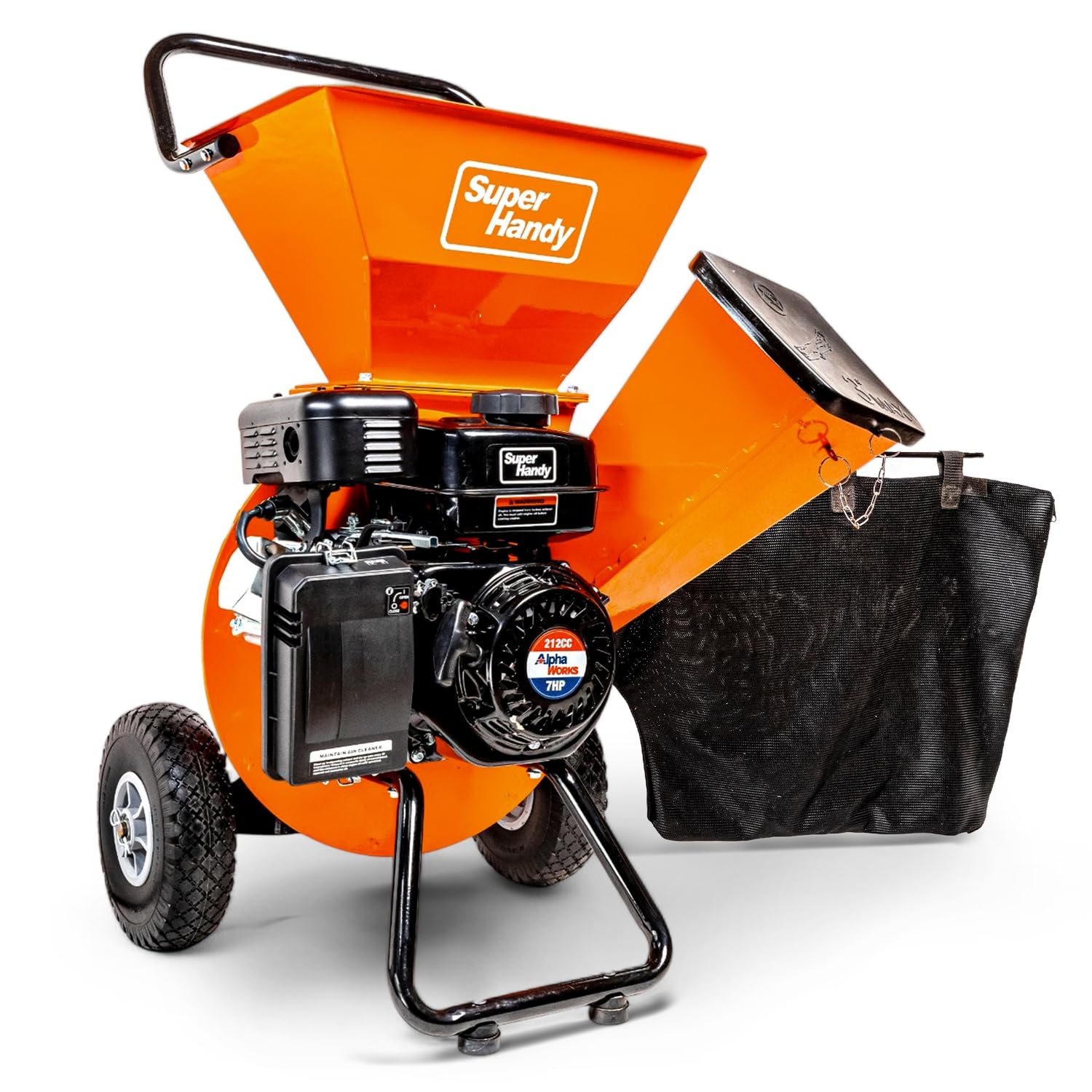
4. SuperHandy Wood Chipper Shredder Mulcher Ultra Heavy Duty 7HP 3-in-1

3-in-1Slanted Housing

The slanted-hopper design that refuses to jam like a straight-sided machine.

This SuperHandy works three ways: it chips branches up to 3 inches through the side chute, shreds smaller material through the top hopper, and can turn a leaf vacuum attachment (sold separately) into a mulcher. The slanted housing is the real story — unlike boxy chippers where debris piles up on flat walls, this angled design lets material slide down, reducing jams significantly. Buyers report it “handles up to 3 inches” and “starts in 3 pulls,” though one noted the included collection bag developed a hole from the machine’s power. The 7HP 212cc engine burns 87+ unleaded gas (ethanol-free recommended) and holds 0.7 gallons. It weighs 133.7 pounds, making it heavier than the S1 and C30 but still manageable with two people.

The downsides are worth knowing. The top hopper clogs with pine straw, so you need a stick to push material down. The collection bag is also small for the volume the machine produces — many owners switch to a tarp. The carburetor can clog early (one buyer needed a rebuild kit after an hour), so using ethanol-free gas matters. Still, the three-way function and slanted housing are unique in this price bracket. If you want one machine that chips branches, shreds leaves, and mulches corn stalks, this is your all-in-one.

what separates it

  • 3-in-1 design (side chute, top hopper, optional leaf vacuum)
  • Slanted housing significantly reduces clogs vs normal chippers
  • Tow bar kit compatible (sold separately) for ATV/tractor pulling

The fine print

  • Heavy at 133.7 lbs; best with two people for setup
  • Wood leaf clog in top hopper with pine straw
  • Carburetor can clog if fuel with ethanol is used

Best for: the person who needs to chip branches, shred garden trimmings, and mulch leaves — all with one engine.

pass on it if: you only chip thick branches and never touch leaves; the 3-in-1 capability is wasted.

Entry-Level Champ

5. S3 Wood Chipper Shredder, 7HP 212cc Gas Powered Heavy Duty, 3″ Max

Compact15:1 Ratio

A compact steel chipper that owners mention “chips 2.5″ branches well; 3″ requires slow feeding.”

The S3 is built to be smaller and lighter than the typical steel chipper, with product dimensions of 32.6 x 26.5 x 41 inches — about 15 inches shorter in length than the EFCUT R0. That compactness makes it a great pick for yards where storage space is tight. It uses the same 7HP 212cc engine and a 15:1 reduction ratio, and sellers report it works well for dry, hard wood but struggles a bit with fresh green material. The vertical discharge chute adjusts from 90° to 145°, and the large extended feeding chute makes loading easier than on stubby hoppers — you do not have to lift branches as high.

The flip side is that assembly can be frustrating. Several owners noted the instructions are poor, with missing washers and a choke sticker that is backward. The rope pull sits near the exhaust, which some owners fixed by rotating the assembly. The machine also lacks a true self-feeding draw — unlike the S1 or C30 — so most branches need manual pushing through. For the price, you get a reliable chipper if you are patient with assembly and mostly feed it dry branches. Buyers consistently call it “excellent value” for the money.

Why it still makes the list

  • Compact frame saves storage space
  • 15:1 ratio is respectable for its size
  • Customers note good long-term reliability with dry wood

What holds it back

  • Assembly instructions are frustratingly vague
  • No self-feeding; manual push required
  • Rope pull location near exhaust is awkward

Go for this when: you need a chipper that fits in a small garage and you plan to feed dry, hard branches.

Pass if: you want a machine that pulls branches in by itself — the S3 needs a push.

Heavy Home-Use

6. Wood Chipper Shredder Mulcher 7HP Gas Powered Heavy Duty Compact Design (R0)

121.7 lbsFoldable

A 121.7-pound compact design that reviewers point out “shreds limbs up to 3″ into dime-sized confetti.”

This EFCUT model (the R0) shares the same 7HP 212cc engine as the S3 and R30 but in a slightly larger frame — 48 x 22 x 41 inches — making it the longest machine in the 7HP group. That extra length houses a long neck chute that simplifies loading tall branches — you do not have to bend over as far as with the S3. A buyer who gave it heavy use reported that it reduced a 9’x5’x5′ pile of branches down to a single 30-gallon bag of mulch. The 15:1 reduction ratio produces consistent chips, and the foldable design lets you collapse it for storage.

The biggest complaint is inconsistent quality control: one buyer received a unit that would not start at all, and customer support (based in China with limited hours) was unreachable. Other buyers reported that the assembly instructions are poor, though the machine itself is well-made and starts on the second pull after setup. It also requires you to use 87+ unleaded gasoline with no ethanol recommended. If you want the extra chute length for easier feeding and do not mind rolling the dice on a potential no-start unit, this chipper rewards patient buyers with serious performance. The foldable design is a real plus for tight storage.

Strong points

  • Long neck chute makes feeding tall branches easier
  • Foldable design for compact storage
  • Shoppers say it reduces huge piles to one bag of mulch

Weak points

  • QC issues — a few buyers got units that never started
  • Customer support is very limited
  • Not for fresh greens or palm fronds

Choose this if: chute length and foldable storage matter more to you than near-certain first-pull starts.

Avoid if: you are not comfortable troubleshooting a machine that may arrive with a dead engine.

Small Lot Special

7. R30 Wood Chipper 7HP Gas Powered, 3″ Max Cutting Diameter, All Steel

Easy Start120.7 lbs

The 120.7-pound chipper one buyer called “best for small lots ≤10,000 sq ft.”

If your yard fits on a standard suburban lot, this R30 from GARDENBEAUT is sized right. The 7HP 212cc engine starts on the first pull according to most buyers, and the direct-drive design creates a strong self-feeding action that pulls branches in without you pushing — unlike the S3 which needs manual effort. One reviewer noted it chips 1/4 to 3/4-inch pieces from fresh and dry branches up to 3 inches in diameter. The 15:1 reduction ratio handles the volume a small lot produces, and it weighs 120.7 pounds.

The hopper has a large throat opening (4.75 by 5.5 inches), but some buyers report the hopper lips snag branches as they go in, so you may need to guide them. It handles woody branches up to 2 inches in hardwood comfortably; 3-inch softwood only. The foldable design also helps with storage. If you have a small property with mostly twigs, thin branches, and some leaves, this is the most targeted tool for the job. Assembly takes about 20 minutes with an impact wrench, and the engine’s low-oil alert sensor (a sensor that shuts the engine off if oil runs low) protects it from damage on slopes.

What fits the small yard

  • Compact size (25 x 20 x 33 inches) for tight storage
  • Self-feeding direct drive — less manual work
  • Owners mention consistent first-pull starts

The limits

  • Hopper lips snag branches, requiring guidance
  • Hardwood over 2″ is a stretch; 3″ is softwood only
  • Not for large properties with many thick limbs

Grab this for: a half-acre or smaller yard where branches rarely exceed 2 inches — it fits perfectly.

it’s not for you if: you have 3-inch hardwood limbs to process frequently; you need the larger engine.

Budget 3-in-1

8. Landworks Wood Chipper Shredder Mulcher Super Heavy Duty 7HP 3-in-1

TowableJam-Proof

A slanted jam-proof hopper and tow bar hooks — for a price that undercuts the SuperHandy.

The Landworks is the closest competitor to the SuperHandy, sharing the same 3-in-1 concept (side chute, top hopper, leaf vacuum) and the same slanted housing design that reduces jams. The 7HP 212cc engine is the same power plant, and it handles branches up to 3 inches through the side chute and shreds smaller material through the top. You can hook it to an ATV or lawn mower with a tow bar kit (sold separately), which the SuperHandy also offers. One buyer who used it for two years said it “handles up to 2-inch hardwood” and still starts easily after winter storage. The Motor comes with a two-year warranty according to the manufacturer.

The downsides hit harder here. Multiple customers note that the bag clogs at the discharge chute and that the machine works better without it. The flailing blade screws snapped on one unit after a few hours, and the branch chute split over time. Customer support is reportedly poor, with no spare parts available for some issues. It weighs about 130 pounds (58.97 kg), which is comparable to the SuperHandy. If you are on a tighter budget and want the 3-in-1 versatility, this machine works if you accept you may need to rig your own bag solution and source your own hardware fixes. The two-year warranty on the motor is a good safety net, but parts support is limited.

The value play

  • Slanted housing reduces jams better than boxy chippers
  • Tow bar compatible for ATV/tractor transport
  • Two-year warranty on motor is decent

Where corners show

  • Bag clogs at the discharge chute; better to use a tarp
  • Some reviewers point out bolt failures and material weakness
  • Poor customer support and spare parts availability

Consider it if: you want the 3-in-1 function at the lowest price and are handy with basic repairs.

Walk away if: you prefer a machine with a strong warranty and easy parts support.

Compact Lightweight

9. Forest Master FM6DD 6hp Gas Compact Self-Feeding Wood Chipper

2″ Max88 lbs

A 6HP machine with dual reversible blades that one buyer says is “small but more mighty than it looks.”

The Forest Master FM6DD is the most compact and lightest machine here. If your yard only grows thin branches and brush, this saves you 30 to 40 pounds of heavy steel compared to the 120+ pound 7HP models. The machine weighs 40 kilograms (about 88 pounds), making it easy for one person to wheel around. It uses a direct drive (no belts to slip) and double-reversible blades (blades you can flip to a sharp edge before you need to sharpen). The hinged hopper folds up for compact storage, and the drain chute makes oil changes simple.

The limitation is clear: a 2-inch max diameter. It will not handle the 3-inch limbs the other machines claim. It also discourages leaves — one owner noted it “does not like leaves.” Assembly is straightforward, and the LCT engine is known for reliable starting. If you have a small garden with only twigs, thin branches, and the occasional piece of 2-inch wood, this chipper saves you money and storage space. It is ideal for the light-duty user who does not want to manage a heavy 130-pound machine. The 2-inch limit is honest and keeps the unit from bogging down.

Where it works best

  • Lightest in the test at ~88 lbs — truly one-person portable
  • Dual reversible blades double blade life
  • Direct drive means no belts to replace

The honest trade-off

  • Max diameter is only 2 inches — no 3″ limbs
  • Not designed for leaves; may clog
  • Less power than any other model here

Pick this when: your yard never grows branches thicker than 2 inches and you want the lightest machine to move around.

Look to the 7HP models if: you regularly deal with 3-inch wood — this machine will stall.

Understanding the Specs

Reduction Ratio (15:1 vs 20:1)

This number tells you how much your pile shrinks. A 15:1 ratio means you end up with 1 bag of mulch for every 15 bags of branches you started with. A 20:1 ratio goes further, producing finer, more compost-ready chips. If you plan to use the mulch in garden beds, 20:1 gives you better material. If you are just clearing brush to haul away, 15:1 is plenty. Both are good; the difference depends on how you use your mulch.

Engine Size and Starting

Most gas chippers in this class use a 7HP 212cc engine. That is enough power to handle 3-inch branches in most conditions. The premium C40 uses a 9HP 274cc engine, which handles 4-inch wood but is harder to pull-start. All these machines use a recoil starter (a pull cord). Look for a low-oil alert sensor on any engine — it shuts down the motor before you damage it by running it dry. Plan to use 87+ unleaded gasoline with no ethanol if possible, since ethanol attracts moisture and can clog small carburetors.

Rotor Design and Blades

The rotor is the spinning drum inside that does the actual cutting. A larger rotor (like 15.6 inches) has more inertia, meaning it keeps spinning when you hit a thick branch instead of stalling. Most chippers use 2 blades and 6 hammers. The blades do the heavy chopping; the hammers break up leaves and small twigs. Some models let you reverse or flip the blades (double-reversible) to get a second life before sharpening. Check windows for blade access save you from disassembling the whole machine when it is time to swap.

Self-Feeding and Hopper Design

A self-feeding chipper has a direct-drive system where the rotor’s motion pulls the branch into the blades. This saves you effort — you just drop the branch in and step back. Non-self-feeding models require you to push every piece through, which is tiring on a long day. Also look at the hopper: a long neck chute helps feed tall branches, and a slanted housing prevents material from piling up and jamming. A large throat opening (like 4.75 x 5.5 inches) helps with odd-shaped branches.

FAQ

Can I use a 7HP chipper on a slope?
You can, but be careful. Many 7HP chippers have a low-oil sensor that shuts the engine off if the oil sloshes away from the pickup on an angle. Check your manual for the maximum slope angle. It is generally safer to chip branches on flat ground and move the machine rather than trying to run it on a steep hill.
What happens if I feed a branch that is too thick?
The engine will bog down and may stall. If a 3-inch machine meets a 4-inch branch, the blades cannot grab it, and the engine labors until it stops. You then have to clear the jam manually, which takes 20-30 minutes depending on the model. Stick to the rated diameter; “3-inch” machines handle 3-inch softwood best.
Can I chip palm fronds with these machines?
No. Every manufacturer in this guide explicitly warns against palm branches. The fronds are fibrous and will wrap around the rotor, jamming the machine. Palm fronds need a grinder, not a standard chipper.
How do I stop the engine if there is a jam?
Turn off the engine using the on/off switch or throttle to idle. Disconnect the spark plug wire so the engine cannot accidentally fire. Then use a stick or gloved hand to pull out jammed branches. Never reach into the chute while the engine is running. Some models have a rear check window to access jams without disassembly.
Should I always use ethanol-free gasoline?
It is strongly recommended. Ethanol attracts moisture and can gum up the carburetor, especially if the machine sits for weeks between uses. Most manufacturers say “no ethanol recommended.” If you must use pump gas, use 87+ unleaded with no more than 10% ethanol, and empty the carburetor bowl if you are storing the machine for months.
How often do the blades need sharpening?
It depends on how much wood you chip. Heavy users report blade dulling after 5 hours. Light users may get a full season. The double-reversible blades let you flip to the sharp edge once, doubling usable life. When both edges are dull, you can sharpen them with a file or angle grinder, or buy replacements.
Can I chip fresh green branches or only dry wood?
Fresh green branches are fine, but they put more stress on the engine. Dry hardwood chips easier because it snaps. Green material is softer but wetter, so it can clog the chute. Start with dry wood if you have a choice. The S1 and C30 both handle fresh material well, but feed slowly.
What is the difference between shredding and chipping?
Chipping uses sharp blades to cut clean pieces from solid branches. Shredding uses hammers (blunt flails) to pulverize soft material like leaves, vines, and small twigs into a finer mulch. Most of these machines do both, providing you with a versatile mulch mix from all your garden waste.
Is a 20:1 reduction ratio always better than 15:1?
Not always. A 20:1 machine produces finer mulch, which is better for compost and garden beds. But if you are just clearing brush to reduce volume for disposal, 15:1 is perfectly adequate. The 20:1 machines also tend to need more precise feeding to avoid jams. Choose by your final use for the mulch, not just the ratio number.
Can I run the chipper in the rain?
No. These are gas-powered outdoor machines, but they are not waterproof. Running them in heavy rain or storing them uncovered can damage the engine, carburetor, and electrical components. Use the chipper in dry weather and store it under a cover or in a shed.

Final Thoughts: The Verdict

For most people, the best rated wood chippers winner is the S1 Wood Chipper because the 20:1 reduction ratio and large 15.6-inch cutting rotor give you fine, consistent mulch for gardening while keeping the weight manageable at 110 pounds. If you want to chew through 4-inch thick limbs, grab the EFCUT C40 with its 9HP 274cc engine. And for a small lot where branches never reach 2 inches, the light and compact Forest Master FM6DD saves you storage space and heavy lifting.

How We Picked

We do not accept paid placement. Every pick is matched to a real buyer and a real use-case; we do not hands-on test units.

Sources & Methodology

Specifications: manufacturer listings and product documentation. Review insights: verified customer reviews, as of July 2026. Pricing: not shown on this page (it changes often); check the current price via the retailer link.

As an Amazon Associate, Lawn Gear Lab earns from qualifying purchases. This does not affect which products we feature.

Please use a real email you check. If it's fake or mistyped, your message won't reach us and we can't reply — wrong addresses are rejected automatically.