
Specs are compiled from manufacturer listings and verified buyer reviews and can change over time — please confirm the key details on the product page before buying.
You need a small gas chainsaw when a branch hangs just beyond a pole pruner’s reach, or when storm debris lands far from any outlet. But sorting through a dozen nearly identical 12-inch top-handle saws feels like guesswork when every brand claims to be the lightest or most powerful. This guide compares each saw’s real details — engine size (measured in cubic centimeters, or cc), horsepower (the work the engine can do), weight, and what actual owners say after a year of use — so you pick the one that fits your arm, your ladder, and your weekend.
I’m Rikta — the founder and writer behind Lawn Gear Lab. This guide is built by comparing the manufacturers’ published specifications and the patterns across verified customer reviews, so you get each pick’s real strengths and trade-offs instead of marketing spin.
Whether you climb trees, tackle overgrown limbs as a homeowner, or just want a backup saw that starts every time, you need a small gas chainsaw that balances weight against cutting power without emptying your wallet.
Quick Picks
- Husqvarna 120 Mark III Gas Chainsaw — Premium Power
- V-MODEST Top Handle Chainsaw, 25cc 2-Stroke — Climbing King
- V-MODEST 25cc Gas Chainsaw (Low Kickback) — Beginner’s Choice
- NEO-TEC 12 Inch Top Handle Gas Chainsaw, 25.4cc — Budget Versatile
- PROYAMA 26CC 2-Cycle Top Handle Gas Powered Small Chainsaw — Best Value
How To Choose The Best Small Gas Chainsaw
A small gas chainsaw isn’t a grab-and-go tool. You need the right mix of power, weight, and safety features for your type of cutting. Here are the three specs that separate a keeper from a frustration.
Engine Power and Displacement
Engine size is measured in cubic centimeters (cc) and horsepower (HP). For 12-inch bars, 25cc to 40cc is typical. A 38cc engine like the Husqvarna 120 Mark III is rated at 1.88 HP, while the 25cc V-MODEST saws are rated at 1.51 HP. But higher cc usually means more weight and vibration, so match the engine to your branch size — 25cc works for limbs up to 4–5 inches thick, while 38cc handles larger trunk sections.
Weight and Handle Design
This is the single most important factor for a climbing saw. A 5.5-pound saw (dry weight, meaning without fuel or bar oil) lets you work one-handed while holding a branch. An 8.7-pound saw will fatigue your wrist within an hour. Top-handle designs (handle above the engine) give you better control in tight spaces and above your head. Rear-handle saws (like the Husqvarna) offer more stability for ground-level cutting. If you prune from a ladder, prioritize a top-handle under 6 pounds. If you split firewood on the ground, a rear-handle with a longer bar is more comfortable.
Safety and Maintenance Features
Every small gas chainsaw should have a chain brake that stops the chain instantly in a kickback (when the bar nose hits wood and jerks the saw toward you) — this is mandatory for climbing. Look for an inertia-activated chain brake (the Husqvarna has one) that engages even if your hand slips. Also check for tool-less chain tensioning (adjusting the chain tightness without a tool) and an automatic oiler that keeps the bar lubricated during cuts. A saw that is easy to adjust and maintain will start reliably season after season, saving you trips to the repair shop.
Quick Comparison
| Model | Best For | Engine (CC/HP) | Weight | Bar Length | Amazon |
|---|---|---|---|---|---|
| Husqvarna 120 Mark III | Premium Ground Cutting | 38cc / 1.88 HP | 10.7 lbs | 14 inches | Amazon |
| V-MODEST Top Handle 25cc (1.5 HP) | Lightweight Climbing | 25cc / 1.51 HP | 5.5 lbs | 12 inches | Amazon |
| V-MODEST 25cc (Low Kickback) | Beginner Safety | 25cc / 1.51 HP | 5.5 lbs | 12 inches | Amazon |
| NEO-TEC 25.4cc | Mid-Range Limbing | 25.4cc / 1.2 HP | 8.2 lbs | 12 inches | Amazon |
| PROYAMA 26cc | Budget Entry | 26cc / 1.1 HP | 8.7 lbs | 12 inches | Amazon |
In‑Depth Reviews
1. Husqvarna 120 Mark III Gas Chainsaw

This Husqvarna brings pro-grade muscle to weekend cutting without the pro price — its 38cc, 1.88 HP engine outpowers every other saw here for heavy cuts.
You get noticeably more torque than the 1.5 HP 25cc saws because the 38cc X-Torq engine (a Husqvarna design that burns fuel more efficiently) delivers 1.88 HP. That extra displacement means you cut through 6-inch logs without the engine bogging (slowing under load), and the 14-inch bar lets you reach farther into a branch union. The LowVib technology reduces vibration through dampeners between the engine and chassis, so your hands feel less numb after 20 minutes of cutting compared to the budget options like the PROYAMA.
Buyers report that it starts first pull and cuts smoothly even for heavy yard cleaning tasks. One reviewer noted it dies if the saw is parallel to the ground when low on gas — a minor quirk that only matters during stump cutting. At 10.7 pounds dry, it is heavier than every top-handle saw here, so it is best kept on the ground for limbing and firewood splitting rather than climbing.
The Torque Advantage
- 1.88 HP engine outmuscles every other saw here for heavy cuts
- Inertia-activated chain brake adds real safety on the ground
- Separate choke/stop switch prevents accidental flooding
The Weight Trade-Off
- 10.7 pounds — double the weight of a 5.5 lb climbing saw
- 14-inch bar may feel long for tight pruning in dense branches
Ground-level pick: This saw suits homeowners who want power for firewood, fallen trees, and heavy pruning from the ground — not for climbing.
Better left on the shelf: If you need a top-handle saw to work one-handed up a ladder or in a tree, the weight and rear-handle design make this the wrong choice.
2. V-MODEST Top Handle Chainsaw, 25cc 2-Stroke
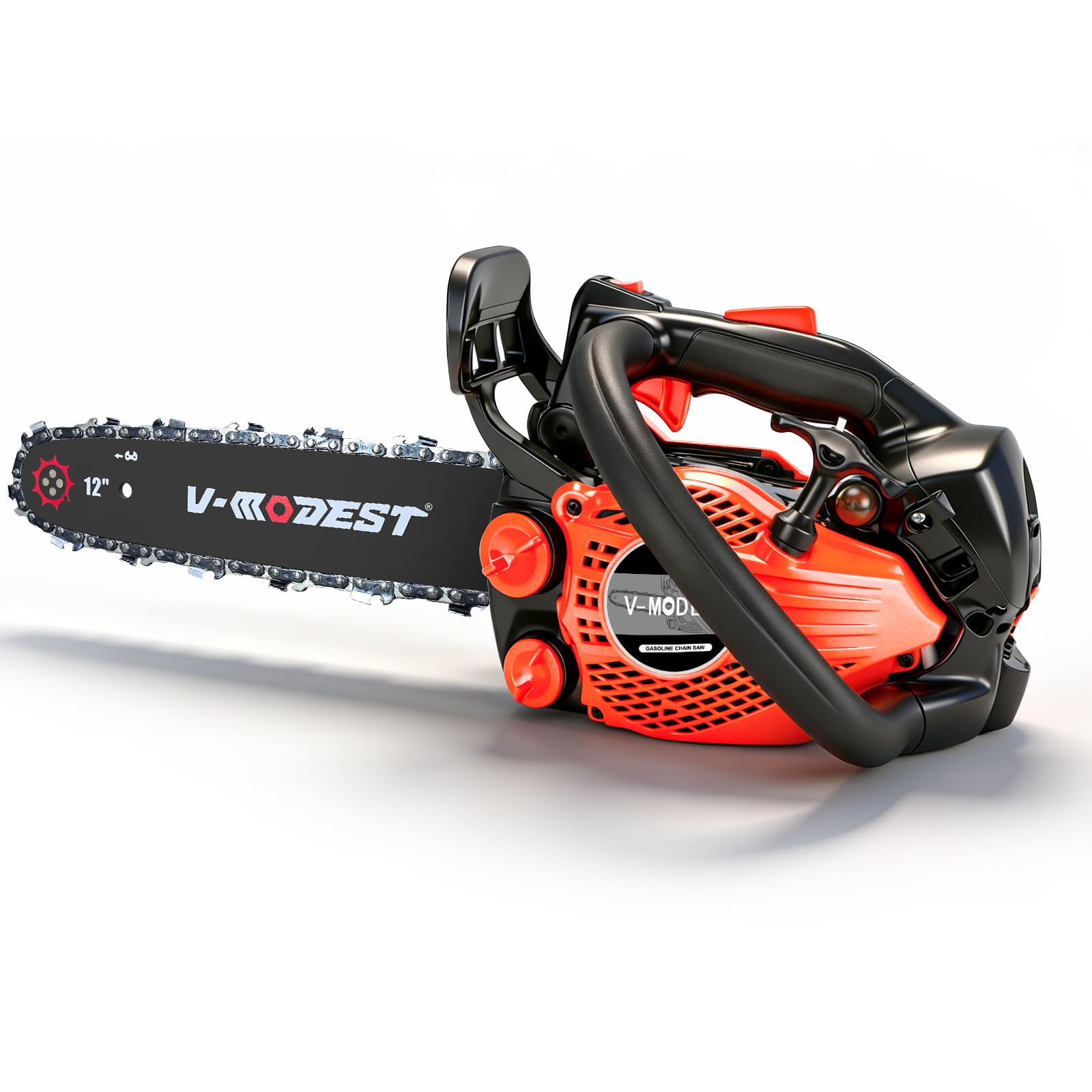
At 5.5 pounds dry, this is the lightest saw in the lineup at 5.5 pounds versus the PROYAMA at 8.7 pounds, and its 1.51 HP gives it the best power-to-weight ratio here: 0.275 HP per pound.
That weight matters when you are holding it in one hand while bracing against a branch 20 feet up. The 25cc 2-stroke engine (a type that mixes oil with fuel for lubrication) delivers 1.51 HP and spins at up to 12,000 RPM (revolutions per minute — how fast the chain rotates), making it class-leading among these picks for weight savings. It includes a full kit with gloves, fuel bottle, funnel, and tool kit, so you start cutting right after mixing fuel.
Owners mention it as the lightest gas saw available, noting it starts every time and delivers excellent cutting performance for its small size. However, one owner had a defective unit with a stuck clutch (the part that engages the chain), and another mentioned fine sawdust getting past the air filter. For the price, this is a micro powerhouse that, according to reviewers, rivals saws costing twice as much — if you get a good unit, it is a gem for climbing.
Weight Champion
- 5.5 lbs versus the PROYAMA 26cc at 8.7 lbs saves weight on long climbs
- 1.51 HP feels fast and responsive for pruning and limbing
- Complete kit saves you from buying extras
Quality Variance
- Some units arrive with clutch or air filter issues from the start
- No brand warranty network — support may be slow
Best for climbers: If you need a saw you can carry up a tree without tiring, this is the lightest option with enough power for branch cuts.
Caution: If you want a rock-solid warranty and the ability to walk into a dealer for parts, a name-brand saw like Echo is the safer bet.
3. V-MODEST 25cc Gas Chainsaw (Low Kickback)
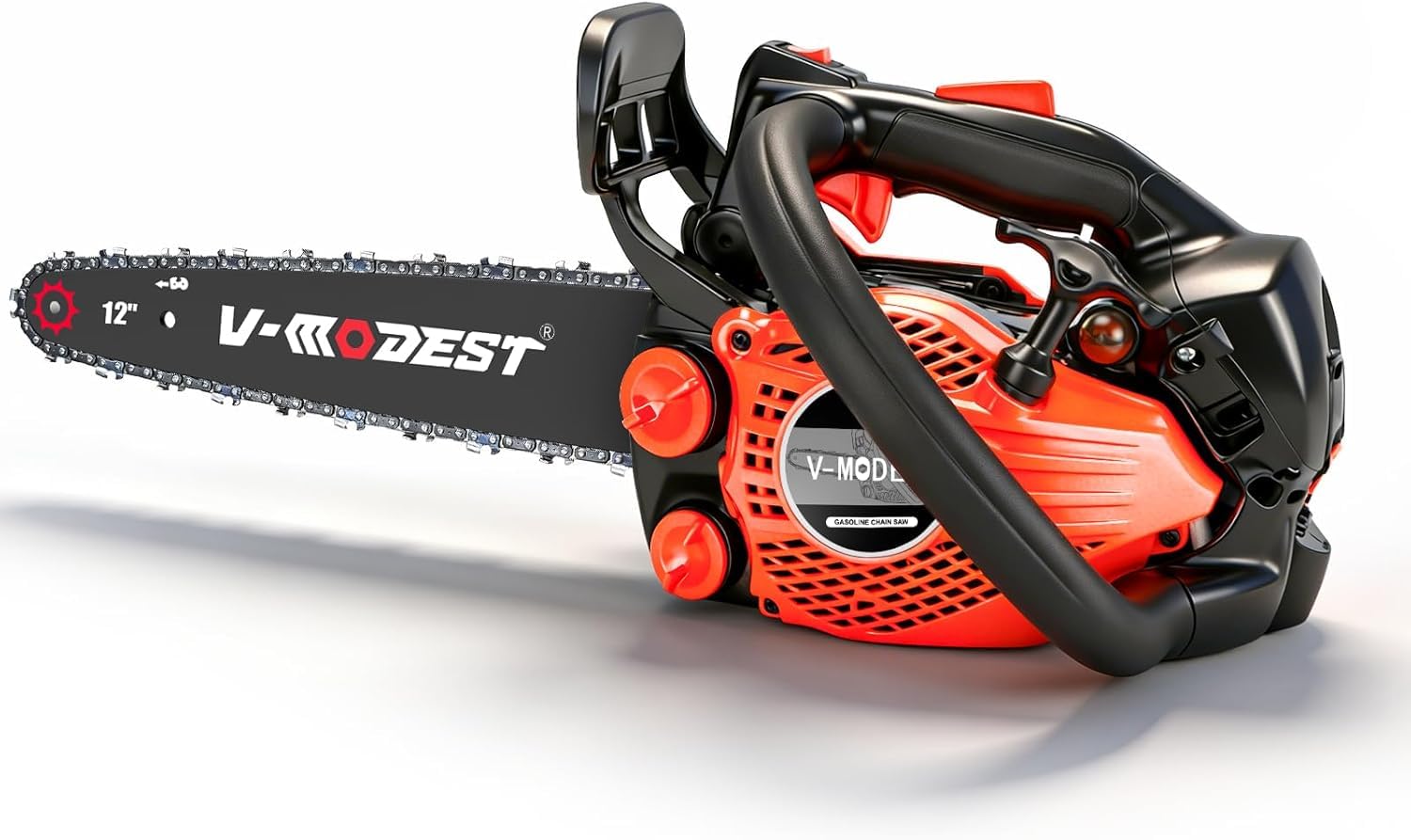
This saw shares the 25cc, 1.51 HP engine with the climbing V-MODEST, but its 1/4″ LP low-kickback chain (a smaller, finer chain that reduces the chance of the saw jerking back at you) makes it safer for new users.
That 1/4″ LP chain has a 0.043 gauge (the thickness of the drive links that fit into the bar groove) with 64 drive links — smaller than the standard 3/8″ LP chain on the other V-MODEST. That smaller, finer chain reduces the risk of a violent kickback (when the nose of the bar catches wood and the saw jerks toward you) — a real safety upgrade for someone new to gas saws. The top-handle design and 5.5-pound dry weight make it equally easy to handle one-handed, and the complete kit includes gloves, bar cover, fuel bottle, and tool kit.
Customers note it is lightweight, starts easily, and offers excellent cutting performance for its size, but one reviewer had a defective unit from the start. The air filter may let fine sawdust through over time, so regular cleaning is important. The low-kickback chain also means slightly slower cuts than the 3/8″ chain on the standard V-MODEST, but for a weekend pruner, that trade-off is worth the added safety margin.
Safer Starting Point
- 1/4″ LP low-kickback chain reduces kickback risk for new users
- 5.5 lbs keeps fatigue low during long sessions
- Dual-post chain brake and side chain tensioner make adjustments easy
Cutting Speed Sacrifice
- Low-kickback chain cuts slower than standard 3/8″ chain
- Quality control issues reported — some units arrive defective
Smart first saw: This is the right pick for a homeowner who wants a lightweight saw with a safety-first chain that forgives rookie mistakes.
skip it if: You need fast, aggressive cutting for thick wood — the standard 3/8″ chain on the other V-MODEST will serve you better.
4. NEO-TEC 12 Inch Top Handle Gas Chainsaw, 25.4cc

One reviewer called this 8.2-pound, 1.2 HP saw a reliable replacement for an Echo 330 — it has more power than the PROYAMA but weighs less than the Husqvarna, making it a solid mid-range option for limbing.
At 8.2 pounds, this is heavier than the 5.5-pound V-MODEST saws but still lighter than the PROYAMA. The 25.4cc 2-stroke engine produces 1.2 HP and spins up to 12,000 RPM, giving you enough power for limbing (cutting branches off a felled tree) and small tree felling without the extra weight of a 38cc engine. The ergonomic wrap-around handle includes a metal lanyard ring for climbing, and the spring-assisted ignition system means you start it in one pull after assembly. Reviewers point out that after correcting to a 25:1 fuel mix (5 ounces of oil per gallon of gas), the saw starts easily, pulls strongly, and cuts like a demon — with one owner calling it a reliable replacement for an unreliable, expensive Echo 330.
However, the same 25:1 mix ratio (not the 50:1 common in many newer saws) is a requirement, and using the wrong mix causes hard starting and no-idle issues. The choke knob (which controls the fuel-air mixture for starting) protrudes far enough to snag on climbing gear, and the chain is aggressive rather than safety-rated, so it cuts fast but demands caution. According to one owner, it also uses about 10–12 hours on the original chain before needing replacement, which is decent for the price.
Reliable Workhorse
- One-pull start after assembly saves frustration
- Well-balanced design with low vibration for extended use
- Hardened chain cutters resist dulling even in dirty wood
Mix & Maintenance
- Requires 25:1 fuel mix — using 50:1 causes starting failure
- Choke knob protrudes and may snag on climbing harness
Solid limbing saw: This is a good mid-range choice for someone who wants a reliable top-handle saw and is comfortable mixing fuel at 25:1.
Not for beginners: The aggressive chain and sensitive carburetor mean this saw works best in experienced hands.
5. PROYAMA 26CC 2-Cycle Top Handle Gas Powered Small Chainsaw

A year-long owner says this cheapest saw in the lineup still runs flawlessly after 12 months — despite being 8.7 pounds and producing only 1.1 HP.
At 8.7 pounds and 1.1 HP, this is the heaviest and least powerful saw in the lineup. It weighs 8.7 pounds versus the V-MODEST at 5.5 pounds and is rated at 1.1 HP versus 1.51 HP. However, the PROYAMA has a following among budget buyers who just need a functional saw for occasional pruning and firewood prep. The wrap-around handle reduces fatigue, and the anti-vibration system (dampeners that reduce hand shaking) makes it more comfortable than its weight suggests. Shoppers say that after a small carburetor adjustment from the start, it starts in 2 pulls cold and runs for about an hour on a tank, cutting through wood up to 6 inches thick. One verified owner said, “I’ve been using this saw for a year now with no issues.”
The trade-offs are real: fuel and oil caps feel fragile, and the plastic parts may not survive a drop onto concrete. It also requires a 25:1 mix, and the assembly instructions are poor for novices. But for the price, it gets the job done without breaking — and the one-year warranty adds a safety net.
Budget Champion
- Cheapest saw in the lineup with proven year-long reliability
- Anti-vibration system makes the 8.7 lbs feel manageable
- Includes fuel mixing container — a small but welcome bonus
Heavy & Underpowered
- 8.7 lbs versus the 5.5 lb V-MODEST will tire your arm faster
- 1.1 HP struggles on thick cuts that the 1.51 HP saws slice through
- Fragile fuel/oil caps may crack over time
Entry-level value: This saw fits a budget-conscious buyer who needs a functional saw for light pruning and firewood and is willing to tune the carburetor from the start.
Better to spend a little more: If you cut more than once a month or value light weight, the extra cost of a 5.5 lb saw saves your arm every session.
Understanding the Specs
Horsepower (HP) vs Engine Displacement (CC)
Engine displacement (measured in cubic centimeters, or cc) tells you the volume of the combustion chamber, while horsepower (HP) measures the actual work the engine can do. A 38cc engine like the Husqvarna 120 Mark III delivers 1.88 HP — enough to cut through 6-inch logs without slowing down. In contrast, a 25cc engine producing 1.5 HP is lighter and adequate for branches up to 4–5 inches, but will bog (slow under load) if you push it into thicker wood. For a small gas chainsaw, look for at least 1.2 HP if you plan to fell small trees; 1.0 HP is fine for pruning only.
Weight and Power-to-Weight Ratio
Dry weight (without fuel and bar oil) is the number that matters for climbing. A 5.5-pound saw lets you work one-handed for 30 minutes, while an 8.7-pound saw forces you into two-handed cuts, reducing reach. The power-to-weight ratio (HP divided by pounds) tells you how much cutting force you get per pound of saw. The V-MODEST 25cc achieves 0.275 HP per pound, while the PROYAMA 26cc delivers 0.126 HP per pound. That means the V-MODEST is rated at 1.51 HP and 5.5 pounds, while the PROYAMA is rated at 1.1 HP and 8.7 pounds. For limbing and pruning, a ratio above 0.20 is ideal. For ground cutting, weight matters less, and a lower ratio is acceptable.
Chain Pitch, Gauge, and Drive Links
The chain pitch (the distance between chain links, measured in inches) determines how aggressive the cut is. A 3/8″ LP pitch (low profile) cuts faster but can kick back harder, while a 1/4″ LP pitch cuts slower but with less kickback risk. The gauge (the thickness of the drive links that fit into the bar groove) is typically 0.050″ or 0.043″ — you must match chain to bar gauge exactly. Drive link count (44 DL for a 3/8″ LP chain on a 12-inch bar, 64 DL for a 1/4″ LP chain) tells you the chain length. If you replace a chain, match all three numbers — pitch, gauge, and drive links — to the original bar, or the chain will not fit or run safely.
Fuel-to-Oil Mix Ratio
Two-stroke engines require a precise mix of gasoline and 2-cycle oil because the oil lubricates the internal moving parts. A 25:1 ratio (about 5 ounces of oil per gallon of gas) provides more lubrication for cheaper engines with looser tolerances, which is why many budget saws require it. A 50:1 ratio (about 2.6 ounces per gallon) burns cleaner and leaves less carbon buildup, common on premium saws like Husqvarna. Using a 50:1 mix in a saw that needs 25:1 causes lean running, overheating, and eventual seizure (the engine locks up). If your saw starts hard or idles poorly after a few tanks, check your mix ratio first.
FAQ
Can I use a small gas chainsaw for cutting firewood?
What is the difference between a top-handle and rear-handle chainsaw?
How do I know the right fuel mix for my chainsaw?
How often should I sharpen the chain on my small gas chainsaw?
Can I replace the chain on a budget chainsaw with a name brand chain?
What does the chain brake do and should I use it?
How long does a small gas chainsaw typically last?
What should I do if my chainsaw won’t start after sitting for a few months?
Is a 25cc gas chainsaw powerful enough for felling small trees?
Can I use a top-handle chainsaw if I am not a professional climber?
Final Thoughts: The Verdict
For the majority of shoppers, the best small gas chainsaw is the V-MODEST Top Handle 25cc because it delivers the lightest weight (5.5 lbs) and highest power-to-weight ratio (0.217 HP/lb) for climbing and pruning, making it the most versatile option for both tree work and ground tasks. If you want pro-grade power for heavy ground cutting, grab the Husqvarna 120 Mark III with its 38cc X-Torq engine and 1.88 HP. And for a budget-friendly entry point that still starts every time after a year of use, the standout is the PROYAMA 26cc.
How We Picked
We do not accept paid placement. Every pick is matched to a real buyer and a real use-case; we do not hands-on test units.
Sources & Methodology
Specifications: manufacturer listings and product documentation. Review insights: verified customer reviews, as of July 2026. Pricing: not shown on this page (it changes often); check the current price via the retailer link.
As an Amazon Associate, Lawn Gear Lab earns from qualifying purchases. This does not affect which products we feature.