
Specs are compiled from manufacturer listings and verified buyer reviews and can change over time — please confirm the key details on the product page before buying.
You tuck a seed into soil, get it to sprout under a grow light, and then face the hard part — how do you get that seedling into the garden without ripping its roots apart? Plastic pots make you wiggle, pry, and often tear the root ball right when the plant is most fragile. Biodegradable plant pots solve that by letting you bury the whole container in the ground. It breaks down naturally while roots grow straight through the walls. This guide compares the real specs that matter — material, size, drainage, and how long each pot holds up before decomposing — so you match the right pot to your seedlings.
I’m Rikta — the founder and writer behind Lawn Gear Lab. This guide is built by comparing the manufacturers’ published specifications and the patterns across verified customer reviews, so you get each pick’s real strengths and trade-offs instead of marketing spin.
Your choice depends on matching the pot’s size and material to what you grow, from compact succulents in 2.36-inch pots to larger seedlings that need the breathing room of a 4-inch pot with drainage holes (small openings at the bottom that let excess water escape, keeping soil from staying soaked).
Quick Picks
- YESIACE 126 Packs Square Peat Pots — Best Overall
- Dalzom 60Pcs 4” Peat Pots with Plant Labels — Top Performer
- JNYONG 120 Packs 3.15 Inch Peat Pots — Long-Lasting Value
- 131 Pcs Organic Peat Pots, 3.15 Inch Round Nursery Pot — Versatile Bulk
- FDGARDEN Biodegradable Peat Pots for seedlings, 100 Pack, 2.36inch — Compact Starter
- JERIA 200-Pack 3.15 Inch Peat Pots with Plant Labels — Budget Champion
How To Choose The Best Biodegradable Plant Pots
Every biodegradable pot eventually turns into soil, but the timing and strength vary hugely by material. A pot that falls apart in two weeks is useless for a tomato seedling that needs a month before planting out. Here are the three specs to check first.
Material blend and decomposition speed
The base material — recycled pulp, peat, moss, or wood fiber — decides how long the pot holds its shape when wet. Pure peat pots (pots made primarily from compressed peat moss, a spongy, decomposed bog material) tend to stay intact longer (around four weeks indoors, as buyers report with the Dalzom pots). Pulp-only pots break down faster, which is fine for fast-germinating herbs but risky for slow-growing vegetables. Look for “recycled pulp” if you want fast breakdown or “peat fiber” for longer structure.
Size and drainage design
Match the pot diameter to your seedling’s expected stay. A 2.36-inch pot (just over 2 inches across) works for succulents and short-cycle herbs. A 3.15-inch or 4-inch pot gives tomatoes, peppers, and cucumbers room to develop a strong root ball (the dense tangle of roots that fills the pot) before transplanting. Drainage holes at the bottom are critical — without them, the pulp stays waterlogged and turns slimy. Some pots in this guide list one drainage hole, while others list 4 drain holes, so always check the listing.
Piece count and extras
Biodegradable pots are single-use by nature. A pack of 60 pots may get you through a small herb garden, but a 120-pack or 200-pack covers a full vegetable bed plus extra for succession planting (planting new seeds every few weeks for a steady harvest). Many kits include plant labels — some are plastic and oversized, so check the size description if you want markers that fit the pot rim.
Quick Comparison
| Model | Best For | Number of Pieces | Diameter | Material | Amazon |
|---|---|---|---|---|---|
| YESIACE 126 Packs Square Peat Pots | High-count square pots that fit standard trays | 126 | 3.15 inches | Peat and Plant Fibers | Amazon |
| Dalzom 60Pcs 4” Peat Pots | Larger 4-inch pots with included labels | 60 | 4 inches | 100% Recycled Pulp | Amazon |
| JNYONG 120 Packs 3.15 Inch Peat Pots | Long-lasting value pack with extra labels | 120 | 3.15 inches | Peat | Amazon |
| 131 Pcs Organic Peat Pots | Bulk round pots for family or class projects | 131 | 3.15 inches | Pulp | Amazon |
| FDGARDEN 100 Pack Peat Pots | Small compact pots for succulents and herbs | 100 | 2.36 inches | Moss, Recycled Pulp | Amazon |
| JERIA 200-Pack 3.15 Inch Peat Pots | High-volume starter kit with matching labels | 200 | 3.15 inches | Peat | Amazon |
In‑Depth Reviews
1. YESIACE 126 Packs Square Peat Pots
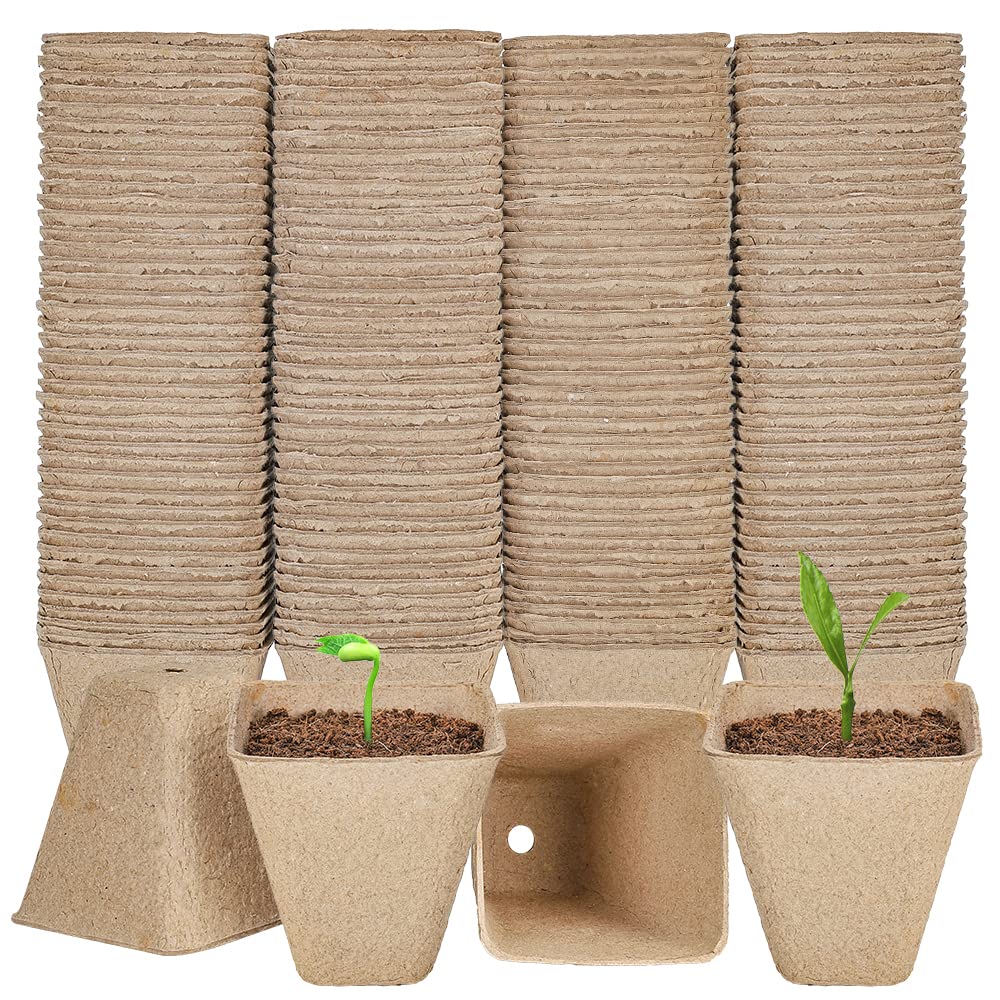
The square-sided design that fits standard trays without wasting a single inch of space.
Round pots waste surface area in a tray because of their shape. The YESIACE pots are square, so they pack tightly into a flat with no gaps. Each pot measures 3.15 x 3.15 x 3.15 inches — owners mention they “fit 3.5″ / 18 pot trays perfectly.” That means you can fit more seedlings per tray compared to round pots of the same diameter. The material is a blend of peat (decomposed bog moss) and plant fibers with one drainage hole at the bottom. The square walls also prevent the pots from spinning or tipping when you carry a full tray.
At 126 pieces in one pack, you get a full season of seed starting without running out mid-spring. The square shape gives each seedling a uniform amount of soil, unlike round pots that leave variable corner gaps. If you use a humidity dome or a standard 1020 tray (a 10-by-20-inch tray that holds multiple small pots), these align without shifting.
The catch is the material feel. One reviewer noted the pot does not seem to contain much peat despite the label, so the breakdown rate may lean faster than pure peat pots. For crops that need 4-5 weeks indoors, monitor the bottom condition around week three. Still, for the combination of tray fit and sheer count, this is the most practical all-rounder for a serious home gardener.
Why it wins the tray test
- Square shape packs tightly into 3.5-inch tray slots with no wasted space.
- 126 pots cover multiple seed-starting rounds without reordering.
- Drainage hole prevents waterlogging in the peat blend.
A note on the material
- Reviewers question the actual peat content — may break down faster than pure peat pots.
- Round pots still dominate in shape options if you prefer traditional styling.
Reach for this if: you use standard 3.5-inch tray inserts and want maximum seedling count per flat without the round-pot air gaps.
Watch for: the peat-fiber blend may disintegrate a bit sooner than pure peat, so keep an eye on week-3 moisture.
2. Dalzom 60Pcs 4” Peat Pots with Plant Labels
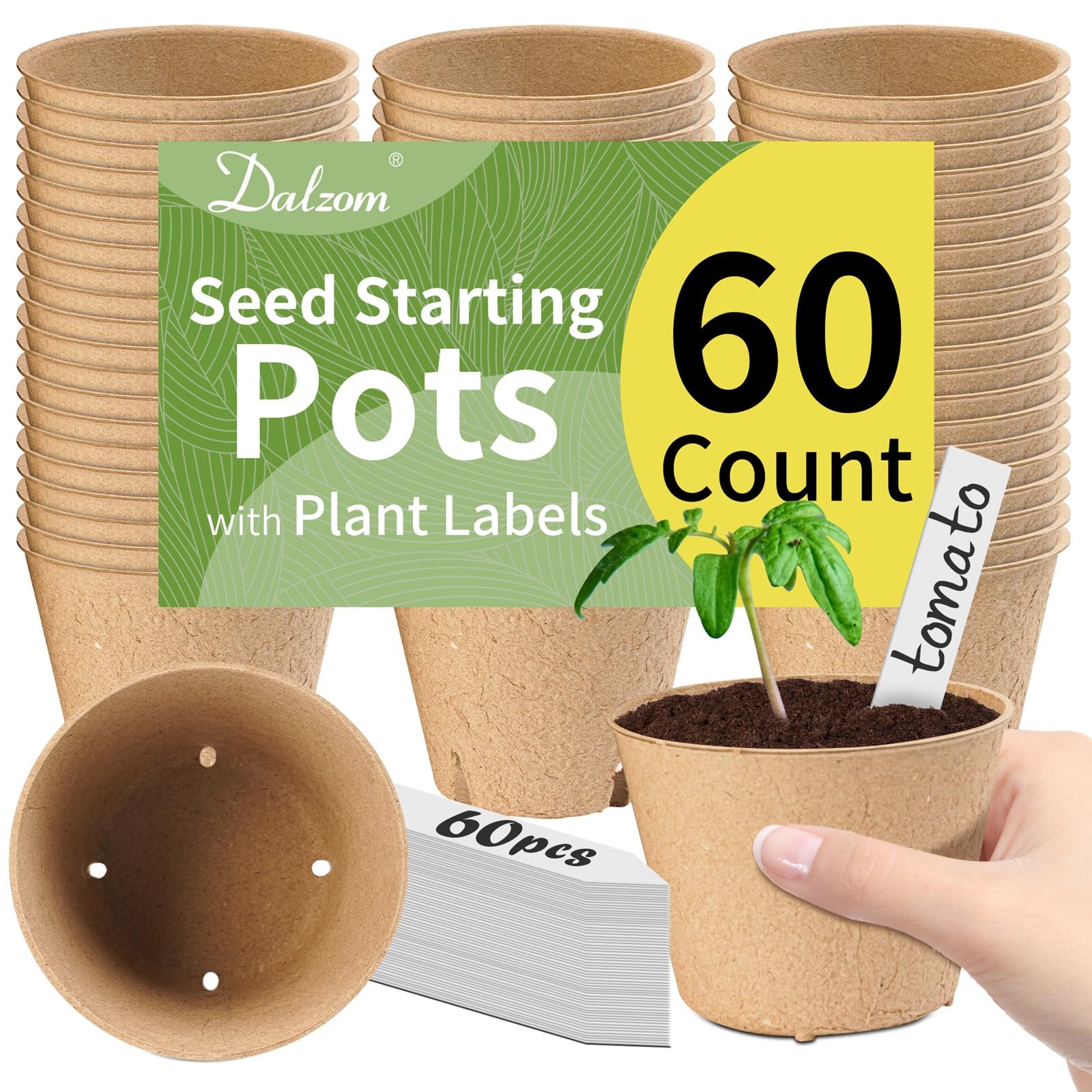
The wide 4-inch pot that gives tomato and pepper roots room to stretch before moving outside.
Most biodegradable pots max out at 3.15 inches across. The Dalzom pots are a full 4 inches across at the top, with a height of 3 inches. That extra width matters for crops like tomatoes, peppers, and cucumbers that spend a month indoors before the last frost — the roots have space to spread without circling the bottom. Customers note the pots “wick moisture well” (pull water up through the walls from a tray below) and “stay intact for 4 weeks indoors before ground planting,” which is the ideal decomposition window for a standard spring start. Each pot has one drainage hole, and you get 60 matching plant labels (4 inches long, 0.8 inches wide) in the same package, so you can mark every variety immediately.
The material is 100% recycled pulp — not a peat blend. That means the breakdown is predictable and complete, and the bottom stays firm long enough for a full indoor cycle. One reviewer planting on a hill noted the pot holds soil and seed in place even on a slope, preventing washout during heavy rain. The 4-inch size also means you generally use one pot per seedling rather than starting multiple seeds in a smaller pot and thinning later.
The trade-off is the 60-count pack — 60 pieces versus 120 for JNYONG and 126 for YESIACE. If you are starting dozens of varieties, you may need two packs. The pots are also slightly shorter than some users expect, at 3 inches tall. But for the crops that need the 4-inch breathing room, this is the most reliable option in the list.
What works best
- 4-inch diameter gives roots significant room vs the typical 3.15-inch pot size.
- Stays intact for 4 full weeks indoors based on real buyer experience.
- 60 labels included, each 4 inches long — easy to write on and insert.
What to consider
- 60-piece pack is small compared to 120-count or 200-count alternatives.
- Slightly shorter at 3 inches than some users may want for deep-root varieties.
Perfect for: anyone starting large-seeded crops (tomatoes, squash, cukes) that need a full month indoors with minimal root disturbance.
If you need more: the 60-unit count runs out fast for big gardens — consider if you need two packs upfront.
3. JNYONG 120 Packs 3.15 Inch Peat Pots
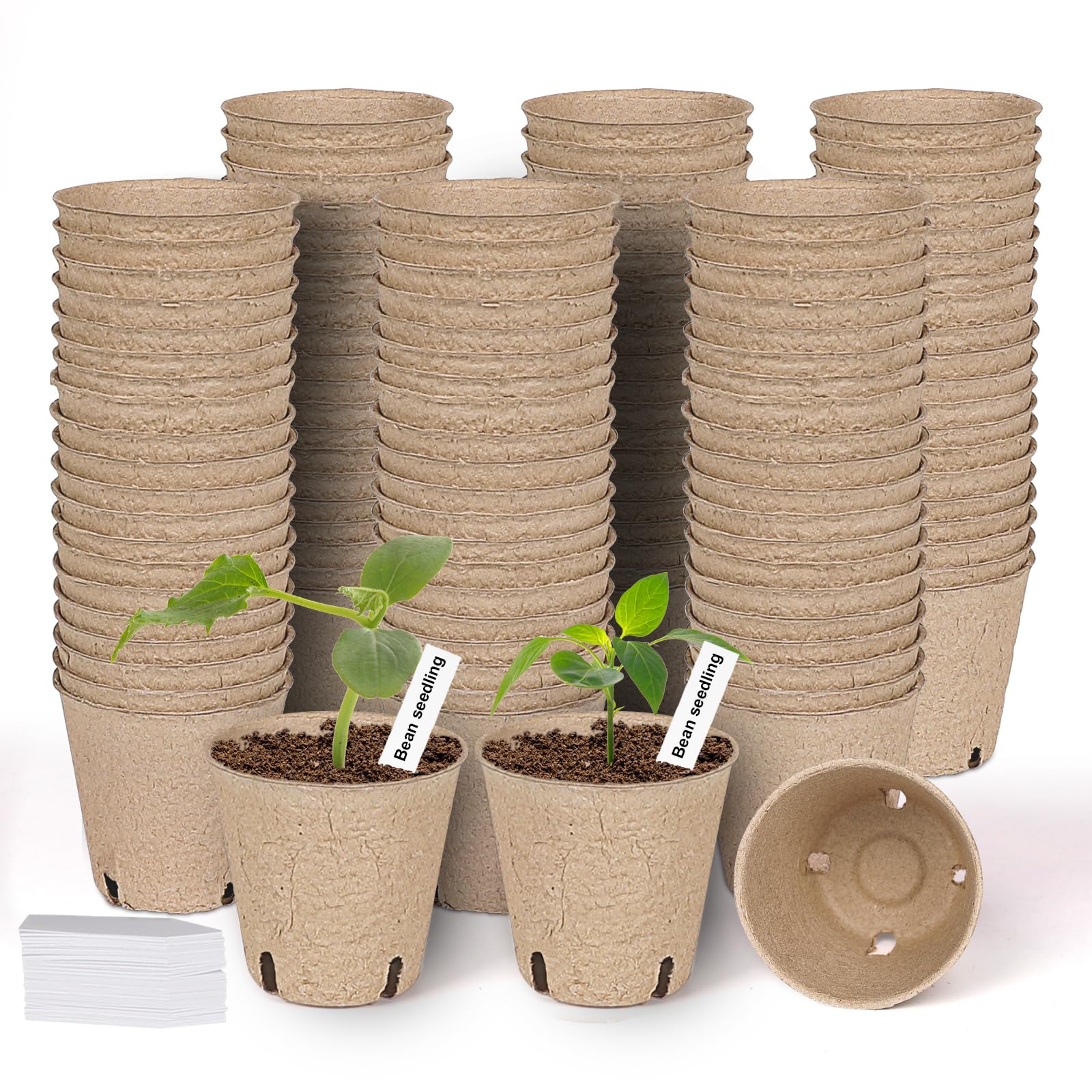
The peat pot that one reviewer kept watering daily for four months with no structural failure.
Durability is the headline here. The JNYONG pots are made from peat and hold together significantly longer than standard pulp pots. One buyer mentioned starting seedlings 4 months ago, watering daily, and the pots were still intact — an extreme case that shows the material strength. Each pot measures 3.15 inches in diameter and has 4 drain holes at the bottom for even moisture release. The 120-count also includes 100 plant labels (plastic), so you can mark every pot without buying extras. The peat material composts quickly when planted in the ground, but it resists crumbling during the indoor growing phase better than eco-friendly pulp-only options.
Buyers consistently mention the sturdiness. The reviews note the pots are “deep, easy-to-use seed starters” and that they “compost quick” once planted. That is the ideal balance — stable indoors, rapid breakdown outside. The 3.15-inch size is the balance for most vegetables, fitting 18 pots per standard 1020 tray. The pots are also reusable for a second cycle if you handle them carefully, though the one-time nature of biodegradable pots means the structure weakens after full saturation.
Compared to the YESIACE square pots, these are round and do not pack as tightly in a tray, but the peat material feels denser and more substantial. The labels are the same size as the Dalzom labels but you get 100 instead of 60. If you had to pick one value pack that lasts through a long, wet spring, this is the strongest structural choice.
The durability edge
- Peat material holds structure under daily watering for months based on buyer reports.
- 120 pots plus 100 labels at a mid-range price point.
- 4 drain holes provide good bottom airflow and drainage.
The shape limitation
- Round pots leave air gaps in standard square tray cells, reducing total count per flat.
- Plastic labels are standard size but not biodegradable.
Best for: growers in wet climates or anyone who tends to overwater — the peat resists saturation breakdown better than pulp.
skip it if: you pack trays tightly and prefer square pots for zero-gap arrangement.
4. 131 Pcs Organic Peat Pots, 3.15 Inch Round Nursery Pot

The round pulp pot that comes with 131 labels — one for every single seedling you start.
The 131 Pcs Organic Peat Pots from ModaSin is a round-pot bulk kit that matches every pot with a planting label, so you never have to scavenge for markers mid-season. The pots measure 3.15 inches across the top and 3 inches tall, with 4 drain holes at the bottom. Reviewers point out the actual diameter is 3.25″ with a 3″ height — smaller than the standard 4×4 pots you find at Home Depot or Lowe’s — but adequate for 3-node seedling growth. The material is natural recycled pulp paper that breathes like clay (meaning air moves through the walls naturally), so roots can push through the bottom and walls without circling like they would in a plastic pot.
Compared to the JNYONG pack, these are pulp instead of peat, meaning the breakdown happens a few days faster once planted. That works well for flowers, herbs, and quick-turn crops. One reviewer used these for a Mother’s Day class activity with kids — the pots held up to coloring and handling without immediate collapse. The round shape is traditional and fits into any pot holder or tray, though it does leave gaps in square tray cells. The 131-piece count is generous, with enough leftover to share or save for fall planting.
The main limitation is that the size runs smaller than many gardeners expect — at 3.25 x 3, it is not a full 4-inch pot. For slow-growing crops that need 5+ weeks indoors, the roots may outgrow the depth. But for standard spring seed starting where you transplant at 3-4 weeks, the thickness and drainage are more than adequate.
What stands out
- 131 labels match 131 pots — no shortage for large variety gardens.
- Pulp material breathes well and roots penetrate easily without circling.
- Good thickness for handling and labeling without tearing.
A known gap
- Diameter is 3.25″ not 4″, so it is smaller than typical big-box nursery pots.
- Round shape leaves unused space in standard square tray grid.
Ideal for: flower gardeners and classroom planting projects where the 1:1 pot-to-label match prevents mix-ups.
Consider another option if: your seedlings need a full 4-inch depth and width to develop before transplant.
5. FDGARDEN Biodegradable Peat Pots for seedlings, 100 Pack, 2.36inch

The small-size pot made from moss and pulp that fits succulents, herbs, and shallow-root greens.
At 2.36 inches across, these are the smallest pots in the lineup. The small size is not a limitation — it is the selling point for plants that do not need deep soil. The FDGARDEN pots are made from a blend of moss and recycled pulp, with a 150 ml capacity (roughly 5 fluid ounces). They are ideal for starting herbs (basil, cilantro, parsley), succulents, and microgreens where a 3-inch pot would waste soil and tray space. The material is fully biodegradable and buyers confirm the pots work well for seed starting — one reviewer used them to demonstrate water wicking (pulling water upward through the material) with APSA-80 polymer (a water-absorbing gel). The pack includes 100 pots and 10 plant markers, though several reviewers noted the plastic labels are disproportionately large compared to the tiny pots.
Compared to the 3.15-inch and 4-inch options above, these take up significantly less space on a windowsill or under a grow light — you can fit about 48 of them in a single 1020 tray. The moss-pulp blend breathes well and prevents damping off (a fungal disease that kills seedlings at soil level) if you avoid overwatering. One owner reported that the pots are hard to separate without tearing the rim, so handle the stack carefully when pulling individual cups. The 9 x 9 x 2.5 inch package dimensions are the shipping box, not the pot size — the actual pot is the 2.36-inch diameter listed in the specs.
The catch is the small size limits how long a seedling can stay before transplanting. Anything that needs more than 3-4 weeks of indoor growth (tomatoes, peppers) will outgrow these quickly. But for quick-turn greens and compact ornamentals, the moss-pulp material and low profile make this a smart buy.
The compact advantage
- 2.36-inch size fits high-density tray layouts for herbs and succulents.
- Moss and pulp blend breathes naturally and prevents root rot.
- 100 pots for a small footprint at a low cost per unit.
The real limitations
- Too small for long-season vegetables like tomatoes, peppers, or squash.
- Pots are hard to separate cleanly without tearing the rim.
- Only 10 labels included — not enough for 100 pots.
Right for: windowsill herb growers and succulent propagators who work with small containers and quick turnover.
Not right for: vegetable gardeners who need at least a 3-inch depth for 4-week-old transplants.
6. JERIA 200-Pack 3.15 Inch Peat Pots with Plant Labels
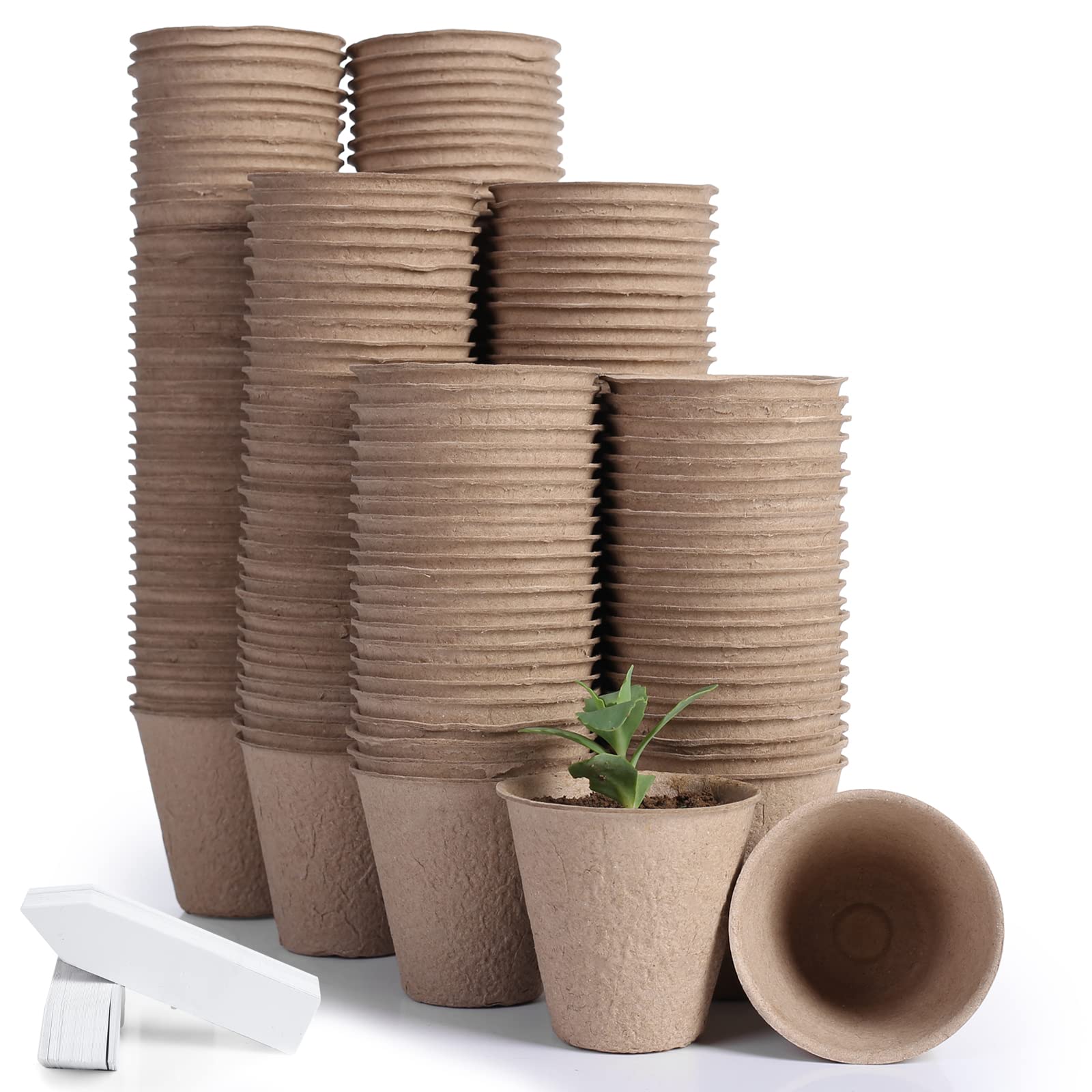
The 200-count beast that covers an entire garden without needing a second order.
Scale is the whole point of the JERIA pack. With 200 peat pots and 200 plant labels, you can start every seed in your spring lineup from a single box. The pots are 3.15 inches in diameter and 3.15 inches tall, made from recycled peat pulp (pulp made from decomposed peat moss) that buyers describe as “hefty” and “sturdy” — not the thin, papery pots that disintegrate when wet. One customer observed the pots “don’t crumble under moist environments,” which is a common failure point for cheap biodegradable pots. The pots breathe like clay, and the roots can push through the bottom once the pot begins to degrade in the soil. Each pot measures 3.15 inches in diameter, and the 200-piece count is the highest in this comparison, versus 126 for YESIACE.
Buyers consistently note the durability as the standout feature. One review compared them favorably to store-bought alternatives, calling them “better quality and cheaper” than in-person retail options. The peat material handles the wet indoor environment without turning to mush, and the pots drain well and dry quickly when you avoid overwatering. The 200 labels are a perfect 1:1 match, so every pot gets a marker. The pots are round rather than square, which is the only shape compromise for the volume you get.
The downside is that these are explicitly a one-time use item — the product notes state they cannot be reused. That is true of all biodegradable pots, but the JERIA instructions are explicit about the single-use nature. For the price per pot, this is the most economical way to outfit a large garden without sacrificing peat quality or stability.
The volume advantage
- 200 pots with 200 labels — the largest count in this comparison at the best per-pot value.
- Peat material holds up under moisture better than pulp-only alternatives.
- Buyers consistently rate durability higher than store-bought peat pots.
One thing to know
- Explicitly single-use — no reusing after the first cycle like some thicker pulp pots.
- Round shape does not pack as efficiently as square pots in standard trays.
Bring this home if: you are starting a whole garden from seed and need enough pots and labels for every variety without reordering mid-season.
Look elsewhere if: you prefer square pots for compact tray packing and are willing to accept a lower piece count for that shape.
Understanding the Specs
Material — Peat vs Pulp vs Moss Blend
The material is the single biggest predictor of how long the pot holds together. Pure peat (as in JNYONG and JERIA) resists water damage longer, often staying intact for 4+ weeks of daily watering. Recycled pulp (as in YESIACE, ModaSin, and Dalzom) breathes better and breaks down faster once planted, which is preferable for quick-germinating crops. Moss blends (FDGARDEN) offer a middle path — good breathability with moderate durability. If you need the pot to stay strong for a month, lean toward peat. If you want fast root penetration and quick soil integration, choose pulp.
Drainage Holes — A Non-Negotiable Feature
Drainage holes at the bottom are important for excess water to leave the pot, preventing the pulp from turning into a soggy mass that suffocates roots. In this guide, some pots list one drainage hole while others list 4 drain holes. Without drainage, the pot acts like a sponge and keeps the root zone wet, which leads to damping-off disease (a fungal condition that kills seedlings). Drainage also speeds up the decomposition process after transplant — water can enter from the soil and help break down the walls faster. If a pot does not list drainage holes in the specs, it is likely not suitable for seed starting.
FAQ
Can I plant biodegradable pots directly in the ground?
How long do biodegradable pots last before breaking down?
Are biodegradable pots better than plastic seed starter pots?
Do biodegradable pots need drainage holes?
What size biodegradable pot should I use for tomatoes?
Can I reuse biodegradable peat pots?
Are the plant labels included with the pots biodegradable?
How many biodegradable pots do I need for a vegetable garden?
Final Thoughts: The Verdict
Across the board, the biodegradable plant pots winner is the JNYONG 120 Pack because the peat material holds structure under daily watering longer than pulp alternatives, and the 120-pot count with 100 labels offers genuine value for the price. If you want the largest 4-inch room for tomatoes and heavy feeders, grab the Dalzom 60 Pack. And for a budget-friendly way to start succulents, herbs, and microgreens in small pots, the standout is the FDGARDEN 100 Pack.
How We Picked
We do not accept paid placement. Every pick is matched to a real buyer and a real use-case; we do not hands-on test units.
Sources & Methodology
Specifications: manufacturer listings and product documentation. Review insights: verified customer reviews, as of July 2026. Pricing: not shown on this page (it changes often); check the current price via the retailer link.
As an Amazon Associate, Lawn Gear Lab earns from qualifying purchases. This does not affect which products we feature.