
Specs are compiled from manufacturer listings and verified buyer reviews and can change over time — please confirm the key details on the product page before buying.
Tap water from your garden hose often carries chlorine, chloramine, heavy metals, and sediment that harm plant roots, strip beneficial soil bacteria, and leave white crust on leaves. A good garden hose filter removes those contaminants so every drop nourishes your plants — but filters vary widely in media type, capacity, and lifespan.
I’m Rikta — the founder and writer behind Lawn Gear Lab. This guide is built by comparing the manufacturers’ published specifications and the patterns across verified customer reviews, so you get each pick’s real strengths and trade-offs instead of marketing spin.
Whether you are topping off a hot tub, watering a vegetable patch, or running a hydroponic system, you need a garden hose filter that actually removes what your municipal supply adds without choking your pressure to a trickle — here are the few that earn their place on your spigot.
Quick Picks
- ecoone Hose Filter Advanced Purification Water Filter — Best Overall
- Camco Hydro Life 52700 Inline Water Filter — Best for Hydroponics
- VENUSFILTER Garden Hose Filter — Best Value
- Camco GardenPURE Carbon Water Filter — Budget Champion
How To Choose The Best Garden Hose Filter
A garden hose filter is a small device, but picking the wrong one means either replacing it every month or watching your water pressure disappear. Here are the three things that define a good filter for your setup.
Filter Media: Carbon, KDF, or Dual-Stage
The material inside the filter decides what gets trapped. Activated carbon (usually from coconut shells) is great at pulling out chlorine, bad taste, and odor. KDF (Kinetic Degradation Fluxion — a process using a copper-zinc alloy) handles heavy metals and chloramine better, and it also stops bacteria from growing inside the filter. Dual-stage filters layer both materials, giving you the broadest protection — they trap sediment first, then polish the water through carbon and KDF.
Gallon Capacity: How Long Before Replacement
Every filter has a rated total gallon capacity — the amount of water it can clean before it stops working. A filter rated for 8,000 gallons will serve a small garden or a single hot-tub fill for several months, while a 40,000-gallon unit can last a full year of heavy use. Lower-capacity filters are cheaper upfront but cost more over time if you have a big garden or multiple uses.
Flow Rate: Keeping Your Water Pressure
A filter that restricts flow too much makes a sprinkler weak and a pressure washer useless. Most inline filters with a 3/4-inch garden hose thread allow 1.0 to 2.5 gallons per minute (GPM — the volume of water that flows through each minute). For drip irrigation or a spray nozzle, 1 GPM is fine — for filling a pool or running a sprinkler, look for at least 2.0 GPM so you are not stuck waiting.
Quick Comparison
| Model | Best For | Filter Media | Gallon Capacity | Flow Rate | Amazon |
|---|---|---|---|---|---|
| ecoone Hose Filter Advanced Purification | Premium high-capacity use (hot tubs, pools, heavy gardening) | Dual-stage (carbon + KDF) | 40,000 gallons | — | Amazon |
| Camco Hydro Life 52700 | Hydroponics and organic gardens, chloramine removal | Catalytic carbon + KDF 85 | 8,000 gallons | Up to 2.5 GPM | Amazon |
| Camco GardenPURE Carbon Water Filter | Small organic gardens, budget-friendly entry | Activated carbon (with aluminum/PET housing) | ~1,000 gallons | Restrict to 1 GPM for best performance | Amazon |
| VENUSFILTER Garden Hose Filter | Filling hot tubs, pools, and basic sediment/chlorine reduction | Coconut shell activated carbon + KDF | 8,000 gallons | — | Amazon |
In‑Depth Reviews
1. ecoone Hose Filter Advanced Purification Water Filter

The high-gallon workhorse that tackles everything from hot tubs to heavy gardens.
If you need a single filter that can handle an entire season of pool fills, hot-tub top-offs, and vegetable-garden watering, the ecoone is the one to grab. Its dual-stage system — a pre-filtration layer for debris, then premium activated carbon, then KDF media, then a post-filtration layer — filters particles as small as 20 microns (a micron is one-millionth of a meter, so it catches very fine sediment). That multi-layer approach is why it earned the highest capacity in this roundup by a huge margin.
The 40,000-gallon rating puts it five times higher than the Camco Hydro Life (8,000 gallons) and gives it a clear advantage for anyone refilling a spa or cold plunge regularly. Buyers report that it removed 40 ppm (parts per million — a measurement of dissolved solids) from tap water in before-and-after testing, and several mention backwashing to extend its life even further. At 1.37 pounds, it feels solidly built, but the extra weight is a minor trade-off for the durability you get. The main catch is that the exact flow rate is not published — but users say water flow remains good for most tasks.
Why it leads the list
- Massive 40,000-gallon capacity — 5x more than the next best filter here, so far fewer replacements
- Dual-chamber system with four filtration layers (pre-filter, carbon, KDF, post-filter)
- Buyers confirm it measurably reduces total dissolved solids (one reviewer tested a 40 ppm drop)
What to watch
- Unspecified flow rate — best for tasks that do not need high pressure (hot tub fills, watering cans)
- At 1.37 lbs, it is noticeably heavier than the Camco Hydro Life (0.9 lbs), so hose strain is a tiny concern
Reach for this if you fill a hot tub, pool, cold plunge, or large garden and want a filter that lasts a full year between changes without sacrificing broad contaminant removal.
If you only have a couple of potted plants and cannot justify spending at the top of the price range, a smaller-capacity filter will do the job for less.
2. Camco Hydro Life 52700 Inline Water Filter

The hydroponic specialist that combines chloramine removal with a strong flow rate.
For anyone running a hydroponic or organic vegetable setup, chloramine is the bigger threat — standard carbon alone struggles with it. The Hydro Life uses catalytic carbon plus KDF 85 media that bonds with heavy metals and chloramines while preventing bacterial fouling inside the filter. That makes it a smarter pick than the VENUSFILTER or the Camco GardenPURE for sensitive soil-less systems where root health is everything.
It filters up to 2.5 GPM — noticeably faster than the GardenPURE’s recommended 1 GPM — so you can run a micro-irrigation system without waiting. The 8,000-gallon capacity sits in the middle of this list, but owners mention that with moderate use it lasts about a year. One reviewer noted that they still use a small amount of dechlorinator for their koi pond because the filter drops chlorine very low but not to zero. The included flexible hose protector relieves strain on the spigot, a small but appreciated detail.
The strong points
- Up to 2.5 GPM flow rate keeps pressure alive for sprinklers and drip lines
- KDF 85 extends carbon life and traps heavy metals plus chloramines
- Lightest unit here at 0.9 lbs, so minimal sag on the hose
Limitations
- 8,000-gallon capacity is 5x less than the ecoone, so high-volume users replace more often
- Some buyers recommend adding a pre-filter if your water has visible sediment
Best suited for hydroponic gardeners and urban organic growers who need chloramine removal at a flow rate that does not cripple their irrigation system.
skip it if you are filling a hot tub or pool — the ecoone’s 40,000-gallon capacity will save you from multiple replacements.
3. VENUSFILTER Garden Hose Filter

The entry-level NSF-certified filter that punches above its price on capacity.
The VENUSFILTER matches the Camco Hydro Life’s 8,000-gallon capacity but at a significantly lower cost, making it the budget-friendly pick that does not skimp on the basics. It uses natural coconut-shell activated carbon and KDF technology (Kinetic Degradation Fluxion, a process that uses a copper-zinc alloy to remove contaminants), and it holds NSF certification — a third-party stamp that the Hydro Life and the GardenPURE do not advertise.
Customers note it handles chlorine, bad taste, odor, and sediment effectively. The manufacturer suggests replacing it every three months depending on usage, though at 8,000 gallons that timeline will stretch for moderate gardeners. One quirk: excess carbon dust comes out during the first use, so you need to let the water run for about 30 seconds before attaching anything you care about. The flow rate is not specified, but standard 3/4-inch garden hose threads make it a straightforward swap onto any spigot.
What we like
- NSF certification adds an independent quality check that some pricier filters lack
- 8,000-gallon capacity equals the Camco Hydro Life at a much lower price point
- No tools or assembly required — just screw on and flush the initial carbon dust
What is missing
- Flow rate not published, so it may feel slow with a high-volume sprinkler
- The three-month replacement window is shorter than the Hydro Life’s reported one-year life for similar capacity
Choose this for a first-time garden filter buyer who wants NSF certification and the same 8,000-gallon capacity as a premium model without the premium price.
Pass on it if you need chloramine-specific filtration (get the Hydro Life) or you fill a hot tub weekly and want the 40,000-gallon ecoone.
4. Camco GardenPURE Carbon Water Filter
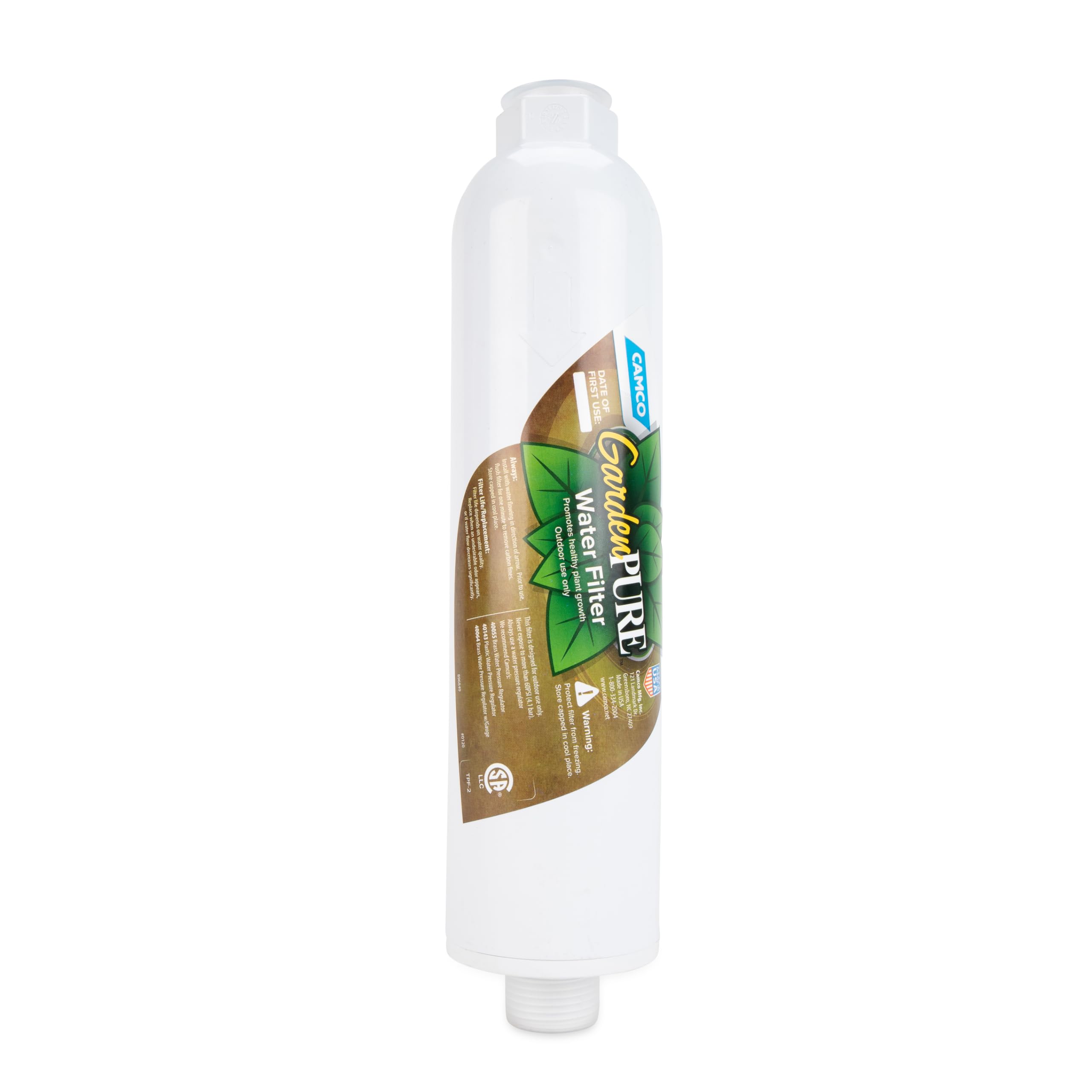
The affordable inline option for small organic gardens that do not need high volume.
If you have a few raised beds, some houseplants, or a small hydroponic setup, the GardenPURE is the lowest-cost way to pull chlorine and chloramine from your hose water. It uses an activated carbon filter (housed in a blend of aluminum and PET — polyethylene terephthalate, a sturdy plastic) that reduces lead, mercury, and hydrogen sulfide on top of the usual chemicals. Buyers consistently say it does not suppress water pressure as much as other brands — one reviewer even runs it with a sprinkler and a fertilizer injector without problems.
The trade-off is capacity. The approximate 1,000-gallon lifespan means more frequent swaps than the VENUSFILTER’s 8,000 gallons. That makes it a higher cost per gallon over time, but the low upfront price makes it an easy entry point for anyone who just wants to try filtered water on a small patch of plants. Camco recommends restricting the flow to 1 GPM for optimal filtration, so this is not the filter to use when you are filling a kiddie pool in a hurry.
Why it still makes sense
- Very low entry cost for testing whether filtered water improves your plants
- Buyers confirm good pressure with sprinklers and injectors — better than some competing brands
- Made in the USA with a limited 1-year warranty
Where it falls short
- ~1,000-gallon lifespan means frequent swaps for medium-to-large gardens
- Optimal performance requires restricting flow to 1 GPM, which slows down any high-volume task
Perfect for a small organic garden or a few houseplants where you want to remove chlorine cheaply and do not need to filter thousands of gallons.
Not the one for anyone who waters a large vegetable patch or fills a hot tub regularly — the replacement cycle will frustrate you.
Understanding the Specs
Activated Carbon vs. KDF Media
Activated carbon (often from coconut shells) grabs chlorine, bad tastes, and odors by trapping them in its porous surface. KDF (Kinetic Degradation Fluxion) is a blend of copper and zinc that creates a chemical reaction to remove chlorine, heavy metals, and chloramine — and it also stops bacteria from growing inside the filter. Many mid-range and premium filters combine both, using KDF to protect the carbon layer and extend its life.
Gallon Capacity: What 8,000 vs. 40,000 Means
This is the total amount of water a filter can clean before its media is exhausted. An 8,000-gallon filter can handle a typical three-person household’s garden watering for several months, while a 40,000-gallon unit (like the ecoone) can last a full year even with frequent hot-tub fills. If your use is light — just a few containers and occasional plant watering — lower capacity is fine. If you are filling a pool or running heavy irrigation every day, higher capacity saves you from buying multiple replacements per season.
FAQ
Will a garden hose filter reduce water pressure?
Can I use a garden hose filter with well water?
How often should I replace my garden hose filter?
What is the difference between KDF and activated carbon?
Will a garden hose filter remove chloramine?
Can I use a garden hose filter for filling my hot tub or pool?
Do garden hose filters remove heavy metals like lead?
How do I install a garden hose filter?
Can I backwash a garden hose filter to extend its life?
Is a garden hose filter worth it for just watering potted plants?
Final Thoughts: The Verdict
For most buyers, the garden hose filter winner is the ecoone Advanced Purification because its 40,000-gallon capacity and dual-stage carbon-KDF system handle everything from hot tub fills to heavy gardening without the need for frequent replacements. If you run a hydroponic system and need chloramine removal with strong flow, grab the Camco Hydro Life 52700. And for a budget-friendly entry into filtered gardening, the VENUSFILTER offers the same 8,000-gallon capacity as the Hydro Life at a much lower cost, with NSF certification to back it up.
How We Picked
We do not accept paid placement. Every pick is matched to a real buyer and a real use-case; we do not hands-on test units.
Sources & Methodology
Specifications: manufacturer listings and product documentation. Review insights: verified customer reviews, as of July 2026. Pricing: not shown on this page (it changes often); check the current price via the retailer link.
As an Amazon Associate, Lawn Gear Lab earns from qualifying purchases. This does not affect which products we feature.