
Specs are compiled from manufacturer listings and verified buyer reviews and can change over time — please confirm the key details on the product page before buying.
The wrong bag of soil can turn your seedling tray into a graveyard before you even see a sprout. The right one gives your plants a head start that shows in days. You can spot the difference before you open the bag — it depends on a few key ingredients you can read on the label. This guide breaks down the exact mix and real-world results for six distinct growing soils so you match the bag to what you are planting.
I’m Rikta — the founder and writer behind Lawn Gear Lab. This guide is built by comparing the manufacturers’ published specifications and the patterns across verified customer reviews, so you get each pick’s real strengths and trade-offs instead of marketing spin.
If you need a fine seed-starting mix for delicate sprouts or a nutrient-dense blend for heavy-feeding tomatoes, this breakdown of the best growing soil options helps you match the right bag to your garden’s actual needs.
Quick Picks
- Coast of Maine Organic & Natural Planting Soil for Vegetables & Tomatoes — Best Overall
- Coast of Maine Organic & Natural Bar Harbor Blend Potting Soil — Premium Pick
- Miracle-Gro Potting Mix (8 qt. 3-Pack) — Best Value
- BACCTO General All Purpose Premium Potting Soil (50 Pounds) — Bulk Power
- Jiffy Natural & Organic Seed Starting Soil Mix (10 QT) — Seed Starter Special
- Premium Potting Soil Mix with Peat Moss, Vermiculite, Perlite (8 Dry Quarts) — Compact Performer
How To Choose The Best Growing Soil
Picking a growing soil is not just about grabbing any bag with a pretty label. The right blend matches your specific plants — seeds need a fine, light texture, while established vegetables in containers need better drainage and more nutrients. Pay attention to the ingredients list and the bag’s intended use.
Texture and Aeration
The physical feel of the soil determines how well roots can spread and breathe. Look for ingredients like perlite (those small white rocks) and vermiculite (a flaky mineral that soaks up water) that create air pockets. A soil that is too dense will hold water and suffocate roots, while one that is too light may drain so fast it dries out your plants.
Moisture Retention vs. Drainage
Peat moss and compost are excellent at holding onto water, which means you water less often. But for plants that hate wet feet, like heirloom tomatoes, you need a balance — a soil that retains moisture but also has plenty of perlite or sand so excess water drains away quickly. The Coast of Maine soil is a good example of that balance.
Nutrient Content and Organic Certifications
Some soils come with starter fertilizers already mixed in, which gives your plants a head start without you needing to add anything. Others are designed to be a blank slate. If you want a soil that is approved for organic gardening, look for an OMRI listing on the bag, which means the ingredients met organic standards.
Quick Comparison
| Model | Best For | Volume | Key Ingredient | Organic | Amazon |
|---|---|---|---|---|---|
| Coast of Maine Veg & Tomato | Vegetable & Tomato Containers | 20 Quarts | Composted Manure | OMRI Listed | Amazon |
| Coast of Maine Bar Harbor Blend | Premium Container Gardens | 16 Quarts | Lobster & Kelp Meal | Yes | Amazon |
| Miracle-Gro Potting Mix (3-Pack) | Outdoor Container Plants | 8 qt. x 3 | Fertilizer Blend | No | Amazon |
| BACCTO All Purpose | General Purpose & Raised Beds | 50 Pounds | Reed Sedge Peat | No | Amazon |
| Jiffy Seed Starting Mix | Starting Seeds & Seedlings | 10 Quarts | Vermiculite & Lime | Organic | Amazon |
| Midwest Hearth Premium Mix | Seed Starting & Houseplants | 8 Quarts | Peat Moss, Perlite | No | Amazon |
In‑Depth Reviews
1. Coast of Maine Organic & Natural Planting Soil for Vegetables & Tomatoes

This bag helps your heirloom tomatoes and vegetables show visible growth within days of transplanting.
This soil gives you a perfect balance for your edible garden — it holds onto moisture well without waterlogging the roots, which is exactly what heavy-feeding vegetables need. The bag contains composted manure (animal waste that has broken down into rich nutrients) and sphagnum peat moss (a spongy plant matter that holds water). Buyers report “excellent moisture retention and drainage, high nutrients; lightweight; visible plant growth within days of transplanting.” It is specifically formulated for vegetables and tomatoes, and the 20-quart volume gives you more soil than the 8-quart Midwest Hearth bag for larger container projects.
A single 1.0 Count bag from Coast of Maine gives you 20 quarts, while the 3.0 Count Miracle-Gro pack gives you three 8-quart bags for 24 quarts total. Reviewers also note it contains an aromatic wood material that helps deter insects, a thoughtful extra for outdoor pots. One reviewer noted the bag can be heavy, and some found undecomposed twigs that needed removing for fine-soil crops like carrots.
If you are serious about container vegetables and want an OMRI (Organic Materials Review Institute) listed mix that meets organic standards, this is the most straightforward choice. The catch is the weight — the bag is heavy to move, but the plants inside it will thank you.
What gives it the edge
- Lightweight 20-quart bag goes a long way for containers
- Visible growth reported within days of transplanting
- Organic compost blend with good drainage
Things to watch for
- Bag is physically heavy to carry
- May contain undecomposed twigs that need removal
Reach for this if: you grow vegetables or tomatoes in containers and want an organic blend that provides visible results fast with minimal extra work.
Look elsewhere if: you need a soil for starting tiny seeds indoors or want a lighter bag that is easy to maneuver.
2. Coast of Maine Organic & Natural Bar Harbor Blend Potting Soil
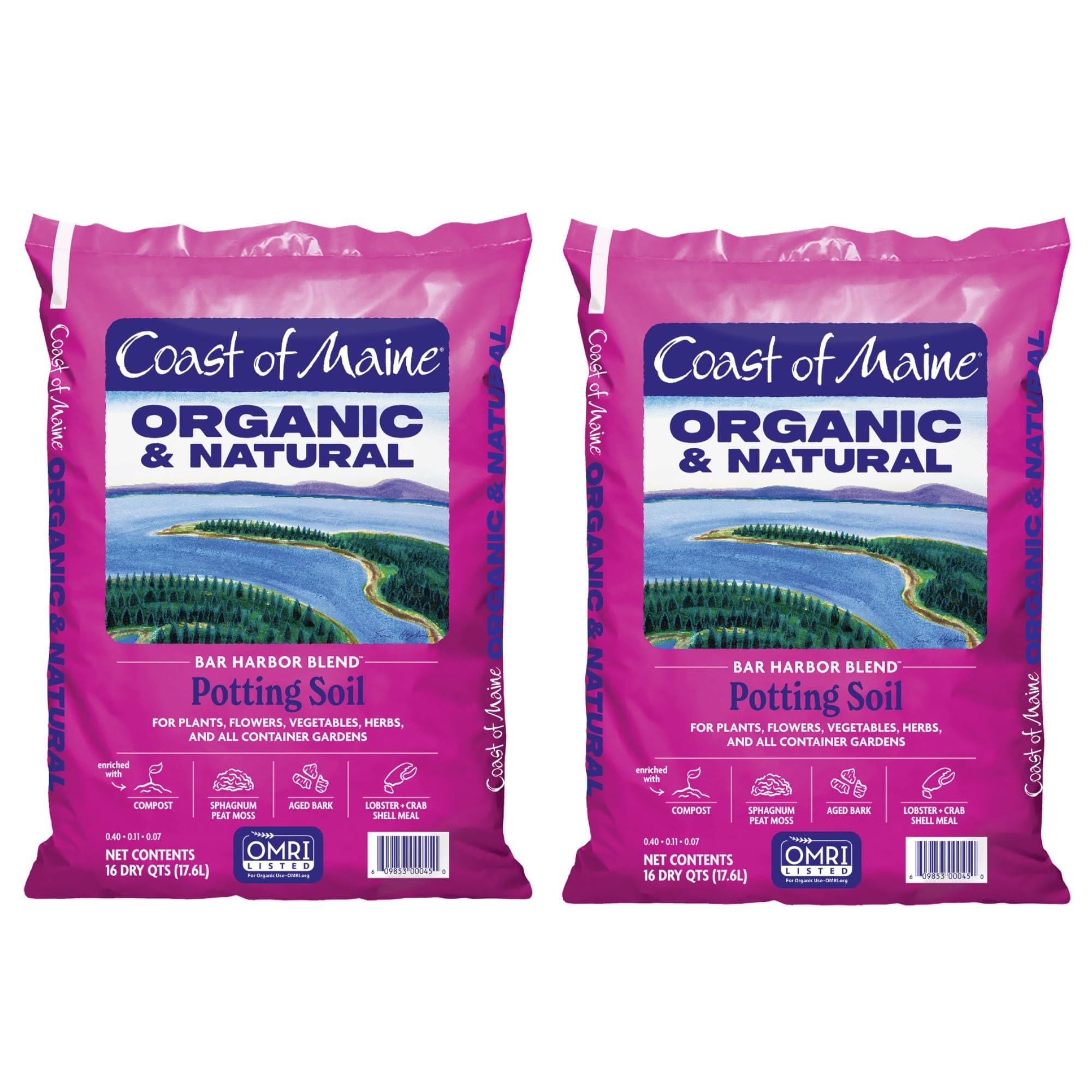
Your potato and tomato planters can turn into a jungle you did not expect with this mix.
This is the premium, all-in-one mix that goes beyond basic peat. It is formulated with sphagnum peat moss, compost, perlite (volcanic glass that creates air pockets), and unique ingredients like lobster and crab shell meal and kelp meal — providing natural slow-release nitrogen and essential minerals that standard soils lack. One buyer mentioned “super nice feeling soil, planted containers with potatoes and also peas and tomato plants, everything is growing more than I even expected.” The 16-quart volume is generous, and the two-pack configuration means you can fill multiple large planters at once.
Unlike the general-purpose Michigan Peat option, this Coast of Maine blend is specifically designed for vegetables, herbs, and flowers, and the natural fertilizers mean you water and feed less often. Buyers consistently praise the dark color, which indicates high compost content, and note there is no bad smell. The darker color and compost-heavy texture also mean it holds moisture differently than peat-heavy mixes.
For container gardeners who want unique ingredients for their plants and are willing to pay for the added lobster and kelp meal, this is the top-tier option. One owner reported “my tomatoes never looked so good” and “I will never go back” to the top brand they used before.
Best for high-value plants: If you are planting prized vegetables in containers or raised beds, the nutrient-rich, organic lobster and kelp formula minimizes the need for additional fertilizing.
Who it suits: Gardeners who want a rich, organic, all-in-one mix with natural slow-release food built in, especially for tomato, pepper, and potato containers.
Who should skip: Anyone on a tight budget or those who only need a plain basic soil without added amendments.
3. Miracle-Gro Potting Mix (8 qt. 3-Pack)

This reliable workhorse feeds your outdoor containers for half a year straight with no extra mixing.
No guesswork needed here — this mix comes with built-in fertilizer that feeds your plants for up to 6 months, and the brand claims it “Grows Plants Twice As Big” compared to unfed plants. Each 8-quart bag fills two 8-inch containers, and the 3-pack gives you a total of 24 quarts. Buyers consistently say it is reliable, with one noting it “doesn’t tend to pack down enough to be hard,” which keeps water moving to the roots. The unit count is 3.0 Count, compared to the Coast of Maine Veg & Tomato’s 1.0 Count.
This is not an organic mix, and it comes in smaller bags than the bulk 20-quart options, so you will buy more bags for larger gardens. Reviewers love the smaller bag size for ease of handling — one person said “I order in these smaller bags so I don’t have to lug around the large ones.” Another buyer noted it is a “reliable soil for potting” that you can still fertilize on top of as the nutrients get absorbed.
If you container-garden a mix of flowers, vegetables, and shrubs and prefer the convenience of not mixing your own fertilizer, this is the set to grab.
Reasons to pick this
- Built-in fertilizer feeds plants for up to 6 months
- Small, manageable bags are easy to carry and store
- Stays loose and does not compact or harden around roots
Reasons to consider alternatives
- Not an organic or OMRI-listed blend
- Smaller individual bag volume compared to bulk options
Grab this for: Easy, no-fuss container planting where you want built-in feeding for months, especially for flowers, annuals, and shrubs.
Think twice if: You need an organic-certified soil or you have very large raised beds that need a single giant bag.
4. BACCTO General All Purpose Premium Potting Soil (50 Pounds)

A massive 50-pound bag of ready-to-use soil for anyone filling lots of pots fast without buying multiple bags.
If you are filling large raised beds or many containers, this is the pure bulk option that saves you from buying multiple smaller bags. It features a proven combination of rich dark reed sedge peat (a type of peat from sedge plants), perlite (volcanic rock for aeration), and sand, and it comes with starter and slow-release fertilizers already included so your plants get nutrients right away. The 50-pound weight is substantial, and the brand name is BACCTO.
Some buyers warn about gnats emerging from the soil, which can be a common issue with large peat-based bags. The texture is described as “perfect consistency for potting” by one reviewer, and it arrived moist to the touch. Unlike the lighter, more specialized Coast of Maine bags, this is a general-purpose blend designed for versatility — use it for vegetables, flowers, bulbs, or just about any container crop.
This is the budget-friendly bulk buy for gardeners who need volume above all else and do not mind a more general mix. It is ready to use straight out of the bag with no mixing required.
Best for filling big projects: When you have multiple raised beds or dozens of pots to fill, one 50-pound bag covers the ground fast and includes slow-release food to get everything started.
Use this for: Large-scale potting projects where volume matters most and you want a simple, ready-to-use blend with fertilizer already mixed in.
skip it if: You are seed starting, need a certified organic soil, or prefer a lighter bag that is easy to carry.
5. Jiffy Natural & Organic Seed Starting Soil Mix (10 QT)

The fine, light mix gives your seeds the perfect, fluffy bed to germinate without large bark chunks.
This is not a general garden soil — it is specifically designed for starting seeds. The mix contains peat moss (spongy plant matter that soaks up to 20 times its weight in water), vermiculite (a flaky mineral that prevents soil compaction and holds 3-4 times its own volume in water), and lime (a mineral that promotes a healthy pH balance). Owners mention it has an “excellent germination rate and healthy seedlings” and note the “fine texture, no large bark chunks.” One reviewer called it their “favorite starter soil” because it holds together when transplanting to larger pots.
Unlike heavier blends like the 50-pound BACCTO bag, this Jiffy mix is very light — the item weight is only 16 ounces for the bag. It is organic, though customers note it is “slightly expensive but worth it” for the quality. The texture is so fine it is unsuitable for mature plants in large pots, but for germinating seeds, it is excellent. It comes as a 10-quart bag, and some people mix it with regular potting soil to make it go further.
For anyone starting vegetable or flower seeds indoors, this is the dedicated mix to buy. Use it for the initial sprouting phase, then transplant your seedlings into a heavier container soil like the Coast of Maine Veg & Tomato blend.
Why it stands out
- Fine texture with no large bark chunks for delicate roots
- Vermiculite prevents soil compaction and holds moisture
- Organic and promotes excellent germination rates
Consider this
- Not suitable as a long-term container soil for mature plants
- Some buyers find it slightly expensive for the volume
Best suited for: Gardeners starting seeds indoors who need a fine, sterile-feeling, organic mix for high germination rates.
Not ideal for: Filling large pots or raised beds with established plants, where a heavier, nutrient-dense soil is needed.
6. Premium Potting Soil Mix with Peat Moss, Vermiculite, Perlite (8 Dry Quarts)

A well-balanced, ready-to-use mix from a small brand that mimics what professional growers use.
This Midwest Hearth blend combines peat moss, perlite (volcanic glass for drainage), and vermiculite (a flaky mineral that holds water) in a formulation that mimics what professional growers use. The pH is controlled for a broad spectrum of plants, and the texture is light and fluffy — an “excellent peat-vermiculite-perlite blend” according to one buyer, who noted it promotes “strong roots and faster growth in herbs and flowers.” Another reviewer specifically said “this potting soil was great for my germinating petunias,” showing it works well for both seeds and established plants. Unlike the Jiffy mix, this one includes perlite for aeration in addition to vermiculite, giving a more balanced texture.
The bag is resealable and made in the USA. One important note from a buyer: you must soak the soil before use to prevent it from draining water too quickly. The bag is light at 1.25 kilograms (about 2.75 pounds), making it easy to handle. This is a strong choice for a small container or houseplant project where you want a well-aerated, professional-style mix without buying a giant bag.
Perfect for small spaces: The 8-quart bag is ideal for a few houseplants, a window box, or germinating a batch of flower seeds without committing to a massive amount of soil.
Choose this for: Smaller container jobs, houseplants, or seed starting where you want a light, professional-grade blend in a compact, resealable bag.
Skip if: You need a large volume for multiple raised beds or prefer a soil with added slow-release fertilizer already mixed in.
Understanding the Specs
Peat Moss & Organic Matter
Peat moss is the spongy foundation of most premium soils. It can absorb up to 20 times its own weight in water, which means it holds moisture around the roots and prevents the soil from drying out too fast. It also helps the soil stay loose and airy, giving roots room to spread. Look for sphagnum peat moss specifically — it is the gold standard for water retention and aeration.
Perlite vs. Vermiculite
These two look similar but do different jobs. Perlite is the small white volcanic rock you see in potting mixes — it does not hold much water, but it creates air pockets so oxygen reaches the roots and excess water drains away. Vermiculite is a flaky mineral that absorbs water like a sponge (up to 3-4 times its volume) and prevents the soil from compacting into a hard block. A good mix has both: perlite for drainage and vermiculite for moisture and texture.
FAQ
Can I use seed starting mix for my mature potted plants?
What does OMRI listed mean on a bag of soil?
Is Miracle-Gro potting soil good for organic gardening?
How much soil do I need for a standard 10-inch pot?
Why does my potting soil have small white rocks in it?
Will a bag of soil that arrived wet be ruined?
Can I use vegetable garden soil for indoor houseplants?
What is the best soil for starting tomato seeds indoors?
Final Thoughts: The Verdict
If you want one dependable pick, the growing soil winner is the Coast of Maine Organic & Natural Planting Soil for Vegetables & Tomatoes because it balances moisture retention and drainage perfectly while being OMRI-listed organic — reviewers point out visible growth in days. If you want a rich organic mix with unique ingredients like lobster and kelp meal for premium container plants, grab the Coast of Maine Bar Harbor Blend. And for the budget-conscious gardener filling large projects with a reliable 50-pound bulk bag, the BACCTO All Purpose covers the most ground.
How We Picked
We do not accept paid placement. Every pick is matched to a real buyer and a real use-case; we do not hands-on test units.
Sources & Methodology
Specifications: manufacturer listings and product documentation. Review insights: verified customer reviews, as of July 2026. Pricing: not shown on this page (it changes often); check the current price via the retailer link.
As an Amazon Associate, Lawn Gear Lab earns from qualifying purchases. This does not affect which products we feature.