
Specs are compiled from manufacturer listings and verified buyer reviews and can change over time — please confirm the key details on the product page before buying.
Hostas need cool, damp soil and hate fighting weeds — the right mulch gives you both. But pick the wrong one, and you get soggy crowns, a mess of landscape fabric, or a layer that washes away in the first heavy rain. This guide uses the specs that matter most — moisture retention, coverage volume, pH range (acidity level), and breakdown speed — to find the best mulch for hostas.
I’m Rikta — the founder and writer behind Lawn Gear Lab. This guide is built by comparing the manufacturers’ published specifications and the patterns across verified customer reviews, so you get each pick’s real strengths and trade-offs instead of marketing spin.
The mulch for hostas you choose decides how often you water, how many weeds you pull, and whether the soil stays loose enough for those shallow roots to spread — whether you are shading a woodland border or dressing up a shaded patio pot.
Quick Picks
- MODELLOR Premium Super Washed Coco Chips — Best Overall
- Back to the Roots 100% Organic Coconut Mulch — Organic Pick
- Plantonix Organic Coco Chips — Water Saver
- SuperMoss Coco Mulch Mini Bale — Mini Bale
- HealthiStraw GardenStraw — Large Bed
How To Choose The Best Mulch For Hostas
Hostas are shallow-rooted shade plants that need steady moisture but rot if the soil stays soggy. The right mulch keeps the root zone cool and stops weeds from stealing water — and breaks down slowly enough to last one full growing season. Focus on these three specs when you compare bags.
Expanded Volume vs Compressed Weight
A compressed block that promises “2 cubic feet” only delivers that much after you add water. The dry weight on the bag — 10 or 11 pounds — tells you how compact the shipping brick is, not how much ground it will cover. For hosta beds, one cubic foot of loose mulch covers roughly 12 square feet at a 1-inch depth. Always compare the expanded volume (in quarts or cubic feet), not the raw pounds, so you do not buy a brick that only fills a single pot.
Moisture Retention and Drainage Balance
You need a mulch that holds water without trapping it against the plant crown. Coarse coco chips (large pieces of coconut husk) create air pockets that drain fast while the chip itself absorbs moisture. Finer shredded bark mats into a soggy layer that can invite crown rot (when the base of the plant rots from too much moisture). Look for a chunky texture — pieces roughly the size of a fingernail or larger — so oxygen reaches those tender roots.
pH and Salt Content
Hostas prefer slightly acidic to neutral soil (pH 6.0 to 7.0 — pH measures how acidic or alkaline something is; 7.0 is neutral, below is acidic). A mulch with a pH outside that range slowly shifts your soil chemistry. Coconut-based mulches are naturally near-neutral (typically pH 5.7 to 6.3) and low in soluble salts. Some bark mulches are acidic enough to gradually lower pH, which can turn hosta leaf edges brown. Also check whether the product is “washed” or “low EC” — EC stands for electrical conductivity, a measure of soluble salts; unwashed coir (coconut fiber) can carry salts that dry out roots.
Quick Comparison
On smaller screens, swipe sideways to see the full table.
| Model | Best For | Expanded Volume | Item Weight | Key Feature | Amazon |
|---|---|---|---|---|---|
| MODELLOR Coco Chips | Best Overall Value | 18 Gallons | 11 lbs | Triple-washed, low salt | Amazon |
| Back to the Roots Coconut Mulch | Organic Garden Confidence | 2 Cubic Feet | 10 lbs | OMRI Listed organic | Amazon |
| Plantonix Organic Coco Chips | Water Conservation | 15 Gallons | 10 lbs | Absorbs 10x its weight | Amazon |
| SuperMoss Coco Mulch | Small Beds & Crafts | 0.6 Cubic Feet | 2.66 lbs | RHP certified, pH balanced | Amazon |
| HealthiStraw GardenStraw | Large Bed Coverage | 3 Cubic Feet | 6.71 kg | Water-conserving wheat straw | Amazon |
In‑Depth Reviews
1. MODELLOR Premium Super Washed Coco Chips

The chunky 18-gallon block that offers generous coverage for the price among the coco picks here.
This is a high-volume option for the price. The 11-pound compressed block expands to 18 gallons of chips, while the Plantonix is listed at 15 gallons and the Back to the Roots at 2 cubic feet. Buyers report it “filled up my 50 gallon tanks and I still had a trash bag filled up of this,” so expect serious coverage for medium to large hosta beds.
The chips are triple-washed to lower the salt content, which helps you avoid the root-burn that sometimes hits unwashed coir. Chunky husk pieces resist compaction and keep air moving around hosta roots — critical for a plant that rots easily in dense soil. The 11-pound block is bone-dry and dense enough to need a metal tool to break apart, but once hydrated it turns into a fluffy, odor-absorbing layer that looks natural around green and variegated leaves. Compared to the Back to the Roots, the MODELLOR chips are noticeably chunkier and create fewer fine particles for crown contact.
Why hosta growers love it
- Expands to 18 gallons — enough for large beds or multiple containers
- Triple-washed and low in salt so delicate roots stay healthy
- Chunky texture creates air pockets for drainage and root gas exchange
One honest trade-off
- Block is very hard dry; buyers mention needing a metal tool to break it apart
- A few reviewers found smaller dusty pieces mixed with the large chips
Choose this if: you have a medium-to-large hosta bed (or several pots) and want clean, low-salt chips with 18 gallons of expanded volume from an 11-pound block.
Not for you if: you need a ready-to-use mulch straight from the bag — this compressed block requires soaking and breaking up before spreading.
2. Back to the Roots 100% Organic Coconut Mulch
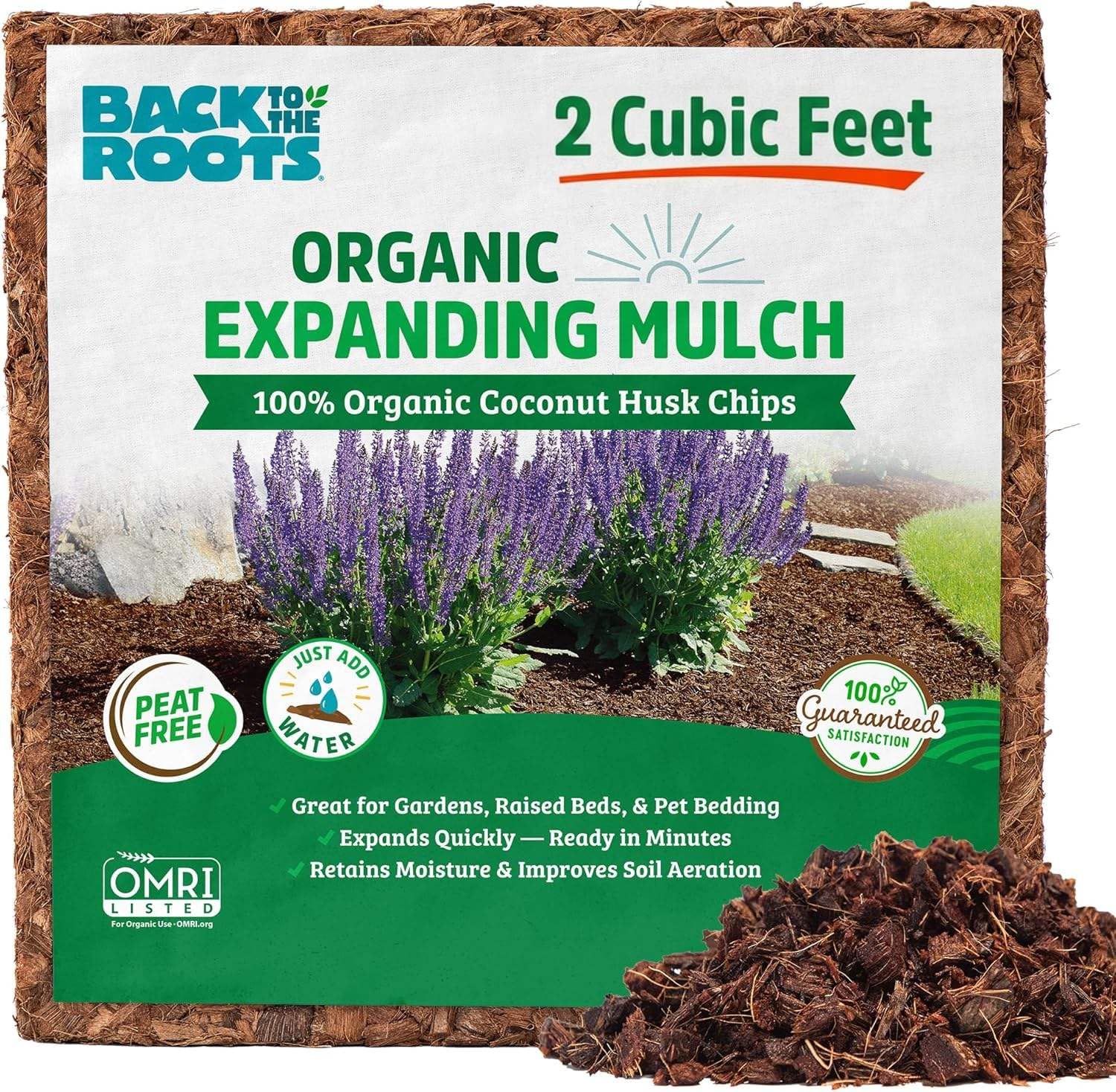
The OMRI Listed block that doubles as a soil amendment when it breaks down — and the only pick here presented with that seal.
This is the cleanest organic option in the lineup. The 10-pound compressed block expands to 2 cubic feet (about 58 quarts) and carries the OMRI (Organic Materials Review Institute) seal — meaning it is certified for organic vegetable and herb production right next to your hostas. Owners mention it “expands significantly with water” and works as both a top-dressing mulch and a tilled-in soil amendment, which adds organic matter back to the bed each season.
In practice, it retains moisture noticeably longer than straw or shredded bark, even in full sun — one review specifically noted it held water better than other mulches on a south-facing border. The chip size is uniform and small enough to fit neatly around tiny hosta crowns without burying them. Unlike the MODELLOR block, which is geared more toward pure chunky aeration, this one has a finer texture that looks tidy in a suburban shade garden from day one. The trade-off versus the MODELLOR is a finer texture and less air space in the mulch layer.
Standout features for hostas
- OMRI Listed organic — safe for vegetable gardens and edible landscapes
- Expands to 2 cubic feet (58 quarts) for broad coverage
- Fine chip size fits neatly around small hosta crowns without smothering
Consider this before buying
- Compressed block needs soaking in a large bucket or wheelbarrow
- Wet weight is heavy — buyers warn you will need help carrying the hydrated block
Buy this when: you grow hostas next to tomatoes or herbs and want one organic-certified mulch for the whole garden that also enriches the soil as it breaks down — no other coco pick here has the OMRI seal.
Pass if: you only have a few small pots — the block’s expanded volume (2 cubic feet) is more than a single container needs, and it is not resealable.
3. Plantonix Organic Coco Chips

The coco mulch that claims to absorb up to 10 times its weight in water — a strong fit for dry-shade spots.
Plantonix markets this on one standout spec — “absorbs up to 10x its weight in water” — and in a shade bed under a tree canopy where rain is blocked, that matters. The 10-pound compressed brick swells to 15 gallons of chips. That is 15 gallons versus the MODELLOR’s 18 gallons, but the trade-off is this product is specifically engineered for moisture retention, making it a strong pick for hostas planted in dry shade under mature trees or eaves.
Reviewers consistently mention that the chips are “much bigger than coco-coir” and create less dust when you hydrate them. The blend of chunky and medium pieces mats just enough to stay in place on a gentle slope, and the neutral pH (coconut husk is naturally around 6.0) means you are not slowly acidifying your hosta bed. One thing to note: the brick expands into a thick, spongy layer, so do not pile it higher than 2 inches or you risk holding too much moisture right against the crown on a rainy week.
Why it earns a spot in shade beds
- Claims to absorb up to 10x its weight in water — great for dry-shade hosta spots
- Chunky texture creates less dust and maintains air pockets in the soil
- Neutral pH helps prevent nutrient lock-up in the root zone
One thing to watch
- Expands into a thick wet layer; depth control matters to avoid crown rot
- 15 gallons of expanded volume versus the MODELLOR block’s 18 gallons
Best fit for: hosta patches under eaves, large trees, or overhangs where natural rainfall is blocked and you need the mulch to emphasize moisture retention.
Not ideal for: low-lying beds that already stay wet — the 10x water absorption can make a soggy spot even worse.
4. SuperMoss Coco Mulch Mini Bale
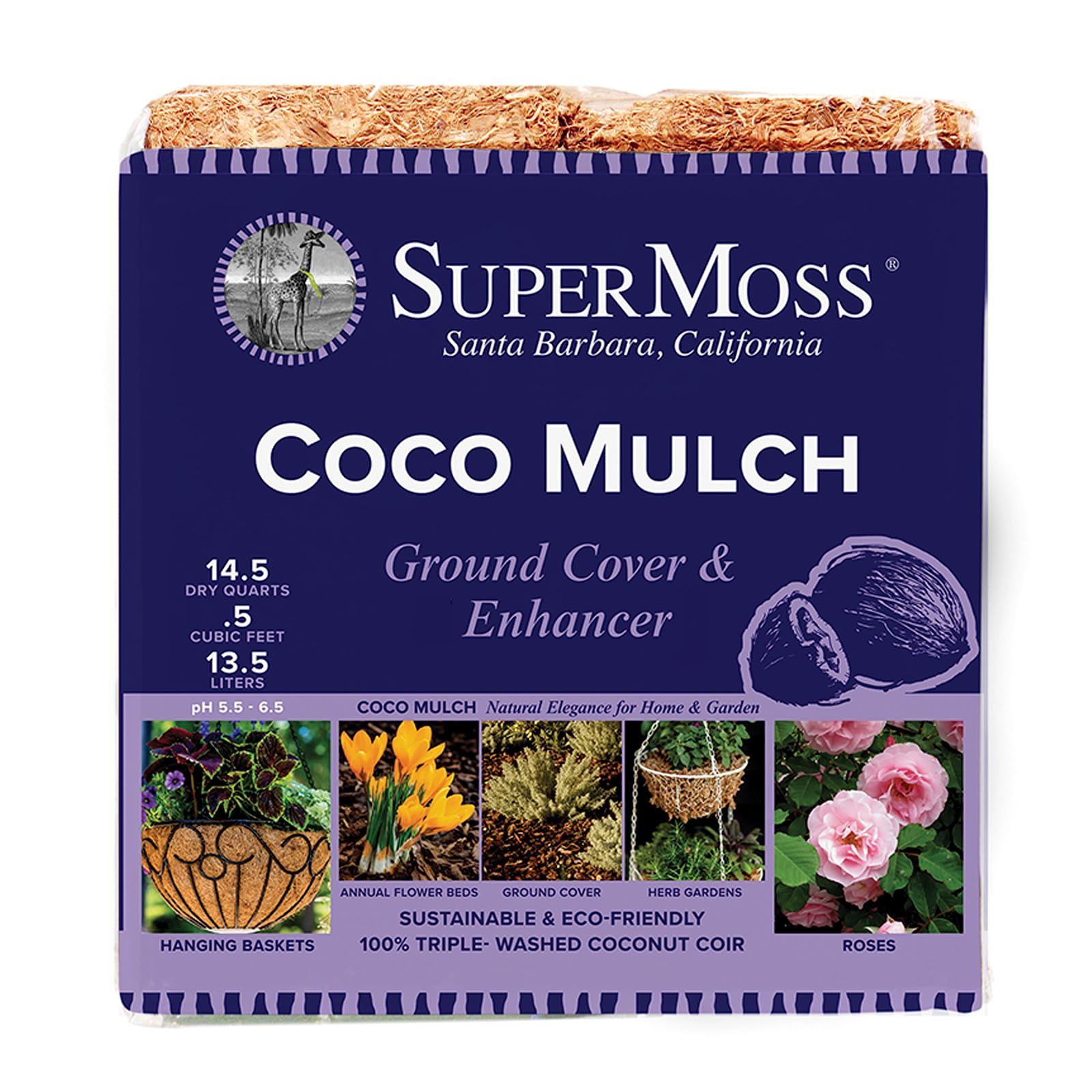
The RHP-certified mini bale listed at 2.66 pounds — handy for a single pot or a small area, with no large block to store.
At 2.66 pounds, this mini bale is much lighter than the 11-pound MODELLOR block. It is RHP-certified (RHP is a European quality standard for horticultural substrates that tests for contaminants) and has a lab-tested pH range of 5.7 to 6.26, giving you the same low-salt, balanced-acidity profile as the bigger coco blocks in a package you can hold in one hand. For someone with three hosta pots on a porch or a tiny strip bed, the 0.6 cubic feet of expanded volume is exactly the right amount with no leftover block to store.
The catch is value at scale. The chips are also finer than the MODELLOR or Plantonix options, which means they will degrade faster and may need a top-up mid-season if you spread them thin. If you only have a small space to cover, the quality is excellent and the convenience beats any 10-pound block.
Perfect for small spaces
- Weighs only 2.66 lbs fully dry — easy to carry, hydrate, and use in minutes
- RHP-certified with pH 5.7-6.26 for safe root zone chemistry
- Fines and small chips are ideal for filling around tight hosta crowns
The downside at scale
- Reviewers point out the price doubled on reorder — significant volatility
- Higher per-cubic-foot cost than the bigger compressed blocks
- Package volume (0.6 cu ft) is small; you need multiple units for a bed
Ideal for: apartment gardeners or first-time buyers who want to test coco mulch without committing to a 10-pound block — the lightest, most convenient option here.
Reconsider if: you are covering more than a few square feet — this mini bale gives you 0.6 cubic feet, while a single MODELLOR block is listed at 18 gallons.
5. HealthiStraw GardenStraw
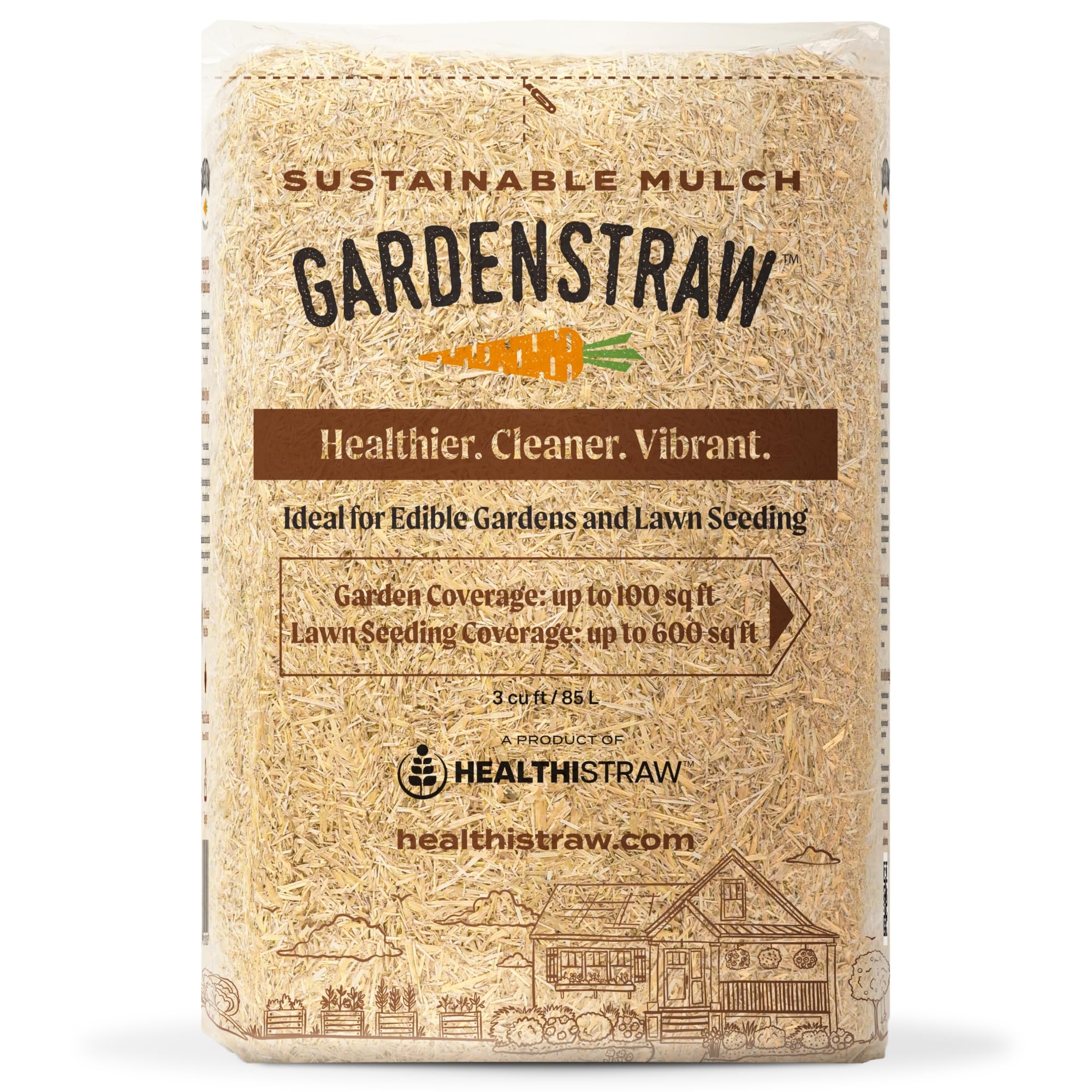
The 3-cubic-foot wheat straw bale that covers up to 100 square feet — a larger coverage figure than any coco block listed here.
This is a fundamentally different material from the coco chips above — it is compressed wheat straw, not coconut husk. The 3-cubic-foot bale covers up to 100 square feet at a 2-3 inch depth, while the coco options are listed by expanded volume from 0.6 cubic feet to 2 cubic feet or 15 to 18 gallons. For a large hosta bed that stretches 10 by 10 feet, this is the only single-bag solution that will finish the job. The straw fibers interlock when you wet them down, so they stay put on slopes and resist wind scattering — unlike coco chips, which can slide on a steep incline.
There are two trade-offs versus coco. First, straw decomposes faster, so you will need to reapply mid-season for continuous weed suppression. Second, it can carry weed seeds: one reviewer noted “so many seeds” that sprouted in the bed and were hard to distinguish from grass. The manufacturer says the straw is “naturally filtered” to remove as many seeds as possible, but reviewers report it is not 100% seed-free. For hosta beds, where you do not want any competition, that is a real risk — especially if the grass-like seedlings blend into the broad hosta leaves.
Where straw shines for hostas
- Massive 3-cu-ft bale covers 100 sq ft at a 2-3 inch depth — class-leading coverage
- Interlocking fibers stay on slopes without chemical binders
- Breaks down into carbon-rich compost that feeds soil microbes
The seed problem
- Several shoppers say excessive weed seeds that sprout in the bed
- Decomposes faster than coco chips, needing a mid-season top-up
- Lighter material may look less “finished” than dark coco in a curated shade garden
Choose this for: a large, informal hosta bed (50+ square feet) where you prioritize coverage cost and eventual soil improvement over a weed-free guarantee — no other pick covers this much ground per bag.
Skip if: you want a clean, weed-seed-free surface for a tidy front-yard hosta border, or you only need to cover a few feet — the bale is bulky and best used at scale.
Understanding the Specs
Expanded Volume (cubic feet / gallons)
This is the number that tells you how much ground you can actually cover. A compressed block might list a dry weight of 10 pounds, but the real comparison is the loose volume after you add water — measured in cubic feet or gallons. One cubic foot covers roughly 12 square feet at a one-inch depth. If you are mulching a 6-by-4-foot hosta bed (24 square feet), you need about 2 cubic feet of expanded product. Always compare the expanded volume, not the dry brick weight.
pH and EC (Electrical Conductivity)
Hostas grow best in slightly acidic to neutral soil (pH 6.0 to 7.0). A mulch with a pH outside that range slowly shifts your bed chemistry. Coco-based mulches are naturally near-neutral, around pH 5.7 to 6.3. EC (electrical conductivity) measures soluble salts — high salt content can dry out and burn tender hosta roots. Look for “low EC” or “washed” on the label, which means the manufacturer has rinsed the salts out before compression.
FAQ
Is coco coir or bark mulch better for hostas?
How deep should I layer mulch around hostas?
Will mulch attract slugs to my hostas?
How much will a 10-pound block of coco mulch cover?
Can I use straw mulch around hostas?
Do I need to remove old mulch before adding new?
What is the difference between coco chips and coco coir?
How long does coco mulch last in a garden bed?
Will mulch prevent hostas from spreading?
Should I fertilize before or after mulching hostas?
Final Thoughts: The Verdict
For most gardeners, the mulch for hostas winner is the MODELLOR Premium Coco Chips because it pairs triple-washed, low-salt chips with 18 gallons of expanded volume, versus the Plantonix listing of 15 gallons. If you want a certified-organic option that doubles as a soil amendment, grab the Back to the Roots Coconut Mulch. And for a huge shade bed on a budget, nothing matches the coverage of the HealthiStraw GardenStraw — just watch for weed seeds and expect a mid-season top-up.
How We Picked
We do not accept paid placement, and we did not hands-on test every unit. Instead, we match each pick to a real buyer and use-case by comparing the manufacturers’ published specifications against the patterns in verified customer reviews — so you get each pick’s real strengths and trade-offs instead of marketing copy.
Sources & Methodology
Specifications: manufacturer listings and product documentation. Review insights: verified customer reviews, as of July 2026. Pricing: not shown on this page (it changes often); check the current price via the retailer link.
As an Amazon Associate, Lawn Gear Lab earns from qualifying purchases. This does not affect which products we feature.