
Specs are compiled from manufacturer listings and verified buyer reviews and can change over time — please confirm the key details on the product page before buying.
Decoding the bottle label on an organic liquid fertilizer shouldn’t feel like reading a chemistry exam. The real challenge isn’t finding one—it’s picking the one that actually feeds your specific plants without stinking up your living room or burning delicate roots. This guide separates the potent concentrates from the watered-down impostors, matching the right NPK (nitrogen-phosphorus-potassium) ratio to your garden’s exact hunger.
I’m Rikta — the founder and writer behind Lawn Gear Lab. This guide is built by comparing the manufacturers’ published specifications and the patterns across verified customer reviews, so you get each pick’s real strengths and trade-offs instead of marketing spin.
Whether you are nursing a fiddle leaf fig indoors or aiming for a record tomato harvest, the right organic liquid fertilizer can make the difference between a plant that survives and one that thrives. Here is how to choose yours with confidence.
Quick Picks
- True Organic Liquid All Purpose Plant Food – 32 fl. oz. — Best Overall
- Grow Queen Organic Indoor Plant Food – 8 fl. oz. — Ultra Concentrate
- SUPERthrive Liquid Organic All Purpose Plant Food – 1 qt. — Bloom Booster
- Espoma Organic Indoor Plant Food – 8 fl. oz. (Pack of 2) — Indoor Gentle
- Alaska Fish Fertilizer 5-1-1 – 115 fl. oz. — Garden Size
- The Grow Co Fish Emulsion Fertilizer – 1 Gallon (128 fl. oz.) — Bloom Master
How To Choose The Best Organic Liquid Fertilizer
The label on the front tells you the NPK ratio (the percentage of nitrogen, phosphorus, and potassium by weight). The label on the back tells you the source—fish solubles, kelp extract, or soy protein hydrolysate. Both numbers matter, but one reveals the feeding speed and the other reveals the soil-building side effects. Your choice starts with matching both to what your plant actually needs.
Match the NPK to the Life Stage
A leafy houseplant in winter needs a gentle 2-3-1 formula to avoid leggy growth. A heavy-feeding vegetable bed in July wants a 5-1-1 to push out massive foliage. The first number (nitrogen) drives green leaves; the middle number (phosphorus) fuels flowers and fruit; the last number (potassium) builds strong stems and roots. Pick the ratio that matches your goal.
Bottle Size vs. Dilution Ratio
An 8-ounce bottle that treats 50 gallons is vastly different from a 32-ounce bottle that treats 60 square feet. Check the mixing ratio (for example, 2 oz. per gallon of water) and multiply by the bottle’s total liquid volume. A concentrated product costs more up front but lasts several seasons for a small indoor collection.
Smell Is a Feature, Not a Bug
Real organic fish emulsion smells like—you guessed it—fish. That odor fades after a day in the soil, but it can linger indoors for hours. If you are fertilizing houseplants in a small apartment, a deodorized or low-odor formula (like a kelp-based blend) might be worth the premium. For an outdoor vegetable patch, the smell is a non-issue that fades quickly in fresh air.
Quick Comparison
On smaller screens, swipe sideways to see the full table.
| Model | Best For | NPK Ratio | Liquid Volume | Coverage / Treats | Amazon |
|---|---|---|---|---|---|
| True Organic All Purpose Plant Food | General outdoor gardens & heavy feeders | 3-2-2 | 32 fl. oz. | 60 sq. ft. | Amazon |
| Grow Queen Organic Indoor Plant Food | Houseplants & indoor tropicals | 5-5-5 | 8 fl. oz. | 50 gallons | Amazon |
| SUPERthrive All Purpose Plant Food | Transplanting & boosting blooms | 4-1-1 | 0.94 L (32 fl. oz.) | — | Amazon |
| Espoma Organic Indoor Plant Food | Pothos, figs, & sensitive indoor plants | — | 8 fl. oz. (pack of 2) | — | Amazon |
| Alaska Fish Fertilizer 5-1-1 | Vegetables & heavy outdoor foliage | 5-1-1 | 115 fl. oz. | 1000 sq. ft. | Amazon |
| The Grow Co Fish Emulsion Fertilizer | Blooms, fruiting, & large garden beds | 2-3-1 | 128 fl. oz. (1 gal.) | 160+ gallons | Amazon |
In‑Depth Reviews
1. True Organic Liquid All Purpose Plant Food – 32 fl. oz.
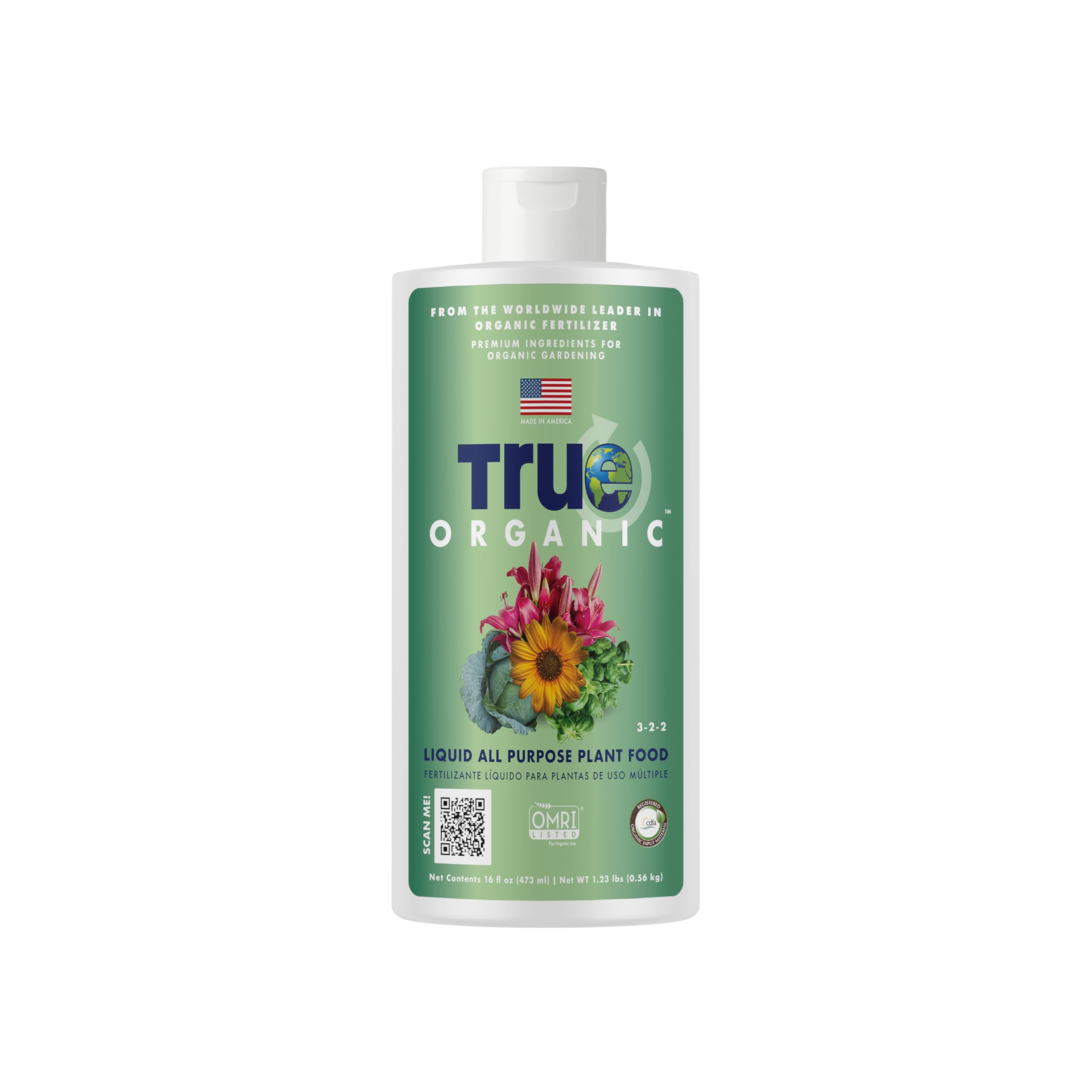
The all-rounder that turns a modest patch of soil into a producing garden.
This 32-ounce bottle covers about 60 square feet, making it a strong choice for a medium-sized raised bed or a collection of large containers. The 3-2-2 NPK ratio leans into balanced growth—you get enough nitrogen for lush leaves without shortchanging the phosphorus that drives flowers and fruit. The formula is built around fish solubles, soy protein hydrolysate, and kelp extract, so the soil gets biological activity on top of the nutrients. Buyers report exactly what you hope to hear: “The plants are HUGE, beautiful, bountiful.”
That said, the smell is noticeable during mixing—several reviewers mention a strong odor—and the 3-2-2 ratio is a generalist’s tool, not a specialist’s. If you need a heavy blast of nitrogen for a leafy crop, the Alaska 5-1-1 farther down this list gives you 5% nitrogen versus 3% in the True Organic formula. The trade-off for that convenience is a bottle that holds 32 fl. oz. versus the Grow Queen’s 8 fl. oz. bottle that treats 50 gallons, with a different dilution profile.
Why It Works for Most Gardens
- Easy mix ratio: 2 oz. per gallon of water every two weeks
- Made in the USA with organic inputs, OMRI-listed quality you can trust
- Balanced NPK supports roots, leaves, and blooms in one bottle
The Real Trade-offs
- Strong fishy smell that lingers during mixing
- Lower nitrogen concentration than specialist formulas (3-2-2)
Reach for this if: you want one bottle that handles everything from your tomato patch to your basil pots without needing a second product.
Better to look elsewhere if: you mostly feed indoor houseplants and need something odorless and more concentrated.
2. Grow Queen Organic Indoor Plant Food – 8 fl. oz.
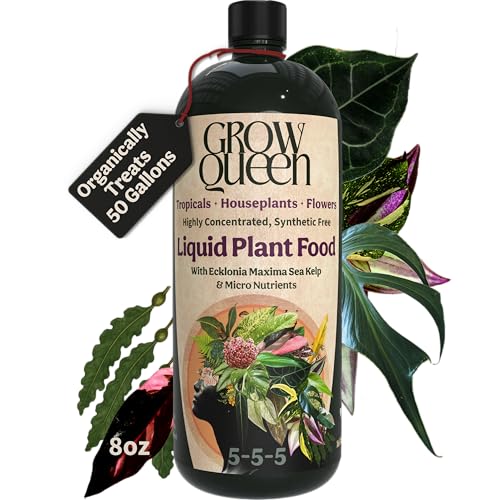
The tiny bottle that punches above its weight for indoor plant collections.
The standout spec here is the 5-5-5 NPK—a perfectly balanced ratio that is also the strongest true organic indoor fertilizer on this list. One 8-ounce bottle treats up to 50 gallons of water, which means it lasts a small apartment full of houseplants for a full season or more. The formula is powered by Ecklonia maxima sea kelp, cold-processed to preserve auxins (natural plant hormones that encourage root growth) and trace minerals. Unlike the fishy SUPERthrive, this product is virtually odor-free, so you can feed your monstera and pothos in the living room without complaints. Owners mention it “boosts plant health and growth significantly.”
You must dilute this ultra-concentrated 5-5-5 (a balanced ratio of nitrogen, phosphorus, and potassium) precisely—too much risks overfeeding, especially for slow-growing succulents and snake plants. It is designed for indoor and tropical plants, not for outdoor vegetable beds, so if you need to feed a 1000 square foot garden, the Alaska 5-1-1 or the The Grow Co 1-gallon fish emulsion will go further for less per application.
The indoor specialist edge: The Grow Queen comes in an 8 fl. oz. bottle that treats up to 50 gallons, while the True Organic bottle is 32 fl. oz. and covers about 60 sq. ft., making the Grow Queen a notably more concentrated indoor-focused option.
The honest limit: If your plants are heavy-feeding outdoor vegetables, the balanced 5-5-5 can be overkill on phosphorus and under-deliver on nitrogen compared to a 5-1-1 fish formula.
Best for: houseplant collectors who want a clean, odor-free fertilizer that lasts forever and feeds every species from calathea to fiddle leaf fig.
Not for: outdoor gardeners with large beds, where a gallon-sized fish emulsion is more practical.
3. SUPERthrive Liquid Organic All Purpose Plant Food – 1 qt.

The fishy powerhouse that turns seedlings into harvest-ready plants.
The 4-1-1 NPK tells you this is a nitrogen-forward formula designed to push massive leaf and stem growth before plants shift to flowering. It is OMRI-listed (certified for organic use) and made from natural fish fertilizer that breaks down gradually, feeding soil microbes as it goes. The mixing ratio is flexible: use 4 tablespoons per gallon for general feeding, or just 1 teaspoon per gallon when transplanting seedlings to avoid shock. One reviewer noted “used it last year and we had a bountiful vegetable garden,” which matches the product’s reputation as a reliable bloom and foliage builder.
The unavoidable catch is the smell. Reviewers are split—some say “the smell is not worth the product” and call it a “brown, thick consistency” with a putrid odor, while others say “it stinks like hell but it works wonderful.” If you fertilize outdoors and can tolerate a day of fish scent, this is a fantastic value. If you need to feed indoor plants, the odor may be a dealbreaker.
What Makes It Sing
- Flexible mixing ratio for different growth stages
- Gentle enough not to burn plants, even on seedlings
- Eco-friendly formula reduces fertilizer run-off
The Fishy Reality
- Strong persistent fish smell that some reviewers find unbearable
- Thick consistency requires thorough shaking before each use
Grab it for: outdoor vegetable gardens and flower beds where smell isn’t a concern and you want a proven organic booster.
skip it if: you plan to fertilize houseplants indoors—the odor will linger.
4. Espoma Organic Indoor Plant Food – 8 fl. oz. (Pack of 2)

The houseplant specialist that pampers your finicky fiddle leaf fig.
This two-pack of 8-ounce bottles from Espoma is formulated specifically for indoor plants like pothos, snake plants, palms, and monstera. The application is about as simple as it gets: add half a cap of liquid per quart of water, drench the soil, repeat every 2-4 weeks. Reviewers with decades of gardening experience call it “the very best you can use,” noting that a mild manure-like smell dissipates quickly after watering. Unlike the SUPERthrive or Alaska fish formulas, this product keeps the odor low enough for bedroom or living room use.
The main limitation is the coverage. At 8 fluid ounces per bottle (even with the pack of 2), you need to buy multiple packs if you have a large collection or an outdoor garden. The undefined NPK ratio also means you are trusting the Espoma proprietary blend rather than tailoring the nutrients yourself. Compared to the Grow Queen 5-5-5, the Espoma is a simpler, more entry-level choice that works but doesn’t give you the same concentrated power per drop.
The simplicity: no measuring spoons or mixing math—just a capful per quart and you are done, which is ideal for casual plant owners who just want healthy leaves.
The gap: the undefined NPK is less transparent than the clear 5-5-5 on the Grow Queen bottle, so experienced growers may prefer the data-rich alternative.
Pick this when: you keep a small indoor collection of common houseplants and want the easiest, least-smelly feeding routine available.
Consider another option if: you grow heavy-feeding vegetables outdoors or want the highest possible concentration for your dollar.
5. Alaska Fish Fertilizer 5-1-1 – 115 fl. oz.

The old-school fish brew that feeds a massive garden while staying affordable.
With a 115 fluid ounce bottle that covers 1000 square feet, this is the high-volume workhorse for serious outdoor growers. The 5-1-1 NPK is nitrogen-rich, designed to push explosive green growth on vegetables, perennials, shrubs, and trees. It is OMRI-listed for organic use and cold-pressed from fish to preserve micronutrients and amino acids.
The low phosphorus and potassium (the 1-1 part) means you will likely need a separate bloom booster if you grow heavy-fruiting crops like tomatoes, peppers, or squash. For comparison, the The Grow Co fish emulsion at 2-3-1 flips the ratio to focus on flowers and fruit, which is a better fit for a fruiting garden. The Alaska 5-1-1 is a foliage machine, not a balanced meal.
What Makes It a Garden Essential
- Enormous coverage: 1000 sq. ft. per bottle for large beds
- Nitrogen-heavy 5-1-1 drives rapid leaf and stem growth
- OMRI-listed and trusted by generations of gardeners
The Two Gaps
- Low phosphorus/potassium means you need a bloom supplement for fruiting
- Strong fish odor requires outdoor use or good ventilation
Best for: vegetable gardeners with large outdoor beds who want the most nitrogen per dollar for leafy growth.
Not the best if: you grow mostly houseplants indoors, or if your garden relies on balanced bloom support.
6. The Grow Co Fish Emulsion Fertilizer – 1 Gallon (128 fl. oz.)

The phosphorus-forward fish juice built for flowers, tomatoes, and heavy fruiting.
This is the only product on this list with a 2-3-1 NPK—meaning it contains 2% nitrogen and 3% phosphorus, which fuels blooms, fruit set, and root development. The 128 fluid ounce (1 gallon) bottle treats over 160 gallons of water, making it the highest total volume pick here, with a mixing ratio of 1:100 (just over 1 oz. per gallon). It is made from sustainably sourced, cold-pressed fish emulsion, so all the nutrients and amino acids remain intact. One reviewer with over 50 years of gardening experience called it a “great natural fertilizer” and reported high yields from their garden.
The trade-off is the nitrogen is lower than the Alaska 5-1-1, so if you are growing leafy greens like lettuce or spinach, this formula is too weak on nitrogen. The smell is also aggressively fishy—the brand’s own description says “if it doesn’t smell, then it’s not real fish.” You will want to use this outdoors or in a well-ventilated greenhouse. Compared to the True Organic 3-2-2, this one is a specialist for fruiting and flowering, not an everyday all-purpose feed.
The bloom advantage: At 3 parts phosphorus, it outpaces every other pick here for flower and fruit production, making it the clear choice for a cutting garden or a tomato patch.
The coverage edge: treating 160+ gallons from a single bottle is class-leading for a large fruiting garden, though the Alaska 5-1-1 covers 1000 square feet at a lower cost per sq. ft. for leafy crops.
Choose this for: a fruit and flower garden where yield per plant is the priority, and you don’t mind the fishy smell.
Step away from this if: you grow mostly leafy greens, ferns, or indoor tropicals that need balanced or nitrogen-heavy feeding.
Understanding the Specs
NPK Ratio – The Three Numbers That Matter
The letters stand for nitrogen, phosphorus, and potassium—the three main macronutrients plants need to grow. The numbers tell you the percentage of each by weight. A 5-1-1 formula, for example, contains five parts nitrogen for every one part phosphorus and one part potassium. Nitrogen drives green leaf growth; phosphorus boosts flowers and fruit; potassium strengthens roots and stems. Picking the right ratio means matching the nutrient profile to your plant’s current growth stage.
Dilution Ratio & Bottle Volume
The dilution ratio on the label (for example, “2 oz. per gallon of water”) tells you how many gallons of ready-to-use fertilizer one bottle makes. Multiply that by the bottle’s total liquid volume to calculate coverage. A small 8 oz. bottle with a 1:100 dilution can treat 50+ gallons, while a larger 32 oz. bottle with a 1:64 dilution might only treat 60 sq. ft. Always check the total coverage, not just the bottle size, to avoid buying too little or too much.
FAQ
What does the NPK ratio on an organic liquid fertilizer actually mean?
Can I use an outdoor organic liquid fertilizer on my houseplants?
How often should I apply organic liquid fertilizer during the growing season?
Does organic fish fertilizer smell bad, and how long does the smell last?
What is the difference between a fish emulsion and a fish hydrolysate fertilizer?
Can I mix organic liquid fertilizer with my regular watering schedule?
What size bottle do I need for a small indoor plant collection vs. a large garden?
Is organic liquid fertilizer safe for pets and children after application?
Should I fertilize my plants in winter or during dormancy?
How do I store open bottles of organic liquid fertilizer to keep them fresh?
Final Thoughts: The Verdict
For most buyers, the organic liquid fertilizer winner is the True Organic All Purpose Plant Food because its balanced 3-2-2 NPK and 32-ounce bottle cover a wide range of indoor and outdoor plants without needing a second product. If you want an odor-free, ultra-concentrated indoor formula, grab the Grow Queen 5-5-5. And for a large fruiting garden where flower counts and tomato yield matter most, the The Grow Co Fish Emulsion 2-3-1 delivers the phosphorus punch to keep the harvest coming.
How We Picked
We do not accept paid placement, and we did not hands-on test every unit. Instead, we match each pick to a real buyer and use-case by comparing the manufacturers’ published specifications against the patterns in verified customer reviews — so you get each pick’s real strengths and trade-offs instead of marketing copy.
Sources & Methodology
Specifications: manufacturer listings and product documentation. Review insights: verified customer reviews, as of July 2026. Pricing: not shown on this page (it changes often); check the current price via the retailer link.
As an Amazon Associate, Lawn Gear Lab earns from qualifying purchases. This does not affect which products we feature.