
Specs are compiled from manufacturer listings and verified buyer reviews and can change over time — please confirm the key details on the product page before buying.
Your fruit tree is a living engine that turns sun and soil into apples, plums, and citrus. Feed it the wrong stuff and you get lush leaves with nothing to harvest. Feed it the right organic formula and it rewards you with fruit you can actually eat. The trick is picking a fertilizer that delivers the exact nutrients (nitrogen for leaves, phosphorus for roots and flowers, potassium for fruit quality) without harsh chemicals that burn roots or kill the soil microbes. The Espoma Organic Citrus-Tone 5-2-6 two-pack (36 lbs total) is the best deal for serious home-orchard owners because it gives you the most fertilizer per dollar, a 5-2-6 ratio, and Bio-tone microbes — all for less per pound than most competitors. For a simple reviver for a mixed yard, grab the Down To Earth 6-2-4. If you hate mess, the Jobe’s 3-5-5 Spikes are your best bet for potted trees.
I’m Rikta — the founder and writer behind Lawn Gear Lab. This guide is built by comparing the manufacturers’ published specifications and the patterns across verified customer reviews, so you get each pick’s real strengths and trade-offs instead of marketing spin.
Commercial orchards and backyard gardeners alike trust these formulas because they release nutrients slowly and build soil structure over time. Below you will find the most reliable organic fertilizer for fruit trees, matched to your orchard size and how you like to garden.
Quick Picks
- Espoma Organic Citrus-Tone 5-2-6 — Premium Groves
- Down To Earth Organic Fruit Tree 6-2-4 — Healthy Roots
- FoxFarm Happy Frog Citrus & Avocado 7-3-3 — Yellow Leaf Fixer
- FoxFarm Happy Frog Fruit & Flower Fertilizer — Bloom Booster
- Jobe’s Organics Fruit & Citrus Tree Fertilizer Spikes 3-5-5 — No-Mess Spikes
- Espoma Organic Tree-Tone 6-3-2 — Budget All-Rounder
How To Choose The Best Organic Fertilizer For Fruit Trees
You have three key choices to make: the nutrient balance (N-P-K ratio), how the food gets released (granule or spike), and whether the bag includes the soil microbes that help your tree dig into the food you give it.
N-P-K Ratio: What Do Those Numbers Mean?
Every bag shows three numbers separated by dashes — that is the N-P-K ratio. The first is the percentage of nitrogen (that drives leaf growth), the second is phosphorus (for roots and flowers), and the third is potassium (for overall tree health and fruit quality). Your fruit tree needs a balanced formula with moderate nitrogen compared to the other two. Too much nitrogen and you get a full canopy but almost no fruit. Most organic fruit-tree fertilizers fall in the 3-5-5 or 5-2-6 range. Scanning that trio is your first move.
Granules vs Spikes: Which Application Method Fits You?
Granular formulas let you spread the food evenly across the soil around the drip line — the ring directly below the outermost branches where feeder roots are active. Spikes are pre-measured sticks you hammer into the ground. They are mess-free and stop runoff, but they concentrate the nutrients in a smaller area. If you have several trees or a big planting, granular bags give you the flexibility to adjust the dose per tree. For container-grown trees or just a few in-ground plants, spikes offer a simple hands-off approach.
Check for Soil Microbes and Mycorrhizal Fungi
Some organic fertilizers include beneficial microorganisms like mycorrhizal fungi (a type of fungus that attaches to roots and extends their reach) or proprietary blends such as Bio-tone or Jobe’s Biozome. These microbes colonize the root system and help your tree pull more nutrients from the surrounding soil. That means you can often use less fertilizer and still see stronger growth, because the tree is not relying only on what you sprinkle — it can reach deeper into the native soil.
Quick Comparison
On smaller screens, swipe sideways to see the full table.
| Model | Best For | N-P-K Ratio | Item Weight | Number of Items | Amazon |
|---|---|---|---|---|---|
| Espoma Organic Citrus-Tone 5-2-6 | Premium Long-Term Citrus Feeding | 5-2-6 | 18 lbs | 2 | Amazon |
| Down To Earth 6-2-4 | All-Purpose Home Orchard Growth | 6-2-4 | 5 lbs | 1 | Amazon |
| FoxFarm Happy Frog Citrus & Avocado | Citrus & Avocado Tree Revival | 7-3-3 | 4 lbs | 1 | Amazon |
| FoxFarm Happy Frog Fruit & Flower | Abundant Blooms & Fruit Set | — | 4 lbs | 1 | Amazon |
| Jobe’s Organics 3-5-5 Spikes | Mess-Free Container Citrus Trees | 3-5-5 | — | 6 | Amazon |
| Espoma Organic Tree-Tone 6-3-2 | Budget All-Tree Care | 6-3-2 | 4 lbs | 2 | Amazon |
In‑Depth Reviews
1. Espoma Organic Citrus-Tone 5-2-6

Big bags mean deep roots and a full growing season of steady citrus nutrition.
If you tend several citrus, avocado, or nut trees, this pack of two 18 lb bags delivers 36 lbs of a 5-2-6 formula enriched with Bio-tone (a blend of beneficial soil microbes that speed up nutrient release) and 5% calcium to stop blossom-end rot (a soft, dark spot on the bottom of the fruit). That 36 lbs gives you more product per purchase than the single 4 lb bags from many competitors — 36 lbs versus 4 lbs — so it makes the most cost-per-pound sense for serious growers.
The slower nitrogen release means you apply it three times a year: late winter before the flowers open, spring after the fruit sets, and again in fall. Unlike the Down To Earth 6-2-4 powder, this is a granular form you sprinkle around the drip line (the area directly under the outermost branches), then water in.
The main trade-off is the upfront investment: two 18 lb bags cost more at checkout than any other option here. It is best for several trees across a whole season. If you have just one potted lemon tree, a smaller bag is more practical.
Citrus-specific organic boost
- Hefty 36 lbs total (two 18 lb bags) — far more than any other single product in this lineup
- Targeted 5-2-6 ratio plus 5% calcium for citrus and avocado trees
- Bio-tone formula boosts soil microbes for better nutrient uptake
- No mixing needed; just sprinkle and water
Slow-release needs patience
- Higher sticker price than smaller bags — best suited for multiple trees
- One reviewer found it “a little pricey” for a single tree
- Contains no mycorrhizal fungi, unlike the FoxFarm Happy Frog formulas
Volume investment: This is the best pick if you have several citrus, avocado, or nut trees and want to buy once for the whole season without running out.
Small gardens: For a single potted tree, the 4 lb bags from FoxFarm are a better size to avoid storing extra product.
2. Down To Earth Organic Fruit Tree 6-2-4

Revives stressed trees with a seven-ingredient all-natural formula that keeps working all year.
This 5 lb box of Down To Earth 6-2-4 is a versatile dry powder that works on apples, pears, plums, and tropical trees like mangos and figs. The mix includes feather meal, fish bone meal, calcium carbonate, langbeinite (a natural mineral source of potassium and magnesium), potassium sulfate, alfalfa meal, and kelp meal — seven ingredients that break down at different rates to keep feeding the tree across the whole growing season. It weighs 5 lbs compared to the Espoma Tree-Tone 4 lb bags, so you get 5 lbs in one box versus 4 lbs in the Espoma bags for a similar price.
Buyers report that this fertilizer visibly revived a Royal raindrops crabapple tree: after two years of staking with poor leaves and berries, the organic formula produced healthy leaves, a heavy crop of berries, and stronger roots in just one season. Another reviewer confirmed it helped trees “revitalize from the cold frost.” The product is OMRI listed (approved for certified organic use), and the maker states it does not expire if stored in a cool dry place, so leftover powder keeps for next season.
The catch is that, as a powder rather than granules, it can be dusty when you apply it, and you need to water it in well to stop the fine particles from blowing away. Also, it lacks the mycorrhizal fungi boost that the FoxFarm Happy Frog products include for root efficiency.
Versatile fruit tree feed
- Seven natural ingredients for a rich, slow-release nutrient profile
- 5 lbs provides more feed by weight than the 4 lb Espoma Tree-Tone
- Calcium content supports proper fruit development and prevents issues
- Will not expire if stored correctly — ideal for occasional use
Lower nitrogen ratio
- Powder form can be dusty and requires thorough watering to settle
- Higher nitrogen (6) than citrus-specific formulas — best for general fruit trees
- No mycorrhizal fungi included for root efficiency enhancement
Reviver for trees: Excellent for stressed or frost-damaged fruit trees of any variety, plus it stores indefinitely so you always have it on hand.
Heavy feeders: You prefer a no-dust granular application or your priority is a high-phosphorus formula for maximum flower production.
3. FoxFarm Happy Frog Citrus & Avocado 7-3-3

Targeted slow-release nitrogen plus mycorrhizal fungi to turn yellow citrus leaves green fast.
Formulated specifically for citrus trees like lemons, limes, and oranges as well as avocado trees, the FoxFarm Happy Frog Citrus & Avocado 7-3-3 brings a higher nitrogen ratio than the general fruit tree blends. That 7 (nitrogen) fuels the vegetative growth that keeps trees full and leafy. The mycorrhizal fungi (a beneficial fungus that attaches to roots and extends their reach) in this mix help increase root efficiency so the tree pulls more nutrients and water out of the same soil — a feature that separates it from the Espoma Citrus-Tone formula, which relies on Bio-tone microorganisms instead.
At 4 lbs with a 7-3-3 mix ratio written on the package, this is a compact but potent bag that fits a small citrus grove or a group of container trees.
The honest trade-off is that the higher nitrogen means you need to apply it more often than a balanced 5-2-6 formula. One reviewer used it once and saw good yield but noted the leaves yellowed again toward the end of the season, suggesting the tree needed a follow-up feeding. You might go through the bag faster if you have multiple trees and follow a monthly schedule.
Corrects yellow leaves
- Targeted 7-3-3 ratio built specifically for citrus and avocado trees
- Mycorrhizal fungi improve root efficiency and nutrient absorption
- Granular form for simple sprinkle-and-water application
- Proven track record with over a decade of user loyalty
Higher price per pound
- Higher nitrogen requires more frequent reapplications for sustained results
- 4 lb bag covers fewer trees than the 5 lb Down To Earth or 18 lb Espoma options
- Dogs and pets are attracted to the smell; water in well to prevent digging
Yellow-leaf fix: Pick this if your citrus or avocado trees have visible nutrient deficiencies like yellowing leaves and you want to see results in days, not weeks.
Budget buys: For a less-frequent application schedule on established trees, the 5-2-6 Espoma Citrus-Tone needs fewer feeds per season.
4. FoxFarm Happy Frog Fruit & Flower Fertilizer

Phosphorus-rich granules push fruit trees toward abundant flowering and heavy fruit sets.
Unlike the balanced formulas or citrus-specific blends, the FoxFarm Fruit & Flower fertilizer focuses on a rich phosphorus content to support fruit and flower development. Mycorrhizal fungi are included in the mix to boost root efficiency, which is particularly useful for young trees that need to establish strong root systems before producing heavy crops. It comes in a 4 lb bag of granules that you can sprinkle around fruit trees, flowering bushes, or container plants without any mixing or measuring beyond the simple monthly application pattern.
Owners mention impressive results on a variety of plants. One reviewer confirmed it “revived struggling banana trees after cold winter” with an easy root application and no strong odor. Another user noted “healthier, more vibrant flowering plants with increased blooms and stronger growth.” The same formulation works for both in-ground and container setups, so if you have a mix of fruit trees and ornamental flowering plants, this single bag covers both without needing a second product.
Because the precise N-P-K numbers are not printed on the spec sheet the same way as the other blends, you should check the bag’s label to confirm the exact percentages for your specific tree type. For fruit trees that are already leafing well but not setting flowers, this is the right choice; for trees with pale leaves and slow growth, a formula with higher nitrogen like the 7-3-3 would be more targeted.
Boosts flower production
- Designed for abundant flowering and fruit set with phosphorus support
- Mycorrhizal fungi enhance root efficiency and water absorption
- Suitable for containers, in-ground, and row planting
- No-mess granular application with monthly schedule
Watchouts
- Exact N-P-K ratio not listed in the spec data — verify on the bag
- Phosphorus focus may not correct nitrogen deficiency in pale-leafed trees
- Shares the same 4 lb size as the citrus formula, so larger orchards need multiple bags
Flower trigger: Reach for this when your fruit trees have healthy green leaves but are failing to set flowers or fruit — the phosphorus push addresses the bottleneck.
Fruit focus: Your trees show yellow leaves or slow vegetative growth, which signals they need a higher nitrogen formula first.
5. Jobe’s Organics Fruit & Citrus Tree Fertilizer Spikes 3-5-5

Pre-measured spikes that deliver slow-release nutrients without a single scoop or spill.
If the thought of measuring powders or handling dusty granules puts you off, Jobe’s fruit tree spikes offer a completely different approach: a 3-5-5 time-release formula compressed into six solid spikes per package. You simply push each spike into the soil around the tree’s drip line, and the nutrients feed the roots directly for weeks without runoff or waste. The 3-5-5 ratio tilts toward phosphorus and potassium, which supports fruit development more than leafy growth, making it a smart fit for citrus trees in containers that tend to drop blossoms from stress.
Customers note a clear payoff for the simple method. One reviewer with three potted Meyer lemon trees says, “I get an abundance of juicy, sweet lemons every year!” Another user revived an indoor Calamondin orange shrub after repotting and noted the spikes perked up the plant. The same reviewer who wrote about their citrus trees added: “Jobe’s Citrus-specific fertilizer revived indoor Calamondin orange shrub; user anticipates flowers.” Because the spikes contain Jobe’s Biozome — a proprietary microorganism that accelerates breakdown of organic material — the roots start accessing nutrients sooner than a standard slow-release granular.
The limitation is that the six-spike count covers a limited number of trees per package compared to the high-volume bags. For a single container citrus tree, one spike a few times a season works perfectly. For a dozen trees in the ground, you will need multiple packs, which can add up in cost compared to a single bag of granular fertilizer. Also, correct placement matters: one reviewer had issues when they placed the spikes too close to the trunk; following the spacing directions resolved the problem.
Easy spike application
- Zero-mess application — no powder, no mixing, no measuring
- 3-5-5 ratio optimized for fruit production, not leafy growth
- Jobe’s Biozome microorganisms accelerate nutrient release for faster results
- OMRI listed for certified organic gardening
Limited nutrient control
- 6 spikes per pack — larger orchards will need multiple boxes
- Placement is critical; spikes too close to the trunk can harm the tree
- Higher per-tree cost compared to bulk granular bags
Container convenience: Perfect for potted Meyer lemon, Calamondin orange, or any container-grown citrus where digging in granular feed would disturb the compacted root space.
Large orchards: You have a large home orchard of ten or more trees — bulk granular formulas will be more economical and flexible.
6. Espoma Organic Tree-Tone 6-3-2
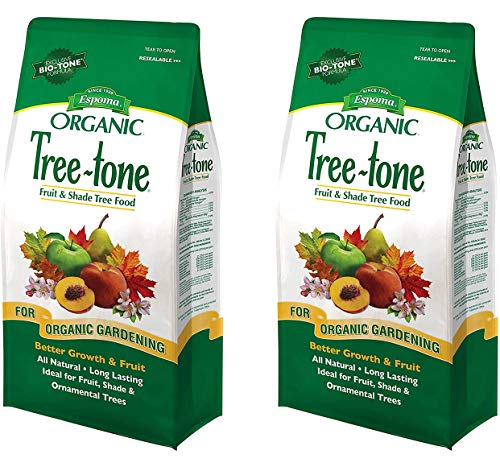
A low-cost 6-3-2 powder that feeds any shade or fruit tree with zero synthetic chemicals.
Espoma Tree-Tone brings a 6-3-2 analysis with 5% calcium in a dual-pack of 4 lb bags, giving you 8 lbs total for the lowest entry price in this lineup. It is designed for any shade, fruit, or ornamental tree — including apple and peach trees — so you do not need to buy separate formulas for different parts of your yard. The powder form requires no mixing; you just spread it around the tree and water it in. The Bio-tone formula in the mix supports soil microbe activity, similar to the mycorrhizal fungi approach FoxFarm uses in their Happy Frog line, but relying on Espoma’s own proprietary microorganism blend.
Buyers consistently confirm the results. One reviewer wrote, “1 week after using product entire tree leafed out and looks good,” after their tree was slow to leaf out. Another user with apples and pluots said the trees “love it” and noted the “great price.” Because Tree-tone uses no sludges or toxic ingredients, it is registered as an Organic Input Material, which means you can use it confidently in a certified organic home garden. The 4 lb bags are manageable for carry and storage compared to the 18 lb behemoth of the Citrus-Tone pack.
The trade-off is the 6-3-2 ratio has a higher nitrogen component than fruit-specific formulas like the 3-5-5 Jobe’s spikes or the 5-2-6 Citrus-Tone. That means it encourages strong leaf and branch growth, which is great for establishing young trees, but mature trees that are already leafy may not shift all that energy into fruit production. For fruiting trees, it is best used in early spring to kickstart growth, then switch to a bloom-focused formula later in the season.
Budget-friendly option
- 8 lbs total across two bags for a very accessible price point
- Ready-to-use powder — no mixing step required
- 5% calcium supports strong cell walls in fruits and wood
- Approved for organic gardening with Bio-tone soil microbes
Weak on citrus needs
- Higher nitrogen (6) promotes leaf growth over fruit — time applications carefully
- One reviewer noted dogs eat it and vomit; bury into the soil if pets are around
- Powder form requires thorough watering to prevent it from blowing away
Entry price: This is the best choice for a new gardener who owns a mix of shade and fruit trees and wants one organic bag that covers both without a big investment.
Citrus-specific: You only have mature fruit trees that already have dense canopies — a lower-nitrogen, higher-phosphorus formula will give you more fruit per branch.
Understanding the Specs
N-P-K Ratio Explained
The three numbers on every fertilizer label stand for nitrogen-phosphorus-potassium, the primary nutrients plants need. Nitrogen (N) drives leaf and stem growth, phosphorus (P) supports root development and flower/fruit formation, and potassium (K) boosts disease resistance and fruit quality. A fruit-tree fertilizer should have moderate nitrogen compared to phosphorus and potassium — look for a second number (P) that is close to or higher than the first. Ratios like 3-5-5 or 5-2-6 are common; the 6-3-2 blends are better for early-season growth when the tree is building its canopy.
Mycorrhizal Fungi vs Bio-tone
Both are beneficial soil microorganisms that help tree roots absorb more nutrients, but they work slightly differently. Mycorrhizal fungi attach to the root system physically and extend the reach of the roots through the soil. Bio-tone, a proprietary blend from Espoma, uses a mix of microbes that break down organic material in the soil to release nutrients faster. If your soil is poor or compacted, a product with mycorrhizal fungi (like the FoxFarm Happy Frog line) can help the tree establish a wider feeding network. If your soil is already healthy, Bio-tone (in the Espoma products) can speed up nutrient cycling.
FAQ
Can I use a general organic fertilizer on my fruit trees?
How often should I apply organic fertilizer to my fruit trees?
What does OMRI listed mean for fruit tree fertilizer?
Is granular or spike fertilizer better for fruit trees?
Can I use citrus fertilizer on my apple and pear trees?
What is the Bio-tone formula in Espoma fertilizers?
How close to the trunk should I apply fertilizer?
Will organic fertilizer attract dogs or other animals?
Can I use fruit tree fertilizer on my vegetable garden?
What is the difference between 6-2-4 and 5-2-6 in fruit tree fertilizer?
Final Thoughts: The Verdict
Across the board, the organic fertilizer for fruit trees winner is the Espoma Organic Citrus-Tone 5-2-6 because its two-pack of 18 lb bags offers a 5-2-6 ratio with 5% calcium plus Bio-tone microbes, making it the most cost-effective long-term feed for serious citrus and tree fruit growers. If you want a soil-friendly reviver for a mixed home orchard, grab the Down To Earth 6-2-4. And for mess-free container citrus trees, the standout is the Jobe’s Organics 3-5-5 Spikes.
How We Picked
We do not accept paid placement, and we did not hands-on test every unit. Instead, we match each pick to a real buyer and use-case by comparing the manufacturers’ published specifications against the patterns in verified customer reviews — so you get each pick’s real strengths and trade-offs instead of marketing copy.
Sources & Methodology
Specifications: manufacturer listings and product documentation. Review insights: verified customer reviews, as of July 2026. Pricing: not shown on this page (it changes often); check the current price via the retailer link.
As an Amazon Associate, Lawn Gear Lab earns from qualifying purchases. This does not affect which products we feature.