
Specs are compiled from manufacturer listings and verified buyer reviews and can change over time — please confirm the key details on the product page before buying.
You are staring at a bare patch of dirt or a bare concrete patio, and you want to grow real food — tomatoes, peppers, lettuce, herbs — without digging up your whole yard. What you actually need is a planter that is tough enough to hold damp soil, wide enough for root growth, and built to last more than one season.
I’m Rikta — the founder and writer behind Lawn Gear Lab. This guide is built by comparing the manufacturers’ published specifications and the patterns across verified customer reviews, so you get each pick’s real strengths and trade-offs instead of marketing spin.
Finding the right containers to grow vegetables in depends on matching the material, size, and drainage to the space you have and the plants you want.
Quick Picks
- JERIA Raised Garden Bed (4×2×1ft) — Best Overall
- Galvanized Raised Garden Bed Kit Oval (4×2×1ft, 2-Pack) — Top Performer
- OYEAL 4-Tier Vertical Raised Garden Bed — Compact Pick
- VIVOSUN 5-Pack 30-Gallon Grow Bags — Budget Champion
- DIIYIV 12x4x1ft Galvanized Raised Garden Bed (2-Pack) — Large-Scale Pick
- Land Guard Galvanized Raised Garden Bed (8x4x2ft) — Premium Deep Bed
How To Choose The Best Containers To Grow Vegetables In
Picking the wrong container can mean stunted roots, rusted metal by mid-summer, or a planter that tips over in a gust of wind. Here are the three things experienced gardeners check before buying.
Material matters most for longevity
Galvanized steel is the go-to for outdoor beds because the zinc coating resists rust and corrosion from rain and heat. Thicker metal (0.80 mm or more) holds up better under soil weight and stays square over multiple seasons. Fabric grow bags, made from nonwoven material (a felt-like fabric that lets air through), offer class-leading drainage and prevent roots from circling, but they dry out faster and may need more frequent watering in hot weather.
Depth and width determine what grows
Leafy greens and herbs need only about 6 inches of soil depth, while tomatoes, peppers, and carrots require at least 12 inches. A bed that is 24 inches deep (like the Land Guard 8x4x2ft) gives you room for deep-rooting crops. Width and length matter too — a 4×2 foot bed fits around 8-10 plants, while a 12×4 foot bed can handle a serious kitchen garden, around 30 to 40 plants.
Drainage and root health go together
Standing water rots roots fast. Open-base metal beds let excess water drain directly into the ground below. Fabric grow bags are naturally porous so water and air move through the walls, which keeps roots cooler in summer. If you are using a raised bed on a hard surface like a deck or patio, make sure the container has drainage holes or a removable bottom tray (like the OYEAL tiered planter) so water does not pool.
Quick Comparison
On smaller screens, swipe sideways to see the full table.
| Model | Best For | Dimensions | Material | Weight | Amazon |
|---|---|---|---|---|---|
| JERIA 4×2×1ft | Best Overall Value | 47 x 23 x 11 in | Galvanized steel | 4.21 kg (9.3 lbs) | Amazon |
| OYEAL 4-Tier Vertical | Small-space vertical garden | 16.9 x 18.5 x 41.7 in | Metal frame / Plastic bins | 7.3 lbs (3.3 kg) | Amazon |
| VIVOSUN 30-Gal 5-Pack | Portable fabric grow bags | 23.8 x 23.8 x 15.9 in each | Nonwoven fabric | — | Amazon |
| Galvanized Oval 4×2×1ft (2-Pack) | Premium double-bed setup | 24 x 48 x 12 in each | Galvanized steel (0.80 mm) | 7.67 kg (16.9 lbs) each | Amazon |
| DIIYIV 12x4x1ft (2-Pack) | Large-scale kitchen garden | 144 x 48 x 12 in each | Galvanized steel | — | Amazon |
| Land Guard 8x4x2ft | Deep-root crops (tomatoes) | 96 x 48 x 24 in | Galvanized steel | — | Amazon |
In‑Depth Reviews
1. JERIA Raised Garden Bed (4×2×1ft)

This 4×2-foot galvanized steel bed gives you the best trade-off between planting area, portability, and price for most home gardens.
You get roughly 8 square feet of planting area (47 inches long by 23 inches wide), enough for a mix of peppers, lettuce, and bush beans. At just 4.21 kilograms (about 9.3 pounds), it is noticeably lighter than the Galvanized Oval 2-Pack at 7.67 kilograms each, which makes this one easy to reposition by yourself. The 11-inch soil depth works well for determinate (bush-type) tomatoes and shallow-root crops, though it falls short of the 24-inch depth the Land Guard offers for tall tomatoes and carrots.
Buyers report that the assembly is quick with the included tools, though several mention swapping the provided screwdriver for your own speeds things up. The rubber edge strips along the top prevent cuts from the galvanized sheet metal, a detail the DIIYIV bed also includes. The open base lets excess water drain straight into the ground, so roots do not sit in soggy soil.
Three-year track record: One reviewer noted it has held up well after 3 years outdoors, calling it “great value, cheaper than alternatives” — a durability claim that matches the powder-coated galvanized construction.
Reach for this if: You want a solid, affordable galvanized bed that is manageable to assemble alone and fits a patio or small garden plot.
Look elsewhere if: You need deeper soil (over 11 inches) for large tomato cages or full-size carrot varieties — the 11-inch depth limits deep-root crops.
2. Galvanized Raised Garden Bed Kit Oval (4×2×1ft, 2-Pack)
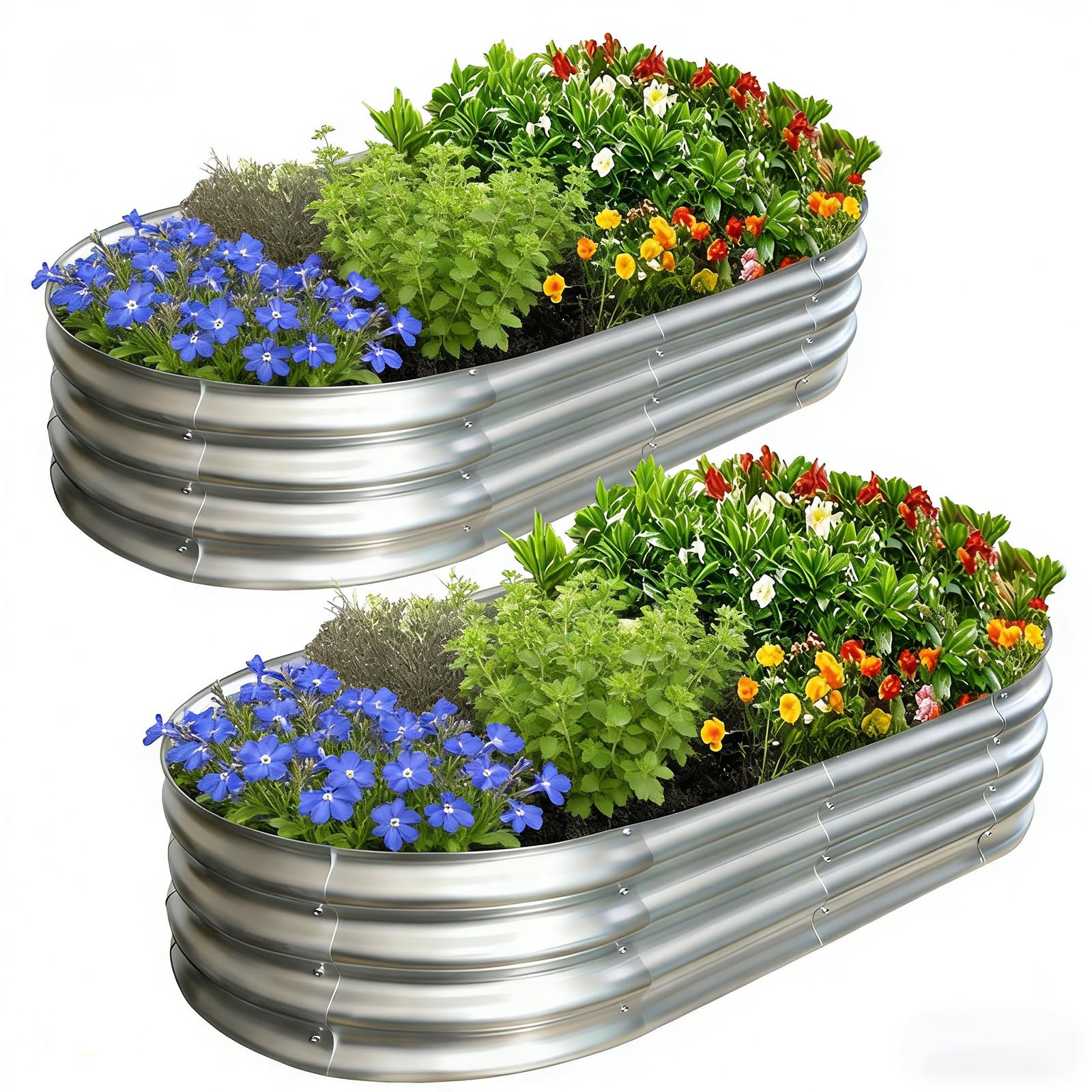
This 2-pack uses thicker galvanized steel (0.80 mm wall, 0.98 mm at overlapped seams) than the JERIA bed, so it resists bowing under wet soil over multiple seasons.
You get two oval beds, each measuring 24 x 48 x 12 inches, so you double your growing space in one purchase — a smart way to rotate crops or separate herbs from vegetables. The steel gauge is the strongest in this group, and at 7.67 kilograms per bed (roughly 17 pounds) versus the JERIA single bed at 4.21 kilograms, it clearly shows the extra metal. Thicker metal means the bed stays square under wet soil, unlike thinner budget beds that can bow or rust through faster in wet climates.
Reviewers highlight that the assembly is straightforward but stress one thing: the folded lip on every panel must face inward, or you will have to take it apart and start over. The included gloves are essential because the steel edges are sharp fresh from the start. Once assembled, the oval shape gives a clean modern look that stays cool in hot climates, according to a Florida buyer who planted wildflowers and herbs.
What stands out
- Double-thickness overlap at seams (up to 0.98 mm) for rigidity
- Three-year manufacturer warranty included
- Open base prevents waterlogging and root rot
One real catch
- Instructions omit the critical detail that the folded lip must face inward — check twice before tightening bolts
Best suited for: The gardener who wants two identical beds from one box and prefers thicker steel (0.80 mm) that resists warping over time.
Not ideal if: You plan to put these on a deck or balcony — at 16.9 pounds each, they are not lightweight when filled with soil, and the open base requires ground contact for drainage.
3. OYEAL 4-Tier Vertical Raised Garden Bed

This vertical planter grows a lot of food in a 1.5-foot-wide footprint, making it the best option here for a balcony or tiny patio where horizontal space is the limit.
When you have no ground space but plenty of vertical room, this OYEAL planter makes the most of it. At 16.93 inches deep by 18.5 inches wide and 41.73 inches tall, it stands over 3 feet high, so you do not have to bend down to tend your herbs and greens. Each of the four bins measures 16.8 x 7.02 x 5.5 inches — shallow enough for lettuce, spinach, strawberries, and compact flowers, but too shallow for deep-rooting vegetables like tomatoes or carrots. Unlike the JERIA bed’s 11-inch depth, these 5.5-inch bins limit you to only shallow-root crops.
One buyer mentioned it “held up well to 40 mph winds,” thanks to the triangular metal frame that keeps the structure stable. A small caveat: a few buyers received units with broken plastic bins or missing hardware, so it is worth checking contents right away. The removable bottom trays under each bin prevent water from dripping onto your deck — a feature the open-base metal beds lack, making this a better choice for surface protection.
Small-space verdict: If you have a balcony, tiny patio, or indoors near a sunny window, this earns its spot by packing four tiers of growing space into a 1.5-foot-wide footprint — something no single-level bed can match.
Ideal for: Container gardeners with limited floor space who want to grow leafy greens, herbs, and strawberries without bending.
Not for: Anyone planning to grow tomatoes, peppers, or root vegetables — the 5.5-inch-deep bins are not deep enough for those crops.
4. VIVOSUN 5-Pack 30-Gallon Grow Bags

These fabric grow bags air-prune roots (meaning roots stop at the bag wall instead of circling) and drain better than any rigid planter here — a key benefit for root health.
For gardeners who need portability and superior root health, these VIVOSUN grow bags are a smart alternative to rigid planters. Each bag holds 30 gallons (roughly equivalent to a 23.8 x 23.8 x 15.9-inch container), and the 5-pack gives you plenty of modular growing space you can arrange anywhere — across a driveway, along a fence, or on a deck. The 300g thickened nonwoven fabric (a felt-like, BPA-free material) lets air reach the root zone, which prevents the circling root structure common in plastic pots. This is a different drainage approach from the open-base metal beds like the JERIA, which rely on ground contact to drain.
Owners mention the fabric feels “strong and durable” and the serger-stitched handles hold up when moving bags full of wet soil, unlike the flimsy handles on cheaper grow bags. One owner reported they “had no problem moving and carrying them up the stairs” after filling them, which speaks to the handle reinforcement. The main trade-off against the Galvanized Oval beds: fabric dries out faster in hot sun, so you will water more often.
Why pick fabric
- Superior drainage — excess water drains through the fabric walls, not just the bottom
- Reusable for seasons if you trim and prune roots between uses
- Fold flat for winter storage, saving huge space compared to steel beds
One limitation
- Fabric dries quickly on hot days — expect to water more frequently than you would with a galvanized bed
Go for these if: You want affordable, portable containers that let you start a garden anywhere — patio, rooftop, or rented yard — and fold away when not in use.
Skip them if: You live in a hot, dry climate and prefer the moisture retention of a solid-walled bed, or you need deep soil (over 15.9 inches) for long-root crops.
5. DIIYIV 12x4x1ft Galvanized Raised Garden Bed (2-Pack)

At 12 feet long by 4 feet wide, each bed in this 2-pack gives you 48 square feet of growing surface — far more linear space than the JERIA’s 8 square feet, for serious food production.
If you have a large backyard and want to grow a substantial amount of food, the DIIYIV 2-pack gives you two beds that each measure a full 12 feet long by 4 feet wide by 1 foot tall (144 x 48 x 12 inches). That is 48 square feet of growing surface per bed — enough for dozens of tomato plants, rows of beans, squash, and more. The galvanized steel with polished edges and corner pads prevents sharp injuries, a safety detail the Galvanized Oval 2-Pack also provides with its gloves but the DIIYIV adds fixed pads on all four corners.
Customers note the metal is on the thinner side — lighter than expected — but say it firms up once filled with soil. One reviewer who is in their second year of planting noted the sides have lost their perfect square shape and cautioned against leaning on the walls. The 2-pack comes in one box, and the panels can be reconfigured into different layouts, though some kits have arrived with wrong-sized nuts, so check the hardware before you start.
Real-world note: Several owners recommend filling the bottom third with mulch or branches before adding soil — this reduces the amount of dirt needed and improves drainage, an especially useful trick for these long, shallow (12-inch deep) beds.
Best for: The ambitious gardener who has a large, flat area and wants maximum linear growing space at a lower entry price than buying multiple small beds.
Be aware: The 12-inch depth is good for most vegetables but too shallow for carrots and parsnips; and the thin steel walls can bow if you lean on them after a rain.
6. Land Guard Galvanized Raised Garden Bed (8x4x2ft)

A full 24 inches of soil depth — the deepest container here, built to accommodate tomatoes, carrots, and potatoes that the 12-inch beds like the DIIYIV simply cannot grow.
At 96 inches long by 48 inches wide by 24 inches deep (8x4x2ft), this Land Guard bed is the only container here that gives you a full 2 feet of soil depth. The 24-inch depth supports deep-rooting crops like indeterminate tomatoes, carrots, parsnips, and potatoes — crops the 12-inch DIIYIV and Galvanized Oval beds cannot handle. The 478-gallon capacity means you will need a lot of soil to fill it — roughly 2.5 cubic yards — but the open bottom lets roots reach into the ground below if you place it on bare earth.
The corrugated galvanized steel is reinforced at the corners and frame, and reviewers point out it is heavy-duty enough to “last a long time.” Assembly takes about 15 minutes with no special tools required, though there are many screws to tighten. The classic silver finish fits any garden aesthetic, and the environmentally friendly coating is safe for edible crops. One reviewer combined two of these beds into a 12-foot-long configuration using leftover panels, but noted the support braces (thin rods with bolts) are the weakest part of the design.
The depth advantage
- 24-inch depth supports deep-root vegetables that other beds here cannot grow
- Corner reinforcement and 0.8mm+ gauge steel for long-term rigidity
- 15-minute assembly with straightforward instructions
Downsides to weigh
- Very large — requires a lot of soil to fill and a permanent spot once placed
- Support brace system is somewhat flimsy; some owners supplement with their own braces
Ideal for: The committed vegetable grower who wants maximum soil depth for tomatoes, root crops, and heavy-feeding vegetables in a single, durable galvanized structure.
Not the right fit if: You have limited space, a balcony, or a tight budget for soil — filling this 478-gallon bed is an investment in both money and wheelbarrow trips.
Understanding the Specs
Galvanized Steel Thickness
Thicker steel means the bed stays square under wet soil and resists dents from wheelbarrows or knees. Look for 0.80 mm or higher — the Galvanized Oval 2-Pack lists both 0.80 mm at the wall and 0.98 mm at the overlapped seams, which is the strongest in this group. Thinner steel, like some budget 0.5 mm beds, can bow or rust through faster in wet climates.
Soil Depth and Root Room
Depth dictates what you can grow. Shallow-rooted greens and herbs need only 6-8 inches. Most vegetables (peppers, beans, cucumbers) do fine in 12 inches. Tomatoes, carrots, and potatoes need 18-24 inches. The Land Guard (24-inch depth) is the only container here that handles all three tiers. If you are growing mostly leafy things, the JERIA’s 11-inch depth or the OYEAL’s 5.5-inch bins will work fine.
Drainage Systems
Open-base metal beds (JERIA, Galvanized Oval, DIIYIV, Land Guard) let water drain directly into the ground — simple and effective if placed on soil. Fabric grow bags (VIVOSUN) are fully porous so water exits through the sides and bottom, which prevents overwatering but speeds drying. The OYEAL vertical planter uses removable bottom trays under each bin, a must if you are using it on a deck or indoors where you do not want water runoff.
Assembly Complexity
Most galvanized beds assemble in 10-30 minutes with bolts and a provided wrench. The DIIYIV and Galvanized Oval kits need you to pay attention to panel orientation (folded lip inward) to avoid rework. Fabric bags need zero assembly beyond opening the package. The OYEAL vertical planter requires the most building time and, according to some reviews, the instructions can be vague — set aside an hour for that one.
FAQ
What size container do I need to grow tomatoes?
Will galvanized steel rust after one season?
Can I use these containers on a deck or concrete patio?
How many plants can I fit in a 4×2 foot bed?
Fabric grow bags vs galvanized beds — which is better?
Do I need a drill to assemble these beds?
What vegetables grow best in shallow containers (under 12 inches)?
How do I keep the soil from washing out of open-base beds?
Can I leave these containers outside in winter?
What is the best container for growing carrots?
Final Thoughts: The Verdict
Across the board, the containers to grow vegetables in winner is the JERIA Raised Garden Bed because it delivers solid galvanized construction, easy assembly, and the right 11-inch depth for everyday vegetables at a price that undercuts most competitors. If you want a set of two matching beds with thicker steel (0.80 mm), grab the Galvanized Oval 2-Pack. And for deep-root crops like tomatoes and carrots, the standout is the Land Guard 8x4x2ft with its full 24-inch soil depth.
How We Picked
We do not accept paid placement, and we did not hands-on test every unit. Instead, we match each pick to a real buyer and use-case by comparing the manufacturers’ published specifications against the patterns in verified customer reviews — so you get each pick’s real strengths and trade-offs instead of marketing copy.
Sources & Methodology
Specifications: manufacturer listings and product documentation. Review insights: verified customer reviews, as of July 2026. Pricing: not shown on this page (it changes often); check the current price via the retailer link.
As an Amazon Associate, Lawn Gear Lab earns from qualifying purchases. This does not affect which products we feature.