
Specs are compiled from manufacturer listings and verified buyer reviews and can change over time — please confirm the key details on the product page before buying.
You pick the perfect seed variety, set up a warm spot, and watch the tray daily — only to have half the seedlings flop over from damping-off (a fungal disease that rots stems at the soil line) or struggle to break the surface. Nine times out of ten, the culprit isn’t your watering or your windowsill — it is the mix you filled the cells with. A soil for germinating seeds needs a fine, light texture that keeps a seed snug while letting air reach the root tip, and most bagged potting soils are too heavy or chunky for this job.
I’m Rikta — the founder and writer behind Lawn Gear Lab. This guide is built by comparing the manufacturers’ published specifications and the patterns across verified customer reviews, so you get each pick’s real strengths and trade-offs instead of marketing spin.
The best soil for germinating seeds balances moisture retention without turning into mud, aeration so tiny roots can breathe, and a fine enough texture that a seed makes full contact with the growing medium.
Quick Picks
- Old Potters Germination Mix with Peat Moss, Fine Perlite & Vermiculite, 24 Quarts — Big Value
- Purple Cow Organics Seed Starter 12 Quart Bag — Pro Grade
- Black Gold 1311002 8-Quart Seedling Mix (2 Pack) — Two-Pack Value
- Duspro Seed Starter Potting Soil Mix, 8 Dry Quarts, 4-in-1 Blend — Peat-Free Blend
- Hoffman Seed Starter Potting & Planting Mix with Wetting Agent, 10qt Bag — Expert’s Pick
- Jiffy Natural & Organic Seed Starting Soil Mix, 10 QT — Classic Blend
- MODELLOR Coco Coir Bricks, 4-Pack (5 lb) — Budget Champion
How To Choose The Best Soil For Germinating Seeds
The bag might say “seed starter” on the front, but a quick look at the texture and ingredients list tells you the real story. Here is what to check before you buy.
Texture and particle size
Seeds germinate best when the mix is fine enough to wrap around the seed without air pockets, but still loose enough for a root to push through. Chunky bark pieces or large perlite can leave a seed sitting in a dry gap. Look for a mix described as “hand-screened” or “fine” — the Hoffman and Old Potters options in this list are examples of a consistently fine particle size.
Water retention vs. drainage
A seed needs consistent moisture to germinate, but standing water invites rot. Ingredients like vermiculite soak up three to four times their own volume in water, while perlite creates tiny air channels. A good seed-starting mix includes both. The Duspro blend uses coco coir instead of peat moss, which holds water well without getting soggy.
Nutrient content (or the lack of it)
Seeds carry their own food for the first week or two. Too much fertilizer in the mix can burn a tender seedling before it grows its first true leaves. Many professional mixes, like the Hoffman soilless mix, contain minimal to no fertilizer on purpose. If you want a mix that feeds after germination, look for one with worm castings, like the Duspro 4-in-1 blend.
pH and buffering
Most seed-starting mixes aim for a pH between 5.4 and 6.3. Peat moss is naturally acidic, so lime is added to balance it. Coco coir tends to be closer to neutral but can have high salt levels if not washed properly. The MODELLOR bricks are listed as triple-washed and pH-balanced, which removes that guesswork.
Quick Comparison
On smaller screens, swipe sideways to see the full table.
| Model | Best For | Volume | Weight | Base Material | Amazon |
|---|---|---|---|---|---|
| Old Potters Germination Mix | Large seed-starting projects | 24 Quarts | 4.82 kg | Peat Moss | Amazon |
| Purple Cow Organics Seed Starter | Soil blocking & organic growing | 12 Quarts | 8 Pounds | Activated Compost | Amazon |
| Black Gold Seedling Mix (2 Pack) | Small, beginner tray fill-ups | 8 Quarts | 6 Pounds | Peat Moss | Amazon |
| Duspro 4-in-1 Seed Starter | Peat-free, ready-to-use convenience | 8 Dry Quarts | — | Coco Coir | Amazon |
| Hoffman Seed Starter Mix | Reliable germination with wetting agent | 10 Quarts | 4.67 Pounds | Soilless | Amazon |
| Jiffy Natural & Organic Seed Starting Mix | Classic peat-vermiculite balance | 10 Quarts | 1 Pounds | Peat Moss | Amazon |
| MODELLOR Coco Coir Bricks (4-Pack) | Budget-friendly volume & storage | 9 Gallons | 5 Pounds | Coco Coir | Amazon |
In‑Depth Reviews
1. Old Potters Germination Mix with Peat Moss, Fine Perlite & Vermiculite, 24 Quarts
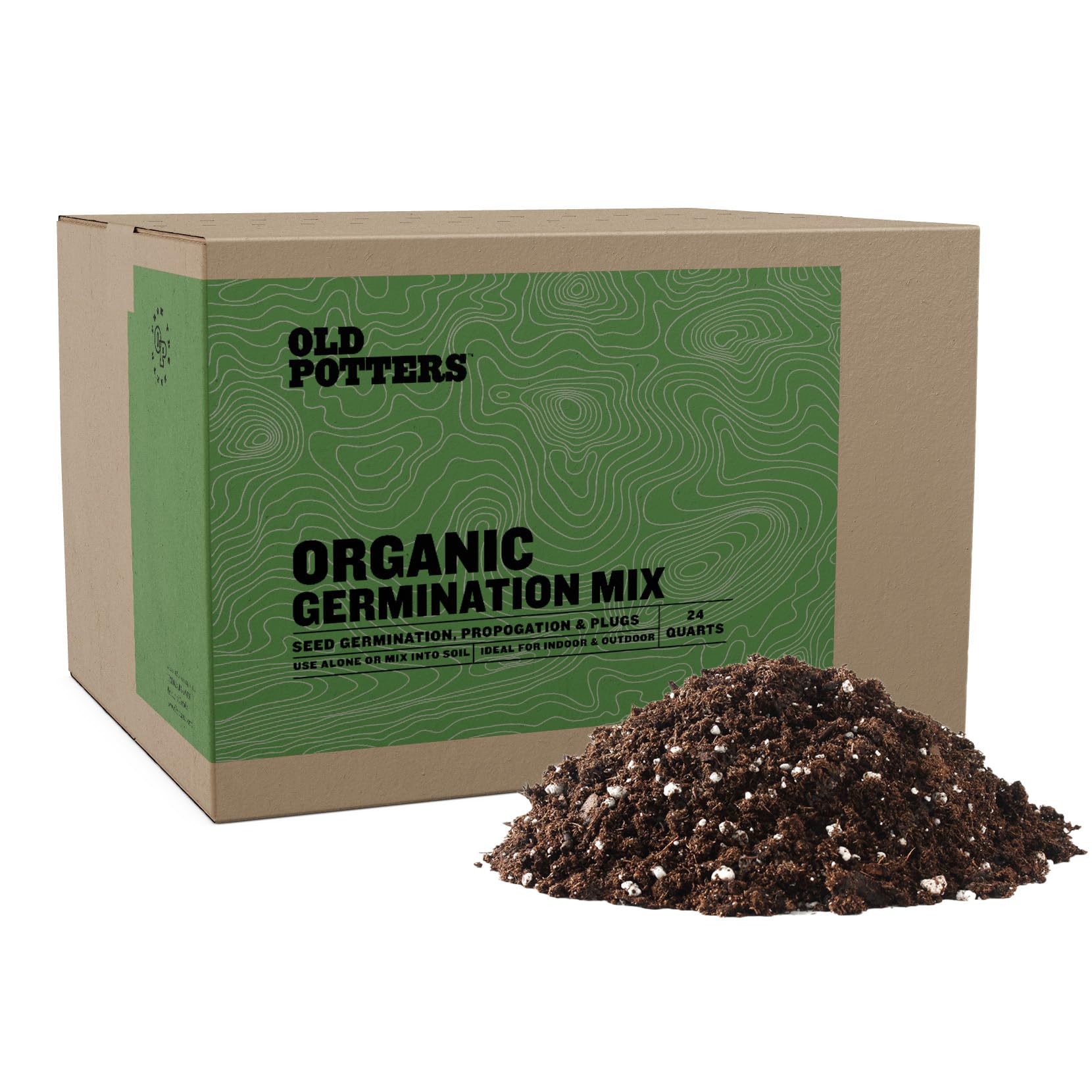
The big bag that gives you room to start an entire season’s garden without restocking.
If you are starting tomatoes, peppers, and flowers all at once, you need volume without sacrificing quality. This mix holds 24 Quarts versus the Black Gold 8-Quart two-pack, and enough to fill several 72-cell trays. The blend is 80 to 90 percent fine Canadian sphagnum peat moss, plus top-quality fine perlite and vermiculite for aeration and moisture control. Buyers report a 90% germination rate with no fungus gnat issues, calling it the best success they have had with a seed starting mix.
Peat moss can be acidic, so calcitic and dolomitic limestone are added to hold the pH between 5.4 and 6.3. A wetting agent is also included so the dry mix rehydrates evenly rather than beading up water on the surface. The texture is loose, fine, and free of large filler pieces — unlike coarser commercial mixes that can leave seeds sitting in air pockets. At over 10 pounds when full, it is not a lightweight bag, but the results justify the weight.
Why it stands out
- Largest volume in the lineup — enough for big seed-starting operations
- Fine texture with small perlite and vermiculite for even moisture distribution
- pH balanced between 5.4 and 6.3 for good nutrient availability
- Owners mention no gnats and consistent 90% germination
One thing to know
- At 4.82 kg it is heavy — store it where you plan to use it
Grab this if: you have more than a few trays to fill and want a pro-grade mix with a proven pH balance and fine texture that outperforms coarse bagged blends.
Pass it up if: you only need a small bag for a single tray of herbs — the volume will last longer than you need.
2. Purple Cow Organics Seed Starter 12 Quart Bag

The compost-based mix that holds together for soil blocking and feeds seedlings for six weeks.
Not all seed starters are built for soil blocking. This Purple Cow mix is designed for both trays and soil blockers, forming blocks that hold together well according to buyers who tried it. The base is Activated Compost — a premium soil amendment refined over 20 years — blended with enough fertility to feed seedlings for up to 45 days. That built-in food means you can delay liquid fertilizer until the plants are ready for transplanting.
At 12 Quarts, it is a mid-size bag weighing about 8 Pounds. Some customers note the texture is slightly more compact than fluffy peat-based mixes, but all seeds started well. One reviewer noted it worked beautifully for soil blocking, with blocks coming out perfectly sized. If you grow organically or prefer a mix that is ready to use straight from the bag without adding anything, this is a solid choice.
what separates it
- Built-in fertility supports seedlings for up to 45 days without extra fertilizer
- Blocks hold together well for soil blocking method
- All natural and organic ingredients
A consideration
- Texture is a bit more compact than light peat-based mixes; not ideal if you prefer very airy soil
Reach for this if: you use soil blockers or want an organic mix that feeds seedlings from day one without extra fertilizer additives.
Look elsewhere if: you prefer a light, fluffy soilless mix and plan to fertilize on your own schedule.
3. Black Gold 1311002 8-Quart Seedling Mix (2 Pack)

The two-bag set that gets beginners sprouting seeds fast with a fine, clean texture.
Black Gold’s seedling mix is a straightforward peat moss-based option with a reputation for being beginner-friendly. Reviewers point out no big chunks or twigs, just a consistently fine texture that helps seeds germinate well. The two-pack gives you a combined volume of 16 Quarts across two 6-pound bags, making it easier to store and handle than a single larger bag.
A few users found the soil dried out quickly and did not hold together as well for transplanting compared to heavier, homemade blends. That is common with light, peat-heavy seed starting mixes. If you are starting seeds in trays and plan to transplant as soon as true leaves appear, this mix works well. For direct-soil blocking or very long germination crops, a denser mix might hold together better.
What works well
- Very fine, screened texture with no bark or twigs — ideal for small seeds
- Quick germination — shoppers say seedlings sprouting in about 5 days
- Two 8-quart bags are easy to handle and store separately
Where it falls short
- Some users say soil dries out fast and does not hold together for transplanting
- True leaf development can be slow according to experienced growers
Best for: first-time seed starters who want a clean, fine mix that gets seeds sprouting fast without the complexity of blending their own ingredients.
skip it if: you need a mix that holds a tight soil block or retains moisture for very long germination windows.
4. Duspro Seed Starter Potting Soil Mix, 8 Dry Quarts, 4-in-1 Blend
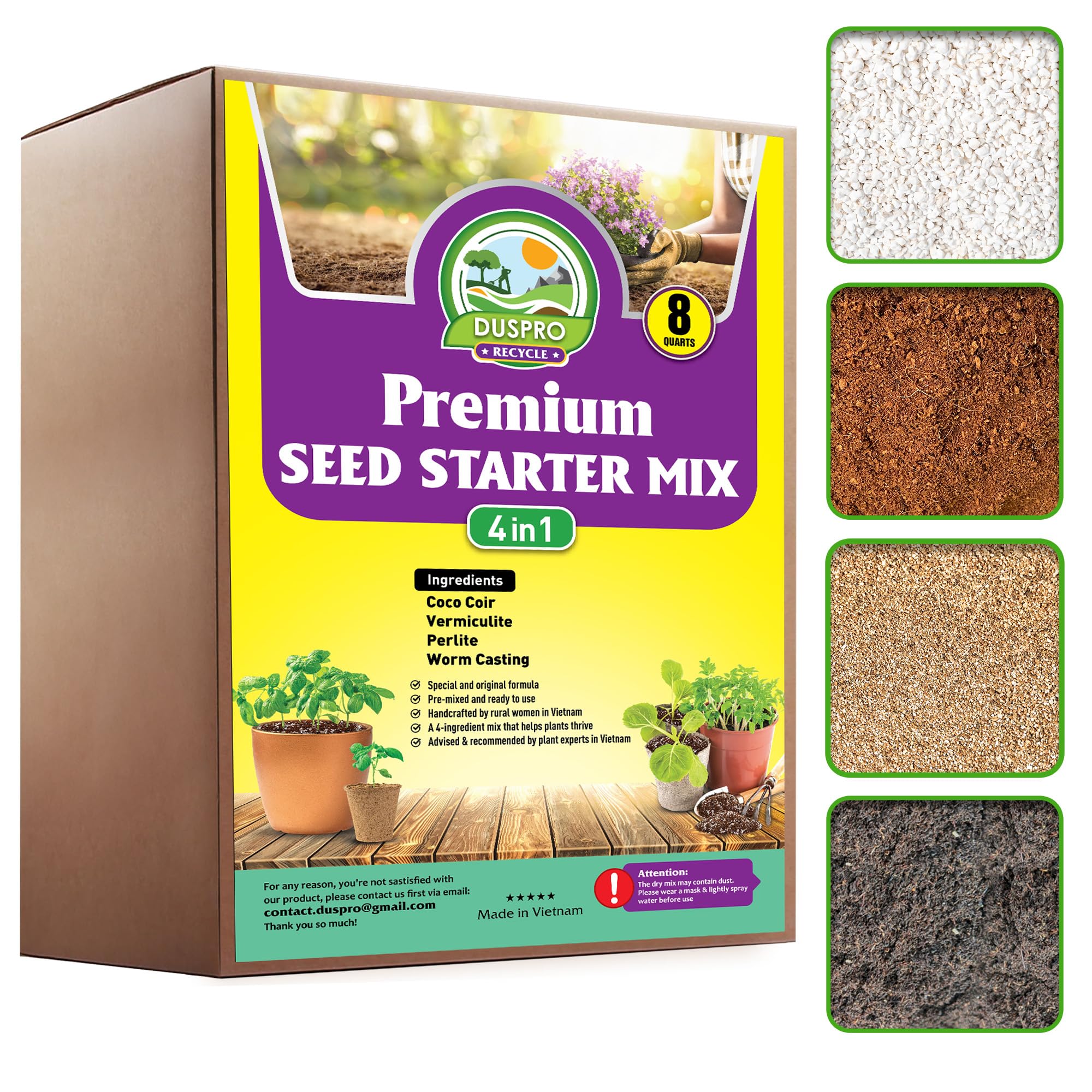
A ready-to-use peat-free mix that skips the measuring step with coco coir, perlite, vermiculite, and worm castings.
If you want to avoid peat moss entirely, this Duspro blend is a solid alternative. It replaces peat with coco coir and adds perlite, vermiculite, and worm castings for gentle nutrition. One reviewer called it an excellent wick-watered seed starting mix, noting perfect moisture transfer and aeration balance with no sogginess or dry spots. The 4-in-1 formula is pre-screened for a fine, consistent texture that helps seeds make good contact with the growing medium.
At 8 dry quarts, the bag is sized for a few trays of vegetables, herbs, or flowers. Some buyers mentioned the pellets were a little larger than expected — likely a reference to the perlite size — but it worked fine for seed starting and even for orchids in one case. Because it is ready to use straight from the bag with no measuring or blending, it is a good pick for newer gardeners who want a peat-free option without the hassle.
Why we like it
- Peat-free formula uses coco coir instead, a more sustainable option
- Worm castings provide gentle nutrition right from the start
- Buyers report excellent moisture transfer without sogginess
One note
- Perlite particles are a bit larger than some mixes; may not suit very fine-seeded trays
Choose this for: peat-free gardening with a pre-mixed blend that includes worm castings for gentle feed and handles wick-watering trays well.
Look elsewhere if: you want an ultra-fine, dust-like texture for tiny seeds like lettuce or petunias.
5. Hoffman Seed Starter Potting & Planting Mix with Wetting Agent, 10qt Bag

A six-component soilless blend that experienced gardeners reach for season after season.
This is not a simple two- or three-ingredient mix. Hoffman’s seed starter blends six components — a soilless base with a wetting agent for fast rehydration — in proper proportions for superior germination. Owners mention a 90% germination rate and note the mix is easy to work with, with no large chunks to fight against. One experienced gardener called it the best seed starting mix per verified buyer reviews against regular potting soil and pure coconut coir, where it outperformed both in germination rate and seedling strength.
The texture is fine and highly water-absorbent, and lime is already added to keep pH balanced. The bag weighs 4.67 Pounds and holds 10 Quarts — a middle-ground size that covers several trays without taking up too much shelf space. A common compliment is that the mix contains no significant fertilizer, which is correct for seeds since seedlings do not need feeding until the first true leaves form. For growers who like to control their own feeding schedule, that is a feature, not a flaw.
What stands out
- Six-component formula offers a balanced, soilless environment for seedling roots
- Wetting agent helps the dry mix absorb water evenly without beading
- Buyers consistently report 90% germination and strong early growth
Keep in mind
- Contains no fertilizer, so you need to feed seedlings after true leaves appear
Solid bet for: gardeners who want a refined soilless mix with a wetting agent and a proven track record for high germination rates.
Not the right fit if: you want a mix with built-in nutrients to carry seedlings through to transplanting without extra feeding.
6. Jiffy Natural & Organic Seed Starting Soil Mix, 10 QT

The classic peat-and-vermiculite formula that gardeners have trusted for decades.
Jiffy is a name that has been on seed starting shelves for years, and this mix is the straightforward version of that reputation. It contains peat moss, vermiculite, and lime. Peat can absorb up to 20 times its own weight in water, which keeps the mix consistently damp around a germinating seed. Vermiculite prevents compaction and improves aeration while soaking up three to four times its volume in water. Customers note an excellent germination rate with healthy seedlings, and several note the fine texture has no large bark chunks that would interfere with delicate roots.
At 10 Quarts, the bag is lightweight — only about 1 Pound — because it is mostly dry peat. Some users mix it with potting soil to stretch it further, but it works perfectly as a standalone seed starter. One reviewer who uses it as their favorite starter soil mentioned it holds together well when transplanting, without compacting hard. The trade-off is that peat-based mixes can be slightly more acidic, so the added lime handles the pH balance automatically.
Why it works
- Time-tested peat and vermiculite formula with lime for pH balance
- Fine texture with no large chunks — good for small seeds
- Holds together during transplanting without getting rock hard
Consider this
- Some buyers find it slightly expensive for the bag size compared to mixing their own
Good for: traditionalists who want a proven, fine-textured peat and vermiculite blend with consistent performance from a trusted brand.
Better options exist if: you want a peat-free, compost-based, or nutrient-rich mix — this is a classic soilless blend with minimal extras.
7. MODELLOR Coco Coir Bricks, 4-Pack (5 lb)
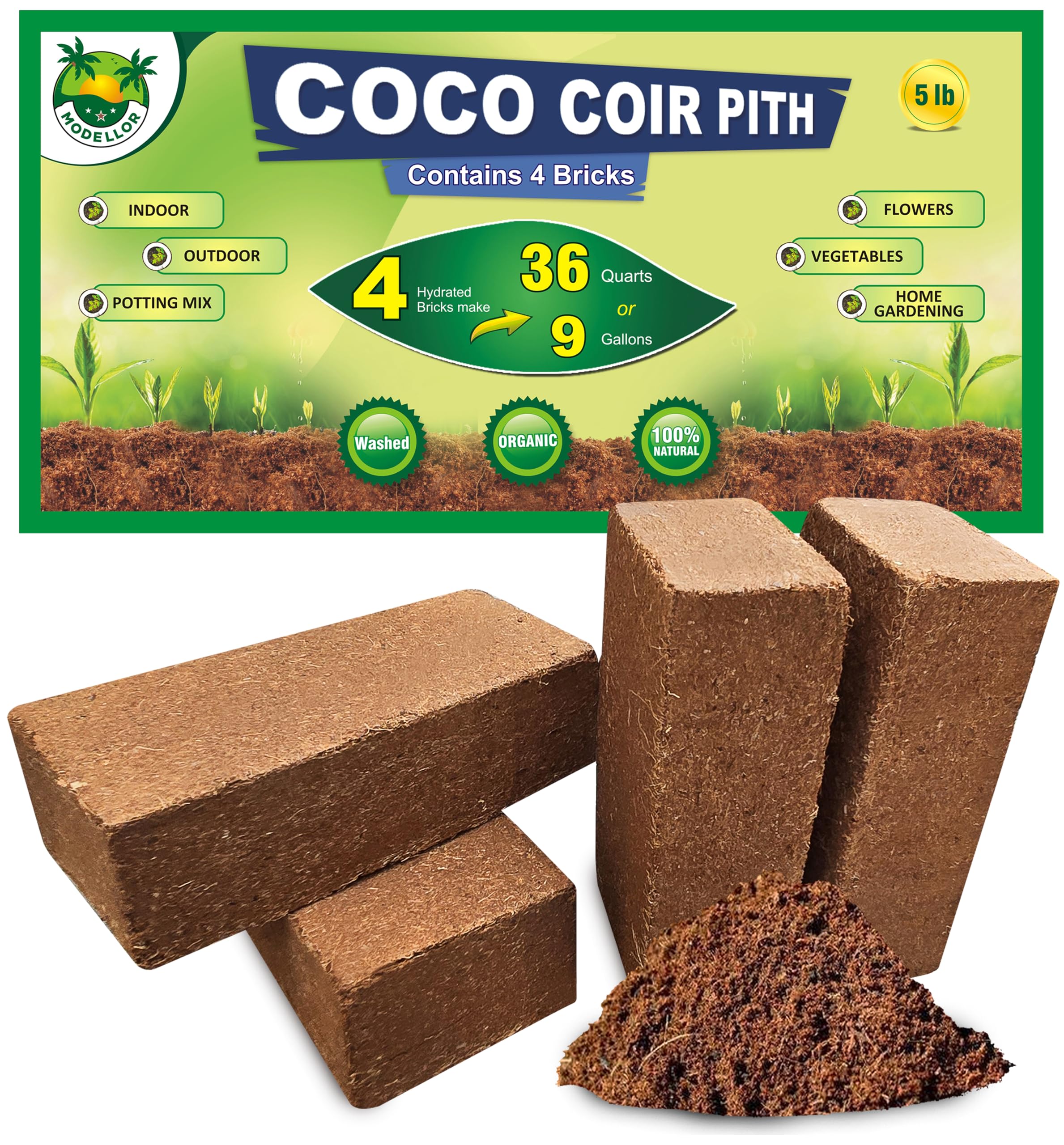
The compressed brick that gives you 9 gallons of fluffy growing medium from a small storage footprint.
If space is tight but you need a lot of growing medium, these coco coir bricks solve that problem. Four bricks weighing 5 pounds total expand into up to 9 gallons (36 quarts) of material when hydrated — a massive volume for the price compared to pre-bagged mixes like the Jiffy, which comes in at 1 pound for 10 quarts. Reviewers point out it hydrates fast and expands more than expected, with a clean texture, no smell, and no debris. The coir is triple-washed and pH-balanced, so salt levels are low enough for seed starting straight away.
Because it is pure coco coir with no perlite or vermiculite, you may want to mix it with those ingredients if you are using it for seed starting trays. Many gardeners blend it half and half with potting soil or add perlite for aeration. The bricks work well for microgreens, soil amendment in raised beds, and as a base for custom seed-starting blends. One buyer mentioned it looks just as good as premium coco brands, with consistent quality brick to brick and no weird smells.
What you get
- Expands to 9 gallons from a compact 5-pound brick pack — excellent storage efficiency
- Triple-washed and pH-balanced with low salts, ready to use after hydrating
- Shoppers say it hydrates fast, produces more volume than expected, and has a clean texture
The catch
- Pure coco coir with no perlite or vermiculite — you may need to add these for seed-starting trays to get enough aeration
Perfect for: budget-minded gardeners who want maximum volume per dollar and like to customize their own seed-starting blend.
Not for you if: you want a ready-to-use, open-and-pour mix with no extra blending step before you fill your seed trays.
Understanding the Specs
Volume (Quarts & Gallons)
This tells you how much material you get. Seed trays typically need 2 to 3 quarts per 72-cell tray. A 10-quart bag covers about three to four trays, while a 24-quart bag like the Old Potters can handle a full season of starts. Compressed coco coir bricks are measured by expanded volume — a 5-pound brick pack can yield up to 9 gallons, making them the most space-efficient option for storage.
Wetting Agent
A wetting agent is a surfactant added to dry mix so it absorbs water evenly instead of beading on the surface. Dry peat moss and coco coir can become hydrophobic — water rolls right off. Mixes like the Hoffman and Old Potters include a wetting agent, which means you spend less time waiting for the soil to hydrate before you plant. If a bag lacks one, you can add a drop of mild dish soap to your water to help it soak in.
FAQ
Can I use regular potting soil for germinating seeds?
What is the difference between peat moss and coco coir for seed starting?
How much water should a seed starting mix hold?
Do I need fertilizer in my seed starting mix?
Should I add perlite or vermiculite to coco coir bricks?
How long does an opened bag of seed starting mix last?
What is the ideal pH range for seed starting?
Can I reuse seed starting mix from last year?
What is the difference between a soilless mix and a compost-based mix?
Is a wetting agent necessary in seed starting mix?
Final Thoughts: The Verdict
For most people, the soil for germinating seeds winner is the Old Potters Germination Mix because it delivers the largest volume with a professionally balanced pH and a fine, screened texture that gives a 90% germination rate. If you want an organic, compost-based mix with built-in fertility for soil blocking and longer seedling hold time, grab the Purple Cow Organics Seed Starter. And for a budget-friendly, space-saving option that expands into 36 quarts of growing medium, the MODELLOR Coco Coir Bricks are tough to top.
How We Picked
We do not accept paid placement, and we did not hands-on test every unit. Instead, we match each pick to a real buyer and use-case by comparing the manufacturers’ published specifications against the patterns in verified customer reviews — so you get each pick’s real strengths and trade-offs instead of marketing copy.
Sources & Methodology
Specifications: manufacturer listings and product documentation. Review insights: verified customer reviews, as of July 2026. Pricing: not shown on this page (it changes often); check the current price via the retailer link.
As an Amazon Associate, Lawn Gear Lab earns from qualifying purchases. This does not affect which products we feature.