
Specs are compiled from manufacturer listings and verified buyer reviews and can change over time — please confirm the key details on the product page before buying.
Scattering fresh grass seed and then blasting it with a heavy jet stream is basically throwing money down the drain. You need a sprinkler that delivers a gentle, even soak — something that keeps the soil damp without washing seeds into a pile or leaving bare patches. The wrong pick either drowns your new lawn or leaves it dry, but the right one makes germination feel easy.
I’m Rikta — the founder and writer behind Lawn Gear Lab. This guide is built by comparing the manufacturers’ published specifications and the patterns across verified customer reviews, so you get each pick’s real strengths and trade-offs instead of marketing spin.
Whether you are starting a patch of bare earth or reseeding a thinning lawn, finding the best sprinkler for new grass seed means looking for a soft spray, good coverage control, and durable materials that survive a full growing season without cracking or leaking.
Quick Picks
- Honoson Metal 360 Degree Circle Pattern Spot Sprinkler (6-Pack) — Best Value
- Eden 94143 Multi-Pattern Sprinkler Plus One-Direction Misting System — Most Versatile
- Jin&Bao Sprinkler Hose with Holes 50FT — Best for Beds
- ESOW All Metal Misting Spike Sprinkler 2-Pack — Precision Mist
How To Choose The Best Sprinkler For New Grass Seed
New grass seed is fragile. A hard blast of water pushes seeds into clumps or washes them into the gutter. A good sprinkler for this job spreads water gently and evenly, as close to a light rain as possible.
Spray Pattern: Mist Or Gentle Circle
Look for a mist setting or a circular spot pattern that lets water fall softly. Avoid impact sprinklers that shoot a single hard stream — those will relocate your seed in seconds. The best options for new seed use either a fine mist (so the droplets land softly) or a 360-degree rain-circle pattern that mimics natural rainfall.
Coverage Area
Match the sprinkler’s coverage to the size of your seeded area. A sprinkler that claims 30 feet of diameter covers a much larger area than a misting spike that only covers about 7 feet. Too large and you waste water; too small and you have to move it constantly. Measure your patch and check the spec.
Material Durability
Zinc-alloy and brass bodies resist rust and hold up to full sun and rain season after season. Plastic and PVC options cost less but tend to crack after a year or two. A zinc spike or brass head costs a few dollars more upfront but usually means you buy it once instead of every spring.
Quick Comparison
On smaller screens, swipe sideways to see the full table.
| Model | Best For | Coverage | Max Pressure | Material | Amazon |
|---|---|---|---|---|---|
| Honoson Metal 360° Spot Sprinkler (6-Pack) | Gentle rain-like watering for small lawns | Up to 30 ft diameter | 80 psi | Zinc alloy | Amazon |
| Eden 94143 Multi-Pattern Sprinkler | Adjustable pattern for varied lawn shapes | Up to 3,737 sq ft | — | Zinc | Amazon |
| Jin&Bao Sprinkler Hose 50FT | Straight, narrow beds and raised gardens | 50 ft length, 3-6 ft spray height | 60 psi | PVC | Amazon |
| ESOW All Metal Misting Spike 2-Pack | Delicate seedlings and flower beds | ~7 ft diameter (mist) | — | Brass / Zinc alloy | Amazon |
In‑Depth Reviews
1. Honoson Metal 360 Degree Circle Pattern Spot Sprinkler (6-Pack)
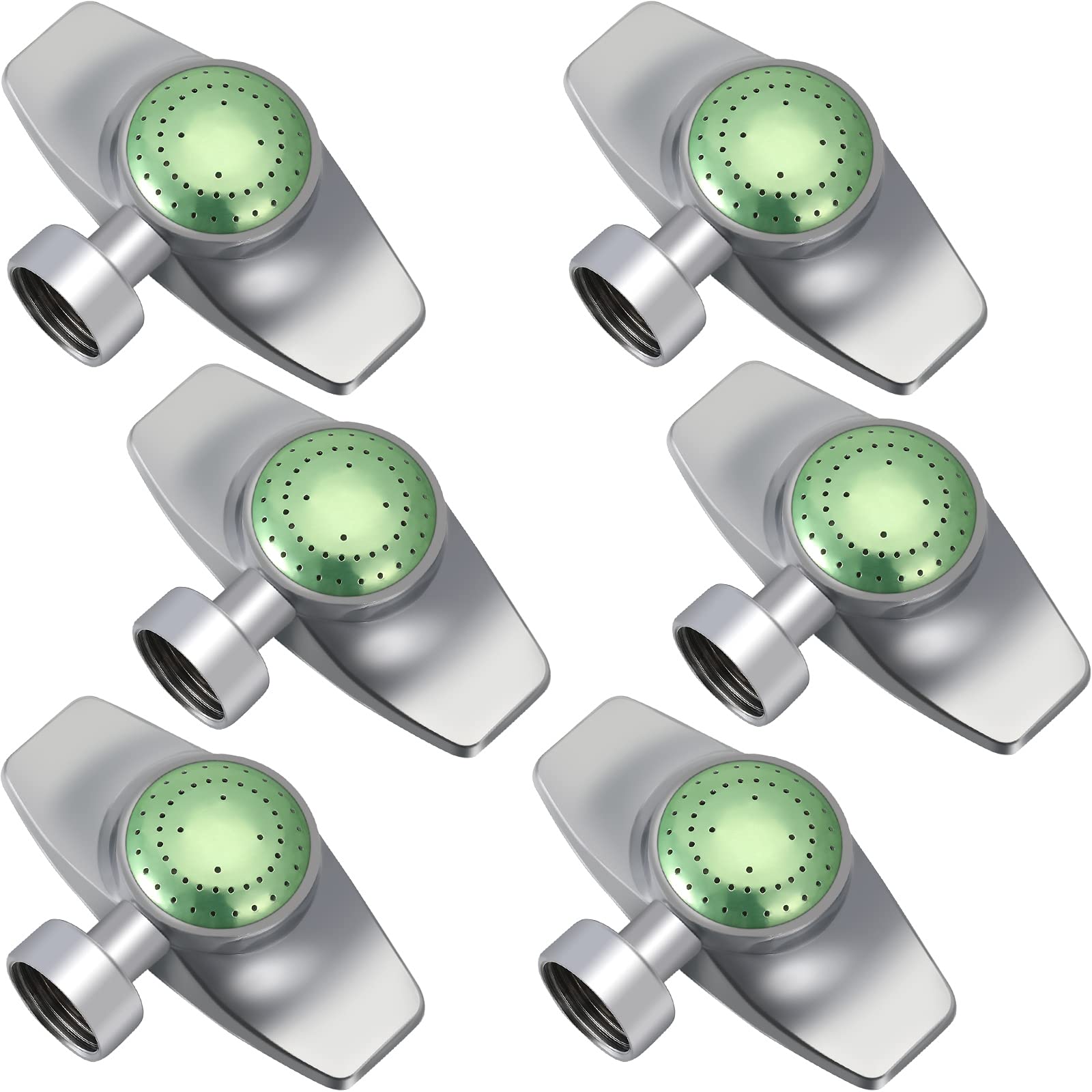
A zinc-built circle sprinkler that soaks new seed like a soft rain without waste.
For new grass, the gentlest watering pattern is a 360-degree circle that lets water fall vertically rather than blasting sideways. The Honoson sprinkler does exactly that — it creates a rain-like ring with a maximum coverage of 30 feet in diameter, so a single unit can handle a decent-sized patch of bare soil. The body is made of quality zinc alloy, which buyers confirm is studier and more corrosion-resistant than any plastic nozzle they have used before.
One difference you will notice versus the ESOW misting spike (which covers only about 7 feet) is the sheer reach: Honoson handles a 30-foot diameter, making it practical for a small lawn instead of just a flower bed. It handles a maximum pressure of 80 psi (pounds per square inch — the water force it can take before damage), versus the Jin&Bao hose’s 60 psi limit, giving you more room to adjust the flow without damaging the hardware. Buyers report the sprinklers save water and are easy to maneuver — one buyer bought enough to replace all their other sprinklers after seeing the price and build quality.
Keep in mind that the circular spot and rectangular spot patterns are shipped randomly, so you might receive either shape. That matters if you need a perfectly round pattern for a specific bed layout. For most new-seed applications, though, the circle works beautifully and stays put thanks to the 1.3-pound weight.
Rain-like soak: The 360-degree circular spray mimics natural rainfall, keeping soil damp without disturbing seeds — ideal for germination.
Reach for this if: You need a durable, low-cost sprinkler that can water a medium patch of new seed gently with a rain-circle pattern.
Look elsewhere if: You need an exact round-only pattern — the shape ships randomly and you might get a rectangular spot version instead.
2. Eden 94143 Multi-Pattern Sprinkler Plus One-Direction Misting System

Five spray patterns and a rugged zinc spike that lets you dial in the perfect seed-friendly soak.
If you are reseeding different shapes of lawn — a long strip along a driveway, then a square patch in the backyard — you want a sprinkler that adapts without needing a second tool. The Eden 94143 offers five spray patterns: multi, large, mist, fan, and flat. The mist setting is the one you will use for new grass seed because it breaks water into fine droplets that land gently. The other patterns give you flexibility once the seed is established.
Buyers specifically praise the “even lawn watering” and the “sturdy metal spike” that stays planted in hard soil — a real plus if your seeding area is compacted earth. The maximum flow rate is 15 gallons per minute (gpm — the volume it passes through), and coverage can reach up to 3,737 square feet; the ESOW misting spike covers about a 7-foot diameter, and the Jin&Bao hose is a 50-foot run. The angle cap also lets you control how far the water travels, so you can concentrate the spray exactly on your seeded zone and avoid drenching the sidewalk.
The honest catch: a small number of owners mention the rotating mechanism stops working after a few uses. One reviewer noted it worked perfectly for one day and then stopped rotating. That seems to be a quality-control issue rather than a design flaw, but it is note if you want a low-maintenance solution for a full season.
Why it works for new seed
- Mist pattern delivers a gentle fine spray that will not wash seeds away
- Zinc spike drives into hard soil and stays upright
- Coverage control via angle cap keeps water on the seeded area
What to watch for
- Some units lose rotation after a few uses — quality varies
- Mist setting does not rotate; it is a fixed fine spray
The flexible pick: Ideal if you have multiple lawn shapes to seed and want a single sprinkler that handles mist for seed and wider patterns for established grass.
The trade-off: The rotating mechanism durability is a weak point, so buy from a seller with easy returns.
3. Jin&Bao Sprinkler Hose with Holes 50FT

A flat soaker hose that waters a straight seed bed evenly without disturbing the soil.
Sometimes your new grass seed is in a narrow strip — along a fence line, in a roadside verge, or in a rectangular raised bed. A round sprinkler wastes a lot of water spraying into the air, while the Jin&Bao hose lays flat along the entire run and seeps water upward 3 to 6 feet high. The small-hole design means water sprays up and falls back down gently, exactly the kind of soft irrigation new seed needs to stay in place.
At 50 feet long, it covers more linear ground than any single spike sprinkler, and the included landscape staples keep it from curling or moving. One buyer mentioned “strong water output from every hole; water sprays upward and falls back into bed, not everywhere,” which is precisely what you want for a straight seeded area. The PVC (polyvinyl chloride, a flexible plastic) material handles water pressure from 20 to 60 psi; the Honoson is rated for 80 psi, so if you have high household water pressure, you may need to dial it down.
The limitation is curves: customers note the hose does not bend tightly around corners despite the anchors. It works best laid in a straight line or a wide gentle arc. Also, a few buyers experienced uneven output where the front holes sprayed too hard and the end holes barely dribbled, so test the whole length before committing to a large seeded area.
Straight-run specialist: Perfect for long narrow seed beds and raised garden rows where a circle sprinkler would waste water on surrounding paths.
Best for: Linear beds, fence lines, and raised gardens where you want steady soaker-like coverage along the seed row.
Best to skip if: Your seeded area is square, circular, or has tight curves — this hose struggles with bends.
4. ESOW All Metal Misting Spike Sprinkler 2-Pack

A heavy-duty brass-and-zinc misting spike that protects the tiniest seedlings from being washed out.
For ultra-delicate new grass seed — or seed mixed with fine topsoil on a small patch — the standout is a true mist. The ESOW spike uses a triple-head design that turns water into a fine, gentle spray that settles on the ground rather than pounding it. The brass spray head and zinc alloy spike are rust and corrosion resistant, standing up to all-year outdoor use better than the PVC Jin&Bao hose. It also comes pre-installed with a washer and multi-layer mesh filters to prevent clogging, which is a thoughtful touch.
The trade-off is that “mist” is not “stream.” One buyer pointed out that the spray covers only about a 7-foot diameter, and most of the water can evaporate or drift in wind. Compare that to the Honoson’s 30-foot coverage or the Eden’s 3,737-square-foot reach, and you will see this is strictly for small, protected areas — a flower bed-sized patch of new seed, not a full lawn. The 2-pack gives you two spikes, and the dual-port feed-through design lets you connect them in series to cover a slightly larger zone from a single faucet.
Some buyers have reported the head breaking off within a week or the units leaking at the connection. That said, the company offers a 1-year low-maintenance return, so build quality is a known risk worth considering if you need a long-term fixture.
Ideal for delicate seed
- Gentle mist does not displace or clump new grass seed
- Full metal construction (brass and zinc) resists rust and UV damage
- Pre-installed washer and mesh filters stop debris from clogging the nozzles
Limitations to know
- Mist covers only ~7 ft diameter — not suitable for large seeding projects
- Wind can blow fine mist away before it reaches the soil
- Build quality inconsistency: some units leak or break within days
Choose this for: A small, sheltered seed bed where a strong stream would wash away seed and a fine mist keeps everything perfectly damp.
Look elsewhere for: Large lawn reseeding, windy yards, or any situation needing more than 10 feet of coverage per sprinkler.
Understanding the Specs
Spray Pattern: Mist vs. Stream vs. Circle
For new grass seed, you want a mist or 360-degree gentle circle that lets water fall vertically. Hard streams from impact sprinklers wash seeds into gutters or clump them together. A mist setting breaks water into tiny droplets that land softly, while a circular spot pattern mimics rain. The Eden sprinkler offers both mist and fan patterns, while the Honoson uses a pure rain-circle design.
Maximum Pressure (psi)
Measured in pounds per square inch (psi), this tells you how much water pressure the sprinkler can handle before leaking or breaking. The Honoson is rated for 80 psi, versus the Jin&Bao’s 60 psi. Higher psi means you can run your faucet at a stronger flow without damaging the unit, but for new seed you will typically dial the pressure down to keep the spray gentle.
Coverage Area
The coverage spec tells you how wide the water reaches. The Eden claims up to 3,737 square feet with its rotating pattern, while the ESOW misting spike covers roughly a 7-foot diameter (about 38 square feet). For a new lawn patch, match the coverage to your plot size — a 30-foot diameter Honoson is great for a 30×30 area, while a small flower bed works better with the ESOW or a section of the Jin&Bao hose.
Material: Zinc vs. PVC vs. Brass
Zinc alloy and brass bodies resist corrosion and hold up to full sun and rain for seasons. PVC (like the Jin&Bao hose) is flexible and cheaper but tends to stiffen and crack after a year or two of UV exposure. A metal spike also stays planted in hard soil, as the Eden’s zinc spike demonstrates. If you want a sprinkler that lasts more than one season, opt for metal over plastic.
FAQ
Can I use a regular impact sprinkler for new grass seed?
How often should I water new grass seed?
What is the difference between a misting spike and a soaker hose for new seed?
Will a 360-degree circle sprinkler wash away new seed?
How do I know if the sprinkler is too strong for my new seed?
Which material lasts longer: zinc alloy or PVC?
Can I connect two misting spikes together to cover more area?
What does “maximum pressure 80 psi” mean for my home faucet?
Is a multi-pattern sprinkler like the Eden better than a single-purpose one?
How long does a soaker hose last compared to a metal spike sprinkler?
Final Thoughts: The Verdict
If you want one dependable pick, the best sprinkler for new grass seed is the Honoson Metal 360 Degree Spot Sprinkler 6-Pack because it delivers a gentle rain-circle pattern across a 30-foot diameter using durable zinc alloy at an unbeatable value. If you need flexible spray patterns for different lawn shapes, grab the Eden 94143 Multi-Pattern Sprinkler. And for a narrow straight seed bed where you want full-length even coverage, the standout is the Jin&Bao Sprinkler Hose 50FT.
How We Picked
We do not accept paid placement, and we did not hands-on test every unit. Instead, we match each pick to a real buyer and use-case by comparing the manufacturers’ published specifications against the patterns in verified customer reviews — so you get each pick’s real strengths and trade-offs instead of marketing copy.
Sources & Methodology
Specifications: manufacturer listings and product documentation. Review insights: verified customer reviews, as of July 2026. Pricing: not shown on this page (it changes often); check the current price via the retailer link.
As an Amazon Associate, Lawn Gear Lab earns from qualifying purchases. This does not affect which products we feature.