
Specs are compiled from manufacturer listings and verified buyer reviews and can change over time — please confirm the key details on the product page before buying.
If your vegetable seedlings are stretching tall and thin, or your indoor herbs look pale and leggy, the problem isn’t your watering schedule — it is almost certainly weak light. Vegetables evolved under direct sun, so recreating that intensity indoors takes a proper grow light with full-spectrum output and enough wattage (the power you pull from the wall) to drive real photosynthesis, not just a desk lamp with a green bulb.
I’m Rikta — the founder and writer behind Lawn Gear Lab. This guide is built by comparing the manufacturers’ published specifications and the patterns across verified customer reviews, so you get each pick’s real strengths and trade-offs instead of marketing spin.
This breakdown helps you choose indoor grow lights for vegetables by matching the light output, coverage area, and features to the size of your grow space and the crops you want to actually harvest.
Quick Picks
- MARS HYDRO TS1000 150W LED Grow Light — Best Overall
- VIPARSPECTRA XS1500 Pro LED Grow Light — Optical Lens Champ
- VIVOSUN LumaLight 200W LED Grow Light — Smart Tent Titan
- TYAGMAM 4ft T8 180W (4 x 45W) Full Spectrum LED Grow Light — Shelf Strip King
- Barrina Vertical Grow Light T10, 42W 5000K — Vertical Space-Saver
- Abriselux 540-LED Full Spectrum Grow Light with 58″ Stand — Flexible Multi-Head
How To Choose The Best Indoor Grow Lights For Vegetables
Choosing a vegetable grow light is less about the number of LEDs and more about three things: the actual power draw — the real wattage you measure from the wall outlet — the evenness of the light over your plants (how uniform the PPFD is), and whether the spectrum includes the red and far-red (660nm and 730nm) wavelengths that flowering and fruiting vegetables need. Most budget lights advertise “equivalent wattage” — that is the marketing number, not what you plug into the wall.
Real Wattage vs. Equivalent Wattage
A light that claims “1080W equivalent” but draws only 180W from the outlet (like the TYAGMAM 4ft T8) is still an efficient grow light — but you compare it to other lights by the 180W number, not the hype number. For vegetables that need high light intensity (tomatoes, peppers, cucumbers), look for at least 150W of real draw per 2×2 foot area. For leafy greens and herbs, 40W-80W per square foot can work if the light is close to the plants.
Coverage Area and PPFD Uniformity
PPFD (Photosynthetic Photon Flux Density) measures how many photons — tiny light particles — land on a square meter every second; it is the real unit of “brightness” for plants. A good veg grow light should deliver 300-600 µmol/m²/s at the plant canopy. Look for third-party PPFD maps that show readings at the center and corners. Lights with a lens design (like the VIPARSPECTRA XS1500 Pro) concentrate light more evenly, so the edge plants aren’t left in the dark and grow just as well as the center ones.
Dimmability and Timer Features
An adjustable dimmer lets you start seedlings at 50% power to prevent scorching, then ramp up to 100% during the flowering stage. A built-in timer (like the 5H/10H/15H auto-cycle on the Abriselux 540-LED model) automates the on/off schedule so you don’t have to manually plug and unplug every day — especially useful if you grow both short-day and long-day crops in separate tents.
Quick Comparison
On smaller screens, swipe sideways to see the full table.
| Model | Best For | Real Wattage | Coverage Area | LED Count | Amazon |
|---|---|---|---|---|---|
| MARS HYDRO TS1000 | High-yield veg & flower in 2×2 tents | 150W | 2.5×2.5 ft | 354 | Amazon |
| VIPARSPECTRA XS1500 Pro | Seed-starting to harvest with uniform PPFD | 150W | 3×3 ft veg / 2×2 ft flower | — | Amazon |
| VIVOSUN LumaLight 200W | Larger 2×4 tents with smart app control | 200W | 2×4 ft / 3×3 ft | — | Amazon |
| TYAGMAM 4ft T8 4-Pack | Long shelves & greenhouse benches | 180W (4 x 45W) | 4 ft x width of rack | — | Amazon |
| Barrina Vertical T10 | Tall potted plants & dark corners | 42W | Vertical 4 ft tall | — | Amazon |
| Abriselux 540-LED Stand | Adjustable multi-head coverage for seedlings | — | Multiple 1.7-inch heads | 540 | Amazon |
In‑Depth Reviews
1. MARS HYDRO TS1000 150W LED Grow Light

The quantum-board workhorse that grows dense buds and thick leaves on 150 real watts.
This light draws exactly 150W from the wall — no inflated “equivalent” wattage number. Buyers report that switching from a 1200W-equivalent King LED to this MARS HYDRO TS1000 caused tomato plant growth to surge overnight, and after six months the light was still running strong with dense fruit. The 354 SMD LEDs (surface-mount diodes, the standard efficient chip) are arranged with a patented dense-in-the-middle, sparse-on-the-sides layout that makes the PPFD more uniform across the 2.5×2.5 foot coverage area than older designs. This means the leaves at the edge of the pot get almost as much light as the center leaves, so your pepper plant grows evenly on all sides.
A 120-degree beam angle and a reflective hood increase light utilization by 25%, according to the manufacturer, which means more photons hit the canopy and fewer bounce off the tent walls — helping bottom leaves stay productive when the light hangs 24 inches above the plants. The fanless design runs completely silent, and the aluminum body dissipates heat without burning leaves. The dimmer lets you dial from 0% to 100%, so you can start seedlings at 50% and gradually ramp up through the vegetative and flowering stages.
Unlike the VIPARSPECTRA XS1500 Pro, which uses an optical lens for focusing, the TS1000 relies on a reflective hood — both achieve similar PPFD at 150W, but the MARS HYDRO is slightly more compact at 14.2″L x 13.2″W x 1.4″H (compared to the VIPARSPECTRA’s 14.2″L x 11.4″W x 3.1″H). One clear trade-off: the unit weighs 1.7 kilograms (about 3.7 lbs), so you will want sturdy rope hangers or a solid tent frame to hang it securely.
Yield-focused power: The 150W of real draw and the dimmable daisy-chain feature make this the go-to panel for a 2×2 or 2.5×2.5 foot tent, giving you the intensity to push peppers, tomatoes, and cannabis to harvest while staying affordable.
One honest trade-off: There is no built-in timer or smart app — you will need an external timer or a smart plug to automate the on/off schedule, which adds a small step to your daily routine.
Go for this light if: You have a 2×2 or 3×3 tent and want the highest PPFD per dollar for flowering vegetables — it outpunches pricier panels in that footprint.
Choose the VIVOSUN LumaLight 200W instead if: You need app control or a waterproof light for a high-humidity greenhouse; the TS1000 has neither.
2. VIPARSPECTRA XS1500 Pro LED Grow Light

Lens-focused light that hits 747+ PPFD at half power — serious intensity for a compact board.
Instead of scattering light in a broad cone like the MARS HYDRO TS1000, the XS1500 Pro uses secondary optical lenses to focus the beam at 120 degrees, achieving measurably more uniform PPFD from the center to the edges. One reviewer measured an excellent 747 µmol/m²/s at 50% power from just 13 inches — that reading roughly doubles at full power. For a 150W panel, that is exceptional canopy penetration, meaning lower leaves on a tomato or pepper plant still get usable light rather than stretching thin and pale.
The spectrum includes white 3000K and 5000K LEDs plus red 660nm (nanometer — a deep-red wavelength) and far-red 730nm diodes, giving you both the blue light for vegetative growth and the red/far-red stretch for flowering. At 2.55 kilograms (about 5.6 lbs), it is noticeably heavier than the MARS HYDRO TS1000 — a sign of the larger aluminum heatsink that keeps the unit cool even after 12 hours at full power. Buyers growing super-hot peppers and wild Morning Glory bushes report the light is effective for “difficult plants,” but caution that the adjustable intensity can easily scorch seedlings if set too high from the start — so start at 50% for young plants.
One practical difference from the TS1000: the XS1500 Pro is specified for a 3×3 foot vegging footprint and a 2×2 foot flowering footprint, whereas the MARS HYDRO covers 2.5×2.5 feet for both stages. If you have a slightly larger veg tent, the VIPARSPECTRA’s wider coverage is a real advantage — it lights the edges better. However, the unit lacks an on/off switch — owners mention you need a timer in the circuit to control the photoperiod, which is slightly inconvenient compared to the built-in timer on the Abriselux model.
Sharp Focus
- Optical lenses produce the most uniform PPFD in this price class; corner readings match the center within 10-15%, so every plant grows evenly
- Can daisy-chain up to 20 units for unified dimming across a larger grow room
- Runs cool and silent even at 12-hour full-power cycles — good for bedroom or living-room setups where noise matters
Two Snags
- No built-in timer or on/off switch; you must use an external timer or smart plug to automate the lights
- Weighs 2.55 kg (5.6 lbs) — requires a sturdy tent frame; the included rope hangers help but are not bombproof
Reach for this if: You want the most even light distribution for a 3×3 veg area and are willing to add your own timer — the edge-to-edge uniformity beats the MARS HYDRO TS1000 in that larger space.
Look at the VIVOSUN LumaLight 200W if: You need a waterproof light for a humid greenhouse environment; the XS1500 Pro is not rated for splashes.
3. VIVOSUN LumaLight 200W LED Grow Light
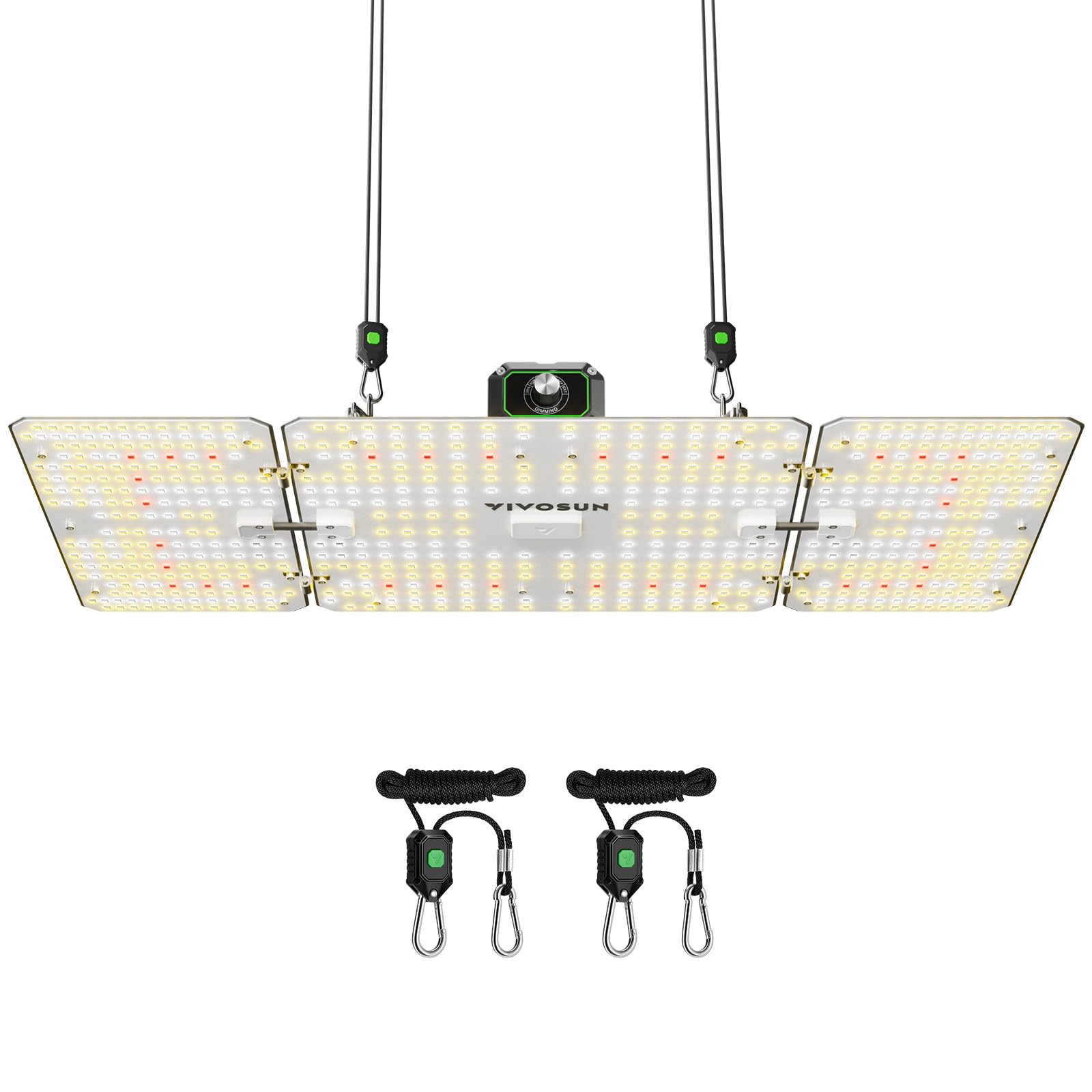
The 200W bar-style panel that covers a full 2×4 tent and shrugs off water splashes.
If you are running a 2×4 or 3×3 grow tent and want one light to fill the whole canopy, the LumaLight 200W is the best shape for that job. The long 23.5″ x 11.8″ rectangular board distributes light evenly across a 2×4 footprint — the same coverage typically requires two smaller square panels like the TS1000. But the standout spec here is the IP65 waterproof and dustproof rating (IP65 means fully sealed against dust and low-pressure water jets from any direction): you can safely spray water, nutrients, or even a mild soap cleaner directly onto the light without risking a short circuit — a big deal for humid greenhouse environments where condensation drips.
The spectrum includes white 3000K and 5000K LEDs plus red 660nm and far-red 730nm diodes, covering all stages from seedling stretch to flower maturation. The unit is compatible with the VIVOSUN GrowHub (sold separately), which lets you automate lighting schedules, set dim levels, and monitor via a mobile app — something the MARS HYDRO TS1000 and VIPARSPECTRA XS1500 Pro lack entirely. Even without the hub, the 4-level dimming knob (25%, 50%, 75%, 100%) gives you easy manual control. Customers note that the light is extremely bright — 25% power alone illuminates a whole house — and that running at 100% in a 4×4 tent raises temperatures significantly, so you will need good exhaust ventilation to keep plants comfortable.
One clear trade-off: the 200W draw produces noticeably more heat than the 150W panels, and the rectangular shape works best in a tent or on a flat bench — less useful for standalone shelves. The 2-year unlimited warranty plus a 3-year limited warranty provides confidence, but at 9 pounds it is the heaviest light here and requires sturdy hanging support.
Wet-space specialist: The IP65 rating means you can mist propagate or spray foliar feed without covering the light — the only model in this lineup that tolerates direct water contact, making it uniquely suited for high-humidity setups.
The heat factor: 50W extra compared to the 150W panels pushes tent temperatures up 8-10°F at 100% power, so plan for adequate intake and exhaust fans to prevent heat stress on your vegetables.
Buy this if: You have a 2×4 tent, want app-based scheduling for convenience, or grow in a high-humidity environment where water splash is a risk — no other pick here handles moisture like this one.
Skip this if: Your grow space is a small 2×2 or you need to keep heat low — the 150W MARS HYDRO or VIPARSPECTRA panels run cooler and still deliver excellent results for that footprint.
4. TYAGMAM 4ft T8 180W (4 x 45W) Full Spectrum LED Grow Light

Four linked 4-foot strips that flood a multi-shelf rack with even white light.
For growers who use wire shelving or greenhouse benches, a single T8-style strip per shelf often does the job better than a bulky square panel. This 4-pack gives you four individual 45W strips (180W total across all four) that are each 46 inches long, though reviewers point out the actual length is “closer to 45 inches” — a 1-inch discrepancy from the advertised 48 inches. The strips come with 36-inch connecting cords so you can link all four in a series from one plug, keeping cable clutter low. The integrated reflector and aluminum housing dissipate heat effectively, and the 5000K full-spectrum light supports seedlings, vegetative growth, and flowering.
Compared to the Barrina Vertical T10, which aims its light sideways from a standing tripod, the TYAGMAM strips are purely top-down — ideal for flat trays of microgreens, lettuce flats, or a single shelf of peppers. The “1080W equivalent” claim on the listing is the marketing number (the real draw is 180W), but buyers consistently report that one strip per shelf perfectly lights a 2-foot-wide rack and that the lights “work great” and are “very easy to install.” The pinkish-white light color (listed as “Pink” in the specs) is a full-spectrum mix that some growers find visually less pleasant than the cool white of the Barrina T10, but the plants do not care — they respond to the PAR (photosynthetically active radiation), not the color temperature you see.
The two biggest limitations: the strips are not dimmable, so you cannot adjust intensity for seedlings vs. flowering without raising or lowering the fixture, and the T8 form factor makes them less effective for tall plants like determinate tomatoes, where a vertical light such as the Barrina T10 provides better side illumination for lower leaves.
Shelf-scale coverage: Four 45W strips linkable in series — perfect for a multi-tier rack growing lettuce, herbs, and microgreens where you need even top-down light on each level without dark spots.
No dimmer, no timer: You will need an external outlet timer to automate the on/off schedule, and there is no dimming adjustment, so you control intensity only by changing the distance to the plants.
Use this for: Seed-starting shelves, lettuce flats, and microgreen trays on a multi-level wire rack where even strip lighting beats a single panel for uniform coverage.
Choose the MARS HYDRO TS1000 or VIPARSPECTRA XS1500 Pro if: You need deep canopy penetration for tall tomato or pepper plants — those panels push light deeper than strips can.
5. Barrina Vertical Grow Light T10, 42W 5000K

The elegant standing solution that lights tall plants from the side without clutter.
If your indoor vegetables include a potted dwarf tomato, a citrus tree, or large basil plants, a top-down panel may only light the top leaves while the lower foliage stays shaded. The Barrina T10 solves this by emitting 5000K daylight-white light from a vertical 4-foot T10 tube, illuminating the plant from the side — the same way a sunny window would. It draws only 42W, making it the lowest-wattage pick here, and it is a 3.6x gap compared to the 150W panels, so it is not a substitute for a high-intensity tent light. But for a single large plant in a living-room corner, the 42W is enough to keep it thriving, and the light is “cool to the touch” with a CRI (Color Rendering Index — how true colors appear to your eye) of 96, meaning leaves look natural green rather than washed out.
Buyers consistently call it “bright, affordable, well-made” and note that new leaves emerged soon after setting it up. The tripod stand gives you adjustable height without needing separate extenders, and the weighted base keeps the unit stable on standard floors. However, one reviewer flagged that the tripod legs “are not very stable” unless the hex screws at the base are tightened properly — an easy fix with the included hex wrench during assembly. The light includes a remote control and works with a smart plug, which partially compensates for the lack of a built-in timer.
Compared to the TYAGMAM strips, which are strictly top-down, the Barrina T10 is the only model in this lineup designed for side or vertical illumination — it reaches the lower leaves that top-down lights miss. It is also the most living-room-friendly option aesthetically, with a slender white tube and stand that blends into décor better than a black square panel with hanging wires.
Corner grow specialist: Perfect for lighting a tall potted plant in a dark room corner where a hanging panel would look out of place or would not reach the lower leaves — the 4-foot vertical tube covers the entire plant height.
Not a tent replacement: At 42W, it simply lacks the intensity for a full tent of flowering vegetables; it complements high-power panels but does not replace them.
Choose this for: A single large houseplant or a dwarf vegetable in a living room, where aesthetics and low heat matter more than raw PPFD — the 42W keeps it compact and cool.
Skip this for: A 4×4 grow tent full of tomatoes — you need the 200W VIVOSUN LumaLight or a 150W panel to drive fruiting yields from that space.
6. Abriselux 540-LED Full Spectrum Grow Light with 58″ Stand
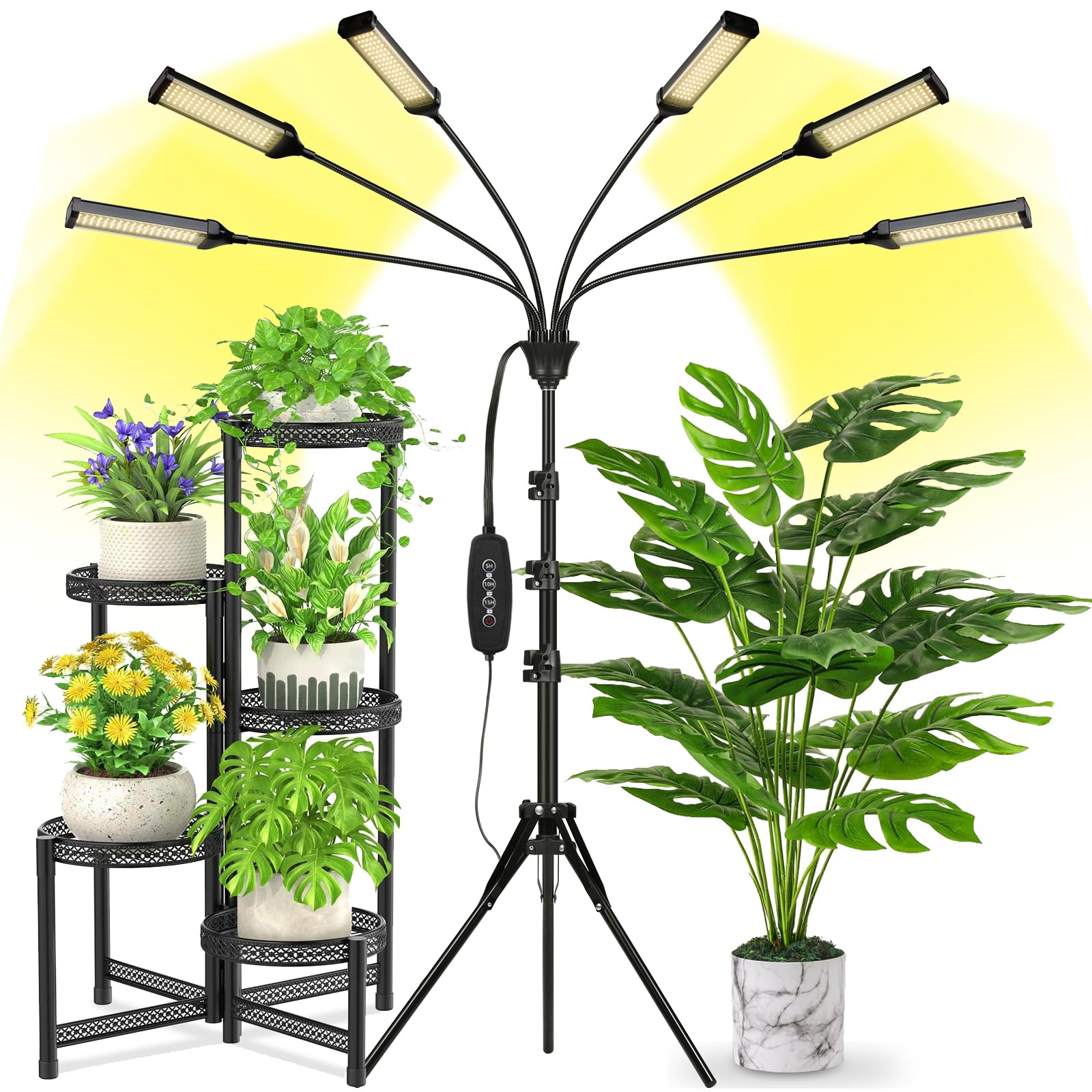
Six independently adjustable heads that point light exactly where each plant needs it.
The Abriselux grow light takes a different approach from the fixed-panel designs above: six square light heads, each 1.7 inches wide, sit at the ends of 360-degree rotatable goosenecks mounted on a 58-inch adjustable tripod stand. With 540 LEDs total, it has a 53% greater LED count than the MARS HYDRO TS1000’s 354 LEDs — but note that LED count is not the same as brightness; the Abriselux spreads its output across six smaller heads, so the PPFD per square inch is lower than a focused 150W panel. Still, for growers who have plants at different heights or need to cover an irregular shelf layout, the adjustability is a real advantage — you can aim one head at a seedling tray and another at a tall pepper, all from the same stand.
The light includes a built-in auto-timer with 5H, 10H, and 15H settings that cycle daily once set — a genuine convenience feature not found on the MARS HYDRO or VIPARSPECTRA panels (both require external timers). You set the cycle once, and the light remembers to turn on and off at the same time every day. One reviewer pointed out a reliability concern: after one month on an 18/6 cycle (18 hours on, 6 off), the right-side head started flickering at 100% brightness, and dropping it to 90% eliminated the flicker. That suggests running the LEDs at full blast for long hours may stress the drivers on some units. The 3-year warranty from Abriselux provides some cover, but it is note if you plan to run the light near 100% for long photoperiods.
Unlike the Barrina T10, which is a single vertical tube, the Abriselux lets you position one head over a tray of microgreens, another directed at a tall coleus, and a third angled toward a potted pepper — all from one stand. The trade-off is stability: the tripod can tip over if all six arms are extended in the same direction, so you need to balance them around the center pole. At 7″L x 4″W x 16″H folded, it is relatively compact for storage when not in use.
Directional Flexibility
- Six 1.7-inch heads with goosenecks let you aim light at specific plants or trays — great for mixed-height setups where one plant is taller than another
- Built-in auto-timer (5/10/15 hours) eliminates the need for an external outlet timer, which the MARS HYDRO and VIPARSPECTRA require
- Dimmable per head, so you can give a sensitive seedling 50% while a flowering pepper gets 100% on a different arm
Two Watch-Outs
- One reviewer noted flickering on the right-side head at 100% brightness after a month of 18/6 cycling — running at 90% resolved it, but it hints at potential driver-level strain under heavy use
- The tripod requires careful balancing; putting all six arms in the same direction can cause tipping, so you need to spread them around the center pole
Use this for: Mixed plant heights, seed-starting trays next to taller plants, or any scenario where you need to aim individual beams rather than blast a single panel — the flexibility is class-leading in this list.
Avoid this for: A dense 2×2 tent full of identical crops — a single 150W panel like the MARS HYDRO TS1000 delivers more uniform intensity canopy-wide and is simpler to set up.
Understanding the Specs
Real Wattage
This is the actual power the light draws from your wall outlet, measured in watts. A light advertised as “1080W equivalent” but drawing only 180W (like the TYAGMAM T8) is still a fine grow light — you just compare it by the 180W number, not the marketing number. Vegetables need roughly 30-50 real watts per square foot of canopy for good yields; 150W panels cover a 2×2 foot area, while 200W panels reach a 2×4 area. Lower wattages like 42W (Barrina T10) work for single specimen plants but cannot drive a full tent of flowering tomatoes or peppers, which need more intensity to set fruit.
PPFD and Coverage Area
PPFD (Photosynthetic Photon Flux Density) measures how many photons land on a square meter each second — the actual “plant light” your vegetables photosynthesize with. The VIPARSPECTRA XS1500 Pro, for example, achieved 747 µmol/m²/s at 50% power and 13 inches, according to a verified reviewer. For leafy greens and herbs, 200-400 µmol/m²/s is sufficient; for flowering vegetables like tomatoes and peppers, aim for 500-800 µmol/m²/s for solid fruit development. A uniform PPFD across the canopy (center to edge) matters more than a single bright spot in the middle — the VIPARSPECTRA’s optical lenses and the MARS HYDRO’s reflective hood both address evenness, but for a large flat tray of lettuce, the TYAGMAM strip’s even top-down coverage is tough to top.
FAQ
Can I use a regular LED bulb to grow vegetables?
How many real watts do I need per square foot for vegetables?
Is optical-lens design better than a reflective hood?
What does IP65 waterproof rating mean for a grow light?
Can I daisy-chain multiple grow lights together?
Why does my grow light have a “pinkish” or “blurple” color?
Will a 42W vertical light like the Barrina T10 grow tomatoes?
How close should I hang my grow light to vegetable seedlings?
What is the difference between a timer built into the light and an external outlet timer?
Will the VIVOSUN LumaLight 200W fit in a 2×2 tent?
Final Thoughts: The Verdict
If you want one dependable pick, the best indoor grow lights for vegetables winner is the MARS HYDRO TS1000 150W because it delivers proven, silent, fanless 150W of real draw with a patented reflective hood that covers a 2.5×2.5 foot area — the ideal balance of intensity, footprint, and price for both leafy greens and flowering vegetables. If you want app-based smart controls and IP65 waterproofing for a humid greenhouse, grab the VIVOSUN LumaLight 200W. And for a tidy vertical stand that lights a single large potted plant without taking up floor space, the Barrina Vertical T10 is the most décor-friendly choice.
How We Picked
We do not accept paid placement, and we did not hands-on test every unit. Instead, we match each pick to a real buyer and use-case by comparing the manufacturers’ published specifications against the patterns in verified customer reviews — so you get each pick’s real strengths and trade-offs instead of marketing copy.
Sources & Methodology
Specifications: manufacturer listings and product documentation. Review insights: verified customer reviews, as of July 2026. Pricing: not shown on this page (it changes often); check the current price via the retailer link.
As an Amazon Associate, Lawn Gear Lab earns from qualifying purchases. This does not affect which products we feature.