
Specs are compiled from manufacturer listings and verified buyer reviews and can change over time — please confirm the key details on the product page before buying.
You picked your peppers, your tomatoes, maybe a few herbs. You found the perfect sunny spot on the patio. The one thing standing between you and a serious harvest is the stuff you fill those pots with — pick the wrong bag of soil, and your plants will sulk, struggle to drain, or starve for nutrients before you ever get a single edible leaf. The right mix, on the other hand, gives roots room to breathe, holds just enough moisture between waterings, and keeps feeding your vegetables for months. That is the exact difference this guide is here to settle for you.
I’m Rikta — the founder and writer behind Lawn Gear Lab. This guide is built by comparing the manufacturers’ published specifications and the patterns across verified customer reviews, so you get each pick’s real strengths and trade-offs instead of marketing spin.
A great container garden starts below the surface, and knowing which bag delivers the right drainage, nutrition, and texture makes all the difference — that’s what this guide to the best container vegetable soil is designed to help you sort out quickly.
Quick Picks
- Espoma Organic Potting Soil Mix (2 Cubic Foot bag) — Best Overall
- Miracle-Gro Potting Mix (3-Pack, 8 qt. each) — Top Performer
- Espoma Organic Potting Soil Mix (8qt. 2-Pack) — Premium Pick
- Lambert Potting Mix (8 Quarts) — Best for Revival
- Back to the Roots All-Purpose Potting Mix (2-Pack, 6 Quarts each) — Eco Pick
- Useful Universe Organic Potting Mix Soil (8 Quarts) — Budget Champion
How To Choose The Best Container Vegetable Soil
Not every bag that says “potting mix” is the same. Your vegetables need a few specific things from the soil inside those containers, and picking the wrong type can stunt growth or drown the roots before the first week is over.
Texture and drainage
The single biggest mistake new container growers make is grabbing dense garden soil. It compacts in a pot and traps water, which rots the roots. A proper potting mix for vegetables should feel light and crumbly — ingredients like perlite (tiny white volcanic rocks that create air pockets), coconut coir (shredded coconut husk fibers that hold moisture), and sphagnum peat moss are signs the mix is built to drain well while still holding enough water between waterings.
Nutrient content and feeding
Vegetables are heavy feeders, meaning they deplete nutrients fast in the confined space of a container. Look for mixes that include starter nutrients — worm castings (earthworm waste, rich in microbes), compost, alfalfa meal, or kelp meal — which give the plants something to eat right away. Some soils also include a slow-release fertilizer that feeds for a set period, so you do not have to add liquid plant food every week.
Bag size and value per pot
Know how many containers you are filling. An 8-quart bag (roughly 0.3 cubic feet) handles two to three medium-sized pots (about 10 to 12 inches across). If you are planting a large raised bed or many pots, a 2-cubic-foot bag gives you far more soil per dollar. On a smaller scale, 6-quart and 8-quart bags are easier to lift and store.
Quick Comparison
On smaller screens, swipe sideways to see the full table.
| Model | Best For | Volume | Weight | Key Additives | Amazon |
|---|---|---|---|---|---|
| Espoma Organic (2 cu ft) | Large batch planting | 2 Cubic Feet | — | Mycorrhizae, worm castings, kelp meal | Amazon |
| Miracle-Gro Potting Mix (3-Pack) | Long-term feeding | 8 qt. | — | Feeds up to 6 months | Amazon |
| Espoma Organic (8qt. 2-Pack) | Quality indoor/outdoor mix | 8 Quarts | 512 Ounce | Mycorrhizae, alfalfa meal, feather meal | Amazon |
| Lambert Potting Mix | Reviving struggling plants | 8 Quarts | 1.75 Kilograms | Peat moss, perlite | Amazon |
| Back to the Roots (2-Pack) | Eco-conscious peat-free growing | 6 Quarts | 4.4 Pounds | Yucca extract, mycorrhizae, coconut coir | Amazon |
| Useful Universe Organic Mix | Budget-friendly light mix | 8 Quarts | 3.85 Pounds | — | Amazon |
In‑Depth Reviews
1. Espoma Organic Potting Soil Mix (2 Cubic Foot bag)

The big-bag premium that feeds your vegetables for a full season without synthetic chemicals.
This is the bag you grab when you are filling multiple large containers or a medium raised bed. At 2 cubic feet, it gives you far more volume per purchase than the 8-quart options — and it is packed with a rich blend of sphagnum peat moss, humus, and perlite (the white volcanic rocks that keep air flowing through the root zone), plus worm castings, alfalfa meal, kelp meal, and feather meal for a slow-release nutrient supply. Espoma also adds its proprietary Myco-Tone, a blend of endo and ecto mycorrhizae (beneficial fungi that partner with roots to pull more water and nutrients from the soil).
Buyers report that the texture is loamy and chunky, which means it will not turn into a dense crust after repeated waterings — one reviewer with 25-year-old houseplants reported the soil kept their sentimental plants thriving after transplant. The trade-off is the price: it costs more per bag than many alternatives, so it is best suited for growers who value organic ingredients and want a reliable base they can trust.
Unlike the lighter Useful Universe mix that reviewers said does not retain water well, this Espoma blend holds moisture without getting soggy, and reviewers across the board found no gnat infestations or large debris in the bag — a common frustration with cheaper soils.
What earns its spot
- Large 2-cubic-foot volume handles serious container gardens
- Rich organic ingredient list: worm castings, kelp meal, feather meal, alfalfa meal
- Myco-Tone mycorrhizae blend boosts root health naturally
- Loamy texture resists compaction and crusting
The honest catch
- Premium price — not the cheapest way to fill pots per bag
- Some buyers found it slightly dry on first use, needing thorough wetting
Perfect for: the container grower who wants one organic mix they can depend on for all their vegetables, from tomatoes to peppers to herbs, and who values consistent quality over the lowest price.
Not the best fit if: you only need soil for a single small pot — the 2-cubic-foot bag will leave you with a lot of leftover mix to store.
2. Miracle-Gro Potting Mix (3-Pack, 8 qt. each)

The classic potting soil that keeps feeding your vegetables for half a year with no extra fertilizer.
Miracle-Gro’s formula is the most recognizable name in potting soil for good reason: it is formulated to feed container plants for up to 6 months, meaning you can plant your tomatoes in spring and not think about adding liquid fertilizer until late summer. The company claims it “Grows Plants Twice As Big!” compared to unfed plants. Each bag in this 3-pack holds 8 quarts, and the bundle covers roughly six 8-inch pots or a good set of medium containers. Reviewers love the texture — one reviewer noted that it drains well and “doesn’t tend to pack down enough to be hard,” so water keeps reaching the roots.
The main trade-off is that this is not an organic mix. If you are strictly organic gardening, you’d want the Espoma or Back to the Roots instead. Also, the 3-pack is a fairly heavy bundle to lift, though one buyer specifically praised the smaller individual bags because they are easier to handle than a large 2-cubic-foot bag. If you want a low-fuss soil that keeps feeding month after month without extra work, this is a strong pick.
Trusted workhorse: Reliable, predictable, and widely available — you know exactly what you are getting. The built-in fertilizer removes the guesswork for new container vegetable growers.
One reservation: Not suitable for organic gardeners, and the 3-pack might be more than you need for a single small planter.
Reach for this if: you want a low-maintenance potting mix where the feeding is handled for you right through the growing season.
Look elsewhere if: organic certification matters to you, or you prefer controlling your own fertilizer schedule.
3. Espoma Organic Potting Soil Mix (8qt. 2-Pack)

Two compact bags of the same premium organic formula, sized for smaller container setups.
This is the same Espoma organic blend as the big 2-cubic-foot bag — sphagnum peat moss, humus, perlite, worm castings, alfalfa meal, kelp meal, feather meal, plus Myco-Tone mycorrhizae — but split into two 8-quart bags. At 512 ounces total unit count, the volume gap is notable: the Useful Universe 8-quart bag comes in at 61.6 ounces, meaning the Espoma 2-pack holds over 8 times the weight of the single smaller bag, reflecting the density and richness of the ingredients. Keep in mind that one buyer mentioned that this mix arrived “too dry, though, to actually absorb water on a new-plant,” so plan to moisten it thoroughly before potting.
Where this shines over the larger Espoma bag is convenience. Two 8-quart bags are easier to carry and store than one massive 2-cubic-foot bag, and the total volume is still enough for several medium pots. One owner reported great results transplanting an African violet and a variegated ivy, saying the plants responded “very quickly” after transplant. This is a top choice if you want the organic quality of Espoma but do not need the enormous volume of the larger bag.
Why choose it
- Same premium organic recipe as the larger Espoma bag
- Two manageable bags are easier to lift and store than one giant bag
- Rich in mycorrhizae, worm castings, and organic meals for balanced feeding
One thing to know
- The soil can arrive very dry — mix in water slowly and let it absorb before planting
- More expensive per quart than many non-organic mixes
Ideal for: organic gardeners with a moderate number of containers who want a proven premium soil blend without handling a huge bag.
skip it if: you need to fill a large raised bed — go for the 2-cubic-foot bag instead for better economy.
4. Lambert Potting Mix (8 Quarts)
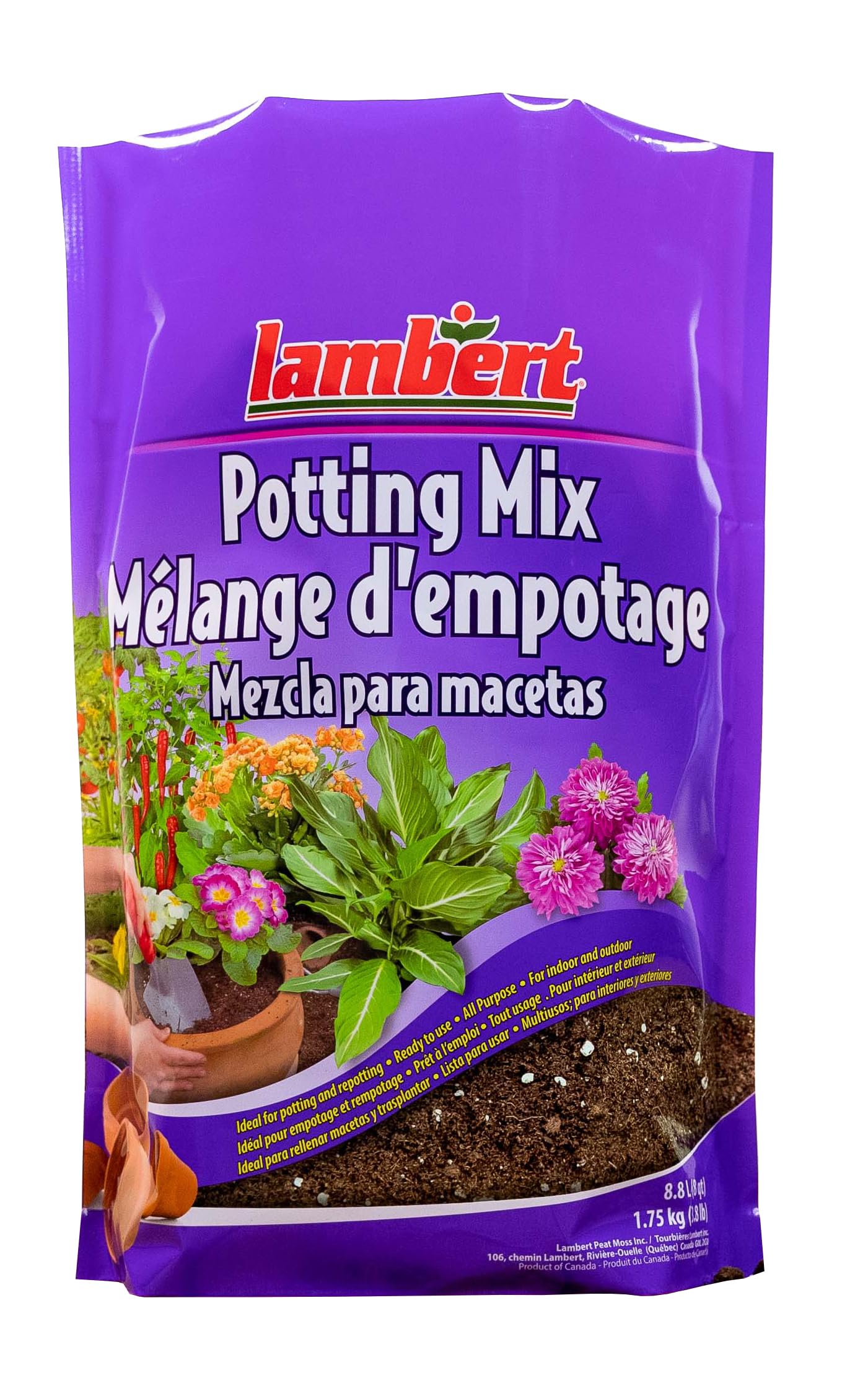
The all-purpose mix that brought one gardener’s lifeless houseplants back in a weekend.
Lambert’s potting mix is a ready-to-use peat moss and perlite blend that covers almost any container plant — flowers, vegetables, shrubs, annuals, perennials, indoors or out. One buyer shared a vivid story: “I repotted my houseplants as they were weak and hanging lifeless. I watered and went out for the New Year’s weekend, and when I got home, WOW! My plants came to life and are thriving!” That kind of turnaround is exactly what you want when transplanting struggling vegetables or herbs. The texture is light and well-draining, and reviewers consistently called it “clean and consistent” with no cheap fillers.
The catch is that this mix relies primarily on peat moss and perlite for its structure, which means it does not come with a rich nutrient load built in. For long-term container vegetables, you will likely need to add compost or a slow-release fertilizer after a few weeks — otherwise your hungry tomato plants may run out of food. One reviewer who used it for seed starting noted it “needs sifting for tiny seeds” because there can be some larger debris. But as a light, airy base soil that gets roots moving quickly, this is a very reliable option.
Clean and airy: The peat-perlite mix drains freely and stays loose, which roots love. The eco-friendly positioning is a bonus.
The asterisk: It is a base mix, not a full-meal deal — plan to supplement with fertilizer for vegetables that will live in the pot for months.
Best for: gardeners who want a simple, reliable, well-draining base mix and prefer to control their own nutrient additions (compost, worm castings, liquid feed).
Not ideal if: you want an all-in-one soil that feeds your vegetables from bag to harvest without extra amendments.
5. Back to the Roots All-Purpose Potting Mix (2-Pack, 6 Quarts each)
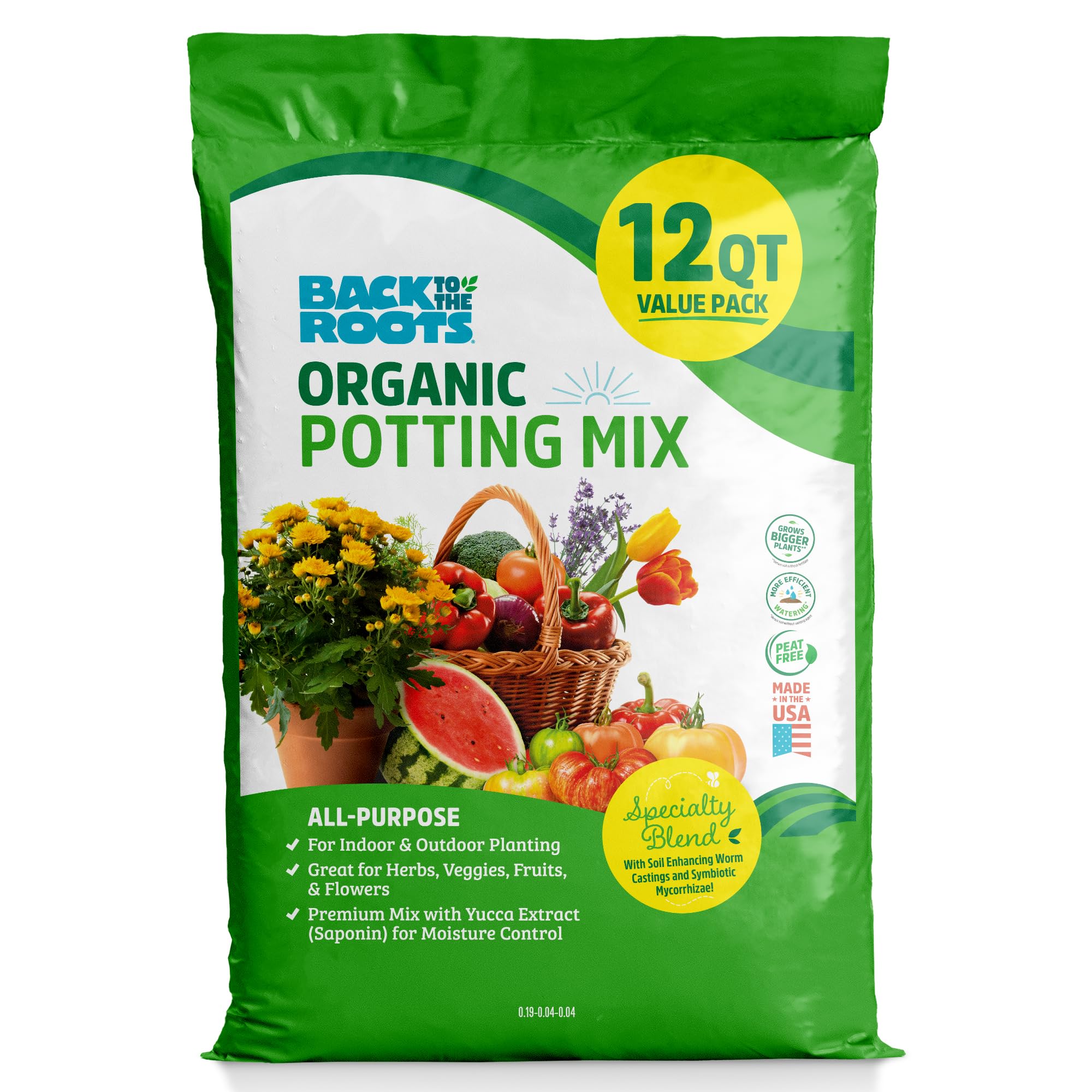
The first major peat-free potting mix that swaps mined peat for coconut coir and worm castings.
Back to the Roots makes a strong environmental argument: mined peatlands contribute yearly CO2 emissions equivalent to what cars worldwide release, so this mix replaces sphagnum peat with coconut coir (shredded coconut husk fibers that hold water well) and adds yucca extract (a natural wetting agent that helps the soil absorb water evenly) plus mycorrhizae to boost root uptake. It also includes pH-balancing dolomitic limestone to neutralize acidity. At 4.4 pounds for the 2-pack, it is noticeably heavier than the Useful Universe 8-quart bag at 3.85 pounds — a 14% weight gap that reflects its denser, nutrient-rich composition. One customer observed buying it three times already for 24 pots, calling it “great value.”
The honest feedback from reviewers is that this soil has large bark particles, making it “unsuitable for seedlings” according to one buyer, but “great for tomatoes” and transplanting larger plants. If you are starting seeds in tiny cells, you may want to sift the soil or use a finer seed-starting mix instead. But for established vegetable transplants placed into medium to large containers, this peat-free formula performs well and aligns with eco-conscious gardening values.
Reasons to consider
- 100% peat-free — an environmental advantage over standard mixes
- Includes yucca extract, mycorrhizae, and coconut coir for moisture and root health
- Dolomitic limestone keeps pH balanced for vegetables
Real-world note
- Large bark chunks make it poor for fine seed starting without sifting
- May feel too chunky for gardeners who prefer a finer, more consistent texture
Reach for this if: avoiding peat is a priority for you, or you transplant established vegetable starts into medium-large pots and want a naturally enriched organic mix.
Look elsewhere if: you mostly start vegetables from seed in small trays — the bark pieces will be a hassle.
6. Useful Universe Organic Potting Mix Soil (8 Quarts)

The low-cost, lightweight mix that works best as a soil conditioner or for quick transplants.
At 3.85 pounds for 8 quarts, this is the lightest mix in the lineup — a 14% weight difference vs the Back to the Roots 2-pack (4.4 pounds), which means it is mostly made of fluffy organic matter like shredded bark and decomposed leaves. Reviewers describe it as “soft and light” and note that it is “easy to use.” One buyer even said it worked well for growing cat grass. The price point makes it an entry-level option for someone who needs to fill a couple of cheap pots quickly without spending much.
The catch is significant for vegetable growers. Multiple reviews point out that this mix “not keeps water inside of soil” — one buyer warned “You can’t care of plants, if you are not hoy for couple of days,” meaning if you skip a watering in hot weather, the soil dries out fast and the plants suffer. Another reviewer described it as appearing “like pulverized tree leaves and dirt” and called it a “decent soil conditioner” rather than a standalone potting mix. If you buy this, plan to mix it with a water-retaining component like coconut coir or add a bit of standard potting soil — and be ready to water more frequently than you would with a denser mix.
Decent value for the budget: It is cheap and lightweight, which works for quick projects or as a soil loosener to mix into heavier earth.
The critical weakness: Water runs through it too fast for most container vegetables — you will have to water every day in warm weather or add ingredients that hold moisture longer.
Works best for: gardeners on a tight budget who are okay amending the soil themselves with water-retaining ingredients, or who are using it as a top-dressing or soil conditioner rather than a primary growing medium.
Avoid this if: you want an easy plug-and-play mix for thirsty vegetables like tomatoes, peppers, or cucumbers — the texture will leave you struggling to keep them hydrated.
Understanding the Specs
Volume (Quarts & Cubic Feet)
The bag size tells you how many containers you can fill. An 8-quart bag (about 0.3 cubic feet) typically fills two to three medium pots (10 to 12 inches across). A 2-cubic-foot bag — like the large Espoma — holds roughly 60 quarts, enough for multiple large containers or a small raised bed. Always check the volume in quarts or cubic feet rather than the bag weight, because moisture content can make a heavy bag misleading.
Organic vs Conventional Fertilizer
Organic mixes use natural ingredients like worm castings (worm waste packed with microbes), alfalfa meal, kelp meal, or feather meal to feed plants slowly as microbes break them down. Conventional mixes like Miracle-Gro add synthetic slow-release fertilizer salts that feed plants immediately and last a set number of months. Neither is “better” — but organic soils are gentler on soil life and the environment, while conventional mixes give more predictable, controlled feeding for beginners.
FAQ
Can I use garden soil instead of potting mix for container vegetables?
How much potting mix do I need per container?
How do I know if a potting mix drains well enough?
Should I add fertilizer to potting mix right away?
Is peat-free potting mix better for the environment?
What does “mycorrhizae” do in potting soil?
Can I reuse potting mix from last season for new vegetables?
Why does some potting mix come very dry and hard to wet?
Final Thoughts: The Verdict
Across the board, the best container vegetable soil winner is the Espoma Organic Potting Soil Mix in the 2-cubic-foot bag because it combines a proven organic recipe, a rich mycorrhizae blend, and enough volume to handle a real container garden without running out after two pots. If you want long-term feeding without thinking about fertilizer, grab the Miracle-Gro Potting Mix 3-Pack. And for the eco-conscious grower who wants to skip peat entirely, the Back to the Roots All-Purpose Mix is the peat-free way to go, as long as you avoid it for fine seed starting.
How We Picked
We do not accept paid placement, and we did not hands-on test every unit. Instead, we match each pick to a real buyer and use-case by comparing the manufacturers’ published specifications against the patterns in verified customer reviews — so you get each pick’s real strengths and trade-offs instead of marketing copy.
Sources & Methodology
Specifications: manufacturer listings and product documentation. Review insights: verified customer reviews, as of July 2026. Pricing: not shown on this page (it changes often); check the current price via the retailer link.
As an Amazon Associate, Lawn Gear Lab earns from qualifying purchases. This does not affect which products we feature.