
Specs are compiled from manufacturer listings and verified buyer reviews and can change over time — please confirm the key details on the product page before buying.
Hard, compacted clay soil that turns into concrete when dry and soup when wet is a real headache. You want to grow a great lawn or a productive vegetable garden, but the soil just doesn’t cooperate. The right amendment — like gypsum or a specialized soil food — works by physically loosening that dense clay, so air, water, and roots can finally move through. This guide picks the six best options, each backed by real specs and verified buyer experience.
I’m Rikta — the founder and writer behind Lawn Gear Lab. This guide is built by comparing the manufacturers’ published specifications and the patterns across verified customer reviews, so you get each pick’s real strengths and trade-offs instead of marketing spin.
We dug into the numbers — from purity percentages to coverage area — and cross-referenced them with actual buyer experiences to find the best amendment for clay soil that delivers visible results without breaking your back or the bank.
Quick Picks
- 97% Pure Gypsum Powder – High Solubility Calcium Sulfate Dihydrate – 10 lb — Potent Purity
- Espoma Organic Garden Gypsum Soil Conditioner – 36 lb. Bag — Massive Coverage
- Jonathan Green (12191) Love Your Soil – 54 lb Bag — Soil Revitalizer
- Earth Science Fast Acting Gypsum Granules – 5 lb — Best Overall
- Organic Gypsum Powder 10LB – Cz Garden Supply — OMRI Listed
- Greenway Biotech Organic Gypsum Powder – 2 Pounds — Specialty Fix
How To Choose The Best Amendment For Clay Soil
The single biggest mistake is assuming all clay soil amendments work the same way. Some fix a specific nutrient problem, while others are broad-spectrum soil conditioners. Your choice depends on your primary goal: are you trying to break up hardpan clay, fix blossom end rot on your tomatoes, or feed a lawn across a large area?
Item Form: Powder vs. Granules
Powders, like the Greenway Biotech or Olympus Myco options, dissolve fast in water and work well for drenching individual plants or mixing into a fertigation system (a method of injecting fertilizer into your irrigation water). Granules and pellets, like the Earth Science or Espoma picks, are easier to spread with a broadcast spreader across a whole lawn and break down more slowly over weeks.
Purity and Active Ingredients
The key ingredient in gypsum is calcium sulfate dihydrate. Some products, like the 97% Pure Gypsum Powder from Olympus Myco, list a 97% purity alongside specific calcium (around 22.5%) and sulfur (18%) content. Higher purity means less filler and faster results for your clay soil.
Coverage and Quantity
A 2-pound bag is perfect for a small vegetable patch or a few potted plants, while a 36-pound bag from Espoma covers a larger area of heavy clay. For massive lawns, the Jonathan Green option covers 15,000 sq. ft. Choose the unit count that fits the scale of your garden or lawn to avoid running out mid-project.
Specific Use Case: Lawn vs. Garden
If you are growing vegetables and fighting blossom end rot (a black, leathery spot on the bottom of tomatoes and peppers caused by a calcium deficiency), you need a gypsum that provides a quick calcium boost. For general lawn health, a product with “Nutri-Bond” technology or microbial stimulants, like the Earth Science or Jonathan Green picks, might be a better fit.
Quick Comparison
On smaller screens, swipe sideways to see the full table.
| Model | Best For | Item Form | Item Weight | Coverage / Unit Count | Amazon |
|---|---|---|---|---|---|
| Earth Science Fast Acting Gypsum | Loosening clay and reducing nutrient runoff | Granules | 5 Pounds | 80.0 Ounce | Amazon |
| Greenway Biotech Organic Gypsum | Targeted calcium boost for vegetables | Powder | 2 Pounds | 32 Ounce | Amazon |
| Cz Garden Organic Gypsum Powder | Organic gardening and mushroom cultivation | Powder | 10 Pounds | 160.0 Ounce | Amazon |
| Olympus Myco 97% Pure Gypsum | High-purity soil and substrate amendment | Powder | 10 Pounds | 160.0 Ounce | Amazon |
| Espoma Organic Garden Gypsum | Large-scale lawn and garden clay breaking | Granules | 36 lb. | — | Amazon |
| Jonathan Green Love Your Soil | Massive lawn area coverage and microbial health | Powder | 55 Pounds | 15,000 Sq. Ft. | Amazon |
In‑Depth Reviews
1. 97% Pure Gypsum Powder – High Solubility Calcium Sulfate Dihydrate – 10 lb

This 97%-pure gypsum powder flushes salt out of clay and feeds calcium to picky plants like tomatoes and avocado trees.
If your clay soil has a high salt buildup from too much fertilizer or poor irrigation, you need a powerful flush of calcium. This Olympus Myco gypsum powder is 97% pure calcium sulfate dihydrate and comes in a 10-pound bag that doubles as a go-to for mushroom growers who need a clean substrate. Unlike the Greenway Biotech 2-pound bag, this offers a massive 5.0x jump in unit count (160 Ounce vs 32 Ounce), so you have plenty for a larger garden.
One reviewer noted that the powder “effectively fixed salt buildup in avocado trees in planters,” noticing that after weeks the brown leaves dropped and new green growth appeared. It is a solution-grade powder, meaning it dissolves faster than chunky pellets to start improving soil structure right away.
The catch? This is gypsum with zero extras — no microbial stimulants or added binders. It is a pure mineral amendment, so it is best if you know exactly what your soil chemistry needs. For a general lawn feed that also stimulates biology, you would want the Jonathan Green option instead.
The Strong Points
- 97% high-solubility purity for fast results
- Versatile: works in soil and for mushroom substrate
- 10 pounds gives you excellent value for the coverage
Consider This
- Does not include organic fillers or additional soil conditioners
- Powder form may be dusty to handle in windy conditions
Reach for this if: you have a salt-affected clay soil or are serious about mushroom cultivation and want a reliable, high-purity ingredient from a brand that packages it in a HEPA enclosure.
Look elsewhere if: you want a single-product “fix-all” lawn conditioner with added microbes or wetting agents.
2. Espoma Organic Garden Gypsum Soil Conditioner – 36 lb. Bag
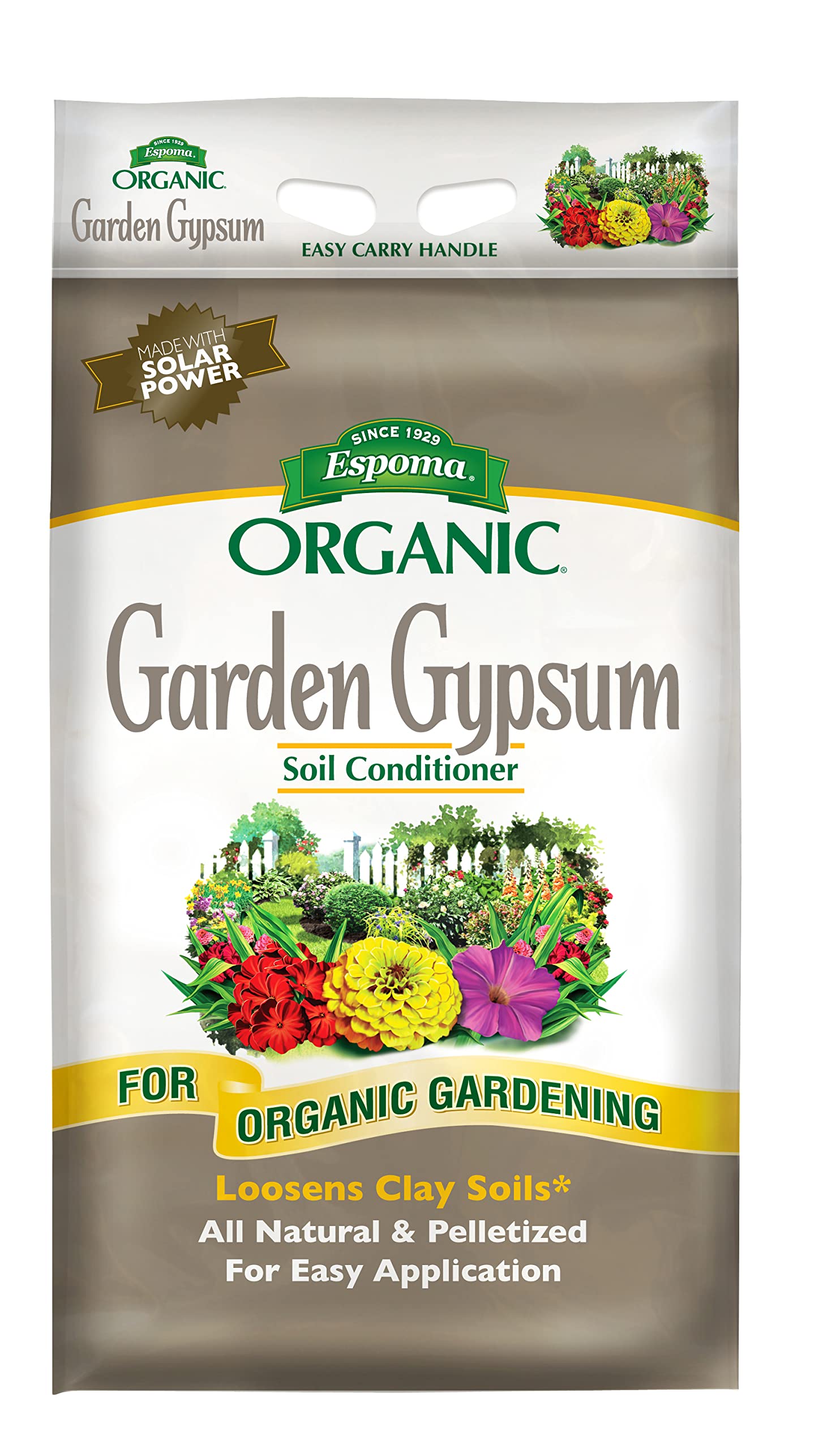
A 36 lb. bag of pelletized, all-natural gypsum for the patient gardener with a big lawn or multiple beds.
Espoma has been the go-to for natural organic gardening since 1929, and their 36-pound bag is the pick for anyone with a big lawn or multiple garden beds. It is pelletized mined gypsum with no fillers or additives, so you can spread it easily with a broadcast spreader. Buyers report that after a year of use, the heavy red clay soil becomes “much easier to work.” It is a slower process than the Earth Science granules, but the scale is aimed at the long haul.
This product is approved for organic gardening and is made in the USA. Reviewers specifically note it helps with “turf burns from winter ice-milter salts” and pet spots. Unlike the Jonathan Green product, which focuses on microbial stimulation, this is a pure gypsum approach that aims to physically soften the clay structure itself.
The main trade-off mentioned in reviews is speed; because it is a pelletized mined product, it doesn’t dissolve into the soil as fast as a powder. One buyer mentioned it took “a year or so” to fully notice the clay breaking down, so patience is key.
What Works
- 100% all-natural mined gypsum with no synthetic additives
- Large 36 lb bag suitable for extensive planting areas
- Pelletized form is easy to use with standard spreaders
What to Know
- Slow acting compared to a soluble powder or fine granule
- Delivery times from third-party sellers were reported as inconsistent
Grab it for: your entire lawn or a large garden if you are willing to apply it year after year for steady, lasting improvement.
skip it if: you need a quick fix for a single season or a small container garden where a 2lb bag is more practical.
3. Jonathan Green (12191) Love Your Soil – 54 lb Bag

This soil food feeds microbes to break up clay from the inside, and a single 55-pound bag covers up to 15,000 square feet.
Unlike the pure gypsum approaches above, this Jonathan Green product is a “soil food” that stimulates microbial life. It does not just add calcium; it actively encourages the tiny organisms in your soil to create a humus reserve (a rich, spongy layer of organic matter) that makes the soil more porous. For a half-acre lawn, one owner reported it “saved me over a thousand dollars by restoring my clay-infested lawn” after two or three applications.
This 55-pound bag covers up to 15,000 square feet, making it the single biggest coverage option in this list. It also helps increase drought resistance by improving root penetration and release nutrients trapped in the soil. Unlike the Earth Science granules, this is a powder and is designed to be spread with a drop or rotary spreader.
One important buyer note: the bag instructions for the spreader setting were reportedly wrong. Users found a “4 setting with the Scotts Mini Edge Guard rotary spreader” worked better than the suggested setting, and the product still ran out faster than expected on the initial pass.
Major Benefits
- Loosens hard, compacted soil while feeding beneficial microbes
- Excellent coverage of up to 15,000 sq. ft. per bag
- Improves root mass and drought resistance over time
Keep in Mind
- Spreader settings on the bag may be inaccurate
- Premium-level price for a single application
Choose this if: you are managing a big lawn and want a comprehensive solution that fixes the soil’s biology, not just the mineral composition.
Pick something else if: you only have a small vegetable garden or need a very targeted calcium supplement for blossom end rot.
4. Earth Science Fast Acting Gypsum Granules – 5 lb
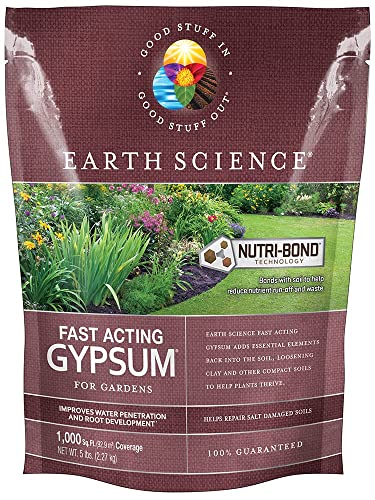
Fine, fast-dissolving granules that soften clay within weeks — and the built-in Nutri-Bond technology is claimed to reduce nutrient runoff by up to 50%.
If you need a clear winner for the average homeowner fighting a clay lawn, this is it. These fine, pelletized granules “start immediately to loosen clay,” according to the manufacturer, and they come with Nutri-Bond Technology that naturally bonds with soil to cut down nutrient run-off by up to 50%. Unlike the coarser Espoma pellets, owners mention these dissolve quickly, with one user noting they “effectively softened rock-hard clay from a sewer line trench, enabling grass to grow.”
The 5-pound bag is a manageable size for spot-treating problem areas or for a smaller lawn. It also adds calcium to fight blossom end rot, which is a nice bonus for garden beds nearby. Reviewers consistently mention it is safe for kids and pets to walk on immediately after application.
While it is more expensive per pound than the big Espoma bag, the speed of action is the real advantage here. Customers note seeing “improved water penetration and workability within weeks,” whereas the mined Espoma pellets can take a year to fully break down.
Why It Earns Top Spot
- Nutri-Bond technology reduces nutrient runoff by up to 50%
- Granules dissolve quickly for fast clay softening
- Safe for immediate use with kids and pets
The One Downside
- Only 5 lbs may be insufficient for a very large lawn
Perfect for: the DIY homeowner who wants a fast, visible improvement in their clay soil’s drainage and workability without waiting a full season.
Not ideal for: a massive, multi-acre property where a 36 lb bag or 15,000 sq. ft. coverage product makes more sense economically.
5. Organic Gypsum Powder 10LB – Cz Garden Supply

An OMRI-listed (Organic Materials Review Institute) gypsum powder that cures blossom end rot, and a 10-pound resealable pouch gives you 5.0x more product than the Greenway Biotech 2lb bag for a similar cost.
For organic gardeners, the OMRI listing (Organic Materials Review Institute) is a green light. This Cz Garden Supply gypsum is calcium sulfate dihydrate specifically designed to “cures Blossom End Rot” — a black, sunken spot on the bottom of tomatoes and peppers. One customer observed “quick results after mixing 1-2 oz/gal for a soil drench,” confirming it works for calcium deficiency.
This 10-pound bag comes in a heavy duty resealable pouch, making it easy to store for months between applications. Compared to the Greenway Biotech pick, this is a 5.0x larger unit count (160.0 Ounce vs 32 Ounce) for a similar price bracket, giving you far more product for the money. It is also pH neutral, meaning unlike lime, it will not raise the pH of your already-alkaline clay soil.
The main consideration is that this is a pure gypsum powder — it does not contain any of the Nutri-Bond technology of the Earth Science granules or the microbial stimulants of the Jonathan Green product. It is a straightforward mineral fix.
What We Like
- OMRI listed for certified organic production
- 10 lbs in a resealable pouch for convenient storage
- Specifically formulated to prevent blossom end rot in tomatoes
What We Don’t
- Powder can be messy to mix and apply without a spreader
- No added soil conditioners; it is a single-ingredient mineral
Best suited for: the dedicated organic gardener or mushroom cultivator who needs an OMRI-listed calcium source and values a larger quantity for the price.
Pass if: you are strictly a lawn-care person looking for a broad-spectrum soil amendment that also feeds microbes.
6. Greenway Biotech Organic Gypsum Powder – 2 Pounds

A 97%-pure, solution-grade powder (22.5% calcium and 18% sulfur) made for precise soil drenches on a handful of calcium-starved vegetables.
If you are fighting blossom end rot on a few tomato plants or need a calcium boost for a small raised bed, this 2-pound bag is the right scale. It is 97% pure calcium sulfate dihydrate with 22.5% calcium and 18% sulfur, making it a concentrated supplement. Reviewers point out they “mixed in water to add to plants like Tomatoes, Squash, Pumpkins, Corn, Peppers, Okra and Zucchini” suffering from end rot.
Unlike the Earth Science granules which spread across the lawn, this is a powder designed for a soil drench or fertigation system (where you mix it with water and apply it through your watering system). It is pH neutral, meaning it won’t mess with the chemistry of your soil the way lime would. It is also trusted by commercial farmers and greenhouse growers.
The downside is the small quantity. At 2 pounds (32 Ounce), it has 5.0x less product than the Cz Garden 10 lb bag, and several reviews mention the package sometimes arrives with a small hole. It is also not as fast-acting on general clay compaction as the pelletized Earth Science granules.
Strong Suits
- Solution-grade powder dissolves completely in water for drenching
- High purity at 97% with specific calcium and sulfur percentages
- Trusted by professionals for precise fertigation applications
Weaknesses
- Small 2-pound quantity is easily outmatched by other options
- Packaging may be prone to damage during shipping
Grab it for: quick-targeted care for a handful of calcium-deficient veggies or a small container garden where a large bag is overkill.
Look for a bigger bag if: you plan on amending a whole bed or lawn and don’t want to reorder frequently.
Understanding the Specs
Item Weight and Unit Count
These two numbers tell you how much amendment you are getting. A product measured in “Ounces” (like 80.0 Ounce or 160.0 Ounce) gives you a direct weight comparison. A 36 lb. bag covers far more area than a 5 lb. bag, but the trade off is manual handling. Shoppers say a 55-pound bag is a workout to carry from the car to the backyard, so plan your application schedule.
Item Form: Granules vs. Powder
Granules are small, pellet-like particles that you can spread with a broadcast spreader, ideal for lawns. Powders are finer and dissolve faster, making them better for mixing with water to create a soil drench for individual plants or fertigation systems. For general lawn use, granules are less dusty and easier to control. For vegetable garden spot-treatments, a water-soluble powder is more effective.
Mixing Ratio (N-P-K)
This is the ratio of Nitrogen-Phosphorus-Potassium. A ratio of 1:0:0 means the product is gypsum, which provides calcium and sulfur, but no significant nitrogen, phosphorus, or potassium. This is normal for a soil conditioner — you are not trying to fertilize the plants; you are fixing the clay structure itself. Do not confuse this with a balanced fertilizer.
Specific Uses For Product
A soil amendment is labeled for “Soil Conditioning” or “Plant Growth.” A product labeled for “Soil Conditioning” is designed to physically break up the clay structure and improve drainage. One labeled for “Plant Growth” may include additional nutrients or microbial stimulants. The specific use case should match your primary goal: lawn health vs. vegetable yield.
FAQ
How much gypsum should I apply to clay soil?
Will gypsum raise the pH of my alkaline clay soil?
How long does it take for gypsum to break up clay soil?
What is the difference between powdered gypsum and pelletized gypsum?
Can I use gypsum on my lawn in the summer?
Will gypsum hurt my earthworms or beneficial soil microbes?
Is gypsum safe for vegetable gardens and edible crops?
What is blossom end rot, and how does gypsum help?
Can I use too much gypsum on my clay soil?
How does gypsum compare to using sand or peat moss to amend clay?
Final Thoughts: The Verdict
If you want one dependable pick, the amendment for clay soil winner is the Earth Science Fast Acting Gypsum because it offers the best balance of speed, ease-of-use with a spreader, and the added benefit of Nutri-Bond technology to reduce nutrient waste. If you want a high-purity powder that also works for mushroom cultivation, grab the Olympus Myco 97% Pure Gypsum. And for a massive lawn where microbial health is the focus, the standout is the coverage of the Jonathan Green Love Your Soil.
How We Picked
We do not accept paid placement, and we did not hands-on test every unit. Instead, we match each pick to a real buyer and use-case by comparing the manufacturers’ published specifications against the patterns in verified customer reviews — so you get each pick’s real strengths and trade-offs instead of marketing copy.
Sources & Methodology
Specifications: manufacturer listings and product documentation. Review insights: verified customer reviews, as of July 2026. Pricing: not shown on this page (it changes often); check the current price via the retailer link.
As an Amazon Associate, Lawn Gear Lab earns from qualifying purchases. This does not affect which products we feature.