
Specs are compiled from manufacturer listings and verified buyer reviews and can change over time — please confirm the key details on the product page before buying.
Vines don’t just grow — they strangle, climb, and bury your yard until you can’t see the fence, tree, or garden underneath. The real question isn’t whether a spray will brown the leaves for a week; it’s whether the root dies so the vine never comes back.
I’m Rikta — the founder and writer behind Lawn Gear Lab. This guide is built by comparing the manufacturers’ published specifications and the patterns across verified customer reviews, so you get each pick’s real strengths and trade-offs instead of marketing spin.
Before you grab the first bottle on the shelf, you need to match the formula to the vine you are fighting — whether it is poison ivy creeping up a tree trunk or wild blackberry overtaking a fence line. This guide breaks down the best vine killer options on the market today.
Quick Picks
- Roundup Poison Ivy Plus Tough Brush Killer₂ Concentrate, 32 fl. oz. — Best Overall
- Ortho 0475010 MAX Poison Ivy & Tough Brush Killer Ready-To-Use, 24-Ounce — Top Performer
- Southern AG 01113 Brush Weed Killer, 1 Quart (32 oz) — Best Value
- Image Brush & Vine Killer Concentrate, 32 oz — Max Coverage
- PWBV-B-128-S, Brush & Vine Ready to Use Weed Killer, 128 oz — Bulk Ready-to-Use
- Bonide Vine & Stump Killer With Applicator Concentrate 8 Oz, 2 Pack — Cut‑Stump Specialist
- Southern Ag Brush Killer 8.8% Triclopyr, 1 Gallon — Acre‑Pro
How To Choose The Best Vine Killer
The right vine killer for your yard depends on what lives there, how you want to apply it, and whether you are protecting nearby plants. A poison ivy invasion needs a different approach than blackberry brambles choking a pasture. Here is what to weigh before you buy.
Active Ingredient Matters Most
Triclopyr is the standard for woody vines — it travels through the leaves into the root system and kills the whole plant. Many of the top picks in this guide use triclopyr alone or in a blend. Glyphosate works on general weeds but often fails against established vines like blackberry or kudzu. Check the active ingredient on the label before you buy.
Liquid Volume and Coverage
One quart (32 fluid ounces) of concentrate can cover 1,500 to 4,000 square feet depending on the brand. A ready-to-use spray is simpler — you just pull the trigger — but you burn through the bottle faster. If you have acres of brush, a concentrate you mix yourself stretches your dollar further.
Ready-to-Use vs Concentrate
Ready-to-use sprays are the easiest for small patches and spot treatments: no mixing, no measuring. Concentrates require a sprayer and clean water, but they let you dial up the strength for stubborn plants and cover much more ground per bottle. For a single cluster of poison ivy, go ready-to-use. For a fence line full of wild blackberry, grab a concentrate.
Quick Comparison
On smaller screens, swipe sideways to see the full table.
| Model | Best For | Liquid Volume | Active Ingredient | Coverage | Amazon |
|---|---|---|---|---|---|
| Roundup Poison Ivy Plus Tough Brush Killer₂ | Fast results on poison ivy | 32 fl. oz. | Triclopyr / Fluazifop / Diquat | 1,500 sq ft | Amazon |
| Ortho MAX Poison Ivy & Tough Brush Killer | Targeting 60+ weed types | 24 fl. oz. | Triclopyr | Non-selective | Amazon |
| Southern AG Brush Weed Killer | Blackberry & cherry control | 32 fl. oz. | Triclopyr | 512–1,024 sq ft/gal | Amazon |
| Image Brush & Vine Killer Concentrate | Big coverage for the price | 32 fl. oz. | Triclopyr | 4,000 sq ft | Amazon |
| Pulverize Brush & Vine Ready to Use | Large ready-to-use bottle | 128 fl. oz. | Maleic hydrazide | 1,000 sq ft | Amazon |
| Bonide Vine & Stump Killer Concentrate | Cut-stump precision | 8 fl. oz. (2-pack) | Sodium metabisulfite | Broadleaf & woody | Amazon |
| Southern Ag Brush Killer 8.8% Triclopyr | Ranch & acreage scale | 1 gallon (128 fl. oz.) | Triclopyr 8.8% | 4,096 sq ft | Amazon |
In‑Depth Reviews
1. Roundup Poison Ivy Plus Tough Brush Killer₂ Concentrate, 32 fl. oz.

A three-ingredient hitter that shows visible results in hours, not weeks.
This concentrate uses a blend of triclopyr (2.50%), fluazifop-P-butyl (2.00%), and diquat dibromide (1.50%) — a combination that hits the leaves fast and travels to the roots. At 32 fluid ounces it covers 1,500 square feet when mixed according to the label directions. Buyers report it “kills most plants with 1 application” and that tough plants like kudzu and wild blackberry need a follow-up spray.
You spray this around trees, fences, cabins, and freshly cut stumps. Rainproof in as fast as 30 minutes means you don’t lose the treatment if a shower rolls in after you finish. One reviewer living in a forest called it “the best stuff I’ve ever used” for keeping invasive brush under control.
The catch: 32 ounces of concentrate goes fast if you are tackling a full acre of poison ivy. Some buyers wished it came in a larger size — one ordered three bottles at a time to cover his acre and a half. Allow 1 to 30 days after application before you plant something new in that spot.
Speed demon: Visible results in hours and rainproof in 30 minutes make this the pick for when you want to see progress today.
One caveat: For large properties, the 32-ounce bottle means buying multiple units or finding a bulk alternative — it does not come in a gallon size.
Grab this if: You have poison ivy, poison oak, or kudzu invading a 1,500 square foot area and want a concentrate that works fast and stays on through rain.
Look elsewhere if: You need to cover acre‑scale brush — the bottle is too small to handle a large property in one mix.
2. Ortho 0475010 MAX Poison Ivy & Tough Brush Killer Ready-To-Use, 24-Ounce

The ready‑to‑use option that tackles over 60 weed types without mixing a drop.
Ortho MAX Poison Ivy & Tough Brush Killer ships as a ready-to-use spray — you twist the nozzle and go. It kills poison ivy, poison oak, kudzu, wild blackberries, and woody plants including stumps and vines. At 1.13 pounds per 24-ounce bottle, it is the lightest of the serious vine killers here and rainproof in 2 hours. Owners mention it is “highly effective against wild berry plants” and that it kills them in 4-5 weeks with one spray where Roundup previously failed.
Unlike the Roundup concentrate above, this one does not require a separate sprayer or any measuring — just point and spray onto the leaves. That makes it ideal for a quick spot treatment on a single poison ivy patch or a maple sapling popping up in a flower bed. One reviewer in Northern California noted it was 100% effective on poison oak, taking about 2 weeks for yellowing and about a month for full death.
Because it is non-selective broad-spectrum, you need to protect nearby plants with plastic or paper. The 24-ounce bottle is best for small-to-medium patches. For a sprawling blackberry field, you will run out fast.
Real‑world strengths
- No mixing, no measuring — spray straight from the bottle
- Kills woody brush and stumps, not just leafy weeds
- Proven against wild blackberry and poison ivy where other brands failed
The limits
- At 24 fluid ounces you cover less ground than a concentrate mix
- Non-selective means it damages any plant it touches — shield your garden
Perfect for: Small patches of poison ivy, poison oak, or stubborn wild berry where you want a grab‑and‑go solution with no prep work.
Skip if: You need to treat a large overgrown area — you will go through the bottle quickly and pay more per ounce than a concentrate.
3. Southern AG 01113 Brush Weed Killer, 1 Quart (32 oz)

The triclopyr concentrate that wilted blackberry leaves by sundown for buyers.
Southern AG Brush Weed Killer uses triclopyr as its single active ingredient — the same chemical that defines the high-end brush killers at a lower price than many competitors. At 32 fluid ounces (1 quart), it covers 512 to 1024 square feet per gallon when mixed. Customers note one memorable use: “applied in morning with full sun; leaves wilted by day’s end on blackberry and cherry; dead after a week.”
This product is designed for non-crop areas — roadsides, rangeland, pastures, and fences. It also prevents sprouting on clean-cut tree stumps, which makes it a two-in-one tool for clearing brush and keeping stumps from regrowing. One reviewer in Oregon said it took about two weeks for larger shrubs to dry and turn brown, but it did the job eventually.
The listed item weight is 9.6 ounces for the quart bottle, while the Image concentrate is listed at 2 pounds, and both hold 32 fluid ounces. That lighter weight and smaller physical footprint make it easier to store and carry to a remote fence line. Just note that the coverage is tighter than some alternatives: at 512 to 1,024 square feet per gallon, you need to be more targeted with your spraying.
Dollar‑wise chemistry: High triclopyr concentration equals the tough‑stuff performance of premium brands at a gentler price.
Trade‑off: Coverage per gallon is narrower than the Image concentrate so you spray more concentrated hits, not a wide sweep.
Grab this for: Blackberry and cherry thickets you want dead in a week, and stumps you want to stay dead — the triclopyr concentration does what cheaper general weed killers cannot.
Not for: Quick‑spraying a large open pasture — the 512‑1,024 sq ft per gallon range demands a more careful, targeted application.
4. Image Brush & Vine Killer Concentrate, 32 oz
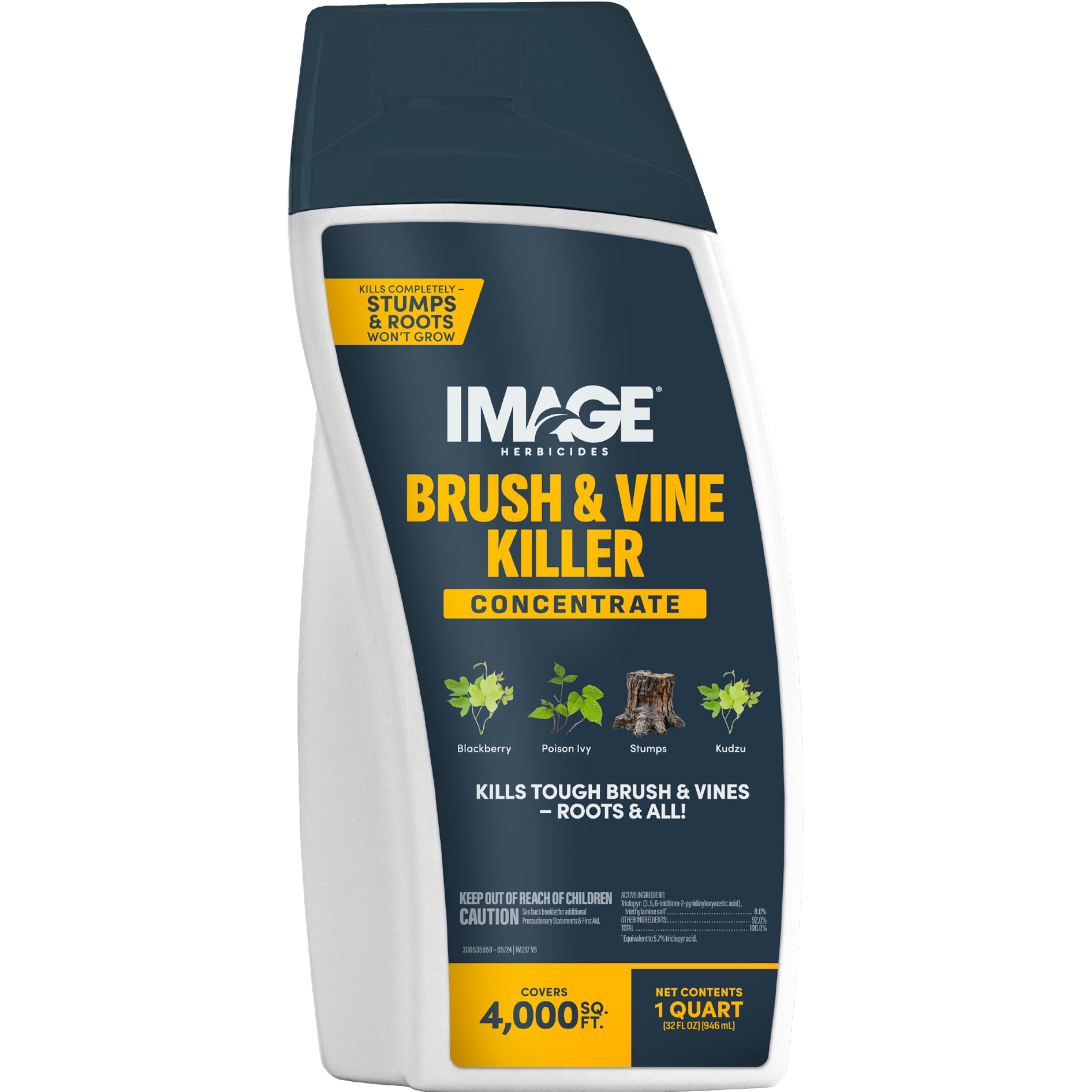
The 32‑ounce concentrate that stretches to 4,000 square feet — 2.6x more than the Roundup concentrate.
Image Brush & Vine Killer Concentrate covers 4,000 square feet from a single 32-ounce bottle, which is a huge gap vs the Roundup concentrate’s 1,500 square feet. That is a 2.6x advantage in coverage, making this the strongest buy for anyone clearing a large area on a budget. It targets poison ivy, poison oak, poison sumac, wild blackberry, and horsetail brush, killing roots and all so regrowth does not happen.
Reviewers point out it is “effective on poison ivy” with leaves beginning to brown in about one week. Some reviewers noted that you need to add a surfactant (like a squirt of dish soap) for it to work well on waxy leaves like kudzu. After adding a surfactant, one reviewer noted it did “a great job of killing the invasive kudzu” in their yard.
One experienced user tackling Himalayan blackberries on 2 acres used a strong mix (12 ounces per gallon) and killed vines in 2 weeks, where Roundup had previously failed. At the max dose of 1 cup per gallon, overspray can irritate your throat — wear long sleeves, pants, and a mask when mixing strong.
Why it stands out
- 4,000 sq ft coverage per 32 oz bottle — the widest reach in this lineup
- Kills roots so persistent woody vines do not regrow from underground
- Works on kudzu, blackberry, and poison ivy with a surfactant boost
Before you buy
- Requires a surfactant (dish soap) for full effectiveness on waxy‑leafed plants
- Strong mixes above label rates can cause throat irritation if inhaled
Best for: Large areas of kudzu, blackberry, or poison ivy where you want the most ground covered per bottle for the money.
Consider another if: You want a grab‑and‑go ready‑to‑use spray — this is a concentrate that needs a sprayer and a surfactant added.
5. PWBV-B-128-S, Brush & Vine Ready to Use Weed Killer, 128 oz

A full gallon of ready-to-use formula — no mixing, no pouring, just spray and walk.
At 128 fluid ounces, this is the largest ready-to-use bottle in the list — 16 times the volume of the Bonide concentrate (8 fluid ounces) and 5.3 times the size of the Ortho ready-to-use spray. You do not need a tank sprayer or measuring cup; the built-in sprayer attaches to the bottle and you start working. It uses maleic hydrazide as the active ingredient and covers 1,000 square feet straight from the bottle.
Shoppers say mixed results. One buyer mentioned it “destroyed the ivy in the front yard” after 4 thorough applications, with the ivy turning brown within a day and dying after they cut it back. Another reviewer found it did not work on English ivy at all — only temporarily browning the leaves — and noted that the sprayer stopped working early. A second buyer also reported the sprayer gave out partway through the bottle. English ivy is notoriously tough, and a few applications may not be enough for established ground cover.
For the price, this is a mid-range option that gives you a huge volume of pre-mixed chemical, but the inconsistent sprayer quality is a real gamble. If you buy it, keep a backup sprayer handy.
Volume champ: The largest ready‑to‑use bottle in this guide — enough to treat a whole yard without mixing a single batch.
The risk: sprayer reliability is hit‑or‑miss based on buyer reports; you may need a separate sprayer to finish the bottle.
Reach for this if: You hate mixing concentrate and want a full gallon of pre‑mixed spray you can hook up and start using right away.
Look elsewhere if: You are fighting English ivy specifically — buyer reports show inconsistent kill rates on that species — or if you want a guarantee the sprayer will last through the whole bottle.
6. Bonide Vine & Stump Killer With Applicator Concentrate 8 Oz, 2 Pack
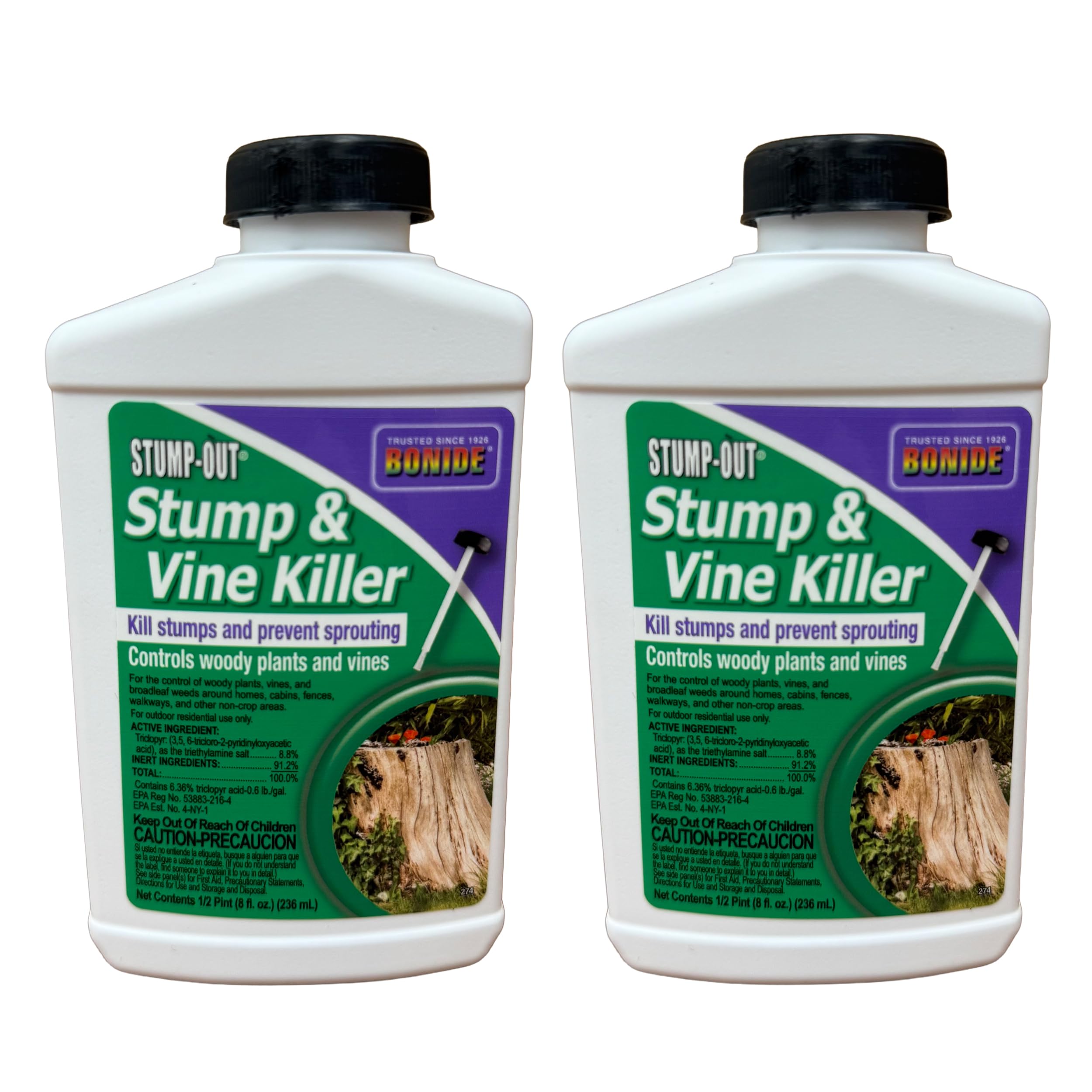
The brush‑on concentrate designed for snipped vines and fresh stumps, not leaf‑spraying.
This is a different tool from everything else here. Bonide Vine & Stump Killer is a 2-pack of 8-ounce concentrate bottles — 16 fluid ounces total — that you apply by snipping a vine or cutting a stump and then painting the cut end with the built-in applicator. The active ingredient is sodium metabisulfite, not triclopyr, so the chemistry works differently: it travels through the cut surface into the vascular system of the plant rather than being absorbed through leaves.
Buyers report it is “effective on raspberry/blackberry bushes after snipping and painting cut ends,” with leaves yellowing and tips browning within a few weeks. One owner reported the roots pulled easily from loose soil after the treatment. The targeted application means nearly zero drift onto desirable plants — you only treat what you cut. However, multiple buyers reported that one of the two bottles leaked in transit, causing a wet box and lost product. The total 16 fluid ounces is a 2.0x gap vs the Image concentrate’s 32 ounces, so you get half the liquid volume.
Expect some regrowth in spring — this product kills the treated stem well, but surrounding root systems may push up new shoots that need a second application.
Smart approach
- Zero overspray — you only touch the cut vine or stump
- Easy to use on vines wrapped around trees you want to keep
- Works well on raspberry and blackberry bushes
The downsides
- Very small bottle size — 8 ounces per bottle — for what it costs
- Multiple buyer reports of leaking bottles on arrival
Perfect for: Vines growing up a tree trunk or stump sprouts where spraying the whole plant is not possible or would harm the tree.
Not for: Broad patch spraying — you cannot treat leaf surfaces with this product; every application needs a fresh cut.
7. Southern Ag Brush Killer 8.8% Triclopyr, 1 Gallon

The largest triclopyr concentrate in this guide — one gallon covers 4,096 square feet.
This is the bulk-size option for serious brush control: 128 fluid ounces (1 gallon) of 8.8% triclopyr that covers 4,096 square feet. That is the same active ingredient as the Southern AG quart above but at a higher concentration and in a much larger volume. One customer observed using it at 4 ounces per gallon of water on ivy, sumac, and sassafras with excellent results, and at 8 ounces per gallon on yaupon (a tough woody shrub) to kill everything that absorbed it. Another review stated it “kills everything” — poison ivy, oak, sumac, and briars to the root — with visible results in 2-3 weeks and no regrowth seen after 8 months.
At 128 ounces, it weighs 128 ounces (8 pounds), making it the heaviest product in this guide. If you are mixing it yourself, you need a large tank sprayer and a place to store a gallon of liquid. That is a commitment, but for landowners with multiple acres of brush, it is the only option that does not force you to buy multiple small bottles.
There is a warning from a recent buyer who said the product “looks like water” at the max recommended dilution of 9 ounces per gallon and did nothing on their property. Another flagged that the gallon jug arrived with no labeling or directions. The inconsistency in quality control is a risk — some batches appear to be less effective than the one that earned the strong reviews.
Volume leader: At 4,096 square feet per gallon of concentrate, it outpaces the quart‑size triclopyr options for ranch‑scale work.
Quality concern: A small but notable set of recent reviews report weak performance and missing labels — quality control may vary by batch.
Grab this for: Multiple acres of poison ivy, sumac, yaupon, or briars where the cost and labor of buying small bottles would be prohibitive.
skip it if: You want consistent results on the first try — some batches may underperform, and missing labels make proper mixing guesswork.
Understanding the Specs
Triclopyr vs Glyphosate
Triclopyr is the active ingredient that defines a true vine killer — it is a selective herbicide that targets woody plants and broadleaf weeds without harming most grasses. Most of the picks here use triclopyr because it travels through the leaf surface into the root system and kills the whole plant, including underground growth that would otherwise resprout. Glyphosate (the chemical in standard Roundup) kills many plants on contact but often fails on established woody vines like wild blackberry and kudzu because the root system survives and pushes new growth within weeks.
Liquid Volume and Coverage
Liquid volume is measured in fluid ounces (or gallons for larger bottles). A 32-ounce concentrate might cover 1,500 to 4,000 square feet depending on the brand’s dilution ratio. Ready-to-use sprays like the Ortho 24-ounce bottle cover less ground per bottle because you are spraying a pre-mixed solution. The rule of thumb: higher liquid volume plus higher concentration equals more total coverage. Check the manufacturer’s “Coverage” spec — it tells you how many square feet a single bottle treats at the recommended mix rate.
FAQ
Will vinegar kill poison ivy roots?
How long does it take for a vine killer to work?
Can I spray vine killer on English ivy?
Should I use a ready-to-use spray or a concentrate?
Will vine killer kill nearby grass or trees?
What is the best time of year to apply a vine killer?
Is triclopyr safe for pets after it dries?
Can I use a vine killer on kudzu?
Why do some vine killers need a surfactant?
How do I apply a cut-stump vine killer?
Final Thoughts: The Verdict
For most buyers, the best vine killer winner is the Roundup Poison Ivy Plus Tough Brush Killer₂ Concentrate, 32 fl. oz. because its three-ingredient blend (triclopyr + fluazifop + diquat) delivers visible results in hours and stands up to rain in 30 minutes — crucial for anyone fighting poison ivy or kudzu without perfect weather. If you want maximum coverage from a single bottle, grab the Image Brush & Vine Killer Concentrate, 32 oz with its 4,000 square foot reach. And for precise cut-stump work on vines wrapped around trees you want to keep, the standout is the Bonide Vine & Stump Killer With Applicator Concentrate 8 Oz, 2 Pack.
How We Picked
We do not accept paid placement, and we did not hands-on test every unit. Instead, we match each pick to a real buyer and use-case by comparing the manufacturers’ published specifications against the patterns in verified customer reviews — so you get each pick’s real strengths and trade-offs instead of marketing copy.
Sources & Methodology
Specifications: manufacturer listings and product documentation. Review insights: verified customer reviews, as of July 2026. Pricing: not shown on this page (it changes often); check the current price via the retailer link.
As an Amazon Associate, Lawn Gear Lab earns from qualifying purchases. This does not affect which products we feature.