
Specs are compiled from manufacturer listings and verified buyer reviews and can change over time — please confirm the key details on the product page before buying.
If you’ve ever yanked a pull cord until your shoulder aches, only to have the engine cough once and die, you know the real pain a self-propelled mower is supposed to solve. The right pick should start on the first try, pull itself across your lawn, and leave you with a clean cut — not a sore back and a half-hour wrestling match.
I’m Rikta — the founder and writer behind Lawn Gear Lab. This guide is built by comparing the manufacturers’ published specifications and the patterns across verified customer reviews, so you get each pick’s real strengths and trade-offs instead of marketing spin.
Whether your yard is a small city lot or a sloped half-acre, here is everything you need to find the best self-propelled lawn mower that actually matches your grass, your terrain, and your patience.
Quick Picks
- EGO POWER+ LM2135SP — Best Overall
- Greenworks 80V 21″ MO80L416 — Premium Pick
- SKIL PWR CORE 40 SM4910C-11 — Best Value Electric
- YARDMAX YG2860 — Best for Hills
- PowerSmart DB8622S — Budget Champion
- SENIX 21″ FWD A025054-A — Solid Flat-Yard Pick
- SENIX R-H6 22″ RWD — Variable Speed for Hills
- BILT HARD 21″ 201cc — Budget 201cc Gas
How To Choose The Best Self-Propelled Lawn Mower
You need a self-propelled mower that matches your yard’s slope, your grass type, and whether you prefer gas or battery power. Here is what matters most.
Drive System: Front-Wheel vs. Rear-Wheel
A front-wheel drive (FWD) mower pulls itself forward, which makes it easier to pivot around flower beds and trees. This works best on flat to gently rolling yards. Rear-wheel drive (RWD) pushes from behind, giving you better traction on hills and slopes because the weight of the mower sits over the drive wheels. If your yard has a noticeable slope, RWD is the safer, less frustrating choice.
Engine Power vs. Battery Power
Gas mowers are measured by engine displacement (cc’s). A 170cc engine is fine for a quarter-acre of regular grass, while a 200cc-plus engine handles taller, thicker grass without bogging down. Battery-powered mowers are rated by voltage and amp-hours (Ah). Higher voltage, like 56V or 80V, means more cutting torque, while higher Ah means longer runtime. A 4.0Ah battery typically handles a third of an acre on a single charge, but thick or wet grass drains it faster.
Cutting Width and Deck Material
Wider decks (21 to 22 inches) mean fewer passes across the yard, which saves you time. Steel decks are more durable and handle rough use better than plastic or stamped steel, but they add weight. If you have a small yard with narrow gates, a 20-inch deck is easier to maneuver and store.
Quick Comparison
On smaller screens, swipe sideways to see the full table.
| Model | Best For | Engine / Power | Cutting Width | Drive Type | Amazon |
|---|---|---|---|---|---|
| EGO Power+ LM2135SP | Premium Battery Performance | 56V Brushless | 21 Inches | RWD (Touch Drive) | Amazon |
| Greenworks 80V MO80L416 | Quiet Power on Hills | 80V Brushless | 21 Inches | RWD (Variable Speed) | Amazon |
| SKIL SM4910C-11 | Best Value Electric | 40V Brushless | 20 Inches | FWD (Variable Speed) | Amazon |
| YARDMAX YG2860 | Tough, Hilly Yards | 201cc Gas | 22 Inches | FWD (6-Speed CVT) | Amazon |
| PowerSmart DB8622S | Budget Gas Runner-Up | 170cc Gas | 22 Inches | RWD | Amazon |
| SENIX A025054-A | Flat Yard Value | 170cc Gas | 21 Inches | FWD | Amazon |
| SENIX R-H6 | Variable Speed on Hills | 201cc Gas | 22 Inches | RWD (Variable Speed) | Amazon |
| BILT HARD 21″ 201cc | Lowest-Price 201cc | 201cc Gas | 21 Inches | RWD | Amazon |
In‑Depth Reviews
1. EGO POWER+ LM2135SP

The battery champ that leaves gas mowers in the dust, with a second battery thrown in.
This EGO mower is built for people who want gas-level cutting torque without the pull cord. Its brushless motor delivers up to 7.0 ft-lbs of torque, which the maker says exceeds gas performance. You get an extra 5.0Ah battery alongside the included 7.5Ah battery, meaning you can mow a half-acre without stopping to recharge — one reviewer noted their whole yard took a bit over an hour between two batteries. The Touch Drive self-propel system responds to your palm, and you scroll a dial to change speed on the fly, so you never need a lever.
The Select Cut multi-blade system lets you swap lower blades for mulching, high-lift bagging, or extended runtime, which is unique at this price. With 8 height positions from 1 to 4 inches, you can dial in everything from a close crop to a meadow cut.
Buyers report it is quiet, holds charge well, and the self-propel handles steep hills fine — though one noted the self-propel sometimes doesn’t engage on the first try. The mulch quality is good, but some mention it may leave a few straggler blades compared to a gas mower’s cut. If you already own other EGO 56V tools, the batteries swap between them.
Why it Leads the Pack
- Dual-battery bundle (7.5Ah + 5.0Ah) gives enough runtime for a half-acre yard plus other EGO tools.
- Select Cut blade system lets you swap between mulching, bagging, and extended-run blades without buying extra parts.
- Touch Drive self-propel with a scroll dial adjusts speed while you mow.
The Trade-Offs
- Self-propel may not always engage on the first press when starting.
- Owners mention bagging leaves some stray blades in tall grass.
Best for: Anyone with a quarter- to half-acre yard who wants gas-grade torque without the maintenance and fumes, and who appreciates a second battery included.
Think twice if: You have an acre or more — you’ll likely need a third battery to finish in one go.
2. Greenworks 80V 21″ MO80L416

An 80-volt powerhouse that is three times quieter than gas and cuts like one.
If you want battery power that rivals a gas engine without the noise, this Greenworks mower delivers. Its 80V brushless motor (an electric motor with no brushes for longer life) and 21-inch steel deck give it enough torque for thick grass, and rear-wheel drive with variable speed keeps it stable on hills. The battery is a 4.0Ah pack (amp-hour, a measure of energy storage), and the maker says it covers up to half an acre on a full charge — one buyer with a 20-minute yard noted it used only a quarter of the battery per mow.
Unlike the SKIL mower (which has a 20-inch deck and 7 height positions), this one comes with a 21-inch deck and those same 7 height positions, meaning you shave a pass off your routine. It also has built-in LED headlights for early morning or evening cuts — a feature you don’t see on most battery mowers. The 4-in-1 system adds a turbo leaf pickup mode on top of the standard mulch, bag, and side discharge options. Buyers rave about how quiet it is, saying neighbors can’t even hear it running.
The main caveat is that the self-propel system locks the wheels when you turn, so you have to disengage it early or wrestle the mower around a corner. Mulch quality is only adequate, not great. But if you want a nearly silent mow with zero gas or oil, and you like the idea of using the same batteries in Greenworks 80V trimmers and blowers, this is a serious contender.
Quiet power: The 80V system gives you gas-mower-like cutting torque at a volume buyers describe as barely noticeable to neighbors.
Turning drawback: The self-propel locks the wheels when pivoting, so you must disengage it before you turn or it fights you.
Reach for this if: You want an ultra-quiet mow with the highest voltage in cordless lawn mowers and a durable steel deck.
Look elsewhere if: Your yard has tight obstacles that require frequent sharp turns — the locked-wheel turning can be frustrating.
3. SKIL PWR CORE 40 SM4910C-11

A light, quiet electric mower with a battery that outlasts a front-and-back-yard mow.
This SKIL mower is the electric option that doesn’t demand a premium budget. It runs on a 40V brushless motor with a 6.0Ah battery, and customers note the battery lasts about an hour — enough for both a front and back yard on a single charge. The variable-speed self-propel is front-wheel drive, making it nimble around trees and beds, and you control the speed with a simple lever. Push-button start means no pull cord at all.
With a 20-inch cutting deck and 7 height settings from 1.5 to 4 inches, it covers most small-to-medium yards. That is one more height position than the PowerSmart gas mower (which offers 6), giving you more precision for fine-tuning. The 3-in-1 system handles bagging, mulching, and rear discharge. One buyer with a small 16×70-foot lawn said the battery lasted six separate mows per charge — impressive for a 40V system. It folds and stores vertically without taking up much garage space.
The downside? It struggles to cut very short mossy grass cleanly, and the self-propel drive is louder than the motor itself. It’s also a 20-inch deck, so it takes more passes than a 22-inch mower like the YARDMAX.
What Buys You the Most
- Battery lasts roughly an hour of real mowing, which reviewers point out handles front and back yards easily.
- Folding telescoping handle and vertical storage make it compact for small garages or sheds.
- 7 height settings give you fine-grained control from 1.5 to 4 inches.
What You Give Up
- The 20-inch deck is the narrowest among the electric picks here, meaning more edge passes.
- Does not cut very short mossy lawns cleanly; best at medium height.
Who it suits: First-time battery-mower buyers with a small lot who want push-button simplicity and a battery that reliably finishes the whole yard.
Not ideal for: Yards with very short, mossy grass or anyone needing a wider cutting path for speed.
4. YARDMAX YG2860
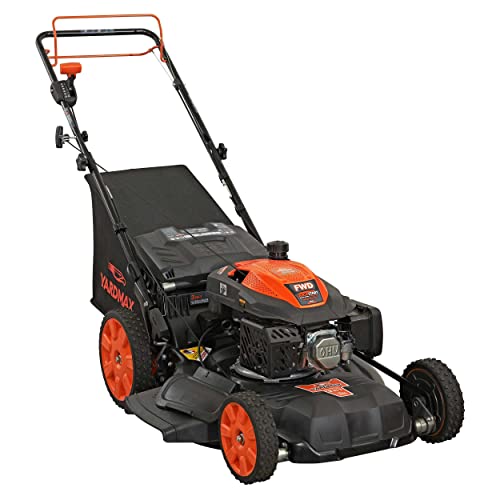
A heavy-duty 201cc gas mower with a CVT transmission that lets you dial in your exact walking speed.
YARDMAX built this mower around its exclusive CVT (Continuously Variable Transmission) — instead of clicking through fixed gears, you slide a lever to match the mower’s pace to your walk speed across 6 settings. The 201cc engine and 22-inch stamped steel deck give it the widest cut among gas mowers on this list, at 22 inches versus the SKIL’s 20 inches. That means you finish your rows faster. The automatic choke system means no priming or choking — just pull and go. The deck cleanout port lets you hose off grass buildup from underneath without flipping the mower.
But the biggest thing to know is the weight. At 84.9 pounds, this is the heaviest mower here — shoppers say it is roughly 90 pounds with wet grass in the bag. It uses front-wheel drive, so on wet grass or loose soil, the wheels can lose traction. One buyer mentioned the speed lever doesn’t always stay where you set it, and the bag is too wide for narrow gate openings. The rubber tires have an aggressive spiked tread that helps, but FWD still struggles on steep wet slopes.
For flat or gently rolling yards over 3/4 acre, the 201cc power and 22-inch cut are a real advantage. Buyers report it starts on the second pull, runs reliably, and sips gas. Just be prepared to muscle it into storage.
The Muscle It Brings
- 201cc engine handles thick, tall, and overgrown grass that would bog down a 170cc mower.
- CVT gives you smooth, stepless speed control between 6 positions.
- 22-inch deck is the widest you’ll find at this price, cutting down on mowing time.
The Burden You Carry
- 84.9 pounds is heavy; with grass, it exceeds 90 pounds — tough to lift or push up steep ramps.
- Front-wheel drive loses traction on wet grass and slopes, limiting it to flatter, dry yards.
Choose this for: Large, flat yards where you want a wide deck and a powerful engine that doesn’t need choke or primer.
Skip this if: Your yard has slopes, wet grass, or narrow gates — the FWD and weight will frustrate you every time.
5. PowerSmart DB8622S
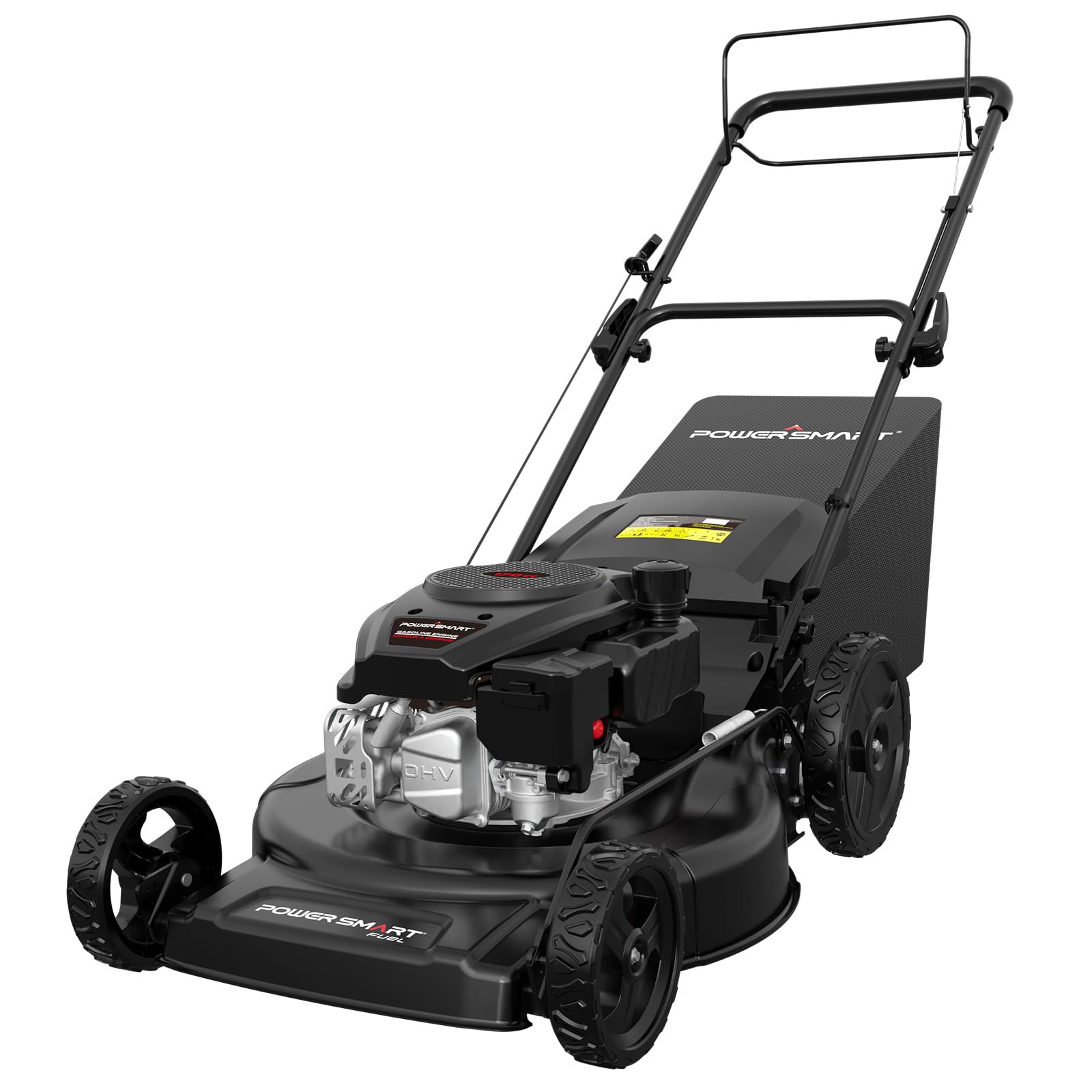
A rear-wheel drive gas mower that starts first pull and weighs just 68 pounds.
It uses a 170cc 4-cycle engine with an auto choke, so you pull once and it starts. The 22-inch all-steel deck matches the YARDMAX for cutting width, and the RWD gives you solid traction on slopes, unlike the FWD units. With 6 height positions from 1.5 to 3 inches, you cover most common grass lengths.
Buyers with a quarter-acre yard said the engine is reliable and starts easily, and the 3-in-1 system (mulch, bag, side discharge) works well. One owner reported the 144cc version of this engine was chosen specifically for its mulching power over a competitor’s engine. The 60-liter grass bag is large enough that you don’t stop every lap to empty it. But there are documented quality issues: the handle nuts and bolts loosen and fall off over time, and the rubber rear skirt can detach and get chewed by the blade. Replacement parts are hard to find from the seller.
The trade-off is build consistency — some buyers have no issues, others face loose hardware within a few months.
The RWD advantage: Rear-wheel drive grips slopes better than the FWD YARDMAX, making this the more hill-friendly budget gas pick.
The part risk: Several reviewers report the handle bolts and rubber rear skirt failing early, with no replacement parts available from the seller.
Best for: Budget-conscious buyers with a quarter-acre yard who want a light, self-propelled gas mower with rear-wheel drive for slopes.
Not ideal if: You want long-term durability without tracking down aftermarket hardware — occasional loose bolts may require DIY fixes.
6. SENIX 21″ FWD A025054-A
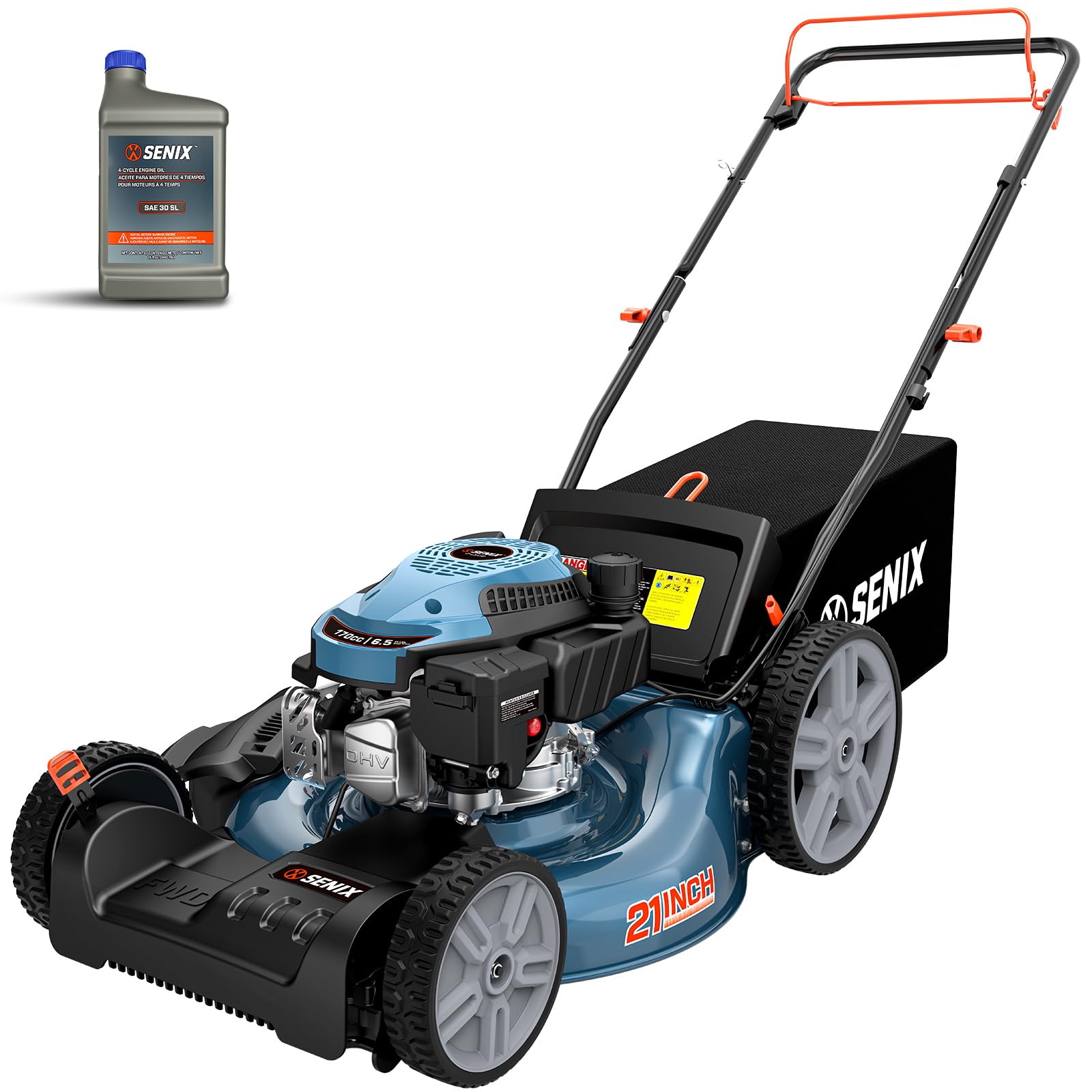
A front-wheel drive gas mower that pulls itself through flat yards and overgrown grass without complaint.
The SENIX 21-inch FWD is built for the classic suburban yard — flat, up to a third of an acre, with maybe a garden edge to pivot around. Its 170cc 4-cycle engine delivers 3.8 HP and 6.5 ft-lb of torque, and the maker says it burns roughly 27 ounces of fuel per hour. The front-wheel drive lifts easily for turning, which is great if you have flower beds or trees. It includes a 1.7-bushel grass bag, which is smaller than the PowerSmart’s 60-liter bag, but sufficient for a tidy lawn.
Owners mention it chews through overgrown 18-inch grass without stalling, and the 6-position height adjustment runs from 1.25 to 3.75 inches. The vortex tunnel deck design reduces grass buildup, and the 8-inch front wheels paired with 11-inch rear wheels handle bumpy terrain better than smaller rollers. One customer observed a hard restart after the engine was shut off, which is common on single-cylinder engines without a primer. Another reported a metal knocking sound ending in a dead engine after the first use — a risk at this price tier.
If your yard is flat and you want an affordable gas mower that pivots well, this SENIX is a strong option. But the FWD system means you should avoid wet grass or significant slopes, where front wheels lose grip.
What Works Well
- FWD makes it easy to pivot around obstacles in flat yards — just lift the front wheels and turn.
- 170cc engine handles overgrown 18-inch grass without bogging down.
- Vortex tunnel design keeps grass from building up under the deck.
What to Watch For
- Some customers note the engine is hard to restart after stopping mid-yard.
- FWD loses traction on slopes and wet grass, limiting its terrain to flat, dry yards.
Choose this for: Flat, dry yards up to 1/3 acre where you want a front-wheel drive mower that pivots cleanly around landscaping.
Look elsewhere if: Your lawn has hills, wet patches, or you want a bagger larger than 1.7 bushels.
7. SENIX R-H6 22″ RWD
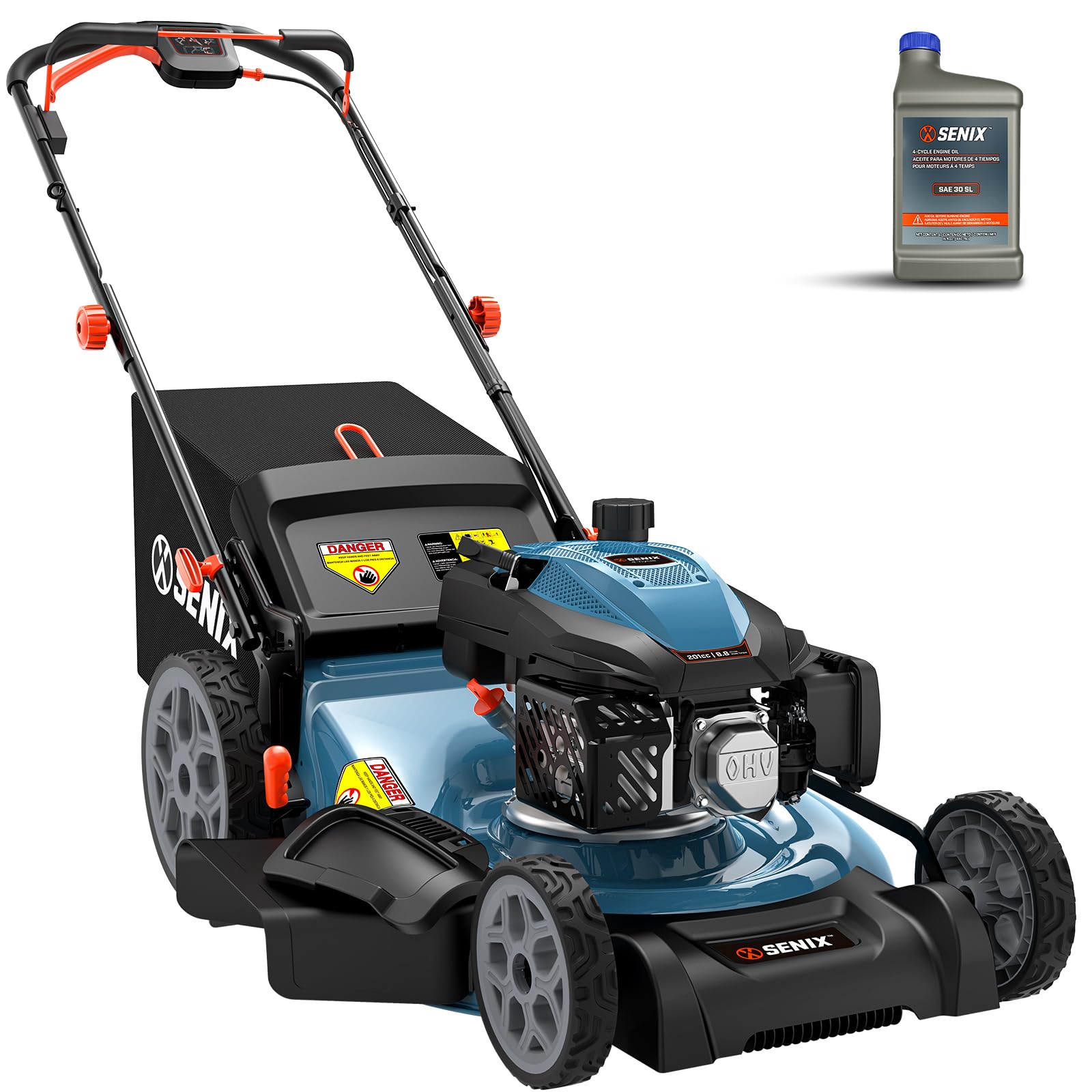
A rear-wheel drive gas mower with variable speed that makes hills feel flat.
If the 170cc FWD SENIX above doesn’t suit your sloped yard, this upgraded version swaps to a 201cc engine and rear-wheel drive, giving you the traction you need on inclines. The RWD variable-speed system lets you adjust pace without losing drive — and the 22-inch deck matches the YARDMAX’s width for fewer passes. Height adjustment runs from 1.25 to 4 inches across 6 positions, which is the same range as the Greenworks electric but with the added range of a gas engine for heavy grass.
Reviewers point out it starts on the first pull, the single-lever height adjustment is a major convenience, and the foldable handle saves about 70% of storage floor space — a huge deal if your garage is cramped. The handle itself has 3 height settings, so taller users don’t have to stoop. One buyer’s first mower had a self-propel failure, but the manufacturer quickly replaced it, and the second unit worked perfectly. The downside: a few shoppers say the drive belt slipping off mid-use, and gas leaks when the mower is stored upright — countering the foldable storage claim. The blade compartment is shallow, so grass packs underneath when you mulch without the bag attached.
For a mid-range gas mower, the RWD and 201cc power give you hill-ready performance that the FWD SENIX and YARDMAX can’t match on slopes. Just be ready for occasional QC hiccups.
RWD for hills: The rear-wheel drive provides the traction on slopes that front-wheel drive mowers simply lack.
The storage paradox: Foldable design claims leak-free upright storage, but several buyers report gas leaking when stored vertically.
Ideal for: Hilly yards where you need rear-wheel drive and the extra torque of a 201cc engine to maintain speed uphill.
Proceed with caution if: You plan to store it upright — some units leak gas when folded, defeating the space-saving promise.
8. BILT HARD 21″ 201cc
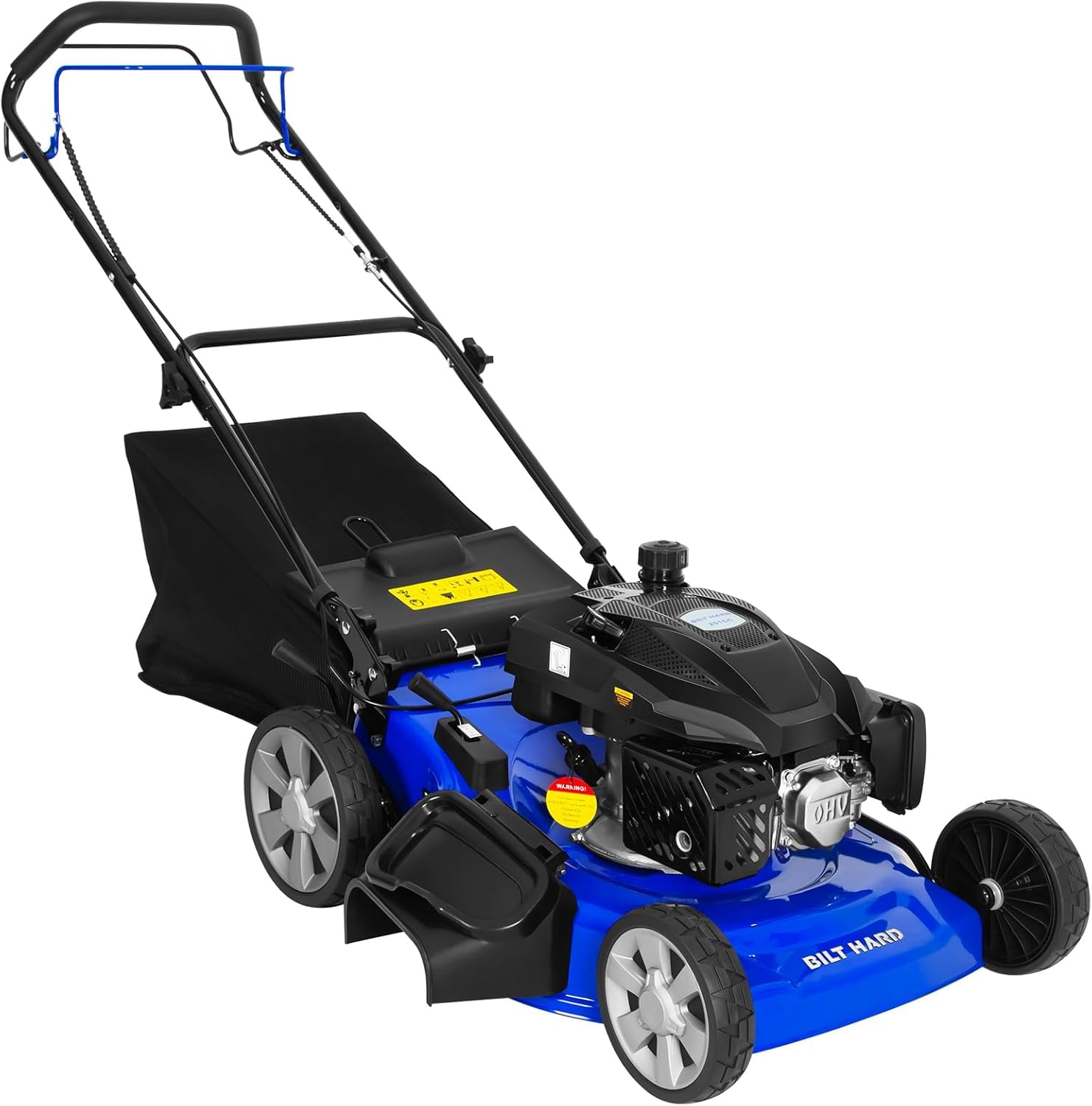
The cheapest 201cc gas mower here, if you are willing to roll the dice on long-term durability.
This BILT HARD mower packs a 201cc 4-stroke OHV engine (overhead valve, a design that improves fuel efficiency) producing 9.0 ft-lb of torque into a 21-inch steel deck for the lowest price of any 201cc gas mower in this list — undercutting the YARDMAX and the SENIX R-H6 by a significant margin. It has 8 height positions from 1.2 to 3.75 inches, which is more than any other mower here except the EGO (which also has 8). Rear-wheel drive gives it hill traction, and the single-speed self-propel is straightforward: pull the bar and go.
The flip side is alarming. One detailed buyer report describes a bent drive shaft that caused severe vibration, and within 8 hours of use, the plastic motor cover, exhaust cover, and dipstick housing cracked and broke. The oil leak caused a leg burn. The same report notes the mower vibrated itself into pieces. Other reviews are mixed — some say it starts first pull, cuts great, and they’ve had no issues in 3 months. One buyer’s wheel fell off during first use but was repairable. Assembly is easy and it comes with oil.
At this price, you get a 201cc RWD mower with the most height options at the cheapest entry point. But the serious quality concerns mean you should only buy this if you are prepared for possible DIY repairs or an early replacement.
The Upside
- 201cc engine with 9.0 ft-lb of torque at the lowest price of any mower here.
- 8 height positions — only the EGO matches this range.
- Rear-wheel drive for slopes and single-lever height adjustment.
The Risk
- Multiple reports of cracked plastic components (motor cover, dipstick housing) within hours of use.
- Bent drive shaft and severe vibration reported by one buyer, creating safety concerns.
- Wheel fell off during first use for another reviewer.
Only for: Budget-first shoppers who absolutely need a 201cc RWD mower at the lowest possible price and are comfortable handling potential mechanical issues.
Stay away if: You want reliable long-term build quality — the safety and durability reports here are too frequent to ignore.
Understanding the Specs
Engine Displacement (cc)
Measured in cubic centimeters (cc), this tells you the size of the engine’s cylinders. More cc generally means more torque for cutting thick or overgrown grass. A 170cc engine is fine for regular weekly cuts on a quarter-acre lawn. A 201cc engine gives you extra power if you let the grass grow tall or if it gets dense. For battery mowers, look at voltage (40V to 80V) — higher voltage means more cutting torque and less bogging in heavy grass.
Drive Type (FWD vs. RWD)
Front-wheel drive (FWD) mowers pull themselves forward. They turn easily around flower beds but lose traction on hills because the weight is in the back. Rear-wheel drive (RWD) mowers push from the driven rear wheels, which sit under the engine and give you grip on slopes. For flat yards, FWD is nimble. For any incline, RWD is safer and far less frustrating.
Battery Runtime and Ah
Amp-hours (Ah) tell you how long a battery lasts before recharging. A 4.0Ah battery on a 40V mower typically handles a small to medium lawn (up to 1/4 acre) in one charge. A 6.0Ah battery on the same 40V system gives you more headroom. Higher voltage mowers (56V, 80V) drain their batteries faster when running wide open, but they cut with more torque. Expect runtime from 40 to 60 minutes of real mowing before a recharge is needed.
Cutting Width and Height Adjustments
Cutting width determines how many passes you need. A 20-inch deck is good for small yards with narrow gates. A 22-inch deck saves time on larger lawns. Height adjustments tell you the range of grass lengths the mower handles. More positions (6 to 8) give you finer control. Single-lever adjustment means you change all four wheels at once instead of bending to each wheel.
FAQ
Is rear-wheel drive better than front-wheel drive for a self-propelled mower?
How much engine power do I need in cc for a self-propelled mower?
How long does a battery self-propelled mower run on a single charge?
Can I use my self-propelled mower without engaging the self-propel drive?
How do I maintain a self-propelled gas mower?
What does 3-in-1 mean on a lawn mower?
Are battery-powered self-propelled mowers as powerful as gas mowers?
How many height positions do I need on a self-propelled mower?
Will a self-propelled mower work on a sloped yard?
What is the difference between a 20-inch and a 22-inch cutting deck?
Final Thoughts: The Verdict
For most buyers, the best self-propelled lawn mower overall is the EGO POWER+ LM2135SP because its dual-battery bundle, Touch Drive self-propel, and Select Cut blade system deliver gas-level performance with zero maintenance. If you want a quieter, more affordable electric mower that still packs serious torque, grab the Greenworks 80V. And for a budget gas mower with rear-wheel drive and a 22-inch deck, the PowerSmart DB8622S is the best value for quarter-acre yards with slopes.
How We Picked
We do not accept paid placement, and we did not hands-on test every unit. Instead, we match each pick to a real buyer and use-case by comparing the manufacturers’ published specifications against the patterns in verified customer reviews — so you get each pick’s real strengths and trade-offs instead of marketing copy.
Sources & Methodology
Specifications: manufacturer listings and product documentation. Review insights: verified customer reviews, as of July 2026. Pricing: not shown on this page (it changes often); check the current price via the retailer link.
As an Amazon Associate, Lawn Gear Lab earns from qualifying purchases. This does not affect which products we feature.