
Specs are compiled from manufacturer listings and verified buyer reviews and can change over time — please confirm the key details on the product page before buying.
A greenhouse floor takes a beating—constant moisture, dirt dragged in from the garden, heavy pots sitting in one spot for months. The wrong floor turns into a muddy, slippery mess that holds moisture against your plants’ roots and invites mold. The right one keeps the ground dry, gives you a stable surface to walk on, and drains water away fast so your plants breathe and you don’t slip.
I’m Rikta — the founder and writer behind Lawn Gear Lab. This guide is built by comparing the manufacturers’ published specifications and the patterns across verified customer reviews, so you get each pick’s real strengths and trade-offs instead of marketing spin.
Whether you are building a new greenhouse or fixing a soggy existing one, the best floor for greenhouse keeps water moving away from your plants and gives you a solid, non-slip surface that lasts through wet seasons and heavy use without rotting or breaking down.
Quick Picks
- Big Floors DuraGrid Deck Tiles — Best Overall
- VEVOR Modular Interlocking Cushion — Max Drainage
- MinCHI257 36-Pack Plastic Interlocking Deck Tiles — Best Value Coverage
- EVANCENT Drainage Interlocking Floor Tiles — Best for Small Sheds
How To Choose The Best Floor For Greenhouse
A greenhouse floor is not just something to walk on—it is the surface that controls moisture, supports your plant pots, and affects how clean your growing space stays. Pick the wrong one and you fight mud, mold, and slippery surfaces every time you water. Here are the three factors that separate a floor that works from one that makes more work.
Drainage and airflow
Water spills are constant in a greenhouse. A solid floor that does not drain traps moisture against your pots, leading to root rot and fungal problems on the ground. Look for tiles with drainage holes or a raised bottom that lets water flow out and air circulate underneath. Tiles with support pins or a rhombic back structure create a small gap between the tile and the ground, so water spreads away rather than pooling.
Material durability
Greenhouse floors live in direct sunlight, temperature swings, and near-constant dampness. High-hardness plastic resists UV damage and does not warp or expand like wood. Soft PVC is easier on your feet and provides more grip, but check that it is commercial-grade recycled material so it holds up under heavy pots and foot traffic without tearing. Avoid materials that can rot, wick moisture, or break under the weight of a loaded potting bench.
Tile thickness and support height
The thicker the tile, the better it handles heavy loads without flexing or cracking. For a greenhouse where you walk, kneel, and set heavy pots down, look for tiles that are at least 0.5 inches thick. The support pins underneath (the raised nubs that lift the tile off the ground) should be tall enough—around 0.6 inches—to keep the tile above standing water and allow airflow. Too-short pins mean the tile still sits in water, defeating the drainage purpose.
Quick Comparison
On smaller screens, swipe sideways to see the full table.
| Model | Best For | Material | Tile Size & Thickness | Coverage | Amazon |
|---|---|---|---|---|---|
| Big Floors DuraGrid | Large, permanent greenhouse setups | UV-resistant composite | 12″ x 12″ x 0.63″ | 40 sq. ft (40-pack) | Amazon |
| VEVOR Modular Interlocking Cushion | High-moisture greenhouses needing max drainage | Soft PVC | 12″ x 12″ x 0.6″ | 50 sq. ft (50-pack) | Amazon |
| MinCHI257 36-Pack Deck Tiles | Covering large areas at a mid-range price | High-quality plastic | 12″ x 12″ x 0.75″ | 36 sq. ft (36-pack) | Amazon |
| Goovilla Plastic Interlocking Deck Tiles | Entry-level greenhouse flooring | High-hardness plastic | 12″ x 12″ (round shape) | 9 sq. ft (9-pack) | Amazon |
| EVANCENT Drainage Interlocking Tiles | Small greenhouse areas and budget builds | Soft recycled PVC | 12” x 12” | 12 sq. ft (12-pack) | Amazon |
In‑Depth Reviews
1. Big Floors DuraGrid Deck Tiles

The permanent solution that stands up to UV, heavy foot traffic, and constant water without breaking down.
You get 40 square feet of coverage from a 40-pack of 12-inch by 12-inch tiles that are 0.63 inches thick. The patented free-draining design keeps water from pooling on the surface—a critical feature for a greenhouse where you water daily and hose down the floor regularly. Buyers report the self-draining feature eliminates standing water completely, so your pots sit on a dry surface rather than in a puddle.
What sets this pick apart from cheaper options is its build: the tiles are stiff, sturdy, and comfortable underfoot even after hours of standing. One reviewer who used them to replace their condo patio flooring for the third time called them the best they had ever bought. Installation takes a rubber mallet and a saw—owners mention the pre-assembled 2-foot by 2-foot squares snap together tightly. The textured finish gives you reliable traction even when the floor is wet.
The catch is the bottom feet are sharp and can scratch a surface underneath, so you want to sweep the area clean before laying the tiles. The tiles are also hard to unsnap once connected, so plan your layout carefully before you start assembling. But for a greenhouse floor that stays dry, looks clean, and outlasts the season, this is the one to beat.
What makes it stand out
- Self-draining design stops water from pooling—keeps pots and roots dry
- UV-resistant build holds up in direct sunlight without fading or cracking
- Stiff, sturdy feel supports heavy pots and frequent foot traffic without flexing
What to watch for
- Sharp bottom feet can scratch the subfloor—sweep the area clean first
- Very hard to disassemble once snapped together, so layout must be precise from the start
- Hard feel underfoot if you stand for long periods, though some buyers use a carpet on top for comfort
Solid choice if: You have a large greenhouse and want a permanent floor that drains, breathes, and resists weather without needing replacements every season.
One honest limitation: The tight snap-fit and sharp bottom edges mean you should not rush the layout—once down, it is not coming back up easily.
2. VEVOR Modular Interlocking Cushion
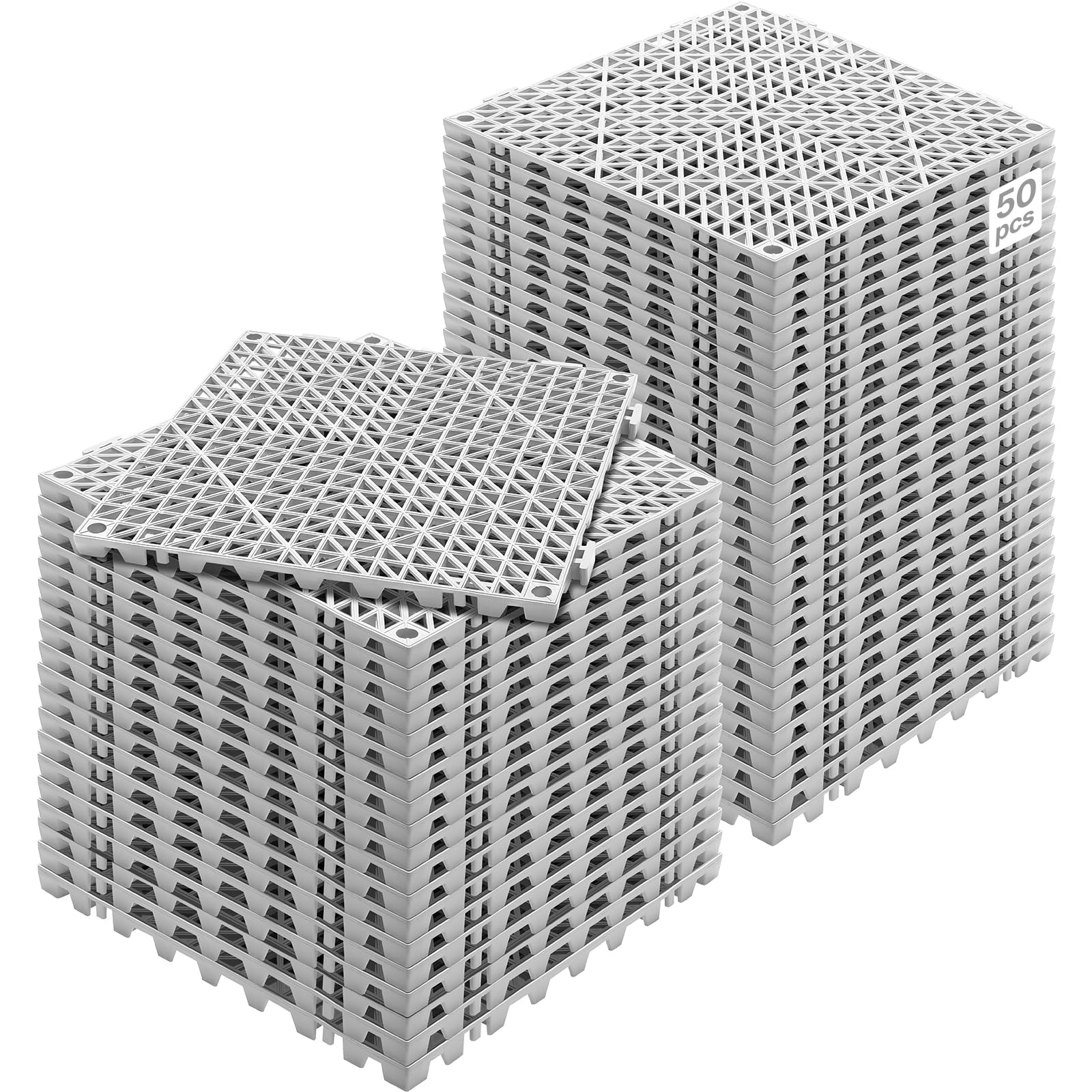
The drainage specialist that lifts your entire floor above the waterline with its tall support pins.
A 50-pack covers 50 square feet with 12-inch by 12-inch tiles. The standout feature is the 0.6-inch (15 mm) support pins underneath—taller than most competing tiles—which creates a larger gap between the tile surface and the ground. That extra height means water from daily greenhouse watering flows away freely and air moves underneath to keep the floor dry. Customers note this design solved 90% of their RV moisture and mold problem by providing about 1 inch of ventilation under a mattress—the same principle works for greenhouse pots sitting on the floor.
The upgraded PVC material feels like car tires: pliable enough to be comfortable barefoot but tough enough to hold its shape over time. One reviewer who installed them in a pool bathroom noted the non-slip surface worked perfectly in open-air conditions and expected a long service life. The tiles resist hair and oil buildup, which is useful when garden soil and organic debris get rinsed off the floor—a simple hose rinse keeps them clean. Unlike the harder plastic tiles above, these cushion your knees when you are leaning over to tend to your plants, a real comfort difference during long sessions.
The initial odor when you open the package is strong—buyers mention it fades in one to two days, but you may want to air the tiles outside before installing. Trimming them to fit odd shapes requires some muscle; one reviewer noted cutting took real effort. But for drainage depth and comfort underfoot in a consistently wet greenhouse, nothing else in this list lifts your floor higher off the ground.
Drainage depth you can feel: The 0.6-inch support pins keep water moving away faster than thinner tiles, so your greenhouse floor stays noticeably drier after watering.
Comfort vs. added cost: The soft PVC is much easier on your knees than rigid plastic tiles, making this a better pick if you kneel on the floor while planting or potting.
Reach for this if: Your greenhouse is constantly wet from daily watering or you want to lift pots off the ground for maximum airflow and weed-free drainage.
Look elsewhere if: You cannot wait out a strong initial off-gassing smell for a couple of days or you need a floor that supports very heavy shelving without flexing.
3. MinCHI257 36-Pack Plastic Interlocking Deck Tiles

The thickest tile in the lineup gives you 0.75 inches of solid plastic for heavy greenhouse loads.
You get 36 square feet from a 36-pack of 12-inch by 12-inch tiles, and at 0.75 inches thick, these are the beefiest tiles on this list. Thickness matters in a greenhouse because you are placing heavy ceramic pots and filled watering cans on the floor—the extra height distributes weight better and keeps the tile from flexing or cracking under load. The high-quality plastic construction has a strong load-bearing capacity; the manufacturer even includes video of weight-bearing tests.
Unlike the VEVOR tiles above which use soft PVC, these are made of hard plastic that clicks together rigidly and stays put on any flat surface. Reviewers point out they installed a full 36-square-foot floor in about 30 minutes on an uneven porch, and the tiles were still holding up well after 8 months with no fading or breakage. Another reviewer used them on a rooftop deck as an alternative to rugs and liked how the tiles protected the original flooring from furniture leg marks. The 0.75-inch height is thick enough that the tiles do not obstruct doors—they are just thin enough to slide under most door clearances.
The honest trade-off is that some buyers found the plastic more brittle than expected. One buyer mentioned the tiles can break under weight and recommended keeping them in low-traffic areas if you are concerned about durability. A buyer who gave a mixed review said they “feel cheap” and questioned long-term durability. If you plan to put extremely heavy shelving or water barrels directly on the tiles, you may want to reinforce the area underneath or go with the stiffer DuraGrid option above. But for standard greenhouse use—pots, trays, foot traffic—the thickness gives you a solid, stable floor for a lot less than premium options cost.
Where it delivers
- 0.75-inch thickness is the thickest on this list, offering better load distribution for heavy pots
- Snaps together fast with no tools required—shoppers say 30-minute installs
- Resists UV, rain, and snow without expanding or warping
Where it falls short
- Some buyers found the plastic brittle; tiles can break under concentrated weight
- Cutting tiles to fit odd corners is difficult and leaves unusable partial pieces
- Color may vary between boxes if you order multiple packs, according to one reviewer
Best for standard greenhouses: If your greenhouse sees normal potted plants, foot traffic, and occasional watering spills, the thick build gives you rock-solid stability for a mid-range investment.
Best avoided if: You need to put extremely heavy water barrels or shelving units directly on the floor without any subfloor reinforcement.
4. Goovilla Plastic Interlocking Deck Tiles

A low-cost starter floor that keeps moisture off the ground with its rhombic drainage structure.
This 9-pack of 12-inch tiles is the smallest on this list, covering about 9 square feet—exactly enough for a small greenhouse aisle or a designated potting area. Each tile uses a rhombic structure on the back that increases friction to prevent slipping and creates space for air to flow underneath, which keeps the floor dry. The high-hardness plastic is designed to withstand direct sunlight, rain, and snow without expanding, making it suitable for year-round outdoor use.
The snap-together connection uses an upgraded rectangular snap design. Buyers report the tiles click together easily without tools and feel secure once connected. One reviewer praised the easy snap-together install and noted the plastic will not rot or wick moisture from concrete—a common problem when wet greenhouse floors sit directly on a solid base. Another buyer said the tiles look nice and seem to be good quality for the price. The drainage design includes 6 drains on the front surface of each tile, so water from watering cans or hose spray drains quickly instead of pooling on top.
The honest limits of a budget pick show up here. The 9-pack covers a very small area, so you will need multiple packs for a full greenhouse floor—and buyers noted that color can vary between boxes from different production lots. The plastic feels less sturdy than the premium options; one buyer called them “very much breakable” and warned they are not rubbery and do not lay flat like heavier mats. Another buyer described them as “slippery when wet,” which is a real safety concern in a greenhouse. If you are covering a small propagation bench or a narrow walkway on a tight budget, these work. For a full greenhouse floor that needs to hold up for years, the thicker options above are a better investment.
The upside
- Rhombic back structure increases grip and allows airflow underneath to keep floors dry
- Rectangular snap connection is upgraded for a tighter fit than cheaper tiles
- Plastic resists rot and will not wick moisture from concrete or soil
The downside
- Only 9 tiles per pack—covering a full greenhouse requires multiple packs
- Feels cheap and breakable to some buyers; not for heavy loads
- Surface can be slippery when wet, a real hazard in a damp greenhouse
Ideal for small spaces: A good entry-level choice for a tiny greenhouse, a single potting bench area, or a damp basement floor where you just need to get plants off the ground.
Not recommended for: Large greenhouse floors where you depend on long-term durability under heavy pots or where safety on a wet surface is critical every day.
5. EVANCENT Drainage Interlocking Floor Tiles

A soft, flexible PVC tile that works well in small wet zones and cuts easily with scissors.
The 12-piece set covers a 3-foot by 4-foot area, with each tile measuring 12 inches by 12 inches. The material is soft recycled PVC that is free of polypropylene—flexible enough that you can cut it to size with a utility knife or scissors, unlike the hard plastic tiles that require a saw. That makes this a great option if your greenhouse has irregular corners, curved edges, or obstacles like support posts that need custom fitting.
The drain holes allow water to pass through the surface, helping prevent pooling underneath. Buyers have used these tiles in all kinds of wet environments: one reviewer lined their boat storage spaces to keep items dry and off the bottom, another turned their basement stairwell into a drain that reduced cleaning time from constant to regular maintenance. For a small greenhouse, the non-slip surface provides good traction even on wet concrete, and the tiles do not wick moisture—a common problem when you place pots directly on a concrete greenhouse floor that sweats. The soft feel is much more comfortable on your knees than rigid plastic tiles.
The trade-off for the soft, flexible feel is that these tiles prioritize comfort and easy cutting over the more rigid build of the top picks. The bottom teeth that create the drainage gap are effective, but the tile itself can flex under a very heavy pot. The initial odor on opening can be strong—one reviewer described it as a “strong nauseating smell” that faded in 1 to 2 days when aired outside. For a small greenhouse where you value easy cutting and comfort over brute load-bearing capacity, these are a solid fit.
Where it shines
- Soft recycled PVC is easy to cut with scissors—perfect for oddly shaped greenhouse footprints
- Non-slip surface and drainage holes keep you safe and the floor dry in wet conditions
- Lightweight enough to pick up, rinse, and reposition as your greenhouse layout changes
Where it falls short
- Can flex under very heavy pots or shelving
- Strong PVC smell from the start requires 1-2 days of airing out before installation
- Coverage is only 12 square feet per pack—large greenhouses need multiple sets
Designed for small, custom spaces: If your greenhouse is a small lean-to or has an irregular footprint where cutting tiles to fit matters, the easy-scissor flexibility and soft feel make this a natural choice.
Not the pick for: A large greenhouse with heavy shelving that needs a floor that does not flex under weight—go with the 0.75-inch thick MinCHI257 or the stiffer DuraGrid for that job.
Understanding the Specs
Tile thickness and load support
The thickness of a greenhouse floor tile—measured in inches—directly determines how much weight it can handle without bending or cracking. Thicker tiles (0.75 inches) distribute pressure from heavy ceramic pots and shelving across a wider area, so the tile does not bow in the middle. Thinner tiles (0.47 inches) are more flexible and easier to cut but can flex under concentrated loads. For a greenhouse where you put 20-pound bags of soil and large water jugs on the floor, aim for tiles at least 0.5 inches thick. For lighter use like seedling trays and hand tools, thinner tiles work fine and cost less.
Drainage design and support pins
The drainage system is defined by the height of the support pins underneath the tile—these are the raised nubs that lift the tile surface off the ground. Taller pins (0.6 inches as on the VEVOR tiles) create a bigger gap between the tile and the subfloor, allowing water to flow freely and air to circulate underneath. Shorter pins still drain water but leave less space for airflow. A greenhouse floor that sits directly on concrete or gravel needs those pins to be tall enough that the tile is not sitting in the water it is supposed to drain away. The drainage holes on the tile surface let watering spills pass through to the gap below rather than pooling on top where you walk.
FAQ
Can I put greenhouse floor tiles directly on soil or grass?
How do I cut interlocking floor tiles to fit around greenhouse support beams?
Will greenhouse floor tiles keep my plants warm in winter?
How do I clean the tiles once they are installed in the greenhouse?
Are soft PVC tiles or hard plastic tiles better for a greenhouse floor?
How many packs do I need to cover my greenhouse floor?
Will the tiles get slippery when the greenhouse floor is wet?
Can I install greenhouse floor tiles on an uneven or sloped floor?
How long do interlocking floor tiles last in a greenhouse environment?
Can I use these tiles under a greenhouse potting bench or only on the floor?
Final Thoughts: The Verdict
Across the board, the best floor for greenhouse winner is the Big Floors DuraGrid because its UV-resistant, self-draining, stiff build handles constant water, heavy foot traffic, and direct sunlight without breaking down or needing replacement. If you want maximum drainage depth with comfortable underfoot feel for long potting sessions, grab the VEVOR Modular Interlocking Cushion. And for a greenhouse where you need the thickest tile to support heavy shelving and large pots on a tight budget, the MinCHI257 36-Pack gives you the most material per dollar.
How We Picked
We do not accept paid placement, and we did not hands-on test every unit. Instead, we match each pick to a real buyer and use-case by comparing the manufacturers’ published specifications against the patterns in verified customer reviews — so you get each pick’s real strengths and trade-offs instead of marketing copy.
Sources & Methodology
Specifications: manufacturer listings and product documentation. Review insights: verified customer reviews, as of July 2026. Pricing: not shown on this page (it changes often); check the current price via the retailer link.
As an Amazon Associate, Lawn Gear Lab earns from qualifying purchases. This does not affect which products we feature.