
Specs are compiled from manufacturer listings and verified buyer reviews and can change over time — please confirm the key details on the product page before buying.
Getting a raspberry patch to pump out sweet, full-size berries starts with what you feed it — but picking the right bag off the shelf is harder than it looks. Some formulas flood the soil with nitrogen (giving you giant leaves and almost no fruit), while others ignore the low-pH raspberries crave. This guide pulls together the best plant food for raspberries that actually matches what the plants need, from fast-acting water-soluble mixes to slow-release organic granules.
I’m Rikta — the founder and writer behind Lawn Gear Lab. This guide is built by comparing the manufacturers’ published specifications and the patterns across verified customer reviews, so you get each pick’s real strengths and trade-offs instead of marketing spin.
You will find six specific options below, each chosen because the nutrient profile (N-P-K ratio) or acid-loving formulation suits raspberries — plus honest notes on where each one falls short, so you can grab the right plant food for raspberries without second-guessing yourself.
Quick Picks
- Espoma Organic Berry-Tone 4-3-4 Natural & Organic Fertilizer and Plant Food for All Berries. 4 lb. Bag. Pack of 2 — Best Overall
- Down To Earth All Natural Fertilizers Organic Acid Mix 4-3-6, 25 lb — Premium Long-Term
- True Organic Berry Food – Organic Fertilizer for Acid-Loving Plants – 4lb Bag — Organic pH Helper
- ENVY Plant Foods Acid-Loving Special | Water Soluble Fertilizer | Hydrangea, Azalea, & Blueberry Plant Food (1.5 lb) — Fast-Acting Boost
- Berry Tone Plant Food, 4-3-4, 4-Lbs. — Proven Performer
- Big A Berries Fertilizer Nutrients – Plant Nutrients for Growth – Organic Powder – Works on Raspberry, Strawberry, Blueberry – 13.5oz — Compact & Versatile
How To Choose The Best Plant Food For Raspberries
Raspberries are heavy feeders that like slightly acidic soil (a pH around 5.5 to 6.5) and a balanced nutrient mix. If you pick a high-nitrogen lawn fertilizer, you will end up with a tangled mess of canes and almost no berries. The key things to check before buying are the N-P-K ratio, the form (granules versus water-soluble), and whether the mix includes anything to adjust soil pH.
N-P-K Ratio — What Those Three Numbers Actually Mean
The three numbers on the bag stand for Nitrogen (N), Phosphorus (P), and Potassium (K). For raspberries you want a middle or slightly higher middle number — phosphorus supports flower and fruit development. A ratio like 4-3-4 or 5-4-4 works well. If the first number is much higher than the other two (like 20-5-5), you will get lots of leaves and very few berries. Stay away from anything over about 10 on the first number unless you are correcting a specific deficiency.
Granules vs Water-Soluble — Speed and Convenience
Granular fertilizers (the kind that look like small pebbles) release nutrients slowly as soil microbes break them down. You sprinkle them on the soil surface or scratch them in and water once. Water-soluble powders dissolve in a watering can and feed the plant immediately — great for a mid-season boost when you see flowers forming. Both work well for raspberries; the choice is how often you want to apply. Granules usually need two applications per year (early spring and late spring), while water-soluble mixes are best applied every two to four weeks during the growing season.
Sulfur and Soil pH — The Hidden Factor
Raspberries take up nutrients best when the soil is slightly acidic. If your soil pH is too high (alkaline), the plant cannot absorb iron and other micronutrients no matter how much fertilizer you apply. Some berry foods include sulfur to lower the pH naturally over time. If you see sulfur listed in the ingredients or the guaranteed analysis, that product is actively working to improve nutrient availability — it is worth paying a bit extra for.
Quick Comparison
On smaller screens, swipe sideways to see the full table.
| Model | Best For | N-P-K Ratio | Form | Unit Count | Amazon |
|---|---|---|---|---|---|
| Down To Earth Acid Mix | Premium long-term feeding | 4-3-6 | Granules | 400.0 oz (25 lb) | Amazon |
| Espoma Berry-Tone (Pack of 2) | Best Overall | 4-3-4 | Granules | 128 oz (8 lb total) | Amazon |
| True Organic Berry Food | Organic pH adjustment | 5-4-4 | Granules | 4 lb | Amazon |
| ENVY Acid-Loving Special | Quick water-soluble boost | 21:7:7 | Water Soluble Powder | 24.0 oz | Amazon |
| Berry Tone Plant Food | Proven single-season results | 4-3-4 | Granules | 128.0 oz (8 lb) | Amazon |
| Big A Berries Fertilizer | Small-space indoor/outdoor | — | Powder | 13.5 oz | Amazon |
In‑Depth Reviews
1. Espoma Organic Berry-Tone 4-3-4 Natural & Organic Fertilizer and Plant Food for All Berries. 4 lb. Bag. Pack of 2

A no-mix organic granule that feeds raspberries exactly what they need, twice a year.
This is the bag that keeps coming up in conversations because it is designed for all berries — raspberries, blueberries, strawberries, and blackberries — in a simple 4-3-4 N-P-K ratio. The 4-3-4 means you get balanced phosphorus for fruit production without too much nitrogen pushing leaf growth. Best of all, there is no mixing required; you just sprinkle the granules around the base of the plant and water it in. Each pack comes with two 4-pound bags, giving you 128 ounces total, which covers a solid patch for a full season.
Buyers report that the Berry-Tone arrived quickly when local garden stores were out of stock, and one reviewer noted they had “the biggest crop of berries after using this product.” The mix contains 5% sulfur (listed in the guaranteed analysis), which helps lower soil pH naturally over time — a smart bonus if your raspberries are planted in neutral or slightly alkaline ground. Espoma has been making organic products since 1929 and the Bio-tone formula is approved for organic gardening.
The one mild trade-off some buyers notice is that the bags are smaller than what you usually find at a local gardening center. You are paying for a premium organic product in a manageable size rather than a huge economy sack. For most home raspberry growers the 8-pound total is plenty, but if you have a very large patch you might want to stock up on two packs before the spring feeding window.
Two-and-done feeding: Early spring and late spring applications are all it takes. The slow-release granules keep feeding for weeks without you having to remix anything.
One real limit: The bags are smaller than the bulk sizes at garden centers, so plan ahead if you have more than a dozen mature canes.
Reach for this if: You want a classic, organic, no-fuss berry food that works on raspberries and every other berry bush in your yard — and you want it approved for organic gardening.
Look elsewhere if: You need to correct a severe soil pH problem quickly (this is a maintenance feed, not a rapid acidifier).
2. Down To Earth All Natural Fertilizers Organic Acid Mix 4-3-6, 25 lb
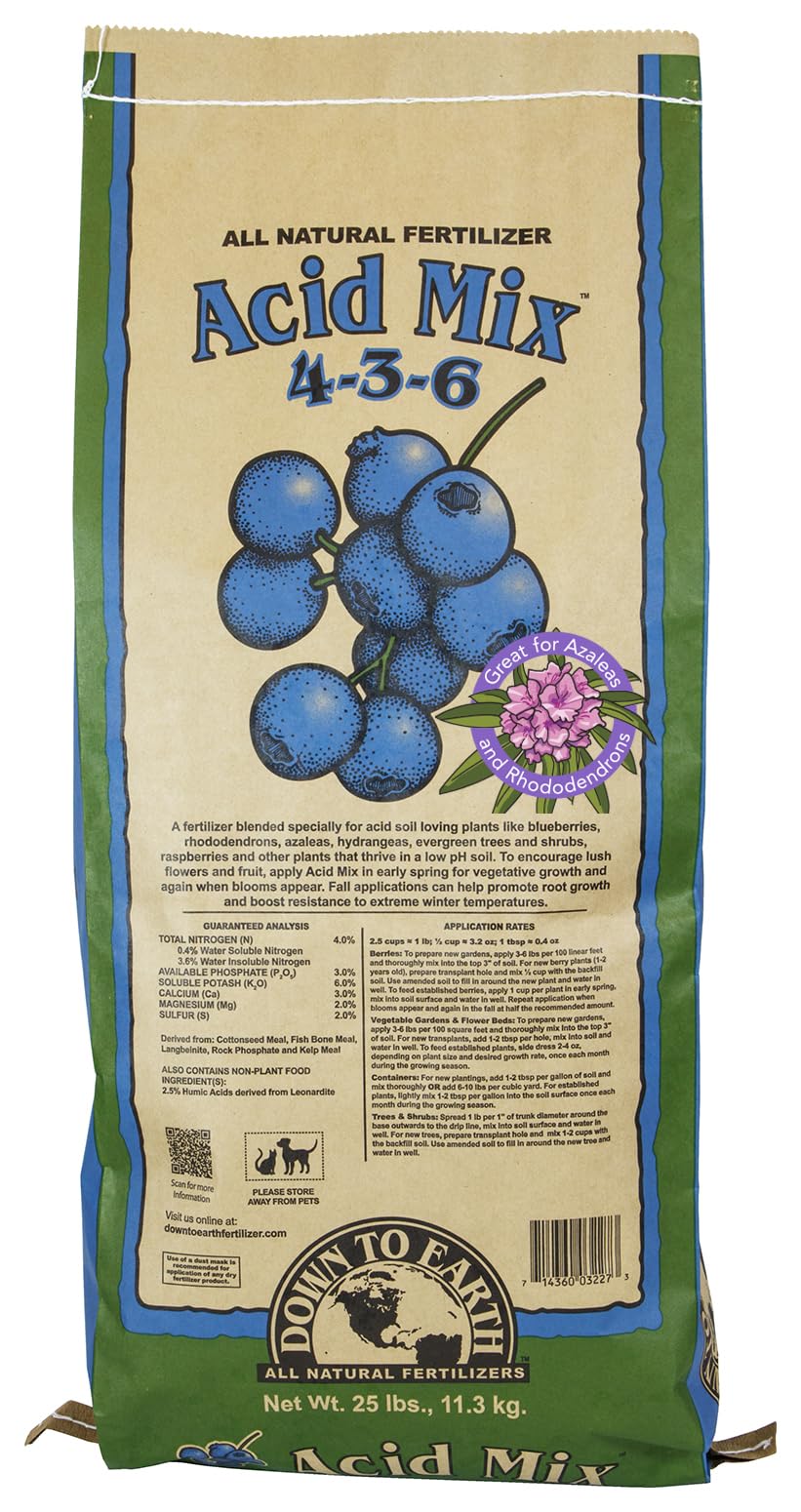
A 25-pound bulk bag built for serious raspberry patches and acid-loving plants at large.
If you have a big berry patch or multiple acid-loving plants (rhododendrons, azaleas, camellias, blueberries, raspberries, strawberries), this bag makes more sense than buying small pouches every season. The 4-3-6 N-P-K ratio leans slightly heavier on potassium, which supports overall plant health and helps raspberries handle temperature swings. The ingredients list includes cottonseed meal, langbeinite, fish bone meal, rock phosphate, humates, and kelp meal — a varied organic blend that feeds the soil microbes rather than just the plant.
Owners mention using it year after year on raspberry plants and blueberry bushes and seeing good results. One buyer mentioned they “have used it for years” and that the larger bag is cheaper per pound and “will last a couple of seasons.” Unlike the Espoma Berry-Tone (which is a dedicated berry blend), this Acid Mix is a general acid-loving formula, so it also works on evergreens and potatoes — useful if you have a mixed garden. The manufacturer recommends applying in early spring for growth and again when blooms appear, or in fall for root development before winter.
Because this is a 25-pound bag (400.0 ounces), it is physically heavy and bulky. If you only have two or three raspberry canes in a raised bed, you will be storing half the bag for next year — not a problem if you have a dry shed, but a consideration for small-space growers. The 4-3-6 ratio also contains sulfur to maintain low pH, but one owner reported that for new blueberry bushes they still needed an initial soil acidifier to get the pH down to 4.5 before this mix could maintain it.
What makes it a good long-term buy
- 25-pound bag (400 oz) means you feed a large patch for multiple seasons
- 4-3-6 ratio with potassium for stress tolerance and fruit quality
- All-natural ingredient list — cottonseed meal, kelp meal, fish bone meal
- Works on blueberries, raspberries, strawberries, azaleas, and rhododendrons
What to know before buying
- Heavy bag — plan for storage space
- General acid-loving formula, not raspberry-specific (works fine, but not tailored)
- May require initial soil acidifier for very alkaline soil
Best for: The grower with a large established patch or a whole collection of acid-loving plants — this bag feeds everything and lasts.
skip it if: You only have a few raspberry canes in a small garden and do not want to store 25 pounds of fertilizer.
3. True Organic Berry Food – Organic Fertilizer for Acid-Loving Plants – 4lb Bag

A 5-4-4 organic blend that actively lowers soil pH while feeding the berries.
This one stands out because it is formulated to adjust soil pH as it feeds — the bag contains sulfur to help lower pH, which improves micronutrient availability for raspberries. The 5-4-4 N-P-K ratio is slightly higher in nitrogen than the Espoma 4-3-4, but still well balanced enough to avoid the “leaves only, no fruit” problem. The ingredient list includes seabird guano, shrimp and crab shell meal, and other organic inputs — an unusual mix that brings calcium and chitin to the soil (chitin feeds beneficial microbes that suppress soil pests).
One customer observed that True Organic Berry Food “revived neglected raspberry patch” and that “older plants now producing beautiful berries.” The 4-pound bag covers up to 58 square feet (the manufacturer’s stated coverage), which is enough for a moderate-sized bed. You apply it monthly during the growing season, so it is a consistent feed rather than a twice-a-year granule. Being a granule, you still scratch it into the top inch of soil and water it in; no mixing required.
The catch is the monthly application schedule. If you prefer a “sprinkle and forget it for six months” approach, the Espoma two-feeds-per-year rhythm will feel easier. Also, at 4 pounds for a single bag, this is a smaller quantity than the 8-pound Espoma twin-pack, so you might need two bags for a full season on a medium patch. But for growers whose soil runs a bit alkaline, the built-in pH correction is a genuine advantage that the other granular options do not emphasize as directly.
Monthly feeding rhythm: Each 4 lb bag covers 58 sq. ft. Apply once a month during the growing season for steady nutrition.
Caveat: Requires more frequent application than the twice-a-year Espoma Berry-Tone, and the bag is smaller.
Best for: Raspberry growers dealing with neutral or slightly alkaline soil — the sulfur adjustment makes a real difference in nutrient uptake.
Not ideal if: You want a single spring application and nothing else until fall; this needs monthly attention.
4. ENVY Plant Foods Acid-Loving Special | Water Soluble Fertilizer | Hydrangea, Azalea, & Blueberry Plant Food (1.5 lb)
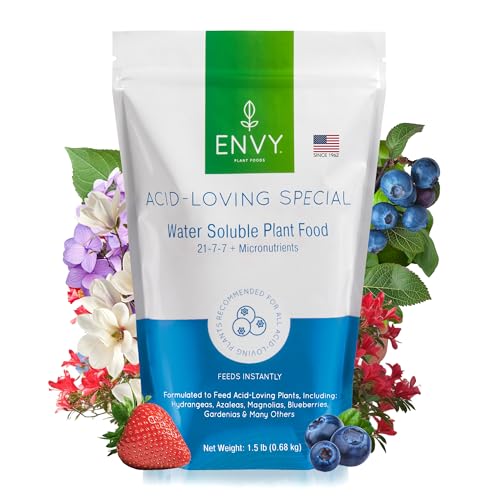
A water-soluble powder that delivers instant nutrients — use it when raspberries start flowering.
Unlike the granular picks above, ENVY Acid-Loving Special dissolves completely in water (100% water soluble), so the nutrients reach the roots within hours instead of weeks. The mixing ratio is 21:7:7, which is much higher in nitrogen than a standard berry food — you use it in a diluted form (the bag includes a measuring scoop to get the ratio right). This is not your “primary” raspberry food; it is the mid-season kicker you reach for when you see flowers or when leaves look a little pale. It is formulated for acid-lovers: blueberries, azaleas, hydrangeas, gardenias, camellias, rhododendrons, and citrus, and it works the same way for raspberries.
Customers note good results on flowering bushes — one buyer in Florida wrote that they “used in FL on east-facing hydrangeas with too much sun; bushes thriving after 4 weeks.” The resealable pouch and included scoop make measuring easy, and the 24.0-ounce (1.5 lb) bag is small enough to store on a shelf without taking up floor space. One reviewer called it “worth the money” and noted the price compared well against popular brands.
The key difference from the True Organic or Espoma options is the speed and the nitrogen level. If you use this as your only raspberry food month after month, the higher nitrogen could tip the plant into leaf production at the expense of fruit. Use it as a supplement — apply the granular early spring feed, then switch to ENVY when a quick foliar or root drench is needed during bloom or after a heavy rain that leached nutrients.
Why keep it on hand
- 100% water soluble — feeds immediately, no waiting for soil microbes
- Comes with a measuring scoop and resealable pouch for mess-free storage
- Versatile for all acid-loving plants, not just berries
- Good value vs. popular brands according to buyers
The catch
- High 21:7:7 ratio — best used as a periodic boost rather than a sole feed
- Only 24 oz (1.5 lb) — a single bag will not last a full season for a large patch
Ideal as a: Quick-response tool for when raspberries need a nitrogen lift during flowering or after rain washes out nutrients. Not a stand-alone year-round feed.
Not recommended as: Your only raspberry fertilizer — pair it with a balanced granular like Espoma Berry-Tone or True Organic Berry Food.
5. Berry Tone Plant Food, 4-3-4, 4-Lbs.
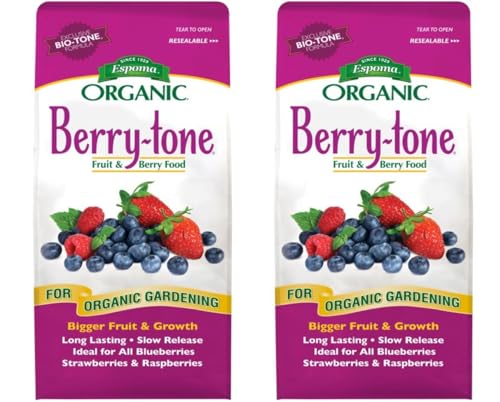
The same Espoma Berry-Tone formula in an 8-pound bag for dedicated raspberry growers.
This is essentially the same product as the Pack of 2 above (Espoma Berry-Tone, 4-3-4, with Bio-tone, organic gardening approval, and 5% sulfur) but sold as a single 4-pound bag by weight — the listing actually ships an 8-pound total (two 4-pound bags). The 4-3-4 ratio is identical, the organic certification is the same, and the target species list covers blueberries, strawberries, raspberries, and blackberries. So why is this listed as a separate pick? Because buyers who already know they want Espoma Berry-Tone might grab this listing if the twin-pack is out of stock or priced higher, and the customer reviews here are specifically for this listing.
One reviewer shared a clear result: “Used this product last summer on my raspberries and had great results. Bowls of raspberries.” Another reported a dramatic increase in blackberry yield — so many that they made syrups and desserts — and noted that when they forgot to use it the following year, they got “very few flowers.” That kind of direct cause-and-effect feedback (lots of berries when used, almost none when skipped) is as convincing as it gets for a fertilizer. The 5% sulfur content helps maintain acidic soil conditions over time, just like the twin-pack.
The main thing to watch is the same as the Espoma twin-pack: each individual bag is 4 pounds, which is smaller than the bulk bags you might find at farm supply stores. If you have a very large raspberry patch (say, 20+ mature canes), you may need two of these units. For the home grower with a modest bed, the 8-pound total (128.0 ounces) should comfortably cover two full feeding cycles (early spring and late spring).
Real-world proof: Multiple customer reports of “bowls of raspberries” and “dramatically increased yield” directly attributed to using this product.
Same formula as the Best Overall: 4-3-4, Bio-tone, organic, sulfur-enhanced — just sold under a different listing variant.
Choose this if: You want the proven Berry-Tone formula with direct customer evidence that it drives raspberry and blackberry yields — and you need the two-bag 8-pound total.
Consider the twin-pack instead if: The Pack of 2 (B088WZH9KG) is available at a better price; the formula is identical.
6. Big A Berries Fertilizer Nutrients – Plant Nutrients for Growth – Organic Powder – Works on Raspberry, Strawberry, Blueberry – 13.5oz

A small-bag organic powder that turned one buyer’s raspberries into “AI-made” looking fruit.
Big A Berries comes in a resealable 13.5-ounce pouch — the smallest unit count among all the picks here, but reviewers point out outsized results. One reviewer at high elevation wrote that two applications (late May and late June) with pruning “dramatically increased raspberry yield and size” to the point where the berries looked “like AI made them.” Another said that within a week of use, their strawberry size jumped from backyard to farm-stand quality. The powder form means you mix it with water and apply it as a liquid feed, which gives you precise control over the dosage per plant.
The brand positions this as organic and versatile across strawberries, raspberries, blueberries, and blackberries. The manufacturer does not publish a standard N-P-K ratio on the listing (it is described as a unique blend of minerals and vitamins), so you cannot easily compare it to the 4-3-4 granulars above. That is a bit unusual and means you are trusting the brand’s proprietary formula rather than a standard label you already understand. The 13.5-ounce bag is small enough to try without a big commitment, and the resealable pouch keeps the powder dry between uses.
The trade-off is obvious: you pay more per ounce compared to the 8-pound or 25-pound bags, and the N-P-K is not listed, which makes it harder to judge the nutrient balance. For the price of one Big A pouch (13.5 oz), you can get four pounds of Espoma Berry-Tone or True Organic Berry Food with a known 4-3-4 or 5-4-4 ratio.
What speaks for it
- Powder dissolves in water for targeted application per plant
- Shoppers say dramatic size and yield increases on raspberries and strawberries
- Organic formulation with a unique mineral/vitamin blend
- Resealable pouch convenient for small-space gardeners
What gives us pause
- N-P-K ratio is not published on the listing — you cannot compare it to standard berry foods
- Small 13.5 oz bag — high cost per ounce vs. bulk granular options
- Often out of stock according to reviewers
Perfect for: The tinkerer who wants to try a specialized organic liquid boost on a small raspberry patch and is okay with a premium per-ounce cost.
Stick with a granular if: You want a known N-P-K ratio, a lower cost per feeding, and the simplicity of a single spring application.
Understanding the Specs
N-P-K Ratio
These three numbers on the front of the bag tell you the percentage by weight of Nitrogen (first number), Phosphorus (second number), and Potassium (third number). For raspberries you want the second number — phosphorus — to be roughly equal to or slightly higher than the first. A 4-3-4 or 5-4-4 ratio provides enough phosphorus for flower and fruit development without letting nitrogen take over. Avoid anything where the first number is over 10 for a primary raspberry food, because that much nitrogen pushes leafy growth at the expense of fruit.
Granules vs Water-Soluble (Powder)
Granules are dry pellets that release nutrients slowly as soil microbes break them down — you apply once or twice per season and the plant gets a steady supply over weeks. Water-soluble powders dissolve in a watering can and feed the plant within hours, which is useful for a mid-season boost or correcting a nutrient deficiency quickly. Deciding between them is about your schedule: granules for low-maintenance feeding, water-solubles for hands-on control.
Sulfur for pH Adjustment
Sulfur is listed in the guaranteed analysis on some berry foods — it works to lower the soil pH over time. Raspberries prefer slightly acidic soil (pH 5.5 to 6.5) because that is the range where iron, manganese, and other micronutrients are available to the roots. If your raspberry leaves turn yellow between the veins while the veins stay green, your soil pH is probably too high and the plant is not absorbing iron. A fertilizer with sulfur (like Espoma Berry-Tone at 5% sulfur or True Organic Berry Food) will gradually correct that.
Organic Certification
“Organic” in the context of a plant food means the ingredients are natural and not synthetic — things like seabird guano, fish bone meal, cottonseed meal, kelp, and rock phosphate. Some bags carry official organic input registration (like the Espoma Berry-Tone), meaning they meet the standards for organic production. For backyard raspberry growers, organic options tend to be gentler on soil life and less likely to burn roots, but they also release nutrients more slowly than synthetic options. If you are growing raspberries for your family and prefer to avoid synthetic chemicals, look for organic certification or ingredients you recognize.
FAQ
Can I use tomato fertilizer on raspberries?
How often should I feed raspberries during the growing season?
What is the difference between a 4-3-4 and a 5-4-4 fertilizer?
Will water-soluble fertilizer burn my raspberry plants?
Is organic berry food better than synthetic for raspberries?
How do I know if my soil pH is wrong for raspberries?
Can I use these fertilizers on raspberries in containers?
What is the difference between Berry-Tone and Berry Tone Plant Food?
Will the Down To Earth 25-pound bag go bad if I do not use it all this year?
Can I mix the ENVY water-soluble powder with other fertilizers?
Final Thoughts: The Verdict
Across the board, the plant food for raspberries winner is the Espoma Organic Berry-Tone Pack of 2 because the 4-3-4 N-P-K ratio is perfectly balanced for fruit production, it feeds twice a year with no mixing, and the sulfur content naturally maintains the acidic soil raspberries need. If you want a quick-absorbing boost during flowering, grab the ENVY Acid-Loving Special — it dissolves instantly and delivers nutrients in hours. And for large-scale growers or those with mixed beds of acid-loving plants, the Down To Earth Acid Mix 4-3-6 (25 lb) offers the lowest per-feed cost and ingredients that feed the soil itself.
How We Picked
We do not accept paid placement, and we did not hands-on test every unit. Instead, we match each pick to a real buyer and use-case by comparing the manufacturers’ published specifications against the patterns in verified customer reviews — so you get each pick’s real strengths and trade-offs instead of marketing copy.
Sources & Methodology
Specifications: manufacturer listings and product documentation. Review insights: verified customer reviews, as of July 2026. Pricing: not shown on this page (it changes often); check the current price via the retailer link.
As an Amazon Associate, Lawn Gear Lab earns from qualifying purchases. This does not affect which products we feature.