
Specs are compiled from manufacturer listings and verified buyer reviews and can change over time — please confirm the key details on the product page before buying.
You feed your onions, but they turn out pale, pithy, and smaller than you hoped. The fix is steady, gentle nitrogen at the right growth stage without burning the roots. Synthetic fertilizers can push leafy growth, but they often wreck the bulb-forming balance that makes a great onion. The right organic fertilizer for onions feeds the soil first. It builds microbial life that unlocks phosphorus and potassium naturally. It keeps your onions building layers from the inside out instead of just getting tall.
I’m Rikta — the founder and writer behind Lawn Gear Lab. This guide is built by comparing the manufacturers’ published specifications and the patterns across verified customer reviews, so you get each pick’s real strengths and trade-offs instead of marketing spin.
Choosing the best organic fertilizer for onions means matching the N-P-K (the three numbers on a bag that stand for nitrogen, phosphorus, and potassium) to each growth phase without overdoing the nitrogen late in the season.
Quick Picks
- Down To Earth All Natural Fertilizers Organic All Purpose Tomato & Vegetable Mix 4-6-2, 5 lb — Best Overall
- Espoma Organic Garden-tone 3-4-4 Organic Fertilizer for Vegetables and Herbs, 4 lb. Bag – Pack of 2 — Premium Pick
- DR EARTH 706P Organic 7 All Purpose Fertilizer, 4-Pound — Microbe Power
- Alaska Fish Fertilizer OMRI Listed 5-1-1, 115 fl oz — Nitrogen Boost
- 1 Gallon Organic Fish Emulsion Fertilizer for Plants, 2-3-1 NPK – The Grow Co — Bloom Builder
- Big A Carrot Fertilizer and Root Vegetable Fertilizer, 13.5 oz — Root Specialist
- Down To Earth All Natural Fertilizers Organic Vegetable Garden 4-4-4, 25 lb — Bulk Value
How To Choose The Best Organic Fertilizer For Onions
Onions need steady nutrients, but too much nitrogen late in the season keeps bulbs small. A fertilizer that pushes green leafy growth into July stops bulbs from sizing up. Pick a balanced or slightly lower-nitrogen blend that shifts your soil biology toward root and bulb development. The three key things to match to your growing stage are the N-P-K ratio, the release speed, and the certified organic status.
Match the N-P-K Ratio to Your Onion Stage
In early spring, young onion plants benefit from a higher first number (nitrogen) for strong leaf growth. Something around a 5-1-1 ratio (five parts nitrogen, one part phosphorus, one part potassium) works well as a foliar feed or soil drench. As the days lengthen and bulbs begin to swell in mid-to-late spring, taper off the nitrogen and boost the middle number (phosphorus). A balanced 4-4-4 or 3-4-4 ratio becomes better during this phase because it supports root mass without overwhelming the leaves. Stop fertilizing altogether about three weeks before you plan to harvest. This lets the onions mature and cure properly rather than staying wet and oversized on top.
Granular vs. Liquid: Different Speeds for Different Phases
Granular organic fertilizers release nutrients slowly as soil microbes break down the particles. This makes them ideal as a pre-planting amendment or a top-dress that feeds onions steadily over several weeks. Liquids like fish emulsion (5-1-1) deliver a fast dose of nutrients that the plant can use within days. That is useful for correcting early-season pale leaves or giving a quick boost after transplant shock. The trade-off is that liquids usually need reapplication every two to three weeks. A granular application can last a month or more depending on soil moisture and temperature.
Check for OMRI Listing and Ingredient Sources
The OMRI (Organic Materials Review Institute) listing means the product has been independently reviewed and complies with organic production standards. It is not a government certification of the product itself, but it is the standard that organic growers trust. Look for ingredient lists that name specific meals — fish bone meal, feather meal, alfalfa meal, kelp, and rock phosphate — rather than vague terms like “natural ingredients.” Products that contain biochar, humates, or mycorrhizal fungi (beneficial fungi that attach to roots and help the plant absorb water and nutrients) can also help lighten heavy clay soils and improve water penetration. This matters for onions because they need consistent moisture without being waterlogged.
Quick Comparison
On smaller screens, swipe sideways to see the full table.
| Model | Best For | N-P-K Ratio | Item Weight | Form | Amazon |
|---|---|---|---|---|---|
| Down To Earth Veg Mix 4-6-2 | All-purpose early growth | 4-6-2 | 5 lb | Granules | Amazon |
| Espoma Garden-tone 3-4-4 | Balanced bulb feeding | 3-4-4 | 4 lb (Pack of 2) | Granules | Amazon |
| Dr. Earth 706P 4-4-4 | Microbe-rich soil building | 4-4-4 | 4.2 lb | Granules | Amazon |
| Alaska Fish Fertilizer 5-1-1 | Quick green boost | 5-1-1 | 8.8 lb (115 fl oz) | Liquid | Amazon |
| The Grow Co Fish Emulsion 2-3-1 | Flowering and root support | 2-3-1 | 128 fl oz | Liquid | Amazon |
| Big A Carrot & Root Veg Fertilizer | Root-specific plant food | — | 13.5 oz | Granules | Amazon |
| Down To Earth Veg Garden 4-4-4 | Large-scale beds | 4-4-4 | 25 lb | Granules | Amazon |
In‑Depth Reviews
1. Down To Earth All Natural Fertilizers Organic All Purpose Tomato & Vegetable Mix 4-6-2, 5 lb

The balanced, multi-source granular that builds soil biology while feeding your onions all season.
This five-pound box of granules delivers a 4-6-2 ratio that is heavier in phosphorus (the middle number, which supports roots and energy transfer) than in nitrogen (the first number, which drives leaf growth). That makes it a strong choice for early transplant feeding and for supporting root and bulb development without pushing excessive leafy growth. The ingredients list reads like a line-up of the best organic sources: fish bone meal, blood meal, feather meal, rock phosphate, langbeinite, greensand, humates, and kelp meal. Together they supply both quick-release nutrients from the blood and feather meals and slower, longer-lasting minerals from the rock phosphate and greensand. Buyers report that the 15 lb bag lasts nearly a year for an avid gardener, which reflects how far a little goes when you work it into the soil.
Unlike the liquid fish fertilizers below, this is a dry, non-burning formula that you can incorporate into planting beds weeks before you set out onion transplants — it will be breaking down and feeding the microbial food web in the soil before a single root hits it. The smell is noticeable for a few days after application, but reviewers mention it dissipates after that.
Why It Gets Results
- 4-6-2 ratio provides more phosphorus for bulb and root formation than standard balanced blends.
- OMRI listed for organic production, backed by ingredients including kelp meal and greensand for trace minerals.
- Gentle, non-burning formula safe for transplants and container plants.
The Trade-Offs
- Weighs 5 lb — covers about a medium-sized raised bed; heavy users might prefer the 25 lb Down To Earth option at the bottom.
- Granules need soil moisture and microbial activity to break down; less effective in cold, dry spring soils.
Best for the well-rounded grower: Ideal for gardeners who want a single organic granular that supports early green growth and later bulb swell without switching products mid-season.
Consider a liquid starter instead if: You are growing in very cold, dry, or newly built soil that lacks the microbial activity to break down granules quickly.
2. Espoma Organic Garden-tone 3-4-4 Organic Fertilizer for Vegetables and Herbs, 4 lb. Bag – Pack of 2

The balanced, calcium-fortified granular that shines during the bulb-swelling phase of onion growth.
At 3-4-4, this formula is noticeably lower in nitrogen than the 5-1-1 fish emulsions above. That makes it a safer bet once your onions start sizing up in late spring — too much nitrogen now pushes leaf growth at the expense of the bulb. The Espoma blend also contains 5% calcium, which helps regulate water movement in the cells and can reduce the risk of internal rot in thick-necked bulbs. You get two four-pound bags per order, which works out to a solid amount for a medium-sized onion bed, and the Bio-tone formula (the company’s proprietary blend of beneficial microbes) is already mixed in. One longtime gardener reviewer notes they have used Espoma products for years and have never burned a plant even when applying generously.
Apply monthly throughout the growing season by sprinkling the granules around the drip line of each plant and watering in well. Compared to the Alaska fish fertilizer, which weighs 8.8 pounds per bottle, this 4-pound bag feels lighter per unit, but the pack of two brings the total to 8 pounds. The downside is the smell — reviewers honestly note it has an odor, though it is mild compared to the fish emulsions.
what separates it
- 3-4-4 ratio with 5% calcium supports cell structure and bulb firmness.
- Bio-tone microbes enhance nutrient cycling in the root zone.
- Pack of two bags gives flexibility for multi-bed gardeners.
Considerations
- Weighs 4 lb per bag — heavier beds need multiple orders or the 25 lb Down To Earth alternative.
- Some smell on application, though less pungent than liquid fish emulsions.
Reach for this if: You want a phosphorus-forward, calcium-boosted granular that is designed for the transition from leafy growth to bulb development.
Look elsewhere if: You need a high-nitrogen starter for early spring green-up — the 3-4-4 is too low in N for that stage.
3. DR EARTH 706P Organic 7 All Purpose Fertilizer, 4-Pound

The soil-first granular that packs eight strains of mycorrhizae to extend your onions’ root reach.
Dr. Earth’s 4-4-4 formula is a balanced all-purpose ratio that works across the onion life cycle. But the real draw is what is living inside the bag. The product contains seven champion strains of beneficial soil microbes plus eight select strains of ecto and endo mycorrhizae — fungi that attach to root systems and effectively extend the reach of the roots, helping the plant access water and phosphorus deeper in the soil. This is especially useful for onions, which have a shallow, fibrous root system that dries out quickly in the top few inches of soil. A reviewer who used it on fruit trees noted that their loquat, satsuma, lemon, and grapefruit perked up within a week — the mycorrhizae help the plant recover from transplant shock fast.
One trade-off is that the bag can arrive damaged — a reviewer mentioned theirs came ripped and had to be transferred into a freezer bag. Still, for a grower who wants to build long-term soil biology rather than just feed the plant in the moment, this is the most microbe-dense option here.
Why It Stands Out
- Eight strains of ecto and endo mycorrhizae improve drought tolerance and phosphorus access.
- 4-4-4 balanced ratio works as a single fertilizer from transplant to harvest.
- Made with clean, non-slaughterhouse ingredients including wild Alaskan fish bone and cottonseed meal.
The Catch
- At 4.2 lb, it covers less total area than the 25 lb Down To Earth 4-4-4 version.
- Bag durability is a weak point — consider transferring to an airtight container immediately.
Your play if: You are rebuilding poor soil or fighting shallow-root issues — the mycorrhizae here actively expand the root zone.
Not the best fit if: You want a fast-acting liquid for a quick green-up fix; this is a slow-release granule that needs warm soil to activate the microbes.
4. Alaska Fish Fertilizer OMRI Listed 5-1-1, 115 fl oz

The workhorse liquid fish feed that snaps pale onion starts into thick green growth within days.
At 5-1-1, this is the highest-nitrogen option in the lineup. It is the go-to for early spring when onion starts need leaf area to capture sunlight before bulbs begin to form. The 115 fluid ounces come in a jug that weighs 8.8 pounds. That gives you 115 fluid ounces versus the 128 fluid ounces in the Grow Co fish emulsion below, and the formula is 5-1-1 versus 2-3-1. For an OMRI-listed product that is cold-processed to preserve micronutrients, the price per feeding is excellent — especially because you dilute it with water before applying every three weeks. One longtime reviewer says it has been a garden staple for 10 years, noting it promotes lush foliage and vigor without burning plants.
The smell is real and strong. Multiple reviewers mention it smells like fish (as you would expect from liquefied fish) and that the odor can linger for about a day. Water it in thoroughly and avoid splashing the leaves to prevent leaf burn. Because it is low in phosphorus and potassium, you will want to switch to a more balanced granular like the Espoma 3-4-4 or the Dr. Earth 4-4-4 once the bulbs start swelling.
What Makes It Effective
- 5-1-1 ratio is the highest nitrogen source here, ideal for spring green-up and strong leaf development.
- OMRI listed for organic use — cold-processed to retain amino acids and micronutrients.
- At 8.8 lb per jug, it weighs more than an Espoma 4 lb bag, delivering more product per purchase.
The Downsides
- Fishy smell is potent; not recommended for indoor use or near open windows.
- 5-1-1 ratio provides very little phosphorus and potassium — you must supplement these later.
Grab this for: Giving young onion starts a fast, nitrogen-heavy boost in early spring before bulb formation begins.
skip it if: You want a fertilizer you can use straight through the season — the 5-1-1 lacks the phosphorus needed for bulb development.
5. 1 Gallon Organic Fish Emulsion Fertilizer for Plants, 2-3-1 NPK – The Grow Co

The rare fish emulsion with more phosphorus than nitrogen, built for the bulb-swelling stage.
This gallon (128 fluid ounces) of liquid fish emulsion flips the usual N-P-K script. Instead of a high-nitrogen 5-1-1, it delivers a 2-3-1 ratio. That means it provides 128 fluid ounces versus the Alaska fish fertilizer’s 115 fluid ounces while being lighter in nitrogen and richer in phosphorus, which is exactly what onions need once they shift from making leaves to building bulb layers. The phosphorus supports both root growth and the plant’s energy-transfer systems, which directly influences how large and dense the bulb gets. It is made from sustainably sourced, cold-pressed fish remains, so no part of the fish goes to waste. The brand claims that if it does not smell, it is not real fish — and reviewers confirm the odor is strong, which they consider a sign of authenticity.
A quick word on the formulas: the Alaska product has a 5-1-1 ratio, while this has a 2-3-1 ratio. That makes this the better late-season option if you have already built good leaf mass with something like the Alaska or Down To Earth 4-6-2. One 50-year gardening veteran reviewer notes that the consistency is very thin compared to other emulsions, so it mixes easily and does not clog sprayers.
Why It Works for Onions
- 2-3-1 ratio supplies more phosphorus than nitrogen, supporting bulb formation and root health.
- 128 fluid ounces covers 160+ gallons when diluted at the 1:100 mixing ratio.
- Sustainably sourced and cold-pressed to preserve amino acids and micronutrients.
The Limitations
- Low in nitrogen — not the best choice for early spring when onions need leaf growth.
- Strong fishy smell that some indoor or balcony growers may not tolerate.
Turn to this when: Your onions have established decent top growth and you want to push bulb size without adding more nitrogen.
Hold off if: Your plants are still in the seed-leaf or thin-leaf stage — they need the higher nitrogen of the Alaska 5-1-1 first.
6. Big A Carrot Fertilizer and Root Vegetable Fertilizer, 13.5 oz

A small bag with a big punch for root crops, fortified with kelp for sweeter, denser bulbs.
This is the only product here specifically marketed for root vegetables including onions. Its granular formula includes kelp — a source of natural growth hormones (cytokinins and auxins) that encourage root cell division and can improve the size and sugar content of bulbs. It provides both phosphorus and potassium and includes secondary nutrients like calcium and magnesium. The bag is small at 13.5 ounces — compare that to the 25-pound Down To Earth 4-4-4 or even the 4-pound Espoma — so this is clearly designed for smaller beds or container growers. One reviewer reports significantly improved root crop harvest size and quality for radishes, turnips, and carrots, noting the vegetables were larger, sweeter, and well-developed even in hot spring conditions.
The granule formula is highly soluble, meaning it dissolves quickly into the soil and reaches the roots faster than chunkier granular blends. However, one critical reviewer points out that the price is high for such a small bag — which is a fair assessment if you are covering a large in-ground bed. For a few square feet of onion starts, though, the concentrated kelp and nutrient profile make this a sensible targeted supplement.
What Makes It Different
- Kelp-enriched formula provides natural growth hormones that support root cell division and sweetness.
- Highly soluble granules deliver nutrients quickly to the root zone.
- Targeted for root crops — provides calcium and magnesium alongside phosphorus and potassium.
Be Aware
- At 13.5 oz, the bag is small — you will need multiple bags for a large onion bed, which gets expensive.
- The N-P-K is not listed in the specs, making it hard to compare ratios to the other products.
Ideal for: Container growers or small raised beds where you need a concentrated, quick-acting root fertilizer for a limited number of onion plants.
Not your match if: You are planting a 50-foot row or more — you will run out of a 13.5 oz bag before the first side-dressing.
7. Down To Earth All Natural Fertilizers Organic Vegetable Garden 4-4-4, 25 lb
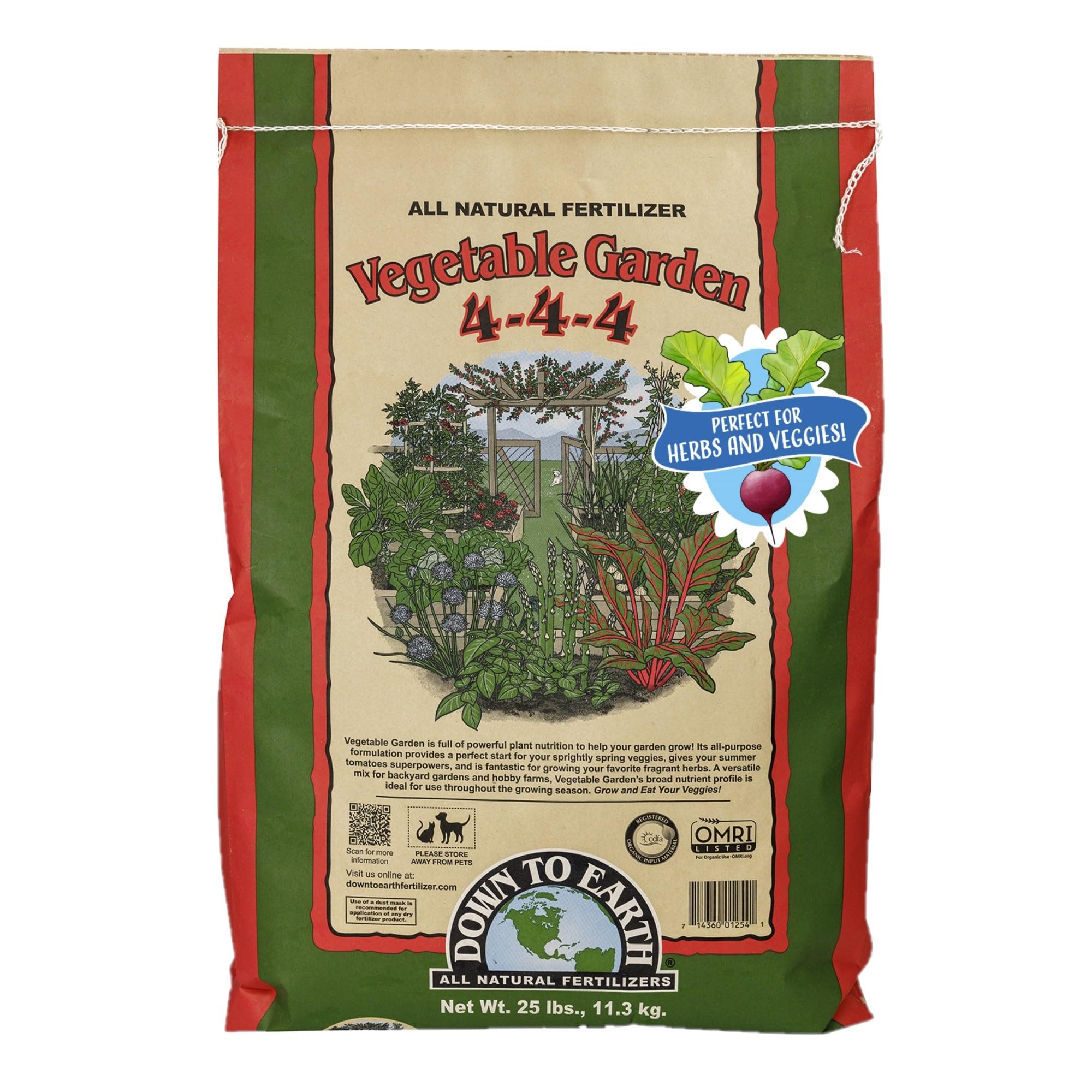
The bulk bag for serious onion growers who want season-long feeding from a single, balanced formula.
At 25 pounds, this is by far the largest bag here — compared with the 5-pound Down To Earth Tomato & Vegetable Mix and the 13.5-ounce Big A bag. The 4-4-4 ratio is evenly balanced, which means it supports steady leaf and bulb growth without pushing too hard in any direction. It is made from fish bone meal, alfalfa meal, feather meal, langbeinite, basalt, potassium sulfate, dolomite, and seaweed meal, which is a broader mineral profile than some simpler blends. Reviewers consistently rate it 5 out of 5, with one calling it the best organic fertilizer hands down and noting that it eliminates transplant shock and shows transformative health in plants.
The key difference from the 4-6-2 Down To Earth mix is the middle number — 4-4-4 instead of 4-6-2. The 4-6-2 has more phosphorus for early root push, while this 4-4-4 works better as a general-purpose maintenance feed through the whole season. If you are growing a large patch of onions, this bag will save you trips to the garden center and give you a single product to apply at planting and as a side-dress through the season. The trade-off is that 25 pounds is heavy to haul and store, and the balanced ratio is not optimized for any specific growth phase.
Why Seasoned Growers Love It
- 25 lb bag provides ample coverage for large beds and multiple plantings across the season.
- 4-4-4 balanced ratio works from transplant through harvest with no need to switch products.
- OMRI listed and derived from high-quality meals and minerals (fish bone, alfalfa, kelp, basalt).
Consider First
- Heavy and bulky to store — a 25 lb bag takes up significant floor or shelf space.
- 4-4-4 ratio is less phosphorus-dense than the 4-6-2 Down To Earth mix, which may matter for early bulb formation.
Best suited for: Gardeners with large in-ground beds who want a single, affordable, OMRI-listed granular that feeds all season without frequent re-application.
Consider a smaller bag if: You only have a small raised bed or container — the 25 lb bag will outlast the growing season and needs dry storage.
Understanding the Specs
N-P-K Ratio Explained for Onions
The three numbers on a fertilizer label stand for nitrogen (N), phosphorus (P), and potassium (K) — the primary macronutrients plants need in the largest amounts. Nitrogen encourages green leaf growth above ground. Phosphorus supports root development, energy transfer, and flower or fruit formation. Potassium strengthens cell walls, improves water efficiency, and helps plants handle stress. For onions, a higher nitrogen ratio (like 5-1-1) is useful in early spring to build leaf area that feeds the bulb. Once the days start lengthening and bulbs begin swelling, you want a ratio with a higher middle number (like 3-4-4 or 4-6-2) to support root growth and bulb density. Too much nitrogen late in the season produces thick necks and soft, watery bulbs that do not store well.
Granular vs. Liquid: Which Works When
Granular fertilizers are solid particles of organic material that release nutrients slowly as soil microbes and moisture break them down. You apply them to the soil before planting or as a side-dress alongside the row. They are lower maintenance because one application feeds onions for several weeks, but they need warm, moist soil to activate. Liquid fertilizers like fish emulsions are mixed with water and applied directly to the soil or as a foliar spray. The nutrients are immediately available to the plant, which makes liquids excellent for correcting a sudden deficiency or giving a quick boost to young transplants. The trade-off is that liquids must be reapplied more often — usually every two to three weeks — because they do not persist in the soil.
FAQ
What is the best N-P-K ratio for growing onions organically?
Can I use a tomato fertilizer on onions?
How often should I apply organic fertilizer to onions?
Will granular organic fertilizer burn my onion plants?
Does organic fish fertilizer smell bad, and how long does the smell last?
What does OMRI listed mean for an onion fertilizer?
Should I use liquid or granular fertilizer for onions?
How much organic fertilizer do I need for a 4×8 foot onion bed?
Can I use Dr. Earth 706P on onions that are already growing?
What is the difference between Down To Earth 4-6-2 and Down To Earth 4-4-4 for onions?
Final Thoughts: The Verdict
For most people, the best organic fertilizer for onions overall is the Down To Earth All Natural Tomato & Vegetable Mix 4-6-2 because its moderate nitrogen and elevated phosphorus hit the right balance for both leaf growth and bulb swelling across the season. If you prefer a two-phase approach — high-nitrogen liquid for spring green-up followed by a phosphorus-forward granular — get the Alaska Fish Fertilizer 5-1-1 for the starter phase and the Espoma Garden-tone 3-4-4 for the bulb-building stage. And for the soil-builder who wants a single bag to feed a large bed all season, the Down To Earth Vegetable Garden 4-4-4 in the 25-pound size gives you the most coverage per purchase.
How We Picked
We do not accept paid placement, and we did not hands-on test every unit. Instead, we match each pick to a real buyer and use-case by comparing the manufacturers’ published specifications against the patterns in verified customer reviews — so you get each pick’s real strengths and trade-offs instead of marketing copy.
Sources & Methodology
Specifications: manufacturer listings and product documentation. Review insights: verified customer reviews, as of July 2026. Pricing: not shown on this page (it changes often); check the current price via the retailer link.
As an Amazon Associate, Lawn Gear Lab earns from qualifying purchases. This does not affect which products we feature.