
Specs are compiled from manufacturer listings and verified buyer reviews and can change over time — please confirm the key details on the product page before buying.
If you are staring down a field, a pasture, a fence line, or an overgrown acre that simply will not stop producing weeds, you already know the real pain: a single spray bottle of ready-to-use stuff empties faster than you can walk a hundred feet. You need something that turns into dozens or hundreds of gallons of spray solution, not a weekly shopping trip to the hardware store. This guide cuts through the small-talk to find the concentrated formulas that deliver enough firepower to tackle a whole property without breaking your back or your budget.
I’m Rikta — the founder and writer behind Lawn Gear Lab. This guide is built by comparing the manufacturers’ published specifications and the patterns across verified customer reviews, so you get each pick’s real strengths and trade-offs instead of marketing spin.
The right concentrate can mean the difference between spot-treating every week and walking away for the season, so here is our close look at the top weed killer for large areas that actually earns its keep when you have real ground to cover.
Quick Picks
- Albaugh Gly Star Plus Herbicide (2.5 Gallons) Glyphosate Concentrate (41%) with Surfactant — Top Performer
- Roundup Pro Concentrate Herbicide – 1 jug (2.5 gal.) — Maximum Coverage
- PBI/GORDON Trimec Lawn Weed Killer, one gallon — Lawn-Safe Pick
- Southern Ag Crossbow Specialty Herbicide Low Volatile Weed & Brush Herbicide, 128oz – Gallon — Brush Buster
How To Choose The Best Weed Killer For Large Areas
When your target is measured in acres rather than square feet, every detail of the chemical you pick multiplies. A wrong choice means either damaging your turf or wasting weeks waiting for a second application.
Selective vs. Non-Selective: Your First Fork in the Road
A selective herbicide like Trimec is designed to kill broadleaf weeds while leaving your lawn grass completely alone — this is the go-to for an established yard. A non-selective formula like glyphosate kills every green thing it lands on, so it is perfect for clearing a new bed, a fence line, or a gravel path but disastrous if it drifts onto your lawn. Know which zone you are spraying before you pour the jug.
Concentration and Coverage: The Math That Matters
The “coverage” number on the label is the key spec. For example, one gallon of a selective concentrate might cover 32,000 to 64,000 square feet, while a 2.5-gallon jug of glyphosate concentrate can stretch up to 435,600 square feet depending on your mix rate. Always check how many ounces of product you mix per gallon of water — that ratio determines how many tanks you can fill from one jug.
Speed of Action and Surfactants
A built-in surfactant (a soap-like additive that helps the chemical stick to the waxy leaf surface) makes a visible difference. Some formulas show results in 48 hours, while others take seven to fourteen days. Faster is not always better — a slower translocation into the root system often kills the whole plant rather than just the top. Look for the active ingredient percentage and whether a surfactant is already mixed in.
Quick Comparison
On smaller screens, swipe sideways to see the full table.
| Model | Best For | Active Ingredient | Liquid Volume | Coverage | Amazon |
|---|---|---|---|---|---|
| Albaugh Gly Star Plus | Total vegetation clearing | Glyphosate 41% | 2.5 Gallons | See label | Amazon |
| Roundup Pro Concentrate | Maximum raw coverage | Herbicide blend | 2.5 Gallons | 435,600 sq. ft | Amazon |
| PBI/GORDON Trimec | Lawn-safe weed control | Trimec | 1 Gallon | 32K – 64K sq. ft | Amazon |
| Southern Ag Crossbow | Tough brush and vines | Garlon, 2,4-D | 128 Fluid Ounces | 2.23 acres | Amazon |
In‑Depth Reviews
1. Albaugh Gly Star Plus Herbicide (2.5 Gallons) Glyphosate Concentrate (41%) with Surfactant

The non-selective workhorse that wipes out everything green across acre-scale jobs.
If you need to clear a plot of land, a fence line, or a gravel drive without worrying about damaging ornamental grass, this is the jug to reach for. The active ingredient is glyphosate at 41% — the same chemical backbone as the big-brand Roundup Ultra — and it already has a surfactant (a sticking agent) built into the liquid, so you do not have to buy and mix a separate additive to make it cling to waxy leaves. The 2.5-gallon jug holds 2.5 gallons of concentrate, giving you a size advantage over the PBI/GORDON Trimec at 2.5 gallons versus one gallon.
Be aware: this is a non-selective herbicide, meaning it kills any vegetation it touches, including grass. It is labeled for professional and commercial use, and the manufacturer restricts sale to several states including California and Washington. A buyer report noted that “takes about 10 days to two weeks to see everything dead, but for the price it’s worth it,” so patience is part of the plan. The same reviewer used a mix rate of 2.5 oz per gallon of water — a good starting point for general broad-spectrum work. The instruction booklet is reportedly excellent and very detailed for many different plant targets.
The catch is residual protection: this has no soil residual activity, which means it does not prevent new weeds from germinating after the current batch dies. Plan on follow-up spot treatments over the season if you are clearing a garden bed.
Why It Earns The Top Spot
- High 41% glyphosate concentration with surfactant already blended in
- 2.5-gallon size goes further than gallon jugs for large properties
- Detailed, plant-specific mixing instructions in the booklet
The Trade-Offs
- Not for residential use per label — intended for commercial applications
- Slow full kill (10–14 days for some users)
- Cannot be sold to several states including CA, OR, WA
Perfect for clear-the-whole-thing jobs: If you need to kill everything on a large site and are willing to wait up to two weeks, the extra volume and built-in surfactant make this the best value jug here.
Not your lawn’s friend: It kills grass as fast as it kills weeds, so skip it if you want to keep your turf alive.
2. Roundup Pro Concentrate Herbicide – 1 jug (2.5 gal.)
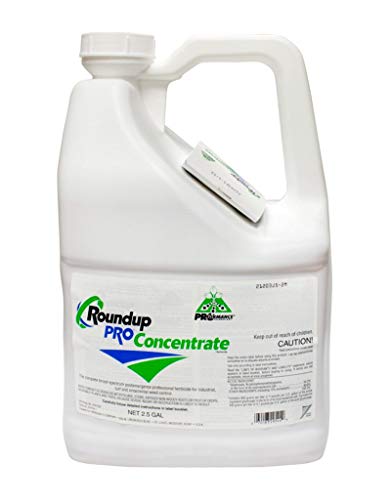
The super-concentrate champion that turns one jug into a tractor-trailer load of spray.
If raw coverage area is your deciding metric, this jug is the one to beat. The Roundup Pro Concentrate promises coverage of up to 435,600 square feet — that is roughly ten acres of ground from a single 2.5-gallon container. It holds 300 fluid ounces total, versus the PBI/GORDON Trimec’s 128 ounces. One reviewer crunched the numbers and noted it makes roughly 150 gallons of standard-strength spray or about 30 gallons of super-strength mix. The recommended mix rate per buyer reports is 2.5 to 3 oz per gallon of water, and those same users report visible results in 3 to 4 days with a full kill inside a week — noticeably faster than the two-week timeline of the Albaugh Gly Star Plus.
Buyers call it “the real deal” and say it works faster than generic brands. One long-time user mentions keeping it in a large tank in spring and spot-treating survivors with a hand sprayer throughout the season. The biggest practical hassle is the jug itself: it is heavy, and you will need a 63mm threaded hand pump spigot to dispense it cleanly. A reviewer recommends the Flying Skull Plant Products pump (1 oz per pump) for easy measuring.
Note: this product cannot be shipped to Wisconsin or New Jersey, so check local restrictions before ordering.
The Draw
- Massive 435,600 sq. ft coverage from one jug
- Faster kill than many generics — 3-4 days to see results
- Super-concentrate ratio stretches your dollar per acre
The Catch
- Heavy jug requires a separate pump spigot for dispensing
- Not for sale in Wisconsin or New Jersey
- Expensive upfront, though cheaper than hiring a pro service
Best for ten-acre-plus properties: If you are covering multiple acres and want the fastest kill speed at the lowest cost per square foot, the Roundup Pro Concentrate is the undisputed coverage king.
pass on it if your area is under an acre: The jug is huge and the mix ratio is extremely concentrated — you will end up storing leftover for years.
3. PBI/GORDON Trimec Lawn Weed Killer, one gallon

The selective formula that takes out broadleaf weeds while letting your cool-season grass thrive.
Unlike the non-selective glyphosate formulas above, Trimec is a selective herbicide that targets broadleaf weeds like dandelions, clover, and Creeping Charlie while being safe for cool-season turfgrasses. That makes it the right choice when your goal is a pristine lawn rather than a blank slate. The one-gallon jug covers 32,000 to 64,000 square feet depending on the infestation level — a solid range for a typical suburban property. Reviewers report that it killed Creeping Charlie in 2 to 3 days, while tougher plants like Virginia Buttonweed took about 2 weeks to die entirely. One home user applied 16 oz through a hose-end sprayer at 83°F and the turf stayed healthy, though dead weed patches appeared where the weeds had been.
One honest buyer note: several customers received Ferti-lome Weed-Out (which also contains Trimec) instead of the branded PBI/GORDON bottle. The product inside still did the job, but brand-picky shoppers should be aware of the substitution risk. Another reviewer found that for heavy infestations, you may need to double or even triple the mixture concentration and may require multiple applications — so it is not a one-and-done solution for seriously overgrown yards.
Compared to the Southern Ag Crossbow below, this is a gentler tool: it will not kill woody brush or trees, but it will not risk burning your lawn either.
Why Your Lawn Will Like It
- Selective formula kills broadleaf weeds without harming cool-season grass
- Fast action on common weeds (2-3 days for Creeping Charlie)
- Large coverage range for a one-gallon jug
The Honest Head-Scratcher
- May need double or triple concentration for tough / established weeds
- Some buyers received a different brand (Ferti-lome) instead of PBI/GORDON
- Not effective against woody brush or trees
Grab this if you want a weed-free lawn, not a dead lawn: The selective chemistry makes it the only pick here that you can safely spray over your whole yard without torching the grass.
Look elsewhere if you are clearing brush or starting from bare dirt: This will not kill vines, saplings, or established woody growth.
4. Southern Ag Crossbow Specialty Herbicide Low Volatile Weed & Brush Herbicide, 128oz – Gallon

The brush-killing specialist that chews through vines, trees, and overgrowth the others cannot touch.
When your large-area problem is not just weeds but actual woody brush, vines, saplings, and 8-foot-tall overgrowth, the selective lawn formulas will bounce off. Crossbow is built for this exact job with a blend of Garlon and 2,4-D as its active ingredients. The one-gallon jug has an incredible yield: it makes up to 96 gallons of spray solution and covers 2.23 acres per the label. One reviewer noted that it killed everything — ivy, vines, small trees, bushes, and grass — within a week, with visible results appearing within 48 hours. Another reviewer described it as a “safer alternative to Roundup” with a 3-day soil half-life and no glyphosates or neonicotinoids.
The catch is that effectiveness seems to vary with soil type. One detailed buyer report tested it across three different soils: it killed 85% of Creeping Charlie on brown Ohio soil, 70% on Indiana soil, and only 30-35% on rich Illinois soil, likely due to rain and snow conditions. The same reviewer noted it has a strong odor and requires gloves. It also struggled against wild violets and poison hemlock, so it is not a universal tool. Pokeweed wilted overnight — a very fast response on that particular target.
If you need to reclaim a fence line overrun with multiflora rose, poison ivy, or small trees, Crossbow is the most efficient choice here. For a straight lawn-weed problem, the Trimec or one of the glyphosate concentrates is a better fit.
Where It Dominates
- Kills woody brush, vines, and small trees that standard weed killers cannot handle
- Massive 96-gallon spray solution yield per jug
- Visible results in 48 hours with full kill in one week
The Limits
- Effectiveness varies significantly between soil types
- Strong chemical odor; requires gloves and protective gear
- Not effective on all weeds (wild violets, poison hemlock)
For the person reclaiming a thicket: If your “weeds” are actually bushes, brambles, and saplings, Crossbow is the right chemistry for the job and nothing else in this list matches it for woody growth.
Skip it for a regular lawn: Its strength against brush is overkill and potentially damaging to turf; save it for the rough edges of your property.
Understanding the Specs
Active Ingredient & Concentration
This is the chemical that actually kills the plant. Glyphosate (41% in the Albaugh Gly Star Plus) is a non-selective systemic that moves through the plant to the roots; Trimec is a selective blend for broadleaf weeds in lawns; and the Garlon/2,4-D combination in Crossbow targets woody brush. A higher percentage means you use less product per gallon of water — but it also means the margin for error on mixing is smaller.
Coverage & Mix Ratio
The coverage number (e.g., 435,600 sq. ft for Roundup Pro, 32,000-64,000 sq. ft for Trimec, 2.23 acres for Crossbow) assumes you mix the concentrate at the label’s recommended rate. Different rates produce different coverage, so the same jug can last a season or one big afternoon depending on how heavy the infestation is. Always check the ounces per gallon and the total spray solution the jug can produce — that is the real test of value for large areas.
FAQ
How much concentrate do I need for one acre of weeds?
Can I use a non-selective weed killer like Gly Star Plus on my lawn?
How long does a concentrated weed killer last in the jug?
What is a surfactant and why does it matter?
Can I mix different weed killers together for a stronger solution?
Do I need a special sprayer for these concentrated gallons?
How soon after spraying can I let my pets or kids on the treated area?
Why can I not buy the Albaugh Gly Star Plus in California or Oregon?
Will Southern Ag Crossbow kill poison ivy and poison oak?
What is the difference between Trimec and standard 2,4-D?
Final Thoughts: The Verdict
For the majority of shoppers, the weed killer for large areas winner is the Albaugh Gly Star Plus because it blends a high 41% glyphosate concentration with a built-in surfactant in a generous 2.5-gallon jug, giving you the simplest path to clearing big patches without a trip to the hardware store mid-project. If you want the absolute maximum acreage coverage from a single jug, grab the Roundup Pro Concentrate. And for keeping your lawn intact while killing broadleaf weeds across a well-maintained yard, the standout is the PBI/GORDON Trimec.
How We Picked
We do not accept paid placement, and we did not hands-on test every unit. Instead, we match each pick to a real buyer and use-case by comparing the manufacturers’ published specifications against the patterns in verified customer reviews — so you get each pick’s real strengths and trade-offs instead of marketing copy.
Sources & Methodology
Specifications: manufacturer listings and product documentation. Review insights: verified customer reviews, as of July 2026. Pricing: not shown on this page (it changes often); check the current price via the retailer link.
As an Amazon Associate, Lawn Gear Lab earns from qualifying purchases. This does not affect which products we feature.