
Specs are compiled from manufacturer listings and verified buyer reviews and can change over time — please confirm the key details on the product page before buying.
Picking the right 1/4-inch drip tubing feels simple until you’re wrestling a coil that refuses to bend around a corner or fight a barbed fitting. The difference between a quick afternoon setup and a frustrating, leaky mess often depends on a few key specs—material, pressure rating, and if you want pre-installed emitters.
I’m Rikta — the founder and writer behind Lawn Gear Lab. This guide is built by comparing the manufacturers’ published specifications and the patterns across verified customer reviews, so you get each pick’s real strengths and trade-offs instead of marketing spin.
Adding a single planter drip line or overhauling a whole row of raised beds? The small tubes’ handling of water, weather, and connectors decides if you get a thriving garden or a chore. Here is how to sort the best 1/4 drip irrigation tubing for your setup.
Quick Picks
- Rain Bird XQ100 Irrigation 1/4″ Polyethylene Distribution Tubing – 100 Foot Coil — Top Performer
- Rain Bird ET256-50S Drip Irrigation Pressure Compensating 1/4″ Emitter Tubing, 6″ Emitter Spacing, 50 Roll, Brown — Best Overall
- CARPATHEN 1/4 Drip Irrigation Tubing – 100 ft Black Drip Irrigation Hose — Great Value
- Maotong 100FT 1/4 inch Drip Irrigation Tubing Distribution Hose Tube — Fittings Bundle
- Habitech 1/4″ Irrigation Dripline Tubing (100 Ft Roll) – 6″ Emitter Spacing — Pre-Installed Dripline
- DIG B38100 100’ ¼” Vinyl Tubing (.170 ID x.250 OD) — Budget Pick
How To Choose The Best 1/4 Drip Irrigation Tubing
Your drip system’s small-diameter tube has one job: deliver water exactly where you want it without kinking, cracking, or leaking. Three specs decide how well it does that job.
Material: Polyethylene (PE) vs. Vinyl
Polyethylene tubing holds its shape, resists UV rays far longer, and can handle higher water pressure without ballooning. Vinyl tubing is noticeably softer to the touch, making it more pliable in cold weather. But buyers report it can be very difficult to get standard barbed fittings to seat properly without heating the ends first.
Pressure Rating (PSI)
Your system’s maximum water pressure dictates which tubing is safe. Lower-rated tubing (around 30 PSI) works on gravity-fed or regulated systems. Tubing rated to 60 PSI matches standard household water pressure and leaves you room to expand your layout without worry.
Pre-installed Emitters vs. Blank Tubing
Blank tubing acts as a distribution line—you cut it and add your own drip emitters or sprayers wherever you need them. Pre-installed emitter tubing has drippers built in at set intervals (like every 6 inches), perfect for watering a dense row of vegetables in a raised bed without any assembly work.
Quick Comparison
On smaller screens, swipe sideways to see the full table.
| Model | Best For | Material | Max Pressure | Length | Amazon |
|---|---|---|---|---|---|
| Rain Bird XQ100 | High-pressure distribution | Polyethylene | 8.5–60 PSI | 100 ft | Amazon |
| Rain Bird ET256-50S | Even watering in rows | Plastic (PE) | 60 PSI | 50 ft | Amazon |
| CARPATHEN 1/4″ Tubing | DIY starter kits | Polymer | — | 100 ft | Amazon |
| Maotong 100FT Kit | Kit with extra fittings | Polyethylene | — | 100 ft | Amazon |
| Habitech 1/4″ Dripline | Pre-installed emitter line | Polyethylene | 50 PSI | 100 ft | Amazon |
| DIG B38100 | Budget-friendly vinyl line | Vinyl | 30 PSI | 100 ft | Amazon |
In‑Depth Reviews
1. Rain Bird XQ100 Irrigation 1/4″ Polyethylene Distribution Tubing – 100 Foot Coil

The workhorse distribution line that shrugs off high pressure and sun exposure.
You get a 60 PSI (pounds per square inch) rating on this Rain Bird coil, versus the DIG vinyl tube below at 30 PSI. That means you can hook it to standard household water pressure without worrying about bursts. The textured surface gives you a good grip when pushing onto barbed fittings, and it works above or below grade.
Owners mention it is durable but note that a heat gun helps fit connectors—a small step that makes installation smoother. For runs longer than 20 feet with multiple sprinklers, reviewers recommend using a 1/2-inch header with 1/4-inch splits, which this tubing handles perfectly. One owner switching from a home-store brand called it superior, saying it lasts longer and is easier to use. The only real thing to know is that like most polyethylene tubing, it benefits from a moment in hot water or sun before you push on fittings.
What you get
- 60 PSI rating handles full household pressure
- UV-resistant polyethylene lasts outdoors
- Textured finish for easy handling
- 100-foot coil covers large layouts
One trade-off
- Stiffer than vinyl; may need heat for connector installation
Reach for this if: you want a reliable, high-pressure distribution line that will hold up for years in the sun.
Look elsewhere if: you need super-flexible tubing for tight, cold-weather bends without any extra preparation.
2. Rain Bird ET256-50S Drip Irrigation Pressure Compensating 1/4″ Emitter Tubing, 6″ Emitter Spacing, 50 Roll, Brown

Pre-installed emitters deliver even watering with no guesswork or assembly.
You get pressure-compensating emitters (drippers that adjust to keep flow constant on slopes) built in every 6 inches on this 50-foot roll. Each emitter puts out 0.8 gallons per hour (GPH). That spacing and flow rate are ideal for dense rows in a raised bed, flower garden, or greenhouse because every plant along the line gets the same amount of water regardless of the terrain or distance from the source.
The emitters have two outlet holes set 180 degrees apart, meaning each dripper waters both sides of the tube—a clever design for a square-foot garden where you snake the line back and forth. Customers note the tubing works well once set up, but they note the material is stiff and difficult to lay in tight curves without heating in the sun. One owner ran it elevated 1 inch above soil with stakes in a grid pattern, finding a 15-minute run moistened a 2×4-foot bed nicely. It operates between 8.5 and 60 PSI, so it fits regulated systems as well as higher-pressure household lines. The unique micro-porous construction is said to create an ultra-tight connection with barbed fittings, reducing leaks at the join points.
Best for
- Built-in 0.8 GPH emitters spaced 6 inches apart
- Pressure-compensating design for even flow
- Dual outlet holes water both sides
- No maintenance soaker hose alternative
Watch out for
- Stiff tubing; needs sun or hot water to soften
- Only 50 feet long—short for large layouts
Great for: raised beds and row crops where you want a consistent, hands-off drip line with zero assembly of individual emitters.
skip it if: you just need a blank distribution tube and want to install your own emitters at custom locations.
3. CARPATHEN 1/4 Drip Irrigation Tubing – 100 ft Black Drip Irrigation Hose
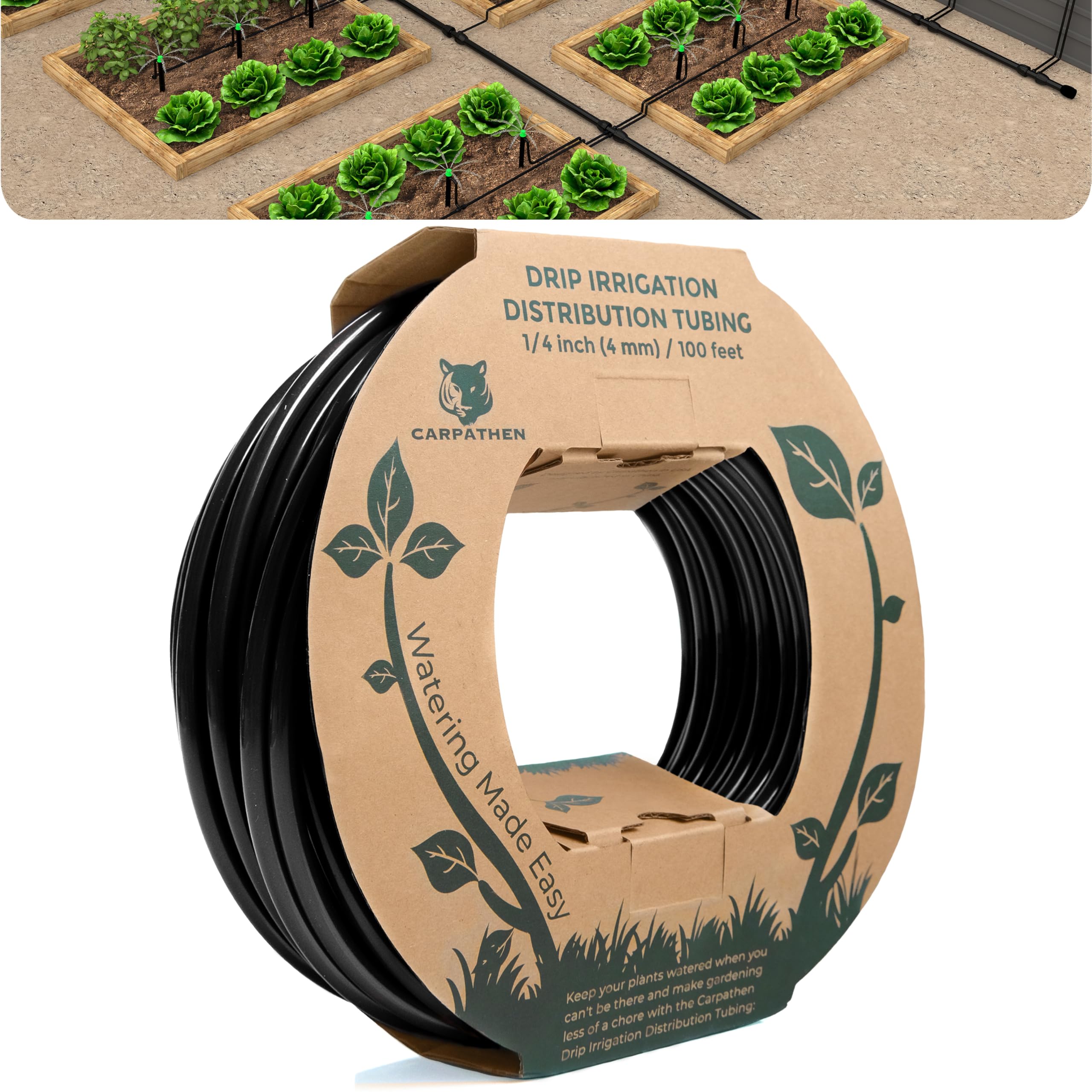
A flexible, budget-friendly coil that gets first-time irrigators set up fast.
CARPATHEN offers a 100-foot coil of black polymer tubing that buyers call excellent for a first-time garden irrigation system. The material is flexible enough to shape around garden beds without needing a lot of force—a clear advantage over the stiffer Rain Bird XQ100. The instructions recommend putting the cut end in hot water for a minute to soften it before connecting to emitters and the main 1/2-inch line.
Reviewers point out that keeping the tubing clean from soil helps prevent issues, and they recommend adding a 25 PSI regulator and filter to the system for best performance. The UV-resistant design is meant for both underground and above-ground installation, season after season. One experienced user mentioned the company has a responsive customer service team, though another reviewer reported trouble getting support for line ruptures.
Why it works
- Flexible polymer material, easy to bend and cut
- 100-foot length covers many beds
- UV-resistant for year-round outdoor use
- Comes with digital growing guides
One concern
- Customer support responsiveness reported as inconsistent
Pick this for: a beginner-friendly, affordable distribution line that bends easily around your garden layout.
Look elsewhere if: you need a high PSI rating for an unregulated, direct-from-spigot system.
4. Maotong 100FT 1/4 inch Drip Irrigation Tubing Distribution Hose Tube
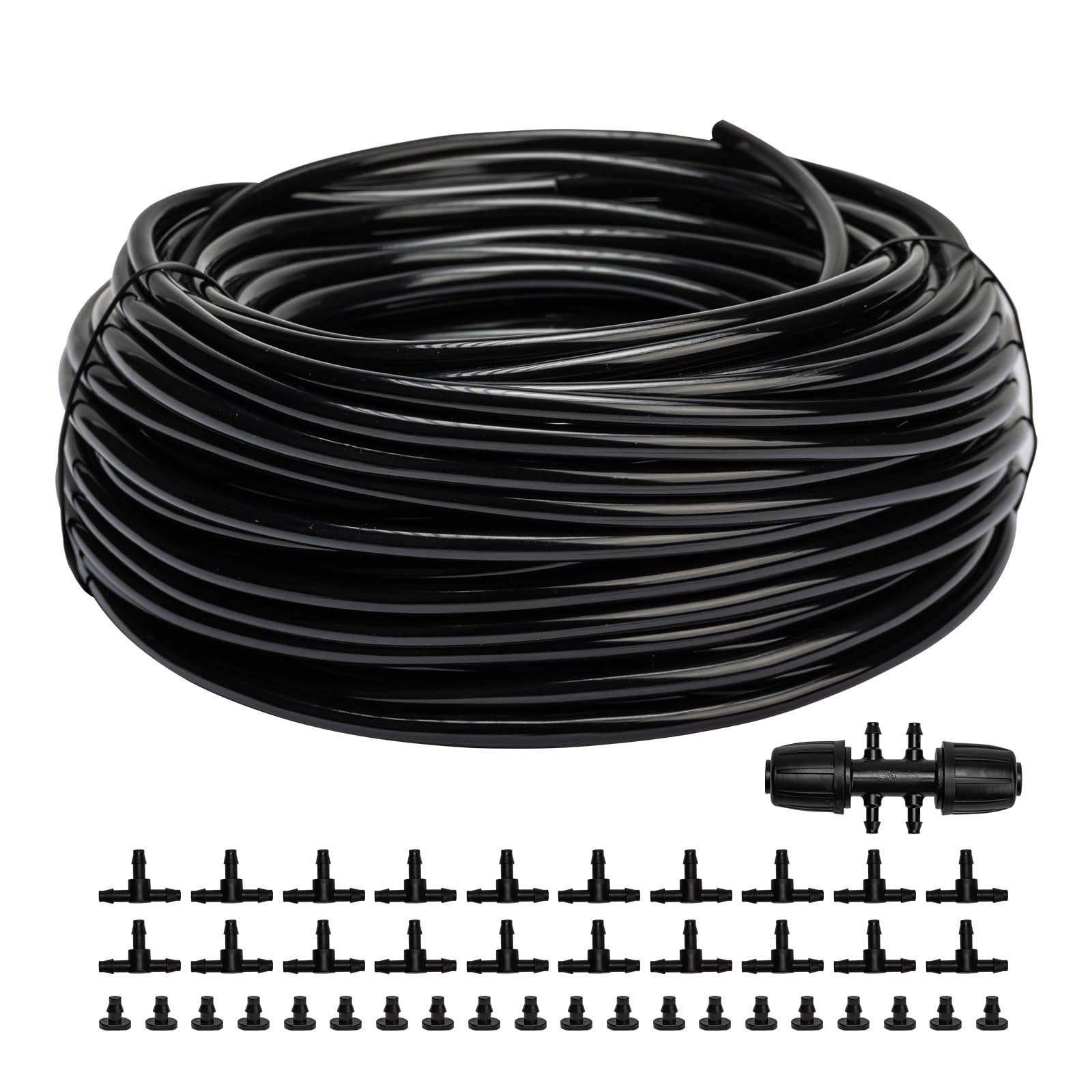
A complete starter pack that pairs the tubing with splitters, plugs, and a 6-way connector.
Maotong’s kit gives you a 100-foot roll of 1/4-inch polyethylene tubing plus 20 tee splitters, 20 end plugs, and one 6-way connector—42 pieces total. That means you can build a small branched distribution network right from the start without buying extra parts. The tubing has an inner diameter of 4mm and an outer diameter of 7mm, with a wall thickness of 3mm. The maker says this offers double explosion-proof protection against pressure bursts, though this is a marketing claim.
Buyers describe it as very flexible and pliable, with adaptors that connect easily. One owner used it with a timer for a 10-day plant-watering setup but noted a spray head blew off due to overpressure, which they fixed by adjusting the faucet flow rate. The material is polyethylene certified by ROSH (a safety standard for restricted substances) and withstands temperatures between -20°C and 70°C, making it usable year-round in most climates.
Standout benefits
- Includes 41 extra fittings and plugs for fast setup
- Thick 3mm wall for burst resistance
- Highly flexible for curves and switchbacks
- ROSH-certified polyethylene
Potential issue
- Spray heads can blow off at high pressure; adjust flow at faucet
Ideal for: anyone building a new drip network who wants tubing and connectors in a single buy.
Consider another if: you already own a box of fittings and just need the tubing roll alone.
5. Habitech 1/4″ Irrigation Dripline Tubing (100 Ft Roll) – 6″ Emitter Spacing

A full 100 feet of emitter tubing that waters rows evenly with no extra drippers to buy.
Unlike the blank tubing picks above, the Habitech roll comes with 0.5 GPH emitters built in at 6-inch intervals along the entire 100-foot length. That is ideal for dense vegetable rows in raised beds or greenhouse benches because every plant gets slow, even moisture without you having to measure and install each dripper. The maximum pressure rating is 50 PSI, and the maximum recommended run length for each dripline section is 19 feet.
The kit also includes five barbed couplings and 10 goof plugs—enough to connect to your main 1/2-inch line and cap off the ends. Shoppers say that 6-inch spacing works noticeably better than 12-inch spacing in planters and raised beds. One reviewer who uses it on two new garden beds said the spacing and water volume provide great coverage for rows of vegetables. Some owners mention that barbed connectors are easier to install when the tubing is heated, and that no extra connectors beyond those included come in the package, so plan ahead for larger layouts.
What stands out
- Built-in 0.5 GPH emitters every 6 inches
- 100-foot roll covers large garden beds
- Includes couplings and goof plugs
- More durable than drip tape or soaker hose
Keep in mind
- Maximum run length is 19 feet per line
- Connectors take effort without heating tubing
Perfect for: anyone with long raised beds or greenhouse rows who wants a 100-foot dripline with no extra assembly of emitters.
Pass on this if: you need custom emitter placement at uneven intervals for pots or sparse plantings.
6. DIG B38100 100’ ¼” Vinyl Tubing (.170 ID x.250 OD)

Soft vinyl that bends easily—if you can get the fittings to stay put.
DIG’s vinyl tubing is the most flexible option here, which makes it popular for tight, curving layouts where stiff polyethylene tubes simply will not cooperate. At 100 feet and a 30 PSI maximum pressure rating, versus the Rain Bird XQ100 at 60 PSI, it is best suited for low-pressure, regulated systems. Long-time buyers report the formulation is not as soft as it used to be, but it remains significantly easier to work with than standard poly hose.
The catch is well-documented in buyer reports: the vinyl material is nearly impossible to insert standard 1/4-inch fittings without heating each end—one reviewer noted it requires a blowtorch, calling it a major nuisance. Another owner noted that while fittings take effort to insert, they stay secure even in 100-108°F Texas heat, which is a real advantage in hot climates where softer hoses can loosen up.
Why choose it
- Very flexible vinyl for tight curves
- Made in the USA
- Fittings stay secure even in extreme heat
Real trade-off
- Inserting fittings almost always requires heating the tubing end
- 30 PSI limit—not for direct household pressure
Best for: low-pressure systems where you value extreme flexibility and the fittings can be pre-heated.
Look elsewhere if: you want a quick, no-prep connection to standard barbed fittings right from the start.
Understanding the Specs
Material Matters: Polyethylene vs. Vinyl
Polyethylene (PE) tubing is the standard in professional drip systems. It resists UV rays, holds up under higher pressure, and keeps its shape when buried. Vinyl is noticeably softer and more pliable, especially in cold weather, but it can be harder to push onto barbed fittings without first softening the end in hot water. PE is the more durable choice for year-round outdoor use; vinyl works better for short-term or indoor setups where flexibility is the top priority.
PSI Rating and What It Means for Your System
The maximum pressure rating, measured in pounds per square inch (PSI), tells you the highest water pressure the tubing can handle without bursting. Standard household water pressure often runs between 40 and 60 PSI. Tubing rated at 30 PSI requires a pressure regulator to avoid damage. Tubing rated at 60 PSI can connect directly to a spigot that is regulated, giving you more flexibility to add longer runs or more emitters without risking a blowout.
FAQ
Can I bury 1/4 drip irrigation tubing underground?
What is the difference between blank tubing and pre-installed emitter tubing?
How do I connect 1/4 tubing to my main 1/2 inch line?
What PSI regulator do I need for drip irrigation?
How long can a single 1/4 inch drip line run?
Can I use 1/4 drip tubing for a misting system?
Why is my 1/4 drip tubing leaking at the fittings?
Which is better for cold weather: vinyl or polyethylene tubing?
How do I cut 1/4 drip irrigation tubing cleanly?
Final Thoughts: The Verdict
Across the board, the best 1/4 drip irrigation tubing winner is the Rain Bird XQ100 because it combines a 60 PSI rating, durable polyethylene construction, and a 100-foot coil at a price that beats many competitors per foot. If you want pre-installed emitters for a raised bed setup, grab the Rain Bird ET256-50S. And for a budget-friendly bundle that includes all the fittings, the Maotong 100FT Kit is the easiest way to get a whole system running in one afternoon.
How We Picked
We do not accept paid placement, and we did not hands-on test every unit. Instead, we match each pick to a real buyer and use-case by comparing the manufacturers’ published specifications against the patterns in verified customer reviews — so you get each pick’s real strengths and trade-offs instead of marketing copy.
Sources & Methodology
Specifications: manufacturer listings and product documentation. Review insights: verified customer reviews, as of July 2026. Pricing: not shown on this page (it changes often); check the current price via the retailer link.
As an Amazon Associate, Lawn Gear Lab earns from qualifying purchases. This does not affect which products we feature.