
Specs are compiled from manufacturer listings and verified buyer reviews and can change over time — please confirm the key details on the product page before buying.
You want strong, compact plants, not pale, stretched stems reaching for a weak window. The difference between a grow light that works and one that is just glowing is in reaching the right intensity and coverage for the size of your indoor garden — a tiny clip-on for a single pot is useless for a tall fiddle leaf fig, and a massive panel overwhelms a desktop herb tray. This guide breaks down seven specific picks, from a towering floor lamp to a pro-grade panel, using published specs and real owner experiences so you match the light to the plant, not the other way around.
I’m Rikta — the founder and writer behind Lawn Gear Lab. This guide is built by comparing the manufacturers’ published specifications and the patterns across verified customer reviews, so you get each pick’s real strengths and trade-offs instead of marketing spin.
Whether you are starting seeds under a desk lamp or keeping a collection of monsteras thriving through a dark winter, understanding the difference between a 10-watt clip-on and a 150-watt panel is what separates successful indoor gardening from frustration — read on for the breakdown of the best plant grow lights for your specific setup.
Quick Picks
- VIPARSPECTRA XS1500 Pro LED Grow Light — Top Performer
- LBW Grow Light with Stand for Indoor Plants — Best Overall
- SANSI Dual-Head Clip Grow Light (20W / 300W Equivalent) — Versatile Value
- Uallhome 2-Pack LED Grow Light Panel 200W — Panel Power
- TYAGMAM 4-Pack 2ft T8 LED Grow Light Strips — Rack Ready
- FECiDA Desk Grow Light for Indoor Plants — Desktop Champ
- SANSI Clip-on LED Grow Light (10W) — Budget Clip
How To Choose The Best Plant Grow Lights
A grow light is just a fancy bulb unless it delivers the right amount of usable light to your plant’s leaves. Before you click buy, match three things: the light’s reach, its spectrum, and how automated it is.
Coverage and Height: Where Does the Light Land?
A light that sits two inches above a small succulent pot is a very different tool from a light you need to cover a 4×4-foot grow tent. Floor-standing models like the LBW tower adjust up to 68 inches to bathe a tall fiddle leaf fig, while a compact desk model like the FECiDA only reaches 24 inches high. The general rule is the farther the light is from the plant, the weaker the intensity reaching lower leaves — so think about the tallest plant in your collection before choosing a stand height.
Spectrum: Sunlight in a Box vs. Pink Blurple
Full-spectrum lights mimic natural daylight with a balanced mix of warm and cool white LEDs, which makes leaves look natural green and supports every growth stage from seedling to flower. Red-and-blue-only lights (sometimes called “blurple”) can work but make leaves look weirdly purple and make it hard to spot pests or yellowing. For most houseplants, pick a light that includes white LEDs, ideally covering a range like 380–800nm as seen in the LBW stand model.
Timers and Dimming: Set and Forget vs. Manual Control
Plants need consistent day and night cycles, so a built-in timer that repeats daily is a major convenience. The LBW offers 6, 8, 12, or 16-hour options that cycle automatically, while the VIPARSPECTRA has no timer at all and relies on a smart plug. If you have both low-light ferns and high-light succulents in one room, a dimmable light with multiple brightness levels — like the LBW’s 20%-100% range — lets you adjust coverage without moving the lamp.
Quick Comparison
On smaller screens, swipe sideways to see the full table.
| Model | Best For | Power | Height / Length | Timer / Dimmer | Amazon |
|---|---|---|---|---|---|
| VIPARSPECTRA XS1500 Pro | Serious growers (tents) | 150W | 14.2″L | Dimmer (no timer) | Amazon |
| LBW Stand Grow Light | Tall floor plants | 80 LEDs (1080 lumens) | 68″H | 6/8/12/16H timer + 5-level dimmer | Amazon |
| SANSI Dual-Head Clip (300W) | Versatile clip-on coverage | 20W total (2000 lm) | 7.72″L head | 4/8/12H timer | Amazon |
| Uallhome 2-Pack Panel | Grow tent / greenhouse | 200W equivalent | 12″x12″ panel | None (plug-and-play) | Amazon |
| TYAGMAM 4-Pack T8 Strips | Shelf / greenhouse racks | 100W total (4000 lm) | 23.6″L | None | Amazon |
| FECiDA Desk Grow Light | Seed starting / desktop | 25W (2000 lm) | 24″H | None (physical switch) | Amazon |
| SANSI Clip-on (10W) | Single pot / small plants | 10W (169.7 μmol/s/㎡ @ 6in) | 15.4″H goose | 3/6/12H timer + 4-level dimmer | Amazon |
In‑Depth Reviews
1. VIPARSPECTRA XS1500 Pro LED Grow Light

The serious panel for the grower who wants dialed-in intensity across a tent.
This is the heavyweight in the lineup. The VIPARSPECTRA XS1500 Pro draws 150 watts of actual power, and unlike budget lights that claim high wattage equivalents with tiny chips, this one uses optical lenses to concentrate light into a uniform pattern — reviewers report PAR levels (photosynthetically active radiation, a measure of usable light) of 747 at 50% intensity from 13 inches away, so the light hitting your plants is intense and even across a 2×2-foot flowering area or a 3×3-foot veg space. The full spectrum combines white 3000K, 5000K, red 660nm, and IR 730nm LEDs to cover everything from seed starting to flower.
The dimming daisy chain (a feature that lets you link multiple lights together and control brightness from one dial) is what separates it for commercial or serious hobby setups — you can connect up to 20 of these lights and control the brightness of all of them from one dial. One caveat: there is no built-in timer, so you will need to pair it with a smart plug (a plug with an app) for consistent on/off cycles. Buyers who grow hot peppers and succulents report it transformed plants that had failed for years, though some note it can scorch seedlings if the intensity is left too high. At 2.55 kilograms (roughly 6 pounds), it is heavy — plan for sturdy ratchet straps in your tent.
Why It Leads
- Actual 150W draw means real light power, not inflated marketing numbers.
- Dimmable daisy chain lets you scale up to 20 units for a large grow room.
- Optical lenses deliver measured 747 PAR at 50% intensity, so light reaches lower leaves.
- Runs cool and quiet — no noisy fans.
One Catch
- No built-in timer — you must buy a separate outlet timer or smart plug.
- Heavy at 6 pounds; the included rope hangers are adequate but a sturdy support is wise.
Grab this for: anyone with a 2×2 or 3×3 grow tent who wants precise, dimmable light that can scale up to a multi-light commercial setup.
Look elsewhere if: you need a plug-and-go light with a timer from the start for a single houseplant — the convenience is not here.
2. LBW Grow Light with Stand for Indoor Plants
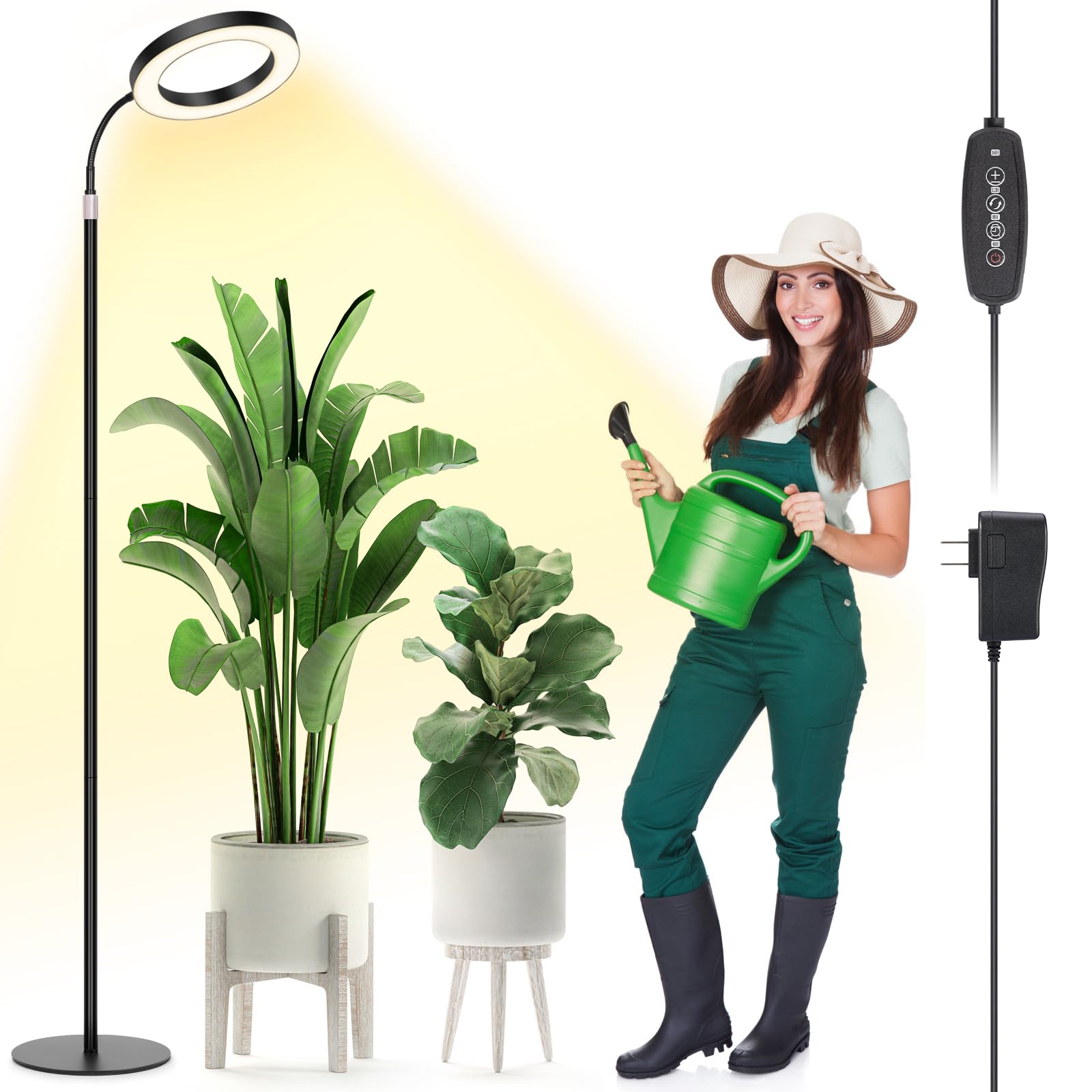
The floor-standing tower that reaches from low pots to a 6-foot tree canopy.
If you have a tall indoor tree like a fiddle leaf fig or a monstera that refuses to stay small, this is the light that physically fits. The LBW extends from 20 inches to 68 inches high, while a desktop model like the FECiDA reaches 24 inches, so you can raise it as your plant grows. It uses 80 high-output LEDs delivering 1080 lumens of full-spectrum light (380–800nm), and the heavy-duty metal base with non-slip pads keeps it planted even if you bump into it. One reviewer noted using it daily for five months and seeing 2 feet of new growth on monsteras, with cycles of 4 hours on and 30–45 minutes off to prevent overheating.
The built-in timer is genuinely useful: you pick a 6, 8, 12, or 16-hour cycle, and it automatically turns on and off at the same time every day — no smart plugs or fiddling required. The 3 lighting modes and 5 brightness levels (20%–100%) let you dial down for low-light plants like pothos or crank it up for active growth on vegetable starts. Assembly is tool-free: slot the pole, attach the gooseneck head, and plug it in. The item measures just 8.2 inches long by 6.3 inches wide at the base, so it tucks into a corner without stealing your whole floor.
Standout Strengths
- Height adjusts to 68 inches, easily the tallest in this guide for big floor plants.
- Four timer options plus 5-level dimmer — set it once and forget it.
- Sturdy metal base with non-slip pads prevents tipping on hardwood or tile.
- Tool-free assembly — ready in under five minutes.
Room for Improvement
- 1080 lumens is fine for a few larger plants but will not cover a wide shelf of succulents.
- No daisy-chain option if you want to link multiple units on a single plug.
Best for: any indoor gardener with a tall plant or a corner that needs bright, timed light without complex setup.
Not for: growers with long, narrow shelving who need linear strip lights to cover an entire row.
3. SANSI Dual-Head Clip Grow Light (20W / 300W Equivalent)

The two-headed clip that bends light precisely onto two different plants at once.
This SANSI model solves the one-light-per-plant problem with two independent goosenecks, each holding a 10W bulb that is replaceable — a rare feature. The maker promises a lifetime free bulb replacement, so if a bulb dims over years, you swap just the bulb, not the whole fixture. Each head emits 2000 lumens total between the two bulbs (380nm–800nm full spectrum), and the clamp grabs onto shelves, poles, or pot rims up to about an inch thick. The auto timer cycles 4, 8, or 12 hours daily, and a reviewer noted it kept outdoor plants alive through a dark garage winter, while another said the bulbs can get hot enough to burn leaves if positioned too close. At 1.76 pounds, it is portable enough to move between plant shelves as needed.
Unlike the single-clip SANSI (10W) which is best for one pot, this dual-head version lets you aim one head at a tall orchid and the other at a low succulent tray from the same clamp. The biggest frustration from owners: the timer must be reset if power is interrupted or unplugged, and the goosenecks, while sturdy, can droop slightly under the weight of the bulbs over time. The lifetime bulb replacement is a standout promise that saves you from junking the whole light when a bulb fails.
What Works
- Two independent adjustable heads cover a wider area than a single clip-on.
- Replaceable bulbs backed by a lifetime free replacement guarantee.
- Auto timer with 4, 8, and 12-hour daily cycles — set it once.
- Compact clamp fits on shelves, poles, or pot rims.
What to Know
- Timer resets if power is cut — frustrating if you have outages.
- Bulbs run hot; keep at least a few inches from leaves to avoid scorch.
Pick this if: you want a single light fixture to serve two plants in different positions, with the long-term value of replaceable bulbs.
skip it if: you need a light that keeps its timer memory through a power flicker — look for a model with non-volatile memory.
4. Uallhome 2-Pack LED Grow Light Panel 200W

The two-for-one panel set that blankets a tent or a bench with even light.
This Uallhome panel delivers a full spectrum that includes UV (ultraviolet), IR (infrared), red, and blue LEDs — covering veg and bloom stages in one package — and the two panels together claim coverage of a 4×4-foot area, so they work well for a small grow tent. Unlike the compact clip-on or floor stand lights, these slim panels (12 inches by 12 inches by just 1 inch thick) mount via hanging kit and a 6-foot power cord, and they run cool enough to be placed close to plants without heat stress. Reviewers report using them for cannabis seedlings and houseplant starts, noting the light eliminates the yellowing caused by older, more intense LEDs. The 200W equivalent is a marketing comparison: the actual draw is low, which keeps electricity use minimal.
The panels have no built-in timer and no dimmer — they are simple plug-and-play lights with a push-button on the power cord. This simplifies installation but means you must supply your own timer. The suspension kit requires no tools and is easy to adjust with paracord and ratchet clips. The 100,000-hour lifespan claim is a manufacturer spec, not a verified buyer experience, but multiple reviews mention the lights staying bright after months of daily use. One buyer mentioned the short hanging hardware can be blinding if the panel is at eye level, so mount it above the plant canopy.
Why It Works
- UV and IR wavelengths included — supports both leaf growth and flowering.
- Ultra-thin 1-inch profile slides easily into tight tent or shelf spaces.
- 2-pack covers a 4×4 area for a reasonable price per square foot.
- Runs cool and quiet — no fan noise.
Drawbacks
- No onboard timer or dimmer — you must buy a separate smart plug.
- Not ideal for a single houseplant on a desk; this is a coverage-area light.
Reach for this when: you need to flood a 4×4 tent or a wide shelf with even, full-spectrum light without spending premium money.
Hold back if: you want a simple plug-in-and-set-timer system for one or two pots — look at the SANSI dual-head instead.
5. TYAGMAM 4-Pack 2ft T8 LED Grow Light Strips

The linear strips built to line up across a shelf and never overheat the leaves.
If your indoor garden is a wire rack with multiple shelves of seedlings, herbs, or succulents, these 2-foot T8-style strips are the obvious pick. Each strip consumes 25 watts (100 watts total for the 4-pack) and puts out a measured 4000 lumens of full-spectrum sunlight-white light — the 6500K-ish color temperature makes your plants look naturally green rather than washed in pink. The key feature for shelf growers is you can link up to 8 of these strips in a series using the included clips and cable ties, so you can power an entire multi-shelf setup from one wall outlet. The 100% aluminum housing acts as a heatsink, so the strips stay cool enough to sit just inches above a seedling tray without burning tender leaves.
There is no built-in timer and no dimmer — these are basic on/off strips, so factor in a smart plug for daily cycles. The 23.6-inch length is a little short of a true 2-foot fixture, but buyers report that one strip per shelf on a 2-foot wide rack lights up plants perfectly. The light includes pinkish-red LEDs alongside the white diodes to boost the spectrum for flowering, making them more versatile than a plain white shop light. If you are covering a long bench, the daisy-chain ability and the low heat output make these a solid choice for propagation and vegging.
Best Features
- Link up to 8 strips in series — power a whole rack from one outlet.
- Aluminum housing dissipates heat; safe to place close to seedlings.
- 4000 lumens across 4 strips delivers strong, even coverage for a multi-shelf setup.
- Sunlight-white color temperature makes plants look natural for display areas.
Watch Out For
- No timer included — you must add one yourself.
- Strips measure about 23.6 inches, not a full 48 inches as some expect.
Best for: the serious plant shelving fan who wants to light a multi-level rack with one power cord and cool-running, linkable strips.
Not for: a single potted plant on a desk — the form factor is wrong for targeted spot lighting.
6. FECiDA Desk Grow Light for Indoor Plants
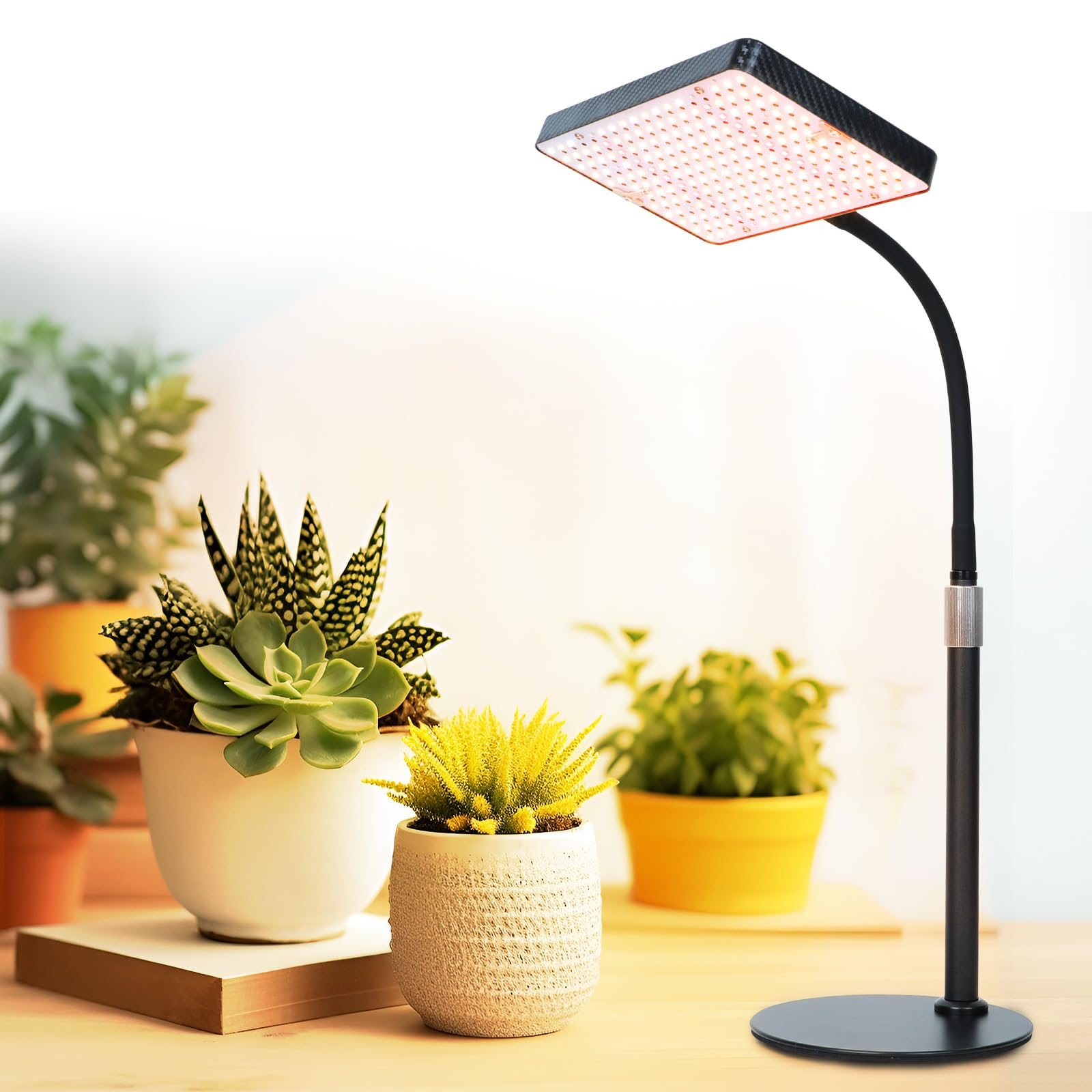
The desktop light that daisy-chains 16 units into one massive grid.
This FECiDA light sits on a desk or tabletop, with a height that adjusts from 16 inches to 24 inches, while the LBW tower reaches 68 inches, so it is strictly for plants on a work surface, not floor plants. What makes it special is the daisy-chain ability: each light has an input plug and an output outlet so you can connect up to 4 units together and run them from a single wall socket. One verified reviewer mentioned running 16 of these lights from one smart outlet, making this a scalable solution for serious propagation benches. The 208 LEDs produce 2000 lumens with a spectrum that includes 3000K, 5000K, 660nm red, UV, and IR diodes — so it covers veg and flower needs in one head. Reviewers mention it is extremely bright for its size and works great for aroids and variegated plants, with one buyer reporting improved variegation and flowering after switching to these lights.
The physical on/off switch is a thoughtful touch — fewer electronics to fail compared to touch panels or push buttons. However, there is no built-in timer at all, so you will rely on the daisy-chained smart plug for cycles. The aluminum base is stable on a desk but takes up some footprint, and at 0.5 meters base diameter, it is not tiny. Keep the light 2–3 inches above seedlings to prevent leggy growth, per one reviewer’s experience. For a dedicated seedling station or a desktop filled with tropicals, the FECiDA delivers more spectrum depth than the basic LBW at a similar footprint.
Why It Stands Out
- Daisy chain links up to 4 units from one outlet — expandable grow grid.
- UV, IR, 660nm red, and dual white spectrum for full-cycle growth.
- Simple physical switch — less to break than a touch sensor.
- 2000 lumens from 25W draw is bright enough for seedlings and tropical plants.
What to Consider
- Maximum height of only 24 inches is too short for tall floor pots.
- No integrated timer — you need a smart plug or an external timer.
Pick this for: a desktop or tabletop grow setup where you want scalable daisy-chain power and a spectrum that includes UV and IR for flowering plants.
pass on it if: you need a full-featured floor stand for a large tree — the height stops at 24 inches.
7. SANSI Clip-on LED Grow Light (10W)

The tiny clip-on that packs a convincing punch for a single pot.
When you only need to keep one mid-sized plant like a small monstera or a succulent arrangement healthy, this 10-watt SANSI clip-on is the smallest and most targeted option in the list. It clips onto a pot rim or a thin shelf (up to about 0.5 inches) and bends a 360-degree gooseneck to aim the light exactly where leaves need it. The 169.7 μmol/s/m² PPFD (photosynthetic photon flux density — a measurement of the light energy that actually lands on plant leaves) at 6 inches is the only measured PPFD value in this entire guide, so you know the light intensity at close range is known rather than guessed. One owner reported new leaf growth on their monstera within a month, and another noted the timer (3, 6, or 12-hour cycles) runs consistently and is easy to set. The 4 brightness levels (25%, 50%, 75%, 100%) let you dial intensity down for low-light plants like ferns or up for succulents that crave direct sun.
At 15.4 inches fully extended, the gooseneck is flexible but short — it works well for a pot sitting on a desk or a shelf, but it cannot reach down into a deep container from above. The clip feels strong, and the ceramic SANSI technology is their trademark for efficient power conversion. This is strictly a one-plant light; buyers confirm it works best for 1–2 small pots, not for a multi-plant shelf. The polished white finish looks clean and modern, but it is plastic and will not stand up to accidental knocks on the floor. If you need a simple, effective, timer-equipped light for a single houseplant without spending much, this is the cleanest option here.
Compact Strengths
- Measured PPFD of 169.7 μmol/s/m² at 6 inches — real light intensity data.
- 4 brightness levels and 3 timer modes give you fine control for one plant.
- 360° flexible gooseneck targets light precisely where leaves need it.
- Strong clip holds onto pot rims or thin shelving.
Size Limits
- Gooseneck is only 15.4 inches tall — cannot reach down into deep pots.
- Best for a single mid-sized plant; insufficient coverage for a shelf of multiple pots.
Ideal for: the one-plant owner who wants automatic daily lighting with a dimmer in a tiny, tidy clip-on form.
Not adequate for: any multi-plant arrangement, tall trees, or a propagation tray — the light spread is too narrow.
Understanding the Specs
Two numbers that matter most: PPFD and the light’s physical reach.
PPFD — The Light That Actually Reaches Your Plant
PPFD stands for photosynthetic photon flux density. It measures the number of light particles (photons) in the usable spectrum that hit a square meter of your plant’s leaves every second, and it is the best way to know if a light is strong enough. A cheap grow light may claim a high wattage, but without a PPFD number you are guessing how much usable light lands on the leaves. In this guide, only the SANSI 10W clip-on provides a PPFD number (169.7 μmol/s/m² at 6 inches), which tells you exactly how close to the light your plant needs to be for good growth.
Wattage vs. Lumens vs. Equivalent Wattage
Wattage is the electricity the light draws — not directly how bright it is. Lumens measure brightness as seen by the human eye, which differs from the red and blue wavelengths plants use. Equivalent wattage (like “300W equivalent”) is just a marketing comparison to old incandescent bulbs and tells you nothing about plant growth. For choosing a grow light, pay more attention to actual watt draw (10W vs 150W), the PPFD if listed, and the light’s physical coverage area, not the inflated equivalent number.
Full Spectrum vs. Blurple
A full-spectrum light emits wavelengths across the visible range (roughly 380–800nm), producing white light that looks natural to your eyes and supports every plant growth stage from seed starting to flowering. A red-blue “blurple” light saves a few pennies in manufacturing but makes it hard to spot leaf discoloration, pests, or mold under that purple glow. For most houseplants, choose a full-spectrum white light — your plants will grow just as well and you will actually see what they look like.
Timer Types: Cycle vs. Clock-Based
An auto on/off timer like the one in the LBW (6/8/12/16H) works on a 24-hour repeat cycle from the moment you activate it. If you turn it on at 8 AM and select 12 hours, it stays on until 8 PM then off until 8 AM the next day — every single day. This is great for consistent light cycles. Some lights like the VIPARSPECTRA have no timer at all, which means you need a separate smart plug. A few models like the SANSI dual-head lose the timer setting if power is interrupted, which is frustrating during storms or if you unplug the light.
FAQ
Can I leave a grow light on 24 hours a day for my plants?
How close should the grow light be to my plant leaves?
What is the difference between the SANSI 10W clip-on and the SANSI dual-head (20W)?
Will these lights work for starting vegetable seeds indoors?
Do I need a dedicated timer, or is the built-in timer enough?
How many plants can one VIPARSPECTRA XS1500 Pro cover?
What does “full spectrum 380–800nm” mean for my houseplants?
Are these lights safe to use on wooden shelves without causing a fire?
Can I connect multiple lights together to cover a bigger area?
What is a grow light’s “useful lifespan” before it needs replacing?
Final Thoughts: The Verdict
For most people, the best plant grow lights winner is the LBW Stand Grow Light because it combines a full 68-inch adjustable height, a useful 6/8/12/16-hour auto timer, 5-level dimming, and tool-free assembly at a price that beats the features of taller competitors. If you want a dimmable, daisy-chainable panel for a 2×2 grow tent, grab the VIPARSPECTRA XS1500 Pro. And for a single houseplant on a desk that needs automated daily light, the standout is the simplicity of the SANSI 10W Clip-on.
How We Picked
We do not accept paid placement, and we did not hands-on test every unit. Instead, we match each pick to a real buyer and use-case by comparing the manufacturers’ published specifications against the patterns in verified customer reviews — so you get each pick’s real strengths and trade-offs instead of marketing copy.
Sources & Methodology
Specifications: manufacturer listings and product documentation. Review insights: verified customer reviews, as of July 2026. Pricing: not shown on this page (it changes often); check the current price via the retailer link.
As an Amazon Associate, Lawn Gear Lab earns from qualifying purchases. This does not affect which products we feature.