
Specs are compiled from manufacturer listings and verified buyer reviews and can change over time — please confirm the key details on the product page before buying.
Aphids can turn a thriving garden into a sticky, sad mess in just a few days. You need a soap that actually kills these tiny sap-suckers without burning your plants or harming the bees. The best choice depends on the concentration type, how fast it works, and whether the formula is gentle enough for your prized vegetables and flowers.
I’m Rikta — the founder and writer behind Lawn Gear Lab. This guide is built by comparing the manufacturers’ published specifications and the patterns across verified customer reviews, so you get each pick’s real strengths and trade-offs instead of marketing spin.
Whether you are fighting a sudden leaf-curl outbreak or want a reliable spray for the whole season, this breakdown of the best insecticidal soap for aphids will steer you to the right concentrate or ready-to-use formula.
Quick Picks
- Safer 5118-6 Insect Killing Soap Concentrate — Best Overall
- Bonide Insecticidal Soap (Captain Jack’s) 2-Pack — Best Value Pack
- NATRIA Insecticidal Soap, Ready-to-Use 1-Gallon — Premium Ready-to-Use
- VPG Fertilome Natural Guard (40704) INSECTICIDAL SOAP — Budget Concentrate
How To Choose The Best Insecticidal Soap For Aphids
The right aphid soap depends on two main things: how you want to apply it and how gentle the formula is on your particular plants. You do not need a chemistry degree to get this right — just understand a few key points before you buy.
Concentrate vs. Ready-to-Use
Concentrates cost less per treatment and let you control the strength, but you have to mix them correctly. Ready-to-use sprays cost more per ounce but are dead simple — just point and spray. Buyers report that concentrates are far more economical for a large garden, while ready-to-use bottles are perfect for a few houseplants or a small raised bed.
Potassium Salts of Fatty Acids
This is the active ingredient in every real insecticidal soap. It works by breaking down the aphid’s outer shell (called the cuticle), causing it to dehydrate and die on contact. Unlike synthetic poisons, these salts break down quickly and are safe to use up to the day of harvest (a benefit called “0-day pre-harvest interval”).
Plant Sensitivity
Some plants are more sensitive to soap than others. Leafy greens like spinach, and delicate flowers, can scorch (turn brown and dry out) if the soap is too strong or applied in direct sunlight. Reviews show that applying the spray in the cool part of the day — early morning or evening — almost always prevents this damage.
Quick Comparison
On smaller screens, swipe sideways to see the full table.
| Model | Best For | Liquid Volume | Form | Organic Certified | Amazon |
|---|---|---|---|---|---|
| Safer 5118-6 | Best Overall | 16 fl oz | Concentrate | OMRI Listed | Amazon |
| Bonide Captain Jack’s | Best Value Pack | 64 fl oz (2-pack) | Ready-to-Use | Approved for organic | Amazon |
| Natria | Premium Ready-to-Use | 1 Gal (128 fl oz) | Ready-to-Use | OMRI | Amazon |
| Fertilome Natural Guard | Budget Concentrate | 16 fl oz | Concentrate | N/A | Amazon |
In‑Depth Reviews
1. Safer 5118-6 Insect Killing Soap Concentrate

The go-to concentrate that knocks out a severe aphid infestation in days without harming your plants.
Safer’s formula uses potassium salts of fatty acids (the active ingredient that dissolves the insect’s waxy cuticle) to dehydrate aphids on contact. It is a concentrate, meaning you mix it yourself — buyers recommend 2.5 ounces per gallon of water for a standard treatment. This 16-ounce bottle makes several gallons, versus the Bonide pack’s 64 fluid ounces of ready-to-use spray.
Owners mention it is “highly effective against severe aphid infestation,” with 90% of aphids dead by the first day and all traces gone by day three. They also note it is safe for kids and cats, though the smell is strong when mixing. The concentrate may solidify in cold storage — just let it warm up and shake to remelt it.
Unlike the Fertilome Natural Guard concentrate below, which has reports of damaging spinach even at half strength, Safer has a strong track record of being gentle on peppers, squash, and flowers when diluted properly. It kills aphids, whiteflies, thrips, spider mites, and more, and is OMRI Listed for organic use, so you can spray up until the day of harvest.
Why It Leads
- Extremely fast on aphids (90% dead day one per reviews)
- Economical concentrate — small bottle covers many treatments
- OMRI Listed for organic gardening
- Safe for use up to day of harvest
Watch For
- Must be mixed carefully — wrong ratio can burn leaves
- Bottle appears smaller than photos suggest
- Product can solidify in cold weather
- Strong smell during mixing
Who This Fits: Gardeners who want the fastest knockdown of heavy aphid populations and prefer to mix their own spray for maximum value per treatment.
The Trade-off: You have to measure and mix carefully; over-concentration will damage delicate leaves, so stick to the 2.5 oz/gallon rule.
2. Bonide Insecticidal Soap (Captain Jack’s) 2-Pack
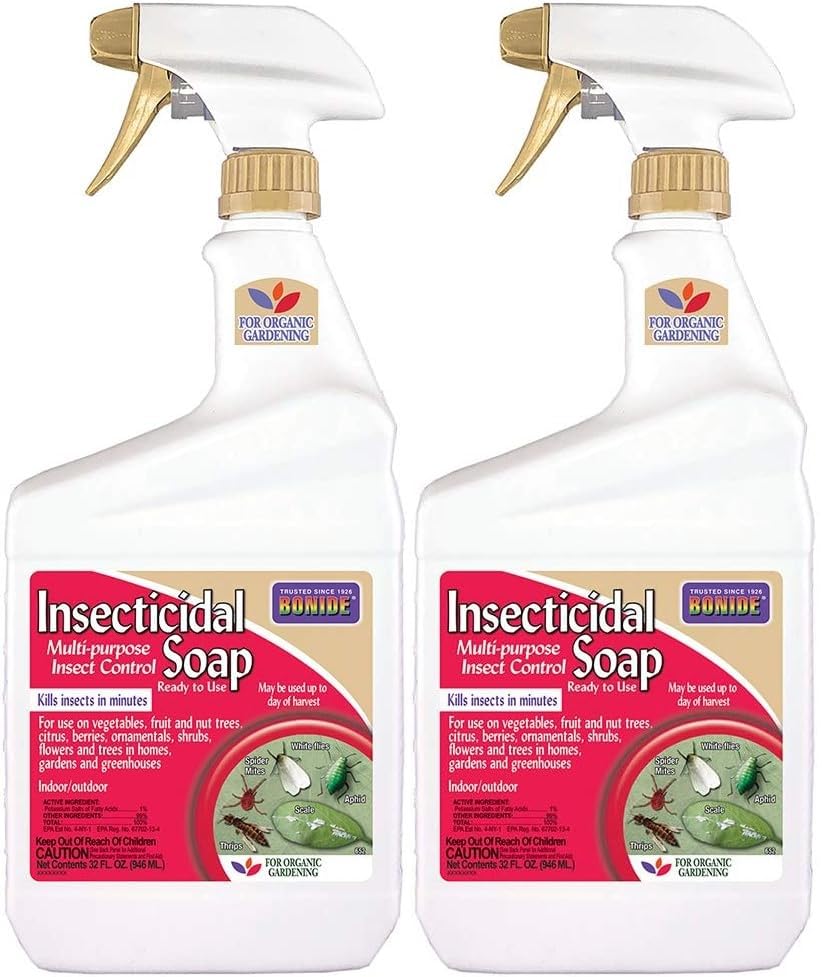
A scent-free, ready-to-use pack that makes aphid control as easy as squeezing a trigger.
Bonide delivers two 32-ounce spray bottles (64 total fluid ounces) of ready-to-use Captain Jack’s Insecticidal Super Soap. There is no mixing or measuring — just aim and spray directly on the aphids. The formula kills through direct contact and ingestion; leaf-feeding insects like caterpillars also die after eating a sprayed leaf surface.
One buyer who battled aphids and white moths for a while reported that “this has taken care of the problem,” finally letting their mint and basil grow leaves worth harvesting. Another reviewer, who is a plant parent, called it “scent-free, nontoxic, safe around pets,” and said it caused zero leaf damage. The fact that it is approved for organic gardening adds confidence for edible crops like cabbage, onions, berries, and herbs.
Unlike the Natria ready-to-use spray below (which customers note has a lousy sprayer head), the Bonide bottles reportedly work well from the start, though the 32-ounce size runs out faster on large gardens. For the price, you get two full bottles compared to the Safer concentrate’s single 16-ounce concentrate, but the Safer concentrate actually makes more total spray volume when mixed.
The Upside
- Zero smell, non-toxic, safe for pets
- Ready-to-use — no mixing needed
- Pack of 2 gives you a spare on hand
- Works on aphids, caterpillars, white moths, and more
The Downside
- Smaller per-bottle size (32 oz) vs. Natria’s 1-gallon
- More expensive per treatment than a concentrate
- Limited to listed pests; not broad-spectrum
the balance: Gardeners who want grab-and-go convenience and value the confidence of a scent-free, pet-safe spray that won’t burn leaves.
The Catch: You pay more per ounce compared to mixing your own concentrate, and a 32-ounce bottle can go fast on a big garden.
3. NATRIA Insecticidal Soap, Ready-to-Use 1-Gallon

The big gallon jug for indoor and outdoor plants that takes persistence to fully work.
Natria gives you a full gallon (128 fluid ounces) of ready-to-use insecticidal soap, versus the Bonide 2-pack’s 64 total fluid ounces. It targets aphids, mealybugs, whiteflies, and mites, and is OMRI-listed for organic gardening, so you can spray right up to the day of harvest. The manufacturer says it kills listed insects in minutes.
One reviewer noted that a severe mealybug infestation was resolved after other products failed: visible bugs were gone in two weeks, and they continued spraying twice weekly for six weeks to fully clear it. This shows that Natria works but requires consistent follow-up, unlike the Safer concentrate which reviewers point out wipes out aphids in three days. Another reviewer called the product effective but deducted a star because the sprayer head is “terrible” — they had to transfer the liquid to a different bottle when the container was still half full.
The main drawback is the unreliable sprayer, which is frustrating on a premium-priced product. If you buy this, plan to have your own spray bottle ready. For large gardens, the gallon size is convenient, but you might get better value from a concentrate that makes multiple gallons for less money.
Why Choose It
- Large 1-gallon jug for extensive coverage
- Works on tough mealybug infestations with persistence
- Can be used on indoor and outdoor plants
- OMRI-listed for organic gardening
Watch Out
- Sprayer head is unreliable — plan to replace it
- Takes weeks of consistent spraying for severe cases
- More expensive per ounce than a concentrate
Reach For This If: You have a large garden or many houseplants and want the convenience of a huge ready-to-use bottle without mixing.
Look Elsewhere If: You want a quick, one-and-done treatment — the Safer concentrate works much faster for heavy aphid pressure.
4. VPG Fertilome Natural Guard (40704) INSECTICIDAL SOAP

An affordable concentrate that works on leaf pests but has a risky reputation for plant damage.
Fertilome Natural Guard is a potassium-salt concentrate that targets lace bugs, spiders, mites, aphids, leafhoppers, and earwigs. It is meant for use on fruit trees, vegetables, ornamentals, and flowers. The 16-ounce bottle is a concentrate, so it dilutes into multiple gallons of spray. On paper, it looks similar to the Safer concentrate.
However, real buyer reviews tell a more cautious story. One verified purchaser reported: “Even applying half the recommended dosage, the product severely damaged the crop of spinach!” Another said it showed no signs of working and turned the grass around their plant brown. This is a stark contrast to the Safer concentrate, where buyers consistently report no plant damage when mixed correctly. A few positive reviews exist — one user combined it with neem oil and called it excellent — but the pattern of leaf burn is a clear risk.
For the price, it is tempting, but the trade-off in potential plant damage makes it a risky choice for delicate crops like spinach or leafy greens. If you have tough plants and want the cheapest concentrate, it might work, but the Safer concentrate is a safer bet for a few more dollars.
The Pro
- Budget-friendly concentrate price
- Covers a range of pests (aphids, mites, leafhoppers, earwigs)
- Suitable for fruit trees, vegetables, and ornamentals
The Con
- Reports of severe leaf burn even at half strength
- Some buyers found it completely ineffective
- Grass and spinach damage reported in verified reviews
Only If: You already have a tough plant in a large area and want the absolute cheapest concentrate to try — but test on one leaf first and expect potential burn.
skip it if: You grow delicate greens like spinach or lettuce — the risk of scorching is too high compared to the other picks here.
Understanding the Specs
Potassium Salts of Fatty Acids
This is the active ingredient in all real insecticidal soaps. It is a contact killer — it only works when it directly hits the aphid. The salts dissolve the insect’s waxy outer shell (cuticle), causing the bug to dehydrate and die within minutes. Because it breaks down quickly in sunlight and air, it is safe to use on edible crops up to the day of harvest, which is known as a “0-day pre-harvest interval.”
Concentrate vs. Ready-to-Use
A concentrate (like the Safer 5118-6) is a small bottle of super-strength soap that you dilute with water, usually at a ratio like 2.5 ounces per gallon. One small bottle can make several gallons of spray, which is much more economical for a large garden. A ready-to-use spray (like the Bonide or Natria) is already mixed and comes in a spray bottle — you pay for the convenience but also for the water weight, making it more expensive per treatment.
FAQ
Will insecticidal soap harm my plants?
How long does it take to kill aphids?
Can I use insecticidal soap on vegetables and herbs?
Does insecticidal soap kill beneficial insects like bees?
How often should I spray for aphids?
What is the difference between Safer 5118-6 and Fertilome Natural Guard?
Is the Natria sprayer really that bad?
Can I use Bonide Insecticidal Soap on my lawn?
Final Thoughts: The Verdict
Across the board, the insecticidal soap for aphids winner is the Safer 5118-6 Concentrate because it provides the fastest knockdown of severe infestations (90% dead by day one), is economical as a concentrate, and has a proven safety record on plants when mixed correctly. If you want grab-and-go convenience for a small garden, grab the Bonide two-pack. And for the largest ready-to-use option that works with persistence, the Natria 1-gallon jug has you covered if you can work around its sprayer.
How We Picked
We do not accept paid placement, and we did not hands-on test every unit. Instead, we match each pick to a real buyer and use-case by comparing the manufacturers’ published specifications against the patterns in verified customer reviews — so you get each pick’s real strengths and trade-offs instead of marketing copy.
Sources & Methodology
Specifications: manufacturer listings and product documentation. Review insights: verified customer reviews, as of July 2026. Pricing: not shown on this page (it changes often); check the current price via the retailer link.
As an Amazon Associate, Lawn Gear Lab earns from qualifying purchases. This does not affect which products we feature.