
Specs are compiled from manufacturer listings and verified buyer reviews and can change over time — please confirm the key details on the product page before buying.
Walking out to a yard where those stubborn weeds have taken over feels like losing a battle. The trick is picking a herbicide that actually reaches the root system, not one that just browns the leaves for a few days. Each option here is a concentrate that you mix yourself, so you get the most killing power for your effort.
I’m Rikta — the founder and writer behind Lawn Gear Lab. This guide is built by comparing the manufacturers’ published specifications and the patterns across verified customer reviews, so you get each pick’s real strengths and trade-offs instead of marketing spin.
You will find the best concentrated weed killers for driveways, flower beds, and fence lines. This guide helps you find the right herbicide for weeds based on how fast it works and how much ground it covers.
Quick Picks
- Control Solutions 82004318 1 Quart Eraser & Grass Killer Concentrate — Best Overall
- Spectracide Weed and Grass Killer Concentrate, 32 Ounces — Fastest Acting
- Ortho GroundClear Weed and Grass Killer Super Concentrate1 — Maximum Coverage
- Martin’s Eraser Max Super Concentrate – 32oz — Tough Vegetation
- Roundup Dual Action Weed & Grass Killer Plus 4 Month Preventer Concentrate — Kill + Prevent
- Fertilome (10525) Weed Free Zone (32 oz) — Lawn Safe
- Hi-Yield (32171) Killzall 365 (1 gal) — Gallon Size
How To Choose The Best Herbicide For Weeds
The right choice depends on what you are spraying and where. A non-selective formula kills everything green, which is perfect for driveways and patios, but a selective one targets broadleaf weeds without harming your grass.
Active Ingredient Strength
Look for the percentage of the active ingredient, like Glyphosate (a chemical that blocks plant growth proteins) or Diquat Dibromide (a fast-acting contact herbicide that damages plant cell membranes on contact). A higher concentration means you often use less product per gallon, which stretches your bottle further. The cheapest option per ounce is not the best deal if you have to use twice as much to get results.
Speed vs. Root Kill
Some formulas show visible wilting within hours, which is satisfying, but they might only kill the top growth. Others take a week or two to work through the entire root system, ensuring the weed does not grow back. Decide if you need instant gratification or long-term control.
Coverage Area
Bottles treat drastically different square footage. A small 32-ounce bottle might cover 1,100 square feet, while a gallon jug can cover over 17,000 square feet. Match the coverage to the size of your property so you do not run out mid-job.
Quick Comparison
On smaller screens, swipe sideways to see the full table.
| Model | Best For | Active Ingredient | Coverage | Item Weight | Amazon |
|---|---|---|---|---|---|
| Control Solutions Eraser | Value & All-Purpose | 41% Glyphosate | Annual weeds, perennial weeds, trees, vines, and shrubs | 2 Pounds | Amazon |
| Spectracide | Fast Results | Diquat Dibromide | 1,350 sq ft | 32 Ounces | Amazon |
| Ortho GroundClear | Hardscape & Paths | — | 2,240 sq ft | 2 Pounds | Amazon |
| Martin’s Eraser Max | Stubborn Perennials | 43.6% Glyphosate + 0.78% Imazapyr | — | 2.6 Pounds | Amazon |
| Roundup Dual Action | Prevention + Kill | — | 1,600 sq ft | 8 ounces | Amazon |
| Ferti-lome Weed Free Zone | Lawn-Safe Broadleaf | Dicamba | Full | 32.0 Ounce | Amazon |
| Hi-Yield Killzall 365 | Large Properties | — | 17,200 sq ft | 6 Ounces | Amazon |
In‑Depth Reviews
1. Control Solutions 82004318 1 Quart Eraser & Grass Killer Concentrate
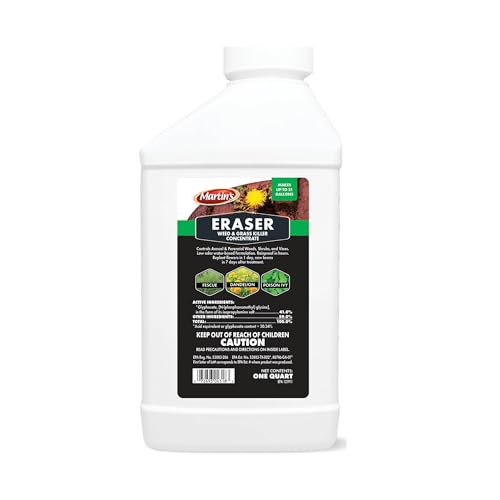
The budget-friendly concentrate that takes down everything from clover to poison ivy with patience.
This is the pick if you want maximum active ingredient for your money. It uses 41% Glyphosate as its active ingredient (a chemical that blocks plant growth proteins), making it a non-selective herbicide that kills annual weeds, perennial weeds, trees, vines, and shrubs. The water-based formula has a low odor, so you are not hit with harsh chemical fumes while spraying.
It comes in a 32-fluid-ounce bottle at 2 Pounds, versus the Roundup Dual Action bottle at 8 ounces. Buyers report a typical routine of mixing 8 oz per gallon; the advice is that it kills everything green (weeds, grass, clovers, flowers) 100% dead in 1-2 weeks. The catch is that it is slow compared to other options — no visible effect for the first two days, then yellowing at 4-7 days, and full death at 7-14 days. That patience pays off for persistent vegetation like poison ivy or woody vines.
This formula has no residual soil activity, meaning it does not linger in the ground to prevent future seeds from sprouting. It is rainproof in hours, so a shower shortly after application will not wash away your work. If you are coming from a brand like Roundup, reviewers warn not to expect fast wilting — this one requires patience.
What justifies the price
- High 41% Glyphosate concentration stretches the bottle over many gallons of mixed spray
- Kills a wide range of plants including trees and vines
- Rainproof within hours after application
The slower timeline
- Requires up to two weeks to see full results
- Unclear mixing instructions on the label according to buyers
- Not a pre-emergent, so new weeds can sprout later
Reach for this if: you want to cover large areas without spending much and you are patient enough to wait a week or two for total kill.
Look elsewhere if: you need weeds gone within a day for a quick cleanup before an event or if you want a product that prevents regrowth.
2. Spectracide Weed and Grass Killer Concentrate, 32 Ounces
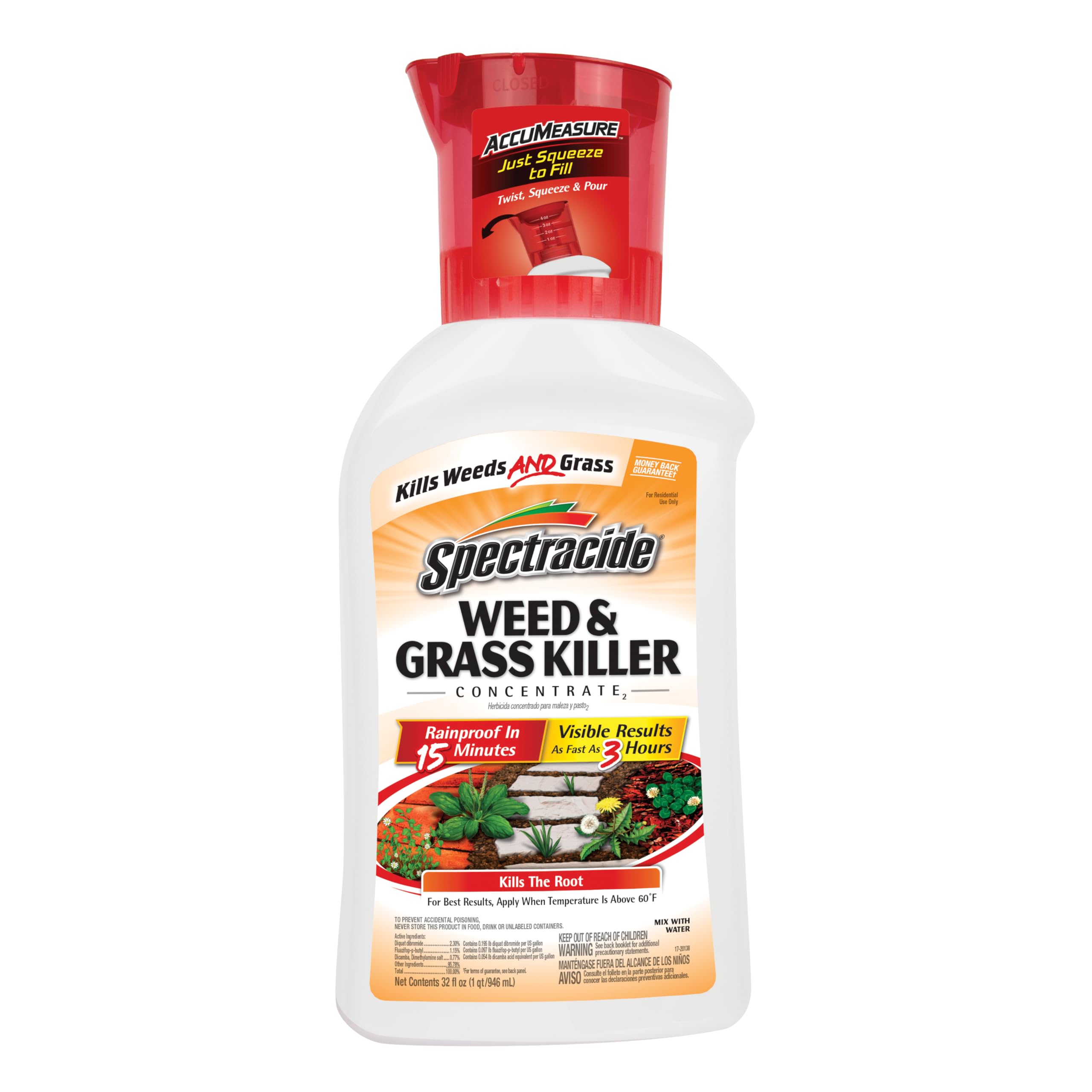
The speed demon that wilts weeds within hours so you can replant the same weekend.
This concentrate uses Diquat Dibromide as its active ingredient (a fast-acting contact herbicide that damages plant cell membranes on contact), and it shows visible results as fast as 3 hours. It is designed for use on driveways, walkways, around fences, and in flower beds. The label says it kills the root, yet you can replant new flowers, trees, and shrubs the same weekend — a rare promise among non-selective killers.
One reviewer noted mixing this up in their reusable Spectracide 1-gallon sprayer, noting it kills the weeds along their curb “within a day.” That is a full day faster than many Glyphosate-based options. The bottle covers up to 1,350 sq ft when mixed according to the label. It also features the Accumeasure cap — a built-in measuring system where you twist, squeeze, and pour — though several reviewers found the cap more of a gimmick than a help and just swapped back to the old bottle lid.
It is rainfast after only 15 minutes, meaning the first trace of rain will not ruin your spray session. Compared to the 30-minute rainfast time on the Roundup Dual Action, this gives you a tighter window for unpredictable weather. The trade-off is that Diquat is a contact killer, so you need to coat the leaves thoroughly; any missed spot survives.
Why speed matters
- Visible results in as fast as 3 hours
- Rainfast in just 15 minutes
- Lets you replant flowers and shrubs the same weekend
Contact-only limits
- Requires thorough leaf coverage to work
- Accumeasure cap is frustrating for some buyers
- Weighs 32 Ounces, which is heavier than some competitors
Grab this for: instant curb appeal — when you want weeds gone within a day and the ability to replant immediately.
skip it if: you have deep-rooted perennial vines or woody shrubs that require systemic translocation to the root.
3. Ortho GroundClear Weed and Grass Killer Super Concentrate1
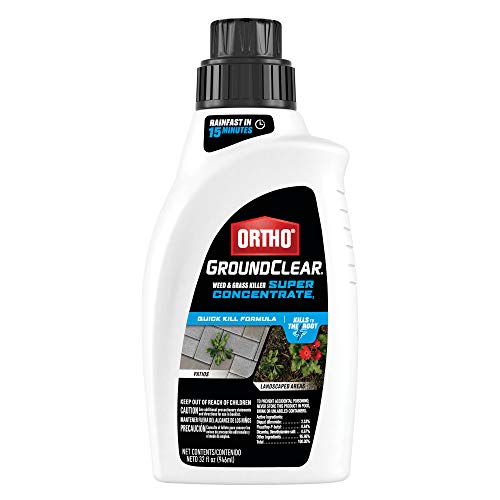
A fast-acting concentrate listed at 2,240 sq ft of coverage, versus 1,600 sq ft for the Roundup Dual Action bottle.
It kills tough weeds and grasses to the root, including crabgrass, dandelion, oxalis, chickweed, and clover. The formula starts working immediately and is rainfast in 15 minutes.
Owners mention using it on a fence line where the grass was “probably a foot tall,” and about 3 or 4 days later you could see it working. Another owner noted that they made 5 gallons of solution with the 32 oz bottle, which speaks to its strong concentration. The recommended method is to use a tank sprayer when the air temperature is above 60°F with actively growing weeds.
One common tip from reviewers is to use a bit more concentrate than the label suggests for tougher weeds, which means the bottle will not last quite as long. The formula is suitable for use around perennial landscape plants, trees, shrubs, and along sidewalks and driveways. It does not prevent new weeds, so you will need a separate pre-emergent if you want bare ground that stays clear.
Why coverage wins
- Covers 2,240 sq ft — the largest area per 32 oz bottle in this lineup
- Rainfast in just 15 minutes
- Works against crabgrass and dandelion specifically
The trade-off
- No pre-emergent properties, so bare ground can sprout new weeds
- Some buyers need to apply a stronger mix for tough species
Best for: people with long fence lines, wide patios, or large driveways who want the most coverage per bottle.
Not ideal if: you need a product that also prevents weed seeds from germinating in the following months.
4. Martin’s Eraser Max Super Concentrate – 32oz
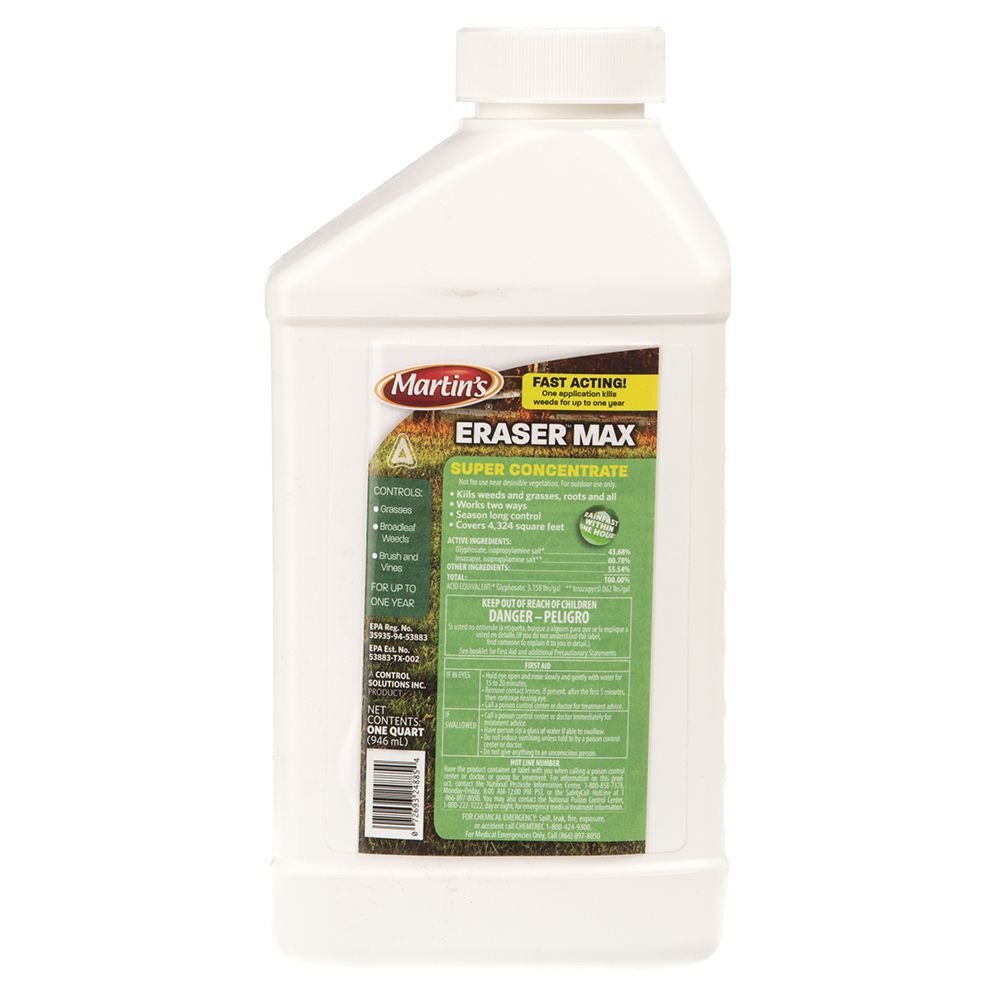
A potent dual-action super concentrate that kills grass and weeds in under 48 hours.
This one brings a two-ingredient punch: 43.6% Glyphosate plus 0.78% Imazapyr (Imazapyr is a soil-residual herbicide that stops roots from growing back). At 2.6 Pounds, it is 30% heavier than the Control Solutions Eraser (2 Pounds), which reflects the added Imazapyr and higher Glyphosate concentration. It is designed as a post-emergent herbicide only, meaning it kills existing growth but does not act as a pre-emergent for new seeds.
Customers note that it kills grass and weeds “in less than two days,” which is significantly faster than the 1-2 week timeline of standard Glyphosate-only products. One reviewer with 30 years of experience spraying weeds said, “This stuff works the best of all I’ve tried.” Another owner in the south uses it specifically to kill kudzu — a notoriously hard-to-eradicate vine — and says it makes yard work “so much easier to spray it and forget it.”
The formula is oil-based and rainproof within hours, meaning it binds quickly to the leaf surface. The catch with Imazapyr is that it has soil activity, so you must be careful not to over-apply near desirable trees or shrubs whose roots might absorb it. It is excellent for fence lines, gravel driveways, and farm use where bare ground is the goal.
The extra power
- Higher Glyphosate concentration (43.6%) than standard formulas
- Imazapyr adds root-prevention in the soil
- Visible results in under two days per buyer reports
Handle with care
- Soil activity can harm nearby trees and shrubs
- Oil-based formula requires careful cleanup of sprayer
- Heavier bottle at 2.6 Pounds
Choose this for: extreme vegetation like kudzu, blackberries, or poison ivy that laugh at standard Glyphosate mixes.
Pass if: you are spraying near a prized garden or tree line where you cannot risk soil movement of the herbicide.
5. Roundup Dual Action Weed & Grass Killer Plus 4 Month Preventer Concentrate

The two-stage concentrate that kills existing weeds and blocks new growth for four months.
This is one of the few concentrates on the market that does double duty. It kills existing weeds and grass down to the root while also preventing new weeds from growing for up to 4 months. That prevention means you spray the entire area you want to control, not just the visible weeds. It produces visible results in as fast as 6 hours and is rainproof in as fast as 30 minutes.
Reviewers point out it kills “within 24 hours of contact!” and that it wiped out ivy and Virginia creeper along a fence line. One owner noted that it is “pricey but effective,” and that cheaper alternatives require the same mix ratio (6 fl. oz. per gallon). The 32-fluid-ounce bottle covers 1600 square feet and weighs just 8 ounces due to the dense concentration.
The key restriction is that all ornamental bedding plants, trees, shrubs, sod, and seed can only be planted 4 months after application. This makes it a poor choice for beds you plan to replant soon. It is best suited for hardscapes (cracks in driveways, sidewalks, patios), along fences, in mulched beds around well-established plants, and on gravel areas.
Why dual action pays off
- Prevents new weeds for up to 4 months after a single spray
- Visible results in as fast as 6 hours
- Concentrate covers large areas efficiently
The waiting period
- You cannot replant anything for 4 months after application
- Higher price point than standard kill-only concentrates
- Not safe near desirable plants you want to keep
Pick this if: you want the lowest-maintenance solution — one spray in spring keeps a gravel driveway or fence line clean all season.
Avoid it if: you plan to plant flowers, vegetables, or sod in that area within the next four months.
6. Fertilome (10525) Weed Free Zone (32 oz)
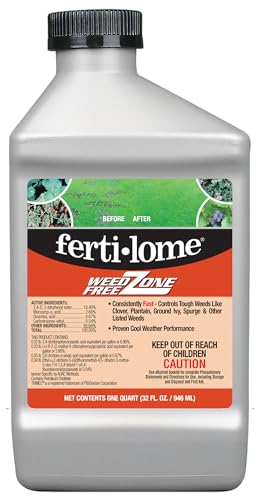
The selective spray that targets broadleaf weeds while leaving your lawn grass untouched.
If you want to kill dandelions and clover without wrecking your entire lawn, this is the pick. It uses Dicamba as its active ingredient (a selective herbicide that broadleaf weeds absorb but grasses metabolize without harm). It controls over 80 broadleaf weeds including Clover, Spurge, Chickweed, and Thistle, while being safe on Kentucky Bluegrass, Bermudagrass, Bahiagrass, and Zoysiagrass.
The formula provides evidence of injury within hours of application. One reviewer calls this “the gold standard” for killing creeping charlie — a notoriously difficult lawn weed — and says it works “overnight.” Another owner sprayed it between flowers and found it did not harm the flowers at all, killing only the dandelions and spurge. The catch appears in multiple reviews: the recommended mixture on the label is often too weak for clover and creeping charlie, and many users needed to double the potency to get full kill.
A common trick among buyers is adding a few drops of Dawn dish soap to the mix, which helps the herbicide adhere to the waxy leaves of broadleaf weeds. The bottle is 32 fluid ounces and the concentrate goes a long way — one buyer mentioned “a little goes a long way” and plans to always keep it on hand.
Why selective matters
- Safe for multiple grass types including Bermuda and Zoysia
- Controls over 80 broadleaf weed species
- Does not kill flowers or ornamental plants as tested by buyers
Label mixing weakness
- Many buyers needed to use nearly double the recommended rate for stubborn weeds
- Higher price point than non-selective herbicides
- Adding dish soap is nearly mandatory for waxy leaves
Choose this for: a healthy lawn with a creeping charlie or clover problem — it hits broadleaf weeds hard while your grass stays green.
Not for: clearing a gravel driveway or patio where you want total vegetation kill (you need a non-selective product for that).
7. Hi-Yield (32171) Killzall 365 (1 gal)
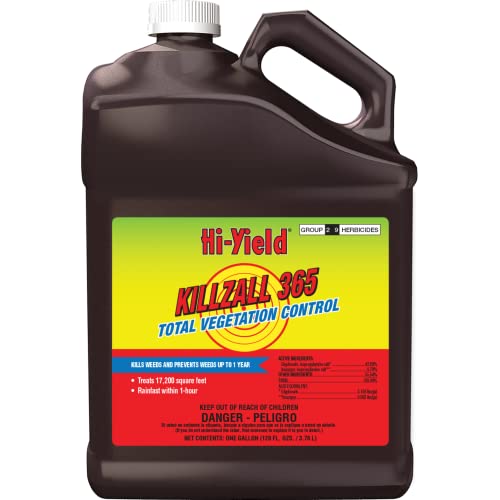
The gallon jug for acreage owners who need to clear brush, vines, and massive weed patches.
This is the heavyweight choice for large properties. The 1-gallon bottle (128 fluid ounces) treats up to 17,200 square feet — a scale that dwarfs every other bottle on this list. For context, that is roughly a third of an acre of bare ground. It controls a wide variety of broadleaf weeds, grasses, trees, brush, and vine species, and is intended for non-crop/no-vegetation areas only (do not use on lawns).
For spot control of brush and vines, you mix 6 oz of concentrate per 1 gallon of water. For total bare-ground control, you mix 7.4 oz with 1 to 10 gallons of water and spray where you want nothing growing. One buyer battling blackberry intrusion from an abandoned property next door calls this “amazing” and highly recommends it. Another reviewer notes that even if it rains the next day, the plant or grass will still die, confirming it is rain-resistant.
The realistic catch from a long-term buyer is that while the price is cost-effective versus big-box store options, it does not actually sterilize the ground for a full year. They had to spray three or four times in one season and went through two full bottles. That means the coverage is impressive, but the “365” in the name might be optimistic depending on your weed pressure.
Why bulk wins
- Treats 17,200 sq ft — the largest coverage of any pick here
- Kills brush, vines, trees, and broadleaf weeds
- More cost-effective per gallon than store-bought alternatives
Keep expectations in check
- Does not fully prevent regrowth for a full year as the name suggests
- Do not use on lawns or areas you want grass to survive
- Heavy jug (128 fl. oz.) requires storage space
Reach for this if: you own acreage, a large fenceline, or are clearing overgrown brush along a property boundary.
pass on it if: you have a small to medium yard (under 5,000 sq ft) where a 32 oz bottle will last you all season.
Understanding the Specs
Glyphosate vs. Diquat Dibromide
Glyphosate is a systemic herbicide that the plant absorbs through its leaves and moves to the roots, killing the whole plant over 1-2 weeks. Diquat Dibromide is a contact herbicide that damages leaf cells on contact, showing results in hours but only killing what it touches. Choose Glyphosate for perennial roots; choose Diquat for a fast knockdown on annual weeds.
Rainfast Time
Rainfast time is the period after spraying where rainfall or watering will not wash the product off the leaves. A product that is rainfast in 15 minutes gives you a much smaller worry window than one needing 30 minutes. If you live in a rainy climate, prioritize the shorter rainfast times to avoid wasted product.
Coverage in Square Feet
The square footage listed on a bottle tells you how much area the mixed concentrate will cover under normal conditions. A 32-ounce bottle that covers 2,240 sq ft will go much further than one covering 1,350 sq ft, but the actual coverage depends on how heavily you spray. Lighter applications mean more area but potentially weaker results.
Selective vs. Non-Selective
A non-selective herbicide kills every plant it touches, which is perfect for driveways and patios. A selective herbicide targets specific plant types (like broadleaf weeds) and leaves grasses unharmed. Using a non-selective product on your lawn would kill the grass along with the weeds, so check the label carefully.
FAQ
What is the difference between Glyphosate and Diquat Dibromide?
How long does it take for a Glyphosate concentrate to kill weeds?
Can I use a non-selective herbicide on my lawn?
What does rainfast mean on a herbicide label?
How many square feet does a 32 ounce bottle of concentrate cover?
Will these herbicides kill poison ivy?
What is the difference between a pre-emergent and a post-emergent herbicide?
How soon after spraying can I replant flowers or vegetables?
Does adding dish soap to herbicide mix help it work better?
Which concentrate is best for a gravel driveway?
Final Thoughts: The Verdict
Across the board, the herbicide for weeds winner is the Control Solutions Eraser because it delivers a high 41% Glyphosate concentration at a budget-friendly price that handles everything from annual weeds to woody vines. If you want results within hours rather than days, grab the Spectracide. And for the lowest-maintenance approach with built-in prevention, the standout is the Roundup Dual Action for keeping your gravel driveway or fence line clear all season.
How We Picked
We do not accept paid placement, and we did not hands-on test every unit. Instead, we match each pick to a real buyer and use-case by comparing the manufacturers’ published specifications against the patterns in verified customer reviews — so you get each pick’s real strengths and trade-offs instead of marketing copy.
Sources & Methodology
Specifications: manufacturer listings and product documentation. Review insights: verified customer reviews, as of July 2026. Pricing: not shown on this page (it changes often); check the current price via the retailer link.
As an Amazon Associate, Lawn Gear Lab earns from qualifying purchases. This does not affect which products we feature.